Disclosure: airfryerkitchensupply.com is reader-supported. When you buy through links on our site, we may earn an affiliate commission at no extra cost to you.
Where to buy
Every pick in this guide to the best hand mixers for cakes is sold on Amazon, and Amazon is where we recommend buying: cake bakers care about the exact attachment set — whisk included or not, storage case or not — and the listing shows that configuration plainly before you order. Bundles vary by colour, so use the links below to reach the precise models reviewed. Cake mixer prices drift with season and colour, so check the current price on Amazon rather than relying on any number quoted in an older roundup.
- Breville Handy Mixer (BHM800SIL, Silver) — Best Overall for Cakes: Check the current price on Amazon
- KitchenAid 9-Speed Hand Mixer (KHM926, Contour Silver) — Best Complete Cake Kit: Check the current price on Amazon
- Cuisinart Power Advantage Plus 9-Speed Hand Mixer (HM-90S) — Best for Frosting: Check the current price on Amazon
- KitchenAid 5-Speed Ultra Power Hand Mixer (KHM512, White) — Best Lightweight for Everyday Cakes: Check the current price on Amazon
- Hamilton Beach 6-Speed Electric Hand Mixer with Easy Clean Beaters (62636J, White) — Best Value for Sturdy Cakes: Check the current price on Amazon
- Cuisinart Power Advantage 5-Speed Hand Mixer (HM-50, White) — Best for Small Batches: Check the current price on Amazon
Introduction
The best hand mixers for cakes are judged by a very specific sequence, because cake making is a sequence: cream butter and sugar until pale, beat in eggs without splitting the emulsion, fold in flour without toughening the crumb, and — for a large share of home cakes — whip cream or egg whites for the filling, topping or the batter itself. A mixer that is brilliant at one stage and clumsy at another makes uneven cakes, and most cake disappointment traces back to exactly one weak stage.
Creaming is where cakes are won. The pale, fluffy butter-sugar base is the cake’s structure, and it demands a motor that holds a steady medium pace without the baker muscling the bowl, plus beaters that actually move the mixture rather than carving a tunnel through it. Folding is where cakes are lost: a violent first speed both launches flour and develops gluten, trading a tender crumb for a bready one. Whipping decides the finishes — a whisk attachment turns cream and whites from a chore into a minute’s work.
This guide therefore ranks mixers as cake tools specifically, not as general appliances. The six picks were verified against Amazon’s catalogue connection. They include a premium control pick for serious layer-cake bakers, a complete all-rounder, the anti-splatter frosting specialist, a lightweight everyday option, an easy-clean value workhorse and a compact pick for smaller batches. Each review names the cake stages that mixer handles best and the stage where it asks more of the baker.
One expectation to set honestly: a hand mixer will not make a bad recipe good, and it cannot rescue overbaked sponge. What it does is remove the mechanical excuses — split emulsions, flour clouds, under-creamed butter, reluctant whipped cream — so the cake that comes out of the oven is the one the recipe promised.
In this guide
Quick Picks
Six cake-focused mixers, ranked by how completely they handle creaming, folding, whipping and frosting — the four stages of a cake.
- Breville Handy Mixer — Best Overall for Cakes: Nine settings plus boost give cake bakers precise control at every stage from folding flour to finishing a creamed base. Check price on Amazon
- KitchenAid KHM926 — Best Complete Cake Kit: Beaters, Pro whisk and dough hook with nine speeds — every cake stage covered, including the whipped finishes. Check price on Amazon
- Cuisinart HM-90S — Best for Frosting: SmoothStart keeps powdered sugar in the bowl, nine speeds handle the cake, and the case keeps the kit together. Check price on Amazon
- KitchenAid KHM512 White — Best Lightweight for Everyday Cakes: Five speeds and Turbo Beaters in a compact body — the everyday sponge, loaf and traybake mixer. Check price on Amazon
- Hamilton Beach 62636J — Best Value for Sturdy Cakes: A 275-watt motor, Easy Clean beaters, dough hooks and a whisk — fruit cakes, carrot cakes and big sturdy batters welcome. Check price on Amazon
- Cuisinart HM-50 — Best for Small Batches: Extra-long beaters and a 220W motor in a compact body — single sponges, small loaves and half-batch baking. Check price on Amazon
How These Picks Were Chosen
All six models were verified before inclusion, confirming model identity, speed counts and listed attachments. Cake relevance then decided the order. Creaming performance came first: steady mid-speed power and beaters that move the whole bowl’s contents. Folding gentleness came second: a first speed slow enough to incorporate flour without a cloud or a tough crumb. Whipping support came third: a whisk in the box, or at least beaters that whip credibly.
Storage, cleaning and value broke the remaining ties. Cake baking is messy and frequent for the people who type this query, so dishwasher-safe attachments and sensible storage genuinely matter. Models were excluded if they lacked the mid-range steadiness creaming demands, if their lowest speed was too violent for folding, or if they could not be verified. Mini cordless whisks were left out entirely — they cannot cream butter, and a cake guide that pretends otherwise would be lying to its readers.
The 6 Best Hand Mixers for Cakes

Breville Handy Mixer (BHM800SIL, Silver) — Best Overall for Cakes
Cake making rewards control more than any other mixing job, and control is the Breville Handy Mixer’s entire design brief. Its nine settings plus boost let a cake baker work the stages deliberately: the lowest settings to fold flour into a finished batter without toughening it, the middle to cream butter and sugar at a steady, unhurried pace, and the top end to finish whipped cream or bring egg whites to peaks. Bakers who already think in stages will feel the difference immediately.
The creaming stage is where this pick quietly shines. Precise, closely spaced speeds mean you can find the exact pace where butter and sugar lighten without flinging mixture up the bowl walls, and hold it there. For layer cakes, where two or three batters and a frosting all pass through the same mixer in one session, that repeatability is worth more than any single headline feature.
It is a premium-tier purchase and its bundle emphasises control over sheer attachment count, so bakers who want the biggest kit in the box should weigh the KitchenAid below. For bakers whose cakes are a craft — birthdays, layers, frostings timed to the minute — this is the most satisfying hand mixer in the guide.
The Breville’s cake case rests finally on repeatability. A layer cake is three performances of the same batter, and small speed inconsistencies become visible layer differences. Precise, stable settings mean layer two behaves like layer one, and the baker adjusts the recipe — not the appliance — between bakes. Professional bakers call this process control; in a home hand mixer, it is rare enough to justify both the premium and this ranking.
Strengths
- Precise speed steps suit every cake stage
- Excellent creaming control for butter-sugar bases
- Boost on hand for finishing whipped toppings
Trade-offs
- Premium tier positioning
- Attachment bundle is control-focused, not maximal
- Finesse exceeds what boxed-mix bakers need
Key specs (verified):
- Speeds: 9 plus boost
- Control: Speed settings with boost for precise control
Best for: serious cake bakers making layered and frosted cakes / Not suited for: bakers who only make occasional boxed mixes

KitchenAid 9-Speed Hand Mixer (KHM926, Contour Silver) — Best Complete Cake Kit
If the Breville is the control pick, the KitchenAid KHM926 is the completeness pick — and for many cake bakers completeness wins. The Pro whisk is the headline for cakes: meringue toppings, whipped cream fillings, chiffon-style whites and genoise assistance all move faster and lighter with a real whisk than with flat beaters, and it is in the box rather than on a shopping list. The Turbo Beater II beaters handle the creaming and batter stages with broad, batter-moving strokes.
Nine speeds give the folding stage its gentle start and the creaming stage its steady middle, and the dough hook — irrelevant to cakes themselves — covers the tea-time extras that surround cake baking in real kitchens, from soft buns to enriched doughs. Everything washes in the dishwasher, which matters when a layer cake session dirties every attachment you own.
The compromises mirror its strengths: a full kit costs a premium-tier amount and stores like one. Bakers with tiny drawers should measure. Bakers with a standing weekly cake habit will use every piece of it, and for them this is arguably the guide’s true top pick — it is ranked second only because the Breville’s stage-by-stage control is marginally finer.
The KHM926’s whisk changes which cakes are realistic at home. Chiffon and angel-style cakes live or die on egg white volume, and many home bakers quietly avoid them because beaters make the whites slow and coarse. With the Pro whisk fitted, those cakes return to the repertoire — an expansion of what a kitchen can bake that no amount of beater quality alone provides. Completeness, in this pick, is not convenience; it is repertoire.
Strengths
- Pro whisk included for cream, whites and meringue
- Nine speeds with a gentle folding gear
- Turbo Beater II beaters cream and combine effectively
Trade-offs
- Premium positioning
- Full kit needs storage room
- Dough hook is surplus for pure cake bakers
Key specs (verified):
- Speeds: 9
- Attachments: Stainless Steel Turbo Beater II beaters, Pro whisk, dough hook
- Accessories: Dishwasher-safe attachments
Best for: cake bakers who also whip cream and whites often / Not suited for: minimalists who want the smallest possible kit

Cuisinart Power Advantage Plus 9-Speed Hand Mixer (HM-90S) — Best for Frosting
Ask cake bakers what they dread and frosting wins: the powdered-sugar stage, where a normal mixer turns the first addition into a whiteout and coats the kitchen in a fine sweet dust. The Cuisinart HM-90S is built for that moment. Its SmoothStart feature ramps the beaters up gently to prevent splatter, so buttercream starts calmly, and the nine speeds behind the ramp handle the cake itself — creaming, batter, folding — without fuss.
The snap-on storage case suits cake bakers specifically because cake sessions use multiple attachments in sequence. Beaters for the sponge, then the same beaters or a whisk for the frosting, then perhaps the beaters again for a filling: keeping the whole set clipped to the mixer between stages and between sessions removes the drawer hunt from a bake that already has enough moving parts.
It gives a little ground to the two picks above on attachment breadth and on the finest low-end delicacy, and the deliberate ramp will feel unhurried if you are racing a recipe. For the frosted-cake mainstream — birthdays, cupcakes, celebration bakes — it is the most considerate tool in the guide, and the one whose signature feature you will appreciate every single time.
Frosting has a temperature secret the HM-90S cannot fix but perfectly complements: butter at cool room temperature creams smoothly, while cold butter lumps under any beater ever made. The SmoothStart’s contribution is what happens next — sugar incorporated without a cloud, beating that stays in the bowl, a frosting that reaches lightness without the baker fighting splatter at every addition. Feature and technique multiply each other here.
Strengths
- SmoothStart makes frosting starts splatter-free
- Nine speeds cover all cake stages
- Snap-on case keeps multi-attachment sessions organised
Trade-offs
- Ramp-up start feels slow when rushed
- Kit breadth slightly behind the top pick
- Case adds bulk in storage
Key specs (verified):
- Speeds: 9
- Start: SmoothStart anti-splatter start
- Storage: Snap-on storage case
Best for: bakers whose cakes are usually frosted / Not suited for: bakers who never make frosting and resent paying for the feature set around it
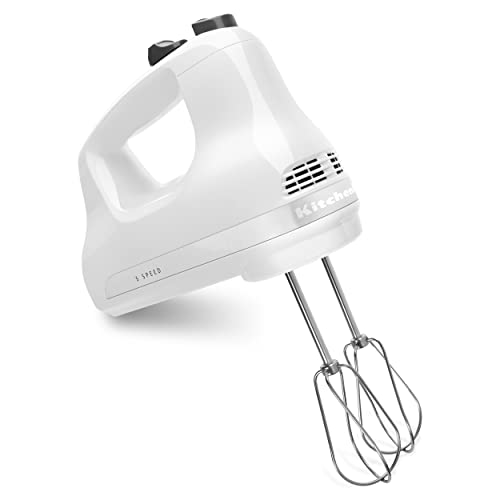
KitchenAid 5-Speed Ultra Power Hand Mixer (KHM512, White) — Best Lightweight for Everyday Cakes
Most cakes are not layer cakes. They are loaf cakes, sponges, traybakes and the occasional birthday sponge — and for that honest majority, the KitchenAid KHM512 in white is a sweet spot. Five speeds cover creaming, batter and a credible whip, the Turbo Beaters move batter properly at low rpm for a clean flour fold, and the compact body is light enough that a full creaming session does not tire the wrist guiding it.
The details suit cake routines: the beaters eject at a button press and go in the dishwasher, and the lockable swivel cord keeps the cable pinned to whichever side keeps it out of the bowl — a small thing that matters when you are circling a bowl of batter for the third scrape. In smaller kitchens it stores where the nine-speed kits cannot.
Be clear about what is not here: there is no whisk for serious meringue work and no dough hook, and five speeds mean the folding stage takes a slightly steadier hand than on the nine-speed picks. For the everyday cake file, those are acceptable trades, and the price tier reflects them honestly.
The KHM512 White earns a note on colour that is more practical than aesthetic: in a bright kitchen, a white mixer shows batter splashes honestly, which sounds like a flaw and is actually a cleaning prompt. Cake sessions are splatter sessions, and the bakers who wipe the tool immediately are the ones whose mixers look new at year five. Choose the colour that makes you clean it; the cake will not care, the appliance will.
Strengths
- Light, compact body for unhurried creaming sessions
- Turbo Beaters fold flour cleanly at low speed
- Dishwasher-safe beaters with one-button eject
Trade-offs
- No whisk or dough hook included
- Five speeds mean coarser stage control
- Less suited to large or double batches
Key specs (verified):
- Speeds: 5
- Attachments: Turbo Beaters
- Cord: Lockable swivel cord
- Beater care: Dishwasher-safe, easy-release button
Best for: everyday cake bakers with standard batch sizes / Not suited for: bakers who whip meringue and cream constantly
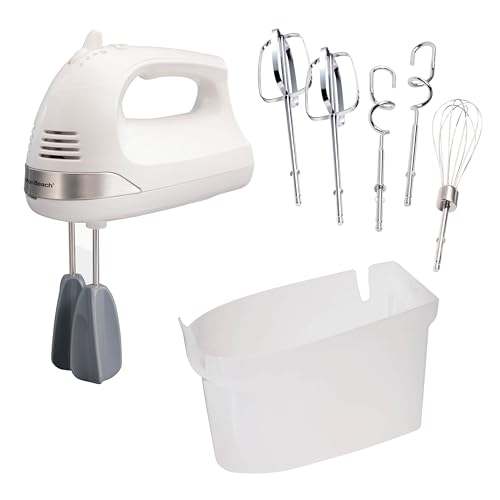
Hamilton Beach 6-Speed Electric Hand Mixer with Easy Clean Beaters (62636J, White) — Best Value for Sturdy Cakes
Not all cakes are delicate. Fruit cakes, carrot cakes, banana breads, ginger cakes and double-batch traybakes are dense, heavy mixtures that punish weak motors and reward torque — and that is the Hamilton Beach 62636J’s territory. Its 275-watt motor, the strongest in this guide, holds a steady pace through thick, fruit-laden batter, and the included whisk covers whipped toppings while the dough hooks handle the enriched doughs that share a baking afternoon with sturdy cakes.
The Easy Clean beaters are a genuine quality-of-life feature for this style of baking: dense batters cling, and beaters designed to release mixture save real scraping and washing time. The snap-on case keeps the three-attachment kit together, which matters in the kind of productive kitchen that bakes these cakes in batches.
The trade-off is delicacy. Its speed steps are workmanlike, so the finest sponge folding asks more care than on the nine-speed picks, and nobody would call its manner refined. Judge it as what it is: the value workhorse for the sturdy half of the cake repertoire, where it outperforms mixers with prettier manners and weaker motors.
Dense cakes expose a hidden 62636J advantage: its beaters and motor handle the add-everything stage of fruit cakes, where dried fruit, nuts and batter must combine without the fruit being smashed or the batter overworked. Low speed, strong motor, brief work — the combination this pick is built from. Delicate it is not; appropriate, entirely.
Strengths
- 275-watt motor powers through dense batters
- Whisk and dough hooks included in the case
- Easy Clean beaters cut scraping and washing time
Trade-offs
- Speed steps are functional rather than fine
- Folding delicacy is behind the nine-speed picks
- Utilitarian feel
Key specs (verified):
- Speeds: 6
- Motor: 275 watts
- Attachments: Traditional beaters, dough hooks, whisk
- Storage: Snap-on storage case
Best for: fruit cake, carrot cake and batch bakers / Not suited for: delicate sponge purists
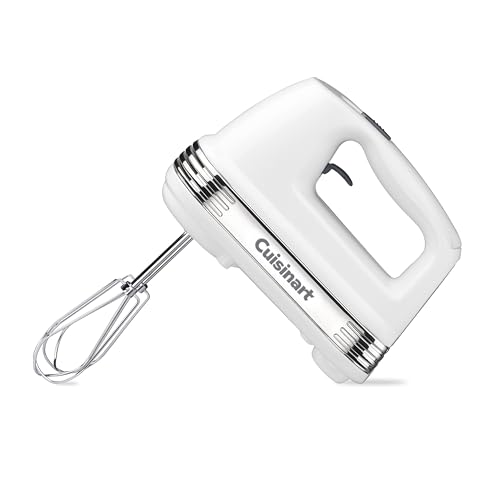
Cuisinart Power Advantage 5-Speed Hand Mixer (HM-50, White) — Best for Small Batches
The Cuisinart HM-50 closes the guide as the small-batch specialist. Its extra-long beaters reach properly into the deeper, narrower bowls that small-batch baking tends to use, so a single sponge or a half batch of frosting mixes evenly instead of swirling under the beaters. The 220W motor is honestly matched to those quantities — creaming a small block of butter and sugar is exactly its pace.
The 60-inch swivel cord is a small-kitchen gift: sockets are never beside the baking station, and a long cord that swivels clear of the bowl removes the constant cable management that makes small counters feel smaller. Five speeds cover the cake stages for standard recipes, and the beaters go in the dishwasher when the cake goes in the oven.
Scale is the limit. Double batches and dense mixtures will make it work at the edge of its comfort, and five speeds give coarser stage control than the premium picks. For bakers who bake small — couples, small households, test bakes and single loaves — it is sized correctly, and a correctly sized tool gets used instead of resented.
Small-batch cake baking has one more HM-50 virtue: proportion. A half-batch frosting in a standard bowl with standard beaters often coats the bowl instead of combining, because there is too little mixture for the tool’s sweep. Extra-long beaters in a deep, narrow bowl keep a small quantity engaged and moving, which is the unglamorous mechanical secret behind most small-batch success.
Strengths
- Extra-long beaters suit deep, narrow bowls
- Long swivel cord suits small counters
- Honestly sized motor for small batches
Trade-offs
- Double batches strain its comfort zone
- Five speeds mean coarser control
- No case included in the listing
Key specs (verified):
- Speeds: 5
- Motor: 220W
- Beaters: Extra-long, dishwasher-safe
- Cord: 60-inch swivel cord
Best for: small households baking single cakes and loaves / Not suited for: batch bakers and dense-mixture specialists
Comparison Table
| Pick | Badge | Key spec | Best for |
|---|---|---|---|
| Breville Handy Mixer | Best Overall for Cakes | 9 speed settings plus boost | Layer-cake bakers who control every stage |
| KitchenAid KHM926 | Best Complete Cake Kit | 9 speeds, beaters + Pro whisk + dough hook | Bakers who want every attachment included |
| Cuisinart HM-90S | Best for Frosting | 9 speeds, SmoothStart, snap-on storage case | Buttercream and frosted cakes |
| KitchenAid KHM512 White | Best Lightweight for Everyday Cakes | 5 speeds, Turbo Beaters, swivel cord | Everyday loaf, sponge and traybake bakers |
| Hamilton Beach 62636J | Best Value for Sturdy Cakes | 6 speeds, 275W, beaters + dough hooks + whisk | Dense, sturdy cakes and easy cleanup |
| Cuisinart HM-50 | Best for Small Batches | 5 speeds, 220W, extra-long beaters | Small-batch and small-kitchen cake bakers |
How to Choose a Hand Mixer for Cakes
Choose by cake stage, not by spec sheet. Creaming needs a steady medium speed and beaters that move the whole mixture; folding needs a genuinely slow first gear; whipping needs a whisk or credible beater performance at the top end; frosting needs a calm start. Walk any candidate mixer through your last three cakes stage by stage, and the right choice usually names itself — the mixers in this guide are simply the ones that survive that walk without a weak stage.
Batch size is the second filter. A mixer that creams beautifully for a single sponge may labour through a double batch of fruit cake batter. Match motor strength to your largest regular bake, not your largest imaginable one, and be honest about frequency: weekly bakers feel build and control differences that monthly bakers never notice, which is why this guide spans from a premium control pick to a compact small-batch option without pretending one answer fits everyone.
- Creaming first: steady mid-speed pace and broad, batter-moving beaters
- Folding second: a first speed slow enough to keep flour in the bowl and gluten down
- Whipping third: a whisk in the box if cream or meringue finishes your cakes
- Frosting check: a soft or ramped start if buttercream is a regular event
- Cleanup always: dishwasher-safe attachments, because cake sessions dirty everything
- Size honestly: motor matched to your largest regular batch, not your rarest
Creaming, Folding, Whipping: What Each Cake Stage Demands
Creaming is aeration: butter and sugar beaten until pale trap the air that becomes the cake’s rise and crumb, and it takes minutes of steady medium-speed work. A mixer that surges or fades forces the baker to compensate constantly, and under-creamed bases bake into dense cakes no oven can fix. Folding is the opposite discipline — minimal, gentle motion that keeps the air in — which is why the lowest gear matters out of all proportion to its speed. Whipping is speed plus geometry: a whisk’s wires cut through cream and white, building volume faster and finer than beaters can, which is why whisk-equipped picks rank highly for bakers whose cakes wear meringue, mousse or whipped finishes.
Cake Troubleshooting: Mixer-Related Problems and Fixes
Dense cake with a good recipe usually means under-creamed butter or overmixed flour — extend the creaming stage and shorten the flour stage. Split or curdled-looking batter after adding eggs means the eggs went in too fast or too cold; add them one at a time at a moderate speed. Flour streaks in the finished crumb mean the bowl was not scraped; hand mixers always leave an edge ring and a base pocket. Whipped cream that will not peak is rarely the mixer’s fault — the cream or bowl was warm — but cream that takes forever usually means beaters doing a whisk’s job.
Cake Batters by Type: Matching the Mixer to the Method
Cakes are not one batter but a family of methods, and each method leans on a different mixer quality. The creaming method — butter and sugar, eggs, flour — is the all-rounder test this guide’s ranking is built on, rewarding steady medium power and a gentle fold. The whisking method behind sponges and chiffons inverts the priorities: the whisk attachment and top-end control do the structural work, and the mixer that creams best is not automatically the mixer that whisks best, which is why the whisk-equipped KitchenAid KHM926 sits so high here despite the Breville’s finer creaming control.
The melting method — ginger cakes, some chocolate cakes — barely needs a mixer at all beyond combining, and any pick here handles it in seconds at low speed; bakers whose repertoire is mostly melted-method cakes should simply buy the compact or budget pick and spend the savings on ingredients. Rubbing-in and all-in-one methods sit between: all-in-one batters reward a mixer that can go from dry ingredients to smooth batter without a flour cloud, which is the Cuisinart HM-90S’s SmoothStart party trick, while rubbed-in bases are finished by hand and ask the mixer only for the wet stage.
- Creaming method: steady medium power plus a gentle folding gear
- Whisked sponges and chiffons: whisk attachment and top-end control decide
- All-in-one batters: calm starts matter most — dry ingredients go in together
- Melting method: any pick works; buy compact or budget
- Fruit and dense cakes: motor strength for heavy, laden batters
Knowing your dominant method cuts the shortlist in half. Most home bakers are creaming-method bakers with occasional whisked cakes, which is precisely the profile of this guide’s top three — but a sponge specialist or a fruit-cake traditionalist should follow their own row of the list instead.
Frosting and Filling: The Second Cake Your Mixer Makes
Every frosted cake is two productions, and the second one — the frosting — has its own mixer demands that cake guides often skip. Buttercream needs a calm start against powdered sugar, then sustained medium beating to reach a spreadable lightness; cream cheese frostings need gentleness, because overbeaten cream cheese turns slack; ganache needs only combining and cooling; whipped fillings need the whisk and a cold bowl. A mixer that bakes a beautiful sponge and then makes frosting a dusty, anxious chore has done only half its job, which is why frosting performance is scored throughout the reviews above.
The practical frosting hierarchy in this guide is clear. The Cuisinart HM-90S’s SmoothStart makes it the frosting specialist outright. The nine-speed KitchenAid and Breville follow closely on control, with the KitchenAid’s whisk giving it the edge for whipped fillings. The Hamilton Beach picks make perfectly good buttercream with a tea towel over the bowl for the first seconds — a legitimate technique, honestly noted, that closes most of the gap for the price.
One frosting habit is worth more than any feature: soften the butter properly. Cold butter defeats every mixer in this guide, producing lumps that bakers then overbeat into greasiness. Butter at cool room temperature, sugar added in stages, beaters buried, patience at the start — with those four, every pick here produces bakery-case buttercream.
The Cake Baker’s Calendar: Matching the Mixer to the Year
Cake baking has a calendar, and a mixer chosen against the calendar serves better than one chosen against a single recipe. The year opens with quiet baking — loaf cakes, sponges, the compact picks’ home ground. Spring brings celebration cakes and the first whipped finishes, where a whisk attachment starts earning its place. Summer is fruit and icebox season: whipped creams, chilled fillings, cakes that set rather than bake, all whisk-and-gentle-fold work. Autumn returns to sturdy bakes — carrot cakes, ginger cakes, the dense mixtures that reward the Hamilton Beach 62636J’s motor. And December is the stress test: multiple cakes, frostings in sequence, attachments rotating through the dishwasher, where a complete kit and a storage case stop being luxuries.
Reading the ranking through that calendar explains its shape. The Breville leads because control serves every season. The KitchenAid KHM926 follows because completeness serves the peaks. The Cuisinart HM-90S owns the frosting-heavy months. The compact and budget picks own the quiet weeks, which — counted honestly — are most of the year, and that is why this guide refuses to treat them as consolation prizes.
The buying advice that falls out of the calendar is simple: buy for your peak if your peak is real — a December that genuinely produces six cakes justifies the complete kit — and buy for your typical week if your peak is imaginary. Most cake disappointment is a February mixer bought for a December that never came, or the reverse. Your calendar, honestly read, is the best reviewer in this guide.
One last calendar note: cakes cluster around people — birthdays, holidays, celebrations — which means cake mixers work under time pressure and audience pressure simultaneously. A mixer that starts calmly, creams reliably and washes quickly is not just a baking tool on those days; it is the difference between a baker who enjoys the occasion and one who survives it. Choose accordingly.
Two Cakes, Start to Finish: The Picks at Work
Abstract rankings land better with concrete cakes, so consider the two bakes that between them test everything in this guide. The first is a classic layered vanilla sponge with buttercream: creaming that decides the crumb, eggs that threaten the emulsion, flour that threatens both the crumb and the kitchen, and a frosting that threatens the counter with powdered sugar. The Breville and the KitchenAid KHM926 walk it in full control; the Cuisinart HM-90S makes its frosting stage the calmest of any pick; the budget and compact picks complete it entirely respectably, asking only for a tea towel at the sugar stage and a steadier hand at the fold.
The second is a dense spiced fruit cake: a batter that resists from the first stir, fruit and nuts that must distribute without breaking, and a long, slow bake that forgives nothing mixed badly at the start. Here the ranking inverts by design — the Hamilton Beach 62636J’s motor and beaters do the heavy stage with the least labour, the premium control picks manage it with more attention, and the compact HM-50 should honestly split the batch or step aside. Neither cake is better than the other; together they are the argument for a guide with six honest specialisms instead of one crowned winner.
Your own two signature cakes are the real review panel. Name them, walk them through the picks above stage by stage, and the mixer your kitchen needs will identify itself more reliably than any ranking — including this one — can do for you.
Setting Up for a Layer Cake: The Station Behind the Mixer
Layer cakes are won at the station before they are won at the dial, and the setup deserves its own paragraph in a cake-specific guide. Tins lined and ready before the batter exists, because a finished batter waits for nobody. Ingredients at cool room temperature and measured into bowls, because the creaming stage will not pause while butter softens. The mixer assembled with the beaters the first stage needs, the whisk washed and within reach for the finish, and a spatula dedicated to the one proper scrape. With that station set, the picks in this guide perform exactly as their reviews describe — the control picks reward the calm, the complete kits never send you to a drawer mid-recipe, and the frosting specialist turns the final stage into the easiest one.
The reverse is also true, and worth stating for bakers blaming their equipment: a chaotic station makes a premium mixer look ordinary. Batter resting while tins are hunted loses the air the creaming built; eggs added from the fridge split under any beater; sugar weighed mid-frosting breaks the rhythm the SmoothStart was designed to protect. Set the station, then let the mixer be the only variable — most bakers find their current pick rises a full tier in the rankings, and those who still feel a specific friction can name it precisely, which is the moment this guide’s distinctions become genuinely useful.
Sugar, Briefly: Why Cake Stages Respect Sweetness Chemistry
One piece of cake science ties this guide’s stages together and is worth a short section of its own. Sugar in a cake is not merely sweetness: it tenderises by competing with flour for water, it stabilises whipped egg foams, it drives the browning that makes a crust taste like a crust, and in the creaming stage its crystals do mechanical work, cutting air pockets into the butter that the mixer then multiplies. That is why the creaming stage cannot be shortcut — the air is physically carved by sugar under the beaters — and why granulated sugar creams differently from caster, which dissolves faster and suits whisked sponges. A mixer with a steady medium gear and beaters that sweep the whole bowl is, in chemical terms, an aeration instrument, and the picks at the top of this guide earned their places by being the best aeration instruments in the set. Understand what the sugar is doing and the stage timings in every recipe stop looking arbitrary. It also explains why two bakers with the same mixer get different cakes: the one who creams patiently is running a chemistry step, not a mixing step, and the mixer rewards the patience with volume no shortcut can reproduce.
How to Mix a Cake With a Hand Mixer, Stage by Stage
This sequence suits a standard butter cake and adapts to most of the home cake repertoire.
- Bring butter and eggs to cool room temperature — creaming cold butter defeats any mixer
- Cream butter and sugar at medium speed for several minutes until visibly paler and fluffy
- Add eggs one at a time at low-medium speed, letting each fully disappear before adding the next
- Add flour in two or three stages at the lowest speed, beaters buried, stopping the moment each addition vanishes
- Scrape the bowl thoroughly once — sides, base and around the beaters — then give the batter a few final seconds
- For whipped finishes, switch to the whisk, use a clean deep bowl, and stop at the peak stage the recipe names
- Rest the mixer on its heel or bowl-rest notch between stages instead of laying it down in batter
The governing principle is that each stage has a correct speed and a correct stopping point, and the mixer cannot know either — the baker supplies both. A cake-specific mixer makes each stage easier to execute; the sequence above makes the execution reliable.
Common Buying Mistakes
- Under-creaming to save time, then blaming the recipe for a dense crumb
- Adding all the eggs at once and splitting the emulsion
- Running the flour stage at batter speed, toughening the crumb and launching flour
- Skipping the scrape, so flour pockets bake into white streaks
- Whipping cream with beaters when a whisk attachment sits unused in the drawer
- Buying the strongest motor for delicate sponges, when control — not power — is what sponges need
Cake mistakes cluster at the transitions between stages, not within them. Slow down at the joins — eggs in one by one, flour in stages, one proper scrape — and the mixer you already own will bake better cakes tonight.
Final Recommendation
For dedicated cake bakers, the Breville Handy Mixer takes this guide’s top recommendation on control, with the KitchenAid KHM926 a breath behind and ahead for anyone who wants the complete kit including the Pro whisk. Frosting-first bakers should choose the Cuisinart HM-90S, everyday bakers the KitchenAid KHM512, sturdy-cake and batch bakers the Hamilton Beach 62636J, and small-batch bakers the Cuisinart HM-50. Every one of them will bake a better cake than a mixer chosen on top speed alone.
Related guides in this cluster: Best Hand Mixers For Baking for the full baking picture, Best Hand Mixers Baking Low Speed for folding technique and gentle starts, Best Hand Mixers For Dough for the dough side of the repertoire, Best Hand Mixers For Potatoes And Cake Mixes for weeknight staples, and Best Hand Mixers Kitchen Appliances for the wider lineup.
Check the current price on Amazon — Breville Handy Mixer (Best Overall for Cakes)
Check the current price on Amazon — KitchenAid KHM926 (Best Complete Cake Kit)
Check the current price on Amazon — Cuisinart HM-90S (Best for Frosting)
Frequently Asked Questions
What is the best hand mixer for cakes overall?
This guide gives the top spot to the Breville Handy Mixer for its stage-by-stage control, with the KitchenAid KHM926 as the best complete kit. Frosting-heavy bakers may prefer the Cuisinart HM-90S, whose SmoothStart keeps powdered sugar in the bowl.
Why is creaming so important for cakes?
Creaming butter and sugar traps air that becomes the cake’s structure and rise. A mixer that holds a steady medium pace with beaters that move the whole mixture creams faster and more evenly, and under-creamed bases are the most common mechanical cause of dense cakes.
Can a hand mixer whip egg whites for sponge cakes?
Yes — especially with a whisk attachment, as on the KitchenAid KHM926 or Hamilton Beach 62636J. Use a clean, deep, grease-free bowl and the top speeds. Beaters alone can do it but take noticeably longer to reach firm peaks.
How do I fold flour without making the cake tough?
Add flour in stages at the lowest speed with the beaters buried, and stop the moment it disappears. Overmixing after flour meets liquid develops gluten and toughens the crumb. A mixer with a genuinely gentle first gear makes this stage much easier to control.
Is a more powerful mixer better for cakes?
Only for dense cakes. Fruit cakes and double batches reward the 275-watt Hamilton Beach 62636J, but delicate sponges reward control instead — the fine speed steps of the Breville or the gentle low end of the KitchenAid models. Match the mixer to the cakes you bake.
Do I need a stand mixer for layer cakes?
No. A good hand mixer handles layer cake batters, frostings and whipped fillings comfortably, and lets you work in several bowls in sequence. A stand mixer helps mainly with very large batches or heavy doughs baked alongside the cakes.


