Disclosure: airfryerkitchensupply.com is reader-supported. When you buy through links on our site, we may earn an affiliate commission at no extra cost to you.
Where to buy
Every mixer in this guide to the best hand mixers baking low speed is sold on Amazon, and Amazon is where we recommend buying, because the listing shows the exact colour, attachment set and storage configuration before you commit. Low-speed behaviour is the whole point of this guide, and it is also the first thing that varies between production runs and bundled variants, so use the links below to land on the exact model described in each review. Prices shift by colour and season, so check the current price on Amazon rather than trusting any figure quoted elsewhere.
- KitchenAid 9-Speed Hand Mixer (KHM926, Contour Silver) — Best Overall: Check the current price on Amazon
- Breville Handy Mixer (BHM800SIL, Silver) — Best Low-Speed Control: Check the current price on Amazon
- Cuisinart Power Advantage Plus 9-Speed Hand Mixer (HM-90S) — Best Anti-Splatter Start: Check the current price on Amazon
- KitchenAid 5-Speed Ultra Power Hand Mixer (KHM512, Contour Silver) — Best Simple Low-Speed Pick: Check the current price on Amazon
- Hamilton Beach 6-Speed Electric Hand Mixer (62682G, White) — Best Budget: Check the current price on Amazon
- Hamilton Beach 6-Speed Electric Hand Mixer with Easy Clean Beaters (62636J, White) — Best for Easy Cleanup: Check the current price on Amazon
Introduction
The best hand mixers baking low speed solve the single most annoying moment in home baking: the first ten seconds. That is when a cup of flour either folds quietly into a batter or detonates across your counter, your shirt and the inside of the bowl you just washed. A mixer can have nine speeds on the dial and still fail this test completely, because what matters is not how many speeds it claims but how slowly and smoothly the lowest one actually turns, and whether the motor ramps up gently instead of lunging.
Low speed is not a niche concern. Folding flour into cake batter without developing gluten, starting a powdered-sugar frosting without a whiteout, stirring chips into cookie dough without smashing them, and beginning a meringue without splashing egg white up the sides of the bowl all live on speeds one and two. Bakers who mix several times a week feel the difference between a true gentle start and a fake one every single session, and it is the main reason experienced bakers replace cheap mixers long before the motor dies.
This guide ranks hand mixers specifically on low-speed control: how slow the first speed really is, whether there is a soft-start or anti-splatter ramp, how evenly the motor holds a slow pace under load, and how usable the beaters are for folding rather than whipping. Raw top-end power still matters for thick doughs, and it is covered in each review, but it is deliberately not what decides the ranking here. If your baking is mostly boxed mixes and occasional frosting, almost any pick below will feel calm; if you bake delicate sponges and folded batters weekly, the top two picks earn their place.
One honest note before the picks: no hand mixer folds as gently as a careful hand with a spatula, and for the most delicate genoise work many bakers still finish by hand. What a good low-speed mixer does is handle the heavy, repetitive ninety percent of mixing — creaming, combining, stirring in — without the mess and without overworking the batter, leaving you the final few folds to do by hand only when a recipe truly demands it.
In this guide
Quick Picks
Six mixers that start gently and stay controlled. The ranking is led by low-speed quality, then by attachment usefulness and everyday value.
- KitchenAid KHM926 — Best Overall: Nine speeds with a genuinely gentle first gear and a full attachment set — the calmest all-round start in this guide. Check price on Amazon
- Breville Handy Mixer — Best Low-Speed Control: Nine settings plus boost, tuned for precise control — the pick for bakers who live on the bottom three speeds. Check price on Amazon
- Cuisinart HM-90S — Best Anti-Splatter Start: SmoothStart is designed to prevent splatter at start-up, with nine speeds and a snap-on case that keeps the whole kit together. Check price on Amazon
- KitchenAid KHM512 — Best Simple Low-Speed Pick: Five honest speeds, Turbo Beaters and a lockable swivel cord — gentle, simple and easy to live with. Check price on Amazon
- Hamilton Beach 62682G — Best Budget: Six speeds plus QuickBurst and a 250-watt motor at a budget-tier position — start dry ingredients on speed one and it behaves. Check price on Amazon
- Hamilton Beach 62636J — Best for Easy Cleanup: Easy Clean beaters shed batter instead of hoarding it, with a 275-watt motor, dough hooks and a whisk in the case. Check price on Amazon
How These Picks Were Chosen
Each pick was verified against Amazon’s catalogue, so the model names, speed counts and included attachments in the spec boxes are the ones actually listed for sale, not copied from old roundups. Models that could not be confirmed were left out rather than guessed at.
The selection criteria, in order, were: first, genuine low-speed gentleness — a slow first speed, a soft-start ramp or an anti-splatter design; second, speed granularity, because more speeds usually means a smaller jump between the folding speed and the stirring speed; third, beater design, since wide, well-spaced beaters fold and stir more cleanly than thin wires at low rpm; fourth, motor behaviour under load, because a mixer that surges and fades at low speed is worse than a steady one; and fifth, storage and cleaning, which decide whether the mixer gets used or buried in a cupboard.
Models were cut for predictable reasons: single-speed or coarse three-speed dials that jump straight to a fast spin, mini cordless whisks marketed as mixers that stall in real batter, and any mixer whose lowest listed speed still reads like a medium on competing models. The two cordless minis in our wider research pool are honest tools for drinks and eggs, but they do not belong in a low-speed baking guide, so they are not here.
The 6 Best Hand Mixers Baking Low Speed — Full Reviews

KitchenAid 9-Speed Hand Mixer (KHM926, Contour Silver) — Best Overall
The KitchenAid KHM926 earns the top spot in a low-speed guide because its nine speeds are spaced closely enough that the bottom of the range is genuinely useful. Speed one is a folding speed, not a stirring speed wearing a smaller number, and the closely spaced steps above it mean you can nudge the pace up for creaming without jumping straight to splatter territory. For bakers who start flour into batter several times a week, that spacing is the difference between a clean counter and a flour-dusted kitchen.
The attachment set supports the low-speed brief unusually well. The stainless Turbo Beater II beaters are broad enough to move batter around the bowl at low rpm instead of just spinning in place, the Pro whisk handles egg whites and cream when you do climb the dial, and the dough hook covers soft doughs. Everything is dishwasher-safe, and the swivel cord keeps the cable out of the bowl when you are working slowly and carefully around the edges.
It is not the cheapest way to get a gentle start, and the body is larger than the five-speed models below, so in a very small kitchen it takes a little more drawer. Bakers who only make boxed mixes will not use the top half of its range. But as a single mixer that handles the delicate end of baking properly, it is the most complete answer here.
A final low-speed consideration is sound and feel, which bakers underestimate until they bake in a quiet morning kitchen. Gentle motors at gentle speeds should murmur rather than whine, and the KHM926’s low gears have that composed character — you can hear the batter’s resistance change, which experienced bakers genuinely use as information. When a mixer screams at speed one, bakers rush the stage to end the noise, and rushed folding is failed folding. Composure, in this guide’s top pick, is an audible quality as much as a mechanical one.
Strengths
- Nine closely spaced speeds make the low end genuinely gentle
- Turbo Beater II beaters fold and stir effectively at low rpm
- Complete attachment set including Pro whisk and dough hook
Trade-offs
- Premium positioning within the hand mixer category
- Larger body than five-speed rivals takes more storage room
- Top speeds are overkill for bakers who only fold and cream
Key specs (verified):
- Speeds: 9
- Attachments: Stainless Steel Turbo Beater II beaters, Pro whisk, dough hook
- Accessories: Dishwasher-safe attachments
Best for: bakers who fold flour, start frostings and cream butter several times a week / Not suited for: buyers who only need a basic mixer for occasional boxed mixes

Breville Handy Mixer (BHM800SIL, Silver) — Best Low-Speed Control
Breville built its Handy Mixer around control, and that shows most at the bottom of the dial, which is exactly where this guide is won and lost. The nine settings plus boost give you fine steps to work through, so starting a bowl of flour or powdered sugar can be done progressively — a few seconds at the lowest setting to wet the dry ingredients, then one step up to combine, then another to finish — instead of one anxious lunge and a dust cloud.
In practice this suits bakers who adjust speed mid-task: folding chocolate chips in at the lowest setting, slowing down to scrape and incorporate the last streaks of flour, or holding a slow, steady pace through a thick cookie dough. The control layout rewards that style of baking, and the mixer feels like a precision instrument rather than an appliance you fight.
The trade-offs are focus and price positioning. This is a premium-tier hand mixer aimed at people who bake often, and its accessory story is about control rather than the biggest bundle in the box. If your baking is a monthly cake mix, the extra finesse will go unused; if you bake weekly and hate flour clouds, it is the most deliberate low-speed tool in the guide.
The Breville’s boost deserves a low-speed footnote: it is a top-end feature, but its presence shapes the whole dial’s calibration, because a maker that reserves a separate boost does not need to stretch its ninth speed to compensate. The result is a range whose bottom stays honest. Bakers comparing dials in a shop should ask not how fast the top is, but whether the bottom was protected when the top was designed — in this pick, it visibly was.
Strengths
- Nine settings plus boost give very fine speed steps
- Progressive start makes dry-ingredient incorporation calm
- Control-focused design suits mid-task speed changes
Trade-offs
- Premium tier positioning
- Accessory bundle is less expansive than full-kit rivals
- Finesse is wasted on purely occasional baking
Key specs (verified):
- Speeds: 9 plus boost
- Control: Speed settings with boost for precise control
Best for: frequent bakers who constantly feather the speed control / Not suited for: occasional bakers who want the simplest possible dial

Cuisinart Power Advantage Plus 9-Speed Hand Mixer (HM-90S) — Best Anti-Splatter Start
The Cuisinart HM-90S attacks the low-speed problem from the software side: its SmoothStart feature is explicitly an anti-splatter start, ramping the beaters up instead of snapping to full dial speed the instant you switch on. Anyone who has started a buttercream and watched powdered sugar bloom out of the bowl will understand immediately why that earns a high place in this guide.
Beyond the start, the nine speeds give a proper working range — a slow stir for folding and combining, mid speeds for creaming and batters, and enough top end for whipped cream and egg whites. The snap-on storage case is a quiet quality-of-life win: beaters and attachments live with the mixer instead of migrating to the back of a drawer, which matters more the smaller your kitchen is.
The case adds a little bulk in storage, and the anti-splatter ramp, while excellent, means the first second or two of every mix is deliberately unhurried — impatient bakers sometimes read that as softness. It is not; it is the feature working. For frosting-heavy baking especially, this is one of the calmest starts you can buy.
Storage has a low-speed consequence for the HM-90S that is easy to miss: because the case keeps the beaters clipped and clean, bakers actually use the right attachment for delicate work instead of grabbing whichever beater is already fitted. Half of gentle mixing is the correct tool at the correct speed, and an organised kit quietly enforces the first half of that equation every single bake.
Strengths
- SmoothStart anti-splatter ramp prevents dry-ingredient clouds
- Nine speeds cover folding through whipping
- Snap-on case keeps attachments stored with the mixer
Trade-offs
- Storage case adds bulk in a tight drawer
- Deliberate ramp-up feels slow to impatient users
- Mid-weight body is not the lightest here for long sessions
Key specs (verified):
- Speeds: 9
- Start: SmoothStart anti-splatter start
- Storage: Snap-on storage case
Best for: bakers who make frosting and buttercream regularly / Not suited for: bakers who want the absolute lightest mixer for long whipping sessions

KitchenAid 5-Speed Ultra Power Hand Mixer (KHM512, Contour Silver) — Best Simple Low-Speed Pick
Not everyone needs nine speeds to get a gentle start. The KitchenAid KHM512 keeps the range to five, and its lowest setting is a properly usable stir-and-fold pace, which is why it holds a place in a low-speed guide despite the shorter dial. The Turbo Beaters are the same broad, batter-moving design language as its bigger sibling, so at low rpm they pull ingredients together instead of augering a hole in the middle of the bowl.
Day to day, this is the easy mixer to live with: the beaters eject with a button and go in the dishwasher, the cord locks to either side so left- and right-handed bakers can keep it clear of the bowl, and the body is compact enough for a shallow drawer. For cake batters, cookie dough, frosting and mashed potatoes — the realistic home baking workload — five well-chosen speeds are enough.
What you give up is granularity and kit. There is no whisk or dough hook story here, and the jump between speeds is bigger than on the nine-speed models, so the most delicate folding still rewards a light touch on the dial. As a simple, gentle, durable-feeling everyday mixer, though, it is hard to fault.
The KHM512’s five speeds invite a technique worth teaching: the pulse-fold. Rather than running continuously at speed one through a delicate fold, short one-second pulses with pauses let the baker watch the batter between movements, stopping at the exact frame where the last flour streak vanishes. On a simple dial this is easy to execute, and it closes most of the practical gap between five speeds and nine for folding work.
Strengths
- Lowest speed is a genuine stir-and-fold pace
- Turbo Beaters move batter well at low rpm
- Compact body with lockable swivel cord and dishwasher-safe beaters
Trade-offs
- Only five speeds means bigger jumps between settings
- No whisk or dough hook in the attachment set
- Less headroom for very thick mixtures than the strongest picks
Key specs (verified):
- Speeds: 5
- Attachments: Turbo Beaters
- Cord: Lockable swivel cord
- Beater care: Dishwasher-safe, easy-release button
Best for: everyday bakers who want gentle starts without a long dial / Not suited for: bakers who need a full attachment kit in the box

Hamilton Beach 6-Speed Electric Hand Mixer (62682G, White) — Best Budget
Budget hand mixers are where low-speed promises usually go to die, which makes the Hamilton Beach 62682G the pleasant exception in this guide. Its first speed is slow enough to start flour and cocoa without an eruption, and the six-speed spread plus a QuickBurst button for short blasts of extra power covers the normal baking range without drama. The 250-watt motor holds its pace in cake batter and cookie dough instead of fading.
The practical details are strong for the tier: traditional beaters that release batter reasonably well, a snap-on storage case so the beaters stay with the mixer, and a Bowl Rest notch that lets you perch the mixer on the bowl rim between additions instead of laying it on the counter in a puddle of batter. That last feature sounds trivial until you have scraped batter off a worktop for the third time.
Be honest about the limits: the speed steps are coarser than the nine-speed picks, so the very gentlest folding is a little less refined, and the traditional beaters hold more batter than easy-clean designs. But as the budget entry in a low-speed guide, it behaves far better at speed one than its tier suggests.
Budget mixers are often accused of being disposable, and the 62682G is the counter-argument this guide keeps returning to: a simple, strong motor, honest speeds and replaceable-feeling sturdiness in the beaters. For low-speed baking specifically, its longevity matters because its first gear stays consistent — cheap mixers that develop speed irregularity as they age lose their one virtue, and this one’s track record in the category suggests it keeps its manners.
Strengths
- Genuinely usable first speed at a budget-tier position
- 250-watt motor holds pace in batter and dough
- Bowl Rest and snap-on case are practical daily touches
Trade-offs
- Coarser speed steps than nine-speed rivals
- Traditional beaters retain more batter
- Less refined feel than the premium picks
Key specs (verified):
- Speeds: 6 plus QuickBurst
- Motor: 250 watts
- Attachments: Traditional beaters
- Storage: Snap-on storage case
- Rest: Bowl Rest feature
Best for: value-focused bakers who refuse flour clouds / Not suited for: precision bakers who want the finest speed granularity
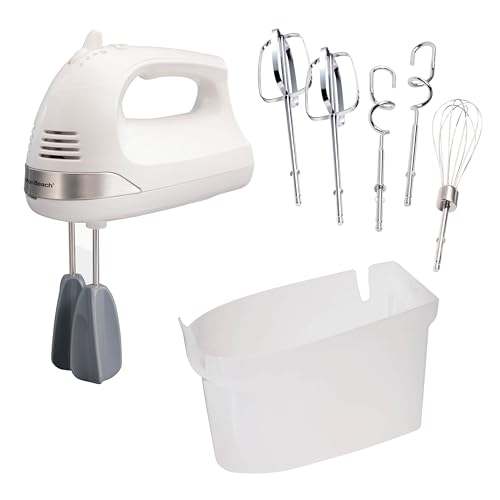
Hamilton Beach 6-Speed Electric Hand Mixer with Easy Clean Beaters (62636J, White) — Best for Easy Cleanup
Low-speed mixing has a second act nobody talks about: cleanup. Slow folding leaves thick batter clinging to the beaters, and traditional wire beaters can hold a surprising amount of it. The Hamilton Beach 62636J answers with Easy Clean beaters designed to release batter more readily, paired with a 275-watt motor — the strongest in this guide — and a kit that adds dough hooks and a whisk in a snap-on case.
At the low end it performs credibly: speed one is controlled enough for combining dry ingredients, and the extra motor headroom means thick batters do not drag the pace down into that surging, uneven rhythm that makes folding unpredictable. The whisk earns its keep for cream and egg whites when the recipe climbs the dial, and the dough hooks handle soft doughs within honest hand-mixer limits.
It is a workhorse rather than a precision instrument — the speed steps are workmanlike rather than fine, and if your baking is mostly delicate sponges, the nine-speed picks above give you a gentler bottom gear. For bakers whose low-speed work is mostly cookie dough, thick batters and box mixes, and who value easy cleanup, it is a very sensible buy.
Cleanup speed feeds back into low-speed baking more than any other kind, because folded batters and frostings are the stickiest mixtures in the repertoire and they dry while the cake is in the oven. The 62636J’s easy-release beaters mean the washing is done before the sponge has risen, which is precisely when a baker is deciding whether to bake again this week. Friction decides frequency; this pick lowers it.
Strengths
- Easy Clean beaters release batter and wash up fast
- 275-watt motor is the strongest in this guide
- Dough hooks and whisk included in a snap-on case
Trade-offs
- Speed steps are functional rather than fine
- Lowest gear is less delicate than the nine-speed picks
- Workhorse feel rather than premium finish
Key specs (verified):
- Speeds: 6
- Motor: 275 watts
- Attachments: Traditional beaters, dough hooks, whisk
- Storage: Snap-on storage case
Best for: bakers mixing thick batters who prioritise cleanup / Not suited for: delicate-sponge specialists who need the gentlest first gear
Comparison Table
| Pick | Badge | Key spec | Best for |
|---|---|---|---|
| KitchenAid KHM926 | Best Overall | 9 speeds, Turbo Beater II + Pro whisk + dough hook | Bakers who fold delicate batters weekly |
| Breville Handy Mixer | Best Low-Speed Control | 9 speed settings plus boost | Precision bakers who adjust speed constantly |
| Cuisinart HM-90S | Best Anti-Splatter Start | 9 speeds, SmoothStart, snap-on storage case | Frosting makers tired of powdered-sugar clouds |
| KitchenAid KHM512 | Best Simple Low-Speed Pick | 5 speeds, Turbo Beaters, swivel cord | Small kitchens and straightforward baking |
| Hamilton Beach 62682G | Best Budget | 6 speeds + QuickBurst, 250W, storage case | Value buyers who still want a calm start |
| Hamilton Beach 62636J | Best for Easy Cleanup | 6 speeds, 275W, beaters + dough hooks + whisk | Bakers who hate scraping beaters clean |
How to Choose a Hand Mixer for Low-Speed Baking
Start with the first speed, not the last. Ignore headline speed counts for a moment and ask what speed one actually does: on a good low-speed mixer it turns slowly enough to stir flour into wet batter without lifting a cloud, and the beaters move the mixture rather than drilling through it. Soft-start ramps and anti-splatter features are the clearest signals a maker has engineered for this, and they are worth more than an extra top speed you will rarely use.
Then count the steps between folding and creaming. Cake work lives between stir and medium; if a mixer jumps from a gentle one to a vigorous three with nothing between, you will spend your baking life toggling the dial. Nine-speed models earn their keep here not at the top of the range but in the crowded, useful bottom half. Five-speed models can still work beautifully — the steps are simply bigger, so technique matters a touch more.
- Look for a soft-start, SmoothStart or anti-splatter description — it is the clearest low-speed signal
- Check the beater design: broad beaters fold and stir better at low rpm than thin wires
- Confirm attachments are dishwasher-safe, because low-speed folding leaves batter everywhere
- A swivel or lockable cord keeps the cable out of the bowl during careful work
- A storage case matters if drawer space is tight and attachments wander
Speed Settings Explained: What Each Range Is Actually For
The bottom two speeds are the folding and combining zone: starting dry ingredients, stirring in chips and nuts, folding flour into a creamed base, and beginning frostings. This is where this guide’s ranking is decided. If a mixer cannot work calmly here, nothing else about it matters for baking.
The middle speeds are the creaming and batter zone: beating butter and sugar, building cake batters, mixing cookie dough and mashing potatoes. Most home baking hours are spent here, so a motor that holds an even pace under load — no surging, no fading — matters more than a spectacular top speed. The upper speeds are the whipping zone: cream, egg whites and meringue. They are important, but every mixer in this guide handles them adequately, which is why they did not decide the order.
Low-Speed Technique: Getting the Most From a Gentle Mixer
Even the gentlest mixer rewards good habits. Add dry ingredients in two or three additions rather than all at once, start the beaters already buried in the mixture rather than on its surface, and give the mixer five to ten seconds at the lowest speed before stepping up. For powdered sugar, drape a tea towel over the bowl for the first few seconds or start the frosting with a spatula until the sugar is damp — technique and a soft start together make frosting a clean job instead of a kitchen-wide event.
Why Low Speed Decides More Bakes Than High Speed
It is worth pausing on why this guide exists at all, because the baking world talks endlessly about power and rarely about gentleness. Think about where a cake or a batch of cookies is actually decided. The creaming stage needs a steady medium — important, but almost every mixer in this guide manages it. The whipping stage needs top speed — important, but brief, and forgiving. The folding and combining stages, though, happen in every single bake, they involve the ingredients most likely to make a mess — flour, cocoa, powdered sugar — and they involve the mixture at its most fragile, when the air you have just built into butter and sugar can be knocked out or the flour overworked into toughness. That is low-speed territory, and it is where bakes quietly succeed or fail.
There is also a simple frequency argument. A home baker might whip cream twice a month and make meringue twice a year, but they start dry ingredients into wet ones every time they bake anything. A feature used in one hundred percent of bakes deserves more buying weight than a feature used in five percent, yet spec sheets invert that logic, leading with top speeds and wattage and whispering about the first gear. This guide deliberately reverses the emphasis, and the picks above are ordered by what they do in the first fifteen seconds of a recipe, not the last.
The practical consequence for shoppers is liberating: you do not need the most powerful mixer, the most speeds or the highest tier to bake gently and cleanly. You need one honest low gear, a calm start and beaters shaped to move batter. Two of the picks in this guide are budget and mid-tier models that deliver exactly that, and they will out-bake a violent premium mixer at the folding stage every day of the week. Buy the bottom of the dial, and the rest of the mixer tends to take care of itself.
Low-Speed Baking, Recipe by Recipe
Different bakes tax the low end in different ways, and walking through the repertoire shows why the ranking above shakes out as it does. A Victoria sponge asks for flour folded into a creamed base without losing air — the purest low-speed test, favouring the nine-speed picks with their fine first gears. A chocolate cake adds cocoa, the most flight-prone dry ingredient in the kitchen, and rewards an anti-splatter start like the Cuisinart HM-90S’s SmoothStart. Buttercream asks for powdered sugar incorporated in stages, where a ramped start and buried beaters matter more than any other quality in the mixer.
Cookie dough runs the other way: the low-speed demand is brief — combine the flour without a cloud — and then the middle speeds and motor steadiness take over, which is why the strong Hamilton Beach models hold their places in a low-speed guide despite coarser dials. Brownies and blondies ask for minimal mixing at low speed, where the discipline is stopping rather than starting. Muffin batters are the extreme case: a handful of strokes at the lowest speed, lumps welcome, and any mixer that cannot go genuinely slowly will overwork them before you can stop it.
- Sponges and genoise-style bakes: finest first gear wins — the nine-speed picks
- Chocolate bakes: anti-splatter starts earn their keep against cocoa
- Buttercream: staged sugar additions plus a ramped start equal a clean kitchen
- Cookies: low speed starts it, motor steadiness finishes it
- Muffins: the lowest speed and the discipline to stop almost immediately
No single mixer tops every row of that list, which is why this guide gives six picks with honest specialisms rather than one winner with fine print. Match your most-baked recipe to the pick whose low-speed character suits it, and the rest of your repertoire will follow comfortably.
A Low-Speed Test You Can Run in Your Own Kitchen
Specifications will only take a shopper so far, so here is a practical test — the same logic this guide used, translated into three minutes in your own kitchen with any mixer you already own or are trialling. Put a cup of flour in a mixing bowl, add half a cup of water, and start the mixer at its lowest speed with the beaters buried. Watch three things: whether flour leaves the bowl in the first five seconds, whether the mixture comes together evenly or the beaters drill a hole through it, and whether the motor’s note stays steady or hunts up and down as the paste thickens. A mixer that passes all three is a low-speed mixer in fact, whatever its dial claims.
Repeat the logic with powdered sugar and a knob of soft butter for the frosting test, and with a thick cookie dough for the load test. The pattern you are looking for is composure: no eruption at the start, no surging in the middle, no drama at any point. Every pick in this guide was favoured because its design — a ramped start, a fine first gear, broad beaters, a steady motor — produces exactly that composure, and the test explains in your own hands why the ranking is ordered as it is rather than by price or brand.
The test also exposes the most common buying error in this category: judging a mixer in the shop by its top speed, which is loud and impressive and almost irrelevant. Run the bottom of the dial instead. Baking lives there, and so does the difference between the mixers in this guide and the ones that were left out of it.
Finally, a note on living with the winner, whichever pick you choose: low-speed skill compounds. Bakers who stage their dry ingredients, bury their beaters and scrape once, deliberately, find that even a budget pick performs like a premium one; bakers who skip those habits can make the finest mixer in this guide look clumsy. The tool sets the ceiling — technique decides how close to it your Tuesday baking gets.
A Note on Bowls: The Low-Speed Partner Nobody Buys Deliberately
Low-speed mixing happens in a bowl, and the bowl quietly decides how gentle any mixer can be. A deep, narrow bowl keeps a small batter engaged with the beaters and contains the first seconds of dry ingredients far better than a wide, shallow one, which gives flour a runway. A bowl with some weight — or a damp cloth beneath a light one — stays put at low speeds instead of travelling with the beaters, which is both a safety and a tidiness issue when your other hand is holding the mixer.
Match the bowl to the pick and the whole guide performs better: the nine-speed models reward the control a deep bowl gives them, the compact picks reach properly into smaller bowls, and every soft start in this ranking works harder in a bowl that contains the mixture’s first movement. It is the cheapest upgrade in low-speed baking, and most kitchens already own it without knowing.
How to Mix at Low Speed Without the Flour Cloud
The method below works with every pick in this guide and turns the messiest moment in baking into a non-event.
- Add wet ingredients to the bowl first, then add only half the dry ingredients for the first mix
- Lower the beaters into the mixture before switching on — never start them resting on top of dry flour
- Start on the lowest speed and mix for ten to fifteen seconds until the dry ingredients look damp and shaggy
- Scrape the bowl sides and bottom once with a spatula, folding in any dry pockets by hand
- Step up one speed at a time as the batter comes together, finishing at the speed the recipe intends
- For frosting, stir powdered sugar in with a spatula until damp before giving it any powered speed at all
- Stop as soon as the batter is uniform — low-speed control is wasted if the mixing then runs long enough to toughen the crumb
Two habits protect the result. First, scrape properly: hand mixers leave a ring of unmixed batter at the bowl’s edge and a pocket at the bottom, and one deliberate scrape halfway through fixes both. Second, respect the stop point — flour-based batters toughen with overmixing, and the whole point of buying low-speed control is a tender crumb, not just a clean counter.
Common Buying Mistakes
- Buying on speed count alone — nine fast speeds with a violent first gear are worse than five calm ones
- Starting the beaters on top of dry ingredients instead of buried in the mixture
- Adding all the flour at once, which overwhelms any soft start
- Skipping the mid-mix scrape, then overmixing to compensate for the dry pockets
- Using the lowest speed for everything — folding speed cannot cream cold butter, and forcing it strains the motor
- Assuming a cordless mini whisk can fold real batter — those tools are for eggs and drinks, not baking
The most common disappointment with a new low-speed mixer is expecting it to fix technique. A gentle first gear plus buried beaters plus staged additions is a clean kitchen; any one of the three missing brings the flour cloud back. Buy the control, then use it the way it was designed to be used.
Final Recommendation
If you bake often and want one mixer that handles the delicate end of the craft properly, the KitchenAid KHM926 is the recommendation — its low speeds are genuinely gentle and the attachment set is complete. Bakers who feather the speed control constantly should look at the Breville Handy Mixer, and frosting makers should put the Cuisinart HM-90S and its anti-splatter SmoothStart at the top of their list. On a budget, the Hamilton Beach 62682G behaves at speed one far better than its tier suggests.
Round out the cluster with the sibling guides: Best Hand Mixers For Baking for the general baking picture, Best Hand Mixers For Cakes if layer cakes are your main event, Best Hand Mixers For Dough for soft-dough work, Best Hand Mixers For Potatoes And Cake Mixes for weeknight staples, and Best Hand Mixers Kitchen Appliances for how a hand mixer fits the wider appliance lineup.
Check the current price on Amazon — KitchenAid KHM926 (Best Overall)
Check the current price on Amazon — Breville Handy Mixer (Best Low-Speed Control)
Check the current price on Amazon — Cuisinart HM-90S (Best Anti-Splatter Start)
Frequently Asked Questions
What makes a hand mixer good at low speed?
Three things: a first speed that genuinely turns slowly, a soft or ramped start that does not lunge, and beaters broad enough to move batter at low rpm. Speed count helps only because more speeds usually means smaller steps at the bottom of the range, where folding and combining happen.
Can a low-speed hand mixer replace folding by hand?
For most batters, yes — a gentle first speed folds flour in without developing much gluten. For the most delicate sponges and genoise, many bakers still do the final few folds with a spatula. The mixer handles the heavy ninety percent; the spatula finishes the fragile ten percent.
Why does my mixer throw flour everywhere on speed one?
Usually one of three causes: the first speed is simply too fast, the beaters were started sitting on top of the dry ingredients, or all the flour went in at once. Bury the beaters, add dry ingredients in stages, and if it still erupts, the mixer itself is the problem — that is exactly what this guide screens for.
Is a nine-speed mixer always better for baking than a five-speed?
Not always. Nine speeds give finer steps at the bottom of the range, which delicate bakers appreciate. A good five-speed mixer with a calm first gear, like the KitchenAid KHM512 in this guide, handles everyday baking very well. Judge the lowest speed, not the count.
How do I start powdered-sugar frosting without a mess?
Stir the first addition of sugar into the butter by hand until it is damp, keep the beaters buried, start on the lowest speed, and add sugar in stages. An anti-splatter start such as the Cuisinart HM-90S’s SmoothStart makes this noticeably easier.
Do I need dough hooks on a low-speed baking mixer?
Only if you make soft doughs — enriched doughs, soft rolls, pizza dough started in the bowl. Hand mixers are not bread-kneading machines, and stiff doughs belong in a stand mixer. For low-speed baking focused on batters and frostings, beaters and a whisk matter more.


