Disclosure: airfryerkitchensupply.com is reader-supported. When you buy through links on our site, we may earn an affiliate commission at no extra cost to you.
Where to buy
Start with this shortlist of the best food processors for house use. All linked models here were verified against Amazon’s catalog data for this site before writing, so the capacities and storage features quoted match real listings. Follow the links in this box, in Quick Picks, and under each review to check price on Amazon when you buy; included discs and colors vary between listings. This guide covers house use in the practical sense: apartments, small houses, and shared homes where storage space and counter room decide what is usable, and no fixed prices are printed because they change constantly.
- KitchenAid 7-Cup Food Processor KFP0718 (Best Overall for House Use) — check price on Amazon
- Cuisinart Mini-Prep Plus 4-Cup DLC-4CHB (Best for Tiny Kitchens) — check price on Amazon
- Cuisinart Elemental 8-Cup Food Processor FP-8SV (Best Full Capability in a Compact Footprint) — check price on Amazon
- KitchenAid 3.5 Cup Food Chopper KFC3516 (Best Countertop Mini for Daily Use) — check price on Amazon
- Braun Easy Prep 8-Cup Food Processor FP3101BK (Best Simple 8-Cup for Shared Homes) — check price on Amazon
- Cuisinart 5-Cup Chop & Shred Food Processor FP-5 (Best Small Processor That Still Shreds) — check price on Amazon
Looking for the best food processors for house use usually means solving a space problem, not a power problem. In an apartment, a small house, a shared kitchen, or a home where the processor must live in a cupboard rather than on the counter, the machine has to be compact enough to store, light enough to lift down from a shelf, and complete enough that its blades and discs do not scatter through three drawers. This guide is the companion to our general home-use roundup, with a deliberately different lens and a different set of picks: here, capacity is judged against storage, and every machine earns its place by fitting the physical reality of a smaller home while still doing real family cooking.
The honest trade-off in this category is batch size. Compact processors in the 3.5 to 8-cup range handle daily cooking for one to four people beautifully, but they ask you to split the occasional big job. What they give back is a machine that is actually present in the kitchen, quick to assemble, easy to wash in a small sink, and simple to put away. A giant processor exiled to a hallway closet helps no one. Each review below states the storage footprint logic, the realistic household size, and the jobs to avoid, so you can choose the largest machine your space comfortably holds rather than the largest machine that exists.
Verified specifications come only from the manufacturers’ own listings, and tiers are described in words rather than prices. Alongside the reviews you will find a buying guide on measuring your space, a practical section on organizing a small-kitchen processor station, and the mistakes that make compact machines disappoint.
In this guide
Quick Picks
Six compact-to-mid-size processors chosen for apartments and small houses, prioritizing in-bowl storage, cord management, small-sink washing, and honest capacity.
- Best Overall for House Use — KitchenAid 7-Cup Food Processor KFP0718: A 7-cup processor with all-in-one in-bowl storage, three speeds, and a 2-in-1 feed tube: the largest sensible only-processor for most small homes. Check on Amazon
- Best for Tiny Kitchens — Cuisinart Mini-Prep Plus 4-Cup DLC-4CHB: A 250-watt, 4-cup mini with an auto-reversing blade and dishwasher-safe bowl, for studios and the smallest counters. Check on Amazon
- Best Full Capability in a Compact Footprint — Cuisinart Elemental 8-Cup Food Processor FP-8SV: An 8-cup, 350-watt Cuisinart with slicing discs, for small houses that still want true slicing and shredding. Check on Amazon
- Best Countertop Mini for Daily Use — KitchenAid 3.5 Cup Food Chopper KFC3516: A 3.5-cup chopper with two speeds plus pulse, a dishwasher-safe bowl, and easy cord wrap, made to live on the counter. Check on Amazon
- Best Simple 8-Cup for Shared Homes — Braun Easy Prep 8-Cup Food Processor FP3101BK: An 8-cup Braun Easy Prep machine whose straightforward design suits shared houses where several cooks use one processor. Check on Amazon
- Best Small Processor That Still Shreds — Cuisinart 5-Cup Chop & Shred Food Processor FP-5: A 5-cup compact whose listing confirms a reversible disc and wide-mouth feed tube: the two-job machine for chopping and shredding in small homes. Check on Amazon
How These Picks Were Chosen
House-use picks were filtered first by storage reality: machines had to store their own accessories sensibly, lift and move without strain, and wash in a standard small sink. Only then was cooking ability scored, using verified listing data for capacity, speeds, feed tube design, and functions. The set deliberately differs from our general home-use roundup: overlapping needs exist, but these models were chosen because their size class and storage design suit apartments and small houses specifically, and each pick occupies a distinct step from mini chopper to full-capability 8-cup machine.
We also weighed the two-bowl problem honestly. In a small home, a mid-size machine that handles ninety percent of jobs beats a pair of machines, one tiny and one huge, that together eat a whole cupboard. Every pick here is a plausible only-processor for a small household, scaled from solo cooking to a family of four, with the limits of each stated plainly rather than hidden behind capacity headlines.
The 6 Best Food Processors for House Use
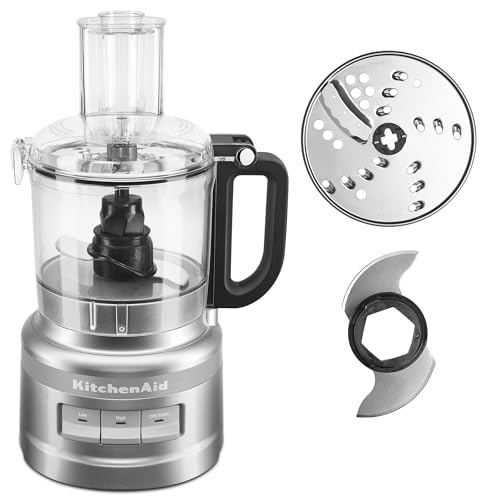
1. KitchenAid 7-Cup Food Processor KFP0718 — Best Overall for House Use
If a small home buys one processor, this is the one that wastes the least space doing it. Its listing confirms a 7-cup bowl, three-speed control, a 2-in-1 feed tube, an easy-clean work bowl, and all-in-one storage, meaning every blade and disc lives inside the bowl instead of in your drawers. Seven cups covers dinner for two to four, a pie, a batch of hummus, and weekday vegetable prep in single runs. It lifts easily, washes in a small sink without acrobatics, and fits the cupboard shelf that actually exists in an apartment kitchen.
Strengths
- All-in-one storage keeps every part inside the bowl, ideal for small cupboards
- 7-cup capacity is a genuine only-processor size for small households
- Three speeds and a 2-in-1 feed tube cover varied daily cooking
Trade-offs
- Big family batches still need two runs
- Costs more than basic machines of similar capacity
- Storage system only works if parts are returned to the bowl each time
Key specs (verified):
- Capacity: 7-cup bowl (verified from listing)
- Controls: three-speed control (verified from listing)
- Storage: all-in-one in-bowl storage; 2-in-1 feed tube (verified from listing)
The design intelligence here is about friction in small spaces. In an apartment kitchen, the barrier to using a processor is rarely the processing; it is fetching parts from three places, clearing counter room, and finding somewhere for everything to dry. A machine that stores complete, assembles in seconds, and cleans in a small sink removes each of those barriers. Its cooking performance then does the rest: even slicing, controlled chopping with real speed options, and enough bowl for the meals small households actually cook.
Its ceiling is the same as its virtue: it is a mid-size machine. A small household that starts hosting large dinners weekly will feel the two-run problem and should treat this as the stepping stone it honestly is. For the apartment and small-house reality it targets, it is the most complete answer in this guide.
Best for: apartments and small houses wanting one complete, easy-storing processor for two to four people / Not suited for: large families or bulk batch cooks who need 12 cups or more
Check on Amazon — check price on Amazon before you buy, since listings and included accessories change over time.

2. Cuisinart Mini-Prep Plus 4-Cup DLC-4CHB — Best for Tiny Kitchens
Some kitchens have one stretch of counter and one cupboard shelf, and the Mini-Prep Plus was designed for exactly that life. Its listing confirms a 4-cup bowl, a 250-watt motor, an auto-reversing stainless blade for chopping and grinding, and a dishwasher-safe bowl and lid. It lives happily in a corner, chops herbs, garlic, onions, and nuts, grinds spices and hard cheese, and makes the dressings, dips, and small sauces that small households actually repeat. For a solo cook or a couple in a studio or tiny apartment, it is often the only processor that makes sense.
Strengths
- Smallest footprint here; stores on a shelf or in a deep drawer
- Auto-reversing blade covers chopping and finer grinding in one tool
- Dishwasher-safe bowl and lid suit small-sink kitchens perfectly
Trade-offs
- No slicing or shredding discs; it is a chopper, not a full processor
- 4-cup bowl means small batches of everything
- 250-watt motor is strictly light-duty
Key specs (verified):
- Capacity: 4-cup bowl (verified from listing)
- Motor: 250 watts (verified from listing)
- Blade: auto-reversing stainless steel blade; dishwasher-safe parts (verified from listing)
Judge this machine by the jobs it does daily and it is close to flawless: the handful of herbs, the onion, the cup of dressing, the small crumble topping. Those tasks are the texture of small-home cooking, and doing them in twenty seconds instead of five minutes is what makes cooking in a tiny kitchen feel possible on a weeknight. The reversing blade is a thoughtful touch, letting one tool chop coarsely in one direction and grind finer in the other, which stretches a mini machine’s range considerably.
Its limits must be respected: ask it to shred a cabbage or slice potatoes and it simply cannot, because the discs do not exist. Households that cook those dishes weekly should step up to the 7 or 8-cup picks here. As the tiny-kitchen specialist, and as a second machine in bigger homes, it remains the standard for the class.
Best for: studios, tiny apartments, and solo or couple cooking focused on chopping and small sauces / Not suited for: anyone needing slicing and shredding, or batches beyond a few cups
Check on Amazon — check price on Amazon before you buy, since listings and included accessories change over time.

3. Cuisinart Elemental 8-Cup Food Processor FP-8SV — Best Full Capability in a Compact Footprint
The FP-8SV is the step up for small homes that cook seriously: a real processor with slicing discs in a footprint a modest kitchen can absorb. Its listing confirms an 8-cup bowl, a 350-watt motor, and medium to fine slicing discs. Eight cups handles a family-of-four dinner’s prep in most cases, and the discs unlock the slaws, gratins, and sliced vegetables that choppers cannot touch. It suits small houses and larger apartments where the processor will live on the counter or in a main cupboard and be used as the kitchen’s primary prep machine.
Strengths
- True slicing ability with medium to fine discs in a compact machine
- 8-cup bowl covers most family-of-four prep in one run
- Cuisinart build and parts support suit long-term ownership
Trade-offs
- 350-watt motor prefers sensible loads over abuse
- Storage of discs needs a plan, unlike in-bowl-storage rivals
- Mid-size bowl still splits the biggest holiday jobs
Key specs (verified):
- Capacity: 8-cup bowl (verified from listing)
- Motor: 350 watts (verified from listing)
- Discs: medium to fine slicing discs (verified from listing)
- Finish: silver (verified from listing)
This is the machine for the small home that refuses to cook small. The slicing discs change the menu: uniform potato slices for gratins, cucumbers and onions for salads, cabbage for slaw, all in the time a knife does a quarter of the job. The bowl size threads the needle between the minis that cannot feed four and the flagships that cannot fit the cupboard. In daily service it feels like a proper processor that happens to be compact, rather than a compact appliance apologizing for itself.
Manage two things and it will serve for years: keep a flat, safe home for the discs, since a loose slicing disc in a crowded small cupboard is both a loss and a hazard, and respect the motor with reasonable batch sizes on dense loads. For small houses with real cooking ambitions, it is the sweet spot of this guide.
Best for: small houses and larger apartments cooking full meals for up to four, with slicing on the menu / Not suited for: tiny studios with no disc storage, or very large households
Check on Amazon — check price on Amazon before you buy, since listings and included accessories change over time.

4. KitchenAid 3.5 Cup Food Chopper KFC3516 — Best Countertop Mini for Daily Use
The KFC3516 takes the opposite storage strategy from the cupboard machines: it is small and tidy enough to live on the counter permanently, with an easy cord wrap confirmed in its listing keeping it neat. The listing also confirms a 3.5-cup dishwasher-safe work bowl, a stainless multipurpose blade, and two speeds plus pulse. In a small house or apartment, a chopper that is always out is a chopper that is always used: herbs, garlic, onions, breadcrumbs, a quick salsa, a small dressing. It suits cooks who prep small amounts constantly and value immediacy over batch size.
Strengths
- Cord wrap and compact size make permanent counter residence tidy
- Two speeds plus pulse give real texture control at mini scale
- Dishwasher-safe bowl keeps daily cleanup effortless
Trade-offs
- 3.5 cups is the smallest working capacity here
- Chopper only: no slicing or shredding
- Not a plausible only-machine for households cooking full dinners nightly
Key specs (verified):
- Capacity: 3.5-cup bowl (verified from listing)
- Controls: 2 speeds plus pulse (verified from listing)
- Features: dishwasher-safe work bowl, easy cord wrap (verified from listing)
- Color in listing: Empire Red (verified from listing)
There is a real philosophy difference between this and the Cuisinart mini: this one bets that visibility equals use. In small homes where cupboard access is awkward, an appliance stored away is an appliance retired, and a neat 3.5-cup chopper on the counter becomes the default tool for every small job, which across a week is most jobs. The pulse control keeps textures honest, and the bowl goes straight in the dishwasher, so the full cycle of use and cleanup has almost no friction.
It cannot grow with you. The day your household regularly cooks for four or discovers slaw, you will need a full processor beside it. Bought knowingly, as the always-ready mini for a small home’s daily rhythm, it is one of the most satisfying small appliances in this guide.
Best for: small homes that prep small amounts daily and want the machine always within reach / Not suited for: households needing an only-processor for full family dinners
Check on Amazon — check price on Amazon before you buy, since listings and included accessories change over time.

5. Braun Easy Prep 8-Cup Food Processor FP3101BK — Best Simple 8-Cup for Shared Homes
Shared houses and multigenerational small homes need a processor that anyone can run without a manual, and the FP3101BK’s Easy Prep concept fits that brief. Its listing confirms an 8-cup capacity in a simple, modern black design. Eight cups is enough for a shared dinner’s prep, and a machine without a maze of programs avoids the housemate problem of settings no one understands. It suits rentals, shared homes, and family houses where the processor is communal property and simplicity is a feature, not a limitation.
Strengths
- 8-cup capacity covers shared-household dinners
- Easy Prep simplicity suits multiple users of different experience
- Clean modern design fits small contemporary kitchens
Trade-offs
- Listing confirms fewer accessory details than some rivals, so check the live listing for the exact kit
- Not the specialist choice for dough or whipping
- Mid-size capacity still splits very large batches
Key specs (verified):
- Capacity: 8-cup bowl (verified from listing)
- Line: Easy Prep (verified from listing)
- Color: black (verified from listing)
Communal appliances fail socially before they fail mechanically: one complicated machine becomes one person’s machine, and everyone else avoids it. A straightforward 8-cup processor avoids that trap. The capacity handles the shared meals that define house living, big salads, curries for four, a traybake’s worth of sliced vegetables, while the operation stays obvious enough that a new housemate can use it on day one. That social usability is a genuine specification in a house-use guide, and this pick is here because of it.
Specialists should look elsewhere in this guide for confirmed whisk, dough, or disc details, and buyers should confirm the exact included accessories on the live listing, since the verified listing data for this model is leaner than for some rivals. As the shared home’s uncomplicated workhorse, it earns its place.
Best for: shared houses, rentals, and families wanting one simple 8-cup machine everyone can use / Not suited for: specialists needing confirmed dough or whisk accessories
Check on Amazon — check price on Amazon before you buy, since listings and included accessories change over time.

6. Cuisinart 5-Cup Chop & Shred Food Processor FP-5 — Best Small Processor That Still Shreds
The FP-5 answers the most common small-home dilemma: choppers cannot shred, and full processors feel too big. Its listing describes it as a two-job machine for chopping and shredding, with a reversible disc and a wide-mouth feed tube, in a 5-cup bowl. That combination covers the daily reality of small-household cooking: chop the onion, shred the cheese or carrot, make the small sauce, all in one compact machine. It suits couples and small families in apartments who cook varied food and refuse to give up shredding, but cannot house an 8-cup unit.
Strengths
- Reversible disc adds real shredding and slicing at a 5-cup size
- Wide-mouth feed tube reduces pre-cutting for a compact machine
- Two-job focus keeps the kit small and storable
Trade-offs
- 5-cup bowl splits family-size batches
- Two-job focus means fewer specialty functions than full-size rivals
- Newer model with a shorter track record than the classics here
Key specs (verified):
- Capacity: 5-cup bowl (verified from listing)
- Disc: reversible disc (verified from listing)
- Feed tube: wide-mouth design (verified from listing)
Reversible discs are the cleverest space-saving idea in small processors: one disc, stored flat, that slices on one face and shreds on the other. Combined with a feed tube wide enough to accept real pieces of food, it gives a 5-cup machine an honest claim to full-processor status at mini-adjacent size. For a couple that makes tacos, salads, and stir-fries through the week, the jobs this covers are the jobs that exist, and the machine stores like the compact it is.
The boundary is volume and ambition: no dough heroics, no party-scale batches, no whisk. Within the two-job brief in its own name, chop and shred, it is arguably the most rational purchase in this entire guide for a small home that cooks properly but lives compactly.
Best for: couples and small apartment households wanting chopping plus shredding without a full-size machine / Not suited for: large batches, dough work, or accessory collectors
Check on Amazon — check price on Amazon before you buy, since listings and included accessories change over time.
Comparison Table
| Pick | Badge | Key spec | Best for |
|---|---|---|---|
| KitchenAid 7-Cup Food Processor KFP0718 | Best Overall for House Use | 7-cup bowl, all-in-one storage | apartments and small houses wanting one complete, easy-storing processor for two to four people |
| Cuisinart Mini-Prep Plus 4-Cup DLC-4CHB | Best for Tiny Kitchens | 4-cup, 250W, dishwasher-safe bowl | studios, tiny apartments, and solo or couple cooking focused on chopping and small sauces |
| Cuisinart Elemental 8-Cup Food Processor FP-8SV | Best Full Capability in a Compact Footprint | 8-cup bowl, 350W, slicing discs | small houses and larger apartments cooking full meals for up to four, with slicing on the menu |
| KitchenAid 3.5 Cup Food Chopper KFC3516 | Best Countertop Mini for Daily Use | 3.5-cup, 2 speeds plus pulse, cord wrap | small homes that prep small amounts daily and want the machine always within reach |
| Braun Easy Prep 8-Cup Food Processor FP3101BK | Best Simple 8-Cup for Shared Homes | 8-cup Easy Prep design | shared houses, rentals, and families wanting one simple 8-cup machine everyone can use |
| Cuisinart 5-Cup Chop & Shred Food Processor FP-5 | Best Small Processor That Still Shreds | 5-cup, reversible disc, wide-mouth tube | couples and small apartment households wanting chopping plus shredding without a full-size machine |
How to Choose the Best Food Processors for House Use
Measure before you shop. Note the height of the cupboard shelf or the counter-to-cabinet clearance where the machine will live, and the depth of the shelf it must fit. Then choose the largest bowl that fits that space comfortably, because in house use the limiting factor is storage, not ambition. As a sizing guide from the picks here: 3.5 to 4 cups suits solo and couple chopping, 5 cups adds shredding for small households, 7 to 8 cups makes a true only-processor for up to four people. Buying one step above your space is how processors end up stored in hallways and forgotten.
Prioritize storage design as a headline feature. In-bowl storage, cord wraps, and reversible discs that store flat are not cosmetic in a small home; they decide whether the machine stays complete and reachable. Also weigh the sink test: parts should wash in your actual sink without filling it entirely, and dishwasher-safe bowls are worth real money in a small kitchen where hand-washing space is limited. Finally, be honest about discs: if you shred cheese and slice vegetables weekly, a compact with a disc beats a chopper; if you truly only chop, the minis here are smaller, cheaper, and better suited.
- Measure shelf height and counter clearance before choosing a size
- In-bowl storage and cord wraps matter as much as wattage in small homes
- 5 cups is the smallest size that can still shred with a reversible disc
- 7 to 8 cups is the only-processor ceiling for most small households
- Dishwasher-safe parts are a genuine feature in small-sink kitchens
Capacity Versus Storage: Finding Your Home’s Sweet Spot
Every cup of bowl capacity costs cupboard volume twice: once for the bowl and base, and again in the sink and drying rack after use. Small homes feel that cost daily, which is why the right question is not how much a machine can hold but how often you will fill it. Track a normal week of cooking: if most jobs are two cups or less, a mini will be filled properly and a big bowl will mostly be washed for nothing. If most dinners serve four, the 7 to 8-cup class earns its shelf. The picks in this guide map to those patterns deliberately, from the 3.5-cup countertop mini to the 8-cup full-capability machines.
There is also a two-machine temptation to resist. A mini plus a flagship sounds like coverage, but in a small home it usually means two half-used machines and one lost set of discs. One well-chosen mid-size processor, kept complete and reachable, outperforms the pair in real kitchens. Add a mini later only if a clear daily pattern, dressings every day, herbs every meal, proves the second machine will be used constantly.
Organizing a Small-Kitchen Processor Station
Give the processor a single home: one shelf or counter corner where the base, bowl, blade, and discs all live together. Loose discs stored separately are the leading cause of both injuries and abandoned machines in small kitchens, so keep discs in the bowl, in a dedicated flat container, or on a mounted rack, never loose in a drawer. Keep the cord managed with the machine’s own wrap where fitted, and store the pusher inside the feed tube so the full kit travels as one object when you lift it down.
Work habits matter as much as storage. Process on a stable, dry surface with room for a bowl of ingredients on one side and a container for results on the other; in a small kitchen that may mean clearing the same stretch of counter each time, which quickly becomes a calming ritual rather than a chore. Wash and dry parts immediately, return them to the machine’s home the same session, and the processor will always be a ten-second setup instead of a treasure hunt.
Small-Home Scenarios: Which Pick Fits Which Life
Consider four common small-home lives and how the picks map to them. The studio solo cook, with one counter and a mini fridge’s worth of storage, is the Mini-Prep Plus household: chopping, grinding, and small sauces cover nearly every meal for one, and the machine disappears into a drawer. The couple in a one-bedroom who cook properly most nights, tacos, salads, stir-fries, a Sunday roast’s vegetables, is the FP-5 or KFP0718 household: shredding matters to them, batches are two-to-four-person sized, and the machine must store in one standard cupboard. The shared house of three or four adults, cooking communally a few nights a week, is the Braun or FP-8SV household: capacity for shared dinners, operation simple enough for every housemate, and discs for the slaws and gratins that feed a group cheaply.
The fourth life is the small family house, two adults and small children in a compact kitchen, and it is the hardest fit because batch needs are real but space is not. That household should buy the largest machine its measured shelf accepts, usually the 7 or 8-cup class here, accept two runs for the occasional party job, and value dishwasher-safe parts above every other feature, because a small kitchen with children has no slack for hand-washing projects. The pattern across all four lives is identical: the right machine is the one whose size, storage, and washing fit the home so completely that using it is never a decision that needs making.
Rentals, Moves, and Shared Kitchens: Practical Ownership Notes
Small-home living often means renting and moving, and a processor for that life should be chosen like luggage: complete in itself, light enough to carry in a box of kitchen gear, and without accessories that live outside the main unit to be lost in a move. In-bowl storage designs shine here for a practical reason: when the machine is packed, every part is inside it, and when it is unpacked in a new kitchen, it is whole. Keep the manual, or a photo of the model number, with the machine, because replacement discs and bowls are ordered by model and the household that can name its model keeps its machine alive for years.
Shared kitchens add a social specification: the machine must be cleanable to a standard everyone accepts and simple enough that no housemate fears breaking it. Agree on two house rules and most friction vanishes: the processor is washed by whoever used it, immediately, and the sharp discs are never left loose in the sink or a drawer, both for safety and because a disc lost to a shared drawer is rarely found again. A machine that survives shared-house life with its kit intact, as the simpler picks here are designed to do, has passed the hardest durability test in domestic appliances.
Noise, Neighbors, and Thin Walls: The Apartment Factor
Apartments add a consideration houses forgive: noise travels. A food processor is loud for the seconds it runs, and in a small flat with thin walls, when and how you process matters to your relationships. The practical habits are simple. Process at sociable hours rather than at dawn before a shift, batch your loud jobs into one session instead of five separate bursts across an evening, and set the machine on a folded towel or mat, which measurably deadens the vibration transmitted into counters and floors. Short pulse work, which good technique already favors, is also kinder acoustically than long continuous runs.
Machine choice plays a smaller role than habit, but a stable, well-seated machine on a solid surface is noticeably less harsh than a light machine rattling on a hollow counter. None of the picks in this guide is marketed as quiet, and this guide will not pretend otherwise; the honest claim is that thirty seconds of processor noise inside a reasonable hour has never yet ended a tenancy, while the cooking it enables, real food in a small kitchen, is part of what makes a small home feel like a home rather than a dormitory.
When the Household Grows: Upgrading Without Waste
Small-home processors are often bought for one life stage and outgrown in another: the couple becomes a family, the shared house becomes a household. The graceful path is to let the compact machine retire into the role it still does best rather than replacing it wholesale. A mini chopper outgrown as an only machine becomes the household’s dedicated herb, nut, and dressing station beside a new full-size processor, a division of labor many large kitchens adopt deliberately. A mid-size machine like the 7-cup pick becomes the second processor for pastry and sauces while a 14-cup handles volume. Bought well the first time, with storage design and parts support, a house-use processor almost never becomes waste; it becomes the small machine in a two-machine kitchen, which is the setup serious home cooks choose on purpose.
One Last Measurement: The Drying Rack Test
Before you finalize a choice, run one more imaginary test: wash the machine in your mind. The bowl, lid, blade, and discs of your chosen model will occupy your sink and your drying space after every use, in a kitchen that by definition has little of either. If the picture that forms is of parts balanced precariously and a counter drowned in dripping plastic, step one size down, because that picture is your future twice a week. If the parts sit comfortably and the machine reassembles dry into its one home, you have found your size. Small-home appliance satisfaction is decided at the sink as surely as at the counter, and the picks in this guide were sized with both places in mind.
How to Measure Your Space and Set Up a Compact Processor
Ten minutes of measuring and organizing before the machine arrives prevents the most common small-home disappointment: a processor that does not fit where it was meant to live.
- Measure the storage spot: shelf height, depth, and width, plus the clearance under wall cabinets if the machine will live on the counter.
- Measure your sink’s usable width; the bowl and lid should fit for washing without wedging diagonally.
- Compare those numbers with the assembled dimensions on the product listing of the model you are considering, allowing a little room to lift the machine in and out.
- Choose the largest bowl size that fits with room to spare, using this guide’s sizing: minis for chopping households, 5-cup for shredding couples, 7 to 8-cup for an only-processor.
- When the machine arrives, wash all parts, assemble it once slowly, and practice removing and refitting the blade and discs before any food is involved.
- Assign one storage home for the complete kit, keep discs in or with the bowl, wrap the cord, and store the pusher in the feed tube.
- Run a first low-stakes job, a batch of breadcrumbs or a chopped onion, to learn the pulse rhythm before trusting it with a dinner.
After the first week, notice where friction appeared: a part stored separately, a shelf slightly too high, a disc with no home. Fix the organization once, early, and the machine settles into the kitchen’s routine instead of fighting it.
Common Buying Mistakes
Buying the biggest bowl and storing it out of reach. A processor in a hallway closet or on top of a wardrobe is a processor you will not use. In house use, reachable and complete beats large and exiled every time.
Storing sharp discs loose in a drawer. Loose slicing discs are a cut waiting to happen and the first parts to be lost. Keep discs in the bowl, a flat case, or a rack, always in the same place.
Choosing a chopper when you cook shredded and sliced food weekly. Choppers cannot shred. If cheese, slaw, and sliced vegetables are weekly events, choose a compact with a disc, like the 5-cup and 8-cup picks here, instead of struggling.
Ignoring the sink test. A bowl that barely fits your sink makes every use end in an awkward wash. In small homes, dishwasher-safe, modest-size parts are a core feature, not a luxury.
Filling a compact bowl to the brim. Compact machines process best at two-thirds full or less. Overfilling guarantees uneven results and spills; two quick batches beat one stuffed batch in both time and texture.
Final Recommendation
For most apartments and small houses, the KitchenAid KFP0718 is the house-use answer: a complete 7-cup processor whose parts store inside its own bowl. The Cuisinart Mini-Prep Plus serves the tiniest kitchens honestly, the Cuisinart FP-8SV adds true slicing at 8 cups, and the KitchenAid 3.5-Cup Chopper suits homes that want a mini living permanently on the counter. Shared homes should consider the simple Braun 8-Cup, and couples who shred should look hard at the Cuisinart FP-5’s reversible disc in a 5-cup body.
Measure your space, keep the kit together, and choose the machine that fits your home’s real dimensions. In house use, the best processor is not the biggest or the strongest; it is the one that is present, complete, and easy every single day.
If you want the shortest path to a decision, check these three first: KitchenAid 7-Cup Food Processor KFP0718, Cuisinart Mini-Prep Plus 4-Cup DLC-4CHB, Cuisinart Elemental 8-Cup Food Processor FP-8SV. Each links to its live listing so you can check price on Amazon and confirm the current bundle before ordering.
Keep exploring this category with our related guides: Best Food Processors For Home Use Best Food Processors For Dough Best Food Processors For Emulsifying Best Food Processors For Baking Best Food Processors For Baby Food
Frequently Asked Questions
What is the difference between home use and house use in this guide?
Home use is our general lens: the best all-round processors for family cooking. House use applies a space lens for apartments, small houses, and shared homes, prioritizing storage design, footprint, and capacity that fits smaller kitchens, with a deliberately different set of picks.
What size processor suits an apartment?
Most apartments do best with 5 to 8 cups: enough for real dinners for two to four, small enough to store and wash comfortably. Solo cooks who mainly chop can go smaller, to a 3.5 or 4-cup mini, and gain counter space back.
Can a compact processor be my only processor?
Yes, if it has the functions you actually use. A 7 or 8-cup model with slicing and shredding discs covers nearly all small-household cooking. A chopper-only mini cannot slice or shred, so it works as an only machine only for households that never need those jobs.
How should I store processor discs in a small kitchen?
Keep them with the machine: inside the bowl where the design allows, in a flat dedicated case, or on a rack. Never loose in a cutlery drawer. One fixed home for the whole kit keeps the machine complete and safe.
Is a 5-cup processor big enough for a couple?
For most couples, yes, especially a model like the FP-5 in this guide that adds a reversible shredding and slicing disc. It handles daily dinners, small sauces, and cheese and vegetable prep, with only the largest batches needing two runs.
Where should a processor live in a small kitchen?
Wherever it can stay complete and reachable: a low cupboard shelf, a counter corner with cord management, or a deep drawer for minis. The best spot is the one that makes setup a ten-second job, because that is what decides whether it gets used daily.
Can I use a house-use compact processor for baby food and family meals as life changes?
Yes, within the honest limits this guide has repeated. A 7 or 8-cup compact purees baby food batches beautifully, in fact small-to-mid bowls are ideal for them, and the same machine handles family dinners for three or four without strain. What changes as a family grows is batch frequency: the machine runs more often, and party-scale jobs need splitting. That is a graceful kind of outgrowing, and it is why the mid-size picks here are recommended as only-processors for small homes rather than as starter machines to be discarded. Buy the largest size your measured space accepts, keep its kit complete, and it will follow a household through several life stages before a second, larger machine ever needs discussing.


