Disclosure: airfryerkitchensupply.com is reader-supported. When you buy through links on our site, we may earn an affiliate commission at no extra cost to you.
Where to buy
Start with this shortlist of the best food processors for home use. Every linked model in this home-use guide was verified against Amazon’s catalog data for this site before publication, so capacities and included accessories match real listings. Use the links in this box, in Quick Picks, and beneath each review to check price on Amazon when you shop, because included discs and bundle contents vary between listings of the same model. Tiers are described in words throughout; no fixed prices are printed, since they change too often to be trustworthy in a guide.
- Cuisinart Core Custom 10-Cup Food Processor FP-110 (Best Overall for Home Use) — check price on Amazon
- BLACK+DECKER 8-Cup Food Processor Easy Assembly (Best Budget for Home Use) — check price on Amazon
- Hamilton Beach 10-Cup Food Processor 70730 (Best for Weekly Meal Prep) — check price on Amazon
- KitchenAid 7-Cup Food Processor KFP0718 (Best Mid-Size for Smaller Households) — check price on Amazon
- Cuisinart 14-Cup Food Processor DFP-14BCNY (Best for Large Families) — check price on Amazon
- Ninja Mega Kitchen System BL770 (Best Processor-Blender System for Home Use) — check price on Amazon
Choosing the best food processors for home use is less about finding the most powerful machine and more about finding the one your household will actually use three or four times a week. Home use means variety: onions and carrots on Monday, cheese and cabbage for slaw on Wednesday, a sauce or hummus on Friday, and pastry or dough when the weekend allows. A good home processor covers that spread without drama, assembles in seconds, washes without a fight, and stores in the cupboard space a real family kitchen actually has. The six picks below were chosen for exactly that daily, mixed workload rather than for any single specialty.
The market splits into three honest groups. Full-size processors in the 9 to 14-cup range handle family batches and come with slicing and shredding discs. Mid-size 7 to 8-cup machines suit smaller households and lighter prep. Systems that combine a processor bowl with a blender pitcher suit homes that use both weekly. What home cooks should not buy is a tiny chopper as their only machine and then blame it for failing at family prep, or a giant commercial-style unit that is so cumbersome it lives in the garage. Each review below names the household size and cooking style the machine fits, and what it will not do.
You will find the selection reasoning, a comparison table, a buying guide covering capacity, discs, and controls, a practical section on setting up a weekly prep routine, and the mistakes that make home processors gather dust. Verified specifications are stated only where the manufacturers’ own listings confirm them, and anything unconfirmed is left out rather than guessed.
In this guide
Quick Picks
Six home processors matched to real household patterns, from the balanced 10-cup all-rounder to the 14-cup family machine and a blender-processor system.
- Best Overall for Home Use — Cuisinart Core Custom 10-Cup Food Processor FP-110: A 10-cup multifunctional platform sized for family prep, with an accessory ecosystem that lets the machine grow with your cooking. Check on Amazon
- Best Budget for Home Use — BLACK+DECKER 8-Cup Food Processor Easy Assembly: An 8-cup, 450-watt processor listed for shred, slice, chop, and puree, at the accessible end of the market for everyday family prep. Check on Amazon
- Best for Weekly Meal Prep — Hamilton Beach 10-Cup Food Processor 70730: A 10-cup processor with a bowl scraper that keeps mixtures moving, listed for slicing, shredding, mincing, and puree. Check on Amazon
- Best Mid-Size for Smaller Households — KitchenAid 7-Cup Food Processor KFP0718: A 7-cup processor with three speeds, a 2-in-1 feed tube, and all-in-one storage, sized for couples and small families. Check on Amazon
- Best for Large Families — Cuisinart 14-Cup Food Processor DFP-14BCNY: A 14-cup, 720-watt flagship listed for mincing, dicing, shredding, puree, and kneading dough, for homes that cook big every day. Check on Amazon
- Best Processor-Blender System for Home Use — Ninja Mega Kitchen System BL770: A 1500-watt system with an 8-cup processor bowl, a 72-ounce pitcher, and two 16-ounce cups, for homes that blend as much as they chop. Check on Amazon
How These Picks Were Chosen
Home-use picks were selected from verified listing data with daily versatility as the first filter: a machine had to chop, slice, shred, and puree credibly in its listing, not just excel at one trick. Capacity was then matched to household reality, keeping family-size bowls for family picks and honest mid-size bowls for smaller homes. Accessory storage, bowl design, and cleanup features were scored because home machines live or die on friction: a processor that takes five minutes to assemble and ten to wash will be skipped on busy weeknights no matter how well it slices.
We deliberately mixed formats. Most households are best served by a conventional full-size processor, but some blend daily, some cook for two, and some feed six, so the set includes a blender-processor system, a compact mid-size machine, and a true large-capacity model alongside the mainstream choices. Price tiers are described in words, budget, mid-range, and premium, so you can place each pick without this guide printing prices that would be stale within weeks.
The 6 Best Food Processors for Home Use

1. Cuisinart Core Custom 10-Cup Food Processor FP-110 — Best Overall for Home Use
For most households, 10 cups is the capacity sweet spot, and the FP-110 builds a complete home station around it. Its listing confirms a multifunctional Core Custom platform, which means the base is designed to work with a family of accessories rather than a single fixed kit. In daily use that translates to a machine that slices potatoes for a gratin, shreds cheese for the week, purees soup batches, and mixes pastry, then accepts added tools later as your cooking expands. It suits families of three to five who cook from scratch several nights a week and want one dependable center for prep.
Strengths
- 10-cup bowl matches family batches without oversizing small jobs too badly
- Core Custom platform supports added accessories over time
- Refined controls suit both coarse chopping and fine purees
Trade-offs
- Premium tier compared with basic full-size processors
- Accessory ecosystem is most valuable if you actually expand it
- Still a full-size footprint on the counter or in the cupboard
Key specs (verified):
- Capacity: 10-cup bowl (verified from listing)
- Line: Core Custom multifunctional platform (verified from listing)
- Finish: white and stainless (verified from listing)
Home use rewards consistency over spectacle, and that is this machine’s character. Day after day it does the unglamorous work evenly: onions diced without turning to mush at the edges, carrots sliced to a uniform thickness that cooks evenly, doughs and pastries brought together without warming the butter. The platform design also solves a quiet home-kitchen problem, which is accessory sprawl; a system designed around its own attachments keeps the drawer of orphaned discs from growing. For a household equipping a kitchen for years rather than a season, that coherence matters.
The case against it is proportionality. A couple that cooks twice a week will not use half of what this machine offers, and the mid-size picks below will serve them better for less money. But as the single best answer to the general question of home use, a capable 10-cup platform from a maker that supports it with accessories is the recommendation that fits the most kitchens with the fewest regrets.
Best for: families cooking from scratch several nights a week who want one long-term prep station / Not suited for: light cooks or strict budget buyers who need only basic chopping
Check on Amazon — check price on Amazon before you buy, since listings and included accessories change over time.

2. BLACK+DECKER 8-Cup Food Processor Easy Assembly — Best Budget for Home Use
Budget home cooking still deserves a real processor, and this BLACK+DECKER is the honest version of one. Its listing confirms an 8-cup bowl, a 450-watt motor, a stainless steel S-blade, and attachments to shred, slice, chop, and puree. That is the complete core skill set of home prep with nothing padded. It suits first-time processor buyers, smaller families, and anyone outfitting a kitchen on a budget who would rather have a full-function machine at a modest tier than a fancy chopper. Assembly is designed to be simple, which at this price is the feature that decides whether it gets used.
Strengths
- Full core functions confirmed in the listing: shred, slice, chop, puree
- 8-cup bowl is a practical family-of-three-to-four size
- 450-watt motor covers everyday vegetables, cheese, and sauces
Trade-offs
- Fit and finish are functional rather than premium
- Not built for heavy dough or very hard, dense loads in volume
- Disc and blade selection is basic compared with flagship models
Key specs (verified):
- Capacity: 8-cup bowl (verified from listing)
- Motor: 450 watts (verified from listing)
- Blade: stainless steel S-blade with shred and slice attachments (verified from listing)
The daily test of a budget processor is Tuesday-night cooking: an onion, two carrots, a block of cheese, a quick salsa. This machine passes that test without fuss, and its straightforward assembly means it comes out of the cupboard instead of being skipped in favor of a knife. Where it asks for compromise is at the extremes: big double batches need two runs, stiff dough is beyond its brief, and the plastics will not feel like a premium appliance. None of that matters much if your cooking is the normal, varied, weeknight kind.
As a first processor it also teaches the right lessons cheaply: how to pulse rather than puree your onions, how the feed tube changes your prep, and whether your household uses slicing discs enough to justify a flagship later. Many owners will find it simply does the job for years. In a guide about home use, that dependable adequacy at a budget tier earns its place outright.
Best for: budget-conscious families and first-time processor owners cooking varied weeknight meals / Not suited for: heavy dough bakers or buyers wanting premium build and accessories
Check on Amazon — check price on Amazon before you buy, since listings and included accessories change over time.

3. Hamilton Beach 10-Cup Food Processor 70730 — Best for Weekly Meal Prep
Meal-prep households process in volume on one day so the week runs smoothly, and the 70730 is built for that rhythm. Its listing confirms a 10-cup bowl for slicing, shredding, mincing, and pureeing, plus an easy-clean bowl scraper. The scraper is the quiet star: it sweeps the bowl walls while the machine runs, so a big batch of hummus, salsa, or shredded vegetables processes evenly without stopping to push food down by hand. It suits batch cooks, big households, and anyone whose Sunday prep session fills containers for the week.
Strengths
- Bowl scraper keeps large batches circulating evenly
- 10-cup capacity suits genuine meal-prep volumes
- Complete slicing, shredding, mincing, and puree coverage in the listing
Trade-offs
- No specialty accessories like a whisk in the listing
- Large bowl is oversized for a single small sauce
- Value-tier finish rather than premium materials
Key specs (verified):
- Capacity: 10-cup bowl (verified from listing)
- Feature: easy-clean bowl scraper included (verified from listing)
- Functions: slicing, shredding, mincing, puree (verified from listing)
Evenness is the whole game in batch prep, because a container of slaw or salsa that is half chunks and half puree fails at its purpose. The scraper addresses the mechanical cause: food climbs the bowl walls and hides from the blade. By continuously returning it to the cutting zone, the machine produces uniform results in one run, which is exactly the efficiency meal prep is supposed to deliver. Shredding for the week, onions for freezing, and sauces in quantity all come out consistent enough to portion and forget.
It is not a specialist’s machine, and cooks chasing whipped toppings or elaborate disc sets should look at the KitchenAid or Cuisinart picks. But judged on the home-use pattern it targets, high-volume, repeatable, weeknight-enabling prep, it is one of the most practical values in this guide, and its price tier leaves room in the budget for the containers to fill.
Best for: meal-prep households and batch cooks who process big volumes weekly / Not suited for: cooks wanting whisk accessories or the smallest possible footprint
Check on Amazon — check price on Amazon before you buy, since listings and included accessories change over time.
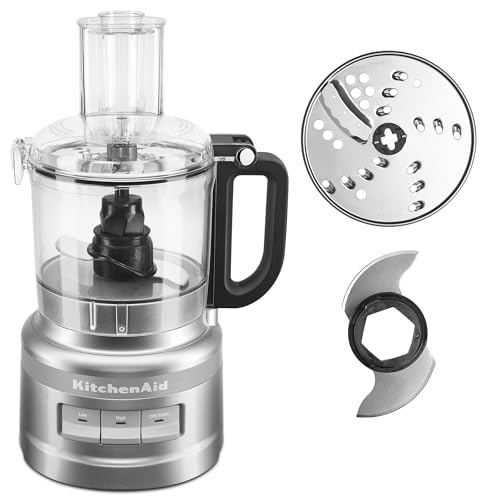
4. KitchenAid 7-Cup Food Processor KFP0718 — Best Mid-Size for Smaller Households
Not every home needs a 10-cup bowl, and forcing one on a household of two just creates washing-up. The KFP0718’s listing confirms a 7-cup bowl, three-speed control, a 2-in-1 feed tube, an easy-clean work bowl, and all-in-one storage for blades and discs. That is a complete home processor scaled to smaller batches: dinner for two or three, a pie, a batch of pesto, weekday vegetables. The storage design deserves emphasis for home use, because blades that live inside the bowl are blades that are always findable, and the machine assembles in seconds.
Strengths
- 7-cup bowl honestly sized for one-to-three-person households
- All-in-one storage keeps every blade and disc with the machine
- Three speeds plus a 2-in-1 feed tube cover varied daily prep
Trade-offs
- Family-size batches need splitting into two runs
- Not the pick for bulk meal prep or big dough batches
- Mid-tier price for a mid-size machine
Key specs (verified):
- Capacity: 7-cup bowl (verified from listing)
- Controls: three-speed control (verified from listing)
- Feed tube: 2-in-1 design; all-in-one storage (verified from listing)
The mid-size class fails when makers simply shrink a big machine’s bowl and keep everything else clumsy. This one was designed at its size: the feed tube handles both a potato and a handful of herbs, the speeds give a gentle option for herbs and a strong one for cheese, and the bowl cleans without flour and paste hiding in seams. For daily cooking for two or three, it hits the exact point where the processor is faster than a knife for almost every task and never feels like overkill pulled out for one onion.
Its ceiling is batch size, plainly. A household that regularly cooks for six or preps for a freezer will run it twice for every job and should buy bigger. For its intended homes, though, it may be the most-used appliance on the counter, which is the highest praise a home-use guide can give.
Best for: couples and small families cooking daily at modest batch sizes / Not suited for: large households or high-volume meal preppers
Check on Amazon — check price on Amazon before you buy, since listings and included accessories change over time.

5. Cuisinart 14-Cup Food Processor DFP-14BCNY — Best for Large Families
Large families and enthusiastic home cooks process at a scale where mid-size machines become a bottleneck, and the DFP-14BCNY removes the bottleneck. Its listing confirms a 14-cup bowl, a 720-watt motor, and duties from mincing and dicing to shredding, pureeing, and kneading dough. A whole cabbage for slaw, cheese for a crowd, double pie crusts, and a family bread batch all fit in single runs. It suits households of five or more, multigenerational homes, and anyone whose cooking regularly feeds a table rather than a couple.
Strengths
- 14-cup bowl ends the two-run problem for family batches
- 720-watt motor handles dense and heavy loads confidently
- Dough and pastry ability confirmed alongside full prep functions
Trade-offs
- Big, heavy machine that wants permanent counter space
- Oversized for small daily jobs like a single sauce
- Premium tier and larger parts to wash
Key specs (verified):
- Capacity: 14-cup bowl (verified from listing)
- Motor: 720 watts (verified from listing)
- Functions: mincing, dicing, shredding, puree, kneading dough (verified from listing)
Scale changes what home cooking is practical. When the bowl swallows a whole batch at once, dishes that were weekend projects, big slaws, gratins, meatball mixes, double pastry, become weeknight options, and that quietly improves how a large household eats. The motor’s headroom also means hard jobs like shredding a full block of cheese or processing dense root vegetables do not slow the machine into strained, uneven work. Everything about it is built for repetition at volume.
The compromises are physical. It is heavy to move, wide on the counter, and its bowl fills a sink. Households under four people will feel those costs daily and use the capacity rarely, which is why this guide places smaller machines above it for general home use. For the big-family kitchen it fits, nothing else here does its job as well.
Best for: large families and high-volume home cooks feeding five or more regularly / Not suited for: small households or kitchens short on counter and storage space
Check on Amazon — check price on Amazon before you buy, since listings and included accessories change over time.

6. Ninja Mega Kitchen System BL770 — Best Processor-Blender System for Home Use
Some homes do not need a better processor; they need fewer appliances. The BL770’s listing confirms a 1500-watt base, a 72-ounce blender pitcher, an 8-cup processor bowl, and two 16-ounce cups, covering smoothies, frozen drinks, chopping, slicing, and dough in one system. The 8-cup bowl handles family prep credibly, the pitcher handles the blender workload entirely, and the cups cover single-serve drinks. It suits households that blend daily and prep regularly, especially where counter and cupboard space argue against two separate full-size machines.
Strengths
- One 1500-watt base replaces a separate blender and processor
- 8-cup processor bowl is a real family prep size, not a token attachment
- Single-serve cups add convenience for daily smoothies
Trade-offs
- Total parts count is high and needs organized storage
- Processor bowl is mid-size; the biggest batches still belong to 14-cup machines
- System value depends on actually using both blending and processing
Key specs (verified):
- Power: 1500 watts (verified from listing)
- Processor bowl: 8-cup; pitcher: 72-ounce (verified from listing)
- Cups: two 16-ounce single-serve cups (verified from listing)
Judged purely as a processor, the bowl is competent and powerful, bringing dough together fast and handling vegetables and cheese with the authority the wattage suggests. Judged as a household system, it is better than that: the morning smoothie, the afternoon salsa, and the evening soup prep all run off one base, and the counter holds one appliance instead of two. For homes where both functions genuinely earn their keep, that consolidation is worth more than a marginal difference in any single task.
Households that never blend should not pay the system premium in money or storage complexity; the conventional processors above will serve them better. But for the blend-and-prep home, this is the most space-efficient route to full capability in the guide, and its power ceiling is the highest here.
Best for: households that blend daily and process weekly, with limited appliance space / Not suited for: non-blenders or cooks wanting the largest processor bowl available
Check on Amazon — check price on Amazon before you buy, since listings and included accessories change over time.
Comparison Table
| Pick | Badge | Key spec | Best for |
|---|---|---|---|
| Cuisinart Core Custom 10-Cup Food Processor FP-110 | Best Overall for Home Use | 10-cup Core Custom platform | families cooking from scratch several nights a week who want one long-term prep station |
| BLACK+DECKER 8-Cup Food Processor Easy Assembly | Best Budget for Home Use | 8-cup bowl, 450W motor | budget-conscious families and first-time processor owners cooking varied weeknight meals |
| Hamilton Beach 10-Cup Food Processor 70730 | Best for Weekly Meal Prep | 10-cup bowl, bowl scraper | meal-prep households and batch cooks who process big volumes weekly |
| KitchenAid 7-Cup Food Processor KFP0718 | Best Mid-Size for Smaller Households | 7-cup bowl, 3 speeds, in-bowl storage | couples and small families cooking daily at modest batch sizes |
| Cuisinart 14-Cup Food Processor DFP-14BCNY | Best for Large Families | 14-cup bowl, 720W motor | large families and high-volume home cooks feeding five or more regularly |
| Ninja Mega Kitchen System BL770 | Best Processor-Blender System for Home Use | 1500W, 8-cup bowl, 72oz pitcher | households that blend daily and process weekly, with limited appliance space |
How to Choose the Best Food Processors for Home Use
Begin with household size and cooking frequency, because home use is a pattern, not a single task. A household of one or two cooking most nights needs a 7-cup machine that is pleasant at small batches. A family of four to five needs 10 cups to avoid splitting every job. A household of six or more, or one that batch-cooks, should look at 12 to 14 cups. Frequency matters as much as size: a machine used daily must assemble fast and wash easily, or it will be skipped; a machine used weekly can tolerate more ceremony. Be honest about both numbers before looking at any feature list.
Then check the core four functions in the listing itself: chop, slice, shred, and puree. A home processor that does those four well covers the overwhelming majority of real cooking. Discs for slicing and shredding are what separate a processor from a chopper, and they are what make slaws, gratins, and cheese prep fast. Controls should include pulse, because pulsing is how you dice an onion instead of pureeing it. Finally, look at storage design and bowl cleaning honestly; in home use, the best machine is the one that is never a chore to get out, use, and put away.
- Size the bowl to your household: 7-cup small, 10-cup family, 14-cup large
- Confirm chop, slice, shred, and puree in the listing before buying
- Pulse control is essential for texture in everyday chopping
- In-bowl accessory storage prevents the lost-disc problem
- Easy-clean bowls get used daily; fussy ones gather dust
Capacity, Discs, and Controls: What Home Cooks Actually Use
Capacity ratings describe the bowl’s total volume, but working capacity is lower, especially for liquids and dough. For home planning, treat the headline number as the dry-prep ceiling and expect comfortable liquid batches at roughly two-thirds of it. The slicing and shredding discs do the most daily work after the main blade: a reversible disc that slices on one side and shreds on the other covers most kitchens, and a feed tube wide enough for a potato half saves more time across a year than any exotic attachment. Specialty discs and spiralizers are pleasant extras; buy them only when a recipe you repeat demands them.
Controls divide into simple and programmed. Simple dial or button machines with low, high, and pulse suit most home cooking and are the easiest to teach to everyone in the household. Programmed machines add presets for dough or specific tasks, which help beginners and busy cooks. What matters more than the control style is responsiveness: the blade should start and stop crisply so pulsing gives you diced, not demolished, results. If several people in the home will use the machine, favor the design the least technical person can run confidently.
Where a Processor Fits in a Real Home Kitchen
A home processor earns its place by replacing knife work that is slow, repetitive, or tear-inducing: onions by the kilo, cheese by the block, cabbage by the head, pastry and crumb crusts, sauces and purees by the batch. It does not replace a knife for a single tomato, and it does not replace a blender for silky drinks or a mixer for big doughs. Homes get the most from the machine by assigning it a prep session: ten minutes of processing at the start of cooking, or a weekly session that fills containers of shredded cheese, sliced onions, and sauce bases. That rhythm turns the processor from an occasional gadget into the kitchen’s quiet labor-saver, and it is the pattern the picks in this guide were chosen to support.
A Home Processor’s First Month: Building the Habit
The first month decides whether a home processor becomes infrastructure or clutter, and the pattern that works is deliberate repetition of small wins. In week one, use it for the jobs with instant payoff: shredding a block of cheese, slicing onions without tears, making one sauce you already love. In week two, add a full meal’s prep, a stir-fry’s vegetables or a soup’s base, and notice how the cooking itself shortens when the knife work is done in minutes. By week three, try the first project food: pastry, a batch of meatballs, hummus in quantity. Each success lowers the activation energy of the next use, which is the entire mechanism by which appliances earn their keep.
Two habits protect the investment from day one. First, wash and reassemble the machine immediately after use, storing it complete; a processor stored in pieces is a processor with a setup cost, and setup cost is what kills weeknight use. Second, keep a small mental list on the fridge of what the machine does faster than you do, because in the tired moment of deciding how to start dinner, that list is what gets the bowl out. Households that build these two habits in the first month almost never relegate the machine to the back of a cupboard, which is why this guide weighted storage design and cleanup so heavily in its picks.
Knife or Processor? An Honest Division of Labor
A food processor does not replace knife skills, and pretending otherwise produces bad cooking and resentful owners. The knife wins for a single onion, a tomato, herbs in small quantities, and any job where the setup and washing exceed the cutting. The processor wins, overwhelmingly, at volume and repetition: onions by the kilo, cheese by the block, cabbage by the head, pastry and crumb mixtures, sauces and purees, and any slicing job where uniform thickness decides how evenly food cooks. The crossover point in most homes is roughly three items: below that, reach for the knife; above it, the processor pays for its washing in saved minutes and saved tears.
There is also a quality dimension. Uniform slices cook uniformly, which is why gratins, scalloped potatoes, and stir-fries genuinely improve with processor prep, while a rustic soup loses nothing to hand-chopped vegetables. Skilled home cooks use both tools without ideology, and the picks in this guide were chosen to be excellent at the processor’s side of that line: fast assembly for the small end of volume, honest capacity for the large end, and textures controlled enough, through pulse and speed options, that the machine never forces puree where dice was wanted.
Safety and Care for a Family Food Processor
A home processor is a safe appliance used carelessly exactly once, so build the household’s habits early. Treat blades and discs as knives at all times: handle them by their hubs and edges designed for gripping, never by the cutting edge, and wash them separately rather than leaving them hidden in soapy water where a hand will find them. Assemble and disassemble on a clear counter, store sharp parts in the bowl or a dedicated container rather than loose in a drawer, and keep the machine unplugged while fitting or removing blades. Households with children should store the blade set out of reach even when the base itself lives on the counter, and teach older children on the simplest tasks with the pulse button treated as the serious control it is.
Care is equally simple and equally decisive. Wash the bowl, lid, and blade promptly after use so food films never set, dry metal blades thoroughly before storage to protect their edges, and never force a lid or bowl that resists: misalignment, not weakness, is the usual cause, and forcing breaks the interlock parts that keep the machine safe. Check the cord and the bowl’s locking tabs occasionally, run the machine empty for a second if it ever sounds strained to confirm it spins freely, and keep the manual’s model information somewhere findable. A processor maintained this way is a decade-long appliance, which is the economic foundation of every recommendation in this guide.
What Home Use Costs Over Time: A Qualitative Look
Without printing prices, which this guide never does, the ownership economics of a home processor are still worth understanding. The purchase is the smallest part: the real return comes from what the machine replaces, pre-shredded cheese, bottled sauces, bakery pastry, takeout slaw, bought in small marked-up quantities across years. Households that cook from ingredients consistently find the machine pays for itself in that quiet arithmetic, while households that mostly reheat will not, which is why this guide keeps returning to honest self-assessment of cooking frequency. The other long-term cost is replacement parts: a cracked bowl or a lost disc. Choosing makers and platforms with continuing parts availability, as the platform-style picks here offer, protects the original purchase far better than a small saving on an orphan model.
A Note on Lids, Interlocks, and Everyday Annoyances
Every modern food processor has a safety interlock: the motor runs only when the bowl and lid are correctly locked. New owners occasionally mistake a mis-seated lid for a dead machine, so learn your model’s alignment marks in the first week and the annoyance disappears forever. Feed tube pushers double as measuring cups and splash guards on many models, and using the pusher rather than fingers is both the safe and the intended way to feed the tube. These are thirty-second lessons, but they separate owners who find their processor effortless from owners who fight it, and they cost nothing to learn before the first real meal depends on them.
How to Set Up a Weekly Prep Routine With Your Food Processor
A simple weekly routine is the fastest way to make a home processor pay for itself. The session below takes under an hour and sets up days of faster cooking.
- Plan the week’s meals first and list every ingredient that needs chopping, slicing, shredding, or pureeing; group the list by blade or disc so you change attachments as few times as possible.
- Start with dry, clean jobs: shred cheese and slice firm vegetables first, since they leave the bowl cleanest and can go straight into containers.
- Move to onions, peppers, and herbs next, pulsing in short bursts and checking texture between bursts so nothing turns to puree.
- Finish with wet jobs: sauces, salsa, hummus, and purees, which leave the bowl messy but need no precision about what came before them.
- Portion everything into labeled containers as you go, noting the day it was prepped; most prepped vegetables keep several days refrigerated, and sauces freeze well.
- Wash the bowl, blade, and discs immediately in warm soapy water or the dishwasher where the maker allows, dry the blade carefully, and store all parts together.
- Note what ran out and what went unused, and adjust next week’s list; within a month the routine matches your household’s real eating instead of an idealized plan.
Keep the machine somewhere it can be reached without moving other appliances. In home use, thirty seconds of access friction is the difference between a processor that is used daily and one that is admired monthly.
Common Buying Mistakes
Buying capacity for the biggest meal of the year. A machine sized for a holiday crowd is oversized for fifty weeks of dinners. Size for your normal week and split the rare huge batch into two runs instead.
Processing everything on continuous run. Onions, herbs, and salsa need pulses, not a long spin. Continuous running is the fastest route to puree when you wanted dice; pulse and look, then pulse again.
Ignoring storage until parts go missing. A processor missing its shredding disc is half a machine. Choose designs that store accessories together, and give the set one home in the cupboard from day one.
Letting the bowl sit dirty. Dried sauce and dough turn a two-minute rinse into a twenty-minute soak. Home machines stay pleasant only with a wash-it-now habit, which easy-clean and dishwasher-safe designs make painless.
Expecting one machine to do every job. A processor will not blend a silky smoothie like a blender or knead a huge dough like a mixer. Buy it for chopping, slicing, shredding, and pureeing, and it will excel at exactly the work home kitchens repeat.
Final Recommendation
For the widest range of households, the Cuisinart FP-110 is the home-use recommendation: right-sized at 10 cups, refined in daily operation, and built on a platform that grows with your cooking. The BLACK+DECKER 8-Cup proves a tight budget does not require giving up real slicing and shredding, the Hamilton Beach 70730 is the meal-prep specialist, and the KitchenAid KFP0718 serves smaller households better than any big machine could. Large families should go straight to the Cuisinart 14-Cup, and blend-heavy homes to the Ninja BL770 system.
Match the machine to your household’s actual week, keep its parts together, and give it a weekly prep session. A food processor chosen that way stops being an appliance purchase and becomes the reason home cooking feels manageable on a Tuesday night.
If you want the shortest path to a decision, check these three first: Cuisinart Core Custom 10-Cup Food Processor FP-110, BLACK+DECKER 8-Cup Food Processor Easy Assembly, Hamilton Beach 10-Cup Food Processor 70730. Each links to its live listing so you can check price on Amazon and confirm the current bundle before ordering.
Keep exploring this category with our related guides: Best Food Processors For Dough Best Food Processors For Emulsifying Best Food Processors For House Use Best Food Processors For Baking Best Food Processors For Baby Food
Frequently Asked Questions
What size food processor is best for home use?
For most families, 10 cups is the sweet spot: big enough for family batches, manageable for daily jobs. Households of one or two do better with 7 cups, and large families or batch cooks should consider 12 to 14 cups. Size to your normal week, not your biggest holiday.
Do I need slicing and shredding discs at home?
For most home cooks, yes. The discs are what turn a processor into a time-saver for cheese, slaw, gratins, and sliced vegetables. A chopper without discs is fine for sauces and small jobs but will not replace knife work the way a full processor does.
Can a home food processor replace a blender?
Only partly. A processor handles chopping, slicing, shredding, and thick purees better, while a blender makes smoother drinks and soups. Households that do both regularly are the ones who benefit from a combined system like the Ninja BL770 in this guide.
How do I stop onions turning to mush in the processor?
Cut them into even chunks, fill the bowl loosely, and use short pulses, checking after every two or three. Continuous running liquefies the bottom layer while the top is still chunky. Pulsing with a quick scrape-down gives an even dice.
Is a food processor worth it for a small household?
Yes, if it is sized honestly. A 7-cup machine used for daily vegetables, sauces, pastry, and cheese earns its space quickly in a small kitchen. The mistake is buying a 14-cup machine for two people; it will feel like a chore and be skipped.
How long should a home food processor last?
A well-kept machine from a major maker should serve for many years of regular use. Longevity comes from not overloading the bowl, washing parts promptly, and storing blades safely. Choose a model whose parts and accessories remain available, as the platform-style picks in this guide offer.
Should a home food processor be stored on the counter or in a cupboard?
Either works, and the right answer is the one that removes friction in your kitchen. On the counter, the machine is always ready and gets used for small jobs without a second thought, at the cost of permanent counter space. In a cupboard, it must be reachable without moving other items and stored complete with its blades, or the retrieval effort will quietly ration its use. The deciding test is honest: if a machine stored in your deepest cupboard would be used weekly, store it there; if not, give it counter space or choose a smaller model that fits the accessible shelf. The picks in this guide include storage-conscious designs precisely because this decision shapes real-world usefulness more than most specifications do.

