Disclosure: airfryerkitchensupply.com is reader-supported. When you buy through links on our site, we may earn an affiliate commission at no extra cost to you.
Where to buy
Every pick in this guide to the best can openers for seniors battery power is sold through Amazon. Battery formats and model revisions change in this category more than most — use the links below to confirm the exact model, its battery type and what is included before you buy:
- Kitchen Mama Auto 2.0 Electric Can Opener — Check the current price on Amazon
- Kitchen Mama Auto Electric Can Opener — Check the current price on Amazon
- Kitchen Mama Mini Plus Rechargeable Can Opener — Check the current price on Amazon
- Canslab Ultrablade PRO Electric Can Opener — Check the current price on Amazon
- Mueller Home SmoothEdge Electric Can Opener — Check the current price on Amazon
- Zyliss EasiCan Electric Can Opener — Check the current price on Amazon
Pay particular attention to the power line of each listing. Picks below run on replaceable batteries or recharge by USB as stated in their reviews; if a listing shows a different power arrangement under the same name, it is a different variant.
Introduction
The best can openers for seniors battery power share a simple promise: the can opens itself while your hands do almost nothing. No gripping and squeezing a manual opener, no wrestling a corded electric model out of a cupboard and hunting for an outlet — you set the opener on the can, press one button, and it travels around the rim on its own, stops, and lifts the lid away with the edge left smooth. This guide ranks six battery-powered models chosen for comfortable, low-effort everyday use in real kitchens.
Why battery power specifically, rather than electric opening in general? Freedom of place and posture. A battery opener works at the counter, at the table, or wherever the cook is sitting; it stores in a drawer instead of occupying counter space beside an outlet; and there is no cord to manage with wet hands. The trade-offs are equally real — batteries to replace or a device to recharge, and motors that prefer a steady pace to brute force — and this guide treats those honestly rather than pretending cordless convenience is free.
A note on framing: this guide talks about comfort, grip effort and ease of use, because those are the product qualities a buyer can actually compare. It makes no medical claims for any model. An opener that asks little of the hands is simply a better-designed opener — for seniors, for anyone recovering from a hand injury, for a tired cook at the end of a long day — and the picks below were chosen on design, not diagnosis.
Key Takeaways
- Every pick is fully automatic: place it on the can, press once, let it travel.
- Smooth-edge cutting is the must-have — blunt lids and rims, safe to handle.
- Choose the power routine that fits the house: swappable batteries or USB recharging.
- A slowing opener is asking for fresh power — answer before it stalls mid-can.
- These openers are judged on comfort and ease of use, with no medical claims attached.
In this guide
Quick Picks
Six battery openers in one line each — hands-free automatics, a rechargeable option, and the smooth-edge designs that leave lids safe to handle.
- Best Overall — Kitchen Mama Auto 2.0 Electric Can Opener: A cordless, hands-free automatic opener with a refined blade and smooth-edge cut — the second-generation version of the category’s best-known design. Check the current price on Amazon
- Best Proven Original — Kitchen Mama Auto Electric Can Opener: The original battery automatic — hands-free, smooth edge, battery operated — the design that proved this category works. Check the current price on Amazon
- Best Rechargeable — Kitchen Mama Mini Plus Rechargeable Can Opener: A compact rechargeable automatic with USB-C charging and hands-free auto stop — no battery drawer required. Check the current price on Amazon
- Best for Extra-Low Effort — Canslab Ultrablade PRO Electric Can Opener: A USB rechargeable automatic with smart auto stop, designed and marketed directly around effortless use for senior hands. Check the current price on Amazon
- Best Value Automatic — Mueller Home SmoothEdge Electric Can Opener: A battery operated, hands-free, one-touch automatic with a smooth-edge cut — the value route into this category. Check the current price on Amazon
- Best From a Classic Opener Brand — Zyliss EasiCan Electric Can Opener: A one-touch automatic with stainless steel blades from a long-established opener brand — hands-free design in a classic package. Check the current price on Amazon
How These Picks Were Chosen
Picks were chosen from can openers verified through Amazon listing held for this site. Only battery-powered models whose Amazon title confirmed the exact machine and its automatic, hands-free operation received a purchase link, and the spec boxes quote those verified listings. Corded electrics and manual openers, however good, were excluded — the search asks for battery power, and this guide answers the question asked.
The comfort criteria came first: one-button operation, no sustained grip or squeeze required, and a smooth-edge cut that leaves the lid safe to lift and the can rim safe to pour from. Practical power came second — replaceable batteries for grab-and-go simplicity, USB recharging where it genuinely suits the routine. Third was everyday robustness: openers that seat reliably on standard cans, stop cleanly at the end of the cut, and come away without fishing for the lid in the food.
- One-button, hands-free operation: the opener travels the rim itself — no gripping, squeezing or holding required during the cut.
- Smooth-edge cutting: lids separate cleanly with no sharp edge on lid or can, for safe handling and pouring.
- Battery practicality: replaceable cells or USB recharging that fits a real routine, with the format stated plainly per pick.
- Reliable seating and stopping: the opener aligns on standard cans without fiddling and stops at the end of the cut without chewing the rim.
- Lid handling: the lid lifts away with the opener or a magnet, not fished out of the food with fingers or a fork.
The 6 Best Can Openers for Seniors Battery Power

Kitchen Mama Auto 2.0 Electric Can Opener — Best Overall
The Kitchen Mama Auto 2.0 is the refined version of the opener that defined this category, and it earns the top spot on the completeness of the experience. Place it on the can, press the button, and it walks itself around the rim — no grip strength requested at any point — cutting from the side so the lid separates with a smooth edge and lifts away with the opener when you pick it up. The ‘2.0’ refinements are in the blade and the seating: it finds the rim more reliably on the first placement and tracks more steadily on cans that are slightly dented or off-round.
Strengths
- Fully hands-free — set it on, press once, it does the travelling
- Smooth-edge cut leaves lid and can rim safe to handle
- Second-generation blade seats and tracks more reliably
Trade-offs
- Batteries are a recurring consumable
- Not designed for oversized catering cans
- Premium of the battery category — check price on Amazon
| Specification | Detail |
|---|---|
| Power | Battery powered, cordless |
| Operation | Automatic, hands-free, one button |
| Cut | Smooth edge |
| Colour | Navy Blue |
For a senior kitchen, the details compound kindly. The body is light and shaped to be set down with a whole-hand placement rather than pinched into position. The smooth-edge cut means the removed lid can go straight into recycling handling without a sharp rim, and the can itself pours without a jagged lip. Battery power keeps it in the drawer by the cans, not on the counter by the outlet, and it is ready the second it is picked up.
Like all battery automatics, it asks for fresh batteries to keep its pace brisk, and very large catering cans are outside its design brief. For the standard cans of a home kitchen, it is the most polished expression of the idea in this guide — the opener you buy when you want the category’s best version of itself.
The Auto 2.0’s steadier tracking pays off most on the cans other automatics dislike — the slightly dented ones from the back of the store cupboard. Where a lesser unit wanders and needs a second placement, this one usually completes the circuit, which is the refinement its name promises, delivered where it counts.
Best for: seniors wanting the most polished hands-free opener / Not suited for: households opening very large cans regularly
Check the current price on Amazon

Kitchen Mama Auto Electric Can Opener — Best Proven Original
The original Kitchen Mama Auto is the pick for buyers who value a proven design over a refined one. It established the formula the whole category follows — sit it on the can, one button, the opener travels the rim unaided, the lid comes away with a smooth edge — and it has been opening cans on that formula for years, in enormous numbers of kitchens. There is a particular confidence in buying the original of a category: the quirks are known, the technique is documented by a legion of owners, and nothing about it is experimental.
Strengths
- The category’s original, proven design
- Fully automatic and hands-free with a smooth-edge cut
- Easy to spot and handle in a busy drawer
Trade-offs
- Seats slightly less certainly than the 2.0 on dented cans
- Batteries are a recurring consumable
- Fewer refinements than the newer generation
| Specification | Detail |
|---|---|
| Power | Battery operated |
| Operation | Automatic, hands-free |
| Cut | Smooth edge, food-safe design |
| Colour | Red |
In use it asks nothing of the hands beyond placement and a button press, which is the entire point for this guide’s readers. The smooth-edge, food-safe cut keeps the blade path outside the food and leaves both lid and rim blunt. The red finish, beyond cheerfulness, is genuinely easier to spot in a drawer — a small, practical mercy that owners mention more than any spec.
Against its 2.0 sibling, the original seats a touch less certainly on awkward cans and lacks the newer blade refinement; against the rest of this guide, it remains the benchmark of simplicity. If the price gap matters more than the polish, this is the sensible buy — the same idea, proven longer.
The original’s enormous ownership base carries a practical benefit: every question a new owner might ask — battery life in practice, behaviour on a particular can shape, cleaning the head — has been answered publicly many times over. For a buyer who likes to research before trusting, no pick here offers deeper water.
Best for: buyers who prefer the proven original at a friendlier tier / Not suited for: buyers who want the latest blade refinement
Check the current price on Amazon

Kitchen Mama Mini Plus Rechargeable Can Opener — Best Rechargeable
The Mini Plus answers the one recurring complaint about battery openers — the batteries — by removing them. It recharges by USB-C, the same cable as a modern phone, so the routine becomes: when it eventually slows, plug it in where the phone charges, and forget it again for a long stretch of cans. For seniors who dislike keeping track of cell sizes and spares, and for households that have standardised on USB charging, that is a genuine quality-of-life difference rather than a gadget flourish.
Strengths
- USB-C recharging ends battery buying and swapping
- Compact body fits shallow utensil drawers
- Hands-free auto stop finishes the cut cleanly
Trade-offs
- Must be charged — a flat unit cannot be revived instantly
- Heavy daily use means more frequent charging
- Small body offers less to hold for users who prefer a larger grip
| Specification | Detail |
|---|---|
| Power | Rechargeable, USB-C charging |
| Operation | Hands-free with auto stop |
| Cut | Smooth edge |
| Colour | Red |
The ‘mini’ is real: this is the most compact automatic here, storing in the shallow drawer where openers actually live, and its hands-free auto stop ends the cut cleanly without the user judging the moment. The smooth-edge cut matches its siblings — lid away cleanly, rim safe — and the cordless body keeps the set-it-and-watch-it simplicity that defines the category.
The rechargeable bargain has two edges. A rechargeable that is flat is a paperweight until charged, where a battery model is one cell-swap from service; and very heavy daily use will visit the charger more often than the marketing suggests. For ordinary household can traffic, though, the Mini Plus is the most modern, least-fuss power arrangement in this guide.
A charging habit worth adopting: top the Mini Plus up where the phone charges, on a rhythm — the first of the month, say — rather than waiting for the slow-travel warning. Rechargeable tools reward routine charging exactly the way they punish forgotten charging, and a calendar habit makes the question disappear.
Best for: seniors who prefer charging over buying batteries / Not suited for: users who want instant revival with a fresh battery
Check the current price on Amazon

Canslab Ultrablade PRO Electric Can Opener — Best for Extra-Low Effort
The Canslab Ultrablade PRO is designed from the senior brief outward rather than adapted to it: one touch starts the cut, the opener travels the rim itself, and a smart auto stop ends the cycle and releases without the user timing anything or prising the unit off the lid. For hands that find sustained grip genuinely tiring — whatever the reason — that total absence of required effort, from placement to removal, is the product. This guide frames it as comfort and ease of use, and on those terms the Canslab is engineered as carefully as anything here.
Strengths
- One-touch start and smart auto stop — minimal hand effort throughout
- USB rechargeable, no battery management
- Purpose-designed around senior ease of use
Trade-offs
- Younger brand with a shorter track record
- Rechargeable — plan around charging, not swapping
- Availability of variants can vary — check the listing carefully
| Specification | Detail |
|---|---|
| Power | USB rechargeable |
| Operation | Automatic with smart auto stop |
| Design | Built for low-effort, one-touch use |
| Cut | Smooth-edge class cutting |
USB recharging keeps the power routine in the phone-charger world, and the body is sized to be placed with a whole hand rather than manipulated with fingertips. The cut follows the category’s smooth-edge pattern, so lids come away blunt and the can pours cleanly — the safety half of the comfort brief, handled as standard.
Canslab is a younger brand than Kitchen Mama, with a thinner long-term track record behind it, and buyers who weight proven years over designed intent should look at the picks above. Buyers whose priority is the lowest-effort interaction available in a battery opener will find this machine aimed precisely at them.
The smart auto stop deserves a specific mention for users opening cans while doing something else — which is to say, all cooks. The cycle ends itself and the unit waits to be lifted away, so the opener can be started, the stove attended, and the finished can collected without a timing judgement anywhere in the sequence.
Best for: users who want the lowest-effort opening interaction available / Not suited for: buyers who prioritise long-proven brands
Check the current price on Amazon

Mueller Home SmoothEdge Electric Can Opener — Best Value Automatic
The Mueller Home SmoothEdge brings the category’s essential experience — battery power, one touch, hands-free travel, smooth-edge cut — to the value end of the shelf. For a senior equipping a kitchen on a budget, or a family buying a second opener for a parent’s house, that matters: the difference between this and the premium picks is refinement, not capability. It seats, travels, cuts and releases the way the category promises, and the lid comes away blunt-edged for safe handling.
Strengths
- Full hands-free automatic experience at a value tier
- SmoothEdge cut leaves lids safe to handle
- Simple one-touch operation with no learning curve
Trade-offs
- Lighter build and less assured travel on dented cans
- Durability record still being written
- Batteries are a recurring consumable
| Specification | Detail |
|---|---|
| Power | Battery operated |
| Operation | Automatic, hands-free, one-touch |
| Cut | SmoothEdge |
| Brand | Mueller Home |
Mueller’s kitchen-tool background shows in the basics being right: the body is easy to place, the button is unambiguous, and the smooth-edge mechanism follows the established, food-safe pattern of cutting outside the rim. Battery operation keeps it drawer-stored and outlet-free like its peers, ready at the moment a recipe calls for a can.
Value-tier compromises are in finish and finesse: the unit feels lighter, the travel pace is a touch less assured on imperfect cans, and long-term durability is a reasonable question rather than a proven record. As an entry into effortless opening — or a second unit for a holiday home — it is honestly specified and honestly priced by tier: check price on Amazon.
As a gift purchase — the way many of these openers enter a parent’s kitchen — the Mueller’s value tier and simple operation make it the low-risk introduction to the category. If the recipient takes to automatic opening, the premium picks await; if not, little was spent learning so.
Best for: budget buyers wanting genuine hands-free opening / Not suited for: buyers seeking the most refined or proven unit
Check the current price on Amazon
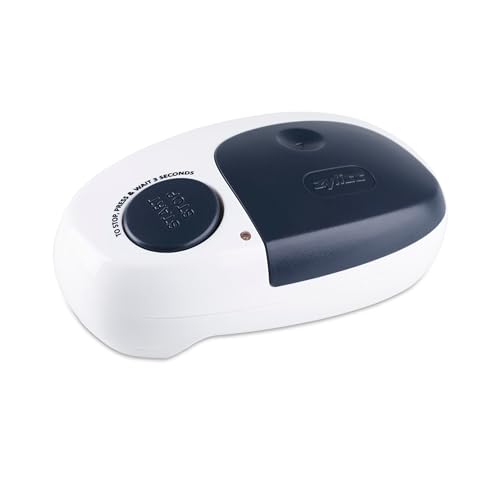
Zyliss EasiCan Electric Can Opener — Best From a Classic Opener Brand
The Zyliss EasiCan is the pick for buyers who trust brands with long kitchen histories. Zyliss has made can openers — including manual designs that seniors have used comfortably for decades — for generations, and the EasiCan applies that heritage to the battery automatic format: one touch, hands-free travel around the rim, and stainless steel blades doing the cutting. For a buyer choosing a gift for a parent, that brand reassurance often settles the decision, and it is not an irrational way to settle it.
Strengths
- One-touch automatic from a long-established opener brand
- Stainless steel blades and a wipe-clean compact body
- Hands-free design asks nothing of grip strength
Trade-offs
- Plainest feature set in this guide
- Less specialised than the Kitchen Mama designs
- Battery consumables, as with the category
| Specification | Detail |
|---|---|
| Operation | One-touch automatic, hands-free |
| Blades | Stainless steel |
| Brand | Zyliss |
| Colour | White |
The EasiCan’s manner is calm competence. It places, engages and travels without drama, and the hands-free design means the user’s role is supervision rather than labour. The white, compact body stores neatly and wipes clean — a practical point in a category where openers live near splashing cans and accumulate grime in crevices if the design invites it.
Against the Kitchen Mama pair, the EasiCan is less specialised — a very good general automatic rather than the category-defining one — and its feature set is the plainest here. Buyers who want the opener from the opener company, executed without fuss, will find exactly that.
Zyliss’s manual openers have a long record in comfort-focused design, and the EasiCan inherits the sensibility: nothing sharp, nothing fiddly, nothing that requires a manual to be believed. Brand continuity matters in a category bought on trust, and this pick is the trust candidate.
Best for: buyers who value an established kitchen brand / Not suited for: buyers wanting the newest refinements
Check the current price on Amazon
Comparison Table
All six are battery automatics — the differences that matter are power format (replaceable or rechargeable), refinement and brand record. The table lines them up on exactly those terms.
| Pick | Badge | Key spec | Best for |
|---|---|---|---|
| Kitchen Mama Auto 2.0 Electric Can Opener | Best Overall | Cordless battery operation, automatic hands-free, smooth edge cut | seniors wanting the most polished hands-free opener |
| Kitchen Mama Auto Electric Can Opener | Best Proven Original | Battery operated, automatic hands-free, smooth edge | buyers who prefer the proven original at a friendlier tier |
| Kitchen Mama Mini Plus Rechargeable Can Opener | Best Rechargeable | USB-C rechargeable, hands-free auto stop, cordless smooth edge | seniors who prefer charging over buying batteries |
| Canslab Ultrablade PRO Electric Can Opener | Best for Extra-Low Effort | USB rechargeable, smart auto stop, automatic one-touch operation | users who want the lowest-effort opening interaction available |
| Mueller Home SmoothEdge Electric Can Opener | Best Value Automatic | Battery operated, hands-free one-touch, SmoothEdge cut | budget buyers wanting genuine hands-free opening |
| Zyliss EasiCan Electric Can Opener | Best From a Classic Opener Brand | One-touch automatic, hands-free design, stainless steel blades | buyers who value an established kitchen brand |
How to Choose a Battery Can Opener for a Senior Kitchen
Choosing among the best can openers for seniors battery power is mostly a decision about power routine and confidence. The opening itself is solved by every pick here — one button, no grip work, a smooth edge — so shop the ownership details: how the unit is powered, how it behaves on imperfect cans, and how much track record stands behind it.
The sections below cover those decisions in plain terms, with the comfort framing kept where it belongs: on the product’s design, not on promises about anyone’s hands.
Replaceable batteries or rechargeable?
Replaceable cells offer instant revival — swap and open — and suit kitchens that already keep batteries for remotes and clocks. Rechargeable USB models end the battery drawer entirely and suit households standardised on phone-style charging, at the cost of planning around a flat unit. Neither is better; match the power routine to the household’s existing habits and the opener will never be the wrong kind of ready.
Smooth edge is the safety feature that matters
Every pick here cuts so the lid separates with a blunt edge and the can rim stays smooth. That is worth more than any other single feature for this guide’s readers: the removed lid can be handled and recycled without a blade-like rim, and the opened can pours and spoons cleanly. When comparing any opener beyond this guide, make the smooth-edge cut the first question — a sharp-edge automatic solves the effort problem and keeps the handling problem.
Seating, travel and the dented-can test
Real cans are not perfect cylinders. The better automatics seat on the first placement and track steadily around slight dents; lesser ones need repositioning and wander. The refinements that separate this guide’s top picks are mostly this — unglamorous, and decisive in daily use. If a household buys economy cans in quantity, weight seating reliability heavily; it is the difference between effortless and fiddly.
Size, storage and spotting it in the drawer
Battery openers live in drawers, so judge the body as a drawer object: compact enough for the utensil drawer, shaped to be lifted out with a whole-hand grasp, and — an underrated point — visible. A bright colour or a distinctive shape that the eye finds instantly is a daily convenience. The best opener is the one that is found, used and put back without a thought, fifty weeks a year.
Trying before committing: the two-can test
If you can handle a model before buying — in a store, or at a relative’s kitchen — two cans tell you nearly everything. The first is a standard can in good condition: the opener should seat on the first placement, travel without wandering and stop cleanly. The second is the awkward one from your own cupboard, slightly dented or with a heavy label seam: this is where refinement separates from adequacy, and where the better picks in this guide earned their order. An opener that passes both cans will not surprise you later; the category has no hidden third act.
When a manual opener is still the right tool
Honesty requires keeping a place for the manual opener in this kitchen. Oversized catering cans, badly crushed rims and the emergency can during a power-and-battery drought all belong to a sturdy manual design with a comfortable handle. Several households in this guide’s audience keep exactly two openers: the battery automatic for the ninety-five percent, and one good manual for the remainder. That is not a failure of the category — it is the correct toolkit, and the manual’s job is so rare that its effort hardly matters.
How to Use a Battery Can Opener (And Keep It Working)
The automatic does the work, but a few habits keep it working well for years. This routine applies to every pick in this guide.
- Start with a clean, dry rim: wipe any liquid or label glue from the can’s top rim. The opener seats and grips by the rim; a clean rim is a reliable cut.
- Place the opener flat and square: set it on the lid so it sits level, with the cutting wheel at the rim. A level start is the whole technique — the machine does the rest.
- Press once and let go: one press starts the travel. Do not hold the unit down or steer it; hands-free means hands off, and guiding hands only fight the mechanism.
- Support tall or light cans: for a tall, nearly empty can, rest a hand lightly against the can’s side — not the opener — so the can does not travel with it.
- Let it stop itself: automatic and auto-stop models finish the circuit and halt. Lift the opener away and the lid comes with it, smooth edge and all.
- Wipe the cutting head after use: a quick wipe of the wheel and housing keeps food residue from building up where the next can must seat.
- Mind the power: battery models get a fresh set when travel slows; rechargeable models go on charge at the same symptom. A slowing opener is asking, politely, before it fails mid-can.
If an opener ever stalls mid-rim, lift it off, check the rim for a dent or label obstruction, and restart it just past that spot. Nearly every stall is the can, not the machine.
Why Battery Beats Corded at This Job
It is worth pausing on why this category exists at all, because the corded electric opener had decades to own the kitchen and quietly lost the drawer to these battery machines. The corded model’s problems were never power — they were place and posture. It demanded counter space beside an outlet, a can lifted and held against a cutting head at the machine’s height, and a hand steadying the can while the mechanism worked. The battery automatic inverts every term: it lives in a drawer, works wherever the cook is — counter, table, seated — and asks the hands only to place it and press a button, after which the can supports the opener rather than the other way round. For a senior kitchen, that inversion is the product. It also travels: to a holiday home, to a caravan, to a relative’s house where the opener is a wrestling match. Categories rarely turn over completely without a structural reason, and here the reason is that opening a can was never really a countertop task. It was always a wherever-you-are task, and battery power is what finally let the tool go to the work.
Setting Up a Kitchen Where Cans Open Themselves
A battery opener delivers its full value inside a small system, and the system is worth arranging once. Keep the opener in the shallow drawer nearest the food preparation area — not with the gadgets, with the daily tools — and keep its power with it: spare batteries in the same drawer, or the charging cable in the same spot, so the power routine never becomes a search. Store cans where they are used, at heights that do not demand reaching and gripping overhead; the opener removed the opening effort, and the storage should not reintroduce effort upstream of it. Keep the backup manual opener — every kitchen should own one for the oversized and damaged cans — in the same drawer, so the exception lives beside the rule. And make the first use a demonstration rather than a discovery: a battery automatic’s technique is thirty seconds to show and obvious forever after, but a senior handed one cold may reasonably not trust that it truly needs no help. Set up this way, the category’s promise holds completely: cans stop being an event in the kitchen’s day.
Designing for the Hands Everyone Will Have
There is a quiet principle behind this whole category that deserves naming: hands change. Grip that was thoughtless at forty is considered at seventy, and the cooks who plan their kitchens for the hands they will have — rather than the hands they remember — cook independently for longer and enjoy it more. The battery automatic opener is the purest expression of that planning in the small-appliance world, because it removes the hand from the work entirely rather than merely assisting it. But the principle extends past this guide: lever-style handles over twist knobs, tools that work by placement rather than by squeeze, appliances whose controls are buttons the size of a fingertip rather than dials the width of a coin. None of this is about frailty; it is about removing friction from a daily pleasure so the pleasure survives. The seniors this guide is written for are, in the main, experienced cooks with standards — the audience least willing to accept a worse kitchen in exchange for an easier one. The picks here were chosen to demand no such exchange: the opening is easier and the result, a clean smooth-edged can, is better than the manual standard ever produced.
The Gift Question: Buying an Opener for a Parent
A large share of these openers are bought by adult children for parents, and that purchase has its own etiquette and pitfalls worth a short section. The pitfall is framing: an opener presented as a concession lands as one, however kind the intent. Presented as what it actually is — the newer, better tool that the giver also uses — it lands as an upgrade, which has the advantage of being true. Include the batteries or charge it before wrapping; set it up in the drawer rather than leaving it boxed; and open the first can together, so the thirty-second technique transfers with the gift. Choose the model by the parent’s kitchen habits rather than by the buyer’s: the battery routine they already keep, the drawer it will live in, the can sizes their cooking actually uses. The picks in this guide span those variables deliberately. Get them right and the gift disappears into the kitchen’s routine within a week — which is the highest compliment a kitchen tool can be paid, and the surest sign the choice was correct.
Common Buying Mistakes
Holding the opener down while it works
Hands-free automatics are designed to travel under their own engagement. Pressing or steering adds uneven pressure, makes the cut wander and can stall the motor. Place it, press the button, and trust the design you paid for.
Buying a sharp-edge automatic by accident
Some automatics still cut inside the rim, leaving a blade-edged lid. For this guide’s readers that defeats half the purpose. Confirm the smooth-edge cut — every pick here has it — before buying any model.
Ignoring the slowing-travel warning
A battery opener announces weak power by travelling slowly long before it stops. Treating that as normal leads to the mid-can stall at the worst moment. Fresh batteries or a charge at the first slowdown keeps the routine effortless.
Storing it where it cannot be found
An opener that lives in a deep, crowded drawer loses to a manual opener that lives in the right one. Give the battery unit the front of a shallow drawer — the entire value of the category is the ten-second, no-effort opening it enables.
Using it on cans outside its design
Oversized catering cans and badly damaged rims defeat compact automatics. Keep a sturdy manual opener for those rare jobs rather than forcing the battery unit past its brief and blaming it for the mismatch.
Final Recommendation
For most senior kitchens, the Kitchen Mama Auto 2.0 is the complete answer — the refined, reliable, hands-free experience this category promises. The original Kitchen Mama Auto is the proven, friendlier-tier version of the same idea. Households done with batteries should take the Mini Plus or the Canslab Ultrablade PRO, both USB rechargeable, with the Canslab the lowest-effort interaction of all; the Mueller SmoothEdge is the value route, and the Zyliss EasiCan the established-brand choice.
The best can openers for seniors battery power succeed by disappearing: drawer to can, one button, lid away, done. Choose the power routine that fits the household, insist on the smooth edge, and opening a can stops being a task worth thinking about — which is precisely the point.
- Kitchen Mama Auto 2.0 Electric Can Opener — Check the current price on Amazon
- Kitchen Mama Auto Electric Can Opener — Check the current price on Amazon
- Kitchen Mama Mini Plus Rechargeable Can Opener — Check the current price on Amazon
Best Can Openers For Seniors Best Battery Operated Can Openers Best Can Openers For Elderly
Frequently Asked Questions
How do battery can openers actually work?
You place the opener on top of the can and press one button. A motor drives it around the rim while a cutting wheel separates the lid — on the smooth-edge models here, from the side, so both lid and rim are left blunt. At the end of the circuit it stops, and the lid lifts away with the opener.
Are smooth-edge lids really safer to handle?
Yes — that is the design’s purpose. A smooth-edge cut leaves no blade-like rim on the removed lid or the can, so handling, emptying and recycling are all free of the sharp edge a traditional cut leaves. It is the single most valuable feature in this category for this guide’s readers.
How often do the batteries need changing?
It depends on can traffic, but the opener tells you: travel slows noticeably as power fades. Changing batteries — or recharging, on the USB models — at that first slowdown keeps every opening effortless and avoids a mid-can stall.
Can these openers handle large or tall cans?
Standard and tall household cans, yes. Oversized catering cans are outside the compact automatics’ design; keep a sturdy manual opener for those rare jobs. Slightly dented cans are handled well by the better-seating picks, notably the Kitchen Mama Auto 2.0.
Rechargeable or replaceable batteries — which is better for a senior?
Whichever matches the household’s habits. Replaceable cells revive instantly with a swap; USB rechargeable models remove battery management entirely but need charging when they fade. Both power routines appear in this guide’s picks for exactly that reason.
What if the opener stalls halfway around?
Lift it off, check the rim for a dent, a label edge or dried food obstructing the wheel, wipe the rim, and restart just past that spot. Stalls are almost always the can’s condition, not the machine’s failure.
Do these openers work on pull-tab cans?
They are designed for standard rimmed cans, and most pull-tab cans also carry a rim the opener can travel — though the tab itself usually makes the opener unnecessary. Use the tab where one is fitted, and keep the automatic for the cans that genuinely need cutting, which is where its effortlessness earns its drawer space.
How do I clean a battery can opener?
Wipe the cutting head and housing with a damp cloth after use, especially after cans with sauces or oils, and dry it before it goes back in the drawer. The cutting wheel area is where residue gathers; a quick wipe there keeps the next can seating cleanly. None of these units should be immersed or put through a dishwasher — the motor and batteries live inside.
Can one of these openers be used with either hand?
Yes — the automatics are effectively ambidextrous, since the hand only places the unit and presses a button; there is no crank to turn with a dominant hand and no grip to sustain. Placement works from either side of the can, which is part of why the format suits so many different users without adaptation.
What happens if the batteries die mid-can?
Lift the opener off, replace the batteries or charge the unit, and restart it at the point where it stopped — the partial cut does not damage the can or the mechanism. To avoid the situation entirely, act on the early warning: travel that has slowed is the opener asking for power, usually several cans before it would actually stop.
Best Affordable Can Openers Best Can Openers Long Lasting Best Bread Machines For Sourdough


