Disclosure: airfryerkitchensupply.com is reader-supported. When you buy through links on our site, we may earn an affiliate commission at no extra cost to you.
Where to buy
This shortlist of the best can openers long lasting was verified model by model before a single link was placed. A can opener is one of the cheapest tools in the kitchen, which is exactly why people keep buying the same flimsy one twice. The long-lasting route is boring on purpose: a hardened cutting wheel, a body that does not flex, and a design you can actually clean. Every pick below was confirmed against a live Amazon listing through our verification pass, so use the Check on Amazon links to check price on Amazon for the exact model named — opener listings get bundled, recolored and renamed often, and the model number is what keeps you from ordering the wrong variant.
- OXO Steel Can Opener (Best Overall): Check on Amazon
- Zulay Kitchen Manual Can Opener Heavy Duty (Best Heavy-Duty Build): Check on Amazon
- KitchenAid Classic Multifunction Can Opener (Best Classic Top-Cut): Check on Amazon
- OXO Good Grips Smooth Edge Can Opener (Best Smooth-Edge Manual): Check on Amazon
- Kuhn Rikon Auto Safety LidLifter (Best Safety Side-Cut): Check on Amazon
- Hamilton Beach Smooth Touch Electric Can Opener (76606AG) (Best Long-Lasting Electric): Check on Amazon
Finding the best can openers long lasting enough to survive a decade of weeknight cooking is less about features and more about failure points. Cheap openers die in predictable ways: the cutting wheel dulls and starts chewing the rim instead of slicing it, the turning knob cracks, the handles flex until the wheel skips, or rust blooms on a wheel that was never dried properly. A durable opener is built to avoid exactly those four deaths, and that is the lens this whole guide is written through.
Two families genuinely last. The first is the heavy manual opener: a thick stainless or high-carbon cutting wheel, riveted or cast handles, and no plastic in the load path. The second is the well-built electric, where longevity comes from a strong motor, a detachable cutting lever you can wash, and a wheel that never touches food. Both families appear below, because the right answer depends on your hands as much as your cans — a manual opener that outlives its owner is no bargain if arthritic fingers cannot turn it.
One honest note before the picks: the two most famous old-school American openers are sold through a rotating cast of marketplace listings, and we could not confirm one stable listing for them in this verification pass, so they are discussed as unlinked context in the buying guide rather than given links. Everything with a Check on Amazon link below was matched, model by model, to a verified listing on 2026-11-21. Prices are never printed here on purpose — they drift — so check price on Amazon on the listing itself.
In this guide
Quick Picks
- OXO Steel Can Opener — Best Overall: A stainless-wheel, soft-grip manual opener built like a tool rather than a gadget — the safest one-and-done purchase in this guide. Check on Amazon
- Zulay Kitchen Manual Can Opener Heavy Duty — Best Heavy-Duty Build: An oversized-knob, rust-proof manual opener whose whole pitch is brute durability — sharp stainless blade, soft-touch handles, built to be squeezed hard without flexing. Check on Amazon
- KitchenAid Classic Multifunction Can Opener — Best Classic Top-Cut: The familiar KitchenAid silhouette with a stainless wheel and ergonomic handles — a proven, easy-to-replace design from a brand that keeps the model in production. Check on Amazon
- OXO Good Grips Smooth Edge Can Opener — Best Smooth-Edge Manual: A side-cut manual opener that lifts the whole lid off with no sharp edges — more mechanism than a top-cutter, but heavily built and easy on the hands. Check on Amazon
- Kuhn Rikon Auto Safety LidLifter — Best Safety Side-Cut: A Swiss side-cut opener that never leaves a sharp edge and never touches the food, with a ring-pull tool built in — precision-built and hygienic by design. Check on Amazon
- Hamilton Beach Smooth Touch Electric Can Opener (76606AG) — Best Long-Lasting Electric: A countertop electric that cuts from the side with an easy push-down lever — no hand strength required, and the cutting wheel stays out of the food. Check on Amazon
How These Picks Were Chosen
We started from the failure data, not the feature lists. For each candidate we asked what physically wears out: the wheel edge, the gear teeth, the knob axle, the handle joint, the motor, or the finish. Models whose listings showed a stainless or high-carbon wheel, a rigid frame, and replaceable or washable cutting parts scored highest. Models that hid their materials behind words like ‘premium’ with no metal named were dropped.
We then split the field by cut style. Top-cut openers slice inside the rim and leave a sharper edge but are usually simpler and cheaper to build well. Side-cut (smooth-edge) openers slice below the rim, cost more, and have more moving parts — yet the good ones are heavily built because the mechanism demands it. Both styles earned places, labeled clearly, so you can choose durability in the style you prefer.
Finally, every product below was cross-checked against the airfryerkitchensupply.com catalog data: brand and model searched, the returned title matched to the product we intended to write about, and the ASIN taken from that response. No match meant no link. That is why a couple of famous names appear only in prose — we would rather lose the link than guess an identifier.
One more filter was applied that rarely appears in roundups: repairability and continuity. A long-lasting purchase is only long-lasting if the model stays in production and the design stays stable, so preference went to openers from lines with long market histories — the OXO, KitchenAid, Kuhn Rikon and Hamilton Beach names above — over novel designs with eighteen months of history and a heroic description. Novelty is not a durability credential; time is.
The 6 Best Can Openers Long Lasting Enough for a Decade of Kitchens

OXO Steel Can Opener — Best Overall
If you want to buy one manual opener and stop thinking about openers, this is the default answer. The OXO Steel pairs a stainless steel cutting wheel with a smooth-turning knob and a soft, non-slip grip, in a body that feels cast rather than stamped. Nothing about it is clever, and that is precisely why it lasts: there is no battery, no motor, and no thin plated wheel waiting to rust.
Strengths
- Stainless steel cutting wheel resists the rust that kills plated wheels
- Smooth turning knob keeps even pressure on the wheel, so the edge wears slowly and evenly
- Works for left- and right-handed users, so it survives household changes too
Trade-offs
- Costs more than a basic supermarket opener — you are paying for the wheel and the build
- Top-cut style leaves a sharper rim than side-cut models
- Heavier than ultralight openers, which matters for camping kits, not kitchens
| Cut style | Top cut |
| Cutting wheel | Stainless steel |
| Grip | Soft non-slip handle |
| Handedness | Left and right handed (per listing) |
Longevity in a manual opener is mostly wheel metallurgy plus frame rigidity, and this model gets both right at a fair tier. A stainless wheel does not depend on a plating layer staying intact; once a chrome-plated wheel chips — and they all eventually chip at the cutting edge — the exposed steel underneath rusts, the rust pits the edge, and the opener starts tearing instead of cutting. Stainless sidesteps that entire failure chain. The frame matters almost as much: when handles flex, the wheel tilts mid-cut, digs in unevenly, and dulls on one side. The OXO Steel body stays true under pressure, so the wheel meets the rim at the same angle on the thousandth can as on the first. Care is simple and is the real secret to its lifespan: wash it, but dry the wheel immediately instead of leaving it in a damp rack, and it will stay bright for years. For most kitchens this is the end of the search — a mid-tier price for a tool-class opener that does not ask anything of you.
Best for: Most households wanting one manual opener that simply keeps working for years / Not suited for: Anyone who specifically wants a smooth, finger-safe rim — choose a side-cut pick below
Check on Amazon — check price on Amazon before you decide, because listings, bundles and included accessories change over time.

Zulay Kitchen Manual Can Opener Heavy Duty — Best Heavy-Duty Build
Some openers are built for finesse; this one is built for force. Zulay’s heavy-duty manual opener combines a razor-sharp stainless steel cutting blade with an oversized easy-turn knob and soft-touch handles, and the listing leans hard on rust resistance — the right obsession for a tool that lives near a sink. If your last opener died because the knob was too small to grip or the wheel rusted in the drawer, this design answers both complaints directly.
Strengths
- Rust-proof construction targets the number-one killer of manual openers
- Oversized turning knob gives leverage, reducing the hand force each can demands
- Stainless blade arrives sharp and the rigid frame keeps it tracking straight
Trade-offs
- The oversized knob and handles make it one of the bulkier manuals here
- Top-cut design, so rims are not the smooth-edge type
- Soft-touch handle coatings need hand-drying to stay at their best over years
| Cut style | Top cut |
| Blade | Stainless steel, razor sharp (per listing) |
| Knob | Oversized, easy-turn |
| Extras | Built-in bottle opener |
What kills heavy-use openers is rarely a single dramatic break; it is the slow partnership of moisture and flex. This Zulay is engineered against both. The rust-proof framing matters because most manual openers spend their lives in the worst possible environment — washed, tossed in a drawer still damp, and left against other metal. A blade and wheel assembly that shrugs off that treatment keeps its edge geometry, and edge geometry is cutting performance. The oversized knob is a durability feature too, not just a comfort one: better leverage means you are not white-knuckling the handles to compensate, so the frame takes less twisting load per can and the wheel stays aligned. In practical terms, this is the pick for households that open cans daily — big-batch cooks, pet owners portioning wet food, anyone whose opener is a workhorse. Treat it like the other manuals here: rinse, dry the wheel, store it dry, and its heavy build should outlast several flimsy replacements bought for less.
Best for: Daily, heavy can-opening households that keep killing lightweight openers / Not suited for: Minimalists who want the slimmest possible drawer footprint
Check on Amazon — check price on Amazon before you decide, because listings, bundles and included accessories change over time.
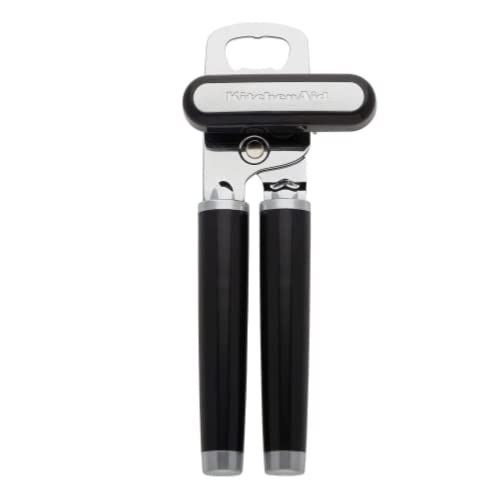
KitchenAid Classic Multifunction Can Opener — Best Classic Top-Cut
There is a longevity argument for boring, long-running product lines: a model a major brand keeps selling year after year is one whose design has already survived the market’s own durability test. The KitchenAid Classic is that opener — a razor-sharp stainless steel cutting wheel, soft ergonomic handles, and a built-in bottle opener, in the shape most people picture when they picture a can opener at all.
Strengths
- Stainless cutting wheel avoids the plating-and-rust failure of budget wheels
- Long-running model line, so the design is proven and replacements are easy to find
- Ergonomic handles reduce the squeeze force needed per can
Trade-offs
- Top-cut rim is sharper than side-cut alternatives
- Plastic handle shells can scuff and age cosmetically even while the mechanism stays sound
- Not the heaviest build here — the OXO Steel and Zulay feel more tool-like
| Cut style | Top cut |
| Cutting wheel | Stainless steel |
| Handles | Soft ergonomic |
| Extras | Bottle opener |
Judge this opener on its wheel and its track record. The stainless wheel does the same rust-avoidance work as the OXO’s, and the gearing is tuned for an easy, even turn rather than maximum clamping force, which is gentler on both the wheel edge and your hand over thousands of cans. Where it differs from the two picks above is intent: this is the mainstream choice, the one you can hand to any household member without a word of instruction, and the one most likely to be sitting in a relative’s drawer already — familiarity is a real feature in a shared kitchen. Its limits are honest ones. The rim it leaves is a standard top-cut rim, so handle lids with the usual care, and the handle shells are polymer, so while they will not rust, they will show years of drawer rash cosmetically. Mechanically, though, there is very little to go wrong: wash it, dry the wheel, and the Classic will quietly do its job for a very long time.
Best for: Shoppers who want a proven, familiar design from a major kitchen brand / Not suited for: Smooth-edge devotees — look at the OXO Smooth Edge or Kuhn Rikon below
Check on Amazon — check price on Amazon before you decide, because listings, bundles and included accessories change over time.

OXO Good Grips Smooth Edge Can Opener — Best Smooth-Edge Manual
Smooth-edge openers earn their keep differently: instead of slicing down through the lid, they cut around the side of the rim, so the lid lifts off whole and neither the lid nor the can edge is sharp. The OXO Good Grips Smooth Edge is the long-running benchmark of that style, with soft easy-grip handles and a built-in lid grip that keeps your fingers off the metal entirely.
Strengths
- No sharp edges on lid or can — the safest rim in this guide
- Side-cut wheel never touches the food, so it stays cleaner and corrodes less
- Soft grips and easy turning suit weaker hands without going electric
Trade-offs
- Side-cut mechanisms have more parts, so technique matters for the first few cans
- Lids come off whole, which some people find slower for draining tuna-style cans
- Bulkier head than a simple top-cut opener
| Cut style | Side cut (smooth edge) |
| Lid handling | Built-in lid grip / pliers |
| Handles | Soft easy-grip |
| Food contact | Wheel does not touch food |
The durability story here is subtler and genuinely interesting. Because a side-cut wheel runs around the outside of the rim, it never dips into tomato sauce, tuna oil or bean liquid — and food acids plus standing moisture are what corrode cutting wheels fastest. Kept clean, a smooth-edge wheel lives a sheltered life compared with a top-cut wheel that bathes in every can’s contents. The trade is mechanical complexity: the gearing must hold the wheel against the rim’s side with consistent pressure, and cheap side-cutters fail by slipping. OXO’s version has been in production for years precisely because its mechanism holds adjustment, and the soft handles let you supply steady pressure without strain. Expect a short learning curve — you place it flat on top, turn until the lid releases, then lift with the little pliers — after which it is arguably the lowest-maintenance opener in this roundup: nothing sharp, nothing food-soiled, nothing to rust in a hurry.
Best for: Families who want finger-safe lids and a cleaner, longer-lived cutting wheel / Not suited for: Anyone who drains cans by pressing the lid down into the contents
Check on Amazon — check price on Amazon before you decide, because listings, bundles and included accessories change over time.

Kuhn Rikon Auto Safety LidLifter — Best Safety Side-Cut
Kuhn Rikon’s LidLifter is the engineer’s answer to the can opener: an auto safety design that cuts from the side, lifts the lid without your fingers touching it, and even pops ring-pull tabs with a built-in tool. Swiss-engineered is doing real work in that description — the mechanism is precise, the turn is light, and the whole cutting head stays out of the food.
Strengths
- Touch-free lid removal is the most hygienic arrangement here
- Side-cut wheel stays out of food, slowing corrosion and easing cleaning
- Built-in ring-pull tool covers the cans this style sometimes struggles with
Trade-offs
- Premium tier for a manual opener
- Side-cut technique takes a few cans to learn
- Compact handle gives less raw leverage than the Zulay for very stubborn rims
| Cut style | Side cut (smooth edge) |
| Origin | Swiss engineered (per listing) |
| Extras | Ring-pull tool |
| Lid handling | Touch-free lift |
If longevity is your top criterion, hygiene-by-design deserves more credit than it gets. Every top-cut opener drags its wheel through the food and then gets rinsed — hopefully — before sitting in a drawer. The LidLifter’s wheel rides the outside of the rim, so the part most prone to corrosion simply never meets the corrosive stuff, and the lid itself is lifted by the tool rather than fished out by hand. That is a design that ages gracefully almost by accident. The mechanism is the thing to respect: precision side-cut gears are less forgiving of being dropped in a crowded utensil crock or cranked at an angle, so store it flat and turn it level. In exchange you get the lightest, cleanest daily operation of any manual here, plus the ring-pull hook that quietly solves the other modern can problem. For a buy-it-for-years purchase in the premium manual tier, this is the connoisseur’s pick — the one people replace only when they move house and lose it.
Best for: Hygiene-first cooks who want smooth edges and touch-free lid handling / Not suited for: Bargain hunters — this is a premium manual, priced like one
Check on Amazon — check price on Amazon before you decide, because listings, bundles and included accessories change over time.

Hamilton Beach Smooth Touch Electric Can Opener (76606AG) — Best Long-Lasting Electric
For some hands, the most durable opener is the one that does not depend on grip strength at all. Hamilton Beach’s Smooth Touch is the long-running electric benchmark: align the can, push the lever down, and it walks around the rim cutting from the side, leaving a smooth edge and a lid you can lift straight off. It handles standard, extra-tall and even pop-top cans per its listing.
Strengths
- Electric drive removes hand strength from the equation entirely
- Side-cut action leaves smooth edges and keeps the cutter out of the food
- Push-down lever is a single, simple motion — nothing to squeeze or twist
Trade-offs
- Needs counter space and an outlet — it is an appliance, not a drawer tool
- Motor and cord are eventual failure points no manual opener has
- Side-cut style cannot press-drain a lid into the can
| Type | Countertop electric |
| Cut style | Side cut (smooth edge) |
| Operation | Easy push-down lever |
| Can sizes | Standard, extra-tall and pop-top (per listing) |
Electric openers have a reputation for dying young, and the cheap ones earn it — weak motors straining against every rim, fixed cutting heads that cake with food and rust in place. The Smooth Touch has outlasted that reputation for two specific reasons. First, the side-cut geometry loads the motor less: the wheel shears the rim’s outer wall rather than punching through the lid, so the drive works at a steadier, lighter torque. Second, the cutting assembly stays out of the food, so the part that corrodes on lesser electrics stays clean here. The honest limits are appliance limits: it occupies counter space permanently, it needs power, and one day a motor or switch will end its service in a way a manual opener never experiences. But measured in cans opened per unit of hand effort — the metric that matters if your grip is unreliable — nothing manual competes. Wipe the cutter after use, keep the cord unkinked, and this is the electric most likely to still be on the counter in a decade.
Best for: Anyone whose hands cannot reliably work a manual opener, or tall-can households / Not suited for: Small counters and anyone who wants a zero-power, drawer-stored tool
Check on Amazon — check price on Amazon before you decide, because listings, bundles and included accessories change over time.
Comparison Table
| Pick | Badge | Key spec | Best for |
|---|---|---|---|
| OXO Steel Can Opener | Best Overall | Stainless steel cutting wheel | Most households wanting one manual opener that simply keeps working for years |
| Zulay Kitchen Manual Can Opener Heavy Duty | Best Heavy-Duty Build | Patented stainless steel blade, rust-proof oversized knob | Daily, heavy can-opening households that keep killing lightweight openers |
| KitchenAid Classic Multifunction Can Opener | Best Classic Top-Cut | Razor-sharp stainless steel cutting wheel | Shoppers who want a proven, familiar design from a major kitchen brand |
| OXO Good Grips Smooth Edge Can Opener | Best Smooth-Edge Manual | Side cut with lid pliers, no sharp edges | Families who want finger-safe lids and a cleaner, longer-lived cutting wheel |
| Kuhn Rikon Auto Safety LidLifter | Best Safety Side-Cut | Swiss-engineered smooth-edge side cut with ring-pull tool | Hygiene-first cooks who want smooth edges and touch-free lid handling |
| Hamilton Beach Smooth Touch Electric Can Opener (76606AG) | Best Long-Lasting Electric | Push-down lever, side cut, opens pop-top cans | Anyone whose hands cannot reliably work a manual opener, or tall-can households |
What actually makes a can opener last?
Strip away the marketing and a can opener has four wear points: the cutting wheel’s edge, the gear that drives it, the joint where force enters (knob or lever), and the frame that holds everything in alignment. A long-lasting opener is simply one where all four are made of materials that do not degrade in a kitchen: hardened or stainless steel at the wheel, metal gearing, a knob axle that cannot wobble loose, and a frame rigid enough that the wheel meets the rim squarely every single time. When any one of the four is compromised — a plated wheel, a plastic gear, a flexing handle — the others wear faster to compensate, which is why cheap openers do not decline gradually; they fall off a cliff.
Corrosion deserves its own paragraph because it is the silent killer. A cutting wheel lives a brutal life: it is wetted with acidic food, rinsed, and stored damp against other metal. Plated wheels survive only while the plating is intact, and the cutting edge is exactly where plating fails first. Stainless and high-carbon wheels — the kind named in the listings of the OXO Steel, the KitchenAid Classic and the Zulay above — remove that dependency. If you take one habit from this guide, take this one: whatever opener you buy, dry its wheel before it goes back in the drawer. Thirty seconds with a towel doubles the working life of almost any model.
The famous old-school American designs — the swing-frame opener your grandparents used, and the heavy deluxe pattern sold under names like EZ-DUZ-IT — deserve an honest mention here. Their all-steel construction is genuinely excellent and many survive for decades. In this verification pass, however, those products were sold through shifting marketplace listings that we could not match to one stable, confirmed listing, so per our rules they appear as unlinked context rather than linked picks. If you shop for one, search the exact brand and model on Amazon, check price on Amazon across the listings, and be wary of lookalike copies trading on the name — the copies are precisely the flimsy tools this guide exists to help you avoid.
Top cut vs side cut: which style ages better?
Top-cut openers slice through the lid just inside the rim. The mechanism is beautifully simple — one wheel, one gear — and simple mechanisms are inherently durable, which is why the classic manuals above are top-cutters. The costs are a sharper rim, a lid that drops toward the food, and a wheel that contacts the contents of every can and must be washed and dried faithfully.
Side-cut openers — the OXO Smooth Edge, the Kuhn Rikon LidLifter and the Hamilton Beach Smooth Touch — slice the outer wall of the rim so the entire lid lifts away. The rim left behind is smooth enough to run a finger around, the wheel never touches food, and the lid can be set back on top for fridge storage. The mechanism is more complex and demands better manufacturing to hold its alignment, which is why cheap side-cutters have a bad name and good ones cost more. In pure lifespan terms, a well-made side-cutter’s wheel often outlasts a top-cutter’s simply because it lives a cleaner life — but a well-made top-cutter has fewer parts to ever go wrong. Both roads reach a decade; choose by whose trade-offs suit your kitchen.
Electric versus manual is the third axis. Manuals win on theoretical lifespan — there is almost nothing in a good manual opener that can truly fail. Electrics win on usable lifespan for anyone whose hands are the limiting factor, because a tool you cannot operate has a lifespan of zero no matter how well it is built. Be honest about which constraint is yours and the choice makes itself.
How to choose the right long-lasting opener for your kitchen
Start with your cans. Households opening mostly standard cans can choose freely; households opening tall cans, big tomato tins or pet-food cans in quantity should weight leverage and frame rigidity — the Zulay’s oversized knob or the Hamilton Beach electric’s powered drive. If ring-pull cans dominate your pantry, you barely need an opener at all, and the Kuhn Rikon’s built-in ring-pull tool covers the stubborn remainder.
Then be honest about your hands. Squeezing and twisting is the whole job for a manual opener; if that motion is painful, unreliable, or simply annoying at the end of a long day, the correct long-lasting purchase is the electric, maintained with a wiped-clean cutter. There is no durability prize for owning a manual opener that lives untouched in a drawer.
Finally, think about storage and care culture. A household that hand-dries tools can keep any wheel in this guide bright for years. A household that tosses everything in the dishwasher and the damp drawer should lean stainless and side-cut — the combinations most forgiving of neglect — and accept the premium tier as the price of that forgiveness. Match the tool to the habits you actually have, not the ones you aspire to.
Manual or electric for a decade of service?
The manual-versus-electric decision deserves a direct answer for this search, because ‘long lasting’ pulls in two directions at once. In absolute mechanical terms the manual wins and it is not close: the OXO Steel or the Zulay contains perhaps a dozen parts, none of them consumable, and its plausible failure modes are measured in decades. An electric opener contains a motor, a switch, a cord and a drive gear, each with its own finite life, and its realistic horizon is years — good years, but years. If both tools serve your hands equally, the manual is the longevity purchase, full stop.
But service life is only meaningful in use. An electric that opens every can for a decade serves longer, in every way that matters, than a manual that spends that decade in a drawer because its owner dreads the twisting. The Hamilton Beach Smooth Touch also removes a subtle wear factor from the household itself: nobody forces it, drops it mid-struggle, or leaves it clamped on a rim. Judge the two families by the service they will actually render in your kitchen — the cans opened, not the years survived — and the right answer for your hands will be obvious. Longevity is a means; dinner is the end.
A word on warranties and wear parts
Longevity shopping should end with a look at what the maker stands behind and what can be replaced. A cutting wheel is a wear part in the same sense as a knife edge — on a quality opener it wears over years rather than months, but a design whose wheel and gear are robust, standard and cleanable will always outlast a sealed novelty. Electric buyers should check that the cutting lever or head detaches for washing, as on the better Hamilton Beach designs, because the part you can clean is the part that does not corrode in place. None of this requires paperwork at purchase; it requires choosing the designs in this guide whose construction assumes a long life, and then keeping the receipt habit you would keep for any tool you intend to own for a decade.
How to Use and Maintain a Manual Can Opener So It Lasts
Technique is a durability feature: most wheels are dulled not by cans but by being run at an angle, and most rust is just water that was never wiped off. This is the routine that keeps the picks above working for years.
- Seat the opener squarely: for a top-cut model, rest the wheel on the rim’s inner edge with the handles level; for a side-cut model, lay it flat on top of the lid so the wheel kisses the rim’s outer wall. A tilted start is what chews rims and dulls edges.
- Turn with steady, moderate pressure. Let the wheel’s sharpness do the cutting — forcing the knob twists the frame and wears one side of the edge. If the wheel skips, back up a quarter turn and re-seat rather than muscling forward.
- Stop just before the final inch on top-cut cans so the lid stays hinged, then lift it with the edge of a spoon or the opener’s lid grip — never your fingertips.
- Rinse the wheel and gear immediately after use, especially after acidic foods like tomatoes. A quick pass with an old toothbrush clears the gear teeth where residue hides.
- Dry the cutting wheel completely with a towel before storing. This single step prevents the pitting that ends most openers’ lives.
- Store the opener dry and uncluttered; a wheel banging against heavy utensils in a crowded drawer nicks its own edge.
- Every few months, check the wheel: if it still slices a clean line on a test can without tearing, it is healthy. Tearing, double-tracking or metal shavings mean the edge is gone — on a quality opener that should take many years to happen.
Follow that routine and the limiting factor becomes the handle and knob, not the wheel — which is another way of saying the opener will outlast your patience for it. Electrics need the same respect in miniature: wipe the cutter head after each session, never immerse the unit, and let the motor rest between back-to-back cans on marathon batch-cooking days.
Common Buying Mistakes
Buying on price alone, repeatedly. A bargain opener replaced every eighteen months costs more over a decade than one good opener — and fills the drawer with corpses in between. The picks above sit in the budget-to-premium tiers, but each is priced as a one-time purchase; that framing is the whole point of this search.
Leaving the wheel wet. More openers die of rust than of wear. The dishwasher is the worst offender: hot, damp, hours-long exposure with detergent stripping any protective oil. Hand-rinse, towel-dry, done — thirty seconds that buy years.
Using the opener as a general pry tool. The same hardened wheel that slices steel lids will chip if you lever paint cans or pry lids with the frame. A chipped wheel tears every can after. Keep a cheap screwdriver for prying and let the opener do its one job.
Forcing a dull or misaligned cut. When an opener starts skipping, most people squeeze harder, which flexes the frame, worsens the alignment, and accelerates the decline. Re-seat the wheel, lighten your grip, and let it track — and if it will not track on any can, retire it rather than fighting it into your hand’s path.
Ignoring cut style when buying for a household. A top-cut opener in a house with small children helping in the kitchen, or an older adult with unsteady hands, leaves sharp rims everywhere. Smooth-edge models exist precisely for those houses. Longevity includes the tool remaining appropriate for the people using it.
Storing the opener in the sink-side crock, wet. The utensil crock beside the sink is the dampest address in the kitchen, and an opener stored there lives in permanent humidity. A drawer with a dry towel’s worth of care beats the crock for any tool whose edge you care about — the wheel will show you the difference within a year.
Final Recommendation
If you want one answer: the OXO Steel Can Opener is the buy-once manual for most kitchens — stainless wheel, rigid frame, nothing to plug in and nothing to program. If your household opens cans in real volume, the Zulay Heavy Duty adds leverage and rust-proofing sized for daily work. If sharp rims are unwelcome in your house, the OXO Smooth Edge or the Kuhn Rikon LidLifter deliver decade-class service in the side-cut style, and if your hands should not be doing this job at all, the Hamilton Beach Smooth Touch is the electric that has earned its long-running place on the counter.
Whichever you choose, check price on Amazon on the exact model listing before ordering, and then commit to the one maintenance habit that matters — dry the wheel. That is the entire secret the long-lasting opener owners share.
If you would rather start from the shortlist, the three picks most readers land on are OXO Steel Can Opener, Zulay Kitchen Manual Can Opener Heavy Duty, KitchenAid Classic Multifunction Can Opener — check price on Amazon on each listing and compare the current bundles before you commit.
Keep exploring the same shelf before you buy: Best Can Openers For Seniors Best Can Openers Best Electric Can Openers Best Manual Can Openers Best Coffee Makers For Seniors Best Can Openers For Arthritic Hands
Frequently Asked Questions
How long should a good can opener actually last?
A well-built manual opener with a stainless or high-carbon wheel should give a household many years of daily service — a decade is a realistic expectation with basic drying care, because there is almost nothing in it to wear out quickly. Electrics trade some of that theoretical lifespan for effortlessness; a good countertop model should still serve for years, with the motor and switch as its eventual limits.
Why did my last can opener start tearing cans instead of cutting them?
Tearing means the wheel edge is no longer slicing — usually because rust pitting roughened the edge, or the frame flexed enough to tilt the wheel so it plows rather than cuts. Both trace back to the two classic causes: moisture left on the wheel, and a frame too light for the force applied. It is rarely worth trying to restore a torn-cut wheel; replace it with a stainless-wheel model and dry it after use.
Are smooth-edge openers really as durable as traditional ones?
A well-made smooth-edge opener can outlast a traditional one, because its wheel never touches food and corrodes more slowly. The caveat is build quality: the side-cut mechanism needs precise, rigid gearing, so this is a style where the cheap versions fail fast and the good versions — like the OXO and Kuhn Rikon picks above — justify their tier.
Can I put my can opener in the dishwasher?
You can, but you will shorten its life. Dishwasher cycles leave the wheel wet for hours in hot, detergent-laden air — ideal rust conditions, especially for any non-stainless part. A ten-second rinse and a towel dry is both faster in total effort and far kinder to the edge. Electrics, of course, should never be immersed at all; wipe the cutter head instead.
Is an electric can opener worth it if my hands are fine?
For most people with healthy hands, a good manual is the better long-term buy: cheaper, smaller, and effectively immortal. The electric earns its counter space when cans are tall or numerous, when batch cooking means twenty cans in a session, or when anyone in the house has limited grip. Judge it by your worst cooking day, not your average one.
What is the one maintenance step that matters most?
Drying the cutting wheel before storage. Rust pitting is the leading cause of opener death, and it is entirely a moisture problem. Rinse off food residue, towel the wheel and gear dry, and store the opener somewhere dry. Everything else — occasional gear brushing, careful storage — is secondary to that single habit.
Should I oil my can opener’s wheel?
It is rarely necessary on stainless models and should not be a routine. If a carbon-steel wheel or gear feels stiff after washing, a single drop of food-grade mineral oil on the gear, worked through a few turns and then wiped nearly dry, is the traditional treatment. Never use a rancid-prone cooking oil, and never oil an electric opener’s cutter unless its manual says so — dryness, not lubrication, is what these tools mostly ask for.


