Disclosure: airfryerkitchensupply.com is reader-supported. When you buy through links on our site, we may earn an affiliate commission at no extra cost to you.
Where to buy
Every pick in this guide to the best fast pressure cookers was checked against live Amazon listings before publication, and only models with a confirmed listing carry a buy link. Prices move constantly on large appliances and countertop cookers alike, so we never print a fixed price here — use the links to check the current price on Amazon, confirm the exact configuration, and read the delivery and installation terms before you order.
Instant Pot Pro 6 Qt 10-in-1 Electric Pressure Cooker — Check the current price on Amazon
Ninja HyperHeat 9-in-1 Pressure Cooker (6.5-qt, PC201GY) — Check the current price on Amazon
COSORI 6QT Pressure Cooker (9-in-1) — Check the current price on Amazon
Presto 02141 6-Quart Electric Pressure Cooker — Check the current price on Amazon
Fissler Vitaquick Premium 3.7 Quart Stovetop Pressure Cooker — Check the current price on Amazon
Instant Pot Duo Crisp Ultimate 6.5 Qt 13-in-1 — Check the current price on Amazon
This guide judges one race only: how quickly a pressure cooker gets to pressure, how effectively it cooks once there, and how fast you can safely get the lid off at the end. The best fast pressure cookers are not always the ones with the most functions — they are the ones whose power, pot design and release systems respect the three phases of every pressure cook: build, cook, release.
That framing produces a different ranking from a general multi-cooker guide. Raw power matters here (two picks quote their wattage in their verified listings — 1200W and 1100W — and we use those figures, and only those figures, in the comparisons). Pot material matters: stainless builds a sear before the seal. Release design matters: a controlled quick release you trust is worth minutes on every vegetable and grain dish you will ever cook.
Six verified models follow — five electric, one stovetop for the outright pace title — each matched to its manufacturer listing before earning a link. If your question is broader (‘what is the fastest way to cook dinner, any technology?’), our fast cookers guide covers that race; this one is for people who have chosen pressure and want it quick.
In this guide
Quick Picks
If you only have a minute, these are the short answers. Each pick below earned its badge for a different reason, and the badge stays the same in the detailed reviews further down, so you can jump straight to the model that matches your kitchen.
- Instant Pot Pro 6 Qt 10-in-1 Electric Pressure Cooker — Best Overall Fast Pressure. The complete fast-pressure package: brisk build, the strongest sauté in its family, and a diffused release that makes quick release a calm, everyday tool. Check price on Amazon.
- Ninja HyperHeat 9-in-1 Pressure Cooker (6.5-qt, PC201GY) — Best Raw Power. 1200W — the highest wattage stated by any listing in this guide — driving a 6.5-quart cooker whose listing claims up to 2X faster cooking. Check price on Amazon.
- COSORI 6QT Pressure Cooker (9-in-1) — Best Value Fast Pressure. 1100W stated in its listing, nine functions and a ceramic pot: honest pressure pace at the value tier. Check price on Amazon.
- Presto 02141 6-Quart Electric Pressure Cooker — Best Simple Electric. Presto’s electric answer: a straightforward 6-quart electric pressure cooker from the oldest name in the business, without smart features or menu sprawl. Check price on Amazon.
- Fissler Vitaquick Premium 3.7 Quart Stovetop Pressure Cooker — Fastest Build — Stovetop. On a strong burner, nothing electric matches a stovetop pot’s build speed — and this German stainless classic claims up to 70% faster cooking in its listing. Check price on Amazon.
- Instant Pot Duo Crisp Ultimate 6.5 Qt 13-in-1 — Best Fast Finish. Pressure speed plus an air-fry finish in the same pot: the fastest total route to tender-and-crisp, with no oven preheat in the timeline. Check price on Amazon.
How These Picks Were Chosen
Phase one, build: we favoured higher stated wattage in electrics and, for the stovetop pick, the physics of a strong burner under a stainless pot. Manufacturers rarely publish time-to-pressure, so we used the honest proxies available — listed wattage where stated, pot size and material, and the design of the heating system — and we say in each review which proxy we are relying on rather than inventing stopwatch numbers.
Phase two, cook: consistent pressure without cycling drama, a sauté function strong enough to brown before sealing (flavour built before the lid goes on is what separates fast-and-good from fast-and-boiled), and programs that cover the pressure canon — beans, grains, tough cuts, eggs, steaming — without menu archaeology.
Phase three, release: every pick offers practical quick release, and the best add diffusion or control so releasing is calm enough to use daily. Natural-release performance matters too — a cooker that holds pressure well during the fall gives juicier roasts. Verification closed the process: model, size and stated specifications were confirmed against live listings for every pick.
The 6 Best Fast Pressure Cookers

Instant Pot Pro 6 Qt 10-in-1 Electric Pressure Cooker — Best Overall Fast Pressure
The Pro takes our overall title because it is quick in all three phases rather than spectacular in one. Its uprated heating gets 6 quarts to pressure briskly, its sauté genuinely browns (so the fast cook starts with flavour, not apologies), and its steam release is diffused — quick release without the geyser — which in practice means you use quick release more, and dinner lands sooner.
Strengths
- Balanced speed: build, sear and release all above average
- Handled pot moves to the hob for fast sauce reduction
- Sous vide and 10 functions ride along for the slow days
Trade-offs
- Premium tier within the Instant Pot range
- Black finish is a fingerprint showcase
- Its wattage is not the headline — rivals quote bigger numbers
| Specification | Detail |
|---|---|
| Capacity | 6 Qt |
| Functions | 10-in-1 incl. sous vide |
| Inner pot | Stainless, handled, stovetop-compatible |
| Release | Diffused steam release |
The release phase is where the Pro quietly wins its title. Quick release on many cookers is a sputtering event cooks avoid, defaulting to natural release and its long tail even for foods that suffer from it. A diffused, controlled release changes behaviour: vegetables stop on time, eggs peel perfectly, grains stay distinct. Multiply that behavioural change across hundreds of cooks and the Pro is the fastest pressure cooker here in lived time, whatever the spec sheets say.
Its build phase deserves its due as well: the Pro’s element and pot design were the brand’s answer to “faster, hotter” requests from its most demanding users, and the sear it produces before sealing is visibly deeper than base-model results. Fast pressure cooking is a chain of small efficiencies, and the Pro is the pick with no weak link.
Best for: cooks who pressure-cook several times a week and feel every phase of the process / Not suited for: buyers who want the lowest-cost route into pressure cooking
Check on Amazon to see the current price, configuration options and delivery terms for the Instant Pot Pro.

Ninja HyperHeat 9-in-1 Pressure Cooker (6.5-qt, PC201GY) — Best Raw Power
If your stopwatch cares most about the build phase, the HyperHeat is your pick: its verified listing states 1200W, the strongest power figure here, in a 6.5-quart 9-in-1 that also sears, sautés, steams, slow cooks and sous vides. Higher wattage is not everything — but for heating a large pot of liquid to pressure, it is the first thing.
Strengths
- 1200W stated power: brisk pressure build for a big pot
- 6.5-qt capacity keeps family batches in one load
- Sear and sauté functions build flavour before sealing
Trade-offs
- Large footprint and a substantial lid to store
- Speed claim (2X) is dish-dependent, as all such claims are
- Serving-pot design prioritises the table over stovetop finishing
| Specification | Detail |
|---|---|
| Capacity | 6.5-qt |
| Power | 1200W (per listing) |
| Functions | 9-in-1 |
| Claim | Cooks 2X faster (per listing) |
| Model | PC201GY |
Wattage physics, plainly: pressure build time is mostly the time to bring the pot’s contents to a boil and then to pressure temperature. More watts into the same liquid means fewer minutes — and the HyperHeat pairs its 1200W with the largest pot here, so its per-quart build performance is the strongest in the guide. For big-batch households, that is the difference between pressure cooking feeling instant and feeling eventual.
Once at pressure it behaves like the modern multi-cooker it is, with the bonus of Ninja’s rapid-cooking modes for fresh foods. Judge it as we do in the fast cookers guide: a speed-led machine whose pressure phase is its foundation. If build time is your bottleneck — big pots, cold ingredients, impatient evenings — this is the pressure cooker built for you.
Best for: family-size batches and cooks who hate waiting for pressure to build / Not suited for: small kitchens or anyone who cooks two-person portions
Check on Amazon to see the current price, configuration options and delivery terms for the Ninja HyperHeat.
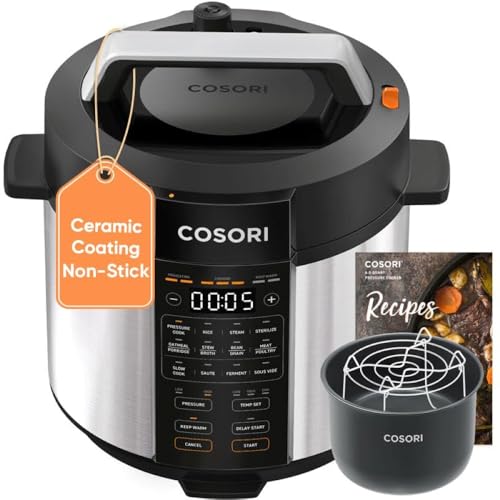
COSORI 6QT Pressure Cooker (9-in-1) — Best Value Fast Pressure
The COSORI’s listing does something we appreciate in a speed guide: it states its power — 1100W — so the build-phase comparison is arithmetic, not vibes. That wattage, in a 6-quart pot, delivers brisk, family-scale pressure cooking with sous vide included, at the friendliest tier in this line-up.
Strengths
- 1100W stated power — verifiable pace, not marketing fog
- Sous vide included at a value tier
- Ceramic pot makes fast grains and beans a fast cleanup too
Trade-offs
- A step behind the 1200W Ninja in raw build power
- Ceramic coating needs gentle utensils
- Accessory ecosystem smaller than Instant Pot’s
| Specification | Detail |
|---|---|
| Capacity | 6QT |
| Power | 1100W (per listing) |
| Functions | 9-in-1 incl. sous vide |
| Inner pot | Ceramic coating |
| Safety | 12 safety features (per listing) |
The 100W gap to the Ninja is real but modest in the kitchen: across a typical family load it is a small number of minutes on the build, and the COSORI claws time back at the other end of the meal — its ceramic pot releases beans, rice and porridge so cleanly that cleanup, the phase nobody puts on a spec sheet, is genuinely the fastest here.
For first-time pressure cooks, the twelve listed safety features and the calm control layout lower the other hidden cost of speed: hesitation. A cooker you trust is a cooker you use at full pace. On value-adjusted speed — minutes saved per unit of budget — this is arguably the strongest pick in the guide.
Best for: value buyers who want stated, honest pressure pace and easy cleanup / Not suited for: stainless-pot loyalists or maximum-wattage chasers
Check on Amazon to see the current price, configuration options and delivery terms for the COSORI 6QT.

Presto 02141 6-Quart Electric Pressure Cooker — Best Simple Electric
Presto spent the 20th century teaching America stovetop pressure; the 02141 is that institutional knowledge in electric form. It is the pick for cooks who want electric automation — set it, let it build, cook and hold — from a brand whose entire identity is pressure, in a simple 6-quart format that does not ask you to learn an app.
Strengths
- Pressure-only focus: simple controls, no feature sprawl
- Presto’s deep pressure-cooking heritage and parts support
- Electric automation with a familiar, unintimidating interface
Trade-offs
- Fewer functions than the multi-cooker rivals (that is also the point)
- No sous vide, no smart features
- Inner pot and finish are workmanlike rather than premium
| Specification | Detail |
|---|---|
| Capacity | 6-Quart |
| Model | 02141 |
| Type | Electric pressure cooker |
| Brand | Presto |
There is a speed that comes from simplicity: no menu tree between you and pressure, no app update, no mode you must remember to cancel. The 02141’s interface respects the classic Presto user — often cooking from the brand’s own long-published pressure recipes — and gets out of the way. For households upgrading from a stovetop Presto to electric convenience, this is the natural landing.
Judged on our three phases: build is competent electric pace, cook is classic Presto consistency, and release follows the straightforward manual-valve school. It will not win a wattage contest it does not enter; it wins the “used daily without a thought” contest, which over a year saves more dinners than any specification.
Best for: Presto loyalists and simplicity seekers moving from stovetop to electric / Not suited for: feature collectors who want sous vide, apps and air fry in one box
Check on Amazon to see the current price, configuration options and delivery terms for the Presto 02141.
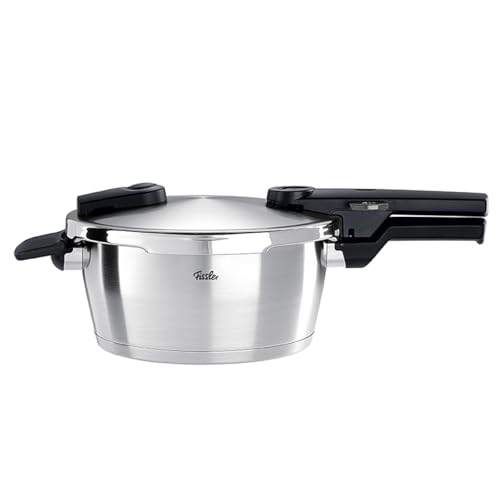
Fissler Vitaquick Premium 3.7 Quart Stovetop Pressure Cooker — Fastest Build — Stovetop
The outright pace title in pressure cooking still belongs to the stovetop: a powerful hob delivers far more energy than a countertop element, and stovetop pots run at full pressure. Fissler’s 3.7-quart Vitaquick Premium — 18/10 stainless, three-level safety system, colour indicator — is the compact, premium expression of that physics, its listing claiming cooking up to 70% faster than conventional methods.
Strengths
- Fastest time-to-pressure in this guide on a strong hob
- Higher stovetop pressure trims the cook phase too
- Indicator-led control makes the pace usable, not scary
Trade-offs
- Requires supervision and heat management
- Premium tier; 3.7 qt suits one to three people
- No automation, timers or keep-warm
| Specification | Detail |
|---|---|
| Capacity | 3.7 Quart |
| Material | 18/10 stainless steel |
| Claim | Cooks up to 70% faster (per listing) |
| Compatibility | Induction, gas, electric |
| Safety | Three-level safety system |
Why stovetop wins the build: an induction hob or gas burner can pour several kilowatts into a pot; a countertop cooker’s element is a fraction of that. The Vitaquick’s small 3.7-quart thermal mass compounds the advantage — less liquid, less metal, pressure in minutes. Its indicator then lets you ride that pace precisely, easing the heat at the right band instead of overshooting and venting time away as steam.
The cook phase follows: at full stovetop pressure, dense foods finish measurably sooner than at typical electric pressure. The trade is your presence — this is piloting, not programming. For the cook who is in the kitchen anyway and wants the fastest pressure physics available in a pot that will outlive its hob, the Vitaquick is the connoisseur’s answer.
Best for: experienced cooks with a strong hob who want maximum pace in a durable pot / Not suited for: anyone who needs walk-away automation or family-size capacity
Check on Amazon to see the current price, configuration options and delivery terms for the Fissler Vitaquick 3.7.

Instant Pot Duo Crisp Ultimate 6.5 Qt 13-in-1 — Best Fast Finish
Our final pick optimises a different clock: not time-to-pressure but time-to-served for the huge class of dishes that need pressure and a crisp finish. The Duo Crisp Ultimate pressure-cooks in its 6.5-quart pot, then air-fries under its single-lid system — deleting the oven preheat and the pan transfer that quietly double the timeline of a pressure-then-roast dinner.
Strengths
- Two-phase speed: pressure-tender, air-crisp, one pot
- 6.5-qt air-fry surface fits useful single layers
- 13 functions cover the rest of the week too
Trade-offs
- Large appliance; lid and pot storage is real
- Crisping is single-layer — big crowds need batches
- Pressure build is family-standard, not the fastest here
| Specification | Detail |
|---|---|
| Capacity | 6.5 Qt |
| Functions | 13-in-1 |
| Modes | Pressure cook + air fry |
| Extras | Roast, bake, proof, dehydrate (per listing) |
Score it on wings, the canonical two-phase food. Pressure alone: tender, pale, unfinished. Oven finish: a preheat plus a long roast. This pot: pressure phase for tenderness, a quick release, then the air-fry phase crisps in the same vessel while you make a sauce. The total is the shortest path to the plate of any method we can name, and the same math holds for whole chickens, chops and ribs.
As a pure pressure cooker it is a strong mainstream performer rather than the pace-setter — that honesty is why it carries the “fast finish” badge instead of the overall title. Buy it when your favourite fast dinners end with crisping; buy the Pro or the Ninja when they end at the pressure phase itself.
Best for: two-phase dinners — wings, ribs, whole chickens — on a weeknight clock / Not suited for: pure pressure purists or very small kitchens
Check on Amazon to see the current price, configuration options and delivery terms for the Duo Crisp Ultimate.
Comparison Table
| Pick | Badge | Key spec | Best for |
|---|---|---|---|
| Instant Pot Pro 6 Qt 10-in-1 Electric Pressure Cooker | Best Overall Fast Pressure | 10-in-1, diffused release, handled pot | cooks who pressure-cook several times a week and feel every phase of the process |
| Ninja HyperHeat 9-in-1 Pressure Cooker (6.5-qt, PC201GY) | Best Raw Power | 1200W, 6.5-qt, 9-in-1 | family-size batches and cooks who hate waiting for pressure to build |
| COSORI 6QT Pressure Cooker (9-in-1) | Best Value Fast Pressure | 1100W, 9-in-1, ceramic pot | value buyers who want stated, honest pressure pace and easy cleanup |
| Presto 02141 6-Quart Electric Pressure Cooker | Best Simple Electric | 6-qt electric, classic simple format | Presto loyalists and simplicity seekers moving from stovetop to electric |
| Fissler Vitaquick Premium 3.7 Quart Stovetop Pressure Cooker | Fastest Build — Stovetop | Stovetop, 18/10 stainless, 3.7 qt | experienced cooks with a strong hob who want maximum pace in a durable pot |
| Instant Pot Duo Crisp Ultimate 6.5 Qt 13-in-1 | Best Fast Finish | 13-in-1, pressure + air fry, 6.5 Qt | two-phase dinners — wings, ribs, whole chickens — on a weeknight clock |
How to Choose the Best Fast Pressure Cookers
Think in three phases and buy for your slowest one. If your frustration is waiting for pressure (big pots of soup, beans from dry), prioritise build power: stated wattage in electrics — 1200W and 1100W are the figures our verified listings state — or go stovetop, where a strong burner beats every countertop element. If your frustration is bland fast food, prioritise the sauté: a pot that browns properly before sealing. If your frustration is the tail — dinners stalled in natural release — prioritise a controlled, diffused quick release you will actually use.
Size interacts with speed more than buyers expect. A half-empty large pot builds pressure quickly but wastes energy; an overfilled small pot builds slowly and risks foaming vents. The 6- to 6.5-quart electrics here are the family optimum; the 3.7-quart Fissler is the small-household rocket. And remember the fill rules that keep speed safe: two-thirds maximum for most foods, one-half for beans, grains and anything that foams.
Finally, distrust any speed figure you cannot trace. In this guide, wattages and percentage claims appear only where the verified product listing states them; where a maker does not state a figure, we describe the design instead. That is the standard to hold every speed claim to, in this category above all.
Pressure, Release and the Clock: The Three Phases Explained
Build phase: the pot heats its contents to boiling, then to pressure temperature. Driven by power (watts or burner), load (cold and full is slowest) and starting temperature — which is why starting with hot liquid from a kettle is the oldest speed trick in pressure cooking. Cook phase: the timed period at pressure, where higher pressure (stovetop’s traditional edge) cooks denser food faster per minute. Release phase: natural release continues cooking gently as pressure falls (free tenderness for roasts, wasted time for vegetables); quick release stops the cook on the spot and suits anything that overcooks easily.
A “fast” recipe time quoted by any maker usually counts only the middle phase. Honest planning adds build and release — typically a third to a half on top of the at-pressure time for family-size loads. The cookers in this guide earn their badges by shrinking the phases around the cook, which is where domestic pressure cooking actually loses its minutes.
Electric vs Stovetop Pressure Speed: The Physics, Honestly
A countertop electric cooker is limited by its element — the listings in this guide state 1100–1200W for the powerful models — and by design choices that favour consistency and safety over raw pressure. A stovetop pot on a strong induction or gas burner receives multiples of that power and traditionally runs at higher pressure, so it wins build and cook phases outright. Nothing in this paragraph is controversial; it is thermodynamics.
What electrics win is everything around the physics: unattended timing, automatic pressure maintenance without heat-fiddling, keep-warm, and a release you can schedule around a life. Over a month of real dinners, the electric’s consistency usually beats the stovetop’s peak pace — unless the cook is present and skilled, in which case the Fissler in our picks remains the fastest pressure instrument a home kitchen can own. Choose by your evenings, not by the stopwatch alone.
Timing the Classics: Pressure Benchmarks Worth Knowing
Every fast-pressure household ends up with a mental chart; here is the shape of it, with the standing reminder that your cooker’s manual and a reliable recipe source govern your actual times. Dried beans, unsoaked: roughly 25–40 minutes at pressure depending on the bean, plus release — the single biggest time theft pressure commits against conventional cooking, where the same beans want hours. Brown rice: around 20–25 minutes with a short natural release. Steel-cut oats: about 10 minutes. A whole chicken of family size: roughly 6–8 minutes per pound at pressure, plus a proper natural rest.
Tough cuts follow the same pattern: beef stew chunks in the 20–35 minute range, a pork shoulder for pulling in the 45–60 range, both emerging with all-day texture. Eggs are the precision party piece — a handful of minutes at pressure, timed to the minute for jammy versus firm. Notice what the chart teaches: the at-pressure numbers are only part of each total, and the build and release habits from our how-to section decide whether the real dinner matches the chart. Learn your own cooker’s offsets once — beans are the perfect calibration dish — and the chart becomes personal and dependable.
Sealing Rings, Valves and the Maintenance of Speed
A pressure cooker’s speed is a property of its seals. Steam that escapes past a tired ring is pressure that builds slowly and cooks weakly, so the fastest maintenance in the category is a fresh sealing ring: replace it when it feels loose, holds odours after washing, or lets the lid hiss persistently at pressure. Keep a spare from the day you buy the cooker — a ring failure on a Tuesday should be a two-minute swap, not a week of waiting for a parcel.
Valves are the second checkpoint: the float valve should rise and fall freely, the release valve should seat cleanly, and the anti-block shield under the lid should be rinsed after starchy cooks (beans and grains are the usual suspects). A pot that gradually gets slower over months is almost never dying — it is asking for a ring and a valve clean. Ten minutes of that attention restores factory pace, which is why we list maintenance here, in a guide about speed, rather than in a footnote: in pressure cooking, upkeep literally is performance.
Altitude, Fill Lines and Other Physics That Bend the Rules
Pressure cooking is altitude-sensitive in a way stovetop simmering only wishes it understood: at elevation, water boils at a lower temperature and a cooker’s gauge pressure sits on a lower atmospheric base, so the absolute cooking temperature drops and times stretch. High-altitude cooks learn to add a margin — commonly a percentage per thousand metres, per their manual’s table — and to favour natural releases that let food coast in the heat. If your kitchen is in the mountains, that table, not this guide’s sea-level benchmarks, is your timing authority.
Fill lines are the other physics with legal force. The two-thirds rule (half for foaming and expanding foods) exists because pressure regulation needs headspace of steam; an overfilled pot can force food into the valve, vent starchy liquid, and — the everyday cost — build pressure slowly and unevenly. Speed-obsessed cooks sometimes read the max line as a challenge. Read it instead as the boundary of the fast zone: inside it, everything in this guide works as promised; beyond it, nothing does.
From-Frozen Pressure Cooking: Times and Technique
Pressure cookers are the best from-frozen machines in the kitchen, and the technique has its own rules worth stating precisely. The pot will take longer to reach pressure with frozen contents — it is thawing as it heats — and that thawing time inside the sealed pot is part of the process, not a failure of it. As a working rule, add roughly half again to the at-pressure time for frozen pieces of meat or poultry compared with fresh, and always confirm the thickest point with a thermometer before serving; your model’s manual gives its own from-frozen guidance and outranks any general rule.
Format decides success: individual pieces (thighs, chops, meatballs, mince frozen in a flat sheet that fits the pot) cook evenly; a solid frozen brick of a roast does not, and should be thawed or at least separated. Sauces and liquids should go in unfrozen so steam can build promptly, and delicate vegetables should be added after the protein’s pressure phase rather than frozen into it. Run this way, the from-frozen capability converts the most common dinner emergency in modern life into a non-event — and it is a capability no oven and no slow cooker can honestly claim.
Pressure Levels Demystified: High, Low and What Electrics Actually Do
Recipes speak of high and low pressure; machines implement them in different dialects, and knowing yours is a quiet speed skill. Traditional stovetop cookers regulate around a higher working pressure than most electrics — one reason the Fissler in our picks cooks dense food a touch faster per minute. Electrics typically offer a high setting for the main canon and a low setting for delicate foods (fish, custards, tender vegetables), holding their pressures with electronic consistency rather than a rocking weight. Neither system is broken; they are calibrated differently, which is why recipe times written for one school can mislead in the other by a few minutes either way.
The practical responses are simple. Learn your cooker’s dialect with a calibration cook (beans are ideal — cheap, timing-sensitive, easy to judge), note the offset against the recipes you use most, and write it inside the manual. Prefer low pressure for anything that foams, delicate proteins and dairy-adjacent dishes; high for beans, grains, stocks and tough cuts. And remember that “keep warm” after the cook is not pressure — food resting in a hot pot continues to soften, which is either a feature (roasts) or a flaw (vegetables) depending on what is inside. Pressure literacy, once acquired, transfers to every cooker you will ever own.
Reading Recipes Across Cooker Types: Converting Times Without Tears
Pressure recipes are written in dialects: stovetop times assume higher pressure, electric times assume the author’s machine, and Instant Pot times assume its particular build and release behaviour. Converting between them is a skill worth acquiring once. As a working approach, when taking a stovetop recipe to an electric cooker, add a small margin to the at-pressure time — the electric’s lower pressure cooks a little gentler per minute — and when taking an electric recipe to the stovetop, shave a little and check early the first time. Beans and grains forgive these experiments; a notebook does the remembering.
Release instructions convert too, and they matter as much as the minutes: a recipe’s “let rest 10 minutes then release” is an instruction about texture, not patience, and skipping it to save time usually spends the savings in toughness. Liquid quantities, by contrast, barely convert at all — electrics and stovetops both lose little in a sealed cook, though stovetop recipes from the open-pot tradition sometimes carry more liquid than a sealed electric needs; reduce cautiously and note the result.
The deeper point is that recipe literacy compounds: after a dozen cooks in your own machine, with your own notes, you stop converting and start knowing. That fluency — not any specification in this guide — is the final form of fast pressure cooking, and every pick here is a good enough instrument to learn it on.
Your First Week With a Fast Pressure Cooker: A Calibration Plan
Give any pick in this guide a deliberate first week and it will serve you for years. Day one: the water test from the manual — a cup or two of water, a short pressure cycle — to learn the sounds, the pin, the valve and the release with nothing at stake. Day two: eggs, timed to your taste, because they teach precision cheaply. Day three: dried beans, your calibration dish, noted against the recipe you used. Day four: a stew with a proper sear, practising the deglaze. Day five: rice or grains with a hybrid release. By the weekend you will own the machine’s dialect — its build time with a real load, its release character, its offsets against published recipes.
Write those offsets down. Every cooker has them, every experienced owner knows theirs, and the notebook page inside the manual is the difference between a cook who “has a fast pressure cooker” and a cook whose dinners land on time. That, in the end, is the product this guide is really selling: not wattage, not claims — a week of calibration that turns specifications into a household skill.
Batch Pressure Cooking: Doubling Without Doubling the Time
Pressure cooking scales kindly: a double batch of beans, stew or grains needs roughly the same at-pressure time as a single, because the time is governed by the size of the pieces, not the size of the load. The build phase stretches a little with more cold mass, and the release deserves a touch more patience, but the headline stands — the second dinner is nearly free, in time, whenever the pot has room within its fill lines.
That arithmetic is why fast-pressure owners become batch cooks almost by accident. Cook the double batch, serve one, chill one in shallow containers, and a future evening inherits a dinner whose total active time was measured in minutes. Respect the fill lines, cool and refrigerate promptly, and the fastest pressure cooker in this guide turns out to be the one you ran on Sunday.
The Bottom Line on Fast Pressure
Pressure speed is a chain — build, cook, release — and the right cooker is the one with no weak link for your loads, your hob or counter, and your patience. The Pro balances the chain, the Ninja powers it, the COSORI prices it fairly, the Presto simplifies it, the Fissler maximises it and the Duo Crisp finishes it. Pick your link, calibrate in the first week, keep the ring fresh, and the minutes this guide has been counting will start appearing in your evenings — which is where they were always supposed to be spent.
How to Pressure Cook Faster: Technique for Any Model
These techniques compress all three phases on any pick in this guide — most cooks leave more time in technique than in hardware.
- Start with hot liquid: fill from a just-boiled kettle and the build phase shrinks immediately, especially for soups and beans.
- Preheat the pot on Sauté while you prep, and sear in batches — a hot start compounds through the whole cook.
- Cut dense ingredients smaller and evenly: pressure time scales with thickness, so a 2.5 cm stew cut can need half the time of 4 cm chunks.
- Do not overfill: respect the two-thirds (or one-half for foaming foods) line — an overfilled pot is slower to pressure and messier to release.
- Match release to food deliberately: quick release for vegetables, eggs and seafood; a timed natural release (often 10 minutes, then quick) for grains and meats — planned, not defaulted.
- Use the residual heat: after release, the pot is a hot serving vessel; finish sauces on Sauté while the table is set instead of reheating anything.
- Keep the ring and valve clean: a sticky valve or tired ring leaks pressure invisibly and stretches every phase — the cheapest speed upgrade is a fresh sealing ring.
Common Buying Mistakes
Timing only the at-pressure phase. Build and release are real minutes. Plan dinner backwards from the plate, adding both, or the “30-minute” recipe lands at 50.
Starting everything cold. Cold liquid, cold pot, fridge-cold meat: the slowest legal start. Kettle-hot liquid and a preheated sauté claw back the build phase for free.
Natural-releasing everything by default. Vegetables, eggs and seafood overcook in a long natural release. Quick release exists for them — especially with the diffused systems on modern picks.
Chasing wattage alone. Power shortens the build; it does nothing for a weak sauté, a bad seal or an overloaded pot. Judge the whole three-phase chain.
Neglecting the sealing ring. A worn ring leaks steam, stretches build times and undermines pressure. Replacing it restores a cooker’s factory pace for the price of a coffee.
Final Recommendation
The Instant Pot Pro is our fast-pressure champion for most kitchens because it has no weak phase: brisk build, real searing, and a diffused release that returns minutes daily. The Ninja HyperHeat is the raw-power pick for big pots, the COSORI the value pace-setter with its stated 1100W, the Presto 02141 the simple electric classic, the Fissler the outright stovetop rocket, and the Duo Crisp Ultimate the fastest finish in the business.
For the wider question — fastest cooking by any technology, including rapid cookers and air-fry systems — see our fast cookers guide, where several of these models compete under a different stopwatch.
Shortlist first: Instant Pot Pro 6 Qt 10-in-1 Electric Pressure Cooker, Ninja HyperHeat 9-in-1 Pressure Cooker (6.5-qt, PC201GY), COSORI 6QT Pressure Cooker (9-in-1) — check price on Amazon for each before you decide.
Keep exploring the cooker cluster: Best Fast Cookers Best Ever Pressure Cookers Best Electric Slow Cook Pressure Cookers Best 6 Qt Pressure Cookers Best Digital Pressure Cookers Best Electric Pressure Cookers Under $100
Frequently Asked Questions
What makes a pressure cooker “fast”?
Three things multiplied together: how quickly it reaches pressure (power and load), the pressure it cooks at (higher cooks denser food faster), and how appropriately you can release it (a trusted quick release saves the tail). This guide scores all three phases, using wattage and speed claims only where the verified listings state them.
Is a higher-wattage pressure cooker always faster?
For the build phase, broadly yes — more watts heat the same liquid sooner, which is why we highlight the stated 1200W and 1100W listings. But wattage does not improve the cook phase beyond reaching pressure, and it cannot fix overfilling or a worn seal. Judge total routine, not one number.
Stovetop or electric — which is faster in real life?
On a strong burner, stovetop builds and cooks fastest, full stop. In real life, electrics often win the month: they need no supervision, hold pressure automatically and keep food warm, so they get used at full pace on evenings when a stovetop pot would stay in the cupboard. Our picks include both, with the trade stated plainly.
How can I make my current pressure cooker faster?
Start with kettle-hot liquid, preheat on sauté, cut ingredients smaller and evenly, respect the fill lines, plan your release method instead of defaulting, and replace a tired sealing ring. Those six habits recover more time than most model upgrades.
Does quick release ruin meat?
A sudden full quick release can make large cuts seize and lose juices — that is why roasts get natural or hybrid release. For small pieces, vegetables, eggs and seafood, quick release is the correct, quality-preserving choice. The skill is matching the release to the food, and modern diffused valves make quick release gentler than it used to be.
Are the “up to 70% faster” stovetop claims believable?
As a comparison against conventional (non-pressure) cooking for suitable foods, yes — pressure cooking’s time savings on beans, tough cuts and stocks are routinely in that range, and the claim appears in the Fissler listing itself. Like all such figures it depends on the dish: it will not make a five-minute food 70% faster in any way that matters.


