Disclosure: airfryerkitchensupply.com is reader-supported. When you buy through links on our site, we may earn an affiliate commission at no extra cost to you.
Where to buy
Every pick in this guide to the best electric slow cook pressure cookers was checked against live Amazon listings before publication, and only models with a confirmed listing carry a buy link. Prices move constantly on large appliances and countertop cookers alike, so we never print a fixed price here — use the links to check the current price on Amazon, confirm the exact configuration, and read the delivery and installation terms before you order.
Instant Pot Duo 6 Qt 7-in-1 Electric Pressure Cooker — Check the current price on Amazon
Instant Pot Pro 6 Qt 10-in-1 Electric Pressure Cooker — Check the current price on Amazon
Instant Pot 6 Qt 9-in-1 Electric Pressure Cooker, WhisperQuiet — Check the current price on Amazon
COMFEE’ 12-in-1 Electric Pressure Cooker (6 Quarts) — Check the current price on Amazon
CHEF iQ Smart Pressure Cooker (6 Quart) — Check the current price on Amazon
COSORI 6QT Pressure Cooker (9-in-1) — Check the current price on Amazon
The best electric slow cook pressure cookers are really one appliance wearing two hats that used to live in separate cupboards: a pressure cooker that turns dried beans and tough roasts into dinner in under an hour, and a slow cooker that takes the same ingredients at dawn and has them ready at dusk. If you cook both ways — and most family kitchens do, depending on whether the day went to plan — a combo multi-cooker is the honest answer.
This guide only includes models whose listings confirm both functions in one electric unit: pressure cooking for speed, a genuine slow-cook program (not just a keep-warm pretence), plus the supporting cast of sauté, steam and rice that makes a multi-cooker earn its footprint. All six were verified against live Amazon listings before receiving a link.
A truth worth stating up front: a dedicated slow cooker with a heavy ceramic crock still wins on pure slow-cooking texture for some dishes, and a dedicated stovetop pressure cooker still wins on raw pressure power. What the combo wins is the week — one appliance, both schedules, no cupboard negotiation. The reviews below are frank about where each model leans.
In this guide
Quick Picks
If you only have a minute, these are the short answers. Each pick below earned its badge for a different reason, and the badge stays the same in the detailed reviews further down, so you can jump straight to the model that matches your kitchen.
- Instant Pot Duo 6 Qt 7-in-1 Electric Pressure Cooker — Best Overall. The original multi-cooker formula — pressure, slow cook, rice, steam, sauté, yogurt, warm — in the size most families need. Check price on Amazon.
- Instant Pot Pro 6 Qt 10-in-1 Electric Pressure Cooker — Best Premium. The upgraded Instant Pot: stronger sauté, a pot that works on the stovetop, gentle steam release and sous vide, in black. Check price on Amazon.
- Instant Pot 6 Qt 9-in-1 Electric Pressure Cooker, WhisperQuiet — Best Quiet. Nine functions with a steam release engineered to stay quiet — the apartment- and open-plan-friendly multi-cooker. Check price on Amazon.
- COMFEE’ 12-in-1 Electric Pressure Cooker (6 Quarts) — Best Budget. Twelve menus, a 24-hour timer and a ceramic nonstick pot at the friendliest tier in this guide. Check price on Amazon.
- CHEF iQ Smart Pressure Cooker (6 Quart) — Best Smart / Guided. A built-in scale, Wi-Fi and hundreds of guided recipes that calculate time from the weight of your ingredients — the cooker that teaches. Check price on Amazon.
- COSORI 6QT Pressure Cooker (9-in-1) — Best for Sous Vide & Grains. Nine functions with sous vide, a ceramic-coated pot and a dozen safety features, from a brand known for thoughtful small appliances. Check price on Amazon.
How These Picks Were Chosen
Selection started with the slow-cook program itself, because that is where multi-cookers cut corners. We looked for models with adjustable slow-cook temperature levels and long maximum times — a slow cooker that only runs hot and short is a pressure cooker with a marketing line. Every pick here offers a real low-and-slow range suitable for braises and pulled meats, alongside its pressure programs.
Pressure performance came second: how the cooker builds and releases pressure, whether natural and quick release are both practical, and whether the sauté function is strong enough to brown properly before the lid goes on — browning in the pot is what makes pressure-cooked food taste cooked rather than boiled. Sealing-ring and lid design matter too, because a cooker that traps odours in its ring will flavour next week’s rice pudding with this week’s curry.
Finally, verification and ownership: each model was matched to its manufacturer listing (brand, model, size and function list confirmed), replacement rings and pots are available for the major brands, and we favoured stainless inner pots where possible for durability and easy deglazing. Sizes here centre on 6 quarts, the family standard, with the reasoning explained in the buying guide.
The 6 Best Electric Slow Cook Pressure Cookers

Instant Pot Duo 6 Qt 7-in-1 Electric Pressure Cooker — Best Overall
The Duo is the model that defined this category, and it remains the default recommendation because it does both halves of this guide’s title competently: pressure cooking for weeknight rescues and a proper slow-cook function for planned ones. Seven functions, a stainless inner pot, and the deepest pool of recipes and accessories of any cooker here.
Strengths
- True two-way cooking: proven pressure programs plus adjustable slow cook
- Stainless steel inner pot browns, deglazes and lasts
- Unmatched recipe and accessory ecosystem (rings, pots, lids)
Trade-offs
- Slow cook runs cooler than a ceramic crockpot — recipes may need extra time
- No air-fry capability in this base model
- The sealing ring absorbs strong flavours; most owners buy a second ring for desserts
| Specification | Detail |
|---|---|
| Capacity | 6 Qt |
| Functions | 7-in-1: pressure, slow cook, rice, steam, sauté, yogurt, warm |
| Inner pot | Stainless steel |
| Extras | App with recipes (per listing) |
The slow-cook nuance deserves honesty, because it is the main thing Duo buyers get wrong. On a traditional crockpot, Low is a gentle simmer reached slowly; on the Duo, the slow-cook Less/Normal/More settings map to lower absolute temperatures, and experienced owners treat Normal as the crockpot Low equivalent and add time for dense roasts. Once you learn that translation, results are excellent — and you gain pressure mode for the days the slow cooker never got loaded.
As a pressure cooker it is the benchmark for a reason: consistent pressure, reliable sealing, and a sauté function strong enough to build a proper fond on beef before a stew. The stainless pot is the long-game advantage — no coating to baby, fine with metal utensils, and it goes from browning to pressure to the dishwasher without drama.
Best for: most families wanting one appliance for both pressure speed and slow-cooked weekends / Not suited for: cooks who slow-cook daily and want a ceramic crock’s exact behaviour, or air-fryer seekers
Check on Amazon to see the current price, configuration options and delivery terms for the Instant Pot Duo.

Instant Pot Pro 6 Qt 10-in-1 Electric Pressure Cooker — Best Premium
The Pro is the Duo’s formula refined for people who cook seriously and often: ten functions including sous vide, a more powerful heating element for faster preheating and better searing, an inner pot with handles that can move to a stovetop or oven, and a diffused steam release that ends the dramatic kitchen geyser.
Strengths
- Faster pressure build and stronger sauté than the base line
- Handled inner pot is stovetop- and oven-compatible — brown anywhere
- Quiet, diffused steam release and sous vide included
Trade-offs
- Premium tier over the Duo for refinements, not a different category
- Black finish shows dust and fingerprints more than stainless
- Same slow-cook learning curve as other Instant Pots
| Specification | Detail |
|---|---|
| Capacity | 6 Qt |
| Functions | 10-in-1 incl. sous vide |
| Inner pot | Stainless, with handles, stovetop-compatible |
| Finish | Black |
The handled pot sounds like a small thing until you try to lift a smooth, full, hot stainless pot out of a cooker base with mitts. The Pro’s pot lifts like a saucepan — because it is one, rated for stovetop and oven use — which makes the sear-then-pressure workflow genuinely pleasant and lets you finish a sauce on the hob while the next course pressures.
Sous vide is the sleeper function: precise low-temperature water-bath cooking for steaks, eggs and delicate fish, from the same box that pressure-cooks your beans. If your cooking spans weeknight-fast and weekend-precise, the Pro is the one-box answer in this list, and its gentler steam release makes it the easiest pressure cooker to live with in an open-plan home.
Best for: enthusiast cooks who want the best sear, sous vide and calmer pressure release / Not suited for: budget-first buyers — the Duo covers the core jobs for less of the budget
Check on Amazon to see the current price, configuration options and delivery terms for the Instant Pot Pro.

Instant Pot 6 Qt 9-in-1 Electric Pressure Cooker, WhisperQuiet — Best Quiet
Pressure cookers announce themselves twice: the hiss of coming up to pressure and the roar of release. This 9-in-1 Instant Pot variant attacks the second one with a WhisperQuiet steam release, while keeping the full slow-cook, rice, steam, sauté and yogurt program set that makes the platform useful.
Strengths
- WhisperQuiet release tames the loudest part of pressure cooking
- Full 9-function set including slow cook and sterilise
- Same accessory ecosystem as the wider Instant Pot family
Trade-offs
- Quieter is not silent — pressure cooking still makes some sound
- No sous vide or air fry at this step of the range
- Stainless exterior fingerprints like any stainless appliance
| Specification | Detail |
|---|---|
| Capacity | 6 Qt |
| Functions | 9-in-1 incl. slow cook |
| Feature | WhisperQuiet steam release |
| Inner pot | Stainless steel (platform standard) |
Who actually needs a quiet pressure cooker? Anyone cooking in a studio or open-plan space, anyone with a sleeping baby in the next room, anyone whose dog has Opinions about the steam release. The WhisperQuiet system diffuses the venting steam so the release is a sigh rather than a shout, and it does it without changing the cooking itself — same programs, same results.
As a slow cooker it shares the family trait: learn the temperature translation (Normal behaves like crockpot Low, with a little extra time for big roasts) and it rewards you with proper braises. Pair that with pressure mode and you have the two-schedule appliance this whole category promises, in its most neighbourly form.
Best for: apartments, open-plan homes and noise-sensitive households / Not suited for: buyers who want sous vide or the Pro’s stovetop pot
Check on Amazon to see the current price, configuration options and delivery terms for the Instant Pot WhisperQuiet.

COMFEE’ 12-in-1 Electric Pressure Cooker (6 Quarts) — Best Budget
COMFEE’ (Midea’s small-appliance brand) packs the combo brief into a budget body: pressure cooking across 12 menus, slow cooking among its nine-cookers-in-one claim, a 24-hour delay timer for schedule-ahead cooking, and a ceramic-coated inner pot that releases food easily and washes up fast.
Strengths
- 12 menus and a 24H timer at a budget tier
- Ceramic nonstick pot is easy-clean and good for rice and grains
- Built-in safety features cover the pressure basics reassuringly
Trade-offs
- Nonstick coating will not outlast stainless — gentle utensils required
- Sauté browning is milder than the premium picks
- Brand accessory ecosystem is thinner than Instant Pot’s
| Specification | Detail |
|---|---|
| Capacity | 6 Quarts |
| Functions | 12-in-1 menus |
| Timer | 24-hour delay |
| Inner pot | Ceramic nonstick (per listing) |
The delay timer is this cooker’s quiet superpower for the slow-cook half of the brief: load steel-cut oats or a bean soup, set the timer, and the machine handles the schedule. For pressure cooking, use the timer with food-safety sense — it suits grains, beans and broths started within a reasonable window, not raw chicken sitting at room temperature for hours.
The ceramic pot changes the daily experience in the other direction from stainless: rice releases cleanly, porridge does not cement itself, and cleanup is a wipe rather than a soak. The trade is longevity and browning depth. If your cooking leans grains, soups and gentle slow-cooking over hard searing, this is the budget pick that fits your actual habits.
Best for: budget buyers whose cooking leans to grains, soups and scheduled slow cooking / Not suited for: hard-searing cooks or anyone who wants a buy-it-for-a-decade stainless pot
Check on Amazon to see the current price, configuration options and delivery terms for the COMFEE 12-in-1.

CHEF iQ Smart Pressure Cooker (6 Quart) — Best Smart / Guided
The CHEF iQ attacks the real reason multi-cookers gather dust: uncertainty. Its built-in scale weighs ingredients in the pot, and its guided recipes use that weight to set times automatically, while the app walks you through each step. Under the smarts it is a full 10-in-1 — pressure, slow cook, rice, sauté and more — in a family 6-quart size.
Strengths
- Built-in scale removes guesswork from pressure times
- Guided recipes genuinely help new pressure cooks succeed early
- Automatic pressure release options reduce the drama for beginners
Trade-offs
- App/Wi-Fi dependence is a minus if you dislike connected appliances
- Premium tier for the smart features
- Slow-cook purists still face the usual multi-cooker temperature translation
| Specification | Detail |
|---|---|
| Capacity | 6 Quart |
| Functions | 10-in-1 multicooker |
| Smart features | Wi-Fi, built-in scale, guided recipes (per listing) |
| Size class | Family size |
Weighing is the hidden variable in pressure cooking: a pound of chicken thighs and two pounds need different times, and most cookers make you guess. CHEF iQ’s scale closes that loop — drop the food in, the cooker knows the load, the recipe sets itself. For the households this guide most serves — people who want pressure speed and slow-cook flexibility without becoming hobbyists — that guidance converts directly into dinners that work the first time.
The slow-cook side benefits from the same philosophy: guided slow recipes with sensible times, and an app that keeps the schedule so you do not have to. If you are confident and recipe-independent, the Pro above is your pick; if you want a coach in the kitchen, this is the smartest cooker here in the literal sense.
Best for: new pressure cooks and busy families who want guided, weighed, repeatable results / Not suited for: app-averse buyers or anyone who cooks confidently from their own notes
Check on Amazon to see the current price, configuration options and delivery terms for the CHEF iQ Smart Cooker.
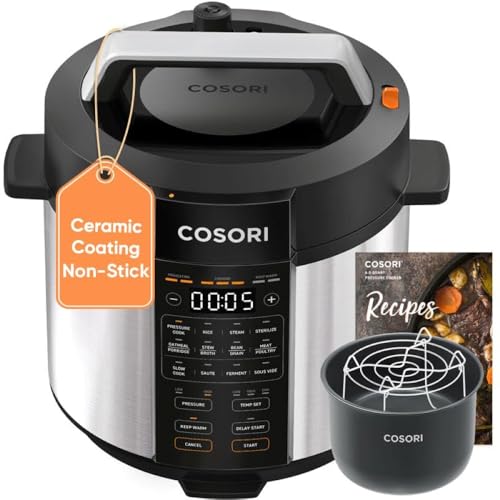
COSORI 6QT Pressure Cooker (9-in-1) — Best for Sous Vide & Grains
COSORI’s 6QT entry is the alternative-brand pick that earns its place on merit: pressure, slow cook, rice, sous vide and sauté in a 9-in-1 format, a ceramic-coated inner pot for easy release, stainless housing, and a safety system the listing counts at twelve features — the kind of detail nervous first-time pressure cooks appreciate.
Strengths
- Sous vide included — rare at this step of the market
- Ceramic-coated pot releases rice and grains cleanly
- 12 safety features and a tidy, modern control layout
Trade-offs
- Ceramic coating needs gentle handling to stay slick
- 1100W is mid-pack power — pressure build is not the fastest here
- Accessory range is smaller than Instant Pot’s
| Specification | Detail |
|---|---|
| Capacity | 6QT |
| Functions | 9-in-1 incl. sous vide and slow cook |
| Power | 1100W (per listing) |
| Inner pot | Ceramic coating |
| Safety | 12 safety features (per listing) |
Sous vide at this level is the differentiator: precise eggs, edge-to-edge medium-rare steaks finished with a sear, and delicate fish become weeknight-reasonable without a separate immersion circulator taking up a drawer. COSORI’s implementation rides on the same pot and lid you pressure-cook with, so the appliance count stays at one.
For the slow-cook half of the brief, the COSORI behaves like the category: give braises the time they want and use the sauté function to build flavour first. The ceramic pot is the daily pleasure — beans and grains release, cleanup is quick — traded against the knowledge that coatings are consumables. Treat it kindly and it is the most versatile dollar in this list after the budget pick.
Best for: versatile cooks who want sous vide plus both pressure and slow cooking in one mid-tier box / Not suited for: buyers who prioritise stainless-pot longevity or the largest accessory ecosystem
Check on Amazon to see the current price, configuration options and delivery terms for the COSORI 6QT.
Comparison Table
| Pick | Badge | Key spec | Best for |
|---|---|---|---|
| Instant Pot Duo 6 Qt 7-in-1 Electric Pressure Cooker | Best Overall | 7-in-1, 6 Qt, stainless pot | most families wanting one appliance for both pressure speed and slow-cooked weekends |
| Instant Pot Pro 6 Qt 10-in-1 Electric Pressure Cooker | Best Premium | 10-in-1, sous vide, handled stovetop pot | enthusiast cooks who want the best sear, sous vide and calmer pressure release |
| Instant Pot 6 Qt 9-in-1 Electric Pressure Cooker, WhisperQuiet | Best Quiet | 9-in-1, WhisperQuiet release, 6 Qt | apartments, open-plan homes and noise-sensitive households |
| COMFEE’ 12-in-1 Electric Pressure Cooker (6 Quarts) | Best Budget | 12-in-1, 24H timer, ceramic pot | budget buyers whose cooking leans to grains, soups and scheduled slow cooking |
| CHEF iQ Smart Pressure Cooker (6 Quart) | Best Smart / Guided | Built-in scale, Wi-Fi guided recipes, 10-in-1 | new pressure cooks and busy families who want guided, weighed, repeatable results |
| COSORI 6QT Pressure Cooker (9-in-1) | Best for Sous Vide & Grains | 9-in-1 with sous vide, ceramic pot, 1100W | versatile cooks who want sous vide plus both pressure and slow cooking in one mid-tier box |
How to Choose the Best Electric Slow Cook Pressure Cookers
Decide your size first. Six quarts is the family standard for a reason: it fits a whole chicken, a 3–4 lb roast or a double batch of soup, while staying manageable on the counter. Smaller households that mostly cook two-person meals can drop to 4 quarts (our fast-cooker guides cover minis), and anyone regularly cooking for crowds or batch-prepping should look at 8 quarts. Remember the pressure rule: never fill past two-thirds for most foods, or one-half for foaming foods like beans and grains — usable capacity is always less than the headline.
Judge the slow-cook function like a sceptic. You want multiple slow-cook temperature levels, maximum times of at least 10–12 hours on low settings, and honest expectations: multi-cookers heat from the bottom, crockpots from the sides too, so multi-cooker slow cooking runs a touch less even and often a touch cooler at equivalent settings. In practice: use the Normal/More settings as your crockpot Low/High equivalents, and give dense roasts a little extra time. If a recipe community exists for the model (a real advantage of the big platforms), those translations are already worked out for you.
Then the pressure details: a stainless inner pot for browning and longevity, or ceramic nonstick for grains and easy cleanup; a sauté function strong enough to actually sear; a lid whose ring removes for washing (and a spare ring for sweet versus savoury); and a steam release you are comfortable operating. Every pick in this guide clears those bars at its tier — the differences are in guidance (CHEF iQ), refinement (Instant Pot Pro), quiet (WhisperQuiet) and value (COMFEE’).
Pressure Mode or Slow Mode? A Practical Decision Framework
Reach for pressure when the constraint is time and the food is forgiving of intensity: dried beans, tough braising cuts, stocks, whole grains, frozen chicken you forgot to thaw. Pressure cooking is not just faster — it infuses flavour into the centre of dense foods in a way simmering cannot match in the same time, which is why pressure beans taste seasoned through rather than salted on.
Reach for slow mode when the constraint is your schedule or the food is delicate about texture: pulled pork that should slump rather than shred-tough, chilli that wants melding, steel-cut oats timed for waking, or a braise you want to load at 8 a.m. and forget. The two modes are complements, not rivals — the same chuck roast is a Sunday slow-cook project or a Tuesday pressure save, and owning both in one pot is the entire point of this category.
Getting Slow-Cook Results Right in a Multi-Cooker
Three habits close most of the gap between a multi-cooker’s slow mode and a dedicated crockpot. First, brown first: the sauté function exists precisely so a slow braise starts with fond and rendered edges rather than grey meat in liquid. Second, use less liquid than a crockpot recipe states — a sealed multi-cooker loses almost no moisture, so a cup less is a good starting adjustment, and sauces can be reduced with sauté at the end. Third, respect the temperature translation: start roasts on the higher slow setting for the first hour if your model allows switching, or simply add 15–20% to crockpot timings for dense cuts.
Dairy and delicate vegetables still go in late, exactly as they do in a crockpot — the sealed environment does not change that chemistry. And keep the lid closed: every peek in slow mode costs the pot a meaningful slice of its gentle heat, in a multi-cooker just as in stoneware. Follow those rules and the “multi-cookers can’t slow cook” complaint mostly evaporates; what remains is the honest difference in crock texture for a few specific dishes, which is why dedicated crockpots still exist for devotees.
The Two-Cooker Kitchen: When to Keep a Dedicated Slow Cooker Too
This guide argues for the combo, so honesty requires the counter-case in full. A dedicated ceramic slow cooker still does three things better than any multi-cooker’s slow mode. It heats from the sides as well as the base through heavy stoneware, giving the gentlest, most even low cook — the texture edge in delicate braises and baked beans. It is the superior serving vessel: a crock goes to the table and holds heat through a long meal in a way a thin multi-cooker pot does not. And it is the better second appliance at a gathering, running the side dish while the multi-cooker does the main.
The households that genuinely benefit from owning both are the ones who slow-cook weekly and entertain: the combo handles the pressure week and the everyday slow jobs, the crock handles holidays and signature dishes. Everyone else — and our years of reader patterns say this is most households — uses a dedicated slow cooker a handful of times a year, and for them the combo’s cupboard economy wins outright. The decision rule is frequency, not ideology: count last year’s slow cooks before you defend the crock’s counter space.
Accessories That Actually Earn Their Place
Multi-cookers attract accessory clutter like no other appliance, so here is the short list that earns its storage. A spare sealing ring — ideally two, colour-coded for savoury and sweet — is the essential one, because rings absorb flavours and age out. A glass lid converts the pot into a stovetop-style slow cooker and serving piece for the modes that do not need pressure. A steamer basket or trivet with handles makes eggs, vegetables and pot-in-pot cooking (a small dish inside the main pot — the trick behind cooking rice and curry simultaneously) practical rather than precarious.
A second inner pot is the power user’s luxury that pays on batch days: one pot of beans out, one pot of rice in, no washing in between. Beyond that list, skepticism is healthy. Most novelty inserts solve problems the trivet already solved, and every unused accessory is cupboard rent. Buy the ring first, the glass lid second, and let a month of real cooking tell you what else — if anything — you actually miss.
Troubleshooting the Combo: Five Fixes That Solve Most Problems
Problem: the cooker will not come to pressure. → Check the sealing ring is seated all the way around, the valve is set to sealing, and there is enough liquid — those three account for nearly every case. A ring that has stretched with age is the fourth; replace it.
Problem: a burn notice during pressure cooking. → The pot sensed scorching, usually from a thick sauce or food stuck after sautéing. Deglaze thoroughly before sealing, layer thick sauces on top of thinner liquid rather than stirring them in, and never pressure-cook a sauce too thick to pour.
Problem: slow-cooked meat is done but drowning. → Multi-cookers lose almost no liquid. Next time, cut the recipe’s liquid by roughly a quarter; this time, lift the meat out and reduce the sauce on Sauté for a few minutes — it concentrates flavour as it thickens.
Problem: rice pudding tastes of curry. → The ring remembers. Wash it, store the lid upside down so the ring airs, and use your second, sweet-only ring for desserts and plain rice.
Problem: steam leaks from the lid’s edge during cooking. → A small wisp early on is normal as pressure builds; a continuous leak means the ring is dirty, mis-seated or worn, or food debris is on the rim. Clean, reseat or replace — in that order — before blaming the machine.
Meal Planning With a Combo Cooker: A Week That Works
The combo cooker’s real product is not any single meal — it is a week with less thinking in it. Here is the pattern experienced owners converge on. Sunday: pressure-cook the week’s foundations — a batch of beans, a grain, a pulled protein — in three quick loads of the same pot. Monday: the slow mode earns its keep, loaded in the morning for a braise that greets you at the door. Midweek: pressure mode rescues the evenings that went wrong — frozen chicken, a fast soup, eggs for tomorrow’s lunches. Friday: the pot rests, or makes rice and steamed dumplings for the easy night.
Notice what the pattern exploits: the two modes cover the two kinds of weeknight — the planned one and the ambushed one — and the same appliance, the same pot, the same washing-up serves both. That is the argument for the combo in its strongest form. It is not that a combo out-cooks two dedicated appliances at their specialities; it is that a household’s actual week needs both specialities, in one footprint, with one learning curve. Plan the week around the pot once, and the pot quietly runs the week for you.
Two habits make the system stick: a standing grocery list built on the cooker’s strengths (dried beans, grains, braising cuts, frozen proteins, aromatics), and a freezer stocked in the flat, fast-thawing portions pressure cooking loves. With those in place, the most common weeknight question — what can we possibly eat tonight? — has a standing answer that takes under an hour and no heroics.
Two Modes, One Groceries List: Shopping for the Combo
A combo cooker quietly rewrites the shopping list, because its two modes reward the same ingredients from opposite directions. The pressure mode loves what is cheap, dried and dense: beans, lentils, whole grains, tough marbled cuts, whole chickens, soup bones. The slow mode loves exactly the same list given a day instead of an hour. A household that stocks for the combo — a shelf of dried legumes and grains, a freezer with two braising cuts and a chicken, aromatics that keep (onions, garlic, ginger, dried chillies, tomato paste) — is a household that can always produce dinner, in either mode, without a shop.
Fresh shopping then becomes the garnish rather than the foundation: herbs, citrus, dairy, salad and bread to finish what the pot has built. That inversion — pantry as the base, fresh as the accent — is the combo cooker’s deepest economic effect, larger than any energy saving. It is also its resilience effect: the households that cooked most calmly through every supply disruption of recent years were the ones whose dinners were already built on dried beans, grains and a freezer.
Build the list gradually: add one dried legume and one grain a week until the shelf covers your tastes, keep a simple inventory on the cupboard door, and let the cooker’s rhythm — Sunday pressure batches, a midweek slow load — set the quantities. Within a month the system runs itself, and the appliance you bought for convenience has quietly become the household’s food security policy.
A Final Word on Lids, Rings and Storing the Pot
Store the cooker with its lid upside down or ajar and the ring will thank you twice: it rests uncompressed, so it seals longer, and it airs, so it carries less of last week’s curry into this week’s rice. Wash the lid’s underside and the anti-block shield after starchy cooks, and give the rim a wipe before every seal — most “mystery leaks” are a grain of rice on the rim wearing a disguise.
If counter space allows, the pot lives out, plugged in and ready; a combo cooker stored in a deep cupboard is a combo cooker used half as often, and frequency is the entire value proposition of this category. Keep the spare ring in the drawer beneath it, the glass lid beside it, and the manual’s translation note (your slow-cook settings versus crockpot language) taped inside the cupboard door. Small systems, faithfully kept, are what separate the households that love these machines from the ones that list them for sale.
Entertaining With the Combo: The Two-Load Strategy
For gatherings, run the combo in two planned loads rather than buying a second appliance in a panic. Load one is the main: the braise or pulled protein, pressure-cooked early and held — these dishes improve with a rest and reheat beautifully. Load two, timed to guests, is the fast fresh element: rice, steamed vegetables or a quick soup. The pot’s keep-warm bridges the gap between the loads without any quality drama.
Serve from the pot at the table if the setting is casual — the stainless pot of the Instant Pot picks is presentable enough — and you have fed a crowd with one appliance, one washing-up sink, and no oven juggling. It is the combo’s party trick, and it is why owners stop borrowing extra slow cookers from neighbours within a year of buying one.
How to Use a Combo Cooker: Sear, Then Choose Your Mode
This workflow is the core skill of the category — one pot, a proper sear, then either the fast road or the slow road. It works on every pick in this guide.
- Pat the main ingredient dry and season it. Moisture is the enemy of browning in any pot.
- Use the Sauté function on its higher setting with a little oil until the pot is properly hot, then brown the meat in uncrowded batches. Crowding steams; batches sear.
- Remove the meat, sauté aromatics in the drippings, then deglaze with stock, wine or water, scraping up every browned bit — that is your sauce’s backbone.
- Return everything to the pot with the cooking liquid: enough to build steam for pressure mode (check your manual’s minimum), or a little less than a crockpot recipe for slow mode.
- For pressure: lock the lid, set the valve to sealing, choose the program and time, and let pressure build. Use natural release for large meats (it keeps them juicy) and quick release for vegetables and grains that would overcook.
- For slow mode: lock or vent the lid exactly as your manual directs for slow cooking, choose the level and time, and leave the lid alone until the final stretch.
- Finish like a cook: taste, adjust salt and acid, reduce the sauce on Sauté if it is thin, and stir in dairy, fresh herbs or delicate vegetables off the boil.
Common Buying Mistakes
Overfilling for pressure. Past two-thirds full (half for beans, grains and foaming foods), a pressure cooker cannot build pressure properly and can vent starchy liquid. The max line is a safety line, not a suggestion.
Slow-cooking on the wrong mental setting. Treating a multi-cooker’s lowest slow setting as identical to crockpot Low undercooks roasts. Learn your model’s translation once and write it on the manual.
Skipping the sear to “save time”. In pressure mode especially, browning is where the flavour is. Ten minutes of sauté buys more taste than any later seasoning can.
Quick-releasing big meats. A sudden release makes large cuts seize and dry. Natural release for roasts is not patience theatre — it is the difference between juicy and chalky.
One ring for everything. Silicone rings absorb curry, cumin and chilli and will perfume a cheesecake or rice pudding. A second, colour-coded ring is the cheapest upgrade in this category.
Final Recommendation
The Instant Pot Duo remains the answer for most kitchens: both cooking modes done properly, a stainless pot, and an ecosystem that answers every question you will ever have. Step up to the Pro for the stovetop pot, sous vide and calmer release, or sideways to the WhisperQuiet if noise is your constraint. The COMFEE’ is the budget route in, the CHEF iQ is the guided route in, and the COSORI is the versatile alternative with sous vide at a mid tier.
Whichever you choose, learn the sear-then-choose workflow in the how-to section and the slow-cook temperature translation for your model. Those two skills, not the function count, decide whether a combo cooker becomes your most-used appliance or a cupboard monument.
Shortlist first: Instant Pot Duo 6 Qt 7-in-1 Electric Pressure Cooker, Instant Pot Pro 6 Qt 10-in-1 Electric Pressure Cooker, Instant Pot 6 Qt 9-in-1 Electric Pressure Cooker, WhisperQuiet — check price on Amazon for each before you decide.
Keep exploring the cooker cluster: Best Fast Pressure Cookers Best Fast Cookers Best Ever Pressure Cookers Best 6 Slow Cookers And Pressure Cookers Best Electric Pressure Cookers For Easy Meals Best 8 Qt Electric Pressure Cookers
Frequently Asked Questions
Can a multi-cooker really replace my slow cooker?
For most households, yes — with one learning curve. Multi-cookers heat from below and seal tightly, so slow-cook temperatures and liquid needs differ slightly from a ceramic crockpot: use the model’s Normal/More slow settings as Low/High equivalents, add a little time for big roasts, and use slightly less liquid. Devoted crockpot users with signature dishes may keep both; everyone else frees a cupboard.
Is pressure cooking safe in these electric models?
Modern electric pressure cookers are built around redundant safety systems — lid locks that prevent opening under pressure, pressure regulation, over-temperature cutoffs and controlled release valves; one of our picks lists twelve safety features. The rules that remain yours: do not overfill, keep the sealing ring and valves clean, and never force a lid. Followed, electric pressure cooking is one of the calmer technologies in the kitchen.
What size should I buy?
Six quarts suits most families: a whole chicken, a family roast, a double soup batch. Remember usable pressure capacity is about two-thirds of the headline (half for beans and grains). Singles and couples who mostly cook small can consider 4-quart minis; entertainers and batch preppers should look at 8-quart models — but check counter and cupboard height, because these are tall appliances.
Why does my slow-cooked roast take longer than the recipe says?
Usually the temperature translation: many multi-cookers’ lowest slow setting is gentler than a crockpot’s Low. Switch to the Normal (or medium) slow setting for crockpot-Low recipes, start dense roasts on a higher setting for the first hour, and keep the lid closed — each peek costs real heat in a gentle cook.
Stainless or nonstick inner pot — which is better?
Stainless browns better, deglazes cleanly, tolerates metal utensils and effectively lasts forever; it is the choice for searing-led cooking. Ceramic nonstick releases rice, grains and porridge beautifully and washes in seconds, but the coating is a wear item. Several of our picks offer one or the other; match the pot to your dominant cooking style.
Natural release vs quick release — when do I use each?
Natural release (letting pressure fall on its own) suits large meats, foaming foods and anything that benefits from resting — it keeps roasts juicy and beans intact. Quick release suits vegetables, seafood, eggs and grains that would overcook in residual heat. Many dishes use a hybrid: ten minutes natural, then release the rest. Your cooker’s manual and recipe will usually specify; when in doubt for meats, go natural.


