Disclosure: airfryerkitchensupply.com is reader-supported. When you buy through links on our site, we may earn an affiliate commission at no extra cost to you.
Where to buy
The fastest way to buy any pick in this guide is through Amazon, where stock and configurations change often, so check the current price on Amazon on the product page rather than relying on any number printed elsewhere. These are the six verified picks for best 6 qt pressure cookers:
- Instant Pot Duo 6 Qt 7-in-1 Electric Pressure Cooker — Check on Amazon
- COSORI 6QT Pressure Cooker, 9-in-1 — Check on Amazon
- COMFEE’ 12-in-1 Electric Pressure Cooker, 6 Quarts — Check on Amazon
- Chefman 6-Quart 13-in-1 Electric Pressure Cooker — Check on Amazon
- Presto 01362 6-Quart Stainless Steel Pressure Cooker — Check on Amazon
- Presto 01264 6-Quart Aluminum Pressure Cooker — Check on Amazon
Availability in this category moves quickly, especially for seasonal colours and smaller brands. If a first choice is out of stock, the alternatives in this guide are ranked so that the next pick down is a sensible substitute, not a compromise.
The best 6 qt pressure cookers are the mainstream of pressure cooking for a reason: six quarts of brim capacity delivers about four working quarts under pressure, which is a whole chicken, a serious pot of chili, a bag of beans or a stock batch worth freezing — the exact jobs the format exists for. This guide covers the verified field across both philosophies: the electric multi-cookers that dominate modern kitchens, and the stovetop classics that predate them and will outlast them.
The electric-versus-stovetop decision deserves more honesty than it usually gets. Electrics regulate themselves, keep food warm, and bundle rice, slow cooking and yogurt into one body — at the cost of counter space, electronics with a finite life, and pressure a notch below the stovetop’s best. Stovetops sear harder, climb faster, store in a cupboard, and ask for gaskets instead of replacements — at the cost of your attention while they cook. Both kinds appear below with badges naming their households, because both households are right.
Buy at 6 quarts if you cook for three to six people, batch-cook for a freezer, or want one cooker that handles everything from Tuesday beans to a Sunday bird. Size down to the 4-quart guide in this series if portions for two are your whole world; size up only if canning or crowd batches dominate your cooking. The shortlist that follows is the verified centre of the market, with working volumes and format trade-offs stated plainly.
In this guide
Quick Picks
If you only read one section, read this one. These are the six best 6 qt pressure cookers worth your money, each with a distinct badge so you can match the pick to your situation in seconds:
- Instant Pot Duo 6 Qt 7-in-1 Electric Pressure Cooker — Best Overall Electric. The category standard with the deepest ecosystem. Check price on Amazon
- COSORI 6QT Pressure Cooker, 9-in-1 — Best Features. Nine functions including sous vide, ceramic pot. Check price on Amazon
- COMFEE’ 12-in-1 Electric Pressure Cooker, 6 Quarts — Best Value Electric. Twelve menus and a 24-hour timer at the value tier. Check price on Amazon
- Chefman 6-Quart 13-in-1 Electric Pressure Cooker — Best Interface. Touchscreen control and thirteen modes. Check price on Amazon
- Presto 01362 6-Quart Stainless Steel Pressure Cooker — Best Stovetop. Stainless Presto built for a generation. Check price on Amazon
- Presto 01264 6-Quart Aluminum Pressure Cooker — Best Budget Stovetop. Light aluminum classic with endless parts support. Check price on Amazon
How These Picks Were Chosen
Every product in this guide was verified against Amazon’s own catalogue data for this site before it was written about: the model name, capacity and headline features in each review come from the maker’s verified listing, not from memory or third-party summaries. Products that could not be verified were left out or written about without a purchase link, and this guide says so where that happened.
The criteria, in order, were: honest capacity for the 6-quart class named in the search; the features that decide daily satisfaction in this category, as set out in the buying guide below; build and care practicality, including whether the parts you wash are dishwasher safe; and a spread of badges so that different households — not just the average one — can find their pick. Where this size class is thin or confusing in the real market, the reviews say that plainly rather than padding the list with products that do not belong.
The 6 Best 6 Qt Pressure Cookers

Instant Pot Duo 6 Qt 7-in-1 Electric Pressure Cooker — Best Overall Electric
The Duo is the electric pressure cooker against which all others are compared, and at 6 quarts it is the size the entire ecosystem — recipes, accessories, replacement parts, community knowledge — is built around. Pressure cook, slow cook, rice, yogurt, steam, sauté and warm in one stainless-pot appliance. It is not the newest or the quietest model in this guide, but it is the safest pair of hands: any question you will ever have about it has been asked and answered a thousand times. For a first electric pressure cooker, that depth is a feature no spec sheet captures.
Strengths
- The best-selling format in the category, with the deepest recipe and accessory ecosystem in existence
- A stainless inner pot that sears properly and never has a coating to baby
- Seven functions genuinely replace separate rice and slow cookers for most households
Trade-offs
- Slow-cook mode on multi-cookers runs gentler than a dedicated slow cooker — allow extra time
- The sealing ring holds odours; a second ring for desserts and rice is a wise small extra
- Counter footprint is substantial; measure the cupboard or counter corner it will own
| Capacity | 6 quarts |
| Format | Electric multi-cooker, 7-in-1 (per listing) |
| Functions | Pressure cook, slow cook, rice, yogurt, steam, sauté, warm, sterilize (per listing) |
| Pot | Stainless steel (per listing) |
In daily service the Instant Pot Duo 6 Qt 7-in-1 Electric Pressure Cooker is judged on three things: how fast it comes to pressure with a realistic load, how predictably it holds it, and how calm the release is when the cook ends. A cooker that does those three things without drama turns dried beans, tough cuts and stock from weekend projects into weeknight options. The controls or the lid hardware — depending on format — are the whole interface, so clarity there matters more than a long feature list.
The flagship jobs at this size deserve naming. Stock from carcasses and trimmings, beans from dry by the bag, whole birds, pot roasts for gatherings, and freezer-filling meal prep are the batches that justify a 6-quart cooker. If those jobs happen monthly, it pays its way in money and in ingredients rescued from the back of the fridge. If they happen once a year, honesty says a smaller cooker plus a borrowed big pot serves you better — this guide would rather sell you the right size than the impressive one.
There is also a confidence curve with the Instant Pot Duo 6 Qt 7-in-1 Electric Pressure Cooker worth respecting. New pressure cooks hover; experienced ones load, seal and walk away. The bridge between the two is about five supervised batches — make them simple ones, learn the sounds the cooker makes at pressure and at release, and the format’s old reputation for drama evaporates. Every pick in this guide was chosen to make those first five batches boring, because boring is what mastery feels like in this category.
Best for: First-time electric buyers and recipe followers / Not suited for: Stovetop loyalists
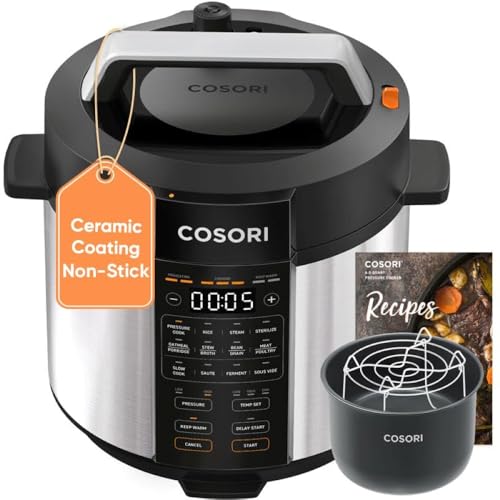
COSORI 6QT Pressure Cooker, 9-in-1 — Best Features
COSORI’s 6-quart is the maximalist entry: nine functions stretching to sous vide, a ceramic-coated pot, 1100 watts, and a dozen listed safety features. Where the Duo is the safe classic, this is the cooker for the household that actually uses the extra modes — grains in the morning, a sous vide bath on the weekend, pressure beans on a weeknight. The ceramic pot is the daily difference: food releases, cleanup shortens, and the trade is the standard coating-care discipline the buying guide sets out.
Strengths
- Nine functions including sous vide — the widest repertoire in this guide
- A ceramic-coated pot releases rice and eggs that stainless makes you soak off
- Twelve listed safety features and strong wattage for a fast climb to pressure
Trade-offs
- Ceramic coating asks for gentle utensils and no thermal shock
- More functions means a longer manual and a learning curve to match
- Sous vide in a sealed cooker is a convenience version of the method, not a circulator’s precision
| Capacity | 6 quarts |
| Format | Electric multi-cooker, 9-in-1 (per listing) |
| Pot | Ceramic coating (per listing) |
| Power | 1100 W (per listing) |
| Extras | Sous vide function; 12 safety features (per listing) |
Fill discipline is the skill this size teaches. Pressure cookers must never be filled past their marked maximum, and foaming or expanding foods — beans, grains, thick sauces — belong at half full at most. The COSORI 6QT Pressure Cooker, 9-in-1 rewards that discipline with even cooking and a clean release; ignore it and you get sputtering valves and starchy spray. Build the pre-cook check into a ritual: gasket seated, vent clear, liquid present, lid locked. Thirty seconds, every time.
Safety culture is the other deep point. Modern pressure cookers, electric and stovetop alike, are engineered with layered safeguards, and the accidents in this category’s history belong to neglected gaskets, blocked vents and forced lids. The COSORI 6QT Pressure Cooker, 9-in-1 asks for the standard respect: inspect before cooking, respect the fill lines, let the release happen on its own path, and never force a lid that resists. Follow that culture and pressure cooking becomes as routine as boiling a kettle — just considerably more useful.
Consider counter and cupboard honesty with the COSORI 6QT Pressure Cooker, 9-in-1: pressure cookers are bulky, oddly shaped, and used with their lids open at an angle no dimension table captures. Measure the home you actually have for it — including the vertical clearance its steam release needs — before the box arrives. A cooker that lives within arm’s reach gets used weekly; one that lives in a garage gets used at holidays. Placement is a feature, and at 6-quart it is a feature you choose.
Best for: Mode-rotating households / Not suited for: Coating-averse cooks — choose stainless instead

COMFEE’ 12-in-1 Electric Pressure Cooker, 6 Quarts — Best Value Electric
COMFEE’ brings the 12-in-1 format to the value tier: a 6-quart electric pressure cooker with a ceramic nonstick pot, twelve menus and a 24-hour timer for loading ahead. It targets the small kitchen that wants one appliance to pressure cook, slow cook, steam and handle grains without paying flagship prices for flagship tuning. The honest framing is breadth over depth — every function works, the specialists in this guide finesse their specialities further — but for many households, breadth at this tier is exactly the right buy.
Strengths
- Twelve menus with a 24-hour timer at the value end of the 6-quart electric class
- Ceramic nonstick pot keeps cleanup short after rice, oats and sauces
- Nine-cookers-in-one breadth covers a small kitchen’s whole wish list
Trade-offs
- Menu breadth at a value tier means shallower tuning than the premium brands’ flagship modes
- Nonstick care rules apply — gentle utensils, no scouring
- Brand service network is thinner than Instant’s; keep the paperwork
| Capacity | 6 quarts |
| Format | Electric multi-cooker, 12-in-1 (per listing) |
| Pot | Ceramic inner pot, nonstick (per listing) |
| Timer | 24-hour timer (per listing) |
What a 6-quart pressure cooker changes most is planning. Beans no longer need last night’s soak decision, stock no longer needs an afternoon, and a frozen-solid chicken is a timing problem rather than a ruined dinner. That flexibility is worth more than raw speed for most households, because it removes the planning barrier that keeps these ingredients out of weeknight cooking entirely.
The flagship jobs at this size deserve naming. Stock from carcasses and trimmings, beans from dry by the bag, whole birds, pot roasts for gatherings, and freezer-filling meal prep are the batches that justify a 6-quart cooker. If those jobs happen monthly, it pays its way in money and in ingredients rescued from the back of the fridge. If they happen once a year, honesty says a smaller cooker plus a borrowed big pot serves you better — this guide would rather sell you the right size than the impressive one.
The COMFEE’ 12-in-1 Electric Pressure Cooker, 6 Quarts changes shopping as much as cooking. Tough, cheap cuts become first choices rather than compromises; dried beans replace tinned on the shelf; whole birds get bought whole because breaking them down under pressure is easy. Households often find the grocery bill moves more than the energy bill — in the right direction — once a pressure cooker enters the weekly routine. That is the deepest argument for the format, and it compounds with every month of ownership.
Best for: Small kitchens wanting breadth on a budget / Not suited for: Buyers who want flagship tuning and service depth

Chefman 6-Quart 13-in-1 Electric Pressure Cooker — Best Interface
Chefman’s 13-in-1 is the feature maximalist of the 6-quart electrics: touchscreen controls, delay start, and named modes for the dishes this size cooks most — soup and chili among them. It suits the cook who genuinely rotates through modes rather than living on one pressure button. The cautions are ergonomic and temporal: touch controls divide opinion in messy kitchens, and a newer line has less accumulated community knowledge than the category standard. Buy it for the interface and the breadth, with eyes open on both.
Strengths
- Thirteen functions with touchscreen controls — the most modes in this guide
- Delay start suits loading in the morning for an evening finish
- Dedicated soup and chili modes match how this size actually gets used
Trade-offs
- Touchscreens and kitchens with wet, floury hands are an acquired pairing
- Thirteen modes is a learning curve; the manual earns its drawer space
- Newer model line — long-term parts depth is still being proven
| Capacity | 6 quarts |
| Format | Electric multi-cooker, 13-in-1 (per listing) |
| Controls | Touchscreen, delay start, keep warm (per listing) |
| Functions | Includes slow cooker, steamer, sauté, soup and chili modes (per listing) |
Care is straightforward but not optional. The gasket is a consumable: wash it, dry it, store the lid ajar or upside down so odours do not take up residence, and replace it when it stiffens or the cooker starts whispering steam from the rim. The vent and safety devices need a visual check and an occasional clear-out with a skewer or pin as the manual directs. A 6-quart cooker maintained this way serves for many years; a neglected one gets retired early for faults that were really maintenance.
Safety culture is the other deep point. Modern pressure cookers, electric and stovetop alike, are engineered with layered safeguards, and the accidents in this category’s history belong to neglected gaskets, blocked vents and forced lids. The Chefman 6-Quart 13-in-1 Electric Pressure Cooker asks for the standard respect: inspect before cooking, respect the fill lines, let the release happen on its own path, and never force a lid that resists. Follow that culture and pressure cooking becomes as routine as boiling a kettle — just considerably more useful.
One more ownership note for the Chefman 6-Quart 13-in-1 Electric Pressure Cooker: keep the manual. Pressure cookers concentrate their wisdom — fill lines, release guidance, gasket part numbers, troubleshooting tables — into a few pages that answer nearly every question the internet will otherwise speculate about. Photograph the key pages to your phone, store the gasket part number with them, and future-you will handle the cooker’s one bad day in minutes instead of an evening.
Best for: Cooks who genuinely use named modes / Not suited for: Hands-wet, screen-sceptical traditionalists

Presto 01362 6-Quart Stainless Steel Pressure Cooker — Best Stovetop
The 01362 is the stainless expression of Presto’s 6-quart stovetop design — the same proven format with a body that sears properly, shrugs off metal spoons and tomato sauce alike, and asks nothing but washing. It is the buy-once pick of this guide: heavier than aluminum, dearer than aluminum, and the one owners report handing down. For cooks committed to the stovetop method who want the pot to be a permanent fixture rather than a consumable, this is where the search ends.
Strengths
- Stainless steel construction: sears hard, cleans bright, ignores metal utensils
- All the stovetop speed advantages with none of aluminum’s care caveats
- Presto’s parts depth behind a pot built for a generation of use
Trade-offs
- Heavier than the aluminum sibling, noticeably when full of stock
- Stovetop discipline required: heat management is the cook’s job
- Costs a tier above the aluminum version for material, not for speed
| Capacity | 6 quarts |
| Format | Stovetop pressure cooker |
| Material | Stainless steel (per listing) |
| Brand | Presto |
Noise and steam are the honest frictions of the format. Electric models vent quietly compared with a stovetop jiggle-top, but every pressure cooker announces its release, and the steam plume needs clearance from cabinets above. Place the Presto 01362 6-Quart Stainless Steel Pressure Cooker where that plume has somewhere to go, keep faces and hands out of the release path, and the drama disappears. Households with very low wall cabinets should measure before they buy, not after the first stock day.
The flagship jobs at this size deserve naming. Stock from carcasses and trimmings, beans from dry by the bag, whole birds, pot roasts for gatherings, and freezer-filling meal prep are the batches that justify a 6-quart cooker. If those jobs happen monthly, it pays its way in money and in ingredients rescued from the back of the fridge. If they happen once a year, honesty says a smaller cooker plus a borrowed big pot serves you better — this guide would rather sell you the right size than the impressive one.
Ownership of the Presto 01362 6-Quart Stainless Steel Pressure Cooker settles quickly into a rhythm: a weekly batch of something — stock, beans, a braise — plus opportunistic speed cooking when dinner plans collapse. Owners who thrive with pressure cookers are the ones who build that rhythm; the cooker rewards routine far more than occasional heroics. Keep the staple ingredients for your two signature batches in the house at all times, and the appliance stops being equipment and becomes infrastructure.
Best for: Buy-once cooks committed to the stovetop / Not suited for: Anyone who wants automation and keep-warm

Presto 01264 6-Quart Aluminum Pressure Cooker — Best Budget Stovetop
The Presto 01264 is the 6-quart stovetop original: aluminum, light, quick to pressure, and supported by the deepest spare-parts ecosystem in the category. It cooks at true stovetop pressure, which is higher than most electrics reach, and it will still be cooking — on its third gasket — when today’s appliances are landfill history. What it never does is think for you. If your kitchen style is hands-on and your horizon is decades, this is the 6-quart pressure cooker to buy once and hand down.
Strengths
- The classic American stovetop cooker: light, fast to pressure, and repairable for decades
- Higher stovetop pressure shortens beans and stocks beyond electric times
- Presto gaskets and parts are available everywhere, indefinitely
Trade-offs
- Aluminum darkens with acidic dishes and wants hand-washing
- You manage heat and timing — no automation, no keep warm
- Not suited to induction hobs unless your listing confirms a compatible base
| Capacity | 6 quarts |
| Format | Stovetop pressure cooker |
| Material | Aluminum (per listing) |
| Brand | Presto |
Judge the Presto 01264 6-Quart Aluminum Pressure Cooker finally on fit for your actual cooking. If your pressure cooking is beans, stock, stews and grains in family quantities, this size is the centre of the market for a reason. If you mostly cook two portions of rice, a smaller cooker or a rice specialist will make you happier and take less cupboard. The badge on this pick tells you which household it was chosen for — match the badge to your kitchen, not the headline to your ambition.
Safety culture is the other deep point. Modern pressure cookers, electric and stovetop alike, are engineered with layered safeguards, and the accidents in this category’s history belong to neglected gaskets, blocked vents and forced lids. The Presto 01264 6-Quart Aluminum Pressure Cooker asks for the standard respect: inspect before cooking, respect the fill lines, let the release happen on its own path, and never force a lid that resists. Follow that culture and pressure cooking becomes as routine as boiling a kettle — just considerably more useful.
Long-term, the Presto 01264 6-Quart Aluminum Pressure Cooker asks for consumables, not repairs: gaskets soften and take on odours, and on electric models the inner pot’s finish ages with use. Budget those small renewals into your thinking and the cooker has no planned end. The models in this guide were chosen partly on that aftercare reality — a cooker whose gasket you cannot buy in five years is a cooker with an expiry date, whatever its first-year performance.
Best for: Value-first traditional cooks / Not suited for: Induction kitchens and dishwasher-only households
Comparison Table
All six picks side by side. Capacity and feature claims are taken from each maker’s verified listing, and where a pick sits deliberately outside the headline size, the table says so rather than hiding it.
| Pick | Badge | Key spec | Best for |
|---|---|---|---|
| Instant Pot Duo 6 Qt 7-in-1 Electric Pressure Cooker (Check on Amazon) | Best Overall Electric | 6 qt electric 7-in-1, stainless pot, the category standard | The category standard with the deepest ecosystem |
| COSORI 6QT Pressure Cooker, 9-in-1 (Check on Amazon) | Best Features | 6 qt electric 9-in-1, ceramic pot, sous vide, 1100 W | Nine functions including sous vide, ceramic pot |
| COMFEE’ 12-in-1 Electric Pressure Cooker, 6 Quarts (Check on Amazon) | Best Value Electric | 6 qt electric 12-in-1, 24 h timer, ceramic pot | Twelve menus and a 24-hour timer at the value tier |
| Chefman 6-Quart 13-in-1 Electric Pressure Cooker (Check on Amazon) | Best Interface | 6 qt electric 13-in-1, touchscreen, delay start | Touchscreen control and thirteen modes |
| Presto 01362 6-Quart Stainless Steel Pressure Cooker (Check on Amazon) | Best Stovetop | 6 qt stovetop stainless, Presto premium stovetop | Stainless Presto built for a generation |
| Presto 01264 6-Quart Aluminum Pressure Cooker (Check on Amazon) | Best Budget Stovetop | 6 qt stovetop aluminum, Presto classic | Light aluminum classic with endless parts support |
How to Choose the Right 6-Quart Pressure Cooker
First decide the format, because it shapes everything else. Electric multi-cookers are set-and-forget appliances: they regulate their own pressure, switch to keep-warm, and bundle extra functions like rice cooking, slow cooking and yogurt. Stovetop cookers reach higher pressure, sear harder, last for decades with gasket changes, and take less counter space, but they ask you to manage the heat and the timing yourself.
Capacity is brim capacity, and pressure cookers cook at two-thirds full at most — half for beans, grains and anything foamy. A 4-quart cooker therefore delivers family-side-dish and small-household batches; a 6-quart is the mainstream family size that fits a whole chicken and a serious pot of chili. Buy for working volume, not the number on the box.
Inner pot material matters daily. Stainless steel sears properly, shrugs off metal utensils and never has a coating to baby, but rice and eggs can stick. Ceramic-coated nonstick pots release food and clean easily, and ask for gentle utensils and no thermal shock. Either is a legitimate choice; pick the maintenance style you will actually follow.
Then check the safety and service layer: multiple independent pressure safeguards, a clear locking indicator, a steam release you can operate without putting a hand over the vent, and — for stovetop models — a gasket and valve ecosystem you can buy replacements for in five years. Pressure cooking is a decades-long relationship with one pot; buy the one whose spare parts will exist.
How to Use a 6-Quart Pressure Cooker for Family Batches
Step 1 — Run the pre-cook check. Gasket seated evenly in the lid, vent and safety devices clear, inner pot in place, and liquid present — pressure cookers need liquid to build steam, and every recipe in this format assumes a minimum amount. Thirty seconds, every time, no exceptions.
Step 2 — Load within the lines. Two-thirds full at most for ordinary foods; half full for beans, grains and anything that foams or expands. Add a spoon of oil to beans to calm foaming, and keep thick sauces layered on top of liquid rather than stirred into it, so the base cannot scorch before pressure builds.
Step 3 — Lock, set, and let it climb. Seal the lid, set the vent to sealing, and give the cooker its uninterrupted climb to pressure. On a stovetop model, bring it up over medium-high heat, then drop the heat to the lowest setting that holds pressure steadily.
Step 4 — Time from pressure, not from switching on. The cooking clock starts when full pressure is reached, not when you close the lid. Coming-to-pressure time varies with how full and how cold the load is; the cook time in a recipe does not.
Step 5 — Choose the release deliberately. Natural release for meats, beans and foamy foods — the gentle settle protects texture and keeps the vent clean. Quick release for vegetables and delicate foods that overcook in minutes. Never put your hand over the vent, and keep the plume away from cabinets and faces.
Step 6 — Wash and store the lid right. Remove and wash the gasket, clear the vent, dry everything, and store the lid ajar or upside down on the pot. Odours live in gaskets stored sealed; air is the cure, and a spare gasket for strong-flavoured cooking is a cheap luxury.
Common Buying Mistakes
- Reading quarts as usable volume. Pressure cookers cook at two-thirds full maximum, half for foaming foods. A cooker bought by its headline number alone is a cooker that overflows, sputters and disappoints.
- Skipping the liquid minimum. No liquid, no steam, no pressure — and a scorched base while the cooker tries. Every pressure recipe needs its minimum liquid, even dishes that do not feel like they should.
- Forcing the lid. A lid that resists is telling you pressure remains inside. Let it release, check the vent, and never persuade a pressure cooker open with strength.
- Quick-releasing everything. Meats and beans want a natural release; a violent quick release toughens meat and paints the vent with starchy foam. Match the release to the food, not to your impatience.
- Neglecting the gasket. A stiff, odorous or nicked gasket causes most ‘broken cooker’ complaints. Wash it, store the lid ajar, and replace the gasket on schedule instead of replacing the cooker.
- Ignoring the steam plume. Releasing pressure under low cabinets steams the cabinet finish meal after meal. Position the cooker so the vent has clear air above it.
Before You Buy: A Final Checklist
- Confirm the size basis. Check the exact capacity statement in the pick’s spec box above, because this category’s headline numbers are not all measured the same way.
- Measure your space. Check the footprint against your counter and the storage spot you actually have, including room for the lid to open or lift clear.
- Match the pick to your three most common meals. Not the most ambitious meal you can imagine — the ordinary ones you cook every week.
- Plan the cleanup. Confirm which parts are dishwasher safe in the verified listing, and be honest about whether you will hand-wash a heavy pot every time.
- Check the current price on Amazon on the product page. Prices and stock in this category move often, and the listing is the only number that counts.
Run through those five checks and the right pick in this guide usually identifies itself. If two picks still tie, choose the one whose trade-offs you mind least — you will live with the trade-offs daily, while the strengths quickly become invisible.
Safety culture around pressure cookers
Modern pressure cookers are safe appliances when their simple rules are followed: check the gasket and vent, respect fill limits, never force a lid, and keep clear of the steam release. The accidents in this category’s past belong to neglected equipment and ignored instructions. Treat the pre-cook check as a ritual — thirty seconds of inspection before every batch — and a pressure cooker becomes as routine as a kettle, just considerably more useful. If a cooker ever behaves oddly — steam leaking at the rim, a valve that will not settle — stop, let it cool, and diagnose the gasket first; it is the cause of most field complaints and the cheapest fix in the kitchen.
Electric versus stovetop: the honest comparison
Electric multi-cookers regulate themselves: they climb to pressure, hold it, and drop to keep-warm without asking anything of you, and they bundle rice, slow cooking and yogurt into the same body. Stovetop cookers reach higher pressure, sear harder, respond instantly to a turned dial, and last for decades with gasket changes — but they ask you to manage heat and timing. Neither is the correct answer in the abstract. Kitchens that cook attentively gain speed and longevity from the stovetop; households that cook in the margins of a busy day gain dinners from the electric. This guide includes both because both households are real.
Grains under pressure: the weeknight multiplier
Rice, oats, barley and farro all cook faster and more forgivingly under pressure than on a stove, because the sealed environment removes evaporation guesswork from the equation. A 6-quart cooker handles family quantities of grains in one batch, and grains are the cheapest foundation a dinner can have. Cook them in stock rather than water and the flavour arrives built in. The discipline is the same as beans: respect the fill line for expanding foods, let the pressure fall naturally for a few minutes before venting, and fluff rather than stir. Households that add two grain batches a week to their routine usually report the cooker has changed their cooking more than any speed record ever could.
Frozen ingredients and the planning-free dinner
One of the format’s quiet superpowers is cooking proteins from frozen safely and well, because the climb to pressure thaws as it goes and the cook time is counted from pressure. A 6-quart cooker turns a forgotten freezer chicken or a solid block of stew meat into dinner on the same evening it was supposed to happen. Allow extra time for the climb, separate pieces when the recipe depends on even shapes, and verify thick joints are cooked through. It is not the method for everything — delicate fish and thin cuts deserve better — but as a rescue system for real life, it has no rival in the kitchen.
The two-pot system: why a second inner pot pays
Owners who cook daily with a cooker like this often buy a second inner pot, and the reasoning is pure logistics: rice in one, a main in the other, no washing in between; a batch of yogurt culturing in the fridge in one pot while dinner cooks in the second. At 6-quart, the spare pot stores inside the cooker or a shallow drawer and removes the format’s only real friction — the serial bottleneck of one pot. If your cooking rhythm involves back-to-back batches, treat the second pot as part of the purchase rather than an accessory, and the cooker becomes a system instead of a queue.
The batches that justify a cooker this size
A 6-quart pressure cooker earns its storage space on a short list of jobs done repeatedly: stock in useful quantity, beans cooked from dry without a planning meeting, whole birds and family braises, and freezer-filling meal prep. If those jobs happen monthly, the cooker pays its way in money and in ingredients rescued from the back of the fridge. If they happen once a year, the honest answer is a smaller cooker plus a borrowed big pot for the annual event. This size class sits where it does because it matches the most common version of those jobs — which is why the guide’s badges name households, not ambitions.
Stock: the flagship use
Stock is where a pressure cooker changes what is practical. Bones, carcasses and vegetable trimmings that would simmer most of a day on the stove become rich stock in a fraction of the time, in quantities that fill a shelf of freezer containers. Strain while hot, cool quickly in shallow pans, and freeze flat in bags that stack like books. Home stock quietly improves every soup, sauce and pot of grains cooked in your kitchen for months afterwards, which is why so many owners cite it — not speed — as the reason the cooker keeps its place.
Beans from dry, without the planning barrier
Pressure cooking removes the overnight decision from dried beans: most varieties cook from dry in well under an hour, seasoned after cooking, with a spoon of oil in the pot to calm foaming and a natural release for the creamiest texture. Respect the half-full line for foaming foods — beans expand and their cooking liquid froths — and a bag of beans becomes a week of meals in one session. Freeze portions in their liquor, and weeknight cooking turns into assembly: beans plus greens plus an egg, beans plus rice plus a sharp sauce, beans blended into soup.
Final Recommendation
Start with the Instant Pot Duo 6 Qt 7-in-1 Electric Pressure Cooker, our Best Overall Electric pick: it is the model we would buy for the widest range of households searching for best 6 qt pressure cookers. If its particular strengths do not match your situation, the COSORI 6QT Pressure Cooker, 9-in-1 (Best Features) is the alternative we would choose next, and every other pick in this guide exists because it serves a specific household better than either of those two. Check on Amazon / Check on Amazon
Still deciding between neighbouring sizes or formats? Compare the related guides in this series: Best 4 Qt Slow Cookers, Best 4 Qt Stoneware Slow Cookers, Best 4 Quart Pressure Cookers, Best 4 Quart Slow Cookers, Best 5 Qt Stoneware Slow Cookers. Sizes in this category sit close together, and ten minutes with the comparison tables in those guides is the cheapest way to avoid buying the wrong capacity.
Frequently Asked Questions
Are modern pressure cookers safe?
Yes, when used as directed. Current electric and stovetop models carry several independent safeguards — locking lids, pressure regulators, and backup release paths — and the format’s bad reputation belongs to neglected antique equipment. Inspect the gasket and vent, respect fill lines, and never force a lid.
How full can I fill a pressure cooker?
Two-thirds full is the absolute maximum for most foods, and half full for anything that foams or expands: beans, grains, pasta and thick sauces. The headline quart size is brim capacity, so usable volume is always less than the number on the box.
What is the difference between natural and quick release?
Natural release lets pressure fall on its own as the cooker cools — gentle, and right for meats, beans and foamy foods. Quick release vents steam immediately, stopping cooking fast for vegetables and delicate foods. Many dishes use a hybrid: ten minutes natural, then vent the rest.
Do I still need to soak beans before pressure cooking?
No — that is one of the format’s great conveniences. Most beans cook from dry in well under an hour at pressure. A soak still improves evenness and digestibility for some cooks, but it is a preference now, not a requirement.
Why does my cooker take so long to come to pressure?
Coming-to-pressure time depends on volume and starting temperature: a full, cold pot takes longer than a half pot of warm ingredients. Frozen ingredients extend it further. It is normal behaviour, not a fault — cook time is counted from full pressure, not from closing the lid.
How long does a gasket last?
With regular use, plan on replacing the sealing gasket every year or two, or sooner if the cooker starts leaking steam at the rim, the gasket stiffens, or it holds odours that washing will not shift. It is an inexpensive consumable and the first thing to check when performance fades.


