Disclosure: airfryerkitchensupply.com is reader-supported. When you buy through links on our site, we may earn an affiliate commission at no extra cost to you.
Where to buy
The best digital thermometer for smokers watches the cooker, not just the cook: a probe clipped at grate level, high and low alarms standing guard over the fire, and a readout you can trust at 3am. This guide is the pit-monitoring half of the thermometer cluster — its sibling covers the probes that live in the meat — and the six verified systems below range from ThermoWorks’ WiFi Signals to a one-probe TempPro wired unit that costs less than the brisket it guards.
- ThermoWorks Signals BBQ Alarm Thermometer — check price on Amazon; choose the listing sold or shipped by Amazon or the brand’s own store, and confirm the exact model name before you order.
- TempPro TempTrack Digital Thermometer with Dual Probe — check price on Amazon; choose the listing sold or shipped by Amazon or the brand’s own store, and confirm the exact model name before you order.
- Govee Bluetooth Meat Thermometer, 6 Probes — check price on Amazon; choose the listing sold or shipped by Amazon or the brand’s own store, and confirm the exact model name before you order.
- MEATER Block WiFi Smart Meat Thermometer, 4-Probe — check price on Amazon; choose the listing sold or shipped by Amazon or the brand’s own store, and confirm the exact model name before you order.
- TempPro TempSync 650FT Bluetooth Meat Thermometer, 2 Probes — check price on Amazon; choose the listing sold or shipped by Amazon or the brand’s own store, and confirm the exact model name before you order.
- TempPro TempTrack Large LCD Digital Meat Thermometer — check price on Amazon; choose the listing sold or shipped by Amazon or the brand’s own store, and confirm the exact model name before you order.
The best digital thermometer for smokers answers the question the meat cannot: what is the fire actually doing? Every smoker’s built-in gauge reads the air near its own mounting point — usually the lid, usually optimistically — while your food lives at grate level, in a climate that can differ by a margin large enough to change dinner. A digital pit thermometer puts a probe where the food is, reports the truth continuously, and — in the systems that define this category — stands guard with high and low alarms while you sleep through the middle hours of a brisket. That guard duty, more than any display or app, is what this search is really shopping for.
The distinction from this cluster’s meat-thermometer guide is worth one clear paragraph. Meat probes measure the food; pit thermometers measure the cooker’s climate, usually with one probe dedicated to ambient grate temperature and the rest free for meat. The best systems do both duties in one box, which is why several picks here are multi-probe instruments judged on their monitoring architecture: channel count, alarm logic, connectivity, and whether the display works without a phone. If your question is ‘is my smoker lying to me, and will something wake me if the fire dies?’ — you are in the right guide.
All six systems were verified in Amazon listing data before inclusion, with the TempPro models confirmed in a fresh verification round on 2026-11-21 and the rest drawn from the programme’s verified cache. Specifications in the spec boxes come from those listings alone; where a maker sells several configurations under one name, the review judges the verified listing and says so.
In this guide
Quick Picks
Six verified pit-monitoring systems — ThermoWorks Signals at the top, dual and six-probe monitors from TempPro and Govee, MEATER’s standalone-capable Block, and the simple wired TempTrack for purists.
- Best Overall: ThermoWorks Signals BBQ Alarm Thermometer — the professional’s monitor — a Wi-Fi and Bluetooth BBQ alarm thermometer from the instrument maker serious cooks calibrate their trust against.
- Best Dual-Probe Value: TempPro TempTrack Digital Thermometer with Dual Probe — pit plus meat, wired and honest — dual probes, high/low alarms and a timer on a large backlit LCD, with no app anywhere in sight.
- Best Multi-Probe Monitor: Govee Bluetooth Meat Thermometer, 6 Probes — six channels of vigilance — six probes over 230ft Bluetooth with app timer, alerts and free data storage for cooks who log everything.
- Best Standalone Wireless Station: MEATER Block WiFi Smart Meat Thermometer, 4-Probe — four wireless probes in a bamboo block with its own brain — WiFi range, a standalone mode that needs no phone, and ambient sensing in every probe.
- Best Bluetooth Range: TempPro TempSync 650FT Bluetooth Meat Thermometer, 2 Probes — the long tether — two rechargeable probes’ worth of monitoring over a 650ft Bluetooth link, for houses where lesser Bluetooth gives up.
- Best Simple Wired Pick: TempPro TempTrack Large LCD Digital Meat Thermometer — one probe, one big honest display — a stainless probe on a wire with a clock timer, for cooks who monitor by walking past, not by app.
How These Picks Were Chosen
Systems that could not be confirmed in this session were not described from reputation.
Judging for this guide weighted monitoring architecture above all: how many channels, whether one can be dedicated to grate-level ambient duty, alarm logic in both directions, and the link — WiFi, RF-class range, Bluetooth, or wire — judged against real houses rather than laboratory ratings. Meat-probe excellence was treated as the sibling guide’s brief; here it counted only as it serves the monitoring whole.
Range figures in this guide are quoted as the listings state them and taxed, in the reviews, by the standing honesty that walls, weather and distance collect their share of every wireless claim; the buying guide’s link-by-geography method exists to convert those claims into a decision your own house can honour.
No prices or ratings are printed, per standing policy. Check price on Amazon for the exact model and configuration — several of these names span multiple bundles — and let your programme size and your house’s geography, as laid out in the buying guide, choose the architecture.
The 6 Best Digital Thermometer For Smokers

ThermoWorks Signals BBQ Alarm Thermometer — Best Overall
Signals is the pit monitor that treats temperature as a profession. ThermoWorks built its name on instruments that read true, and Signals brings that discipline to the smoker: a BBQ alarm thermometer with both Wi-Fi and Bluetooth aboard, so the grate-level truth reaches you across the yard on Bluetooth or across town on Wi-Fi, with high and low alarms standing guard in both directions — the fire spiking and, more importantly at 4am, the fire dying. For cooks running overnight briskets on charcoal or pellet machines without their own trustworthy monitoring, Signals is the upgrade that converts anxiety into sleep.
Strengths
- Wi-Fi and Bluetooth together: no monitoring dead zone between yard and away
- High and low alarms guard both failure directions — flare and fade
- ThermoWorks instrument pedigree: the readings are the product
Trade-offs
- A professional instrument at a professional position in the market
- Power users get the most from it; casual cooks may never open its deeper settings
- Colour choice (this listing is Nautical Blue) is the hardest decision it presents
| Type | BBQ alarm thermometer (from listing) |
| Connectivity | Wi-Fi and Bluetooth (from listing) |
| Maker | ThermoWorks |
| Colour | Nautical Blue (this listing) |
The dual-radio design is the engineering headline, and it maps onto real smoking geography precisely. Bluetooth covers the cook at home — garden, kitchen, sofa — with a direct, internet-free link. Wi-Fi takes over the moment the cook leaves: the school run during a shoulder, the shop trip during a brisket, the neighbour’s porch during anything. Systems with only one radio strand you in one of those worlds; Signals refuses to. Add alarms that trigger on your phone rather than merely beeping at an empty patio, and the monitoring promise is complete in a way single-link rivals cannot honestly match.
ThermoWorks’ other contribution is cultural: this is the company whose instant-reads refereed a generation of barbecue arguments, and Signals inherits the expectation that its numbers settle questions rather than start them. In a category where a cheap sensor’s optimism can ruin a brisket slowly and silently, that expectation is worth money. Buy it as the last pit monitor you intend to purchase for a long while, and run your smoker’s own gauge against it once — the size of the disagreement is your first lesson, and it is always memorable.
Best for: overnight and away-from-home cooks wanting the reference monitoring system / Not suited for: occasional smokers whose needs the simpler wired picks below fully cover

TempPro TempTrack Digital Thermometer with Dual Probe — Best Dual-Probe Value
The TempTrack dual-probe is the pit thermometer for cooks who want the monitoring essentials and nothing else’s opinion: two probes — one clipped at grate level for the pit, one in the meat — a large backlit LCD, high and low temperature alarms, and a timer mode, all on a wired base unit in silver. No Bluetooth pairing ritual, no account, no firmware. It is the architecture that guarded a million briskets before apps existed, executed cleanly: set the pit’s high and low guardrails, set the meat’s target, and let the box beep with authority when either story needs you.
Strengths
- Dual probes cover the pit-and-meat brief in one honest box
- High/low alarms: the overnight guard duty, without any phone
- Large backlit LCD reads at a glance, in the dark, in gloves season
Trade-offs
- Wired and local: the alarm reaches as far as your ears, not your phone
- Two channels is the ceiling — programmes beyond pit-plus-one-protein outgrow it
- No logging or app graph for cooks who analyse their cooks afterwards
| Probes | Dual probes (from listing) |
| Alarms | High/low temperature alarm (from listing) |
| Display | Large LCD with backlight (from listing) |
| Extras | Timer mode (from listing) |
There is a durable wisdom in this design: the two numbers that decide a smoke are the pit’s climate and the meat’s core, and a thermometer that shows exactly those two, with alarms on both, covers the overwhelming majority of real cooks completely. The high/low pit alarm is the feature to linger on — a low alarm is a dying fire announced in time to save the brisket, and a high alarm is a grease flare or a gust-driven spike announced before it becomes bark damage. Together they convert an overnight cook from a vigil into a sleep with a safety net, which is the entire point of the category.
The wired honesty cuts both ways and the review will not hide it: you monitor from where the box is, and the box is at the smoker. For patio-centred cooks — most of us, most of the time — that is no hardship at all, and the compensations are real: instant wake, zero pairing, a display that works with sauce on your hands, and a battery life measured in seasons. The TempTrack is the pick this guide hands to the cook who says ‘just tell me the temperatures’ — and means it as a philosophy.
Best for: patio-centred, app-free cooks running pit-plus-one-protein / Not suited for: cooks who monitor from away or run three-plus proteins at once
Govee Bluetooth Meat Thermometer, 6 Probes — Best Multi-Probe Monitor
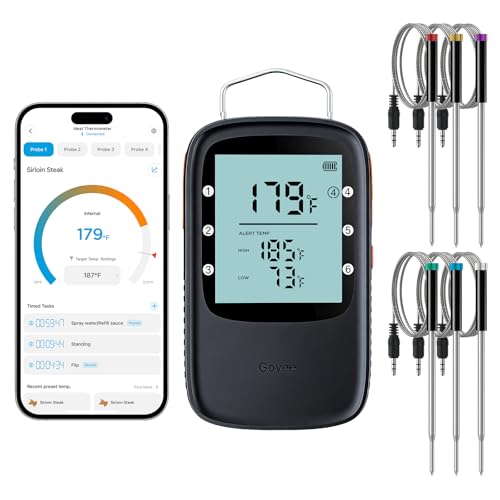
When the programme outgrows two probes, the Govee is where this guide sends you: six probes reporting over a 230-foot Bluetooth link to an app with timers and alerts, a backlit LCD on the base for phone-free glances, and free data storage so each cook’s curves survive for study. Six channels redecorate the monitoring problem — pit at grate level, brisket flat, brisket point, ribs, chicken, and a spare that becomes the second grate zone on a big cooker — and for the cook who runs a full smoker as a matter of routine, anything fewer is a compromise renewed weekly.
Strengths
- Six probes: whole-programme monitoring without instrument juggling
- 230ft Bluetooth with app alerts and free cook-data storage
- Base LCD keeps the essentials visible without the phone
Trade-offs
- Six cables is a routing discipline, not a detail — budget the setup minutes
- Bluetooth’s range is a clear-air rating; brick houses tax it
- App-dependent for the full feature set, unlike the wired picks
| Probes | 6 probes (from listing) |
| Range | 230ft Bluetooth (from listing) |
| App | Smart app with timer and alerts (from listing) |
| Data | Free data storage (from listing) |
Channel count changes what a cook can know. With pit and meat covered by the first two probes, the Govee’s remaining four turn monitoring into mapping: the brisket’s two muscles as separate stories, the ribs as a third, and — the connoisseur’s move — a second ambient probe at the far end of a big offset or cabinet, exposing the hot and cool zones your smoker’s manual never mentioned. Cooks who compete, cater informally, or simply run full machines will find six channels not indulgent but correct, and the per-probe alerts mean the vigilance scales without you watching a screen.
The data storage deserves its sentence: cooks improve on records, and an app that keeps every curve — free, per the listing — turns each brisket into tuition for the next. Compare last month’s stall with this month’s, in the same smoker, with the same fuel, and the arguments end. Govee’s smart-home polish shows in the app experience; the hardware ask in return is the cable management any six-probe system demands, and a Bluetooth link whose honest range you should test against your own house’s walls before the first overnight.
Best for: programme cooks, competitors and anyone who studies their cook curves / Not suited for: one-protein households, for whom six channels is five too many

MEATER Block WiFi Smart Meat Thermometer, 4-Probe — Best Standalone Wireless Station
The MEATER Block earns its place in a pit-monitoring guide through one feature the other wireless systems lack: a standalone mode. Its bamboo block is not just a charger but a station — four wireless probes, each reading meat and ambient temperature, reporting over long-range WiFi, and able to run the monitoring itself when a phone is elsewhere, dead, or simply unwanted at a cookout. Every probe doubles as a grate-level witness, so a Block owner can dedicate one probe to the pit’s climate and three to the programme, all without a single cable crossing the door seam.
Strengths
- Standalone mode: the block monitors without a phone in the loop
- Four wireless probes, each with ambient sensing for pit duty
- Long-range WiFi plus app, watch and voice-assistant reach
Trade-offs
- The premium station of the wireless world; buy it for programmes, not singles
- Wireless probes ask the usual charging discipline, times four
- Ambient reading sits at the probe’s location in the meat’s neighbourhood, not on a dedicated clip — placement is the cook’s craft
| Probes | 4 wireless probes (from listing) |
| Mode | Standalone mode (from listing) |
| Connectivity | Long-range WiFi (from listing) |
| Charger | Bamboo charging block (from listing) |
Standalone mode sounds like a footnote until the first time the phone is inside charging, the app is updating, or the cook simply wants the numbers on the block where the meat is. The Block’s answer — a station with its own display and logic — is the wireless world’s concession to the wired world’s oldest virtue: the instrument should work by itself. For pit duty specifically, owners commonly park one probe in a potato or a probe clip at grate level as the ambient sentinel; it is a hack the hardware quietly encourages, and it works because each probe’s ambient sensor reads the air at its end of the shaft.
As a programme system the Block is complete: four cuts, four curves, WiFi’s honest range, and an ecosystem of app, watch and voice integrations for the cooks who want their brisket announced by the house itself. The discipline it asks — probes home in the block, charged, clean — is the standing price of wirelessness, and the block makes that price as painless as design can. In this guide’s pit-monitoring frame, it is the pick for the cook who has already decided cables are over, but refuses to let a phone become a single point of failure.
Best for: wireless-first cooks running multi-probe programmes with phone-free backup / Not suited for: single-cut cooks and wired purists, both better served above and below

TempPro TempSync 650FT Bluetooth Meat Thermometer, 2 Probes — Best Bluetooth Range
Bluetooth thermometers live or die by one number, and the TempSync’s number is 650 feet: a Bluetooth link rated far beyond the class’s usual hundred-odd, carrying two probes’ data to your phone from a rechargeable base. For the pit-monitoring brief, that range is the feature — it is what lets a cook dedicate one probe to the grate and one to the meat, then actually leave: into the house, down the garden, to the far end of a property where standard Bluetooth systems silently drop the cook. Two channels is the classic pit-plus-meat allocation, and this is its longest-legged Bluetooth expression in the verified field.
Strengths
- 650ft Bluetooth rating: the longest wireless tether in this guide
- Two probes map exactly onto pit-plus-meat monitoring
- Rechargeable base — no battery drawer archaeology
Trade-offs
- Two channels is the whole story; programmes need a bigger system
- Range remains a clear-air figure — walls and terrain still apply their tax
- App-mediated alerts: your phone’s settings become part of the safety net
| Range | 650 ft Bluetooth (from listing) |
| Probes | 2 probes (from listing) |
| Power | Rechargeable (from listing) |
| Use | Smoker, grill and oven (from listing) |
Range claims deserve the guide’s standing scepticism, applied evenly: 650 feet is a line-of-sight rating, and your house will tax it. But taxes apply to a larger principal here — a link rated at 650 feet that loses two-thirds of itself to brick and distance still reaches rooms a 150-foot system never sees, and that margin is precisely the difference between a monitor and a decoration in larger homes. The honest test is your own geography: if standard Bluetooth thermometers have failed you at the smoker-to-sofa distance, this class of rating is the fix that does not require WiFi infrastructure or an RF receiver’s separate hardware.
Within its two channels, the TempSync is well judged: rechargeable rather than battery-hungry, app alerts for the guard duty, and a brief that covers the pit-plus-meat pattern most smokers actually run. It is the specialist pick of this guide — not the most channels, not the most radios, but the longest Bluetooth leash — and specialists earn their slots by being exactly right for a recognisable household. If that household is yours, the search ends here.
Best for: larger homes and gardens where ordinary Bluetooth monitoring drops out / Not suited for: multi-protein programmes needing four-plus channels
TempPro TempTrack Large LCD Digital Meat Thermometer — Best Simple Wired Pick
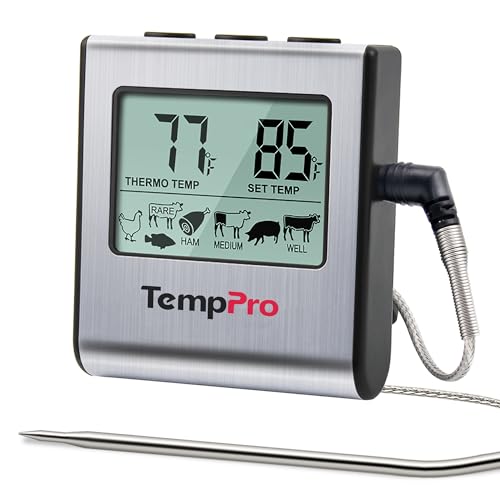
The simplest instrument in this guide may be the most honest: a single stainless probe on a heat-tolerant cable, a large LCD base with a clock timer, and nothing else to configure, pair or charge. As a pit thermometer it does the founding job — put the probe at grate level (or in the meat) and read the truth on a display big enough for a glance from the doorway — and it does it for less, per the listing’s tier, than the cost of the meat it watches. Every serious kit in this cluster ends up containing something like this: the backup, the second zone’s witness, the loaner, the thermometer that works when the systems are charging.
Strengths
- Dead simple: probe, cable, big display, timer — nothing to pair or update
- Large LCD reads across a room; the glance is the interface
- The natural second instrument in any kit: pit witness beside a meat system
Trade-offs
- One channel: pit or meat per cook, not both at once
- No alarms beyond the timer — guard duty requires the dual-probe sibling above
- Local readout only; monitoring means being within sight of the base
| Probes | 1 stainless steel probe (from listing) |
| Display | Large LCD (from listing) |
| Extras | Clock timer (from listing) |
| Use | Smoker, oven, grill rated (from listing) |
Do not mistake this pick’s simplicity for a consolation prize. A single wired probe at grate level settles the oldest argument in smoking — what temperature is my food actually experiencing — for the price tier of a bag of charcoal, and its display’s size makes it the best glanceable witness in the guide. Owners of grand systems routinely add one as the dedicated pit sentinel, freeing the expensive channels for meat; owners of nothing routinely start here and discover, correctly, that one honest number beats a lid gauge’s fiction by more than the rest of the category’s features combined.
Its limits are stated in the trade-offs without decoration: no alarm guard, one channel, no remote story. Buy it as a foundation or a complement and it will serve for years — the wired probe’s failure modes are few and mostly involve doors and cables, both within the cook’s control. In a guide full of radios, the TempTrack is the reminder that the original digital thermometer idea — a sensor, a wire, a true number, big enough to read — still deserves a slot, and still earns it.
Best for: first pit thermometers, system owners wanting a dedicated pit witness, and purists / Not suited for: overnight cooks needing alarms to sleep by — that is the dual-probe pick
Comparison Table
The monitoring field by architecture: radios at the top, wires at the bottom, alarms throughout. Your channel count and your house decide the row.
| Pick | Badge | Key spec | Best for |
|---|---|---|---|
| ThermoWorks Signals BBQ Alarm Thermometer | Best Overall | Wi-Fi + Bluetooth alarm thermometer, ThermoWorks | Serious cooks wanting the reference pit monitor |
| TempPro TempTrack Digital Thermometer with Dual Probe | Best Dual-Probe Value | 2 probes, high/low alarm, backlit LCD, timer | App-free cooks wanting pit-plus-meat in one unit |
| Govee Bluetooth Meat Thermometer, 6 Probes | Best Multi-Probe Monitor | 6 probes, 230ft Bluetooth, app alerts, data storage | Full-programme cooks and data-minded smokers |
| MEATER Block WiFi Smart Meat Thermometer, 4-Probe | Best Standalone Wireless Station | 4 wireless probes, WiFi, standalone mode | Wireless loyalists wanting a phone-free monitoring station |
| TempPro TempSync 650FT Bluetooth Meat Thermometer, 2 Probes | Best Bluetooth Range | 2 probes, 650ft Bluetooth, rechargeable | Cooks whose house defeats standard Bluetooth range |
| TempPro TempTrack Large LCD Digital Meat Thermometer | Best Simple Wired Pick | 1 wired probe, large LCD, clock timer | Purists, backups and second-zone duty |
How to Choose a Digital Thermometer for Your Smoker
Start with channels. One probe means choosing, each cook, between pit and meat. Two — the classic allocation — covers both, and is the correct minimum for anyone who cooks overnight. Four and above serve programmes and zone-mapping. Then choose the link by geography: wired for the patio-centred, Bluetooth for the near house, long-range Bluetooth or RF for the far house, WiFi for the cook who leaves the property entirely. Finally, alarms: for overnight work, high and low alarms on the pit channel are not a feature but the feature, and any system bought for brisket duty should be interrogated on exactly that point before purchase.
Grate level is the whole argument
Mount the ambient probe where the food lives: clipped to the grate, near the meat but not touching it, away from the firebox wall’s radiant lie and the door’s cool seam. A pit thermometer read anywhere else is a weather report for a climate your dinner does not inhabit. Expect the grate reading to disagree with the smoker’s lid gauge — sometimes startlingly — and expect the grate reading, verified against the food’s behaviour over a few cooks, to be the one that predicts your dinners. That disagreement, measured once and understood, is the moment a smoker becomes an instrument you operate rather than a box you negotiate with.
Alarms, logging and the 3am test
Judge every monitoring feature by a single scenario: it is 3am, the brisket is at hour nine, and the fire has just died. Does the system notice (low alarm on the pit channel)? Does it reach you (phone alert, or a beeper loud enough at the base)? Can you act in time (range that includes your bedroom)? Systems pass this test in different ways — Signals by radios and phone alerts, the wired TempTrack dual by a honest beeper near a patio door — and the right answer depends on your house’s layout. Logging, by contrast, is a daytime pleasure: wonderful for improving, irrelevant to rescue. Buy for the 3am test first.
Fan Controllers and the Step Beyond Monitoring
Monitoring tells you the fire is drifting; a temperature controller does something about it. The fan-controller category — represented elsewhere in this programme by the Flame Boss, BBQ Guru and Inkbird units in the automatic controllers guide — closes the loop between a thermometer like the picks here and a charcoal fire’s air supply, metering a blower against the same grate-level reading your monitor reports. The two instrument classes are complements, not rivals: many serious charcoal cooks run a controller for the fire and a standalone monitor like Signals or the Govee as the independent witness and alarm layer, because the witness should not share a brain — or a battery, or a bug — with the thing it watches.
Deciding whether you need the step beyond is a question about your fire’s temperament and your own. A well-sealed bullet on a calm night holds its line for hours with no governance at all, and a monitor’s occasional alarm is all the supervision the cook requires. A leaky offset in gusty weather spends its owner’s night in adjustments, and there the controller earns its keep weekly. Read your own cook log — the one the logging picks in this guide help you keep — and let the recorded drift, not the gadget appetite, make the decision.
Reading Your Smoker: Zones, Offsets and Calibration
A pit thermometer’s first month is an education in your specific smoker. Run the ambient probe at different grate positions across a few cooks and you will map the hot end, the cool corner, the shelf that runs true — knowledge that reorganises how you load food forever after. Note the offset between grate truth and the lid gauge at your usual set points, and write it on the smoker itself if you are the annotating kind; future you, mid-cook, will be grateful. None of this requires new equipment — only the decision to treat the thermometer as a measuring instrument for the cooker, not merely an alarm clock for the meat.
One more reading skill separates thermometer owners from thermometer users: knowing what a healthy curve looks like. A charcoal fire breathes in slow waves as fuel catches and settles; a pellet auger draws a sawtooth around its set point; an electric element cycles in tidy steps. Each signature is normal, and each cooker’s version of it becomes familiar across a season of logged cooks. The alarm that matters is the departure from your machine’s own signature — which is why the logging features in this guide are not decoration, and why the first month with any of these instruments should be spent watching curves with the same attention you once gave the lid gauge.
Calibration keeps the education honest. An ice-water check at the season’s start, and after any probe abuse, confirms the sensor still reports physics correctly; a probe that fails gets replaced before it fails a brisket. Cables deserve the same seasonal inspection — the door-seam pinch point is where wired probes go to die, and a frayed lead announces itself in wandering readings weeks before it quits entirely. Instruments maintained this way outlast the smokers they monitor, which is the natural order of things.
How to Set Up Pit Monitoring for an Overnight Smoke
The overnight brisket is the examination this whole category exists to pass. Set the monitoring up once, in daylight, with this routine, and the night itself becomes the easiest part of the cook.
- Position the ambient probe at grate level. Clip it beside where the brisket will sit — not above the fire’s direct path, not against the wall — and route its cable through the door’s kindest seam or the vent path the maker intends.
- Assign the channels deliberately. Pit on channel one, brisket flat on two, point on three if you have it. Label them in the app or on the base now, while your hands are clean and your thinking is clear.
- Set the guardrails. Pit low alarm below your smoking band, pit high alarm above it, meat alerts at the wrap decision and near the finish. Guardrails set in daylight are judgement; alarms improvised at midnight are hope.
- Verify against the lid gauge and note the offset. As the smoker settles, record grate truth versus lid fiction at your set point. Tonight you will trust the probe; the note is for every future cook.
- Test the alert path end-to-end. Phone charged, app notifications permitted, receiver within earshot — deliberately trip a test alarm before the meat goes on. The 3am test is only fair if the rehearsal happened at 3pm.
- Load the meat, close the door, and go inside. This is the discipline the whole category sells: monitoring by exception. Glance at the curve before bed; let the alarms earn their keep in the silence between glances.
- Respond to alarms by script, not by panic. Low alarm: check fuel first, then vents, then the probe itself. High alarm: check for flare and gusts before touching a setting. Most alarms are information; a few are errands; almost none are emergencies.
- Morning: verify, then judge. Cross-check the meat with an instant-read as the finish approaches, judge by tenderness, and log the night’s curve — the stall’s timing, the fire’s behaviour — while breakfast makes the debrief painless.
Two or three overnight cooks run this way recalibrate a smoker’s whole relationship with their craft: the fire becomes a system under supervision rather than a pet under care, and sleep becomes an ingredient. The instruments above differ in radios and channels, but they share this destination — buy the one whose guard duty fits your house, and let it stand the watch it was built for.
Built-In Gauges, Smart Smokers and the Standalone Monitor
A fair question shadows this whole category: if modern digital smokers have their own sensors and apps, why buy a standalone monitor? Three durable answers. First, independence: a standalone thermometer audits the smoker’s own claims, and the audit — as every owner who has run one discovers — is rarely a formality. Second, portability: the monitor moves between the smoker, the grill, the oven and the next smoker you own, while built-in systems retire with their box. Third, specialisation: dedicated monitors like the picks here are designed around alarms, channels and links as their entire purpose, where a smoker’s monitoring is one feature among fifty competing for the same engineering budget. None of this indicts smart smokers — several are excellent — but it explains why the standalone thermometer remains standard equipment in serious kits, and why this guide exists beside the smoker guides rather than inside them.
Common Buying Mistakes
Mounting the ambient probe wherever it fits. Against the wall, over the fire path, dangling at the door — each lie has a location. Grate level, beside the food, in free air: the placement is the measurement.
Setting alarms at the target instead of the guardrails. An alarm that fires at your exact set point cries wolf all night. Guardrails belong outside the working band — low enough to mean a dying fire, high enough to mean a real spike.
Trusting the smoker’s lid gauge because it is built in. Built-in gauges read their own neighbourhood, which is the lid. Verify once against a grate-level probe and you will never un-know the difference.
Buying channels you will not wire. Six probes in the drawer monitor nothing. Match the system to the programme you actually cook, and let the cables you will genuinely route decide the channel count.
Skipping the alert rehearsal. A notification permission denied at setup is an alarm that will not fire at 3am. Test the whole chain — probe, base, app, phone — before the first overnight, not during it.
Final Recommendation
For most smokers who cook overnight, the recommendation is the ThermoWorks Signals: both radios, both alarm directions, and readings the whole craft trusts. Choose the TempTrack dual-probe for the same guard duty without a phone, the Govee six-probe when the programme is the point, the MEATER Block when cables are banned but a phone-free station is still required, the TempSync 650FT when your house defeats ordinary Bluetooth, and the TempTrack single as the honest first witness or the dedicated pit sentinel beside a meat system.
Check price on Amazon for the exact configuration — bundles vary under these names — and complete the picture with the cluster’s other half: Best Digital Meat Thermometer For Smokers covers the probes that live in the meat, Best Dual Thermometer For Smokers focuses on the two-channel pit-and-meat pattern, and Best Bluetooth Thermometer For Smokers compares the wireless field on range alone. If the fire itself needs governing rather than watching, Best Automatic Temp Controllers For Smokers covers the fan controllers that close the loop, and Best Digital Smokers surveys the machines whose built-in monitoring these instruments audit.
To act on this guide: start with ThermoWorks Signals BBQ Alarm Thermometer, then compare TempPro TempTrack Digital Thermometer with Dual Probe, and finally Govee Bluetooth Meat Thermometer, 6 Probes — check price on Amazon on each listing, confirm the exact model name and size, and choose by the design logic above rather than by the headline discount.
Frequently Asked Questions
Where should a pit thermometer probe be placed?
At grate level, clipped near the food but not touching it, in free air away from walls and the fire’s direct radiant path. That position reads the climate your dinner actually experiences — the entire reason the instrument exists.
Why does my smoker’s built-in gauge disagree with my thermometer?
They measure different air. Lid-mounted gauges read the hot layer near the top, often optimistically; a grate-level probe reads the food’s climate. Trust the grate reading for cooking decisions, and note your smoker’s typical offset so the built-in gauge becomes a rough reference instead of a confident liar.
Do I need WiFi in a smoker thermometer?
Only if you leave the property mid-cook or your house defeats shorter links. Bluetooth serves the near house, long-range Bluetooth and RF serve the far house, and wired units serve the patio. WiFi’s unique gift is distance without limit — valuable exactly when your life uses it.
What alarms matter most for overnight smoking?
A low alarm on the pit channel — the dying fire, announced in time — and a high alarm for spikes and flares. Meat target alerts are conveniences; pit guardrails are the safety net that makes sleeping through a brisket a plan rather than a gamble.
How many probes does a pit thermometer need?
Two is the working minimum for pit-plus-meat, four covers programmes, and six serves mapping and competition-style loads. One probe is a legitimate start — the TempTrack single in this guide — provided you accept choosing pit or meat per cook.
Can one thermometer monitor both the pit and the meat?
Yes — that is the standard multi-probe pattern this guide is built around. Dedicate one channel to a grate-clipped ambient probe and the rest to the food; the systems above from two channels upward all run exactly that allocation.


