Disclosure: airfryerkitchensupply.com is reader-supported. When you buy through links on our site, we may earn an affiliate commission at no extra cost to you.
Where to buy
For the best convection ovens with electric range, start with the Frigidaire 5.3 cu. ft. electric convection range for the mainstream freestanding choice, or the Kenmore induction range with true convection if you want the fastest electric cooktop technology paired with the convection oven. Every linked model was confirmed against a live Amazon listing for the exact range named. Ranges are configured by fuel hookup, finish and retailer, so check price on Amazon for the exact configuration before ordering.
Best convection ovens with electric range means one appliance: a full-size electric range whose oven uses a convection fan to circulate hot air. That fan is the whole point of the search. A convection oven cooks more evenly than a conventional one — no rotating trays halfway through a bake, less difference between the top and bottom racks, and reliable results when both racks are loaded at once. Paired with an electric cooktop, it is the standard modern range formula, sold as freestanding models that slide between cabinets and finished slide-ins with front controls. This guide compares the verified current models across both formats and both electric cooktop technologies: radiant smoothtop and induction.
Two clarifications keep the shopping honest. First, “convection” on a range listing ranges from a simple fan that merely moves air to true convection systems that add a heating element around the fan for tighter temperature control; both beat no fan, and the picks below note which class each model presents itself in, using only what its listing states. Second, an electric range is a 240-volt appliance with real installation requirements — circuit, receptacle, anti-tip bracket — and the buying guide below treats those as part of the purchase, because a range that does not match your kitchen’s electrical reality is not a bargain at any price.
Six ranges make the list: a mainstream Frigidaire freestanding model as the default buy, an induction Kenmore for buyers who want the best electric cooktop technology, a premium Frigidaire Professional slide-in, two Cosmo models at value and style positions, and a compact Avanti for small kitchens — included with a clear note where its listing is silent, so you can weigh it with open eyes. Prices in this category swing with promotions and configuration choices more than in most appliance classes, which is why this guide compares formulas, formats and feature sets and leaves the number itself to the listing on the day you buy.
In this guide
Quick Picks
Six electric ranges with convection ovens, spanning freestanding and slide-in formats, radiant and induction cooktops, and full-size to compact footprints. Each badge names the buyer the range suits best, and the identical badge heads that range’s full review below, so the quick verdict and the detailed one are always the same verdict.
- Frigidaire Electric Convection Range with Steam Cleaning & Air Fry, 5.3 Cu. Ft. — Best Overall: A 5.3 cu. ft. freestanding electric range with a convection oven, air fry mode and steam cleaning — the mainstream formula executed completely. — Check the current price on Amazon
- Kenmore 5.6 Cu. Ft. Electric Induction Range with True Convection — Best Induction: An induction range with true convection, air fry, a temperature probe and self clean — the strongest cooktop technology in this guide paired with a full-featured oven. — Check the current price on Amazon
- Frigidaire Professional 30 in. Slide-In Electric Range with Air Fry and Total Convection — Best Premium Slide-In: A five-element slide-in with Frigidaire’s Total Convection system and air fry, in the Professional line’s heavier styling. — Check the current price on Amazon
- Cosmo COS-RES304SS 30 in. Electric Range with Convection and Air Fry — Best Value with Air Fry: A 4.8 cu. ft. ceramic glass range with a convection oven, air fry, a dual element burner and steam clean, at a value-tier position. — Check the current price on Amazon
- Cosmo COS-ERD304K-BK 30 in. Electric Range with Convection, Black — Best in Black: A black 4.9 cu. ft. electric range with a convection oven, glass cooktop, dual element burners and digital display — the finish-led alternative to stainless. — Check the current price on Amazon
- Avanti ELITE 24 Inch Electric Range — Best Compact 24-Inch: A 24-inch freestanding range with a 2.3 cu. ft. oven, four coil burners, storage drawer and broiler — the compact-kitchen option, with an honesty note on its oven. — Check the current price on Amazon
How These Picks Were Chosen
Every linked pick was confirmed against a live Amazon listing for the exact range named, and spec boxes contain only what those listings state: capacities, formats, cooktop types and named oven features. Where a listing is silent — most notably the compact Avanti’s oven, which carries no convection claim in its listing — the review says so in plain words rather than borrowing the search’s promise. A guide about ovens should not need its own fine print to be honest.
Screening then followed the search’s real intent: full electric ranges (not countertop ovens, not gas or dual-fuel models) whose ovens offer convection cooking. Dual-fuel ranges with electric ovens were excluded deliberately — their cooktops are gas, and a buyer searching “with electric range” deserves an electric cooktop in the bargain. Within the qualifying set, picks were spread across format (freestanding and slide-in), cooktop technology (radiant and induction), capacity and finish so the list maps the market instead of repeating one formula six times.
Finally, installation reality was treated as a selection criterion: every pick is a standard 30-inch model except the explicitly compact 24-inch Avanti, and the buying guide below covers the circuit, receptacle and clearance checks that decide whether any of them can actually go into your kitchen.
Readers comparing this guide with the countertop end of the convection world should note the boundary we held: wall ovens and countertop convection ovens, however good, are not ranges, and they are covered in their own guides rather than borrowed to fill this one. The six picks here are the verified electric ranges with convection ovens that a buyer can actually order — a shorter, more useful list than a padded one.
The 6 Best Convection Ovens With Electric Range

Frigidaire Electric Convection Range with Steam Cleaning & Air Fry, 5.3 Cu. Ft. — Best Overall
This Frigidaire is the range most buyers picturing this search actually want: a full-size freestanding electric range, a 5.3 cu. ft. convection oven big enough for a holiday bird with sides on the second rack, an air fry mode that uses the convection system to crisp without a countertop appliance, and steam cleaning for the light-soil days that do not justify a full self-clean cycle. Nothing about it is exotic, and that is the recommendation — the mainstream formula, complete, from the brand that sells more of these than almost anyone.
The convection system earns its keep in the two situations conventional ovens handle worst: two racks at once, and foods that brown unevenly. Cookies across two sheets come out matched; a roast and a vegetable tray can share the cavity without a mid-cook swap. Air fry mode concentrates the same airflow for wings, fries and reheated pizza, with the honest caveat that range air fry works in a big cavity — results are good, and a small countertop air fryer is still faster for a single portion.
Strengths
- Complete mainstream formula: convection, air fry and steam clean in one range
- 5.3 cu. ft. cavity handles two-rack and holiday cooking
- Freestanding format fits standard range openings and budgets, with finished sides that tolerate an end-of-run position
Trade-offs
- Radiant smoothtop is slower to respond than induction, in both heating and cooling directions
- Steam clean handles light soil only; heavy, long-baked soil still needs the full self-clean cycle and its heat
- Freestanding backguard style looks less built-in than a slide-in, though it protects the wall better
| Format | Freestanding electric range |
| Oven capacity | 5.3 cu. ft. |
| Oven features | Convection, air fry, steam cleaning (per listing) |
Ownership is straightforward: the smoothtop wants the usual glass-ceramic care — sugar spills wiped before they bake on, no dragging rough cookware — and the oven’s steam cycle rewards being used often and lightly rather than rarely and desperately. Frigidaire’s service network and parts availability are part of the value at this tier; a range is a ten-year appliance, and the mainstream choice is partly a bet on being able to fix it in year eight.
Buy this unless you specifically want induction’s speed, a slide-in’s looks, or a compact footprint. It is the centre of the category, and it holds that position on completeness rather than novelty.
Best for: Most households replacing a standard 30-inch electric range with a modern convection model / Not suited for: Induction devotees, slide-in styling purists, or compact kitchens
Check on Amazon — check price on Amazon before you buy, because vehicle and appliance listings change configurations often.

Kenmore 5.6 Cu. Ft. Electric Induction Range with True Convection — Best Induction
Induction is the best electric cooktop technology by most measures that matter at the stove: it heats the pan directly, boils faster than radiant, simmers lower and steadier, and leaves a surface that is far easier to clean because spills do not bake onto hot glass. This Kenmore pairs it with a 5.6 cu. ft. true convection oven — true convection denoting the added element around the fan — plus air fry, a temperature probe for roasts, and self clean. On paper and in the kitchen, it is the most complete specification in this roundup.
The probe deserves its sentence: roasting to a target internal temperature, with the oven managing the rest, is the single feature that most improves results for the cooks who use it, and it pairs naturally with convection’s even heat. Front controls put the cooktop’s business where a slide-in shopper expects it, and the storage drawer keeps the footprint honest.
Strengths
- Induction speed, control and easy-clean surface
- True convection oven with air fry and a temperature probe
- Largest cavity in this roundup at 5.6 cu. ft.
Trade-offs
- Induction requires magnetic cookware; some aluminium and copper pans will not work
- Premium positioning over radiant freestanding models
- Front-control format assumes a slide-in style opening and finished sides
| Cooktop | Induction, 4 elements with Turbo Boil (per listing) |
| Oven capacity | 5.6 cu. ft. |
| Oven features | True convection, air fry, temperature probe, self clean (per listing) |
| Controls | Front controls |
The cookware question is the gate: test your pans with a magnet before ordering, and budget replacements for any favourites that fail. Most stainless and all cast iron and enameled cast iron pass; much aluminium does not. Owners who clear that gate rarely go back — induction’s combination of a fast boil and a true low simmer is the closest electric cooking comes to gas manners, with a cooler kitchen as a bonus.
Choose the Kenmore if the cooktop is where your cooking lives and the oven must not be the weak half of the appliance. It is the performance pick of this guide.
Best for: Serious cooks who want induction speed with a true convection oven / Not suited for: Homes with large non-magnetic cookware collections or radiant budgets
Check on Amazon — check price on Amazon before you buy, because vehicle and appliance listings change configurations often.

Frigidaire Professional 30 in. Slide-In Electric Range with Air Fry and Total Convection — Best Premium Slide-In
Slide-in ranges exist for the look and the ergonomics: controls at the front where you do not reach across hot pans, a cooktop edge that overlaps the counter for a built-in line, and no backguard breaking the backsplash. Frigidaire’s Professional version adds the line’s heavier handles and styling, five cooktop elements for the households that genuinely run three pans at once, and its Total Convection branding for the oven’s fan system, with air fry included.
Five elements deserve a practical note: the fifth is typically a warming or bridge-style zone, and its value depends on your pans. Griddle households and batch cooks use it constantly; two-pan households will forget it exists. Either way, the oven is the headline — a convection system presented as the brand’s most complete, in a cavity sized for family cooking.
Strengths
- Slide-in format with front controls and a built-in look
- Five elements for multi-pan cooking
- Total Convection with air fry covers the modern oven checklist
Trade-offs
- Premium price over the freestanding Frigidaire
- Slide-ins need finished cabinet sides and a suitable counter cut
- Professional styling is a taste decision as much as a functional one
| Format | Slide-in electric range, 30 in. |
| Cooktop | 5 elements (per listing) |
| Oven features | Total Convection, air fry (per listing) |
Buy this range as part of a kitchen refresh, where its format pays visually every day, rather than as a like-for-like swap in a kitchen designed around a backguard model — the backsplash area behind a slide-in should be finished, because the range will no longer cover it. That single installation fact decides more slide-in satisfaction than any feature list.
Within its format, this is the complete premium pick: no feature a 2020s buyer expects is missing, and the brand’s service footprint backs the ten-year view.
Best for: Kitchen refreshes wanting a built-in look with a full convection feature set / Not suited for: Like-for-like backguard replacements or budget-led purchases
Check on Amazon — check price on Amazon before you buy, because vehicle and appliance listings change configurations often.
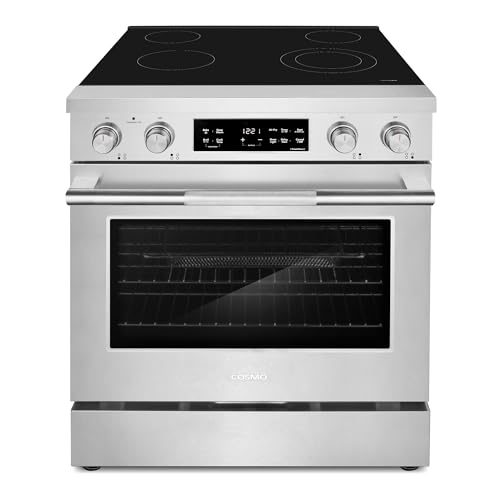
Cosmo COS-RES304SS 30 in. Electric Range with Convection and Air Fry — Best Value with Air Fry
Cosmo’s pitch is the feature list of the tier above at the price of the tier below: a convection oven with air fry, a ceramic glass cooktop with a dual element burner that adjusts to pan size, and steam cleaning, in a stainless 30-inch freestanding range of 4.8 cu. ft. The capacity is a half-step down from the Frigidaire, which most households will never measure outside a holiday, and the dual element is a genuinely useful cooktop feature that bigger brands also charge for.
Value brands earn scrutiny in two places: control feel and long-term support. The specification here is complete and honestly presented; what a buyer trades away versus the mainstream names is the depth of the service network and the refinement of small details. For many kitchens — rentals being upgraded, first homes, budget-led remodels — that trade is rational, and this is the model that makes it best in this roundup.
Strengths
- Convection plus air fry plus steam clean at a value position
- Dual element burner adapts to small and large pans
- Full 30-inch format with a storage drawer
Trade-offs
- 4.8 cu. ft. is a step down in cavity size
- Thinner service network than the legacy brands
- Radiant cooktop response, like all smoothtops here
| Format | Freestanding electric range, 30 in. |
| Oven capacity | 4.8 cu. ft. |
| Cooktop | Ceramic glass, dual element burner (per listing) |
| Oven features | Convection, air fry, steam clean function (per listing) |
Treat steam clean as the maintenance habit it is meant to be — run it after roasts and bakes while soil is light — and the oven will rarely need its heavy cycle. Pair that with normal smoothtop care and the Cosmo covers family duty without drama.
Choose it when the budget is real and the feature list still matters. It is the value pick because it cuts the brand premium, not the oven.
Best for: Budget-led remodels and rentals wanting convection and air fry / Not suited for: Buyers who prioritise the deepest service networks
Check on Amazon — check price on Amazon before you buy, because vehicle and appliance listings change configurations often.

Cosmo COS-ERD304K-BK 30 in. Electric Range with Convection, Black — Best in Black
Not every kitchen is a stainless kitchen. This Cosmo takes the same value formula as its stainless sibling — convection oven, glass smoothtop with dual element burners, digital display with timer, storage drawer — and finishes it in black, at 4.9 cu. ft. For kitchens built around black appliances, dark cabinetry or a deliberate two-tone scheme, the finish is not a detail; it is the reason the model exists, and it is rarer than it should be in convection ranges at this tier.
Functionally the story mirrors the COS-RES304SS with a plainer feature emphasis: six oven functions centred on the convection bake and roast work most households do, without leaning on air fry branding. Buyers cross-shopping the two Cosmos should decide on finish and on whether air fry and steam clean (the stainless model’s listed extras) matter to their cooking.
Strengths
- Black finish in a category that defaults to stainless
- Convection oven with dual element smoothtop at a value tier
- Digital display and timer; storage drawer included
Trade-offs
- Fewer listed extras than its stainless sibling (no air fry headline)
- Value-brand service depth, as with the other Cosmo
- Black glass shows dust and fingerprints differently, not less
| Format | Freestanding electric range, 30 in., black |
| Oven capacity | 4.9 cu. ft. |
| Cooktop | Glass cooktop, dual element burners (per listing) |
| Oven features | Convection, 6 oven functions, digital display with timer (per listing) |
A black range anchors a kitchen; pair it thoughtfully with the hood and the refrigerator finish, because a single black appliance among stainless reads as an accident while two or three read as a scheme. Within the cooking itself, expect the same even convection baking as the rest of this guide’s value tier.
This is the pick when the kitchen’s design says black and the cook still wants a convection oven without leaving the value tier to find one.
Best for: Black-appliance kitchens wanting convection at a value price tier / Not suited for: Air fry prioritists or stainless-matched kitchens
Check on Amazon — check price on Amazon before you buy, because vehicle and appliance listings change configurations often.

Avanti ELITE 24 Inch Electric Range — Best Compact 24-Inch
Compact kitchens — apartments, in-law units, cabins, small rentals — cannot take a 30-inch range, and the Avanti ELITE is the established 24-inch answer: four coil burners on top, a 2.3 cu. ft. oven with a broiler and pan below, and a storage drawer in a footprint that fits where full-size ranges cannot. Its coil cooktop is a deliberate virtue in this class: coils are cheap to replace, tolerant of any cookware, and honest performers for everyday cooking.
The honesty note: this model’s listing describes its oven without the convection claims the other picks carry, so we do not present it as a verified convection model. It is included because compact-kitchen shoppers type this query need a real option more than they need a padded list, and because in a 2.3 cu. ft. cavity the practical gap between fan and no-fan cooking is smaller than in a full-size oven. If verified convection in 24 inches is non-negotiable, treat this as the benchmark to beat and confirm any alternative’s listing claims directly before buying.
Strengths
- Genuine 24-inch footprint for compact kitchens
- Coil burners: universal cookware compatibility, cheap to replace
- Broiler with pan and a storage drawer in a small range
Trade-offs
- Convection is not claimed in its listing — verify if that is essential
- 2.3 cu. ft. oven limits pan sizes and batch cooking
- Coil cooktop cleaning is more fiddly than a smoothtop
| Format | Freestanding electric range, 24 in. |
| Oven capacity | 2.3 cu. ft. |
| Cooktop | 4 coil burners (per listing) |
| Included | Storage drawer, broiler with pan (per listing) |
For the kitchens it fits, the Avanti is a workhorse: apartment landlords and small-space owners have kept this format in production because it solves the actual problem. Measure your pans as well as your opening — a 24-inch oven takes half-sheet pans and standard casseroles, not the largest roasting pans — and the size becomes a planning fact rather than a surprise.
Choose it when the opening is 24 inches. Nothing else in this guide fits that space, and a range that fits beats a specification that does not.
Best for: Apartments, cabins and compact kitchens with a 24-inch opening / Not suited for: Buyers for whom verified convection is the non-negotiable feature
Check on Amazon — check price on Amazon before you buy, because vehicle and appliance listings change configurations often.
Comparison Table
| Pick | Badge | Key spec | Best for |
|---|---|---|---|
| Frigidaire Electric Convection Range with Steam Cleaning & Air Fry, 5.3 Cu. Ft. | Best Overall | Freestanding; 5.3 cu. ft. convection oven; air fry; steam clean | Most households replacing a standard 30-inch electric range with a modern convection model |
| Kenmore 5.6 Cu. Ft. Electric Induction Range with True Convection | Best Induction | Induction cooktop; 5.6 cu. ft.; true convection; air fry; temperature probe; self clean | Serious cooks who want induction speed with a true convection oven |
| Frigidaire Professional 30 in. Slide-In Electric Range with Air Fry and Total Convection | Best Premium Slide-In | Slide-in; 5 elements; Total Convection; air fry | Kitchen refreshes wanting a built-in look with a full convection feature set |
| Cosmo COS-RES304SS 30 in. Electric Range with Convection and Air Fry | Best Value with Air Fry | Freestanding; 4.8 cu. ft.; ceramic glass cooktop; convection and air fry; steam clean | Budget-led remodels and rentals wanting convection and air fry |
| Cosmo COS-ERD304K-BK 30 in. Electric Range with Convection, Black | Best in Black | Freestanding, black; 4.9 cu. ft.; glass cooktop; convection; 6 oven functions | Black-appliance kitchens wanting convection at a value price tier |
| Avanti ELITE 24 Inch Electric Range | Best Compact 24-Inch | 24 in. freestanding; 2.3 cu. ft. oven; 4 coil burners; storage drawer and broiler | Apartments, cabins and compact kitchens with a 24-inch opening |
How to Choose a Convection Oven with an Electric Range
Start with the opening and the electrical supply, because they veto more purchases than any feature list. Measure the width (30 inches is standard; 24 and 36 exist), confirm a 240-volt range circuit and receptacle of the right configuration, and check the anti-tip and clearance requirements for your space. A range is delivered, levelled and connected; discovering a wiring problem with the old range already hauled away is the expensive way to learn this paragraph.
Choose the format next. Freestanding ranges have finished sides and a backguard, fit almost any opening, and cost less. Slide-ins have front controls, unfinished sides meant to sit between cabinets, and a built-in look that shows your backsplash — which must therefore be finished and heat-appropriate behind the cooktop. Neither cooks better by format; the oven inside decides that. Buy the format your kitchen is built for, or budget the small works that changing format implies.
Radiant smoothtop versus induction
Radiant smoothtops are the default: any flat-bottomed pan works, the surface wipes clean, and heat response is leisurely in both directions. Induction is faster, more precise at both boil and simmer, and cooler to work over, at a higher price and with a magnetic-cookware requirement. Serious daily cooks feel the difference every day; occasional cooks may never miss it. The oven does not care which cooktop sits above it, so this choice can be made purely on cooktop merits and budget.
Reading convection claims
A fan alone improves evenness; a fan with its own heating element — sold as true or European convection — holds temperature more precisely when doors open and loads are heavy. Air fry modes are convection with the fan working harder and a mesh basket accessory, useful and worth having, not a separate appliance’s worth of magic. Self-clean versus steam clean is the last axis: steam handles light, fresh soil with water and low heat; traditional self-clean incinerates heavy soil at high heat and asks more of the kitchen’s ventilation and the household’s schedule. Ranges offering both, used as intended, need the heavy cycle rarely.
Controls and displays
Front controls suit slide-in formats and cooks who dislike reaching across steam; rear controls on a backguard suit households with small children, who cannot reach them, and anyone who leans pans against the back of the cooktop. Electronic touchpads offer precise oven programming, timers and modes; knobs offer immediacy and repairability. There is no wrong answer, but there is a wrong match: decide by who cooks, who else lives in the house, and whether the backsplash behind the range will be shown off or covered.
Capacity, honestly
Oven capacity figures count the whole cavity including rack positions you may rarely use. What matters is whether your largest pan fits with the door closed and whether two racks hold your real two-dish meals. Around 5 cu. ft. swallows a large turkey and sides; the mid-4s handle family cooking with occasional Tetris; compact 24-inch ovens take standard casseroles and half sheets. Bring your biggest pan’s measurements to the decision, not the other way round.
What Convection Actually Does to Your Cooking
A conventional oven heats by radiation and slow natural circulation, which leaves hot and cool zones: the top rack browns faster, the back corners run hot, and two loaded racks shield each other. A convection fan erases most of that geography. Air moves, temperatures equalise, and the practical consequences are the ones cooks notice: biscuits and cookies bake evenly across a sheet and across two sheets; roasted vegetables caramelise instead of steaming in their own still air; skin on poultry renders and crisps more reliably.
The adjustments are small and standard. Recipes written for conventional ovens usually want about 25°F less in convection, or the same temperature with a shorter time; most modern ranges either convert automatically or publish the adjustment in the manual, and the first two bakes with a new range will calibrate your eye. Delicate items — soufflés, some custards, meringues — are the traditional exceptions where still air is a feature, and every convection range lets you turn the fan off and cook conventionally, which is the correct answer to “but what about…”: both modes live in the same cavity.
Where convection quietly wins biggest is the multi-dish meal: the holiday roast with trays above and below, the weeknight sheet-pan dinner doubled for guests. Those are the cooks that conventional ovens make stressful, and they are ordinary work for the ranges in this guide. If your cooking is single-dish and simple, convection is a pleasant upgrade; if your cooking is ambitious and parallel, it is close to a necessity.
There is an energy footnote worth knowing: because moving air transfers heat to food more efficiently, convection cooking often finishes a little sooner or at a slightly lower temperature, which trims both the electricity per meal and the heat dumped into the kitchen — a small mercy in summer, when the cooktop and oven together can make a kitchen the warmest room in the house. It will not transform a utility bill, but combined with an induction cooktop’s pan-only heating, the modern electric range is a noticeably cooler appliance to cook over than the ones it replaces.
Living with a Smoothtop: Care, Cookware and the First Month
Five of the six ranges in this guide cook on glass-ceramic, and the surface rewards a short list of habits. Wipe spills when the surface is cool enough to touch safely but before the next cooking session bakes them in; sugary spills deserve immediate attention once the surface can be handled, because molten sugar bonds to glass-ceramic as it cools and can pit it. Use the maker-approved cleaner and a non-scratch pad for the weekly polish, and lift pans rather than dragging them — grit trapped under a pan base is what writes fine scratches into any smoothtop, whatever the brand.
Cookware choice is the other half of smoothtop life. Flat, heavy bases make full contact, heat evenly and stay stable; warped or rounded bases rock, spin and concentrate heat in rings. Cast iron works beautifully and asks only to be lifted rather than slid. On the induction Kenmore the same flatness advice applies with the magnet test added, and with the bonus that the surface itself stays comparatively cool, so the spills that do happen wipe up instead of carbonising.
The oven has its own first-month curriculum. Run the empty burn-off cycle before the first food, as the install section describes. Learn where your range’s hot spots live with a simple test — a sheet of bread slices toasted under the broiler or baked at moderate heat maps the cavity’s geography in one picture — and learn whether your model converts temperatures for convection automatically, because the 25-degree rule applied twice is how cakes come out pale. None of this is burdensome; it is the difference between owning a range and knowing it, and it pays at every meal for a decade.
Finally, register the appliance and keep the manual’s model and serial details somewhere findable. Ranges are repaired, not replaced, across their lives, and the owner who can quote a model number and describe a symptom precisely gets the right part on the first visit. That unglamorous habit, plus a surge-protected circuit for the control board where your electrician advises it, is most of what separates a fifteen-year range from a seven-year one.
How to Install and Set Up an Electric Range Safely
A range installation is electrical work plus levelling, and the safe sequence is not complicated:
- Confirm the circuit: a dedicated 240-volt range circuit of the amperage the new range requires, with the receptacle type (3-prong or 4-prong) matching local code and the cord you will fit.
- Kill the breaker before touching the old range’s connection, and verify power is off before disconnecting anything.
- Fit the anti-tip bracket to the floor or wall exactly as the manual specifies — this small bracket prevents the range tipping if a child or a heavy pan loads the open door, and it is the step most often skipped.
- Connect the cord to the range’s terminal block as diagrammed, seat the range, and level it so pans sit flat and the oven racks roll true.
- Restore power and test every element and the oven, including the convection fan mode, before the delivery crew or your old range leave the picture.
- Run an empty bake cycle as the manual directs to burn off manufacturing residues, with the kitchen ventilated.
If any step exceeds your confidence — especially terminal connections and circuit questions — a licensed electrician or the retailer’s installation service is money well spent. Ranges are heavy, high-current appliances; the cooking they enable is the hobby, not the wiring. Renters and landlords should note that receptacle changes are the building owner’s conversation, not a tenant improvisation. And keep the delivery packaging until the range has cooked its first meal: a unit that arrives with a damaged cooktop or a dead control board is a return, not a repair, and it is far easier to return in its own box.
Common Buying Mistakes
- Ordering before measuring the opening and checking the 240-volt circuit and receptacle type.
- Swapping a backguard freestanding range for a slide-in without finishing the backsplash the old range used to cover.
- Assuming every “convection” listing means true convection with a fan element — read which class the model claims.
- Buying induction without magnet-testing the cookware collection first.
- Ignoring the anti-tip bracket during a self-install.
- Choosing capacity by the headline number instead of by your largest pan’s actual dimensions.
- Treating steam clean as a substitute for self-clean on heavy, baked-on soil — or vice versa.
Final Recommendation
For most kitchens, the Frigidaire freestanding range is the right buy: complete convection formula, air fry, steam clean, a cavity that takes holiday cooking in stride, and a service network to match — the combination that matters across a ten-year appliance life rather than a ten-minute showroom comparison. Cooks who live at the cooktop should stretch to the Kenmore induction model; kitchen refreshes wanting the built-in look should take the Frigidaire Professional slide-in; budgets are best served by the stainless Cosmo, black-finished kitchens by its sibling, and 24-inch openings by the Avanti — with its convection caveat read and accepted.
Closely related searches are covered in their own guides: the same ranges judged with a backguard in focus are in Best Convection Ovens With Electric Range And Lip, countertop-scale convection lives in Best Countertop Toaster Convection Ovens, combined oven-microwave thinking is in Best Convection Ovens With Microwaves, and drawer-equipped models are compared in Best Convection Ovens With Baking Drawer. If your kitchen’s constraint is coatings rather than format, Best Convection Ovens Without Non Stick Coating takes that question on directly.
The shortlist, one more time:
- Frigidaire Electric Convection Range with Steam Cleaning & Air Fry, 5.3 Cu. Ft. — Best Overall: Most households replacing a standard 30-inch electric range with a modern convection model
- Kenmore 5.6 Cu. Ft. Electric Induction Range with True Convection — Best Induction: Serious cooks who want induction speed with a true convection oven
- Frigidaire Professional 30 in. Slide-In Electric Range with Air Fry and Total Convection — Best Premium Slide-In: Kitchen refreshes wanting a built-in look with a full convection feature set
- Cosmo COS-RES304SS 30 in. Electric Range with Convection and Air Fry — Best Value with Air Fry: Budget-led remodels and rentals wanting convection and air fry
- Cosmo COS-ERD304K-BK 30 in. Electric Range with Convection, Black — Best in Black: Black-appliance kitchens wanting convection at a value price tier
- Avanti ELITE 24 Inch Electric Range — Best Compact 24-Inch: Apartments, cabins and compact kitchens with a 24-inch opening
Frequently Asked Questions
Is convection worth it in an electric range?
For most cooks, yes. The fan evens out hot spots, makes two-rack baking reliable, and improves roasting and browning, and it can be switched off for delicate bakes that prefer still air. The premium over a non-convection range is usually modest within the same brand tier, and the benefit arrives at every meal rather than on special occasions.
What is the difference between convection and true convection?
A standard convection oven adds a fan to circulate the heat from the main elements. True (or European) convection adds a heating element around the fan itself, so the moving air is heated directly and cavity temperature recovers faster after the door opens and holds more evenly under heavy loads. Both are real improvements over no fan; true convection is the refinement, most noticeable in multi-rack and long roasts.
Can I put a slide-in range where a freestanding range was?
Usually, with two checks: the slide-in’s sides are unfinished, so it must sit between cabinets, and removing a backguard range exposes the wall behind the cooktop, which needs a finished, heat-appropriate surface. Dimensions and the electrical connection are otherwise the same standard. Many kitchens make the swap during a remodel for exactly those two reasons.
Do I need new cookware for an induction range?
Only the pieces that fail the magnet test. A magnet that sticks firmly to a pan’s base means it will work; cast iron, enameled cast iron and much stainless steel pass, while most aluminium, glass and copper do not without an induction disc base. Test the collection before the range arrives, and budget replacements for any daily-driver pan that fails.
How long should an electric convection range last?
A range is among the longest-lived kitchen appliances: a decade is a reasonable expectation and fifteen years is common with a repair or two along the way, typically an element, an igniter-free electric bake part, or a control component. That lifespan is why this guide weights service networks and mainstream models alongside features — the cheapest range to own is usually the one that can be fixed in year nine, in your town, with parts that still exist.
Does air fry in a range replace a countertop air fryer?
For family quantities, largely yes: the convection system and a mesh basket crisp wings, fries and vegetables well, in bigger batches than most countertop units. For one or two portions, a countertop air fryer is faster to heat and to clean. Households that air fry daily for snacks often keep both; households that air fry for dinners can let the range do it.