Disclosure: airfryerkitchensupply.com is reader-supported. When you buy through links on our site, we may earn an affiliate commission at no extra cost to you.
Where to buy
Our shortlist of the best blenders for herbs is below — every pick verified against the manufacturer’s listed specifications, with full reviews further down the page.
Culinary herb work — pesto, chimichurri, herb oils, gremolata, green sauces — is mostly small, fresh and fast. The wrong blender either leaves leaves uncut in a big jar or purees them into a foamy, oxidised soup. The six machines below were picked for small-load control, chopping attachments and jar sizes that match how herbs are actually used. All were verified against Amazon’s catalogue; check price on Amazon through the links.
- Ninja Kitchen System Pro BL770 (Best Overall for Herbs): Check price on Amazon
- Braun MultiQuick 7 3-in-1 Immersion Blender & Food Processor (Best for Small Herb Batches): Check price on Amazon
- KitchenAid K400 Variable Speed Blender with Tamper (Best for Herb Oils and Pesto): Check price on Amazon
- Cuisinart Smart Stick CSB-179 Hand Blender (Best Budget Herb Kit): Check price on Amazon
- Vitamix 5200 Professional-Grade Blender (Best for Silky Green Sauces): Check price on Amazon
- Hamilton Beach Blender and Food Processor Combo 58163 (Best Budget Countertop Combo): Check price on Amazon
The best blenders for herbs have to solve a problem that smoothie marketing never mentions: herbs are light, leafy and small in quantity. A cup of basil in a 72 oz pitcher is a garnish lost in a stadium — the blades spin underneath it while the leaves ride the walls. Herb work rewards the opposite qualities from smoothie work: small vessels, chopping bowls, pulse control, and speeds low enough to tear leaves rather than liquefy them. This guide ranks machines by how they handle a bunch of parsley, not a bag of frozen mango.
There is also a texture question. Many herb preparations are not smoothies: a good chimichurri has distinct flecks, a gremolata is a dry crumble, and even pesto wants body rather than baby-food smoothness. Machines with processor bowls and genuine pulse control produce those textures; pure high-speed blenders sail straight past them. The shortlist therefore mixes countertop blenders, kitchen systems with chopping bowls, and hand blenders with chopper attachments — because for herbs, the attachment is often the point.
Fresh herbs also punish delay and heat. The guides below cover working cold, batching correctly and keeping green preparations green, using nothing more exotic than the right vessel and the pulse button.
In this guide
Quick Picks
Six machines that actually suit herb quantities and textures — from chopper bowls for chimichurri to dial blenders for silky herb oils.
- Best Overall for Herbs: Ninja Kitchen System Pro BL770 — 1500W with an 8-cup processor bowl alongside the pitcher — the processor bowl is the herb tool: it chops parsley, nuts and garlic to an even fleck that a pitcher never will. — Check price on Amazon
- Best for Small Herb Batches: Braun MultiQuick 7 3-in-1 Immersion Blender & Food Processor — A hand blender with a 2-cup chopper and adjustable speed — the chopper cup is perfectly sized for a bunch of herbs, and the whole kit stores in a drawer. — Check price on Amazon
- Best for Herb Oils and Pesto: KitchenAid K400 Variable Speed Blender with Tamper — A 5-speed dial with Intelli-Speed control and a tamper — the control to emulsify herb oils smoothly and keep big leaf loads moving without stopping. — Check price on Amazon
- Best Budget Herb Kit: Cuisinart Smart Stick CSB-179 Hand Blender — A 300W variable-speed hand blender with chopper, whisk and measuring cup included — a complete small-herb toolkit at a budget tier. — Check price on Amazon
- Best for Silky Green Sauces: Vitamix 5200 Professional-Grade Blender — The dial machine for herb preparations that must be perfectly smooth — velvety herb oils, green soups and sauces with no flecks at all, plus the power for frozen-herb storage blends. — Check price on Amazon
- Best Budget Countertop Combo: Hamilton Beach Blender and Food Processor Combo 58163 — 700 peak watts with a 40 oz glass jar plus a 3-cup chopper — countertop herb coverage, blender and chopper, at a budget tier, with a glass jar that washes flavour-clean. — Check price on Amazon
How These Picks Were Chosen
Each machine was verified against Amazon’s catalogue data through the site’s verification system, then assessed on herb-specific criteria: minimum practical load, ability to produce chopped as well as smooth textures, speed control at the low end, and jar material for flavour carryover. Raw power was deliberately down-weighted — beyond a modest threshold, extra watts do nothing for a bunch of basil and can actively harm delicate preparations by adding heat and air.
We also favoured machines whose herb-relevant parts are included rather than sold separately. A blender that needs an optional chopper you may never buy is, in practice, a blender that cannot chop. Every pick here can perform its stated herb role out of the box, and the reviews say plainly which textures each machine cannot do, because herb cooking uses both ends of the texture spectrum.
Every pick below earned its place against those filters. The shortlist of the best blenders for herbs opens with the Ninja Kitchen System Pro BL770 and continues through five more machines, each matched to a specific need rather than ranked by a single score.
The 6 Best blenders for herbs

Ninja Kitchen System Pro BL770 — Best Overall for Herbs
The BL770 wins for herbs because it is two machines: a strong pitcher blender for herb oils and green sauces, and a proper processor bowl for chopping. It suits cooks who make both smooth and chopped herb preparations. It does not suit minimalists — the parts count is real, and you need storage for bowls, blades and cups.
Strengths
- Processor bowl chops herbs evenly without liquefying them
- Pitcher handles silky herb oils and large pesto batches
- Single-serve cups cover small sauce quantities without waste
Trade-offs
- Many parts to wash and store
- Stacked and chopping blades are sharp and demand care in the sink
- Pitcher alone is too big for a single bunch of herbs
| Spec | Detail |
|---|---|
| Power | 1500W |
| Containers | 72 oz pitcher, 8-cup processor bowl, two 16 oz cups |
| Functions | Blend, process, single-serve |
The processor bowl changes what is possible. Herbs plus garlic plus nuts in a pitcher become a uneven swirl — puree at the bottom, whole leaves at the top. In the bowl, the blade sweeps the full width at herb height, and a few pulses give you the even, distinct flecks that chimichurri and gremolata are supposed to have. For anyone who makes chopped herb preparations weekly, this single feature outranks raw blending power.
The pitcher side is no afterthought: 1500W turns a large basil harvest into smooth pesto quickly, and quick matters because basil oxidises as it sits in the vortex. Work in two shorter sessions rather than one long one, add oil early to coat the leaves, and the colour stays bright. The cups handle the Tuesday-night single sauce. It is a lot of kit, but for herb-heavy kitchens it is the right kit.
Best for: cooks who make both chopped and smooth herb preparations / Not suited for: small kitchens with no storage for a multi-part system
Check the current price on Amazon

Braun MultiQuick 7 3-in-1 Immersion Blender & Food Processor — Best for Small Herb Batches
For the most common herb job in real kitchens — one bunch, one small sauce, tonight — the MultiQuick 7’s chopper cup is the right-sized tool. It suits small households and anyone whose herb work is frequent but small. It does not suit harvest-day volume; you will process in several small batches.
Strengths
- 2-cup chopper matches single-bunch quantities exactly
- Adjustable speed lets you stop at flecks instead of puree
- Drawer-sized storage; no counter footprint
Trade-offs
- Batch size is capped by the chopper cup
- Hand-blender format is slower for large liquid volumes
- Chopper lid and blade need hand-washing care
| Spec | Detail |
|---|---|
| Attachments | Blending shaft, 2-cup chopper, whisk, beaker |
| Controls | Adjustable speed control |
Small-batch herb work is where immersion systems quietly beat every countertop machine. The chopper cup keeps leaves in the blade path, the adjustable speed lets you creep up on the texture you want, and cleanup is a cup and a blade rather than a full pitcher. For weeknight herb sauces, salsas verde and flavoured butters, this is the tool cooks actually reach for.
The blending shaft extends its range: herb oils and green soups can be blended directly in the pot or jug, and the whisk handles herb vinaigrettes. Its ceiling is volume and very fibrous material — lemongrass and tough stems will make it work hard. Within domestic herb quantities, though, it is arguably the most-used format on this page.
Best for: frequent small herb preparations in small kitchens / Not suited for: large harvest batches or very fibrous stems
Check the current price on Amazon

KitchenAid K400 Variable Speed Blender with Tamper — Best for Herb Oils and Pesto
The K400 is the countertop pick for liquid herb preparations: pesto in quantity, herb oils, green goddess dressing. The dial plus tamper combination keeps a full jar of leaves folding into the blades. It suits cooks whose herb work is mostly sauces and oils. It does not chop — for dry flecked textures, use the processor picks above.
Strengths
- Dial control suits emulsifying oils gradually into herbs
- Tamper keeps bulky leaf loads moving without added liquid
- Intelli-Speed holds blade speed steady as loads thicken
Trade-offs
- No chopping function for dry herb textures
- Jar is mid-size; single small bunches still get lost
- Presets are drink-focused rather than herb-focused
| Spec | Detail |
|---|---|
| Controls | 5-speed variable dial |
| Programs | Ice Crush, Icy Drinks, Smoothie presets |
| Included | Tamper |
Herb oil is an emulsion problem: you are persuading oil and leaf juice to become one glossy liquid. The K400’s dial lets you start the leaves at moderate speed, then drizzle and raise speed gradually — the technique that produces a stable, vivid oil instead of a separated, foamy one. Intelli-Speed matters because a thickening pesto load slows lesser motors exactly when you need consistency.
The tamper is the second half of the story. Basil is bulky and traps air; without a tamper you add more oil than the recipe wants just to keep things moving. With it, you fold the mass down mechanically and keep the ratio right. For cooks who make pesto by the jarful in season, that control is the difference between a recipe and an approximation.
Best for: pesto, herb oils and green dressings in jar-size batches / Not suited for: dry chopped textures or tiny single-bunch jobs
Check the current price on Amazon
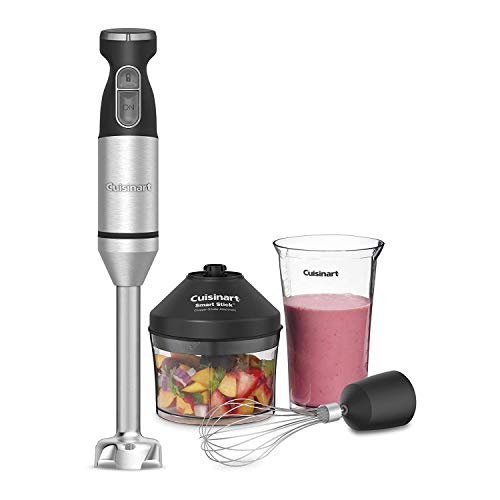
Cuisinart Smart Stick CSB-179 Hand Blender — Best Budget Herb Kit
The CSB-179 bundles the three attachments herb work needs — chopper for flecks, shaft for sauces in the pot, whisk for vinaigrettes — at the friendliest tier on this page. It suits beginners and occasional herb cooks. It does not suit fibrous volume work; 300W is a domestic motor with domestic limits.
Strengths
- Complete herb attachment set in one box
- Variable speed gives texture control rare at this tier
- Quiet motor suits small, frequent jobs
Trade-offs
- 300W struggles with tough stems and frozen material
- Chopper capacity is small
- Not a countertop replacement for big liquid batches
| Spec | Detail |
|---|---|
| Power | 300W |
| Shaft | 8 in |
| Attachments | Chopper, whisk, measuring cup |
Value in herb tools is about attachment coverage, not power, and this bundle covers the whole herb workflow: chop a bunch of parsley in the chopper, blend a salsa verde with the shaft, whisk a herb dressing to finish. The variable speed is the detail that lifts it above other budget hand blenders — two-speed machines chop herbs to mush before the top leaves have been cut once.
Keep expectations calibrated: this is a finesse tool for soft, fresh material. Woody stems, frozen herbs in quantity and big soup pots belong to the countertop picks. But most herb cooking is small and fresh, and for that majority this kit is genuinely sufficient — which is why it earns a place over more powerful machines with no chopper at all.
Best for: beginners and small fresh-herb jobs on a budget / Not suited for: fibrous, frozen or high-volume work
Check the current price on Amazon

Vitamix 5200 Professional-Grade Blender — Best for Silky Green Sauces
Some herb preparations want the opposite of chopping: total smoothness. For those, the 5200’s sustained high speed and fine dial control produce herb oils and green sauces with a texture no chopper can approach. It suits cooks who make smooth preparations and large batches. It does not suit flecked textures or tiny quantities.
Strengths
- Sustained high speed yields truly silky herb oils and sauces
- Low dial speeds allow gentle starts for delicate leaves
- Handles frozen herbs and ice for storage preparations
Trade-offs
- Cannot produce a chopped, flecked texture
- Minimum practical load is larger than a single bunch
- Premium tier
| Spec | Detail |
|---|---|
| Container | 64 oz |
| Controls | Variable speed dial + high-speed switch |
| Blade | Stainless steel |
A great herb oil should pour like a sauce, not chew like a salad. Getting there requires the leaves to be completely broken down, and that is a high-speed, sustained-vortex job the 5200 does better than anything else on this page. The same power turns frozen herb-and-oil cubes back into sauce base, and makes green soups with a genuinely velvety crumb.
Use its dial thoughtfully with fresh leaves: start low to fold the mass in, then climb. Running delicate herbs at maximum from cold whips in air and lightens colour. And accept its one true limit — if the recipe says ‘roughly chopped’, reach for a chopper, because this machine’s idea of done is smooth. Many herb-heavy kitchens end up pairing it with a small chopper for exactly that reason.
Best for: silky herb oils, green sauces and soups, larger batches / Not suited for: chopped textures or single-bunch quantities
Check the current price on Amazon
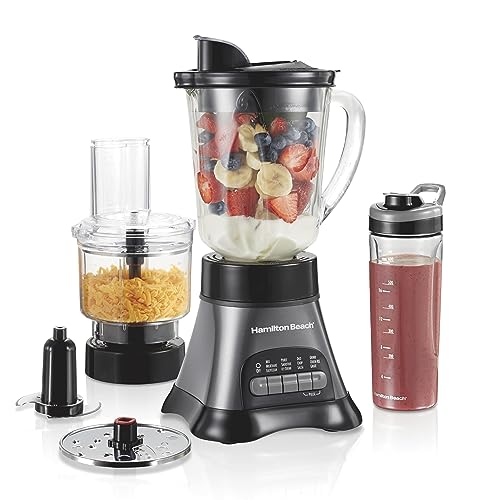
Hamilton Beach Blender and Food Processor Combo 58163 — Best Budget Countertop Combo
This combo is the budget way to get both herb formats on the counter: a glass-jar blender for sauces and a 3-cup chopper for flecks. It suits cost-conscious herb cooks. It does not suit heavy volume or fibrous material — the motor is honest budget power.
Strengths
- Blender plus chopper covers both herb textures in one purchase
- Glass jar releases strong herb flavours completely
- Travel cup adds small-sauce convenience
Trade-offs
- 700W peak is modest for tough or frozen loads
- Chopper is small for family-size salsa batches
- More parts to store than a plain blender
| Spec | Detail |
|---|---|
| Power | 700W peak |
| Containers | 40 oz glass jar, 3-cup chopper, travel cup |
The 3-cup chopper is the herb hero here: a bunch of cilantro for salsa, parsley and lemon zest for gremolata, mint for a raita — all quantities that vanish in a full jar but chop evenly in the small bowl. The glass blender jar then handles the liquid side, and because it is glass, yesterday’s garlic-herb sauce does not haunt today’s delicate one.
Treat the motor kindly: pulse the chopper rather than holding it on, keep blender loads soft or liquid-led, and this combo covers a surprising amount of herb cooking for its tier. It is the pick for cooks who want the two-texture capability of the Ninja system at a fraction of the commitment.
Best for: budget two-texture herb coverage on the counter / Not suited for: fibrous volume work or frozen-heavy routines
Check the current price on Amazon
Comparison Table
| Pick | Badge | Key spec | Best for |
|---|---|---|---|
| Ninja Kitchen System Pro BL770 | Best Overall for Herbs | 1500W, 72 oz pitcher + 8-cup processor bowl + (2) 16 oz cups | cooks who make both chopped and smooth herb preparations |
| Braun MultiQuick 7 3-in-1 Immersion Blender & Food Processor | Best for Small Herb Batches | Adjustable speed, 2-cup chopper, beaker + whisk included | frequent small herb preparations in small kitchens |
| KitchenAid K400 Variable Speed Blender with Tamper | Best for Herb Oils and Pesto | 5-speed dial, Intelli-Speed motor control, tamper included | pesto, herb oils and green dressings in jar-size batches |
| Cuisinart Smart Stick CSB-179 Hand Blender | Best Budget Herb Kit | 300W, variable speed, chopper + whisk + measuring cup | beginners and small fresh-herb jobs on a budget |
| Vitamix 5200 Professional-Grade Blender | Best for Silky Green Sauces | 64 oz container, variable speed + high-speed switch | silky herb oils, green sauces and soups, larger batches |
| Hamilton Beach Blender and Food Processor Combo 58163 | Best Budget Countertop Combo | 700 peak watts, 40 oz glass jar + 3-cup chopper | budget two-texture herb coverage on the counter |
Match the machine to the texture you make most: choppers and processor bowls for flecks, dial blenders for silk. Herb cooks who do both should start with a combo or system rather than a pure blender, however powerful.
How to Choose the Best Blenders for Herbs
Decide your dominant texture first. If most of your herb cooking is chopped — chimichurri, gremolata, tabbouleh-style parsley, salsa — the chopping bowl is the product, and the blender attached to it is secondary. If most is smooth — oils, pestos, green sauces, soups — a controlled countertop blender is the product. Buying for the texture you make monthly, not the one you make yearly, is the whole decision.
Size the vessel to the bunch. A standard bunch of herbs is a loose cup or two. Vessels in the 2–3 cup range keep that load in the blades; full-size jars need at least triple that to work properly. If your herb use is one bunch at a time, a hand-blender chopper or a kitchen system with a small bowl will outperform a flagship smoothie blender every single time.
Check the low end of the speed range, not the top. Herbs reward gentle starts and pulse control. A machine whose slowest speed is already violent will foam and bruise leaves before it cuts them. Dials and adjustable triggers beat fixed high/low buttons for this work.
Keeping Herbs Green: Oxidation, Heat and Technique
Green herb preparations brown for two reasons: oxygen whipped in during blending, and heat from friction. Counter both by working cold — chilled liquid and even a chilled jar — blending in the shortest bursts that achieve the texture, and coating leaves with oil early in oil-based preparations, since the oil film slows oxidation at cut surfaces.
Order of loading matters too. Put liquid and oil in first, then leaves, so the vortex forms immediately and the leaves spend less time being thrown around dry. For chopped preparations, dry leaves chop cleaner than wet ones: spin or pat them dry after washing, and pulse in short bursts, checking texture between each, because the distance between flecked and pureed is about two pulses.
Jar Materials and Flavour Carryover
Herbs are the most flavour-aggressive ingredients most kitchens process, and plastic remembers them. Garlic-herb paste on Monday can perfume a delicate mint preparation on Friday if both share a scratched plastic jar. Glass washes completely clean and is the safest material for mixed herb work; if you use plastic, dedicate one vessel to strong flavours and keep another for delicate ones.
Pigments behave the same way. Turmeric-adjacent and dark green preparations stain plastic permanently over time, which is cosmetic but annoying. The glass-jar picks in this guide exist largely because herb cooks, more than smoothie drinkers, run into both problems within the first month of ownership.
How to Make Pesto and Herb Sauces Without Turning Them Brown
A short, reliable workflow for green herb sauces in any of the machines above.
- Chill everything. Cold leaves, cold liquid, and a jar that has sat in the fridge for ten minutes if your kitchen is warm. Cold is the cheapest anti-browning tool there is.
- Wash, then dry thoroughly. Wet leaves chop unevenly and dilute flavour. A salad spinner or a clean towel is part of herb prep, not an optional extra.
- Load liquid and oil first, leaves second. The vortex should exist before the leaves land, so they are drawn down and cut immediately instead of plastering the walls.
- Pulse to your texture. For flecked sauces, stop while you can still see distinct pieces. For silky sauces, climb the dial gradually and blend only until smooth — every extra ten seconds adds air and heat.
- Add cheese, nuts and acid late. In pesto-style sauces, nuts and cheese go in for the final pulses so they keep texture; lemon or vinegar at the end brightens flavour and helps colour.
- Store with a film of oil on top. A thin oil layer limits air contact in the jar, and refrigerating promptly keeps the green vivid for days.
Freeze leftover herb sauce in ice-cube trays, then bag the cubes: you get tablespoon-sized portions that drop straight into soups, grains and pans, and a harvest glut becomes a winter asset instead of a race against wilting. Label with the herb and date — frozen green cubes all look identical by November.
Herb by Herb: What Each Common Herb Asks of the Machine
Basil is the diva: it bruises, oxidises and turns on you if the blend runs long or warm, so it wants oil early, cold ingredients and the shortest effective blend — a dial machine’s gentle climb or a chopper’s three pulses. Parsley is the opposite temperament: fibrous, forgiving, and happy to be chopped coarse for tabbouleh or fine for sauces, though its stems need a machine with enough conviction to cut rather than wrap them around the blade. Cilantro sits between the two — tender leaves, flavourful soft stems, and a tendency to go slimy if overworked, which argues for pulses over sustained speed.
Mint wants restraint: a few pulses for a raita or a chopped garnish, because sustained blending turns it dark and bitter-edged. Dill and chives are so delicate that many cooks knife them regardless, but a chopper cup with two careful pulses handles weeknight quantities without the board-and-knife production. Rosemary and thyme should be stripped and, if blended at all, blended into oils or marinades where their fibres disperse — no home blender makes woody stems disappear, and pretending otherwise just dulls blades. Knowing each herb’s temperament is worth more than another hundred watts.
Herb Oils, Butters and Frozen Storage: The Three Preservation Formats
Herb oil is the blender’s finest herb trick: leaves and oil, blended briefly at controlled speed, strained or left rustic, and refrigerated in small jars. The machine’s job is a fast, cold, even breakdown — which is why dial control and a chilled jar recur throughout this guide. Herb butter is the chopper’s trick: soft butter, chopped herbs, garlic if you like, pulsed together and rolled in parchment. The texture should stay flecked, which is precisely what pitcher blenders cannot do and chopper bowls do beautifully.
Freezing is the third format and the harvest-saver: herbs blended with a little oil or water, frozen in ice-cube trays, then bagged. Each cube is a tablespoon of summer that drops into winter soups and pans. The stronger countertop picks handle the frozen re-blend when those cubes meet a sauce. A household that freezes two trays a week in season has effectively extended its herb garden by four months — the blender, used this way, is a preservation appliance, not just a prep one.
Knife vs Machine: An Honest Division of Labour
This guide sells blenders, but honesty requires the boundary: some herb work belongs to the knife. A small garnish of one herb, a chiffonade of basil for a finished dish, a coarse rustic chop where the hand-cut irregularity is the point — the knife wins on time, texture and washing-up. Machines win when quantity, consistency or emulsion enters the picture: a jar of pesto, a litre of herb oil, a salsa for twelve, a harvest that must be processed today.
The practical test is the two-minute rule. If the knife finishes the job, including board cleanup, in about the time the machine takes to assemble, use and wash, use the knife. If the job is measured in bunches rather than sprigs, or the texture is an emulsion rather than a chop, the machine earns its wash. Cooks who apply that rule find their blenders used heavily and happily — for the work machines are actually better at — instead of resentfully, for everything.
Setting Up a Weekly Herb Routine
Herbs reward rhythm. A workable pattern for a herb-heavy kitchen: buy or harvest on one day, wash and dry everything at once, then process in a single session — one sauce for the week, one oil, one tray of cubes for the freezer. A single session means the machine is assembled and washed once for three products, which is the difference between a routine that survives busy weeks and one that quietly stops.
Store each format where it will actually be used: the sauce at the front of the fridge, the oil beside it, the cubes bagged and labelled at the top of the freezer. Midweek, the routine pays out — a cube into the soup, a spoon of oil over the grains, the sauce on the eggs — with no fresh prep at all. The machines in this guide were chosen to make that session fast and pleasant: right-sized vessels, quick cleaning, textures you can hit reliably. Herb cooking fails on logistics far more often than on recipes, and logistics is what a good routine fixes.
Herbs in Drinks: Green Smoothies and Herb-Forward Refreshers
Herbs belong in drinks more often than most kitchens attempt, and the blender is the enabler. Mint and basil transform a watermelon or cucumber smoothie; cilantro and parsley carry green smoothies that would otherwise taste like lawn; a small amount of herb blended into lemonade concentrate makes a drink guests ask about. The technique rules from this guide apply directly: cold ingredients, leaves blended briefly at the end for fresh drinks so their flavour stays bright rather than cooked by friction.
Texture choices matter here too. A smoothie wants the herb fully dispersed — countertop territory. A refresher often wants the herb present but gentle, which argues for blending the herb with a portion of the liquid, straining if you like, and combining — a two-step the small-cup machines handle gracefully. Either way, herbs in drinks follow the same law as herbs in sauces: the machine’s job is control, and the cook’s job is knowing when to stop it.
Growing Windowsill Herbs to Match Your Blender
The cheapest herb upgrade is not a machine but a pot: basil, mint, parsley and cilantro grown on a windowsill arrive at the blender fresher than any shop bunch, in the exact quantities small-batch machines love. A grower’s rhythm suits the tools in this guide — a chopper cup of pesto from a hard-pruned basil plant, mint leaves for drinks picked minutes before blending, parsley that never wilts in a fridge drawer because it was never stored.
Growing also changes batch logic for the better: instead of processing a large bought bunch against the clock, you harvest what the recipe needs, when it needs it, and the freezer-cube routine becomes a seasonal glut tool rather than a weekly rescue. Pair a modest windowsill garden with any pick in this guide and the herb cooking that results will taste noticeably different — fresher input is the one upgrade no motor can substitute for.
Herb-Forward Cooking for People Who Think They Do Not Like Herbs
Some households resist herbs because their only encounters were harsh ones: a mouthful of raw parsley, a pesto that tasted like lawn. The blender is the diplomat that fixes this, because it lets herbs arrive as a background richness instead of a foreground chew. A spoon of herb oil through a soup, a mild herb sauce under eggs, a green smoothie where the fruit leads and the herbs lift — these are the formats that convert sceptics, and every one of them is a machine format from this guide.
Start such households gently: mild herbs first — parsley, chives, basil in friendly company — blended smooth so texture is never the objection. Increase presence as palates adjust. Within a season, most kitchens find the herbs they once tolerated becoming the ingredients they plan around, and the blender that made the introductions becomes one of the most-used tools in the house.
Herb Prep for Entertaining: Sauces That Hold
Entertaining exposes herb sauces’ one weakness: many are best in the first hour. The techniques in this guide — cold blending, oil early, acid late — extend a green sauce’s vivid life across an evening, and the format choices help too. A sauce blended at the last responsible moment, in the right-sized vessel, beats a large batch made ahead and refrigerated into dullness. Plan the herb work as the final five minutes before guests sit down, not the first task of the afternoon.
For larger gatherings, the system picks in this guide earn their keep: the processor bowl produces a big batch of chopped relish while the pitcher handles the smooth sauce, and the cook is not queueing one vessel through two textures. Serve herb sauces in small bowls refilled from the fridge stock rather than one large bowl oxidising on the table. Entertaining is logistics wearing a apron, and herb logistics is mostly temperature, timing and vessel size — all solvable, all covered above.
Herbs and Children: Getting Small Cooks Involved Safely
Herb work is one of the friendliest entry points for children in the kitchen: leaves to wash and spin, mild sauces to taste, cubes to unmould from the freezer tray. The machine rules are simple and worth stating in a guide that families will use — blades and chopper attachments are adult-handled, always; children load leaves and press nothing until an adult has seated lids and checked the vessel; and the tasting spoon is the child’s official instrument, because a cook who tastes is a cook who learns.
The recipes that recruit best are the vivid ones: a green sauce whose colour changes as it blends, a herb butter rolled and chilled for dinner, a smoothie where the mint was picked by the person drinking it. Kitchens that hand children the gentle end of herb work find the machines in this guide used more, not less — the herb routine becomes a family habit with assigned roles, and family habits are the ones that survive busy years.
A Note on Dried Herbs in a Fresh-Herb Kitchen
This guide is built around fresh herbs, but every herb kitchen keeps dried ones, and the blender touches them too — most often when a dried herb needs waking up: a brief pulse to crack bay-adjacent leaves for a rub, dried herbs ground with salt into a finishing blend, or a dried-herb oil infusion that starts with a coarse crush. The chopper cups and small vessels recommended here handle those jobs in the same pulse discipline as fresh work, with the burst-and-check rhythm doing the protecting.
Keep the two worlds’ tools mentally separate even when the machine is shared: dried material wants the vessel bone-dry, fresh material often arrives wet from washing, and crossing those states carelessly is how powders cake and fresh herbs smear. A quick dry-wipe of the vessel between worlds is the whole ritual. For deep dried-herb practice — roots, barks, apothecary quantities — the sibling herbalists guide in this cluster is the right next read; this one keeps its promise to the fresh, green, everyday end of the herb shelf.
Common Buying Mistakes
Blending a single bunch in a full-size jar. The leaves ride the walls and the result is half whole leaves, half puree. Match vessel size to the bunch, or scale the batch up and freeze the extra.
Holding the button down for chopped herbs. Chopped textures live and die in two-second pulses. Continuous running purees the bottom layer before the top is cut once.
Blending wet, warm leaves. Warm, wet herbs foam, oxidise and turn olive-drab quickly. Cold and dry is the whole trick to vivid green sauces.
Adding all the oil at the end. Oil added late sits on top instead of emulsifying. For oils and pestos, get oil in early or drizzle as you blend for a glossy, stable result.
Using one plastic jar for garlic herbs and delicate herbs. Flavour carryover is real in scratched plastic. Dedicate a vessel or choose glass.
Final Recommendation
Most herb cooks should start with the Ninja BL770 system: its processor bowl handles the chopped half of herb cooking that pure blenders cannot touch, and its pitcher covers the smooth half. Small kitchens and small batches point to the Braun MultiQuick 7; budget buyers get the same two-texture idea from the Hamilton Beach combo or the Cuisinart Smart Stick kit. For silky oils and green sauces above all, the KitchenAid K400 and Vitamix 5200 are the connoisseur picks.
Keep exploring the cluster: Best Blenders For Herbalists covers small-batch dried and fresh herbalist workflows, Best Blenders For Hummus looks at thick purees, Best Blenders For Indian Cooking covers spice-and-herb heavy kitchens, and Best Blenders For Healthy Smoothies handles the green-drink side.
Start with the Ninja Kitchen System Pro BL770 if you want one machine that covers the brief without second-guessing. It is the only pick here that truly covers both chopped and smooth herb work in one box.
The closest alternative is the Braun MultiQuick 7 3-in-1 Immersion Blender & Food Processor: A hand blender with a 2-cup chopper and adjustable speed — the chopper cup is perfectly sized for a bunch of herbs, and the whole kit stores in a drawer.
Frequently Asked Questions
Why do my herbs come out uneven in a regular blender?
Because a small, light load cannot form a vortex in a big jar. Leaves stick to the walls above the blades while the bottom layer over-processes. The fixes are a smaller vessel, a chopper bowl, or a bigger batch — geometry, not power, is the issue. The processor-bowl and chopper picks in this guide exist precisely to solve it.
Can I chop herbs in a blender instead of a food processor?
Only blenders with a processor bowl or chopper attachment truly chop. A pitcher blender purees: it can make pesto and herb oils beautifully, but it cannot give you the distinct flecks of a chimichurri. If chopped texture matters to your cooking, buy a system with a bowl, like the Ninja BL770 or the Hamilton Beach combo.
How do I stop pesto turning brown?
Work cold, work fast, and coat the leaves with oil early. Chill the jar and ingredients, blend in the shortest effective bursts, and store the finished sauce with a thin film of oil over the surface, refrigerated promptly. A little lemon juice in the recipe also helps colour. Long, warm, high-speed blending is the main cause of drab pesto.
Should I blend herbs with stems?
Soft stems — parsley, cilantro, dill — blend fine and carry plenty of flavour; include them. Woody stems from rosemary, thyme and mature herbs should be stripped, because they stay fibrous in any home blender and can damage lighter chopper blades over time. When in doubt, chop a stem with a knife: if it snaps woody, strip it.
Is a hand blender or a countertop blender better for herbs?
For small, frequent herb jobs, a hand blender with a chopper cup is usually better: right-sized, fast to clean, and texture-friendly. For large pesto batches, herb oils in quantity and green soups, a countertop machine wins. Many herb-heavy kitchens own both formats, using the hand blender several times a week and the countertop machine in season.
Can I blend frozen herbs?
Yes — frozen herb cubes and frozen leaves blend well in the stronger countertop picks, especially into soups and cooked sauces where texture is forgiving. For raw chopped preparations, fresh herbs are far better; frozen leaves thaw limp and will not give you clean flecks. Freeze herbs in oil for cooked use, and keep fresh for finishing.


