Disclosure: airfryerkitchensupply.com is reader-supported. When you buy through links on our site, we may earn an affiliate commission at no extra cost to you.
Where to Buy
Outdoor grills live where they are sold to work, so buy from a listing that states the body material plainly — marine-grade stainless, cast aluminum, ceramic — and keep the packaging until you have checked the finish for transit damage. All six picks are sold on Amazon; several are marine and RV staples, so confirm any mounting hardware is the version you need before ordering.
- Kuuma 316 Elite Gas Grill (Best for Coastal Air): Check the current price on Amazon.
- Magma Marine Kettle3 Combo Stove & Gas Grill, Party Size 17-Inch (Best for Boats and RVs): Check the current price on Amazon.
- Weber Q 2800N+ Portable Grill (Best Compact All-Weather): Check the current price on Amazon.
- Napoleon Rogue PRO-S 625 5-Burner Propane Grill (Best Full-Size Stainless): Check the current price on Amazon.
- Broil King Baron 590 Pro Shadow 5-Burner Propane Gas Grill (Best for Big Families Outdoors): Check the current price on Amazon.
- GRILLA Kong Ceramic Kamado Grill (Best Ceramic for Outdoor Life): Check the current price on Amazon.
The best durable out door grills are not simply good grills moved outside — they are grills designed around the assumption that weather wins every argument eventually. Rain finds seams, salt air eats fasteners, sun bakes finishes, and freeze-thaw cycles work water into every joint. What survives that assault is a short list of materials: 316 marine-grade stainless steel, cast aluminum, refractory ceramic, and heavy porcelain enamel, assembled with hardware that does not become the weak link.
This guide is specifically about outdoor durability — grills that live on open patios, decks, docks, RVs and boats, often uncovered, sometimes in coastal air. Several picks come straight from the marine world, where a grill that rusts is not an inconvenience but a failure, and where makers learned decades ago which alloys and finishes actually hold up. If your grill will sleep in a garage, our general durability guide is the better read; this one assumes the sky is the roof.
The honest market note: most grills sold for backyard use are fair-weather equipment with a cover sold separately as the real weather strategy. The grills below were chosen because their materials strategy works even when the cover blows off in a storm — which, over ten years of outdoor life, it will.
Read the picks by exposure, not by size. A small marine grill that laughs at salt air is a better outdoor grill than a giant stainless cabinet inland-grade alloy placed on a beach deck. The reviews name the exposure each pick is built for — match that to your postcode and the rest of the decision makes itself.
In this guide
Quick Picks
Six grills chosen for life outdoors: marine stainless, cast-aluminum portables, ceramic and heavy stainless patio models that treat weather as the design brief. Badges match the reviews below.
- Best for Coastal Air: Kuuma 316 Elite Gas Grill — built from 316 marine-grade stainless — the alloy boats specify because ordinary stainless still rusts at sea. — Check price on Amazon
- Best for Boats and RVs: Magma Marine Kettle3 Combo Stove & Gas Grill, Party Size 17-Inch — a stainless kettle that works as both grill and stove, designed to cook in wind on a moving boat — weather included. — Check price on Amazon
- Best Compact All-Weather: Weber Q 2800N+ Portable Grill — a cast-aluminum body and porcelain-enameled cast iron grates in a portable that can live on a deck rail year-round. — Check price on Amazon
- Best Full-Size Stainless: Napoleon Rogue PRO-S 625 5-Burner Propane Grill — five burners, rear and side burners and 88,500 BTUs of stainless patio hardware built for permanent outdoor placement. — Check price on Amazon
- Best for Big Families Outdoors: Broil King Baron 590 Pro Shadow 5-Burner Propane Gas Grill — the Baron formula at five burners — cast cook box thinking, side and rotisserie burners, built for a working family patio. — Check price on Amazon
- Best Ceramic for Outdoor Life: GRILLA Kong Ceramic Kamado Grill — a ceramic kamado with 600 square inches of cooking space on an EZ Glide wheel system — weatherproof by material, movable by design. — Check price on Amazon
How These Picks Were Chosen
Every pick was verified against its current Amazon listing. Our filter for this list was stricter than usual: the primary body material had to be one with a proven outdoor record — 316 stainless, cast aluminum, ceramic or heavy-gauge stainless — and painted mild steel was disqualified from the top spots no matter how good the grill was otherwise.
We also considered the details weather attacks first: fasteners, hinges, igniter housings, wheel axles and the underside of lids. Marine grills scored heavily here because boat equipment is engineered for constant salt exposure, and two of our picks come from that world. Weight and mounting mattered too — an outdoor grill on a dock or RV needs to stay put in wind, not just survive rain.
The result spans the real outdoor use cases: a coastal home patio, a boat or dock, a compact deck or RV pad, a full-size family patio in stainless, a big five-burner for entertainers, and a ceramic kamado that treats weather as irrelevant.
We also checked the unglamorous hardware: whether lids latch or seal against wind-driven rain, whether control panels shed water or invite it, and whether wheels and feet are materials that survive standing on wet decks. Outdoor durability is decided by these details as surely as by the headline alloy, and the picks above were chosen with their fasteners facing the weather, so to speak.
The 6 Best Durable Out Door Grills
Each review names the weather threat the grill is built to beat — salt, rain, sun, wind or all four — and the material choice that beats it. Specs come from the verified listings.
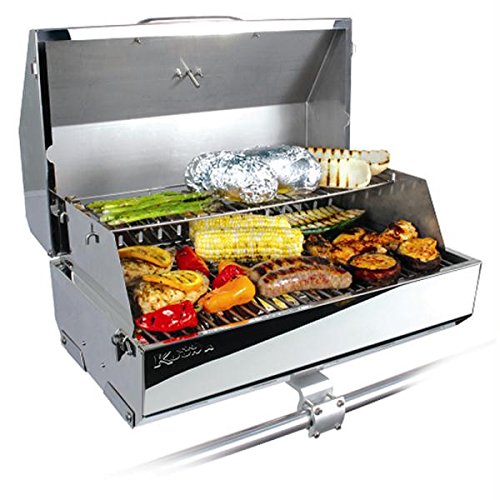
Kuuma 316 Elite Gas Grill — Best for Coastal Air
Kuuma builds grills for boats, and it shows in the one specification that matters most outdoors: 316 stainless steel, the marine grade alloyed with molybdenum specifically to resist the chloride corrosion that pits and stains ordinary 304 stainless near the coast. If you live within sight or smell of salt water, this is the grill material conversation, finished. The 316 Elite is a compact grill sized for docks, decks and smaller patios rather than party duty.
Strengths
- 316 marine-grade stainless body resists salt-air pitting that defeats lesser stainless
- Marine design heritage means hardware and latches are specified for outdoor exposure
- Compact footprint suits docks, decks, balconies and RV pads
Trade-offs
- Compact cooking area — this is a quality-over-capacity grill
- Marine-grade material carries a premium over ordinary stainless grills of similar size
- Mounting options are marine-oriented; patio buyers should confirm their stand setup
| Body | 316 marine-grade stainless steel |
| Fuel | Propane gas |
| Origin | Marine grill specialist (Kuuma/Camco) |
The difference between 304 and 316 stainless is invisible in a showroom and obvious in year three on a coastal deck: tea-staining, pitting around fasteners, and rust freckles on the lid. Kuuma’s whole product line exists because boat owners cannot garage their grills, and the 316 Elite brings that engineering to any outdoor spot where the air itself is corrosive — beach houses, lakeside decks with winter road salt nearby, and humid southern patios alike.
As a cooker it is a straightforward, well-sealed compact gas grill that heats evenly and shrugs off being left out. You are paying for the alloy, and for a specific buyer that is the smartest money in this entire guide: the one whose previous three grills all died of rust.
One practical note for dock and deck mounting: Kuuma’s ecosystem of mounts — rail, post and deck options — is part of the durability story, because a grill that is properly mounted does not get knocked, dragged or stored on its side in a locker. Choose the mount when you buy the grill, keep its fasteners on your seasonal check list, and the installation will outlast several ordinary patio grills.
Inland buyers sometimes ask whether 316 is wasted away from the coast. It is never wasted — pool decks, winter road salt and fertilizer-heavy garden air all carry chlorides — but its premium earns fastest within a few miles of salt water.
Best for: coastal homes, docks and any patio with salt in the air / Not suited for: cooking for crowds or buyers far inland who do not need marine alloy
Check on Amazon to see the current configuration and delivery options for the Kuuma 316 Elite.

Magma Marine Kettle3 Combo Stove & Gas Grill, Party Size 17-Inch — Best for Boats and RVs
Magma’s Marine Kettle line is standard equipment on serious boats for a reason: the kettle shape is inherently wind-resistant, the stainless construction tolerates constant salt exposure, and the Kettle3 version doubles as a stove, taking a pot or kettle as happily as it grills. The Party Size 17-inch model feeds a cockpit crew or an RV campsite, and the whole unit is designed to be mounted, used in weather, and stowed without drama.
Strengths
- Marine stainless construction proven in the harshest grill environment there is
- Wind-tested kettle design keeps heat in when the weather turns
- Converts between grill and stove duty for boats and RVs with limited space
Trade-offs
- Mounting hardware is sold for marine rails and posts — land buyers should plan their stand
- Kettle format suits grilling and pot cooking, not large flat batches
- Premium pricing for its size reflects the marine build, not cooking area
| Size | 17-inch, Party Size |
| Design | Kettle3 combo — grill and stove |
| Body | Marine stainless steel |
| Fuel | Propane |
Boat grills live a life no backyard grill survives: spray, sun, vibration, and storage in damp lockers. The Kettle3’s endurance in that world is the strongest outdoor-durability credential any product in this guide can claim. The lid and bowl are shaped to shed water rather than pool it, the hardware is minimal and replaceable, and the whole grill can be broken down for a proper clean — essential when salt is the enemy.
For RVers and dockside cooks, the stove conversion is the sleeper feature: morning coffee and evening steaks from one compact stainless unit that asks for almost no storage space. If your outdoors has a hull or wheels under it, start here.
The stove conversion deserves a second mention for RVers: a single burner unit that grills dinner and then boils the kettle for washing up replaces two appliances in a storage bay. In vehicles where every cubic foot is argued over, that dual duty is a durability feature of a different kind — the grill earns its place aboard, so it is maintained rather than left behind.
Magma’s mount ecosystem is worth browsing before purchase: the right rail or post mount turns a good grill into a permanent cockpit fixture, and permanent fixtures get maintained like the boat equipment they are.
Best for: boats, docks, RVs and small outdoor kitchens / Not suited for: landlocked families wanting a big patio grill
Check on Amazon to see the current configuration and delivery options for the Magma Kettle3.

Weber Q 2800N+ Portable Grill — Best Compact All-Weather
The Q series has always been Weber’s weather-beater: the body is cast aluminum, which cannot rust, the frame is glass-reinforced nylon that does not care about rain, and the grates are porcelain-enameled cast iron. The 2800N+ is the larger, more capable Q, with a temperature range the listing puts at 250 to 700 degrees — low enough for roasting, hot enough for a real sear — in a package that still lifts onto a cart or table.
Strengths
- Cast aluminum body eliminates body rust entirely
- Wide 250–700°F range covers roasting and hard searing in one burner system
- Porcelain-enameled cast iron grates are heavy, durable and easy to maintain
Trade-offs
- Portable format means modest cooking area for the price tier
- Runs on small canisters or an adapter hose — plan fuel for long cooks
- No enclosed cabinet; outdoor storage means the optional cart or a table
| Temperature range | 250–700°F (listing figure) |
| Body | Cast aluminum |
| Grates | Porcelain-enameled cast iron |
| Fuel | Propane |
For apartment decks, small patios and townhouse terraces — places where a grill lives outside because there is nowhere else for it to live — the Q formula is close to ideal. There is simply very little on it that weather can destroy: no painted steel shell, no plated frame, no wooden handles to rot. The burner is stainless, protected, and replaceable, and Weber stocks Q parts deeply.
It also travels, which makes it the rare pick that serves a balcony in the week and a campsite on the weekend. If your outdoor space is small but fully exposed, this is the durable answer that fits it.
A storage habit specific to the Q: because the body cannot rust, owners tend to neglect the one part that can suffer — the burner — if the grill lives out in spider season. A quick burner check each spring, and storing the grill with the lid closed and vents set, keeps the inside as immortal as the outside. The parts are inexpensive and the job takes minutes.
The Q also earns an honorable mention as the storm grill: when the big patio grill is covered and cold, the Q on a sheltered table under the eaves keeps dinner possible. Small, sealed and rust-proof is a weather strategy in itself.
Best for: balconies, small exposed patios, and camper-campers who grill at home too / Not suited for: cooking for more than about six at once
Check on Amazon to see the current configuration and delivery options for the Q 2800N+.

Napoleon Rogue PRO-S 625 5-Burner Propane Grill — Best Full-Size Stainless
The Rogue PRO-S 625 is the full-size answer for a patio where the grill never comes in: stainless construction, five main burners, rear and side burners, and a listing-rated 88,500 BTUs across 988 square inches. Napoleon’s stainless wave grates and sealed cook box suit permanent placement, and folding shelves let a genuinely large grill live against a wall or railing between cooks.
Strengths
- Stainless construction throughout the weather-facing surfaces
- Rear rotisserie burner and side burner make it a complete outdoor kitchen
- Five burners and near a thousand square inches handle serious entertaining
Trade-offs
- A lot of stainless to keep wiped in pollen and dust season
- Five-burner maintenance is real — annual burner and igniter checks are mandatory
- Premium price and footprint demand a committed patio
| Burners | 5 main + rear and side burners |
| Output | 88,500 BTUs (listing figure) |
| Total area | 988 sq. in. (listing figure) |
| Body | Stainless steel |
Permanent outdoor placement is a war of attrition against fasteners, hinges and igniter housings, and this is where a grill from a maker with a real parts pipeline justifies itself: every wear item on the Rogue PRO-S is a catalog part. The stainless body removes exterior rust from the worry list, leaving grease discipline and an annual inspection as the whole ownership burden.
For the entertainer, the rear burner plus rotisserie capability turns the patio into the kitchen for whole birds and roasts, while the side burner keeps sauces and sides out of the house. It is a lot of grill — deliberately, for households whose outdoor season is long and whose guest list is longer.
Rotisserie work outdoors deserves its weather note: the rear burner setup lets you run long, lid-down roasts in conditions — cold wind, light drizzle under a patio cover — that would end an open-grill session. A grill that keeps cooking through marginal weather gets used more months of the year, and used grills, once again, are the ones that stay maintained.
For all its size, the Rogue PRO-S is happiest treated like the Kuuma: rinsed occasionally in salty air, inspected each spring, and covered clean. Big stainless rewards the same marine habits as small stainless.
Best for: committed patio hosts in any climate / Not suited for: small decks or occasional grillers
Check on Amazon to see the current configuration and delivery options for the Rogue PRO-S 625.
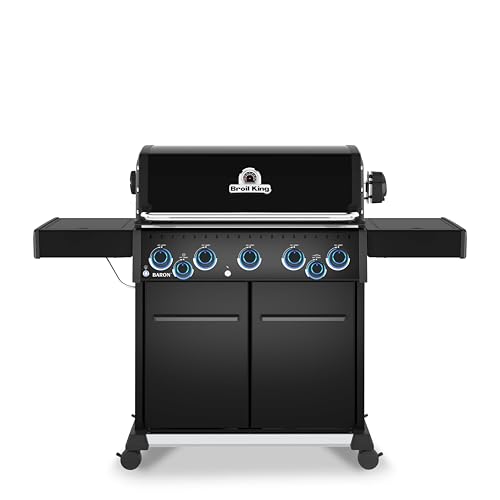
Broil King Baron 590 Pro Shadow 5-Burner Propane Gas Grill — Best for Big Families Outdoors
The Baron 590 Pro scales Broil King’s cast cook box design to five burners with a side burner and rear rotisserie burner, aimed at families whose grill lives outside and works constantly. The cast box is the durability headline: it does not flex, it holds heat in bad weather, and it cannot rust through the way folded steel boxes eventually do — a meaningful advantage for a grill that winters on the patio.
Strengths
- Cast cook box gives structural life and cold-weather heat retention
- Five burners plus side and rotisserie burners cover the full family menu
- Even-heat dual-tube burner design cooks full loads without scorch spots
Trade-offs
- Shadow finish needs a cover to stay handsome through pollen season
- Large and heavy — a two-person placement job
- More grill than a couple or small family will use
| Model | Baron 590 Pro Shadow (675144) |
| Burners | 5 main + side burner + rear rotisserie burner |
| Fuel | Propane |
| Cook box | Cast construction |
Cold-weather performance is an underrated outdoor durability trait: a grill that holds temperature in November wind gets used all year, and used grills get maintained. The cast box’s thermal mass is what makes winter grilling practical here, while the same mass protects burner mounts and seams from the flex-fatigue that ages thin boxes.
For a big household, the zone layout is the daily win — a full five-burner spread for the weekend crowd, or two burners lit for Tuesday with the rest cold. Buy the cover, keep the tray empty, and this is a decade-long patio fixture.
Families should note the Baron’s cold-weather manners once more: the cast box and heavy lid mean the grill reaches temperature and holds it when the patio is near freezing, which turns winter grilling from a stunt into a routine. Pair it with a fitted cover and a clear spot out of the prevailing wind, and its outdoor life will be measured in decades of family dinners.
One placement note for the Baron: its cast box holds heat so well that it also holds warmth after shutdown longer than thin grills — position it with the same clearance you would give it at full temperature, even in the off hours.
Best for: large families whose grill lives and works outdoors year-round / Not suited for: small households or covered-porch-only spaces with tight clearance
Check on Amazon to see the current configuration and delivery options for the Baron 590 Pro.

GRILLA Kong Ceramic Kamado Grill — Best Ceramic for Outdoor Life
Ceramic is the original outdoor material: it cannot rust, it ignores sun, and it does not mind being rained on for the ten-thousandth time. The Kong from Grilla Grills pairs that body with a generous 600 square inches of cooking space and a wheel system actually designed to move a heavy kamado — the detail that usually stops owners repositioning a ceramic grill for winter or storms.
Strengths
- Ceramic body is indifferent to rain, sun and salt — no finish to fail
- 600 sq. in. of cooking space is generous for the kamado class
- EZ Glide wheels make a heavy ceramic grill realistically repositionable
Trade-offs
- Ceramic still cracks from impact — wheels help, care still required
- Gasket and hardware remain wear items on any kamado
- Heavier and pricier than steel grills of similar grate area
| Body | Ceramic construction |
| Cooking space | 600 sq. in. (listing figure) |
| Mobility | EZ Glide wheel system |
| Venting | Adjustable vent control |
A kamado’s weather strategy is total indifference: there is no coating to protect because the body is the same fired material all the way through. Rain runs off, sun cannot peel it, and the insulation that makes it efficient also makes it a genuine four-season cooker — it will hold smoking temperature in weather that has steel grills burning fuel just to stay warm.
The Kong’s size and mobility make it the practical family’s kamado: big enough for a brisket or a party load of chicken, movable enough to roll under the eaves when a real storm comes. Treat the gasket as the consumable it is, and the body will outlast the patio furniture by a generation.
Kamado owners in storm country should use the Kong’s wheels as intended: roll it to the sheltered wall before severe weather, not because the ceramic fears rain — it does not — but because flying debris and falling branches are impact events, and impact is ceramic’s one true enemy. Positioned sensibly, a kamado is the least weather-concerned object on the patio.
The Kong’s ceramic also shrugs off the freeze-thaw cycle that worries owners of lesser outdoor gear: fired ceramic with a dry interior does not care about frost. Empty the ash, close the vents, and winter can do its worst.
Best for: four-season cooks who want ceramic permanence with family capacity / Not suited for: buyers who need to lift a grill into a vehicle regularly
Check on Amazon to see the current configuration and delivery options for the Kong.
Comparison Table
Notice the material column doing the talking: 316 stainless, marine stainless, cast aluminum, stainless, cast box and ceramic. For outdoor life, the body material is the review.
| Pick | Badge | Key Spec | Best For |
|---|---|---|---|
| Kuuma 316 Elite Gas Grill | Best for Coastal Air | 316 marine-grade stainless body | coastal homes, docks and any patio with salt in the air |
| Magma Marine Kettle3 Combo Stove & Gas Grill, Party Size 17-Inch | Best for Boats and RVs | 17-inch marine stainless kettle, grill + stove | boats, docks, RVs and small outdoor kitchens |
| Weber Q 2800N+ Portable Grill | Best Compact All-Weather | Cast aluminum body, 250–700°F range | balconies, small exposed patios, and camper-campers who grill at home too |
| Napoleon Rogue PRO-S 625 5-Burner Propane Grill | Best Full-Size Stainless | 5 burners + rear/side, 88,500 BTUs, stainless | committed patio hosts in any climate |
| Broil King Baron 590 Pro Shadow 5-Burner Propane Gas Grill | Best for Big Families Outdoors | 5 burners, cast cook box, rotisserie burner | large families whose grill lives and works outdoors year-round |
| GRILLA Kong Ceramic Kamado Grill | Best Ceramic for Outdoor Life | Ceramic body, 600 sq. in., wheeled cart | four-season cooks who want ceramic permanence with family capacity |
How to Choose the Best Durable Out Door Grills for Your Climate
Name your enemy first. Within a few miles of the ocean, the enemy is chloride corrosion, and the answer is 316 stainless or cast aluminum — ordinary stainless will freckle, and painted steel is on a short clock. In rainy continental climates the enemy is standing water and freeze-thaw: look for bodies that shed water, sealed igniters, and ash or grease systems that cannot hold a puddle against metal. In high sun, finishes and plastic parts age fastest, which favors ceramic and stainless over painted surfaces and wood trim.
Then decide the grill’s sleeping arrangements honestly. A grill that will truly live uncovered needs a marine or cast-aluminum or ceramic body, full stop. A grill under a porch roof or a good breathable cover can step down to heavy stainless or enamel and live just as long. The worst purchases are mid-priced painted grills bought for uncovered life — they are priced for a garage and built for one too.
Hardware is where weather wins
Bodies get the marketing; hardware gets the rust. Hinges, lid latches, igniter buttons, caster axles and shelf brackets are small steel parts in constant weather, and on cheap grills they fail years before the box does. Marine grills earn their premium here — their makers spec every fastener for exposure. On any grill, stainless or coated hardware and sealed ignition are worth real money outdoors.
Budget tiers, honestly framed
For outdoor duty the tiers shift up: the budget tier is effectively disposable in uncovered weather. The mid-range buys cast aluminum portables and honest stainless. The premium tier buys marine alloys and ceramic — materials with no weather failure mode at all. If the grill must live outside, spend on the body material before spending on burners, size or features; you can add a side table next year, but you cannot retrofit an alloy.
Covers, Placement and Drainage: The Free Durability Upgrades
Placement is a durability decision. Put the grill where water does not pool under it, where the lid can open without catching a gutter drip line, and — for gas — where wind does not hit the control panel dead-on. A slight tilt on the patio that drains away from the grill is worth more than a price tier. On decks, a grill mat protects the boards and keeps the area under the grill dry rather than greasy-damp.
Covers help when they are breathable and the grill goes under them clean and dry; they hurt when they trap a damp, dirty grill in a plastic tent for a month. In coastal air, rinse the exterior with fresh water occasionally — salt film is hygroscopic, pulling moisture from the air onto the metal, and a two-minute rinse removes the mechanism entirely. These habits cost nothing and routinely add years.
Grading Stainless and Reading Outdoor Specs
Stainless steel is a family, not a material. The grades that matter for grills are 304 — the common food-grade alloy, fine inland — and 316, which adds molybdenum for chloride resistance and is the marine standard. Some grills use magnetic 430 stainless on outer panels; it looks the part and rusts sooner. A magnet is a crude field test: strongly magnetic panels are usually the lower grades, while quality 304 and 316 are weakly magnetic at most. Use it as a prompt for questions, not a verdict.
For other materials, the spec to chase is thickness and completeness: cast aluminum should feel like a casting, not a shell; ceramic should be described as high-fire or refractory; enamel should be porcelain enamel, not ‘porcelain-look’ paint. When a listing will not name the grade or the process, assume the cheaper version and price the grill accordingly — outdoors, assumptions get tested by the weather within two seasons.
A Note on Wind, the Forgotten Weather
Rain gets the blame, but wind does quieter damage: it drives moisture into seams and control panels, cools one side of a firebox so metal expands unevenly cook after cook, vibrates fasteners loose over seasons, and — on exposed decks — can physically move or topple a light grill. The durable outdoor setup treats wind as a design input: a sheltered corner, a grill heavy or mounted enough to stay put, and covers that strap down rather than lift off.
Kettle and kamado shapes earn their keep here too, presenting round, low-drag profiles that shed gusts instead of catching them like a sail. When you place your grill, stand where it will live and feel the prevailing wind; two minutes of attention to airflow at placement saves years of asymmetric wear that owners usually misread as a defective grill.
Winterizing an Outdoor Grill, Step by Step
In cold climates, one proper winterizing session decides whether spring starts with a cook or a repair. Clean the firebox or bowl completely — no ash, no grease — because winter is when residue does its slowest, wettest damage. Run gas grills hot for fifteen minutes to dry the interior, then close the fuel and disconnect or cover the connection. Brush grates, oil iron lightly, and leave every tray and catcher empty and dry.
Then position and cover: grill out of the drip line, cover breathable and strapped, vents in their closed or winter position per the maker. Kamados get one extra step — a quick gasket and band check while you are there. Mid-winter, after the worst storm, lift the cover once and look for standing water. That five-minute January check has saved more grills than any product ever sold, and it is the difference between an outdoor grill that ages gracefully and one that ages all at once, in the dark, under snow.
How to Weatherproof Your Grill Setup for Year-Round Outdoor Life
The grill is only half the system. Set up the space around it once, properly, and every grill in this guide will outlast its warranty by years:
- Choose the spot for drainage first: no standing water, no roof drip line over the lid, and enough clearance from siding and railings for safe heat.
- Level the grill on a mat or pavers so rain sheets off the lid instead of pooling at seams, and so grease trays drain the way they were designed to.
- For gas grills, route the hose and tank so the connections stay off wet ground, and keep the tank valve accessible in the dark.
- Fit the cover correctly — snug, vented, and only ever over a clean, cool, dry grill. In storm country, add a strap so the cover is still there in the morning.
- Coastal and road-salt households: rinse the exterior with fresh water monthly and dry the control panel area; two minutes defeats the salt film.
- Before winter, deep-clean the firebox or bowl, empty every tray and ash catcher, close vents, and check that no water is trapped anywhere in the system.
- Mid-winter, lift the cover once and look: standing water in a tray or a damp ash load caught early is a wipe; caught in spring, it is a rust patch.
- Each spring, run the full inspection — burners or dampers, grates, gaskets, hardware tightness — and order wear parts before the season starts.
None of these steps involves buying anything except perhaps a mat and a strap. Outdoor durability is a system of material plus placement plus habit, and the habit part is entirely within your control from the first day.
Common Buying Mistakes
Outdoor grills are usually killed by their environment, with help from these five owner errors:
Buying a garage grill for an uncovered life
The most expensive mistake in this category. Painted steel and thin stainless are engineered for sheltered storage; left in open weather they age in dog years. If the grill will live uncovered, the body material decision is the whole decision.
Covering a dirty, damp grill
A cover over wet ash and grease creates a corrosion chamber. Clean and dry first, every time, or leave it uncovered — a rained-on clean grill dries; a covered dirty one rots.
Ignoring salt film inland
Road salt in winter and pool chemicals in summer corrode like the coast does. If your grill freckles every spring, start the monthly fresh-water rinse — the cause is a salt film, not a defective grill.
Letting water pool in trays and bowls
Grease trays, ash catchers and kamado ash drawers all hold water against metal after storms. A ten-second empty after big weather is the cheapest lifespan insurance in grilling.
Placing the grill under the drip line
A concentrated roof drip will defeat any finish and fill any bowl. Two feet of horizontal movement often fixes a grill that seemed to be rusting abnormally fast.
Final Recommendation
Match the grill to your weather and the choice makes itself. Coastal and dockside buyers: the Kuuma 316 Elite or the Magma Kettle3, in marine materials that treat salt as a design input. Small exposed patios and balconies: the Weber Q 2800N+, whose cast aluminum body simply declines to rust. Full-size family patios: the Napoleon Rogue PRO-S 625 in stainless or the Broil King Baron 590 Pro with its cast box. Four-season charcoal cooks: the Kong, in ceramic that ignores the calendar.
Whichever you choose, do the free parts of the program — drainage, placement, the rinse, the dry cover. Materials decide what a grill can survive; habits decide whether it has to.
The outdoor brief is ultimately simple: the weather is not an event, it is the environment. Choose a body material that treats that environment as normal — marine stainless, cast aluminum, ceramic, honest stainless — place the grill where water and wind do it the fewest favors, and keep the two-minute habits. Do that, and the forecast stops being a factor in your grilling life.
Ready to check today’s configurations? Start with the top three: Kuuma 316 Elite Gas Grill, Magma Marine Kettle3 Combo Stove & Gas Grill, Party Size 17-Inch, Weber Q 2800N+ Portable Grill — each listing shows the current setup and delivery options.
Keep exploring the cluster before you decide: Best Durable Grills Best Durable Gas Grills Best Durable Charcoal Grills Best Easy Storage Camping Grills Best Portable Grills Best Grills For Camping.
Frequently Asked Questions
What is the most weather-resistant grill material?
For metal, 316 marine-grade stainless steel and cast aluminum lead: 316 resists salt pitting, and cast aluminum cannot rust at all. Ceramic is equally indifferent to weather. Ordinary 304 stainless is good inland but freckles near the coast, and painted steel is the weakest choice for uncovered life.
Can any grill really live outside uncovered all year?
Yes — marine stainless, cast aluminum and ceramic grills are designed for exactly that, and the picks in this guide prove it in marine and RV service. Even so, a breathable cover over a clean, dry grill extends the life of grates, igniters and hardware, so uncovered should be a capability, not a habit.
Why did my stainless grill get rust spots?
Usually one of three causes: it is a lower stainless grade exposed to salt, steel-wool or carbon-steel contamination has embedded iron particles in the surface, or a salt film has been pulling moisture against the metal. Clean with a nylon pad, rinse, and dry; true 316 and clean 304 both resist far better once surface contamination is removed.
Is a kamado a good choice for a wet climate?
Excellent — the ceramic body does not care about rain, and the insulation makes it the best cold-weather cooker here. Keep the ash drawer emptied so it does not hold water, maintain the gasket, and shelter it from falling branches rather than from weather.
How do I protect a grill on a boat or RV?
Choose marine materials first, then secure the mount — vibration loosens fasteners, so check them on a schedule. Rinse salt off after trips, store the grill dry when the boat or RV is laid up, and keep a small parts kit (igniter, regulator, fasteners) aboard, since marine wear items are easier to replace than to source mid-trip.
Does wind affect grill durability or just cooking?
Both. Wind drives rain into seams and vents, cools one side of the firebox causing uneven expansion cycles, and can topple light grills outright. A sheltered corner, a kettle or kamado shape, and a grill heavy or mounted enough to stay put all count as durability features in exposed locations.
How do I stop my patio grill blowing over in storms?
Weight, width and position are the answers: a low, heavy grill against a wall, out of the wind’s main path, with locking casters or a mount where the design allows. Folding shelves reduce the sail area on cart grills. In severe storm country, the honest solution is a garage corner for the worst nights — even marine grills cannot argue with a hurricane.
Do I still need a cover for a marine-grade grill?
Need is too strong a word — a 316 or cast-aluminum grill survives uncovered by design. But a breathable cover over a clean, dry grill still protects grates, igniters and hardware, and keeps pollen and debris out of the cook box. Think of the cover as protecting the accessories of the grill, while the body protects itself.
How do I clean salt off a grill without harming it?
Rinse with fresh water from a hose on a gentle setting, wipe with a soft cloth, and dry — especially around the control panel and fasteners. Avoid pressure washers and steel wool. For stainless, wipe with the grain and finish dry; the salt film, not the metal, is the enemy, and it dissolves in plain water.


