Disclosure: airfryerkitchensupply.com is reader-supported. When you buy through links on our site, we may earn an affiliate commission at no extra cost to you.
Where to buy
Every mixer in this guide to the best dj mixers for vinyl was verified against current retailer catalogue data before it earned a purchase link, so the buttons below lead to the exact models reviewed — no lookalikes, no substituted listings. Prices move constantly in DJ gear, so check price on Amazon for the current figure on each pick before you decide. If a pick shows as unavailable in your region, the comparison table further down will point you to the closest alternative in the same guide.
- Allen & Heath XONE:96 — Best Overall: check price on Amazon
- Allen & Heath Xone:92 Mk2 — Best Analog Sound: check price on Amazon
- Pioneer DJ DJM-A9 — Best Club Standard: check price on Amazon
- Allen & Heath Xone:43 — Best Mid-Range Analog: check price on Amazon
- Pioneer DJ DJM-450 — Best Compact Vinyl + DVS: check price on Amazon
- Allen & Heath Xone:23 — Best Budget Vinyl Mixer: check price on Amazon
Choosing the best dj mixers for vinyl is a different exercise from choosing a controller-era mixer. Your records are the source, so the phono preamps, the warmth and headroom of the analog path, and the feel of long EQ blends matter more than screens or sample pads. A great vinyl mixer disappears: it lets two records become one continuous piece of music.
This list is deliberately split between two philosophies. Allen & Heath’s Xone family represents the analog purist path — four-band EQ, dual filters, and sound that flatters vinyl’s dynamics. Pioneer’s DJM line represents the club-standard path — the layout you will find in booths worldwide, with DVS options for DJs who mix records and files in the same set. Both philosophies are right; they suit different DJs.
Every pick below was verified against current retailer catalogue data before receiving a purchase link, including the phono-friendly budget end of the range. If you play house, techno, disco, soul or hip-hop on wax, one of these six mixers is the correct centre of your setup — the only question is which mixing style is yours.
One more framing note: this guide treats ‘vinyl DJ’ as a spectrum, not a purity test. At one end sit analog-only DJs whose laptops stay closed; at the other, hybrid DJs for whom a record and a file are simply two sources. Both ends are legitimate, both are served below, and the middle — DJs who play records at home and whatever works at gigs — is where most readers actually live. The picks are ordered so that each philosophy gets its champion before the compromises begin.
Key Takeaways
- Phono stage quality is the vinyl mixer’s defining spec — listen before you buy, with a record you know.
- Four-band EQ and a musical filter (the Xone formula) transform long blends; three-band suits quicker styles.
- Decide analog purity versus DVS flexibility before comparing prices — the two regrets in this category are buying either one wrong.
- Gigging vinyl DJs gain real value from the club-standard layout, because fluency travels between booths.
In this guide
Quick Picks
Short on time? These are the six best dj mixers for vinyl that matter, in the order most buyers should consider them. Each badge below is repeated at the top of that mixer’s full review, so you can jump straight to the one that matches your style.
- Allen & Heath XONE:96 — Best Overall. For vinyl, the 96’s four-band EQ is transformative: you can hand the low end from one record to the next in two stages, which is the difference between a blend and a collision. Check price on Amazon
- Allen & Heath Xone:92 Mk2 — Best Analog Sound. If sound is your religion, the 92 Mk2 is the cathedral. Check price on Amazon
- Pioneer DJ DJM-A9 — Best Club Standard. The A9 earns its vinyl place through reality: it is the mixer in the booths where your records will actually be played. Check price on Amazon
- Allen & Heath Xone:43 — Best Mid-Range Analog. The 43 is the vinyl sweet spot for home and small-club rigs: four channels of real Xone analog sound, the VCF filter, and a price that leaves money for records — which, let us be honest, is where a vinyl DJ’s budget wants to go. Check price on Amazon
- Pioneer DJ DJM-450 — Best Compact Vinyl + DVS. Hybrid DJs, this is yours: real records on the phono inputs, control vinyl and your whole digital library through rekordbox DVS, club-standard FX on top. Check price on Amazon
- Allen & Heath Xone:23 — Best Budget Vinyl Mixer. The budget vinyl pick that embarrasses pricier mixers: its phono stages sound genuinely good, the VCF filter adds expression no rival at the price offers, and the compact body fits the small spaces where most home vinyl rigs actually live.. Check price on Amazon
How These Picks Were Chosen
Vinyl mixers were judged first on phono stage quality and analog sound — records must sound full, quiet and detailed — then on EQ architecture for long blends, filter quality, channel count for multi-deck rigs, and build for daily use. DVS capability was scored as a bonus for hybrid DJs, never as a requirement, because a vinyl-first guide must respect DJs who will never open a laptop. Crossfader scores were weighted for smooth blending rather than battle cutting, except where a pick explicitly serves both worlds.
Verification discipline matters as much as judgement. Every linked product in this guide was confirmed through the retailer’s own catalogue data — brand and model searched, the returned title matched to the product under review, and the identifier taken from that confirmed response. Products that could not be confirmed that way were never given purchase links; where a famous model failed confirmation, it is discussed honestly in the text as context, so you know exactly what we could and could not stand behind. No prices are printed in this guide because DJ gear pricing shifts with sales, bundles and stock — each pick links to its live listing so you always see the real current figure.
A note on listening tests, because vinyl mixers are bought with ears or not at all. Bring the same three records to every audition: one quiet, detailed pressing (a jazz trio or acoustic recording), one loud dancefloor pressing, and one record with deep, sustained bass. Play the quiet one first — phono hiss and hum announce themselves immediately — then the loud one for headroom, then the bass record through a long blend to judge EQ behaviour. Any shop that will not let you do this with a serious purchase is telling you something about the shop.
The 6 Best dj mixers for vinyl
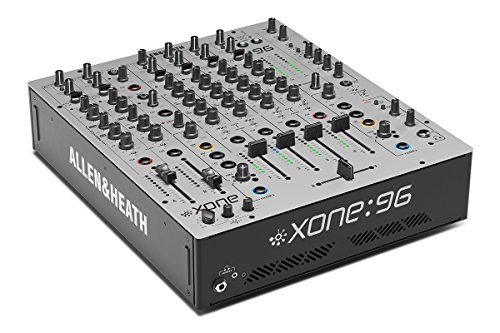
Allen & Heath XONE:96 — Best Overall
For vinyl, the 96’s four-band EQ is transformative: you can hand the low end from one record to the next in two stages, which is the difference between a blend and a collision. Add dual soundcards for the nights you do run DVS, and it is the most complete vinyl mixer money can buy.
Strengths
- True analog signal path with the famous Xone filter sound
- 4-band EQ gives surgical control for long vinyl blends
- Dual USB soundcards for hybrid vinyl/DVS rigs
Trade-offs
- Premium price tier
- No onboard FX — effects come from send/return pedals or units
- Analog workflow rewards patience; not a quick-cut battle mixer
| Channels | 6 |
| Type | Analog DJ mixer |
| EQ style | 4-band EQ + dual filters (Xone VCF tradition) |
The XONE:96 is Allen & Heath’s love letter to DJs who mix with their ears over long blends. Its fully analog signal path, four-band EQ and dual VCF filters produce the warm, forgiving, deeply musical sound that made Xone mixers the choice of techno and house institutions. Four-band EQ is the quiet superpower: splitting the low end into two bands lets you swap basslines between two records without the mud that three-band mixers force you to accept. Two independent USB soundcards mean hybrid rigs — vinyl on two channels, Traktor or another DVS on the others — run without compromise, and the send/return architecture invites proper studio effects pedals and units into your sets. There are no onboard FX, deliberately: this mixer trusts you to bring your own. The crossfader is tuned for smooth blending rather than turntablism, and the price is firmly professional. For vinyl DJs who play long, layered sets and care about sound above features, the 96 is not just a contender — for many, it is the destination mixer they stop upgrading at.
The 96 changes how you practise: you start mixing for the blend rather than the drop, riding four-band EQ and filters across minutes-long transitions and recording everything through its soundcards to study later. It pairs beautifully with external FX on the sends — a single quality delay pedal multiplies its voice. Keep the analog path clean, give the filters regular exercise to keep pots sweet, and resist stacking it under heavy cases in storage; this is a precision instrument that happens to survive clubs.
The 96 invites an audiophile’s supporting cast: well-maintained turntables, cartridges chosen for sound rather than abuse, and — through its send/return architecture — one or two quality external effects, a studio delay being the classic first addition. Its dual soundcards pair with a laptop for hybrid sets and painless recording. Give it a listening-room’s care: stable power, ventilation, and cables you do not trip over. DJs who build patiently around a 96 tend to stop shopping; the rig becomes a reference rather than a project.
Best for: buyers who want overall done properly. / Not suited for: premium price tier.
Check on Amazon — Allen & Heath XONE:96 (check price on Amazon for the current figure).

Allen & Heath Xone:92 Mk2 — Best Analog Sound
If sound is your religion, the 92 Mk2 is the cathedral. Its filters beg to be ridden across eight-minute blends, and its analog path gives records a weight that makes digital sources sound thin by comparison. Vinyl purists who play techno and house will understand within one mix why this mixer became folklore.
Strengths
- The techno/house benchmark, refreshed in Mk2 form
- Dual VCF filters remain the creative heart of the Xone sound
- Built for long, layered blends rather than fast cuts
Trade-offs
- No USB audio interface — recording needs a separate interface
- Crossfader is tuned for blending, not scratching
- Premium price tier
| Channels | 4 |
| Type | Analog DJ mixer |
Few products in DJ culture carry the Xone:92’s reputation: for two decades it was the mixer behind the defining techno and minimal sets, prized for its dual VCF filters and four-band EQ long before those features were fashionable. The Mk2 refresh keeps everything that mattered — the analog warmth, the filters you play like an instrument, the bombproof club build — and tidies the details for modern booths. Playing on one is a lesson in restraint: instead of effects tricks, you shape energy with EQ and filter rides across blends that last minutes, and the mixer rewards that patience with a sound smaller mixers cannot fake. The trade-offs are equally clear. There is no USB soundcard, so digital recording or DVS needs an external interface, and the crossfader is a blending tool, not a scratch weapon. It is also a serious investment in a deliberately focused tool. For vinyl-first house and techno DJs, though, the 92 Mk2 is less a purchase than an inheritance — the classic, still in production, still setting the standard for analog DJ sound.
Daily life with a 92 Mk2 is a study in restraint: fewer controls than digital rivals, each one voiced to matter. Owners develop filter technique the way guitarists develop vibrato — slowly, personally, recognisably. Because there is no USB soundcard, settle your recording chain once (a small interface from the record output) and forget it. The mixer asks for a dust cover and occasional pot exercise; in return it delivers the same sound on year ten as on day one, which is precisely its legend.
Build around the 92 Mk2 the way its original era did: two or more turntables, a small recording interface on the record output, and external effects only if your style truly uses them — the filters cover most DJs’ expression. It pairs with rooms and booths that value sound over spectacle, and with record collections deep enough to reward four-band blending. Keep a quality pair of headphones permanently assigned to it; on a mixer this revealing, inconsistent monitoring is the last weak link worth tolerating.
Best for: buyers who want analog sound done properly. / Not suited for: no usb audio interface.
Check on Amazon — Allen & Heath Xone:92 Mk2 (check price on Amazon for the current figure).

Pioneer DJ DJM-A9 — Best Club Standard
The A9 earns its vinyl place through reality: it is the mixer in the booths where your records will actually be played. Its phono inputs are clean, its workflow is universal, and learning it at home means walking into any club already fluent. For gigging vinyl DJs, that familiarity is a feature no spec sheet captures.
Strengths
- The current club-standard layout most venues and riders expect
- Third-generation Magvel-style channel faders and refined EQ feel
- Dual USB-C/USB connections smooth DJ changeovers
Trade-offs
- Premium price tier aimed at venues and serious rigs
- Large footprint for small home booths
- Battle DJs will prefer a dedicated 2-channel scratch mixer
| Channels | 4 |
| Role | Professional club DJ mixer |
| Interface | Audio interface for recording & performance |
The DJM-A9 is what the world’s club booths converged on: a four-channel flagship that refined the DJM-900NXS2 formula with better sound, smoother faders, a bigger colour screen and dual USB-C/USB-B connections for painless changeovers. For DJs who play out, its value is familiarity — walk into almost any serious venue and the layout under your hands is this layout, so your muscle memory travels with you. The third-generation Magvel channel faders, per-channel Sound Color FX and the expanded Beat FX section make long club sets expressive without external gear, and the audio interface side records sets and handles digital sources cleanly. It is a four-channel mixing machine first: house, techno, open-format and multi-deck workflows are its home turf, and while the crossfader is perfectly competent, dedicated battle DJs will still prefer a two-channel scratch mixer. The price is professional, the footprint is generous, and home users should measure their booth before ordering. As the reference point every other club mixer is compared against, its place on any all-time or best-of list is not nostalgia — it is current reality.
In practice the A9’s luxury is cognitive: you stop thinking about the mixer entirely. Changeovers with the previous DJ take seconds via the dual USB connections, the screen answers questions before you ask them, and the layout is identical to the booth you played last weekend. Home owners should measure depth and ventilation before committing furniture to it. Venues should budget for a dust cover and an annual service; treated that way, an A9 is a decade-long fixture rather than a purchase.
The A9 anchors permanent systems: two flagship media players or turntables, a booth monitor on its dedicated output, and recording wired once and forgotten. Venues should pair it with a managed power supply and a dust cover; home owners with furniture that respects its footprint and ventilation. Because changeovers are its party trick, booths benefit from both USB connections being cabled and ready before doors. Its partners should be as standardised as it is — this is the mixer around which an entire booth’s muscle memory organises itself.
Best for: buyers who want club standard done properly. / Not suited for: premium price tier aimed at venues and serious rigs.
Check on Amazon — Pioneer DJ DJM-A9 (check price on Amazon for the current figure).

Allen & Heath Xone:43 — Best Mid-Range Analog
The 43 is the vinyl sweet spot for home and small-club rigs: four channels of real Xone analog sound, the VCF filter, and a price that leaves money for records — which, let us be honest, is where a vinyl DJ’s budget wants to go. It does less than the flagships and gives up almost nothing that matters on wax.
Strengths
- Genuine Xone analog sound and VCF filter for far less than the flagships
- 4+1 channels cover two decks plus spares, sampler or third deck
- Simple, honest layout with nothing menu-driven
Trade-offs
- No USB soundcard or onboard FX
- Crossfader aimed at mixing, not turntablism
- Fewer routing options than XONE:96/PX5
| Channels | 4 + 1 |
| Type | Analog DJ mixer |
The Xone:43 is the honest workhorse of the Allen & Heath DJ range: four full channels plus an extra input, genuine analog circuitry, the famous Xone VCF filter, and none of the digital extras that inflate flagship prices. For vinyl DJs its appeal is direct — your money buys sound quality, channel count and build, in that order. Four channels transform home and small-club rigs: two turntables stay permanently wired while media players, a third deck or a sampler join without cable swapping, and the filter gives every blend the sweep-and-resonate character Xone owners love. There is no USB soundcard and no onboard FX, so recording means an external interface and effects mean the send/return loop and your own units — a limitation that doubles as simplicity, since there is nothing to update, crash or learn. The crossfader is spec’d for mixing rather than scratching. If your sets are long blends of house, techno, disco or hip-hop instrumentals and your budget stops short of the 92/96 tier, the 43 delivers the essential Xone experience with the fewest compromises that matter.
The 43 is the mixer owners describe with the word ‘finally’: finally enough channels, finally the filter, finally no menus. In practice it simplifies a home rig — everything stays plugged in, guests’ media players included — and its honesty exposes sloppy gain habits quickly, which improves your mixing within weeks. Without a USB soundcard, pick a small recording interface once and the setup is complete. It asks almost nothing and gives the essential Xone experience every single session.
The 43’s perfect partners are the sources its channels invite: two turntables permanently wired, a media player that never needs unplugging, and a phone or sampler on the spare input for requests and interludes. Add a compact recording interface once and the system is complete. It asks for no ecosystem loyalty and no software at all, which makes it the easiest flagship-adjacent mixer to share with guest DJs — everyone already knows how to drive it, because it behaves like mixers have always behaved.
Best for: buyers who want mid-range analog done properly. / Not suited for: no usb soundcard or onboard fx.
Check on Amazon — Allen & Heath Xone:43 (check price on Amazon for the current figure).

Pioneer DJ DJM-450 — Best Compact Vinyl + DVS
Hybrid DJs, this is yours: real records on the phono inputs, control vinyl and your whole digital library through rekordbox DVS, club-standard FX on top. The 450 is the compact answer for DJs whose sets refuse to choose between the crates and the laptop.
Strengths
- Club-style Pioneer layout in a compact 2-channel body
- Beat FX and Sound Color FX make it creative beyond its size
- USB soundcard unlocks rekordbox DVS with control vinyl
Trade-offs
- Premium-mid price for a 2-channel mixer
- Crossfader is good but not the flagship Magvel Pro
- Only two channels — no room for a third deck
| Channels | 2 |
| FX | Beat FX |
| Software | rekordbox, DVS ready |
The DJM-450 is Pioneer’s club DNA in a two-channel body: the same layout language, Beat FX and Sound Color FX as the big DJMs, scaled for home booths, bars and smaller rigs. For vinyl DJs its party trick is the built-in USB soundcard with rekordbox DVS — plug in turntables, drop control vinyl, and your digital library plays through a mixer that also handles your real records natively, with phono inputs that do them justice. Beat FX synced to the BPM, with the familiar level/depth control, makes echo-outs and reverb tails effortless, and the Magvel-family crossfader feels a class above most two-channel rivals. It is the mixer DJs buy when they play Pioneer gear in clubs and want practice at home to translate exactly. The limits are channel count and price positioning: two channels only, and it costs meaningfully more than simpler two-channel mixers from Numark or Allen & Heath. If your world is rekordbox and club-standard workflow, that premium buys genuine continuity between the bedroom and the booth.
The 450’s practice gift is translation: every hour at home is an hour of club fluency, because the layout, FX logic and even the knob feel mirror the big DJMs. Rekordbox users should set up DVS and real-vinyl switching until it is muscle memory; that fluency is the product. It is compact enough for apartment booths yet serious enough for bar residencies. A fitted cover keeps the booth dust out of the faders, and that is the whole maintenance sermon.
The 450 pairs with rekordbox like it was poured from the same mould: control vinyl for the digital library, real records for the crates, and a laptop that treats the mixer as its soundcard and effects engine in one. Add booth-standard headphones and your home practice becomes indistinguishable in feel from club work. Media players join happily on the line inputs for gigs that mix formats. Its ideal owner plays out, or intends to — the whole design is an apprenticeship that happens to throw excellent house parties.
Best for: buyers who want compact vinyl + dvs done properly. / Not suited for: premium-mid price for a 2-channel mixer.
Check on Amazon — Pioneer DJ DJM-450 (check price on Amazon for the current figure).
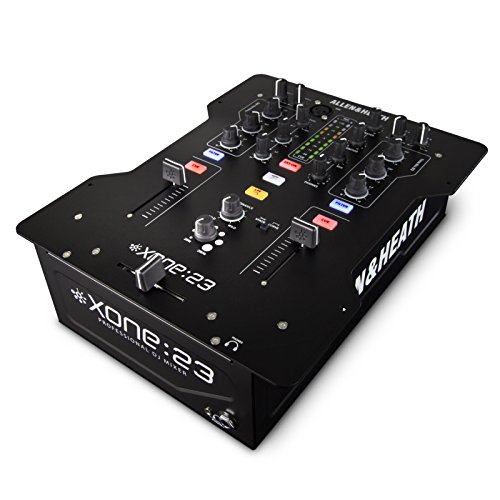
Allen & Heath Xone:23 — Best Budget Vinyl Mixer
The budget vinyl pick that embarrasses pricier mixers: its phono stages sound genuinely good, the VCF filter adds expression no rival at the price offers, and the compact body fits the small spaces where most home vinyl rigs actually live.
Strengths
- Real Xone VCF filter and analog warmth in a compact 2-channel body
- 2+2 inputs handle turntables plus a backup source
- Excellent phono stages for the money — vinyl sounds full
Trade-offs
- No USB interface or DVS support
- Compact top panel can feel tight with big hands
- No onboard FX
| Channels | 2 + 2 |
| Type | Analog DJ mixer |
The XONE:23 distils the Allen & Heath formula into a compact 2+2 channel mixer that costs a fraction of the flagships yet keeps the two things that make a Xone a Xone: analog sound and the VCF filter. That filter, assignable across channels, turns basic blends into performances — resonant sweeps and gentle high-pass rides that budget mixers simply cannot imitate. Its phono inputs deserve special mention for vinyl buyers: records sound full and detailed, without the thin, harsh edge cheap phono stages add. The 2+2 layout means two main channels plus two additional inputs, so a phone or backup player can sit ready for the moment a needle skips or a guest wants a request. Compromises are size and scope: the top panel is compact, there is no USB or DVS, and scratch DJs get a mixing-grade crossfader rather than a battle weapon. As a first ‘real’ mixer for a vinyl setup, a home-booth centrepiece, or a characterful backup for a working DJ, the 23 punches far above its price class.
Small footprint, outsized influence: the 23 tends to become the most-used mixer in a house because it is always ready — two decks wired, filter warmed up, a guest source on the spare inputs. Its compact panel teaches economical hand movement that transfers surprisingly well to big booths. Keep expectations aligned — it is a mixing instrument, not a battle weapon — and it will be the purchase friends keep asking about after playing on it once.
Small rigs flatter the 23: two turntables on a sideboard, a streamer or phone on the spare inputs, powered speakers doing the loud work. Its filter makes even this modest chain feel expressive, which is why guests remember playing on it. Keep a record brush and a spare stylus nearby — in compact home rigs, those two items guard more sound quality than any upgrade. If the rig grows, the 23 migrates gracefully to second-room or backup duty rather than to a cupboard.
Best for: buyers who want budget vinyl mixer done properly. / Not suited for: no usb interface or dvs support.
Check on Amazon — Allen & Heath Xone:23 (check price on Amazon for the current figure).
Comparison Table
| Pick | Badge | Key spec | Best for |
|---|---|---|---|
| Allen & Heath XONE:96 | Best Overall | 6 channels | Best Overall |
| Allen & Heath Xone:92 Mk2 | Best Analog Sound | 4 channels | Best Analog Sound |
| Pioneer DJ DJM-A9 | Best Club Standard | 4 channels | Best Club Standard |
| Allen & Heath Xone:43 | Best Mid-Range Analog | 4 + 1 channels | Best Mid-Range Analog |
| Pioneer DJ DJM-450 | Best Compact Vinyl + DVS | 2 channels | Best Compact Vinyl + DVS |
| Allen & Heath Xone:23 | Best Budget Vinyl Mixer | 2 + 2 channels | Best Budget Vinyl Mixer |
Read the table as a shortlist, not a ranking shortcut: the right row is the one whose badge matches your style, your software world and your rig. The full reviews above explain the trade-offs the table cannot.
How to Choose the Right Mixer for Your Setup
Phono stages: the spec nobody advertises
Two mixers can both list ‘phono inputs’ and sound completely different. Good phono stages are quiet, with accurate RIAA equalisation and enough headroom for loud pressings. The Xone range built its reputation here; whatever you buy, test with a record you know intimately and listen for hiss at blend volume and thinness in the low end.
EQ architecture shapes your mixing style
Three-band EQ is the standard; four-band EQ (XONE:96, Xone:92) splits the lows so basslines can be swapped surgically during long blends. If your sets are quick cuts and hip-hop, three bands suffice. If your blends last minutes, four bands will change how you mix within a month.
Analog purity vs DVS flexibility
Pure analog mixers (Xone:43, Xone:23, 92 Mk2) keep the signal path simple and the price focused on sound. DVS-ready mixers (DJM-450, XONE:96, PX5-class designs) add a soundcard so control vinyl joins real records. Neither is superior — but buying DVS you never use, or skipping it and wanting it later, are the two classic regrets in this category.
Why Vinyl DJs Still Choose Analog Mixers
An analog mixer treats your record as a continuous electrical signal from needle to speaker, and many DJs hear the result as warmth: gentle saturation in the filters, forgiving headroom when a pressing runs hot, and EQ that feels like it was voiced by people who mix records rather than files. The Xone VCF filter is the emblem of this school — a resonant, musical filter you play like an instrument across a blend, tightening the energy of a room without touching the faders.
Digital club mixers answer with precision and consistency: the same sound in every booth, effects locked to the beat, and recording built in. Neither school wins absolutely. The practical test is your own records in your own room: if long blends give you goosebumps, buy analog depth; if you play five venues a month, buy the standard. Many serious vinyl DJs eventually own one of each — the analog mixer at home, where listening matters most, and fluency on the club standard for work.
Cartridges, Pressings and the Vinyl Chain Beyond the Mixer
The cartridge is your first upgrade
Before upgrading any mixer on this list, most vinyl DJs gain more from a cartridge and stylus matched to their style — DJ cartridges for durability and tracking under cueing, hi-fi-leaning cartridges for listening-first home rigs. A worn stylus damages records permanently, so styli are consumables with a schedule, not heirlooms. Keep a stylus brush and a loupe; five seconds of inspection per week protects a whole collection.
Pressing quality and record care
A great mixer reveals pressing quality mercilessly: off-centre pressings wobble, dirty records crackle through quiet passages, and worn charity-shop finds sound worn. Budget for a basic record-cleaning routine — a carbon brush for daily dust, a wet clean for new acquisitions — and store records vertically, sleeved, away from heat. Your mixer investment only pays out in sound when the vinyl feeding it is cared for; the chain is only ever as honest as its dirtiest record.
How to Set Up Two Turntables and a Vinyl Mixer Correctly
Most vinyl sound problems are setup problems. This sequence takes ten minutes and fixes the majority of them.
- Level the turntables first — a spirit level on the platter — then set tracking force and anti-skate to your cartridge maker’s specification. A mixer cannot fix a mistracking needle.
- Connect RCA cables to the mixer’s phono inputs and attach the ground wires to the mixer’s ground terminal. Finger-tight plus a quarter turn; hum almost always traces back to this connection.
- Switch each channel to PHONO. If your turntables have built-in preamps with a line output, choose one path only — phono into phono input, or line into line input — never both stages at once.
- Set gains with your loudest record: peaks just under the red on the channel meters. Vinyl varies hugely between pressings, so re-trim gain on every record change; riding gain is part of vinyl DJ craft.
- Balance your blend volumes in the headphones using the cue mix, then commit to the master. Your ears, not the meters, make the final call on two different pressings.
- End the session by cleaning the stylus and returning records to sleeves. Dust is a phono stage’s enemy and a record’s slow destroyer.
Once this setup is done, resist re-doing it. Vinyl rigs reward stability: the same levels, the same gain habits, the same cleaning ritual. Your ears calibrate to a stable system, and that calibration — knowing exactly how a record should sound through your chain — is the quiet skill underneath every great vinyl set.
Vinyl Mixing Terms, Translated
Phono stage
The preamplifier that boosts a turntable’s tiny signal and applies RIAA equalisation. Its quality — quiet, accurate, with headroom — is the largest single influence a mixer has on how your records sound, and the reason vinyl-first guides obsess over it.
RIAA curve
The standard equalisation applied when records are cut and reversed on playback. A mixer (or turntable) must apply it exactly once; twice produces the boomy distortion described in our mistakes section, and not at all produces a thin, quiet signal.
VCF filter
Allen & Heath’s voltage-controlled filter: a resonant analog filter swept by one knob to add movement to blends. It can gently remove low end during a transition or be played aggressively as an effect — the signature sound of the Xone school.
Gain staging (vinyl edition)
Matching each record’s level at the channel gain before blending, because pressings vary wildly in loudness. On vinyl, gain riding is not a setup chore; it is a continuous performance skill that separates smooth sets from lurching ones.
Control vinyl
Timecode records that let DVS software treat digital files like vinyl. Hybrid mixers in this guide accept both real records and control vinyl on the same channels — the bridge between the analog and digital schools.
Common Buying Mistakes
Double phono stages
Running a turntable’s built-in preamp into a mixer’s phono input applies RIAA equalisation twice — boomy, distorted, awful. One stage only, always.
Ignoring the ground wire
That thin forgotten wire is the difference between silent backgrounds and a hum that follows every blend. Connect it before blaming the mixer.
Buying channels you never wire
A six-channel flagship is wasted on a two-deck home rig if the money could have bought records and cartridges. Match the mixer to the rig you actually own.
Judging by controller-era features
Pads and screens do not make records sound better. For vinyl, phono quality, EQ and filters are the features — weight your budget accordingly.
Owning an Analog-Leaning Vinyl Rig Over the Long Term
Pots, faders and the gentle arts
Analog mixers age gracefully when exercised: rotate every knob through its full travel monthly, especially the filter and EQ pots you favour least, so no control sits in one position long enough to grow scratchy. Keep the top panel dusted — dust plus humidity is the enemy of every contact in the box — and give the mixer ventilation space rather than a sealed cabinet. A professional service every few years (cleaning, calibration, a check of the phono stages) costs little against the mixer’s lifespan and keeps the sound you bought intact.
Protecting the chain around the mixer
Your mixer’s longevity is entangled with its partners: surge protection for the whole rig, cables with strain relief that never hang by their connectors, and turntables maintained on schedule. Keep the ground wires’ terminals clean and tight — intermittent hum that ‘comes and goes’ is usually corrosion introducing itself. Finally, insure the rig honestly if it travels: replacement value on a Xone-class mixer plus two serviced turntables surprises people who never added it up.
Which Vinyl Mixer Fits Your Situation?
The home listener-DJ
Your room is a listening room first, so buy sound: Xone:43 for value, XONE:96 for the summit, Xone:23 if space and budget are tight. Your records will tell you within one side whether you chose well — that intimacy is the whole reward of the analog path.
The club and techno resident
Fluency is income. If your venues run Pioneer, the DJM-A9 keeps your home practice identical to your work; if your scene is Xone country — and techno often is — the 92 Mk2 or 96 is your professional dialect. Choose the mixer your next fifty gigs will be played on.
The hybrid crate-and-laptop DJ
The DJM-450 was designed for you: records and rekordbox DVS in one compact, club-flavoured box. Set up both paths until switching is reflex, keep one real record per side as your insurance, and your sets gain the full history of your collection in both formats.
Vinyl Mixer Buying Checklist
Run this list against any finalist — including mixers not in this guide — before money moves. A mixer that fails two or more items for your situation is the wrong mixer at any price.
- Phono inputs auditioned with a familiar record — quiet, full, hiss-free
- EQ architecture matched to your blend length (4-band for long blends)
- Filter quality tested, not just listed
- Channels counted against every deck and source you own
- DVS path decided: built-in, external interface, or proudly none
- Recording route planned (soundcard or record-out interface)
- Ground terminal solid; RCA jacks tight
- Cartridge and stylus budget protected — the mixer is not the whole chain
Final Recommendation
If one mixer must be named for vinyl above all others, it is the XONE:96 — the most complete expression of analog DJ mixing available today. The Xone:92 Mk2 runs it close on pure sound and folklore, while the Xone:43 and Xone:23 deliver the same philosophy at prices that respect a record budget. DJs who gig in clubs or blend digital files into vinyl sets should look hard at the DJM-A9 and DJM-450 instead.
Whichever you choose, pair it with honest basics: levelled decks, fresh styli, clean records. A great vinyl mixer reveals your setup’s weaknesses as clearly as its strengths — and that honesty is exactly why records through a proper mixer still move rooms like nothing else.
Ready to buy? Start with the three most-chosen picks in this guide — Allen & Heath XONE:96, Allen & Heath Xone:92 Mk2, Pioneer DJ DJM-A9 — and check price on Amazon for the current figure on each.
Keep exploring the cluster: Best Dj Mixers · Best Dj Mixers For Scratching · Best Dj Mixers Of All Time · Best Dj Mixers Under $500 · Best Dj Mixers Under $300
Related guides
Frequently Asked Questions
Do vinyl DJs need a special mixer?
Any DJ mixer with phono inputs works, but vinyl rewards mixers with quiet, accurate phono stages and musical EQ. Analog mixers like the Xone range are popular because their filters and headroom flatter records. The special part is not the badge — it is phono quality.
Can I play vinyl through a DJM-A9 or DJM-450?
Yes. Both have phono inputs for turntables alongside their digital features, and both support DVS control vinyl, so real records and digital files share one setup. They are the natural choice for DJs who mix both formats in the same set.
What is a VCF filter and why do Xone fans love it?
VCF stands for voltage-controlled filter. On Xone mixers it is a resonant analog filter you sweep across a blend to add movement and tension — tightening a mix before a drop or gently removing low end during a long transition. Played well, it becomes a third hand on the mixer.
Is four-band EQ worth it for vinyl?
For long-blend styles — house, techno, disco — yes. Splitting low frequencies into two bands lets you exchange basslines gradually without mud. For quick-cut styles it is a luxury. Your mixing style, not the spec sheet, decides.
How do I record vinyl sets from an analog mixer?
Use the mixer’s record or booth output into a USB audio interface or handheld recorder, set levels conservatively, and trim gain per record. Mixers with built-in soundcards (XONE:96, DJM-450) simplify this to a USB cable.
Should a beginner buy an analog or digital mixer for vinyl?
Buy the sound you will grow into. Beginners who love records and long blends thrive on a Xone:23 or Xone:43. Beginners aiming at club work should start on the Pioneer layout with a DJM-250MK2-class or DJM-450 mixer so practice transfers to booths.


