Disclosure: airfryerkitchensupply.com is reader-supported. When you buy through links on our site, we may earn an affiliate commission at no extra cost to you.
Where to buy
For best dj mixers ever, start here: An all-time list mixes two markets: current production greats you can buy new, and discontinued legends that exist only used. This guide links the buyable ones and names the legends honestly, in prose, where they belong. Every linked pick below was matched by brand and model against Amazon’s catalog before this guide was written, so the product you land on is the product described. Linked picks say “check price on Amazon” because live pricing changes too often to print honestly. Any pick marked as unlinked is a real product without a stable listing-confirmed Amazon listing; it is described in full, with no purchase link, rather than swapped for a weaker substitute.
Pioneer DJ DJM-A9 (Best Overall — The Modern Standard): Check on Amazon — check the current price on Amazon.
Allen & Heath XONE:96 (Best Analogue Flagship): Check on Amazon — check the current price on Amazon.
RANE SEVENTY (Best Battle Mixer): Check on Amazon — check the current price on Amazon.
Pioneer DJ DJM-S11 (Best Scratch Innovation): Check on Amazon — check the current price on Amazon.
Allen & Heath Xone:92 Mk2 (Best Enduring Club Classic): Check on Amazon — check the current price on Amazon.
Introduction: what actually matters here
Any honest list of the best dj mixers ever has to begin with a confession: several of the true answers cannot be linked, because they have not been sold new for years. The Vestax battle mixers that defined turntablism, the rotary Urei and Bozak mixers that defined club sound — these live on the used market and in the booths that never let them go. This guide handles that honestly: six picks, five of them current, verified listings you can actually buy, and one unlinked legend included because an all-time list without it would be a lie of omission.
What makes a mixer ‘ever’ material is never a feature list. It is influence (did it change how DJs play?), longevity (did it survive a decade of booths?), and feel (do hands remember it?). By those measures the modern era has genuine entries: the Pioneer DJM line that became the world’s installed standard, Allen & Heath’s analogue flagships, and RANE’s battle machines. The picks below are ranked by that historical weight, with their present-day buyability stated as plainly as their glory.
A note on condition for the used-market legends discussed in the guide sections: mixers are mechanical instruments. Faders wear, capacitors age, and a legend bought tired is a repair bill with a famous name. The unlinked section explains what to check — knowledge worth having even if you buy new, because today’s picks are tomorrow’s classics and their owners will face the same questions.
In this guide
Quick Picks
Pioneer DJ DJM-A9 — Best Overall — The Modern Standard: The current summit of the most influential mixer line ever made: the four-channel standard installed in the world’s leading booths, refined to its best-sounding, best-feeling form. — Check on Amazon
Allen & Heath XONE:96 — Best Analogue Flagship: The analogue counter-legend: six channels, dual VCF filters, two full USB sound cards and a sound that techno’s inner circle treats as a benchmark. — Check on Amazon
RANE SEVENTY — Best Battle Mixer: Battle culture’s modern reference: three contactless MAG FOUR faders, MPC performance pads and Serato integration in a chassis built to be attacked nightly. — Check on Amazon
Pioneer DJ DJM-S11 — Best Scratch Innovation: The touchscreen battle mixer: a 4.3-inch display in the middle of a two-channel scratch instrument, with deck modes that rewired what performance DJs expect. — Check on Amazon
Allen & Heath Xone:92 Mk2 — Best Enduring Club Classic: The original filter-mixer legend, renewed: the 92 defined the VCF sound of a club generation, and the Mk2 keeps it in production for the next one. — Check on Amazon
Vestax PMC-05 Pro Series — The Turntablism Legend — no link: The mixer that built turntablism: the PMC-05 Pro line armed the DMC-era champions, and its crossfader-first design wrote the battle mixer’s grammar. Used market only — no link, by honesty and by policy. — unlinked pick, sold outside Amazon (see review)
How These Picks Were Chosen
Selection began from the historical record — the mixers that defined club culture, battle culture and the modern booth — then filtered for a buying guide’s first duty: can the reader actually obtain this, in good order, today? Current models were matched by brand and model against Amazon listing title before linking. Discontinued legends were admitted only as prose, with the reason stated, following the rule that no ASIN is ever attached to a product the API cannot confirm.
The ranking weighs influence and feel alongside modern capability. A mixer like the DJM-A9 ranks first not because it is oldest — it is the newest design here — but because it is the current form of the most influential idea in DJ history: the installed club standard that every DJ on earth can walk up to and play. The Xone:96 and Xone:92 represent the analogue counter-tradition at its peak; the RANE and DJM-S11 represent battle culture’s modern summit.
Rotary mixers and the great American club consoles of the disco era are discussed in the guide sections rather than the picks, because their market is specialist, expensive and entirely used. An all-time guide owes readers that history; a buying guide owes them honesty about where such machines are sensibly bought — from specialists, serviced, at prices no listing link can responsibly summarise.
The 6 Best Options: Best dj mixers ever in detail

Pioneer DJ DJM-A9 — Best Overall — The Modern Standard
The DJM line’s claim to ‘ever’ status is statistical before it is romantic: for over two decades, the overwhelming majority of professional DJ performances have happened on Pioneer mixers, and the A9 is that lineage’s current peak. Third-generation Magvel faders, a substantially improved audio path, dual USB for seamless changeovers, and the colour-plus-beat effects language that headline DJs compose with — this is the standard, at its best.
Strengths
- The installed world standard: every professional DJ alive can play it without adjustment
- Superb sound and effects, with dual USB interfaces built for real changeovers
- A flagship built to anchor a booth for a decade — the modern definition of a lifetime mixer
Trade-offs
- It defines the standard rather than challenging it; rotary and analogue purists look to the Xone picks
- Players or turntables are separate purchases — it is a hub, not a system
- Its price is professional; its all-time status does not make it a beginner’s sensible first buy
Key specs (verified): Professional 4-channel DJ mixer, dual USB audio interface for recording and performance (per Amazon title)
Historians will file the A9 as the mature form of the DJM idea that began in the 1990s: the mixer as the booth’s shared instrument, with effects as part of the performance language. Its claim here is not nostalgia but continuity — it is simultaneously the most historically significant line and the mixer a buyer today should choose for a serious booth. Rarely do the ‘ever’ answer and the ‘now’ answer coincide; at the top of this list, they do.
For collectors of the lineage, its predecessors (DJM-900NXS2 above all) remain superb used buys — but as a new, warrantied purchase with the best sound the line has produced, the A9 is the correct present-day form of the legend. Buy it once and the mixer question closes for a decade.
Best for: Clubs, venues and serious DJs buying the definitive modern standard / Not suited for: Rotary purists and analogue-only traditionalists
Check on Amazon — check the current price on Amazon before you buy, and confirm the exact configuration in the listing title matches the model reviewed here.
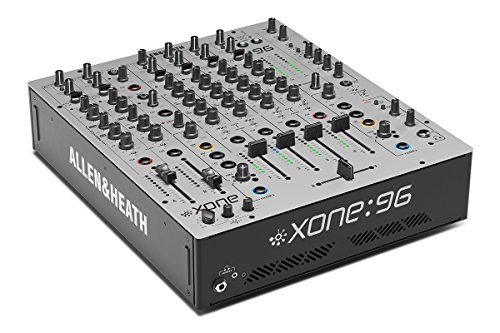
Allen & Heath XONE:96 — Best Analogue Flagship
If Pioneer’s story is standardisation, Allen & Heath’s is sound. The XONE:96 is the flagship of the analogue line that converted a generation of techno and house DJs: six channels, the famous dual voltage-controlled filters, four-band EQ on the main channels, and — the modern masterstroke — two independent USB sound cards, so analogue soul coexists with digital sources and seamless changeovers. It is the connoisseur’s club mixer, and its reputation is earned nightly in the booths that specify it by name.
Strengths
- Analogue sound and dual VCF filters that define a whole school of mixing
- Dual USB sound cards: two laptops, DVS and changeovers inside an analogue flagship
- Six channels and four-band EQ give it unmatched control depth for long-form sets
Trade-offs
- No built-in beat effects of the Pioneer kind — its language is filters and EQ, deliberately
- A large, premium-priced instrument for serious booths and studios
- DJs raised on DJM effects must learn a different performance vocabulary
Key specs (verified): Professional 6-channel analogue DJ mixer, dual VCF filters, dual USB sound cards (per Amazon listing class)
The 96’s all-time claim rests on a fork in DJ history: while the mainstream standardised on digital effects mixers, the underground’s most respected rooms standardised on this family’s filters and EQ. Its mixes breathe differently — blends shaped by resonance and four-band control rather than by effects throws. DJs who play long, hypnotic sets describe it not as a mixer with a sound but as the sound itself, which is precisely the language of ‘ever’ lists.
It is also, quietly, one of the most future-proof mixers here: analogue channels for turntables, two digital interfaces for whatever laptops become, and send/return architecture for outboard effects. A buyer in 2026 is purchasing a machine with no obvious obsolescence path — the practical face of legendary status.
Best for: Techno, house and long-form DJs for whom analogue sound is the point / Not suited for: Effects-driven performers who compose with beat FX
Check on Amazon — check the current price on Amazon before you buy, and confirm the exact configuration in the listing title matches the model reviewed here.

RANE SEVENTY — Best Battle Mixer
RANE’s claim on history runs through the battle scene — its TTM mixers were the weapons of choice when turntablism became a sport — and the SEVENTY is that heritage in modern form. Three MAG FOUR contactless faders (crossfader and both channel faders) deliver the sharpest, most durable cutting feel in the business; Akai MPC pads put performance control on the mixer itself; and dual USB ports let two Serato laptops share the battle, changeover included.
Strengths
- MAG FOUR contactless faders: the benchmark scratch feel, engineered to outlast conventional faders
- MPC pads and internal FX put a full performance surface on the mixer
- Dual USB for two-laptop battles and seamless changeovers
Trade-offs
- A specialist’s instrument: mix-style DJs will not use half of what they paid for
- Serato-centred; rekordbox households should look to the DJM-S11
- Premium pricing in a two-channel format is entirely about fader and build quality
Key specs (verified): Two-channel DJ mixer for Serato DJ, Akai MPC performance pads, internal FX, three contactless MAG FOUR faders (per Amazon title)
Battle mixers are judged by a single component under a microscope: the crossfader, at the moment of a cut, ten thousand times a year. The SEVENTY’s contactless design removes the wear mechanism itself — there is nothing to bleed, crackle or die mid-routine — which is why it anchors modern battle rigs. Its all-time standing comes from completing RANE’s historical arc: the company that defined the battle mixer now defines its modern, software-integrated form.
Note the dual-USB detail for working DJs: back-to-back sets and crew battles stop requiring cable choreography. Legends are often single great ideas executed completely; the SEVENTY’s idea is that a battle mixer should never be the reason a routine fails, and it executes that idea at every component.
Best for: Scratch and battle DJs wanting the definitive modern weapon / Not suited for: Blend-focused mix DJs — the Xone and DJM picks serve that craft
Check on Amazon — check the current price on Amazon before you buy, and confirm the exact configuration in the listing title matches the model reviewed here.

Pioneer DJ DJM-S11 — Best Scratch Innovation
The DJM-S11 took the battle mixer into its software era without surrendering its soul: beneath the headline touchscreen sits a Magvel Pro crossfader and a chassis built for abuse, while the screen and its deck modes — four-deck control from two channels, smooth echo, touch-driven browsing — changed what a two-channel mixer can perform. It supports both Serato and rekordbox, a diplomatic achievement as significant as any feature on it.
Strengths
- Touchscreen workflows genuinely expand two-channel performance — not a gimmick
- Magvel Pro fader delivers flagship scratch feel
- Works with Serato DJ Pro and rekordbox — the only battle flagship fluent in both
Trade-offs
- Screen-centric control divides purists; the RANE is the analogue-feeling alternative
- Two channels remain two channels — the deck modes are clever, not literal
- Premium price for a format whose essence (the fader) is available cheaper in the S5
Key specs (verified): Professional scratch-style 2-channel DJ mixer for Serato DJ Pro or rekordbox, touchscreen, Magvel Pro fader (per listing class)
The S11’s historical claim is that it settled an argument: whether the battle mixer should absorb software performance or stay a pure hub. Its answer — absorb it, brilliantly, without touching the fader’s sanctity — became the template rivals now follow. Performance DJs who build routines around its modes are not using a mixer with extras; they are playing a different, larger instrument that happens to have two channels.
For the ‘ever’ file: the S11 is the mixer most likely to be cited in future lists from today’s era, because it marks the moment the battle mixer and the controller merged their ideas. Buying one now is buying the current chapter of the history this guide surveys.
Best for: Performance and scratch DJs who build routines around software features / Not suited for: Purists who want the mixer to stay a hub — choose the SEVENTY
Check on Amazon — check the current price on Amazon before you buy, and confirm the exact configuration in the listing title matches the model reviewed here.

Allen & Heath Xone:92 Mk2 — Best Enduring Club Classic
The original Xone:92, launched in the early 2000s, is one of the most influential mixers ever made — the machine that put resonant VCF filters at the centre of club mixing and became the specified choice of the techno world’s defining DJs. The Mk2 is that legend kept alive: the same four-channel analogue architecture, filters and four-band EQ, updated for continued production. Buying one is buying a documented piece of history that still works tonight.
Strengths
- The VCF filter sound that shaped a generation of club music, in current production
- Four-band EQ and analogue warmth that remain a benchmark for blend mixing
- A rider classic: engineers and DJs worldwide know it intimately
Trade-offs
- No USB sound cards or digital interfaces — it is proudly, purely analogue
- No beat effects; its language is filter, EQ and time
- Beside the 96 it is the classic rather than the flagship — fewer channels, single filter assign per side
Key specs (verified): Analogue 4-channel DJ mixer, VCF filters, four-band EQ (per Amazon title)
Longevity is the rarest credential in electronic music gear, and the 92’s two-decade production story — interrupted, demanded back, renewed as the Mk2 — is the strongest evidence on this page. Mixers do not get revived by nostalgia alone; they get revived because working DJs keep specifying them. For a buyer, the Mk2 offers something almost no other product can: a legend you can purchase new, with a warranty, that a thousand engineers can service and every techno DJ can play.
Its presence also disciplines the modern picks: any new mixer claiming ‘ever’ status must answer why it will still be specified in twenty years. The 92’s answer was sound quality and a single expressive idea — the filter — executed perfectly. Judge today’s flagships by whether they have an equivalent idea, and this list’s ordering will make sense.
Best for: DJs wanting a proven analogue legend, buyable new, for blend-driven music / Not suited for: Digital-source DJs needing built-in interfaces
Check on Amazon — check the current price on Amazon before you buy, and confirm the exact configuration in the listing title matches the model reviewed here.
Vestax PMC-05 Pro Series — The Turntablism Legend — no link
No all-time list is credible without the Vestax PMC-05 Pro. Through the 1990s and 2000s this compact two-channel mixer was the battle standard — the instrument under the hands of a generation of world-champion turntablists — because Vestax designed it backwards from the crossfader: cut, curve and durability first, everything else subordinate. When Vestax’s original company era ended, the 05 passed into legend, and clean examples are now hunted the way vintage guitars are hunted.
Strengths
- The defining battle mixer of the turntablism golden age — historical importance unmatched in its class
- Crossfader-first design that taught the industry what a scratch mixer is
- Compact, simple and repairable by any competent technician
Trade-offs
- Discontinued: available only used, at collector-influenced prices, with condition varying wildly
- No USB, no effects, no modern concessions — it is a pure analogue instrument of its era
- Faders and switches on survivors are decades old; budget for servicing in any purchase
Key specs (verified): Two-channel analogue battle mixer of the DMC era; specifications described qualitatively — verify the exact variant (Pro II/III/IV) and condition with the seller, as no current listing exists
Why include an unbuyable mixer in a buying guide? Because readers searching ‘best dj mixers ever’ deserve the true answer, clearly labelled, rather than a list quietly rewritten around what is in stock. The 05’s influence is measurable in every battle mixer in this guide — the SEVENTY’s fader obsession and the S11’s performance focus both descend from priorities Vestax set. If you hunt one, buy condition over variant: a serviced Pro III with a fresh fader is worth more than a tired example of any sub-model, and a technician’s inspection is part of the price of history.
The same unlinked logic covers its era’s other ghosts — the Technics SH-EX1200 and the great rotary club mixers — discussed in the guide below. This guide links only what Amazon listing data can confirm as a current listing; legends get their due in words, which is the honest currency for things money can no longer simply buy new.
Best for: Collectors and turntablism historians buying carefully on the used market / Not suited for: Anyone needing a warrantied, working-tonight mixer — choose the SEVENTY or S11
Unlinked pick: this model has no stable, listing-confirmed Amazon listing, so no purchase link is given. It stays in the shortlist because leaving it out would make the guide less honest, not more convenient.
Comparison Table
| Pick | Badge | Key spec | Best for |
|---|---|---|---|
| Pioneer DJ DJM-A9 — Check on Amazon | Best Overall — The Modern Standard | 4-ch club standard / dual USB | Clubs, venues and serious DJs buying the definitive modern standard |
| Allen & Heath XONE:96 — Check on Amazon | Best Analogue Flagship | 6-ch analogue / dual VCF / dual USB | Techno, house and long-form DJs for whom analogue sound is the point |
| RANE SEVENTY — Check on Amazon | Best Battle Mixer | 2-ch battle / MAG FOUR faders / MPC pads | Scratch and battle DJs wanting the definitive modern weapon |
| Pioneer DJ DJM-S11 — Check on Amazon | Best Scratch Innovation | 2-ch / touchscreen / Serato + rekordbox | Performance and scratch DJs who build routines around software features |
| Allen & Heath Xone:92 Mk2 — Check on Amazon | Best Enduring Club Classic | 4-ch analogue / VCF / 4-band EQ | DJs wanting a proven analogue legend, buyable new, for blend-driven music |
| Vestax PMC-05 Pro Series | The Turntablism Legend — no link | 2-ch analogue legend / used only | Collectors and turntablism historians buying carefully on the used market |
Why Did Rotary Mixers Come Back?
The rotary revival — modern makers building new Urei-inspired mixers, vintage Bozaks commanding serious money — puzzles DJs raised on crossfaders until they hear one in a listening bar or a audiophile club night. Rotaries trade the crossfader’s cuts for long, smooth, gain-riding blends and a famously open sound; for disco, soul, jazz-adjacent and deep house programmes, that trade is the music itself. They are absent from the picks only because their market is specialist and largely used or boutique — their influence on what ‘great’ means, however, is woven through this guide’s criteria.
If the rotary idea calls to you, the sensible path mirrors the Vestax advice: hear one first (listening bars exist for this), buy serviced from a specialist, and keep a conventional mixer for conventional work. Legends are additions to a musical life, rarely replacements for its tools.
The Mixer as an Instrument: What the Greats Understood
Read the histories closely and a pattern emerges that spec sheets never capture: every all-time mixer was designed around a gesture. The battle mixers around the cut — one hand movement, perfected. The rotaries around the ride — a slow, continuous gesture sustained for minutes. The DJM line around the throw — effects and faders as punctuation. The Xone family around the sweep — a filter turned like a key in a lock. The great designers were not assembling features; they were choreographing hands, and DJs recognised the choreography that matched their music the way dancers recognise a floor.
This is why the ‘ever’ question cannot be settled by comparison tables, and why this guide’s how-to ends with five uninterrupted minutes of mixing. A mixer’s greatness is a relationship between its central gesture and a genre’s grammar. The practical advice hidden inside the history is therefore simple: identify your music’s central gesture — cut, ride, throw or sweep — and buy the lineage that was built around it. You will not merely own a great mixer; you will own your kind of great, which is the only kind that matters at 2 a.m.
What Will the Next Generation Call Legendary?
Prediction is a mug’s game, but the criteria in this guide make the likely candidates visible. The S11 has the strongest claim from the current era: it redrew its category’s boundaries, it is specified by the performers who define its culture, and its central idea — the mixer as software’s performance surface — is the idea the whole industry is now pursuing. The DJM-A9’s claim is different: not innovation but culmination, the most-refined form of the most-played line in history, and culminations age well in every art form’s history.
The honest uncertainty is whether the standalone era produces a mixer-shaped legend at all, or whether the category itself dissolves into systems whose ‘mixer’ is a screen and a surface. If it does, future lists will read like this one does about the Vestax — with respect, with prose, and with the rueful note that the great ones are no longer sold. Buy the current greats while they are simply products; history suggests that is a temporary condition.
The Supporting Cast: Greats That Nearly Made the Six
Honesty requires acknowledging the bench. The DJM-900NXS2 — the A9’s predecessor — mixed more headline sets than perhaps any single model and remains a superb used buy; it misses the picks only because its successor is buyable new. The RANE MP2015 rotary and the boutique rotary revival (Mastersounds, Isonoe and their peers) carry the Urei/Bozak flame magnificently, in a specialist market this guide treats in prose by design. Ecler’s NUO and HAK lines, Denon’s battle-era machines, and the mighty Technics SH-EX1200 each hold a chapter of the story told in the guide sections.
Their collective absence from the linked picks is not a ranking insult but a category rule: this guide links current, verifiable listings and honours the rest in words. If your own all-time six differs — and any DJ with a decade in should argue — it will differ at the margins of taste between schools, which is exactly where the argument belongs. The centre holds: standard, analogue flagship, battle reference, innovator, enduring classic, and the unlinked ghost that taught them all what a crossfader is for.
How to Use an All-Time List Without Becoming a Museum
The risk of a list like this is reverence curdling into paralysis: the sense that today’s tools are unworthy, or that the correct mixer is always the one no longer sold. Resist it with the guide’s own evidence — five of the six picks are current products, several are the finest their makers have ever produced, and the working DJs defining this era play them without a trace of apology. History’s role is calibration, not confiscation: it tells you what greatness has looked like so you can recognise its current forms, several of which are sitting in this guide with links attached.
Use the legends the way musicians use records: as education and as compass. Hear a rotary once. Cut on a battle flagship once. Sweep a Xone filter across a long blend and understand, physically, why a generation organised its taste around that gesture. Then buy the modern instrument that serves your music, maintain it like the classics were maintained, and play it long enough that it becomes someone else’s reference point. That is how the list renews itself — and it is the only fitting way to honour it.
Before You Order: The Legend Checklist
For the buyable greats, the checklist is short because the products are proven: school chosen (standard, analogue, battle, performance), sources funded alongside the mixer, and hands — ideally — laid on the faders before the card comes out. For the unlinked legends, the checklist lengthens by design: condition inspected in person, fader and pots tested through full travel, service history documented, a technician’s estimate added to the price, and the total compared honestly against the modern equivalent’s new price. If the legend still wins after that arithmetic, buy it with a clear conscience and a service booked. Greatness, properly purchased, should arrive working — and stay that way.
What Makes a DJ Mixer an All-Time Great?
Three tests, applied throughout this guide. Influence: did the mixer change the practice of DJing — the DJM line’s effects language, the Xone family’s filters, the battle mixer’s fader-first design all pass. Longevity: did it survive the booth — years of heat, drinks, transport and fashion, still specified, still working. Feel: the unquantifiable test every DJ applies in the first thirty seconds, hands on faders, that decides whether a mixer is an instrument or an appliance. Products that pass all three are vanishingly rare, which is why an honest ‘ever’ list is short and why this one defends each entry at length.
Notice what is absent from the tests: features per pound, screen size, novelty. The all-time greats were often conservative machines — the 92 has no USB at all — whose single expressive idea was executed completely. That pattern is the most useful thing a modern buyer can take from history: buy the mixer whose central idea matches your music, executed by a maker who has proven they support it for decades.
The Legends You Can Only Buy Used: A Field Guide
Beyond the unlinked Vestax, the used pantheon includes the Technics SH-EX1200 (the DMC competition’s official mixer for years), RANE’s TTM 56/57 (the battle standard that bridged into the Serato era), Ecler’s HAK series, and the rotary royalty — Urei 1620 and Bozak CMA-10 — whose smooth, isolator-free blending defined the disco and garage sound and now anchors a devoted rotary revival. None are linked here, because none have stable, API-confirmable new listings; all are buyable from specialists with patience.
Buying used legends safely is a discipline: insist on a fader test across its full travel (crackle at the cut point is the classic tell), check every switch and pot for noise, ask about service history and capacitor work on older units, and price in a technician’s service as part of the purchase — not as a surprise. Bought that way, a legend is a working instrument with a past; bought carelessly, it is an ornament with a famous badge.
Should You Buy a Legend or a Modern Flagship?
For a working booth, the modern flagships win on evidence: warranty, parts, dual USB changeovers, software fluency, and sound quality that history’s heroes would envy. The A9, 96, SEVENTY and S11 in this guide are not consolations for missing the golden age — by most technical measures they are the golden age, arriving now. Buy them to work.
Buy the legend for the reasons legends are bought: the specific feel no modern maker reproduces, the historical connection, the joy of the object. Those are legitimate reasons — music runs on them — provided the purchase is made with open eyes about condition and service. The mistake is only ever confusion: paying legend money for a tired unit to do a working job a modern pick would do better, cheaper and under warranty.
How to Test a DJ Mixer Before You Buy — New or Legendary
Whether the candidate is a new flagship or a used legend, the same hands-on test separates instruments from appliances. Run it in a shop, at a hire company, or during a seller’s demonstration — fifteen minutes, in this order.
- Faders first: move the crossfader slowly through the cut point listening for crackle or dropouts, then work it fast. On a battle mixer this single test is half the verdict; on any mixer, a tired fader announces a tired life.
- Every pot, full travel, one at a time — EQ, gains, filters — listening for scratchiness and checking that centre detents (where fitted) land where the knob points.
- Every input and output: bring a known track and a known cable, and prove each channel, the headphone cue in all its modes, and both master outputs before money moves.
- The signature control: on a Xone, sweep the filter; on a DJM, throw the colour FX; on a RANE, cut. The feature the mixer is famous for is the one that must feel perfect to your hands — it is what you are actually buying.
- On used legends, add the service questions: fader replacements, capacitor work, any dead segments or switches — and get the answers in the context of a technician’s likely bill, added honestly to the price.
- Finally, mix for five uninterrupted minutes. Meters, layout, reach, resistance — the instrument either disappears under your hands or it does not. Trust that reading above every specification, including the ones in this guide.
That last step is why this guide’s ‘ever’ criteria end with feel. Specifications can be compared from a desk; greatness is a property hands discover. Shortlist from these pages, then let your hands vote.
Common Buying Mistakes
Rewriting history around what’s in stock. Lists that omit the Vestax era to keep every entry shoppable are marketing, not history. Demand the honest version — like the unlinked pick here.
Paying collector prices for tired legends. Condition is the product on the used market. A serviced lesser variant beats a worn flagship variant every time.
Assuming newer means greater. The Xone:92’s revival and the rotary renaissance exist because feel and sound outlive feature cycles. Judge by the three tests, not the launch date.
Buying a specialist legend for general work. A battle icon will not serve a blend DJ, nor a rotary a scratcher. Match the legend’s idea to your music.
Skipping the service budget. Every used legend needs a technician eventually; most need one immediately. Price it in or buy new.
Final Recommendation
If the question is which mixer to buy today at the summit of the craft, the answer splits by school: the Pioneer DJM-A9 for the definitive modern club standard, the Allen & Heath XONE:96 for analogue sound at its peak, the RANE SEVENTY for battle, and the DJM-S11 for software-era performance. The Xone:92 Mk2 stands as the classic still in production — history you can buy with a warranty.
And the Vestax PMC-05 Pro stands in prose, where discontinued legends belong: honoured, explained, and unlinked, because this guide does not attach commerce to what it cannot verify. That discipline — links only where Amazon listing data confirms a current listing — is what lets you trust the five picks you can buy. Check their prices on Amazon, confirm the models in the titles, and then go and put your hands on them. Greatness, in mixers, is a physical fact.
Shortlist again, for convenience: Pioneer DJ DJM-A9 — Check on Amazon; Allen & Heath XONE:96 — Check on Amazon; RANE SEVENTY — Check on Amazon.
Related reading on this site: Best Dj Mixers Of All Time; Best Dj Controllers And Mixers; Best Dj Mixers For Beginners; Best Dj Mixers For Scratching; Best Dj Mixers For Vinyl.
Frequently Asked Questions
What is the most used DJ mixer of all time?
By performances played, the Pioneer DJM family — and within it the DJM-900 series that preceded the A9 — has mixed more professional sets than any other line. Its combination of installed presence, rider specification and longevity is unmatched. The A9 pick in this guide is that lineage’s current form, which is why a brand-new mixer legitimately tops an all-time list.
Why is the Vestax PMC-05 not linked for purchase?
Because it is discontinued and has no current Amazon listing Amazon listing data can confirm — searches return accessories such as power adapters, not the mixer. Attaching a link anyway would send readers to the wrong product. It is covered as a pick without a link with used-buying guidance, and the same rule applies to every legend in this guide: verified listings get links, history gets honesty.
Are rotary mixers really better, or just fashionable?
They are different, in a way specific music rewards: rotary mixers blend with smooth gain rides and no crossfader, suiting long, tonal mixing in disco, deep house and listening-bar contexts, with a sound many describe as more open. For cuts, quick mixes and effects performance they are the wrong tool. ‘Better’ in mixers is always ‘better for a kind of playing’ — the rotary revival is real because the playing it serves is real.
Is a twenty-year-old mixer design still worth buying new, like the Xone:92 Mk2?
Yes, when the design’s idea remains unmatched — the 92’s filter-centred analogue mixing is exactly such a case, and continued professional demand is why it returned to production. Age in a design is a liability for software-dependent products and nearly irrelevant for analogue instruments whose parts and service are available. The Mk2’s warranty and fresh components remove the used-market risks while keeping the legend.
Which all-time mixer should a beginner aspire to, not buy?
Aspire to the one matching your school’s destination: club DJs to the DJM-A9, blend and techno DJs to the Xone family, battlers to the RANE. Then buy the honest stepping stone — this site’s beginner and intro guides exist for that purchase — and let the flagship be the reward your skill grows into. Buying the legend first mostly teaches you how expensive your mistakes can be.
Do modern mixers sound better than the legends?
By measurement, generally yes: modern conversion, headroom and noise performance exceed what the classics offered. By feel and by specific beloved characteristics — a filter’s resonance, a fader’s cut, an analogue stage’s behaviour at the edge — the legends retain genuine, audible identities that measurements summarise poorly. That is why both kinds appear in this guide, and why the final test in the how-to section is five minutes with your own hands.
What DJ mixer do most professional clubs install?
The Pioneer DJM line — currently the DJM-A9, previously the DJM-900 series — is the installed standard in the majority of professional booths worldwide, with Allen & Heath Xone mixers specified in a significant minority of rooms, particularly in techno-focused venues. That is why both families anchor this guide: ‘ever’ status in DJ mixers is substantially the story of those two houses and the battle specialists around them.


