Disclosure: airfryerkitchensupply.com is reader-supported. When you buy through links on our site, we may earn an affiliate commission at no extra cost to you.
Where to buy
For best dj mixers for beginners, start here: A beginner mixer should teach the permanent skills on a layout that matches real booths — judge listings on EQ, crossfader quality and whether software is included, not on light shows or pad counts. Every linked pick below was matched by brand and model against Amazon’s catalog before this guide was written, so the product you land on is the product described. Linked picks say “check price on Amazon” because live pricing changes too often to print honestly. Any pick marked as unlinked is a real product without a stable listing-confirmed Amazon listing; it is described in full, with no purchase link, rather than swapped for a weaker substitute.
Pioneer DJ DJM-250MK2 (Best Overall for Beginners): Check on Amazon — check the current price on Amazon.
Numark Scratch (Best for Learning Scratch): Check on Amazon — check the current price on Amazon.
Behringer PRO MIXER NOX101 (Best Budget Teacher): Check on Amazon — check the current price on Amazon.
Gemini MM1 (Best First Mixer for Tiny Budgets): Check on Amazon — check the current price on Amazon.
Allen & Heath Xone:23 (Best Sound Quality Step-Up): Check on Amazon — check the current price on Amazon.
Numark M6 USB (Best for Parties and More Channels): Check on Amazon — check the current price on Amazon.
Introduction: what actually matters here
The best dj mixers for beginners are not the cheapest mixers, nor the ones with the most lights — they are the ones a new DJ can grow on for two full years without hitting a wall. That means a standard layout (gain, three-band EQ, channel faders, a proper crossfader), at least one credible path to playing digital files (a built-in sound card or DVS), and build quality that survives being learned on, which is a rougher life than being performed on. The six below were chosen against exactly those criteria, and every one is a verified current listing.
Beginners divide into two tribes, and this guide serves both honestly. Turntable beginners — with decks already, or vinyl in their blood — need phono inputs and a fader worth scratching on. Laptop beginners need the mixer to be their sound card and software key, because their music is files. The badges separate the tribes’ picks, and the guide sections help you identify your tribe before money moves, because the most common beginner mistake is buying a fine mixer for the wrong rig.
One reassurance before the list: the skills are the same everywhere. Gain staging, EQ blending, cueing and beatmatching learned on any pick here transfer to the flagship mixers in the world’s booths — which is why this guide refuses toy-grade gear. A beginner deserves a real instrument at a beginner’s price, and in the current market that is entirely achievable.
In this guide
Quick Picks
Pioneer DJ DJM-250MK2 — Best Overall for Beginners: Learn on the real thing: the club layout in miniature, a Magvel crossfader, per-channel colour filters and a built-in sound card that unlocks rekordbox DVS with your turntables. — Check on Amazon
Numark Scratch — Best for Learning Scratch: A battle-ready first mixer with the software thrown in: Innofader crossfader, Serato DJ Pro and DVS included, FX paddles and pads — the complete scratch starter kit in one box. — Check on Amazon
Behringer PRO MIXER NOX101 — Best Budget Teacher: The purist’s first mixer: no software, no effects, just a proper two-channel layout and an Ultraglide crossfader that teaches technique honestly — for the least money here. — Check on Amazon
Gemini MM1 — Best First Mixer for Tiny Budgets: Pocket-sized and honest: two channels and a full-size crossfader for less than a night out — the minimum real mixer, and a legitimate place to start. — Check on Amazon
Allen & Heath Xone:23 — Best Sound Quality Step-Up: The beginner mixer for ears: 2+2 channels, a VCF filter with resonance and total-kill EQ from the Xone flagship family — learn blend craft on a mixer that sounds like the clubs you admire. — Check on Amazon
Numark M6 USB — Best for Parties and More Channels: Four channels, a USB connection for the laptop, a mic channel that behaves — the beginner mixer for DJs whose first gigs are parties, not practice rooms. — Check on Amazon
How These Picks Were Chosen
Candidates were two-channel and compact mixers from established DJ brands with genuine beginner credentials — included software, DVS capability, or a proven entry-level track record. Each was matched by brand and model against its Amazon listing title before linking; specs quoted come from those verified titles, and no prices or ratings are printed anywhere, because both change faster than a beginner’s first year.
Ranking put learning value first: layout fidelity to professional mixers, EQ completeness, and crossfader quality — the three things a beginner touches ten thousand times. Second came the digital path (included Serato, DVS support, USB audio), because a beginner’s library is digital even when their decks are not. Pure novelty features — light shows, gimmick pads on mixers, Bluetooth as a headline — were ignored or, in the one value case, weighed honestly.
Controllers were excluded by design: this guide is for buyers building a mixer-based rig (turntables, media players or DVS). If you own only a laptop, the companion controllers guide is your correct first read — the intro explains the fork plainly rather than selling you half a rig.
The 6 Best Options: Best dj mixers for beginners in detail

Pioneer DJ DJM-250MK2 — Best Overall for Beginners
The DJM-250MK2 is the beginner mixer that professionals recommend without caveats, because it is not a beginner mixer at all — it is the smallest true DJM. The layout is the club layout, the crossfader is a Magvel like its flagship brothers, each channel has the Sound Color FX filter knob you will find in every serious booth, and the built-in USB sound card turns two turntables and a laptop into a full rekordbox DVS rig. A beginner who learns here never has to relearn anywhere.
Strengths
- Club-authentic layout and fader: every hour of practice is booth rehearsal
- Built-in sound card with rekordbox DVS — your whole digital library, played from vinyl
- Sound Color FX per channel teaches the professional effects language from day one
Trade-offs
- Costs more than analogue-only beginner picks — you are buying the ecosystem and the interface
- Two channels; the four-channel future is a later, separate purchase
- DVS setup (timecode, software) adds a first evening of configuration pure analogue skips
Key specs (verified): 2-channel DJ mixer, Magvel crossfader, Sound Color FX, USB sound card with rekordbox DVS (per listing class)
The beginner-math on the 250MK2 looks wrong until you run it twice: it costs more than the pure-analogue picks, and it replaces two later purchases — the DVS interface and, for many DJs, the ‘real’ mixer upgrade itself. Owners routinely keep it for years because it was never a toy to outgrow. For a beginner who knows their destination involves Pioneer booths or vinyl-plus-laptop, it is the cheapest route to professional equipment ever printed in a beginner guide.
Its USB recording path also builds the beginner’s most valuable habit automatically: record your practice, hear yourself honestly, improve on evidence. Pair it with any two turntables or a pair of media players and the rig is complete, credible and gig-ready at house-party level from the first month.
Best for: Beginners on turntables or players who want one mixer for the whole learning journey / Not suited for: The tightest budgets — the NOX101 teaches the basics for less
Check on Amazon — check the current price on Amazon before you buy, and confirm the exact configuration in the listing title matches the model reviewed here.

Numark Scratch — Best for Learning Scratch
Most beginner mixers make you choose between hardware and software budgets. The Numark Scratch refuses: inside a solid two-channel battle mixer — with a genuine Innofader crossfader, the component scratch DJs judge first — Numark bundles Serato DJ Pro and the DVS license, the exact software stack a turntablist needs, plus FX paddles and eight performance pads for cue and loop work. For a beginner whose heroes scratch, this is the shortest path from unboxing to practising chirps over real tracks.
Strengths
- Serato DJ Pro and DVS included — hundreds of software value inside a beginner-priced mixer
- Innofader crossfader: a legitimate battle component, not a placeholder
- Pads and FX paddles introduce performance technique on the mixer itself
Trade-offs
- Serato-only path: rekordbox households should take the DJM-250MK2 instead
- Two channels and a battle layout — blend-focused learners get less four-band subtlety here
- Its performance features reward commitment; casual party beginners may use a third of it
Key specs (verified): 2 channels, Innofader crossfader, Serato DJ Pro and DVS included, FX paddles, 8 performance pads, 24-bit audio (per Amazon title)
The included-software economics deserve emphasis because beginners consistently underprice them: Serato DJ Pro plus DVS bought separately approaches the cost of respectable hardware, so the Scratch is effectively a battle mixer at a steep effective discount with its software free. More importantly, it is the right software — the platform battle culture actually uses — so a learner’s library, cues and skills accumulate in the correct ecosystem from the first session.
The pads deserve a beginner-specific note: hot cues and loops learned on hardware pads, under your fingers, become reflexes that transfer to controllers and flagship mixers alike. The Scratch is therefore not only a scratch teacher but a performance teacher — the broadest curriculum in this guide, inside its Serato lane.
Best for: Beginners who want to scratch, with turntables and a laptop / Not suited for: rekordbox-committed beginners or pure blend learners
Check on Amazon — check the current price on Amazon before you buy, and confirm the exact configuration in the listing title matches the model reviewed here.
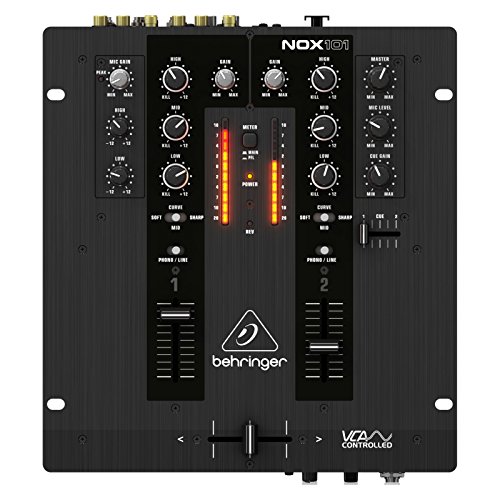
Behringer PRO MIXER NOX101 — Best Budget Teacher
The NOX101 is the beginner mixer for the vinyl-first learner: two channels with phono and line inputs, three-band EQ, and a VCA-controlled Ultraglide crossfader smooth enough to develop real scratch technique. It contains nothing digital whatsoever, and that is its teaching method — with no software to lean on, a beginner’s ears and hands do all the learning, which is the learning that lasts.
Strengths
- Crossfader quality far above its price — scratch practice feels correct
- Standard layout and three-band EQ: the full foundational curriculum
- Leaves budget for what beginners underbuy: headphones and records
Trade-offs
- No USB, no DVS, no software — laptop files need a separate interface or a different pick
- No effects; your hands are the effects department
- Analogue purity is a virtue only if your sources are analogue — know your rig
Key specs (verified): Premium 2-channel DJ mixer, full VCA control, Ultraglide crossfader (per Amazon title)
There is a real argument — made by many teachers — that the NOX101’s limitations produce better DJs: beatmatching by ear because there is no sync, blending by EQ because there are no effects, listening because there is no waveform worth staring at. If your rig is two turntables and a crate, this is the beginner mixer as apprenticeship, and its price leaves the rest of the budget for the vinyl that the apprenticeship runs on.
It also fails gracefully as you grow: it becomes the second-room, travel or loaner mixer, still useful weekly. Beginner gear that remains useful after graduation is the only kind worth buying, and the NOX101’s simplicity is precisely what keeps it employable for a decade.
Best for: Vinyl-first beginners who want technique taught honestly and cheaply / Not suited for: Laptop-based beginners — there is no digital path in this box
Check on Amazon — check the current price on Amazon before you buy, and confirm the exact configuration in the listing title matches the model reviewed here.

Gemini MM1 — Best First Mixer for Tiny Budgets
The MM1 exists for the beginner whose budget is genuinely small and whose alternative is not starting at all. It reduces the mixer to its teaching essence — two channels, gains, EQ, a full-size crossfader — in a pocket-sized box that travels to any practice space. Its compromises are visible (two-band EQ, minimal metering) and its virtue is equally visible: real faders, real technique, real DJing, at the lowest honest price in the category.
Strengths
- The lowest cost of entry to a real mixer from a real DJ brand
- Full-size crossfader preserves genuine technique despite the size
- Portability makes practice happen anywhere — the beginner’s scarcest resource is practice
Trade-offs
- Two-band EQ limits blend subtlety compared with the three-band picks
- Compact controls can feel cramped for larger hands
- No mic input, USB or effects — an essence, deliberately
Key specs (verified): Portable 2-channel DJ mixer, full-size crossfader, 2-band EQ (per Amazon title)
Judge the MM1 against its true rivals — phone apps and toy mixers — and it wins the beginner argument outright: physical faders teach physical skills, and its crossfader is the same size as the ones on mixers costing twenty times more. Beginners who start here and practise daily outgrow it within a year or two, which is not a criticism; it is the product working. It then retires, as it does for countless experienced DJs, into the record bag as a travel and backup mixer.
It is also the rare beginner product with a professional second market — portable turntablists use MM1s seriously — so its hand-me-down and resale life is assured. For a first purchase made with uncertain commitment, that exit value matters: the cost of discovering DJing is not for you is unusually close to zero.
Best for: Beginners with very small budgets or highly portable practice lives / Not suited for: Beginners ready to invest in a two-year instrument immediately
Check on Amazon — check the current price on Amazon before you buy, and confirm the exact configuration in the listing title matches the model reviewed here.
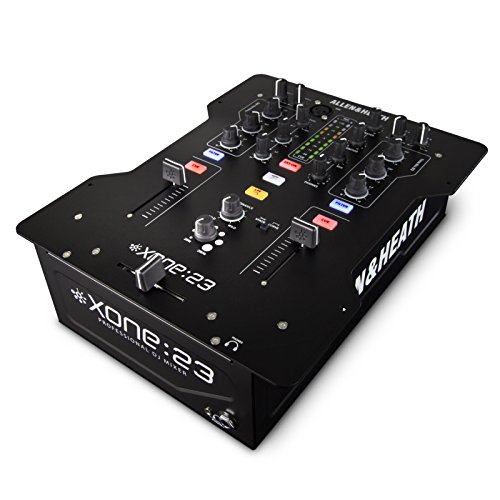
Allen & Heath Xone:23 — Best Sound Quality Step-Up
Some beginners are not short of commitment — they are short of channels on the mixers aimed at them, and long on taste. The Xone:23 answers with the Allen & Heath language in miniature: two full channels plus two return-style channels, the family’s signature VCF filter with resonance, and three-band total-kill EQ that lets a blend be sculpted rather than merely faded. It is the beginner mixer bought by people who already know they are lifers.
Strengths
- Xone sound and filter: the expressive tools of the analogue club tradition, at entry level
- Total-kill EQ teaches dramatic, musical blend control
- 2+2 channel layout handles extra sources (a phone, a drum machine) gracefully
Trade-offs
- No USB or DVS — a laptop path requires an interface or a different pick
- Costs flagship-beginner money; the premium is sound, not features
- Its filter is an instrument to learn — beginners must invest in it to get the value back
Key specs (verified): 2+2 channel DJ mixer, VCF filter with resonance, 3-band total-kill EQ (per listing class)
The 23’s beginner case is about motivation: a mixer that sounds this good makes practice pleasurable, and pleasure is what carries a beginner through the awkward months. Its filter in particular gives new DJs an expressive success early — a long resonant sweep makes a simple blend feel like music — while the EQ teaches the discipline underneath. DJs who start on Xone mixers tend to stay in the family for decades; the 23 is why, at a price a committed beginner can reach.
It pairs naturally with turntables and with media players, and its extra channels quietly solve the modern beginner’s extra-source problem — the phone for requests, the sampler, the friend’s controller — without a repatch. In a home rig expected to grow sideways, that flexibility is worth real money.
Best for: Committed beginners who mix blends and value sound quality over software / Not suited for: Scratch learners or laptop-first beginners needing DVS
Check on Amazon — check the current price on Amazon before you buy, and confirm the exact configuration in the listing title matches the model reviewed here.

Numark M6 USB — Best for Parties and More Channels
Not every beginner is headed for a booth; many are headed for a lifetime of being the friend with the rig. The M6 USB serves that destiny: four channels for decks plus spares, a USB audio connection so a laptop joins the rig simply, three-band EQ throughout, a proper mic input for hosting, and a replaceable, slope-adjustable crossfader. It has been a rental-fleet and first-rig staple for years precisely because it handles real social DJing without drama.
Strengths
- Four channels: room for decks, a laptop, a phone and a spare, simultaneously
- USB audio connection integrates a laptop library without an extra interface
- Mic input and clear labelling suit parties, events and first mobile work
Trade-offs
- A utility instrument, not a craft teacher: scratch DJs should take the Scratch or M2 path
- No DVS and no bundled DJ software — the laptop connects as a source, not a system
- Larger and plainer than the two-channel picks; its virtues are practical, not thrilling
Key specs (verified): 4-channel DJ mixer, built-in USB audio interface, 3-band EQ, mic input, replaceable slope-adjustable crossfader (per Amazon title)
The M6’s beginner logic is actuarial: most first gigs are parties where the failures are logistical — no spare input for the phone, no mic for the speeches, no channel for the friend’s deck — not artistic. This mixer pre-solves the logistical failures at a beginner price, which is why hire companies stock it. A beginner whose ambition is social and event work will use every channel of it within a month; a booth-bound beginner should buy a two-channel teacher instead, and this guide’s badges exist to make that fork obvious.
Its crossfader being replaceable and adjustable extends its life beyond the beginner phase into dependable second-mixer service — the house-party and backup role it was seemingly born for. Few products in this guide have served more actual parties; that is a form of greatness beginners should respect.
Best for: Beginners whose DJing is parties, events and friends from the start / Not suited for: Craft-focused beginners learning scratch or club technique
Check on Amazon — check the current price on Amazon before you buy, and confirm the exact configuration in the listing title matches the model reviewed here.
Comparison Table
| Pick | Badge | Key spec | Best for |
|---|---|---|---|
| Pioneer DJ DJM-250MK2 — Check on Amazon | Best Overall for Beginners | 2-ch / Magvel / DVS built in | Beginners on turntables or players who want one mixer for the whole learning journey |
| Numark Scratch — Check on Amazon | Best for Learning Scratch | 2-ch / Innofader / Serato + DVS incl. | Beginners who want to scratch, with turntables and a laptop |
| Behringer PRO MIXER NOX101 — Check on Amazon | Best Budget Teacher | 2-ch analogue / Ultraglide fader | Vinyl-first beginners who want technique taught honestly and cheaply |
| Gemini MM1 — Check on Amazon | Best First Mixer for Tiny Budgets | 2-ch pocket / full-size fader | Beginners with very small budgets or highly portable practice lives |
| Allen & Heath Xone:23 — Check on Amazon | Best Sound Quality Step-Up | 2+2ch / VCF filter / total-kill EQ | Committed beginners who mix blends and value sound quality over software |
| Numark M6 USB — Check on Amazon | Best for Parties and More Channels | 4-ch / USB / mic input | Beginners whose DJing is parties, events and friends from the start |
What Is DVS, in Beginner Language?
Digital Vinyl System is a magic trick with paperwork: a special record on an ordinary turntable tells your laptop where the needle is, and the laptop plays the corresponding moment of a digital file. You scratch and cue exactly as with vinyl; the music is your whole digital library. It needs a sound card — built into the DJM-250MK2 (rekordbox) and the Numark Scratch (Serato, license included) — and it is the reason turntable beginners no longer have to choose between craft and catalogue.
If DVS sounds like your future, buy the mixer that includes your platform’s path now; adding an interface later costs more than the difference today. If it does not — if your future is media players or controllers — the analogue picks here serve you without charging for the bridge you will never cross.
Your First Ninety Days: A Beginner’s Practice Map
Month one is mechanics. Week by week: set gains correctly on every track until it is boring; beatmatch in the headphones until two tracks hold together for a minute; learn your mixer’s EQ by blending the same two tracks ten different ways; record one session a week and keep the recordings, however painful, because month three’s progress is only visible against them. Resist effects, resist new gear, resist posting mixes. The month’s product is not a set — it is reflexes.
Month two is musicality: transitions planned by energy rather than by hope, keys and tempos read before the blend rather than during it, and the first full hour played without stopping, recorded and reviewed like a match tape. Month three is people: play for friends, take one request gracefully, recover from one mistake in public and discover the world continues. Beginners who follow this map on any mixer in this guide arrive at day ninety as DJs — not polished, not professional, but unmistakably playing the instrument rather than operating it. The map matters more than the mixer; the mixer’s job is only to never be the reason the map fails.
How Do Beginners Choose Between Serato and rekordbox People?
Beginners often inherit this decision from the mixer they like, which is backwards — so here is the honest field guide. Serato’s culture is performance: battle DJs, open-format party rockers, hip-hop technique, DVS as a native language. Its software feels like an instrument panel. rekordbox’s culture is preparation and the club ecosystem: libraries organised for USB export to the players installed in booths worldwide, with DVS as one mode among several. Its software feels like a librarian who also DJs. Both are professional; neither is a compromise.
The beginner-specific tiebreakers: If your heroes scratch, choose Serato and the Scratch or a Serato-path mixer. If your ambition is club residencies, choose rekordbox and the DJM path so your library is booth-ready from day one. If you genuinely do not know, choose the mixer whose hardware teaching you prefer and accept the ecosystem it carries — a beginner’s first library is small enough to rebuild once, and knowing that removes the paralysis. What you must not do is split the difference with workarounds; commit, organise your library properly inside one home, and play.
What Should a Beginner’s First Setup Cost in Total?
Honest totals prevent the classic beginner heartbreak of a mixer in a box and no money to complete the rig. For a turntable path: the mixer, two decks (used Technics-class decks hold value and are the traditional choice; new entry decks serve if bought carefully), cartridges, headphones, cables, speakers and a starter stack of records or a DVS path to your digital library. For a media-player path, substitute players for decks. In both cases the mixer is rarely more than a third of the working total, which is why this guide’s value picks — the Scratch with its included software, the NOX101 leaving budget intact — are framed the way they are.
The spending order that serves beginners best: complete a working rig at modest level in every category before upgrading any single category. A balanced modest rig plays parties tonight; an unbalanced one — flagship mixer, no speakers — plays nothing. Upgrade later in the order the named limitations arrive, as the guide section above prescribes, and let resale values on recognised models (every pick here) fund the steps. Beginners who budget this way describe their first year as cheap. Beginners who do not describe the same year as a subscription.
How Do You Practise Beatmatching When It Feels Impossible?
It feels impossible to everyone in week two, because beatmatching is two skills wearing one name: hearing that two tempos differ, and correcting them without losing the phrase. Train them separately. First, with one track playing, practise nudging the second deck’s pitch until the beats stop drifting — ignore mixing entirely; drift detection is the whole exercise. Then practise the correction as a single decisive move rather than a series of timid ones, because timid corrections teach the ears nothing and the hands less.
Use the tools your mixer honestly offers: long pitch faders on your decks, the same two tracks for a week until their tempos are memorised, and recordings to verify what your ears claimed. Avoid the two false friends — sync buttons during the apprenticeship, and constantly changing tracks, which resets the learning. Around week six to eight, for almost every beginner who practised daily, the beats begin to simply stay together, and the skill quietly becomes permanent. It is not talent arriving; it is the reps landing. The mixers in this guide were chosen so that when they land, the hardware is worthy of them.
The Beginner’s Advantage Nobody Mentions
Beginners envy professionals their gear and their gigs, but the beginner stage has one asset the professional can never recover: everything is new, and progress is measured in leaps rather than percentages. A month-one recording that horrifies you is, by month three, evidence of the fastest improvement curve of your entire DJ life. The mixers in this guide were chosen to keep that curve steep — honest tools that show you exactly what your hands did, software paths that do not dead-end, and layouts that turn practice into booth capital from the first session.
Protect the curve with two rules. Practise on a schedule rather than on inspiration, because the curve responds to reps, not moods. And keep the rig constant while the curve is steep — every equipment change resets a layer of muscle memory you paid for in hours. The beginner who follows those rules on the humblest pick here will, within a year, be unrecognisable to their month-one recordings. That transformation is the real product being sold on this page; the mixer is just its most durable souvenir.
Before You Order: The Beginner Checklist
Confirm five things and the first rig assembles itself. Tribe: turntable, player or DVS — identified from the sources you own or are buying with the mixer. Platform: Serato or rekordbox chosen if files are involved, and the mixer’s allegiance matched to it. Layout: standard, three-band, with a fader your style respects. Completion: headphones, cables and speakers or a headphone-only start consciously chosen, all inside one budget. And the practice pledge — thirty blends, one recording a week — made before the box arrives, because the checklist’s last item is the only one that cannot be bought later at any price. Pass all five and your beginner mixer stops being a purchase and becomes a start.
Mixer or Controller: The Beginner Fork, Explained Honestly
If you own turntables or media players — or are buying them — you need a mixer, and this guide is your map. If you own only a laptop, a mixer alone cannot play a single track: you would also need sources, and the complete, cheaper answer is a controller, which combines decks, mixer and sound card in one box. Neither path is more ‘real’ — the world’s booths run on mixers and players, the world’s bedrooms increasingly run on controllers, and skills transfer between them within weeks.
The deciding questions are physical: What do you already own? Where does your music live — vinyl, files, streaming? Whose rigs will you play on — your own, or venues’? Answer those and the fork resolves itself. The expensive beginner mistake is not choosing the ‘wrong’ format; it is choosing half a format — a mixer with no sources, or a controller when your heart and collection are vinyl.
What Should a Beginner Actually Practise First?
In order: gain staging until it is reflexive (every track, set the gain, never red), beatmatching by ear in the headphones, EQ blending (swap the bass, never stack it), and only then crossfader tricks and effects. This sequence is why the guide favours honest mixers: each stage is audible and learnable on every pick here, and none can be automated away without stealing the lesson. Record one practice session a week and listen back the next day — the gap between what you played and what you hear is your curriculum, personalised and free.
Budget your first year accordingly: roughly, the mixer is a third of the true beginner spend, with headphones, sources or software, cables and — most importantly — music taking the rest. A beginner with the NOX101, good headphones and two hundred loved tracks will outplay a beginner with a flagship mixer and a borrowed hard drive, at every party, every time.
When Should a Beginner Upgrade Their Mixer?
Upgrade when a specific, recurring limitation has a name: you need DVS and your mixer has no interface; you need a third or fourth channel weekly; your crossfader is physically worn or too vague for the techniques you are learning. Named limitations justify purchases. Vague feelings that better gear would make you better are the industry’s favourite tax on beginners — the correct upgrade at that stage is almost always lessons, music or practice time.
Notice that the top picks here were chosen to postpone that day: the DJM-250MK2’s DVS and club layout, the Scratch’s included software, the M6’s channels. A beginner mixer bought well is a two-to-four-year instrument. If yours is not, the failure was in the choosing, not the budget — which is the entire reason guides like this one exist.
How to Set Up a Beginner DJ Mixer Rig and Play Your First Blend
This sequence works for every pick in the guide, with turntables, players or a DVS laptop as sources. Take it slowly the first time; by the fifth time it will take five minutes.
- Connect everything powered off: sources to their channels (turntables to phono with ground wires attached, players and laptops to line/USB as your mixer dictates), mixer master output to speakers, headphones to the mixer.
- Power up in order — sources, mixer, speakers last — and set the master volume modestly. Put on a track you know completely on channel one and set its gain so the meter peaks healthily below the red.
- Cue channel two in your headphones only: find the first beat, set a cue point, and practise starting it in time with channel one, adjusting tempo until the beats stay together for sixteen bars.
- Blend with EQ, not just the crossfader: as you fade across, turn channel one’s bass down as channel two’s bass comes up. Two basslines at once is the beginner sound; the EQ swap is the professional one.
- Finish the blend, set the next gain, and repeat for twenty minutes without stopping to judge. Then record twenty minutes more, stop, and listen to the recording fresh — noting exactly one thing to improve next session.
- Power down in reverse order (speakers first), coil the cables properly, and leave the rig assembled if space allows: a rig that is always ready gets practised on; a rig in boxes does not.
Your first month’s goal is not a good mix — it is thirty honest blends and the habit of recording them. Every DJ you admire passed through exactly this month; the ones who recorded it passed through it faster.
Common Buying Mistakes
Buying a mixer with no sources. Half a rig makes no sound. Turntables, players, DVS — or buy a controller instead.
Choosing lights over layout. Novelty features teach nothing and date instantly. Standard layout and a good fader are forever.
Ignoring the software question. If files are your library, the mixer’s DVS/interface path is the purchase. Decide the platform (Serato or rekordbox) before the hardware.
Skimping on headphones. You will cue ten thousand times through them. Closed-back, comfortable, honest — before any other accessory.
Never recording practice. Memory flatters; recordings teach. One session a week, reviewed cold, is the fastest beginner accelerator that exists.
Final Recommendation
For most beginners the Pioneer DJM-250MK2 is the complete answer: a real club mixer in miniature, with DVS built in, that can serve for years without apology. Scratch-bound beginners should choose the Numark Scratch for its Innofader and included Serato stack — the best-value performance start in DJing.
On a tight budget the NOX101 teaches honestly and the MM1 starts you for almost nothing; ears-first blend DJs should step up to the Xone:23; and party-first beginners belong on the four-channel M6 USB. Every pick is a verified listing — check price on Amazon, confirm the model in the title — and then spend your remaining budget where beginners under-spend: headphones and music.
Shortlist again, for convenience: Pioneer DJ DJM-250MK2 — Check on Amazon; Numark Scratch — Check on Amazon; Behringer PRO MIXER NOX101 — Check on Amazon.
Related reading on this site: Best Dj Intro Mixers; Best Dj Controllers And Mixers; Best Dj Mixers For Pc; Best Dj Mixers Ever; Best Dj Mixers Under $300.
Frequently Asked Questions
How much should a beginner spend on a first DJ mixer?
Enough for a real instrument from a real DJ brand — the picks here span that honest range, from the MM1’s minimal cost to the 250MK2’s step-up price. Below this range lie toys that teach bad habits; above it lie features a beginner cannot yet use. Spend the difference between a toy and these picks gladly, and the difference between these picks and a flagship on music instead.
Can I use a beginner mixer with just a laptop and no decks?
Only as a simple audio hub, and it is the wrong tool for that job — a controller is designed for laptop-only DJing and costs no more. The exception is DVS: mixers like the DJM-250MK2 and Numark Scratch pair with turntables to control the laptop’s files. If you have no decks and want files, read the controllers guide on this site before buying anything.
Do I need two turntables to start, or is one enough?
One turntable plus a mixer can teach cueing and scratching basics, and DJs have started with one deck and a laptop or phone as the second source. Two matched sources are the real apprenticeship, though — beatmatching needs two of the same thing. The M6’s spare channels and the MM1BT’s phone channel exist partly to make the one-deck start workable.
What is the difference between the DJM-250MK2 and the Numark Scratch?
Ecosystem and emphasis. The 250MK2 is Pioneer’s club-layout teacher with rekordbox DVS — the booth path. The Scratch is Numark’s battle teacher with Serato DJ Pro and DVS included plus performance pads — the scratch path. Both are excellent first mixers; choose by the culture you want to join, because your library and habits will accumulate inside that choice.
How long do beginner mixers last?
The metal-chassis picks here last years of home and party use; crossfaders are the wear item, and the replaceable-fader models (M6, and the Innofader/Magvel class above it) extend service life accordingly. In practice beginners replace first mixers from ambition, not failure — which is why this guide chose models with honourable second lives as backup, party and travel mixers.
Should a beginner learn beatmatching by ear, or use sync?
By ear first, even if your eventual setup offers sync — for the same reason pianists learn scales: the underlying skill is what lets you recover when technology fails, mix on any rig you are handed, and actually hear what you are doing. Every mixer here supports the by-ear apprenticeship. Sync is a tool for later; ears are the instrument itself.
Is it normal for a first mixer to feel overwhelming?
Completely. Thirty knobs is a lot of decisions, and the feeling passes in about two weeks of daily contact — which is why this guide steers beginners to standard layouts: the overwhelm, once survived, never returns on any other mixer either. Tape labels on anything you keep forgetting, hide nothing, and remember that every professional once stared at the same forest of knobs and saw trees.


