Disclosure: airfryerkitchensupply.com is reader-supported. When you buy through links on our site, we may earn an affiliate commission at no extra cost to you.
Where to buy
Every pick in this guide was verified against live Amazon listing data before inclusion. Use these links to check price on Amazon and confirm current availability for the best digital mixers for recording studio shortlist:
PreSonus StudioLive 32SX — check price on Amazon · Midas M32 Live — check price on Amazon · Behringer X32 — check price on Amazon · Allen & Heath QU-24C — check price on Amazon · Tascam Model 12 — check price on Amazon · PreSonus StudioLive 24R — check price on Amazon
Picking the best digital mixers for recording studio work is a different exercise from choosing a live desk: the studio cares about preamp quality, recall across sessions, DAW integration and monitor control, while channel counts can be smaller because overdubs replace full-band capture. The best digital mixers for recording studio setups act as the room’s centre — interface, monitor controller, talkback and summing point in one recallable unit.
The six below span that centre role at several levels: full consoles with networked expansion, premium flagships, and hybrid desks that record without a computer. Every pick was verified before inclusion. What unites them is that a studio can build real workflow around them — sessions recall, clients hear themselves properly, and the path from tracking to mixdown stays inside one coherent system.
A word about scope: this guide treats the mixer as the studio’s centre, not as an accessory to a computer. That is the architecture commercial rooms were built on and the one project studios increasingly return to, because a centre that recalls, monitors and records coherently removes more friction than any single plug-in or microphone adds quality. If your studio is purely in-the-box and happy, you do not need this page; if sessions involve other humans, you probably do.
In this guide
Quick Picks
- PreSonus StudioLive 32SX — Best Overall: For a recording studio it is the system choice: AVB expansion for the live room, Capture recording that just works, and Fat Channel flavours for tracking character. Check price on Amazon.
- Midas M32 Live — Best Premium: As the premium studio pick, its preamps and surface make it the desk clients recognise — tracking through it feels like a commercial room. Check price on Amazon.
- Behringer X32 — Best for Studio-Live Hybrids: For studios that also do live work, it is the flexible centre: huge routing, stage boxes for the live room, and a workflow every visiting engineer knows. Check price on Amazon.
- Allen & Heath QU-24C — Best Project Studio Console: For project studios needing a real console feel with generous I/O, it covers tracking a band and mixing on faders without flagship cost. Check price on Amazon.
- Tascam Model 12 — Best Compact Studio Desk: For songwriter studios it is the honest centre: twelve tracks, tactile controls, and recording that never waits for a computer to wake up. Check price on Amazon.
- PreSonus StudioLive 24R — Best Network Expansion: For studios built on AVB, it is the expansion that also mixes — extra preamps in the live room today, a backup mixer tomorrow. Check price on Amazon.
How to use this shortlist: the badges are decisions, not decorations. If the Best Overall pick fits your input list and your way of working, the search for best digital mixers for recording studio can honestly end there — it earned the top badge by being the choice we would defend for the most buyers. Move to a specialist badge only when your situation names it: a tighter budget, a particular room, a recording habit, a network standard. Reading the guide that way — top pick first, specialists as exceptions — mirrors how engineers actually recommend gear to each other, and it will get you to the right mixer faster than comparing every specification against every other.
How These Picks Were Chosen
Two filters did most of the work. The first was honesty of specification: for best digital mixers for recording studio, marketing language hides the differences that matter — whether recording is multitrack or stereo, whether a network port carries audio or only control, whether the advertised channel count matches the microphone preamp count. We read past the headline numbers to the architecture underneath, and dropped models whose listings could not confirm the capability the search asks for. The second filter was ownership reality: control apps that are maintained, ecosystems with stage boxes and spares available, and manufacturers with a service network. A mixer is a five-to-ten-year relationship, and the guide weights it that way.
We started from the mixers buyers actually cross-shop for best digital mixers for recording studio, then verified each candidate against the manufacturer listing data returned by Amazon’s catalogue before writing a word. A pick only carries an Amazon link when that verification matched the exact model — its channel architecture, preamp count and recording path as listed. We weighted real-world workflow over spec-sheet theatre: how the mixer is controlled under pressure, what its recording path really captures, how its monitor buses serve real performers, and whether its ecosystem gives the purchase a future. Badges were assigned after those comparisons, and the same badge follows each pick from the Quick Picks into its full review below.
The 6 Best Options: Best Digital Mixers for Recording Studio Use

PreSonus StudioLive 32SX — Best Overall
The StudioLive 32SX is PreSonus’s compact Series III console: 25 motorized faders, the FLEX DSP engine and AVB networking, aimed at venues and studios that move between live and recording work.
For a recording studio it is the system choice: AVB expansion for the live room, Capture recording that just works, and Fat Channel flavours for tracking character.
Strengths
- AVB networking integrates stage boxes, personal mixers and recording computers elegantly
- Fat Channel processing gives every channel a choice of modelled EQ and dynamics
- Tight Studio One and Capture integration makes recording the show nearly automatic
Trade-offs
- Best experienced inside the PreSonus ecosystem — plan the whole system
- Compact frame packs controls densely for larger hands
- Learning the FLEX routing takes a dedicated session
| Faders | 25 motorized faders |
| DSP | Dual-core FLEX DSP engine |
| Networking | AVB networking for recording, mixing and monitoring |
| Recording | Multitrack recording and DAW integration |
PreSonus thinks in systems, and the 32SX is the centre of one: AVB stage boxes where the band is, personal mixers where the musicians are, and a recording computer quietly capturing everything over the same network. The Fat Channel’s modelled processors give engineers flavours rather than just tools, and the console’s recall makes a venue’s week — services, rehearsals, gigs — a set of scenes instead of a set of repatches. Buy it as a platform and it rewards you; buy it as a lone mixer and you still get a fine desk.
The 32SX rewards studios and venues that commit to its platform: Capture records the show almost without being asked, Studio One integration makes editing the recording a continuation of the same session, and AVB personal mixers give musicians control without console real estate. Its Fat Channel plug-in models let engineers choose processing flavours per channel — a tracking decision that gives mixes a head start. It is a platform purchase, and judged as one, a strong one.
The 32SX makes most sense bought with its first stage box, so the AVB system is real from day one. Purchased as a platform and grown deliberately, it anchors a room for years.
Best for: Venues and studios building an AVB-networked system / Not suited for: Buyers who want a standalone mixer with no ecosystem ambitions.
Check on Amazon — check price on Amazon for the PreSonus StudioLive 32SX.
Midas M32 Live — Best Premium
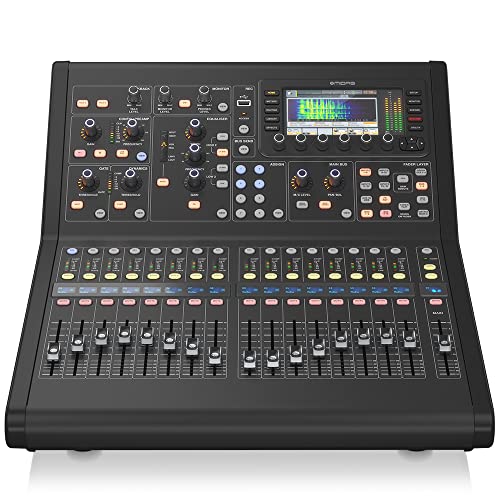
The M32 Live is Midas’s flagship compact console: 32 Midas PRO preamps, 40 input channels, 25 buses and live multitrack recording, built for professional live and studio work.
As the premium studio pick, its preamps and surface make it the desk clients recognise — tracking through it feels like a commercial room.
Strengths
- The preamps and build quality are a clear class above mid-tier consoles
- Fader feel and surface layout reward professional operators
- Multitrack recording is integrated for live album workflows
Trade-offs
- Price reflects the badge and the build — it is the premium option
- Weight and size suit proper cases and crews
- Its depth is wasted on genuinely small shows
| Inputs | 40 input channels, 32 Midas PRO preamps |
| Buses | 25 mix buses |
| Recording | Live multitrack recording |
| Design | Console design with premium faders and carbon-fibre styling |
The M32 Live is what the X32 wants to be when it grows up: the same conceptual layout, executed with Midas PRO preamps, better faders, a faster surface and materials that survive touring. Engineers who learned on the X32 step onto it without a manual and immediately hear where the money went — the top end opens up, the low mids stay clear at high channel counts, and the desk feels like it will outlast the band. For professional rooms and touring acts, it is the benchmark of this class.
Time on an M32 Live teaches respect for its details: faders that feel like instruments, a surface layout that keeps the important things under the hands, and processing that stays composed when the channel count climbs. It is the console engineers request by name on riders in this class, which matters for venues selling their room to touring acts. Expensive, yes — and priced like the professional tool it demonstrably is.
Insure it, case it, and put a trained engineer behind it: the M32 Live’s cost is justified nightly by rooms and tours that treat it as the professional instrument it is.
Best for: Professional venues and touring acts wanting the premium console of this class / Not suited for: Small shows where a stage box does the same work for a fraction.
Check on Amazon — check price on Amazon for the Midas M32 Live.

Behringer X32 — Best for Studio-Live Hybrids
The X32 is the console that moved a generation of small venues, churches and touring bands from analogue desks to digital, and it suits buyers who want a full physical surface with deep routing at a mid-tier price point.
For studios that also do live work, it is the flexible centre: huge routing, stage boxes for the live room, and a workflow every visiting engineer knows.
Strengths
- Huge input and bus count for the tier, so full bands with in-ear mixes fit comfortably
- Motorized faders and scene recall make multi-band bills and volunteer crews manageable
- AES50 stage boxes let you put inputs on stage and run one network cable to front of house
Trade-offs
- The learning curve is real — routing and the effects rack take study before the first show
- The full-size frame needs a proper flight case and two people to move comfortably
- The onboard screen is small by modern touchscreen standards
| Input channels | 40-input, 25-bus architecture |
| Control surface | Full-size console with motorized faders |
| Expansion | AES50 networking for digital stage boxes |
| Recording | USB audio interface expansion options |
What keeps the X32 relevant is ecosystem depth. Thousands of engineers know its layout, so hiring help, borrowing a show file or finding a tutorial is easy in a way newer rivals cannot match. The preamps are clean at sensible gain, the parametric EQ and dynamics on every channel cover club work without outboard, and the bus count means monitor mixes stop being the compromise they are on smaller desks. Treat it as a system — console, stage box, personal monitoring — and it scales from a bar rig to a festival side-stage without changing the workflow your crew already knows.
In daily operation the X32 rewards a methodical engineer: build a sensible input list, keep a house scene with the room tuned, and save per-act scenes on top of it. The effects rack covers the usual live needs — reverbs that do not cloud vocals, a delay that taps to tempo, and dynamics for the money channels. Where it ages most visibly is the small screen and the menu depth for rarely used settings, but muscle memory solves both, and the depth is precisely why it keeps headlining this class.
Budget-wise, remember the X32 is the centre of a system: case, stage box and cables belong in the same spreadsheet. Bought as a system and run by a trained operator, it remains the reference point every rival in this class is measured against.
Best for: Venues, churches and bands that need a full console surface and room to grow / Not suited for: Solo acts and tiny rooms where a rack mixer does the same job in a third of the space.
Check on Amazon — check price on Amazon for the Behringer X32.

Allen & Heath QU-24C — Best Project Studio Console
The QU-24C is a compact digital console with 30 inputs and 24 outputs, motorized faders and the Qu workflow, suiting venues and bands that have outgrown 16 channels but not their budget.
For project studios needing a real console feel with generous I/O, it covers tracking a band and mixing on faders without flagship cost.
Strengths
- Input and output counts cover full bands plus several monitor mixes
- Physical faders and a clear, learnable layout suit volunteer teams
- Strong recording options for services and shows
Trade-offs
- Larger and heavier than rack mixers with similar channel counts
- Interface design is older than the CQ generation
- Stage-box expansion is a further purchase for remote inputs
| Inputs / outputs | 30 in / 24 out |
| Format | Compact digital console, Chrome Edition |
| Control | Motorized faders, touchscreen, remote apps |
The QU-24C occupies the sensible middle: enough channels for a full band with a horn section, enough outputs for wedges and in-ears, and a surface a competent volunteer can learn in an afternoon. Its processing is a known quantity — clean preamps, effective EQ, reverbs that sit in a mix — and its scene system handles the Sunday-morning, Saturday-wedding double life of real venues. If a rack mixer feels too invisible and a flagship console too much, this is the desk that fits.
The QU-24C’s party piece is balance: enough of everything, nothing eccentric. Twenty-four faders cover the band; the output count covers monitors and a recording feed; the processing covers the show without menu-diving. Theatres and schools that run it praise the training curve most — a new operator can be useful in one session and confident in three. In a market of extremes, that moderation is a deliberate and valuable position.
Plan the QU-24C’s home — a proper stand or case, and a stage position with sightlines. It is a console that rewards being treated as the room’s centre rather than as portable gear.
Best for: Venues and larger bands needing 24 faders of hands-on control / Not suited for: Rigs that must travel in a car boot rather than a van.
Check on Amazon — check price on Amazon for the Allen & Heath QU-24C.

Tascam Model 12 — Best Compact Studio Desk
The Model 12 is Tascam’s all-in-one: a mixer with real channel strips, a 12-track multitrack recorder and a USB audio interface, built for musicians who record as naturally as they rehearse.
For songwriter studios it is the honest centre: twelve tracks, tactile controls, and recording that never waits for a computer to wake up.
Strengths
- Records multitrack to SD without a computer, mixes like a classic desk
- Physical controls keep the workflow tactile and fast
- USB interface mode integrates with a DAW when you want one
Trade-offs
- Twelve tracks is a ceiling for ambitious productions
- Channel count suits small line-ups, not full live bands
- Screen is functional rather than luxurious
| Recording | 12-track digital multitrack recorder |
| Functions | Mixer + recorder + USB audio interface in one unit |
| Control | Physical channel strips with faders and knobs |
| DAW | DAW control surface functions |
The Model 12 succeeds because it respects how musicians actually work: plug in, press record, play. No laptop latency, no driver roulette, no update dialogs — the desk captures twelve tracks to SD while feeling like the analogue mixers a generation learned on. Back at the computer it becomes the interface and control surface, so the same unit covers demo, rehearsal recording and finished production. For singer-songwriters, electronic duos and small bands, it is the centre of the room.
The Model 12 changes recording habits the way instant cameras changed photography: because capturing is effortless, it happens constantly. Song ideas, rehearsals, alternate arrangements — all preserved in multitrack, all mixable later. Its DAW-control and interface modes mean the computer joins when wanted rather than being required. Studios built around one describe it less as gear and more as furniture: the desk where music happens, always on, always ready.
Buy fast SD cards and a small stock of them; the Model 12’s appetite for captured ideas is its best feature. Studios that feed it media find their output of finished demos rises noticeably.
Best for: Musicians who want computer-free multitrack recording with a real mixer feel / Not suited for: Large live rigs or studios needing more than twelve tracks.
Check on Amazon — check price on Amazon for the Tascam Model 12.

PreSonus StudioLive 24R — Best Network Expansion
The StudioLive 24R is a Series III rack mixer that doubles as an AVB stage box for StudioLive consoles, suiting systems that need remote inputs and networked recording.
For studios built on AVB, it is the expansion that also mixes — extra preamps in the live room today, a backup mixer tomorrow.
Strengths
- Works standalone as a rack mixer or as a console’s stage box
- AVB networking keeps cable runs digital and simple
- Full Series III processing in a rack footprint
Trade-offs
- App control only in standalone mode
- Value peaks inside a PreSonus AVB system
- Rack infrastructure and networking add to system cost
| Format | Series III digital rack mixer |
| Networking | AVB networking for stage-box and system use |
| Software | Studio One Pro software included (per listing) |
| Recording | Multitrack recording over network and USB |
The 24R is the flexible friend of the StudioLive world: today it is the mixer for a band’s in-ear rack, tomorrow it is the stage box at the end of an AVB cable for a Series III console, and all week it can be the recording interface for the rehearsal room. That shape-shifting makes it a smart buy for production companies and churches whose systems evolve. Its processing is the full Series III Fat Channel world, so the sound never feels like the compromise option.
The 24R’s dual identity makes it the thinking PreSonus user’s favourite: it is the stage box that pays rent as a standalone mixer between console jobs. Production companies keep one as the small-rig mixer and the big-rig expander; churches use it as the youth-room desk that joins the main system on big Sundays. That flexibility protects the purchase against the future better than any single specification could.
The 24R is the rare purchase that becomes more useful as your system grows. If a StudioLive console is anywhere in your future, the 24R is close to a no-regret buy.
Best for: PreSonus users needing a stage box that can also be the mixer / Not suited for: Standalone buyers outside the AVB ecosystem comparing pure channel value.
Check on Amazon — check price on Amazon for the PreSonus StudioLive 24R.
Comparison Table
| Pick | Badge | Key spec | Best for |
|---|---|---|---|
| PreSonus StudioLive 32SX — Check price on Amazon | Best Overall | 25 motorized faders, FLEX DSP, AVB networking | Venues and studios building an AVB-networked system |
| Midas M32 Live — Check price on Amazon | Best Premium | 32 Midas PRO preamps, 40 channels, live multitrack | Professional venues and touring acts wanting the premium console of this class |
| Behringer X32 — Check price on Amazon | Best for Studio-Live Hybrids | 40 inputs, 25 buses, AES50 stage-box networking | Venues, churches and bands that need a full console surface and room to grow |
| Allen & Heath QU-24C — Check price on Amazon | Best Project Studio Console | 30 in / 24 out compact digital console | Venues and larger bands needing 24 faders of hands-on control |
| Tascam Model 12 — Check price on Amazon | Best Compact Studio Desk | 12-track multitrack recorder, mixer and USB interface in one | Musicians who want computer-free multitrack recording with a real mixer feel |
| PreSonus StudioLive 24R — Check price on Amazon | Best Network Expansion | Rack mixer and AVB stage box in one | PreSonus users needing a stage box that can also be the mixer |
Read the table by format first and specifications second. The format decides who can operate the mixer and where it lives; the key spec decides whether your input list and monitor world fit. Badges repeat the Quick Picks verdicts so the table can be used on its own — and every row links to the same verified listing used throughout the guide, so the price you check is the price for the exact model reviewed.
What does value look like in this category?
Studio value compounds: a centre that saves fifteen minutes of setup per session returns a working week per year, and a centre whose recall wins one revision-heavy client returns its price outright. That is why the system consoles here — StudioLive, M32 — justify figures that look steep beside their channel counts. You are buying session velocity and client confidence, and both bill by the hour in your favour.
The honest counterweight is utilisation. A flagship centre in a studio that records twice a month is capital asleep; the Model 12 or QU-24C, fully used, is the better business decision. Audit your calendar before your catalogue: the right studio mixer is the most capable one your actual session load will keep busy. Check price on Amazon for the current figures, then divide by your real sessions per year — the honest metric every studio owner eventually learns.
How to Choose a Digital Mixer for a Recording Studio
What does a studio need from a digital mixer that live work does not?
Recall across days, first of all: a studio session pauses and resumes, clients return after a month, and the mixer must reload gains, routing and monitor setups exactly. Second, monitoring sophistication — multiple speaker sets, talkback to the live room, and personal headphone mixes that keep performers happy. Third, integration: the mixer is also the audio interface, so its drivers, latency behaviour and DAW control decide daily friction. Live desks optimise for speed under pressure; studio desks optimise for repeatability and sound.
How important are preamps in a studio mixer?
More than anywhere else, because the studio records them forever. The differences between competent modern preamps are subtle at sensible gains, but the flagships here — Midas PRO, PreSonus XMAX-class designs — earn their keep on quiet sources, ribbons and condensers pushed hard, where noise and headroom show. If your studio records mostly loud rock drums, mid-tier preamps will not be your bottleneck; if it records voice, acoustic instruments and jazz, budget for the front end first.
Should a studio mixer be a console or a rack system?
A console gives the engineer a home: faders for mixing, a surface clients understand, and monitor control under the hand. A rack system with networked stage boxes gives flexibility: preamps in the live room, control from the control room, expansion by adding boxes. Many studios run both philosophies at once — a console surface controlling rack I/O. Decide by how you mix: if you ride faders during mixdown, buy the surface; if you mix entirely in the DAW, buy I/O and recall.
How does networking change a studio’s wiring?
AVB and AES50 systems replace the analogue snake and much of the patchbay thinking with network cable: stage boxes where the microphones are, personal mixers where the musicians stand, and one cable carrying dozens of channels to the control room. The StudioLive and M32 ecosystems here both offer that path. The gain is not just tidiness — it is that the live room’s input list can grow without re-cabling the building, and every point in the system stays recallable.
How should a studio audition a mixer before committing?
Bring your hardest sources: the quiet vocalist, the ribbon microphone, the drum kit at full tilt. Record the same performance through the candidate and your current chain, level-matched, and compare without knowing which is which. Then run a workflow test — recall yesterday’s scene, build a headphone mix from nothing, record twenty tracks for an hour. Studios buy decades of daily friction or its absence; an afternoon of honest testing reveals which one a given desk offers.
Where does a studio mixer sit in the upgrade order?
After the room’s acoustics and the monitors, before the exotic microphones. The centre touches every signal and every session, so its quality and reliability compound; a microphone colours one source at a time. Studios that upgrade the centre first consistently report that their existing microphones and monitors suddenly seem better — because the path between them stopped being the weakest part of the chain. Buy the centre you can grow around for five years.
How should a studio handle talkback and communication?
Talkback is a small feature that runs the whole session’s morale. The engineer must reach every performer’s headphones instantly, and performers need a way to answer — a talkback microphone in the live room or simply an open mic between takes. Consoles here integrate talkback into the monitor path; plan its routing in your templates so it is never improvised. Sessions flow on communication, and studios that engineer it deliberately feel professional to clients within the first ten minutes.
What does a studio-centre mixer change about session workflow?
The working day reorganises around recall. The morning’s podcast setup, the afternoon’s band tracking and the evening’s mix session are three scenes, not three repatches. Engineers stop photographing knob positions; assistants stop being human patchbays. Studios that make the switch consistently report the same unexpected benefit: they say yes to short, odd sessions — a single vocal overdub, a quick string quartet — because the setup cost collapsed to loading a file.
It also changes the client experience in ways that sell the room. Performers get their own headphone mixes without a separate system in many of these ecosystems, talkback is a button rather than a shout through the glass, and playback of the last take is instant because the recording path was always armed. A studio is partly selling confidence; a coherent digital centre is how a small room projects it.
How does a studio know the mixer centre is due for replacement?
When the workarounds outnumber the workflows: external monitor controllers bolted on, headphone systems improvised, sessions split across two interfaces, scenes abandoned because recall became unreliable. A healthy centre makes those improvisations unnecessary. The consoles in this guide are the class studios upgrade to when the patchwork starts costing clients — and the upgrade usually pays for itself in session speed before it pays in sound.
The subtler sign is creative: engineers stop suggesting ideas that the rig makes tedious. ‘Let us try the band live off the floor’ dies when setup takes an hour; it thrives when a scene loads in seconds. Studios are in the business of capturing moments, and the centre’s job is to make moments cheap to attempt. Judge every candidate here by that standard and the right choice usually names itself.
How to Set Up a Digital Mixer as a Studio Centre
Plan the signal map before cabling: which inputs live in the control room, which in the live room, where the stage boxes sit, and how many network runs the building needs. Patch the everyday sources — the two ‘always’ microphones, the DI, the synth inputs — to fixed channels and label them in the mixer, so the room’s default state is already a session template.
Build and save scene templates per job type: tracking band, vocal overdub, podcast, mixdown. Set the monitor path deliberately — main speakers, nearfields, headphone feeds — and calibrate levels so switching between them is not a volume jump. Connect the DAW, confirm the interface channel count and names match the mixer, and record a test take on every template.
Finally, document the room’s defaults on one page near the desk: network addresses, scene names, where the stage box lives, and the backup routine for session media. Studios run on the days the main engineer is away; the system should survive a competent stranger.
Schedule a quarterly system audit: reload every template, confirm the network still maps as documented, check for firmware notes — without installing anything mid-project — and re-run the full-input test recording. Studio centres drift slowly: a moved stage box, a borrowed cable, a setting changed for one client and never restored. The audit is how the room’s default state stays the best state, which is the entire premise of a recall-based studio.
Setup and Buying Checklist
Before and just after you buy, work through this checklist for best digital mixers for recording studio. It collects the small, unglamorous steps that separate systems which settle in quietly from systems that generate a month of small frustrations.
- Document the signal map — inputs, stage boxes, network runs — on one page kept at the desk.
- Build scene templates for your four commonest session types and name them unambiguously.
- Calibrate monitor levels so switching between speaker sets is not a volume surprise.
- Give every regular performer a starting headphone mix saved in the template.
- Keep the audio network separate from office traffic and labelled at both ends of every run.
- Back up scene files with session audio, on the same schedule, to the same archive.
Which pick fits which studio?
For the commercial-leaning project studio — clients, deadlines, a live room — the StudioLive 32SX and M32 Live are the serious centres: networked expansion for the live room, personal mixes for the talent, and surfaces that visiting engineers respect. Choose PreSonus for the recording integration, Midas for the preamps and the badge; either anchors a room that can charge professional rates with a straight face.
For the hybrid studio that also runs live events, the X32 is the pragmatic champion: the same desk tracks the band on Tuesday and mixes their album launch on Friday, with the stage box serving both. The QU-24C plays the same double role with Allen & Heath manners and a gentler learning curve for the studio’s junior engineers and volunteers.
For the writer-producer’s room, the Model 12 is the centre that respects the process: always patched, always ready, tactile enough that recording feels like playing. Its twelve tracks match the way such studios actually build records — layer by layer — and its DAW control keeps the computer in its proper place as the editor, not the gatekeeper.
For the studio expanding an existing PreSonus rig, the 24R is the obvious, almost obligatory addition: preamps in the live room today, a spare mixer tomorrow, and an AVB network that makes the whole building feel like one instrument. Expansion purchases are rarely exciting; this one is at least elegantly dual-purpose, which is the best kind of sensible.
Common Buying Mistakes
Most buying mistakes with best digital mixers for recording studio are not about choosing a bad mixer — every pick here is capable — but about mismatching the mixer to the room, the crew or the input list. These are the mismatches we see repeated most often, and each is cheaper to avoid on paper than to fix in hardware.
- Buying maximum channels while neglecting monitor control, then bolting on workarounds for years.
- Recording through different preamp paths each session so a project’s tracks never quite match.
- Never building scene templates, so the digital mixer’s recall advantage goes unused.
- Running the studio’s network for audio on the same chaotic Wi-Fi as the office.
- Letting session media live only on the mixer’s card or one laptop — studios lose work this way, not through bad mixes.
Final Recommendation
For a studio building a system, the StudioLive 32SX is the most coherent centre, with the M32 Live the premium alternative when preamps and surface feel lead the decision. Hybrid live-studio rooms belong with the X32 or QU-24C, songwriter studios with the Model 12, and existing PreSonus rooms expand smartest with the 24R. Build scene templates from day one, keep the audio network clean, and the mixer becomes the room’s memory rather than its bottleneck.
Build the studio around the centre deliberately — templates, network, documented defaults — and the room starts behaving like a bigger business than it is. That behaviour, repeated across a hundred sessions, is what this purchase is really buying.
Shortlist links for the top three: PreSonus StudioLive 32SX · Midas M32 Live · Behringer X32 — check price on Amazon for each before deciding, and confirm the current listing matches the model described here.
Best Digital Mixers For Studio Best Digital Mixers For Recording Best Digital Mixers With Ethernet
A note on ownership and upkeep
A final note on stewardship: a studio centre is infrastructure, and infrastructure wants a log. Keep one page — digital or paper — recording firmware versions, network addresses, scene template names and the dates of any service. When the centre misbehaves at year three, that page turns a day of diagnosis into an hour. Studios are remembered by clients for how problems were handled, and the log is the quiet tool that makes problems small. It costs nothing but the habit, and it is the habit that separates rooms that run from rooms that merely own equipment.
Frequently Asked Questions
Can a digital mixer be the only interface in a recording studio?
Yes — the consoles here all function as multi-channel USB or network interfaces. Many studios run exactly that way, with the DAW seeing the mixer’s inputs directly.
Is the M32 Live worth it over the X32 for a studio?
For studios, the case is preamps, faders and build — the parts you hear and touch daily. If the budget stretches and the room records quiet sources often, yes; for loud, live-heavy work the X32’s value is hard to argue with.
How do performers get individual headphone mixes?
Through the mixer’s buses and, in the PreSonus and Behringer/Midas ecosystems, personal monitor mixers on the network. Several picks here can feed multiple independent mixes directly.
Do studio mixers work as DAW control surfaces?
Some do — the Model 12 offers DAW control, and larger consoles provide varying levels of control and integration. Confirm the depth of control for your specific DAW before relying on it.
What is AVB and do I need it?
AVB is an Ethernet-based audio networking standard used by PreSonus StudioLive systems to connect stage boxes, personal mixers and computers. You need it only inside that ecosystem — but inside it, expansion becomes plug-and-play.
Can a studio mixer also handle live gigs?
Several here — X32, M32 Live, QU-24C — are live consoles by birth and excellent at it. A studio that also promotes shows gets double duty from them.
Do I still need a patchbay with a digital studio mixer?
Many studios retire most of it: recall and networked I/O replace daily repatching. A small patchbay for outboard inserts remains useful in hybrid rooms.
Can clients’ engineers walk in and use the house console?
On the major platforms, yes — that is a commercial argument for the X32/M32 and StudioLive families. Keep a house default scene loaded so guests start from a sane state.
To close: the shortlist for best digital mixers for recording studio rewards buyers who decide by workflow first and specifications second. Start from the top pick — the PreSonus StudioLive 32SX — and move down the list only when a specific requirement rules it out: a channel count, a format, a network standard, a control style. That order of decisions, applied honestly, is how the right mixer gets chosen, and it is the order this guide was written in. Keep the verified links above for current availability, save your first good scene the day the mixer arrives, and let the system settle into the background of the work it was bought to support.
Related reading on this site: Best Digital Mixers Using Logice Pro X Best Digital Mixers Under $5000


