Disclosure: airfryerkitchensupply.com is reader-supported. When you buy through links on our site, we may earn an affiliate commission at no extra cost to you.
Where to buy
The under-$1000 frame is where convection ovens get serious: flagship countertop models, a commercial unit, and even a built-in wall oven all live here. Every pick was verified against Amazon’s catalog data. The Breville Smart Oven Air Fryer Pro is the benchmark, the Ninja Prestige Smart XL DT551 serves families, and the Cuisinart TOA-70 is the value all-rounder. Evenness specialists get the KitchenAid KCO255 Dual Convection, producers get the Waring WCO500X, and renovators get the Cosmo 24-Inch Wall Oven. Check the current price on Amazon for each — and for the Cosmo, confirm your cabinet cutout dimensions before anything else.
Introduction
The best convection ovens under 1000 dollars occupy the most interesting territory in the category, because this is the budget where the real compromises end. Below it, you choose between size and quality; here, the flagship countertop ovens deliver both, a commercial convection oven delivers professional throughput, and the frame even stretches to a true built-in wall oven in the 24-inch class. The six picks below were verified in Amazon’s catalog data, and they are organized by ambition: the benchmark Breville for cooks who want the reference countertop oven, Ninja’s thermometer-equipped XL for families, Cuisinart’s proven all-rounder at the tier’s value center, KitchenAid’s dual-convection specialist for bakers, Waring’s commercial half-size oven for producers, and Cosmo’s 24-inch true-convection wall oven for renovators.
One clarification this tier requires: “under $1000” in the search is a budget frame, not a price list, and this guide prints no individual prices — models move in and out of sale pricing weekly, and the frame is your tool for checking the current tag on Amazon. What the frame guarantees is positioning: every pick here is a product whose established place in the market is within this tier, not a flagship borrowed from the tier above on the strength of a temporary discount. Buy at this level and you are buying the last countertop oven most kitchens need — the differences among the six are about the kind of cooking you do, which is exactly the kind of difference worth paying to get right.
In this guide
Quick Picks
- Best Overall: Breville BOV900BSS Smart Oven Air Fryer Pro — the reference countertop oven — 13 functions including air fry, roast and dehydrate, with a convection system Breville rates at up to 30% faster cooking, in the build quality the category is judged against.
- Best for Families: Ninja Prestige Smart XL DT551 — the family powerhouse — a 10-in-1 XL countertop oven at 1800W with a Smart Cook thermometer that takes proteins to temperature without guesswork.
- Best Value Air Fryer Oven: Cuisinart TOA-70 Air Fryer Toaster Oven — the mid-price all-rounder — an 1800W, 8-in-1 air fryer toaster oven with a 0.6 cubic foot cavity and a proper 60-minute timer, from a brand with decades in this exact category.
- Best Dual Convection: KitchenAid KCO255 Dual Convection Countertop Oven — the dual-fan specialist — KitchenAid’s countertop oven built around dual convection, for the most even heat distribution the brand can engineer into the class.
- Best Commercial Grade: Waring WCO500X Countertop Convection Oven, Half-Size — the professional — a commercial countertop convection oven that fits four half-size sheet pans in 1.5 cubic feet, NSF-listed, built by Waring for food-service duty and entirely at home in a serious kitchen.
- Best Built-In Under $1000: Cosmo C51EIX 24 Inch Electric Wall Oven, True Convection — the built-in exception — a 24-inch, 2.9 cu ft electric wall oven with true convection and 8 functions, proving a real installed oven can live inside this budget frame.
How These Picks Were Chosen
Selection began with verification: every model here was confirmed, with functions, capacities and power figures taken from the manufacturers’ own listings — including one case, the KitchenAid, where the listing’s sparseness is itself reported in the review rather than papered over. We then required each pick to hold an established position within the under-$1000 frame and to represent a distinct buying case: benchmark, family, value, evenness, commercial and built-in. Six ovens that are merely six prices of the same idea would have been an easier article and a worse guide.
Excluded: countertop models whose verified specifications belonged to the tier below wearing premium clothes, commercial ovens requiring 240V power that home kitchens cannot casually supply (the Waring’s 120V operation is part of why it is here), and built-ins in the 27- and 30-inch classes whose market position is honestly above the frame — those appear, correctly, in our under-$2000 guide. Within the six, ranking follows breadth of fit: the Breville leads because it serves the widest range of serious cooking best, and each subsequent pick leads its own case outright. Read the verdict lines; they are written to route you, not to flatter the ranking.
The 6 Best Convection Ovens Under 1000 Dollars
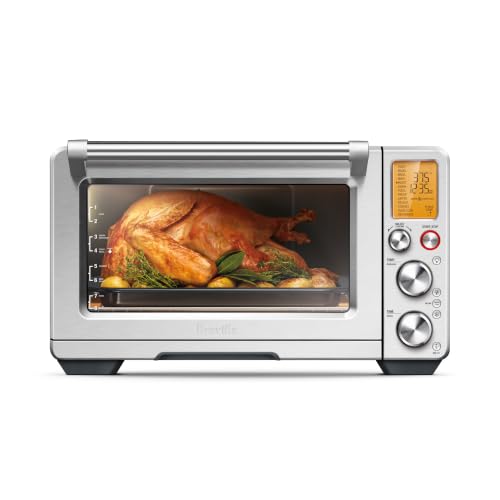
Breville BOV900BSS Smart Oven Air Fryer Pro — Best Overall
Every category has a product the others are measured against, and in countertop convection ovens it is this Breville. The Smart Oven Air Fryer Pro packs 13 functions into a full-size countertop cavity — toast, bake, roast, broil, pizza, air fry, dehydrate and more — and its convection system is the genuine article: Breville rates the convection setting at up to 30 percent faster cooking, a claim rooted in the simple physics of moving air delivered by a properly engineered fan and element system rather than a token breeze. The interior takes the pans real cooking uses, up to a quarter-sheet and small roasting dishes, and the two-speed convection logic lets delicate bakes run gentler than crisping jobs. Brushed stainless, precise controls, an interior light — the details read like a checklist of everything the under-$200 tier could not afford, which is exactly what the under-$1000 frame is for.
Strengths
- The benchmark for even, predictable countertop convection cooking
- 13 functions cover baking, roasting, air frying and dehydrating in one cavity
- Full-size interior takes real pans and small roasts
Trade-offs
- Premium price within the tier — you are paying for engineering, not size
- Large counter footprint; measure depth and cabinet clearance
- More oven than toast-and-reheat households will ever use
| Functions | 13 (per manufacturer listing) |
| Convection | Rated up to 30% faster cooking (per manufacturer listing) |
| Finish | Brushed stainless steel |
| Modes named in listing | Roast, bake, dehydrate, air fry and more |
The case for the Breville is consistency. Owners of lesser countertop ovens develop compensating habits — rotating pans, shielding edges, learning which corner runs hot — and those habits become invisible taxes on every meal. The Smart Oven’s evenness removes the tax: a tray of cookies browns as a batch, a roast chicken cooks without a mid-course rotation ceremony, and a frozen pizza emerges as one pizza rather than a gradient. That reliability is also why this oven anchors so many serious small kitchens as the primary oven, not the backup. Its honest costs are money and counter: it is the premium countertop purchase in this frame, and it asks for a real estate commitment on the counter. Households that cook daily will amortize both within a season. Households that toast twice a week should buy the Cuisinart below and keep the change — a sentence this guide can write because the Breville needs no protection from comparison.
Best for: serious home cooks who will use a countertop oven as a primary oven / Not suited for: light users whose cooking is toast and reheats — the Cuisinart serves them for less
Check the current price on Amazon for the Breville BOV900BSS Smart Oven Air Fryer Pro.

Ninja Prestige Smart XL DT551 — Best for Families
Ninja builds appliances the way game designers build levels: everything is about removing the moment where the user fails. In the Prestige Smart XL, the signature failure-removal is the Smart Cook thermometer — a probe that monitors your protein’s internal temperature and tells the oven when it is done, ending the era of the overcooked roast and the anxiously sliced-open chicken breast. Around that headline is a 10-in-1 function set at 1800W — air fry, air roast, broil, bake, toast, pizza and more — in an XL cavity sized for family cooking: a whole chicken, a large pizza, two trays working the weeknight rotation. Ninja’s air-crisping is the most aggressive in the class, which families experience as fries and wings that actually crunch. This is the oven for households whose countertop cooking is high-volume and protein-centered.
Strengths
- Smart Cook thermometer removes protein guesswork entirely
- XL family capacity with 1800W of working power
- Air fry and air roast performance leads the class for crisping
Trade-offs
- Aggressive fans are not the gentlest environment for delicate baking
- XL footprint is a serious counter commitment
- Feature depth means a learning curve the simple ovens do not impose
| Functions | 10-in-1 (per manufacturer listing) |
| Power | 1800W |
| Thermometer | Smart Cook thermometer included (per manufacturer listing) |
| Modes named in listing | Air fry, air roast, broil, bake, toast, pizza |
Families should read this pick as a workflow appliance. The thermometer alone changes weeknight cooking: proteins go in, the probe goes in, and the cook is free until the oven announces doneness — no basting schedule, no thermometer-poking every ten minutes, no dried-out results from defensive overcooking. The capacity backs the promise up, because a thermometer is only useful if the chicken fits, and in the XL cavity it does, with room for the tray of vegetables beneath or beside. Where the Ninja concedes ground is finesse: its fans prioritize crisping energy, and bakers of delicate cakes and custards will find the Breville above the calmer instrument. Most families, most nights, are not baking custards — they are crisping, roasting and reheating at volume, and for that center of gravity the DT551 is the most capable family oven in the under-$1000 frame.
Best for: families cooking proteins and high-volume weeknight meals / Not suited for: delicate bakers who prioritize gentle, even baking over crisping power
Check the current price on Amazon for the Ninja Prestige Smart XL DT551.

Cuisinart TOA-70 Air Fryer Toaster Oven — Best Value Air Fryer Oven
Cuisinart more or less invented the modern toaster-oven category, and the TOA-70 is its answer to the air-fry era: an 8-in-1 countertop oven at 1800W whose function list — air fry, convection bake, broil, warm and the rest — covers the full daily rotation in a 0.6 cubic foot cavity. That capacity figure is the useful one: it is the size class that takes a 12-inch pizza, a family tray of wings or a small casserole, without claiming the counter acreage of the XL models. The 60-minute timer deserves its sentence, because it is where mid-priced ovens quietly separate from budget ones — an hour of honest timer covers casseroles, baked potatoes and slow-ish roasts that 30-minute budget timers force you to babysit and re-wind. Cuisinart’s analog-style controls keep the operation glove-friendly and manual-free. This is the pick for buyers who want the air-fry oven format at its most proven, without paying the Breville premium or taking the Ninja’s maximalist path.
Strengths
- Proven format from the category’s founding brand
- 0.6 cu ft cavity hits the size most households actually need
- 60-minute timer covers real baking jobs, not just snacks
Trade-offs
- Analog controls lack the precision entry of digital models
- Air fry basket capacity suits families of four, not crowds
- Interior is not the largest here — big sheet-pan work still belongs elsewhere
| Power | 1800W |
| Functions | 8-in-1: air fry, convection, broil, warm and more (per manufacturer listing) |
| Capacity | 0.6 cu ft |
| Timer | 60 minutes |
The TOA-70’s position in this guide is the sensible center, and sensible centers are underrated. It crisps convincingly, bakes evenly enough for the full home rotation, and comes from a manufacturer whose parts, manuals and support will exist in five years — a consideration that matters more in an appliance you use daily than in almost any other purchase in this article. Against the Breville it concedes polish and ultimate evenness; against the Ninja it concedes the thermometer and the XL volume; against both it returns meaningful money to your pocket while covering the same weeknight jobs. For the household upgrading from a basic toaster oven into the convection-and-air-fry era, this is the step that feels like pure gain. First-time countertop-oven buyers who cook for two to four people could start here and, honestly, stop here.
Best for: households of two to four wanting the proven all-round format / Not suited for: large families needing XL capacity or bakers wanting ultimate evenness
Check the current price on Amazon for the Cuisinart TOA-70 Air Fryer Toaster Oven.
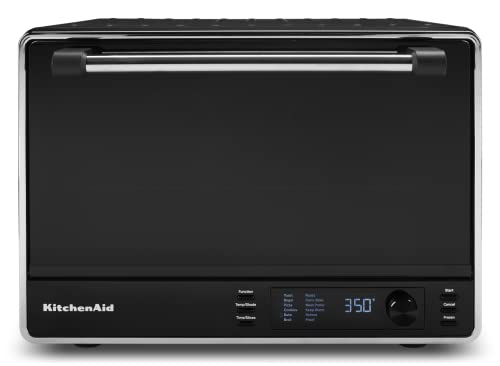
KitchenAid KCO255 Dual Convection Countertop Oven — Best Dual Convection
KitchenAid’s entry competes on a single idea executed seriously: dual convection. Where most countertop ovens move air with one fan, the KCO255’s dual convection design circulates heat from two sources of movement, and the practical promise is the flattest temperature map in the category — no lazy corner, no scorched edge, a cavity that treats the back-left cookie the same as the front-right one. KitchenAid brings its stand-mixer design language with it: solid, weighty, finished like an appliance meant to live on the counter permanently rather than be stored and fetched. The function set covers the standard countertop rotation — bake, roast, toast, broil and their variations — sized for family dishes and the small roasts and casseroles of real cooking. For bakers, whose work exposes uneven heat more mercilessly than any other cooking, the dual-fan premise is aimed precisely at the failure they know best.
Strengths
- Dual convection targets the most even heat in the class
- KitchenAid build and counter presence — an appliance, not an accessory
- Family-size cavity for real dishes and roasts
Trade-offs
- The listing is spare on published detail versus rivals — verify configuration at purchase
- Premium-brand pricing within the tier
- No thermometer-probe party trick like the Ninja’s
| Convection | Dual convection (per manufacturer listing) |
| Type | Countertop oven, family size |
A note on evidence, because this guide practices what it preaches: KitchenAid’s listing for the KCO255 is unusually terse, confirming the model and its dual convection design but publishing fewer figures than its rivals do. We include it because the dual-convection concept is verifiable, the brand’s countertop track record is long, and the evenness problem it addresses is the central problem of the category — but buyers should confirm the exact configuration and included accessories on the Amazon listing at purchase, and this review claims no specifications beyond what the listing states. Judged on its premise, the KCO255 is the baker’s alternative to the Breville: where the Breville wins on functions and ecosystem, the KitchenAid argues that two fans beat thirteen modes when the food in question is a tray of identical pastries that must emerge identical. It is a narrower argument, honestly made, and for the right kitchen it is the winning one.
Best for: bakers and evenness obsessives cooking tray after identical tray / Not suited for: feature-maximalists who want probes, presets and the longest function list
Check the current price on Amazon for the KitchenAid KCO255 Dual Convection Countertop Oven.

Waring WCO500X Countertop Convection Oven, Half-Size — Best Commercial Grade
Cross a line in this tier and the appliances stop being kitchen gadgets and start being equipment. The Waring WCO500X is equipment: a commercial countertop convection oven with a 1.5 cubic foot cavity that fits four half-size sheet pans at once — the pan standard of professional kitchens — running on ordinary 120V power and carrying an NSF listing, the sanitation certification food service requires. The functions are the professional’s short list: convection bake, roast, bake and broil, without a preset in sight. What you are buying is throughput and durability: the ability to bake four trays in one load, in an oven built to run all day in a café, a food truck, a church kitchen or a home that produces like one. For the home baker who sells at markets, the caterer working from a home base, or the household that cooks for crowds, this is the under-$1000 pick that changes what is possible.
Strengths
- Four half-size sheet pans at once — genuine batch throughput
- Commercial build and NSF listing; made for all-day duty
- Runs on standard 120V household power
Trade-offs
- Utilitarian design and controls — no home-kitchen frills
- Large, heavy countertop footprint
- Overkill, honestly, for toast-and-pizza households
| Capacity | 1.5 cu ft; fits 4 half-size sheet pans (per manufacturer listing) |
| Functions | Convection bake, roast, bake, broil |
| Power | 120V |
| Certification | NSF (per manufacturer listing) |
The Waring reframes the under-$1000 question. The consumer ovens in this guide compete on experience — displays, probes, presets, doors. The WCO500X competes on output per hour and years of service, and for producers that is the only metric that pays rent. Four half-sheet pans is not a marginal gain over a home oven’s one tray; it is a different business model for a market baker, and a different holiday for a family cook. The trade-offs are equally real: it looks like what it is, it occupies counter like a small microwave’s bigger sibling, and its controls assume a cook who knows what temperature and time they want. We place it fifth not because it is lesser but because its audience is narrower — and for that audience, the home bakers-turned-sellers and the serious batch cooks, it is not fifth at all. It is the only pick on the page.
Best for: market bakers, caterers, food trucks and high-volume home producers / Not suited for: casual households wanting presets, probes and pretty design
Check the current price on Amazon for the Waring WCO500X Countertop Convection Oven, Half-Size.

Cosmo C51EIX 24 Inch Electric Wall Oven, True Convection — Best Built-In Under $1000
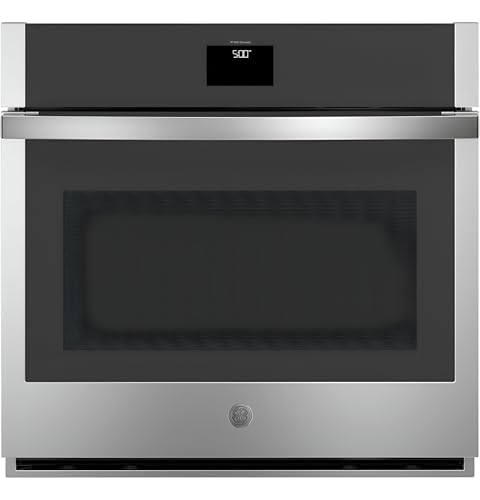
One pick in this guide is not a countertop appliance at all. The Cosmo C51EIX is a 24-inch built-in electric wall oven — 2.9 cubic feet, true convection, 8 oven functions, knob controls — and it earns its place by answering the reader who came to this search hoping “convection ovens under 1000” might include an actual oven. In the 24-inch class, it can: this compact built-in format, standard in apartments, condos, in-law suites and European-style kitchens, delivers genuine true convection — a fan with its own heating element, the configuration that distinguishes true convection from fan-assisted — in an installed appliance that frees the counter entirely. Knob controls keep the interface timeless, and the stainless finish matches standard kitchen suites. For a small kitchen renovation, this is the most consequential purchase in the entire guide.
Strengths
- A real built-in wall oven with true convection inside the budget frame
- 2.9 cu ft capacity dwarfs every countertop pick here
- Frees the counter permanently; 24-inch class fits compact kitchens
Trade-offs
- Requires a cabinet cutout and hardwired installation — a project, not a purchase
- 24-inch width limits the largest pans versus 27/30-inch ovens
- Knob controls mean no digital precision or smart features
| Type | Built-in electric wall oven, 24 inch |
| Capacity | 2.9 cu ft |
| Convection | True convection (per manufacturer listing) |
| Functions | 8 |
| Controls | Knob |
Installation is the honest center of this review. A wall oven is a renovation decision: the cabinet cutout must match, the electrical supply must be correct, and most owners will hire the install or bring a capable helper and a free Saturday. None of that diminishes the value for the kitchen that needs it — a dying 24-inch oven replaced like-for-like, a small kitchen designed around the format, an accessory dwelling unit being fitted out. In those settings the comparison is not against countertop ovens at all but against other 24-inch built-ins, and a true-convection model with 8 functions inside this budget frame is a genuinely strong entry. Measure your cutout twice, confirm your electrical service, and this pick delivers the thing the other five cannot: an oven that is part of the house.
Best for: small-kitchen renovations and 24-inch built-in replacements / Not suited for: renters and anyone not ready for an installation project
Check the current price on Amazon for the Cosmo C51EIX 24 Inch Electric Wall Oven, True Convection.
Comparison Table
| Pick | Badge | Key spec | Best for |
|---|---|---|---|
| Breville BOV900BSS Smart Oven Air Fryer Pro | Best Overall | 13 functions, full-size cavity | Primary countertop oven |
| Ninja Prestige Smart XL DT551 | Best for Families | 10-in-1, 1800W, thermometer probe | Family proteins and crisping |
| Cuisinart TOA-70 Air Fryer Toaster Oven | Best Value Air Fryer Oven | 1800W, 8-in-1, 0.6 cu ft | All-round daily cooking |
| KitchenAid KCO255 Dual Convection Countertop Oven | Best Dual Convection | Dual convection design | Even baking |
| Waring WCO500X Countertop Convection Oven, Half-Size | Best Commercial Grade | 1.5 cu ft, 4 half-size pans, NSF | Batch and commercial duty |
| Cosmo C51EIX 24 Inch Electric Wall Oven, True Convection | Best Built-In Under $1000 | 24 in built-in, 2.9 cu ft, true convection | Compact kitchen renovations |
How to Choose a Convection Oven Under $1000: Where the Extra Money Goes
Compared with the budget tier, the money at this level buys four things, and knowing them tells you whether to spend it. It buys cavity: full-size countertop interiors that take real pans, whole chickens and family trays, ending the batch-cooking shuffle. It buys heat quality: better elements, better fans — dual, in the KitchenAid’s case — and insulation that holds temperature when the door opens and closes. It buys control: probes that cook proteins to temperature, timers that cover real roasts, functions from dehydrating to proofing that turn one cavity into several appliances. And it buys build: stainless, weight, doors that close like they mean it — the difference between an appliance and an heirloom-adjacent tool.
The choosing question is which of the four your cooking lacks. Batch and family cooks lack cavity — buy the Ninja or the Waring. Bakers lack heat quality — buy the KitchenAid or the Breville. Gadget-skeptical all-rounders lack nothing but a good oven — buy the Cuisinart and keep the change. Renovators lack an oven, full stop — buy the Cosmo and a tape measure. The failure mode at this tier is not buying too little oven; it is buying the wrong excellence, a probe-equipped crisping machine for a pastry kitchen or a commercial throughput oven for a toast household. Match the excellence to the cooking and this tier will satisfy you for a decade.
Countertop, Commercial or Built-In: Choosing the Format Before the Brand
Format decides more than brand at this level, so decide it first. The flagship countertop format — Breville, Ninja, Cuisinart, KitchenAid — offers the richest features and zero installation, at the cost of permanent counter residence. It suits renters, remodelers-not-yet, and any kitchen where the counter can spare a large appliance’s footprint. The commercial countertop format, represented by the Waring, trades features for throughput and durability; it suits producers, whose question is never “what mode” but “how many trays per hour.” The built-in format, represented by the 24-inch Cosmo, trades portability for permanence and capacity, and suits kitchens being built or rebuilt around it.
A useful test is to imagine the oven in your kitchen in year three. The countertop flagship is still on the counter, used daily, its footprint long since absorbed into the kitchen’s geography. The commercial unit is in the production corner, scarred and indispensable. The built-in has disappeared into the cabinetry, which is its own kind of success. All three futures are good; they are just different lives. Choose the life, then the brand, then check the current price — in that order, and this tier’s money is well spent by construction.
How to Set Up a Full-Size Countertop Convection Oven for Best Results
Setup decides whether a premium oven performs like one. Start with placement: a level, heat-safe surface with the manual’s clearances honored — these ovens move serious air and heat, and the cabinet above yours will notice if you cheat the gap. Run the initial burn-off cycle the manufacturer specifies, empty, ventilated; every new oven carries manufacturing residues that should become the neighborhood’s problem once, briefly, rather than your first roast’s flavor. Then calibrate before you cook seriously: an oven thermometer in the center rack, a tray of identical cookies, and twenty minutes of attention will teach you your unit’s true temperature honesty and its remaining hot spots, which even the best countertop ovens have in miniature.
Build the accessory kit around the cavity you bought: the sheet pan that fits with air space to spare, a roasting rack, the casserole that matches the interior dimensions, and — for probe models like the Ninja — a habit of probing the thickest part of the protein away from bone. Learn the fan’s settings as gears rather than modes: gentle convection for bakes that rise and set, full convection for roasting and crisping, still air for the rare delicate job that wants the old way. Keep the interior wiped while it is merely warm and the crumb tray emptied on a schedule, because a premium oven’s performance degrades through neglect exactly like a cheap one’s — it just starts from higher, and has further to fall.
Common Buying Mistakes
- Buying features before format. A probe cannot help an oven that does not fit your counter or your cooking. Format, then brand, then features.
- Assuming “under $1000” means the biggest countertop oven. The tier includes a commercial unit and a built-in; the biggest box is not automatically the right buy for a home kitchen.
- Skipping the burn-off and calibration. Premium ovens still ship with residues and personalities. One empty cycle and one cookie tray buy you years of predictable results.
- Crowding the cavity. Convection needs air paths at every size. Four pans belong in the Waring built for them, not stuffed into a two-rack flagship.
- Ignoring installation reality on the built-in. The Cosmo is a renovation: cutout dimensions and electrical supply first, enthusiasm second.
- Paying the premium and using two functions. If your cooking is toast and reheats, the under-$200 tier serves you honestly. Buy the oven your cooking will actually exercise.
Final Recommendation
The default answer at this level is the Breville Smart Oven Air Fryer Pro — the benchmark most kitchens should simply buy. Families cooking proteins at volume should take the Ninja Prestige Smart XL, value hunters the Cuisinart TOA-70, bakers the KitchenAid KCO255, producers the Waring WCO500X, and renovators the Cosmo 24-Inch Wall Oven. The ladder continues in both directions: Best Convection Ovens Under $200 below, Best Convection Ovens Under $2000 above, and the drawer specialists in Best Convection Ovens With Baking Drawer.
Measuring for a Flagship: The Tape-Measure Checklist
More flagship ovens are returned for fit than for performance, so measure like an installer. Depth first: the oven’s feet-to-door depth plus the clearance behind it for the cord and ventilation, against a counter that is shallower than you remember. Height second: the oven’s full height against the cabinet bottoms above, with the manual’s clearance added — heat rises, and cabinets are patient collectors of it. Width third, including the swing of French doors or the drop of a conventional one, and the working room to load a hot pan without choreography. Finally, the path: doorways, hallway turns and the route from box to counter, because an oven that cannot reach the kitchen cannot cook in it. Five minutes with a tape measure is the entire cost of avoiding the most common disappointment in this tier, and it is the same five minutes the built-in pick demands at renovation scale. Measure first, and every pick in this guide arrives as a solution rather than a logistics problem.
Warranty, Support and the Decade View
At this tier an oven is a decade appliance, and the ownership infrastructure around it matters as much as its first-year performance. Established manufacturers — every brand in this guide qualifies — publish manuals, sell replacement racks, baskets and crumb trays, and answer for their products through real support channels. That sounds unglamorous next to a thermometer probe, until month thirty, when a worn air-fry basket or a tired door gasket separates the owners who can restore their oven for a few dollars from the owners shopping for a new one. Commercial equipment like the Waring plays the same game at a higher level, with service networks built for businesses that cannot wait. The buying habit this suggests is simple: at under $200, treat the oven as semi-disposable and buy the best of a cheap class; at this tier, buy the brand as much as the box, because you are purchasing ten years of parts, documentation and accountability along with the cavity.
True Convection vs Fan-Assisted: The Distinction This Tier Makes Real
Two technologies hide behind the word convection. Fan-assisted ovens add a fan to a conventional element layout; the fan stirs air that the elements heat. True convection adds a third element around the fan itself, so the air enters the cavity already heated and the temperature map flattens further. In budget ovens the difference is mostly vocabulary. At this tier it becomes cooking: true convection — the Cosmo’s configuration — holds multi-rack baking together, because every rack receives air at temperature rather than air heated by proximity to an element. Countertop flagships approach the same evenness through element placement and fan engineering rather than the third element, which is why the Breville and KitchenAid compete with built-ins on tray-after-tray consistency. The practical takeaway is not to worship a label but to value what it predicts: the more of your cooking involves multiple racks or delicate bakes, the more evenness technology — in whichever form — deserves your money.
Accessories That Unlock a Full-Size Countertop Oven
A flagship countertop oven is a cavity with potential; the accessories decide how much of it you use. The fitted sheet pan — bought to the oven’s interior dimensions with air space preserved — is the foundation, because most weeknight cooking happens on it. A roasting rack that fits inside that pan turns it into a system: proteins elevated, air circulating, drippings below. A casserole or Dutch oven sized to the cavity extends the oven into braises and bakes that pans cannot hold, and a pizza stone or steel, in the ovens that fit one, converts pizza night from adequate to genuinely good. Probe thermometers, where not built in as on the Ninja, close the protein gap for a few dollars. The pattern to notice is that none of these accessories is exotic or expensive; they are the standard tools of full-size cooking, scaled to the cavity. Budget for them when you buy the oven — an owner who spends the whole frame on the appliance and nothing on what goes inside it has bought a theater and no play.
Dehydrate, Proof, Slow Cook: The Second Life of a 13-Function Oven
The long function lists of flagship ovens invite eye-rolling, and some of the modes are indeed the same heating pattern wearing different names. But three of the quieter functions genuinely change what a kitchen can do. Dehydrating turns a glut of garden tomatoes, apples or herbs into shelf-stable food with no separate appliance, running low and slow overnight. Proofing holds dough at the gentle, steady warmth that home kitchens otherwise improvise with ovens and pilot lights, and bakers feel the difference in winter most of all. A low, stable slow-cook setting braises in the oven you already own, freeing the stovetop and evening out the temperature swings of a burner. None of these will headline a listing the way air fry does, and all three are the kind of capability that, once present, gets used monthly for years. When you compare the flagships in this guide, weigh the quiet functions alongside the loud ones — the loud ones sell the oven, the quiet ones keep it indispensable.
The Second-Oven Strategy at This Tier: Replacing the Range, Not Assisting It
Something interesting happens at this budget: the countertop oven stops being the range’s assistant and becomes its replacement for most households. A flagship countertop unit handles the daily ninety percent — breakfasts, weeknight proteins, roasted vegetables, reheats, small bakes — faster and with less energy than the full-size oven, which idles until holidays and sheet-pan Sundays. Kitchens designed around this reality put the countertop oven on prime counter, invest in the pans that fit it, and treat the range as the specialty tool. That inversion is the strongest argument for buying at this tier rather than below it: a primary appliance justifies primary-appliance money, and the Breville-class oven used three times a day returns its premium in a way the same oven used twice a week arithmetically cannot. Count your oven sessions honestly for a week before you shop. The number you get is the truest and most personal buying guide in this entire article.
Frequently Asked Questions
What is the best convection oven under $1000 overall?
For most kitchens, the Breville Smart Oven Air Fryer Pro — the category benchmark for even cooking, with 13 functions in a full-size countertop cavity. Families may prefer the Ninja Prestige Smart XL for its thermometer and XL capacity, and bakers the KitchenAid’s dual convection. The reviews above route by cooking style, which matters more than any single ranking.
Can a countertop oven at this level really replace a full-size oven?
For daily cooking in most households, yes — the flagship countertop models take whole chickens, family trays and real pans, preheat faster and use less energy on small meals. The honest boundary is simultaneity: one cavity cooks at one temperature, so the two-dish-at-two-temperatures dinner still belongs to the range or to a second oven strategy. The full-size oven keeps its crown for holidays, multiple simultaneous dishes and the largest pans.
Is there a built-in wall oven under $1000?
In the 24-inch class, yes — the Cosmo C51EIX in this guide is a true-convection built-in at 2.9 cu ft positioned within the frame. The 27- and 30-inch built-in classes live in our under-$2000 guide. Confirm cutout dimensions and electrical requirements before ordering any built-in.
What does dual convection do that single convection does not?
It circulates air with two fans or fan sources, flattening the cavity’s temperature map further — the back corners behave like the center. Bakers notice it most: identical trays emerge more nearly identical. It is an evenness technology, not a speed one.
Why buy a commercial oven like the Waring for a home?
Throughput and durability. Four half-size sheet pans per load and food-service construction change what a market baker, caterer or crowd-feeding household can produce. If your cooking is measured in trays per hour, the commercial format is the correct home purchase; if it is measured in meals, the consumer flagships serve better.
Countertop or built-in: which holds value better in a kitchen?
A built-in becomes part of the home and suits owners renovating for the long term; a flagship countertop oven moves with you and suits renters and the undecided. Neither is an investment in the financial sense — the return is a decade of cooking — but the built-in’s value is realized in the kitchen itself, while the countertop’s is realized wherever you live next.
Do full-size countertop ovens need special electrical circuits?
No — the countertop models in this guide, including the commercial Waring, run on standard 120V household power. They draw substantial current while running, so give them a circuit that is not already sharing a heavy load, and plug them directly into the outlet rather than through a lightweight extension cord. The built-in Cosmo is the exception: wall ovens are hardwired installations with their own requirements.
How long should an oven at this level last?
With daily use and basic care — interior kept clean, crumb tray emptied, door gaskets intact — the established-brand models in this guide are decade-class appliances, and the commercial Waring is built for longer, harder service than that. Longevity is helped most by the unglamorous habits in our setup section.
Why are there no prices in an “under $1000” guide?
Because tier prices move with sales and a printed figure would mislead within weeks. The frame is the commitment: every pick is positioned within it as the market understands the tier. Check the current price on Amazon on the day you buy — the links in each review go straight there.