Disclosure: airfryerkitchensupply.com is reader-supported. When you buy through links on our site, we may earn an affiliate commission at no extra cost to you.
Where to buy
A counter mixer is a decade-long purchase, so buy it where the exact model and finish are unambiguous and returns are painless: Amazon. Every pick below links to its verified Amazon listing — use the links to check price on Amazon, because stand mixer pricing moves with color choice and seasonal promotions, and we do not print static prices that would go stale. Confirm the model number in the listing title matches the one in our review before ordering.
- KitchenAid 5.5-Qt Bowl-Lift Stand Mixer KSM55, Porcelain White — Best Overall: check price on Amazon
- Cuisinart Stand Mixer SM-50, 5.5 Quart, White Linen — Best Value: check price on Amazon
- Hamilton Beach 4 Qt Electric Stand Mixer, 7 Speeds, Black — Best Budget: check price on Amazon
- KitchenAid Classic Series 4.5 Quart Tilt-Head Stand Mixer K45SS, Onyx Black — Best Compact Classic: check price on Amazon
- Bosch Universal Plus Stand Mixer 500 Watt, 6.5 Quarts, Bundle — Best for Bread Dough: check price on Amazon
- KitchenAid 7 Quart Bowl-Lift Stand Mixer KSM70, Cast Iron Black — Best for Big Batches: check price on Amazon
The best counter mixers — the stand mixers that live permanently on the counter — are bought once and used for years, which makes choosing the right one worth an hour of thought. The category splits along a few real fault lines: bowl-lift versus tilt-head, bowl size from 4 to 7 quarts, and motors and drive systems built for either cake batter or stiff bread dough. This guide covers the full working range, from a budget planetary mixer for weekend bakers to a 7-quart bowl-lift machine for people who bake in batches.
A note on honesty: a counter mixer earns its counter space only if you bake or cook in ways that use it — bread, pizza dough, cakes, whipped cream, shredded meats, pasta with attachments. If your mixing is a bowl and a spoon twice a month, even the best pick here is furniture. For everyone else, the right mixer changes what home cooking is practical on a weeknight.
Every model below was verified, so the model names, bowl sizes and included attachments in the specs match the listings behind the links. Where a pick has a known weakness — a plastic gear era, a bowl without a handle — the trade-offs section says so plainly.
In this guide
Quick Picks
Six counter mixers that cover the category’s real range: an all-round bowl-lift leader, a value champion, a budget planetary mixer, a compact tilt-head classic, a dough specialist and a big-batch flagship. Match the bowl and the drive to your baking, not to the prettiest color.
- KitchenAid 5.5-Qt Bowl-Lift Stand Mixer KSM55, Porcelain White — Best Overall. The modern all-rounder: 5.5-quart bowl-lift stability, 11 speeds and the flat beater, dough hook and wire whip included — the counter mixer most households should buy. Check price on Amazon.
- Cuisinart Stand Mixer SM-50, 5.5 Quart, White Linen — Best Value. Twelve speeds, a 5.5-quart bowl, whisk, paddle and dough hook with a splash guard — the feature-complete counter mixer that undercuts the flagship brands. Check price on Amazon.
- Hamilton Beach 4 Qt Electric Stand Mixer, 7 Speeds, Black — Best Budget. Planetary mixing, 7 speeds, a splash guard and whisk, beater and dough hook at the category’s entry point — plus a carry handle that makes it genuinely movable. Check price on Amazon.
- KitchenAid Classic Series 4.5 Quart Tilt-Head Stand Mixer K45SS, Onyx Black — Best Compact Classic. The original tilt-head formula in a 4.5-quart size: metal construction, 10 speeds and full attachment-hub compatibility in the smallest KitchenAid footprint. Check price on Amazon.
- Bosch Universal Plus Stand Mixer 500 Watt, 6.5 Quarts, Bundle — Best for Bread Dough. A different engineering answer: a bottom-drive 6.5-quart system with wire whips, dough hook and a dough hook extender, built for big, stiff dough batches. Check price on Amazon.
- KitchenAid 7 Quart Bowl-Lift Stand Mixer KSM70, Cast Iron Black — Best for Big Batches. The flagship bowl-lift: 7 quarts, 11 speeds with a half-speed for folding, and a five-accessory kit led by a double flex-edge beater. Check price on Amazon.
How These Picks Were Chosen
We built this shortlist around the category’s real decision axes: bowl-lift versus tilt-head versus bottom-drive, bowl capacity from 4 to 7 quarts, and the stiffness of dough each drive can handle. Every candidate was verified against its Amazon listing, confirming model, capacity and included attachments before selection.
Each pick had to own a buying pattern: the all-rounder, the value play, the budget and movable option, the compact classic, the dough specialist and the big-batch flagship. Models that overlapped without a clear edge — including color variants of the same machine — were left out, except where a variant is the pick, in which case the listing is named exactly.
We weighted the included attachment set and the accessory ecosystem heavily, because a counter mixer’s lifetime cost and usefulness are set as much by what fits its hub as by the machine itself. Popularity played no part; fit for a defined job did.
The 6 Best Counter Mixers

KitchenAid 5.5-Qt Bowl-Lift Stand Mixer KSM55, Porcelain White — Best Overall
Badge: Best Overall. KitchenAid’s KSM55 is the current center of the stand mixer market, and it earns the position. The bowl-lift design clamps the 5.5-quart stainless bowl rigidly for heavy doughs, the 11 speeds run from a gentle fold to a fast whip, and the included flat beater, dough hook and wire whip cover the core workload from day one. Check the current price on Amazon.
Strengths
- Bowl-lift rigidity handles stiff dough without head wobble
- 11 speeds including a gentle low end for folding
- Full KitchenAid attachment ecosystem at the front hub
Trade-offs
- Bowl-lift needs overhead clearance to remove the bowl
- Heavier than tilt-head rivals — it lives where you place it
- Premium positioning within the category
| Spec | Detail |
|---|---|
| Capacity | 5.5 qt bowl |
| Design | Bowl-lift |
| Speeds | 11 |
| Included | Flat beater, dough hook, wire whip, stainless steel bowl |
The bowl-lift versus tilt-head question decides most stand mixer purchases, and for a permanent counter resident the lift design wins on mechanics: the head never moves, so nothing loosens over years of dough, and the bowl locks to a rigid arm. The trade is workflow — you lower the bowl or pull it off its pins rather than tilting the head back — which takes a week to become habit.
The 5.5-quart size is the sweet spot for real households: a double batch of cookies, a kilo of bread dough, mashed potatoes for a crowd. Add KitchenAid’s attachment hub — pasta, grinding, spiralizing — and the KSM55 becomes the counter’s power base, not a single-task appliance.
Ownership economics favor the KSM55 in a way spec sheets hide: because it sits at the center of KitchenAid’s range, its bowls, beaters and attachments are the easiest to find, borrow and replace, and its resale value if your baking changes is the strongest in the category. A mixer is a ten-year relationship; the ecosystem around the machine is half of what you are buying.
Best for: most households wanting one mixer for a decade of mixed baking / Not suited for: low-clearance counters under cabinets or buyers who move their mixer weekly
Check on Amazon if this pick matches your kitchen and the way you actually cook.

Cuisinart Stand Mixer SM-50, 5.5 Quart, White Linen — Best Value
Badge: Best Value. The Cuisinart SM-50 is the value argument in stand mixers made physical. Twelve speeds — one more than the KitchenAid benchmark — a 5.5-quart stainless bowl, and a box that includes the chef’s whisk, mixing paddle, dough hook and a splash guard with a pour spout. Buyers cross-shopping the flagship brands should start here and justify spending more, rather than the other way around. Check the current price on Amazon.
Strengths
- 12 speeds with a smooth low-speed start
- Splash guard with pour spout included, not an extra
- Full core attachment set in the box
Trade-offs
- Tilt-head design is less rigid than bowl-lift for very stiff dough
- Accessory ecosystem is smaller than KitchenAid’s
- Die-cast body is substantial — plan its counter spot
| Spec | Detail |
|---|---|
| Capacity | 5.5 qt bowl |
| Design | Tilt-head |
| Speeds | 12 |
| Included | Chef’s whisk, mixing paddle, dough hook, splash guard with pour spout |
The SM-50’s tilt-head design is the friendlier workflow for most bakers: tilt, swap the beater, scrape the bowl, tilt back. For cakes, batters, frostings and moderate doughs — the majority of home mixing — it is all the machine you need, and the twelve speeds give fine control at the gentle end where folding happens.
Where it concedes ground is the extreme: a very stiff, low-hydration dough works a tilt-head harder than a bowl-lift. Occasional bread bakers will never notice; weekly sourdough bakers should read the Bosch review below. For everyone between, the SM-50 is the category’s sensible money.
The SM-50 also deserves credit for its control feel: the dial moves through its twelve speeds with defined steps rather than a vague sweep, so returning to ‘the speed that worked’ is repeatable without digital memory. Small interface virtues like that are why this platform has remained Cuisinart’s stand-mixer answer across many seasons of rivals.
Best for: value-focused bakers who want flagship features without flagship pricing / Not suited for: high-volume bread specialists
Check on Amazon if this pick matches your kitchen and the way you actually cook.

Hamilton Beach 4 Qt Electric Stand Mixer, 7 Speeds, Black — Best Budget
Badge: Best Budget. Hamilton Beach’s 4-quart stand mixer is the honest budget pick: it uses planetary mixing action — the beater orbits while it spins, covering the bowl — at a price tier where many rivals cut that corner. Seven speeds, a 300-watt motor, and whisk, flat beater and dough hook are all in the box, along with a splash guard. Check the current price on Amazon.
Strengths
- True planetary mixing action at a budget position
- Easy-carry handle — rare among stand mixers, great for stored-away use
- Complete starter attachment set included
Trade-offs
- 4 qt bowl limits batch size
- 300W motor labors on stiff, full-bowl doughs
- Lighter build can walk on the counter at high speed with heavy loads
| Spec | Detail |
|---|---|
| Capacity | 4 qt bowl |
| Design | Tilt-head style stand mixer |
| Speeds | 7 |
| Motor | 300W |
| Included | Whisk, flat beater, dough hook, splash guard |
The carry handle tells you the design intent: this is the stand mixer for kitchens where the mixer cannot live on the counter. It stores in a cabinet and comes out for baking day without a wrestling match — a legitimate pattern that premium machines serve badly because of their weight.
Calibrate expectations to the tier: cakes, cookies, frostings, whipped cream and soft doughs are its home ground. A single loaf’s dough is fine; a double batch of stiff bagel dough is not. Bakers who stay inside those lines get years of service from the category’s lowest spend.
One more Hamilton Beach virtue: its modest power draw and weight make it the stand mixer most at home in older kitchens, small apartments and even RVs, where a flagship’s mass and appetite are real constraints. Categories have floors as well as ceilings, and this machine defines the floor with dignity.
Best for: budget buyers, occasional bakers and kitchens where the mixer is stored between uses / Not suited for: bread-heavy or batch bakers
Check on Amazon if this pick matches your kitchen and the way you actually cook.

KitchenAid Classic Series 4.5 Quart Tilt-Head Stand Mixer K45SS, Onyx Black — Best Compact Classic
Badge: Best Compact Classic. The K45SS Classic is the mixer that defined the category’s shape: a 4.5-quart tilt-head in durable metal construction with 10 speeds and the standard KitchenAid hub, so every attachment the brand sells fits. Its 59-point planetary mixing action is the benchmark the budget brands imitate. Check the current price on Amazon.
Strengths
- Metal construction and a decades-proven design
- Full KitchenAid attachment ecosystem
- Smallest footprint of the KitchenAid picks here
Trade-offs
- 4.5 qt bowl is tight for double batches
- Tilt-head rigidity trails the bowl-lift models on stiff dough
- Basic included set — some rivals bundle more
| Spec | Detail |
|---|---|
| Capacity | 4.5 qt bowl |
| Design | Tilt-head |
| Speeds | 10 |
| Mixing action | 59-point planetary |
Buy the Classic for the ecosystem and the longevity. Owners keep these machines for decades, parts and attachments stay available, and the 4.5-quart size suits the one-to-three-person household’s actual batch sizes better than the flagship bowls do. The tilt-head workflow is the easiest in the category for adding ingredients and scraping down.
Its limits are size and stiffness ceiling, both honest. If your baking grows into weekly bread or holiday batch marathons, you will upgrade within the brand — and the Classic will still sell or gift easily, because everyone knows what it is.
The Classic in Onyx Black is also the easiest KitchenAid to live with visually in a modern kitchen — it disappears against dark counters when idle, then does a decade of work without complaint. Buyers who care about the hub ecosystem but not about maximum capacity have chosen this exact configuration for years, and the aftermarket of covers, bowls and beaters for it is enormous.
Best for: smaller households wanting the KitchenAid ecosystem in a compact footprint / Not suited for: batch bakers or stiff-dough specialists
Check on Amazon if this pick matches your kitchen and the way you actually cook.
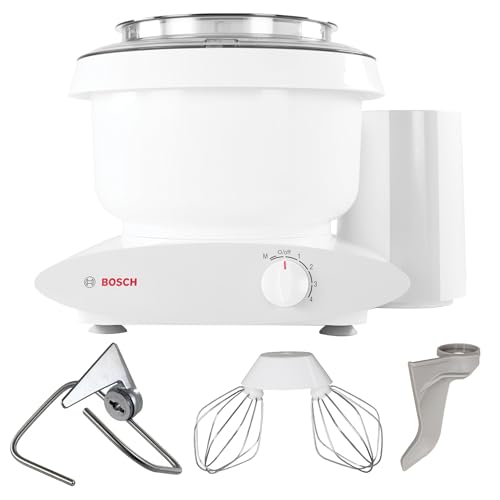
Bosch Universal Plus Stand Mixer 500 Watt, 6.5 Quarts, Bundle — Best for Bread Dough
Badge: Best for Bread Dough. The Bosch Universal Plus ignores the tilt-head template entirely. Its motor sits in the base and drives the bowl from below, which leaves the top open for adding ingredients and lets the machine knead large, stiff doughs that stall overhead-drive rivals. This bundle pairs the 6.5-quart bowl with wire whips, the dough hook and a NutriMill dough hook extender. Check the current price on Amazon.
Strengths
- Bottom-drive torque excels at large, stiff bread doughs
- Open-top bowl makes adding ingredients mid-mix easy
- 6.5 qt capacity for serious batch baking
Trade-offs
- Unconventional design has a learning curve
- Whipping small volumes is less its strength than dough
- Bundle configuration varies — confirm contents on the listing
| Spec | Detail |
|---|---|
| Capacity | 6.5 qt bowl |
| Design | Bottom-drive |
| Motor | 500W |
| Included | Wire whips, dough hook, dough hook extender (bundle) |
Bread bakers are the Bosch’s constituency. The bottom-drive system kneads without the head-rocking that afflicts tilt-heads under stiff loads, and the bowl handles the multi-loaf batches that home bread routines actually produce — several loaves at once, frozen or gifted through the week.
The trade is versatility of feel: the Bosch whips and creams competently, but the experience is engineered dough-first. If your baking is 70 percent bread, that priority is exactly right; if it is 70 percent cakes, the KitchenAid and Cuisinart picks serve you better.
Note the bundle logic before ordering: Universal Plus packages vary in which whips, hooks and extenders are included, and the dough hook extender in this bundle is the piece bread bakers actually write home about, because it improves how the hook engages smaller doughs. Confirm the listing’s contents match the review — with Bosch bundles, the configuration is the product.
Best for: bread bakers and large-batch dough work / Not suited for: cake-led bakers or buyers wanting the classic stand mixer experience
Check on Amazon if this pick matches your kitchen and the way you actually cook.

KitchenAid 7 Quart Bowl-Lift Stand Mixer KSM70, Cast Iron Black — Best for Big Batches
Badge: Best for Big Batches. The KSM70 is KitchenAid’s big-batch flagship: a 7-quart bowl-lift machine with 11 speeds — including a half-speed designed for gentle folding — and an accessory set headlined by a double flex-edge beater that scrapes the bowl as it mixes. In Cast Iron Black it also happens to be one of the best-looking objects in the category. Check the current price on Amazon.
Strengths
- 7 qt capacity for double and triple batches
- Half-speed folding setting protects delicate mixtures
- Double flex-edge beater reduces scraping stops
Trade-offs
- Large, heavy and priced as a flagship
- Oversized for small daily jobs — minimum batches whip poorly in a big bowl
- Needs a permanent, spacious counter home
| Spec | Detail |
|---|---|
| Capacity | 7 qt bowl |
| Design | Bowl-lift |
| Speeds | 11, including 1/2 speed for folding |
| Included | Double flex-edge beater and 4 other accessories |
Capacity is a workflow feature: the KSM70 turns holiday baking from a sequence of half-batches into single runs, and its bowl-lift rigidity keeps those full loads composed. The half-speed matters more than it sounds — folding beaten egg whites or a delicate mousse at the lowest conventional speed still deflates them; the half-speed exists precisely for that moment.
Be honest about minimums, though. Two egg whites in a 7-quart bowl barely reach the whip. Households whose daily jobs are small should pair this flagship with a hand mixer — or choose the 5.5-quart KSM55 and skip the flagship entirely.
The KSM70’s accessory kit deserves a second look: five included pieces led by the double flex-edge beater means the flagship arrives complete, with no first-month extras to buy. Priced against rivals whose headline cost excludes the beater you actually want, the flagship’s real premium is smaller than it first appears — a recurring theme in honest deluxe math.
Best for: batch bakers, large households and holiday-scale cooking / Not suited for: small households or small daily batches
Check on Amazon if this pick matches your kitchen and the way you actually cook.
Comparison Table
Bowl size and drive design decide a counter mixer more than any other specs. Line your typical batch up against this table, then confirm with the review.
| Pick | Badge | Key spec | Best for |
|---|---|---|---|
| KitchenAid 5.5-Qt Bowl-Lift Stand Mixer KSM55, Porcelain White | Best Overall | 5.5 qt bowl-lift, 11 speeds | most households wanting one mixer for a decade of mixed baking |
| Cuisinart Stand Mixer SM-50, 5.5 Quart, White Linen | Best Value | 5.5 qt tilt-head, 12 speeds | value-focused bakers who want flagship features without flagship pricing |
| Hamilton Beach 4 Qt Electric Stand Mixer, 7 Speeds, Black | Best Budget | 4 qt, 7 speeds, 300W, carry handle | budget buyers, occasional bakers and kitchens where the mixer is stored between uses |
| KitchenAid Classic Series 4.5 Quart Tilt-Head Stand Mixer K45SS, Onyx Black | Best Compact Classic | 4.5 qt tilt-head, 10 speeds | smaller households wanting the KitchenAid ecosystem in a compact footprint |
| Bosch Universal Plus Stand Mixer 500 Watt, 6.5 Quarts, Bundle | Best for Bread Dough | 6.5 qt bottom-drive, 500W | bread bakers and large-batch dough work |
| KitchenAid 7 Quart Bowl-Lift Stand Mixer KSM70, Cast Iron Black | Best for Big Batches | 7 qt bowl-lift, 11 speeds + 1/2 | batch bakers, large households and holiday-scale cooking |
How to Choose the Best Counter Mixers: Bowl-Lift, Tilt-Head or Bottom-Drive?
The drive design is the first decision. Bowl-lift models lock the bowl to a rigid arm and never move the head — the most stable arrangement for stiff dough and the best choice for a permanent counter installation with overhead room. Tilt-head models pivot the head back for easy bowl and beater access; they are friendlier for cakes and everyday baking and fit under cabinets more easily, but flex more under heavy dough loads. Bottom-drive designs like the Bosch put the motor in the base, leaving the bowl open on top and delivering dough torque that embarrasses both rivals.
Match the design to your dominant job. Bread-led bakers: bowl-lift or Bosch. Cake-led bakers: tilt-head. Mixed bakers with a permanent counter spot: bowl-lift at 5.5 quarts is the category’s center of gravity, which is why it leads this guide.
- Bowl-lift for rigidity and permanent installation
- Tilt-head for access, cakes and under-cabinet fit
- Bottom-drive for maximum dough capacity
- Check overhead clearance for bowl removal on lift models
- Confirm the bowl size against your largest real batch, not your imagined one
What Bowl Size Do You Actually Need?
Bowl size cuts both ways. Too small and double batches overflow; too large and small jobs fail because two egg whites cannot reach the whip in a 7-quart bowl. As a working map: 4 to 4.5 quarts serves one-to-three-person households and standard single batches; 5.5 quarts is the family all-rounder; 6.5 to 7 quarts is for batch bakers, bread routines and holiday scale.
Flour capacity is the sharper test for bread bakers. A mixer that handles a kilo of flour comfortably will handle anything cake-shaped. If your signature bake is a double batch of sandwich loaves, start your shortlist at 5.5 quarts and a rigid drive, and treat smaller bowls as a false economy.
Attachments and Ecosystems: The Mixer’s Second Life
A counter mixer with a power hub is a platform. Pasta rollers, meat grinders, spiralizers, grain mills and ice-cream makers all run off the same motor, which is why the size of a brand’s attachment ecosystem belongs in the purchase decision. KitchenAid’s hub catalog is the deepest; Cuisinart and Bosch cover the core tools with their own systems.
Budget for the second life honestly: the mixer plus two attachments you will actually use beats a flagship machine whose hub stays capped. And check what is in the box first — several picks here include splash guards or flex-edge beaters that are paid extras elsewhere.
Counter Mixer Techniques: Creaming, Whipping and Kneading Done Right
Technique multiplies any mixer’s value. Creaming is aeration, not stirring: butter at cool room temperature, beaten with sugar at medium speed for several minutes until the color visibly pales — that trapped air is the cake’s structure, and no leavener fully rescues a skipped creaming stage. Whipping is the opposite discipline: cold cream, a clean bowl, high speed, and your full attention at the end, because the distance between soft peaks and butter is measured in seconds.
Kneading is where stand mixers earn their price, and where they are most often abused. The hook works at low speed — speed two is the classic ceiling — and the dough is ready when it clears the bowl sides and passes the windowpane test, stretching thin without tearing. Overfilled bowls and high speeds do not knead faster; they strain gears and overheat dough. Every pick in this guide kneads well inside those rules, and the guide’s capacity advice exists to keep you inside them.
The Attachment Roadmap: What to Add in Year One, Year Two, Never
Year one additions should extend what you already cook. For most households that means a second bowl — batch baking stops being a wash-between-batches relay — and a flex-edge beater if your model did not include one. Pasta rollers come next for the households that will genuinely roll pasta monthly; they are transformative for that habit and shelf-ornaments without it.
Year two is for the specialists: a grain mill for the bread baker who wants fresh flour, a meat grinder for the household that makes its own sausage and burgers, an ice-cream maker for the family that will use it weekly in summer. The ‘never’ list is personal but real — every ecosystem includes attachments bought for an imagined self. The discipline is to let a year of actual cooking, not the launch-day enthusiasm, write the roadmap.
Counter Mixer Care: Ten Minutes a Month for a Decade of Service
Stand mixers ask for almost no maintenance, which is why the little they ask gets skipped. Wipe the hub cap and shaft after messy mixes, wash attachments promptly rather than letting dough concrete onto hooks, and check the beater-to-bowl clearance twice a year — a quarter-turn of the adjustment screw restores factory mixing when normal wear opens the gap.
Store the machine with the bowl fitted and the head locked, keep the cord loosely coiled, and if your model has a planetary that can be regreased, let a service visit every several years handle it rather than opening the housing yourself. That is the whole liturgy. Machines maintained this way are the ones handed down — which, at this category’s prices, is the correct ambition.
Counter Mixers for Special Diets and Modern Baking
Modern baking has moved toward the stand mixer’s strengths. Gluten-free doughs and batters behave differently — wetter, stickier, more dependent on thorough, consistent mixing — and a planetary stand mixer handles them without the arm fatigue that makes hand mixing a barrier. High-hydration sourdoughs, enriched brioche doughs and nut-butter-based baking all reward the machine’s patience: long, controlled kneading and creaming that hands cannot sustain.
Plant-based baking leans on the whip: aquafaba meringues and whipped coconut creams need sustained high-speed aeration that is miserable by hand and trivial for a stand mixer. If your kitchen has moved in any of these directions, the counter mixer stops being a convenience and becomes the enabling tool — size it by your doughs, as this guide advises, and it will keep pace with the recipes.
What Professional Bakers Know That Spec Sheets Do Not Say
Professionals judge mixers by three unprinted qualities: how the machine behaves at minute eight of a knead, whether the bowl shape matches the beater shape through the whole batch, and how the controls feel with floury hands. Home buyers can borrow the tests: read for bowl-and-beater geometry in reviews, prefer controls you could operate wearing oven mitts, and treat any mixer that needs babysitting at minute eight as a mixer whose capacity claim is optimistic.
They also know that consistency beats power. A mixer that mixes the same way every time — same speeds, same action — produces recipes that work every time, and recipe reliability is what home bakers actually mean by ‘a good mixer.’ Every pick in this guide was chosen with that professional lens: boring, repeatable excellence over exciting specification.
Counter Mixers and the Rhythm of a Baking Household
A counter mixer reorganizes a household’s week in ways that do not appear in reviews. Dough mixed on Sunday becomes bread on Monday and pizza on Friday from the same batch’s second half. A birthday stops being a bakery order. The holiday cookie production that once consumed a weekend of hand creaming becomes an afternoon of pleasant machinery. Owners consistently report the same surprise: they did not buy a mixer, they bought back the recipes they had quietly stopped making.
The rhythm has a social physics too. A stand mixer on the counter invites participation — children who would never ask to stir will ask to operate the machine, partners develop opinions about crumb, and the kitchen gains a small permanent theater. This is not sentimentality; it is the observed mechanism by which an appliance becomes a household institution rather than a tool, and it is why the category’s best machines are kept for decades and mourned when they finally retire.
Plan for the rhythm when you buy: the mixer that anchors it must be sized for the household’s real celebrations, not its Tuesdays. The KSM70’s owner and the Hamilton Beach’s owner are both right — their households simply keep different rhythms, and this guide’s job is to match machine to rhythm rather than to declare one rhythm correct.
Reading Mixer Specifications Like an Engineer
Mixer spec sheets mix three kinds of numbers: the meaningful, the contextual and the decorative. Meaningful: bowl capacity in quarts, the drive design, the included attachments, and the machine’s weight — which predicts both stability and how often you will actually move it. Contextual: speed count, which matters only through the quality of the slowest and fastest gears, and wattage, which supports dough ability without determining it. Decorative: most of the rest, including any number that cannot be compared across brands because each brand measures it differently.
The engineer’s habit is to ask what a number predicts. Bowl capacity predicts your largest batch. Drive design predicts your stiffest dough. Weight predicts your storage pattern. Speed range predicts your flour clouds and your folding. When a listing leads with a number that predicts nothing you care about, it is telling you about its marketing, not its mixing — and the verified, model-level approach behind this guide exists to cut through exactly that.
Counter Mixers for Small Bakeries, Cake Businesses and Side Incomes
A growing number of home bakers sell what they make — celebration cakes, sourdough subscriptions, market-stall cookies — and the counter mixer decision changes character at that threshold. Throughput becomes the spec: batches per hour, dough per day, and a machine whose duty cycle treats a production morning as routine. Within this guide, that points to the Bosch for bread-led production, the KSM70 for mixed batch work, and a hard look at whether a second mid-range machine beats one flagship for parallel production.
Compliance enters too: food sold to the public may bring local rules about equipment and kitchens, and a mixer intended for commercial output should be chosen with those rules in view — the commercial-rated end of the wider category exists for a reason. Insurance, labeling and kitchen certification are beyond this guide’s scope, but the equipment advice is simple: buy for the production you can document, keep the machine’s paperwork, and let the business’s growth, not optimism, trigger the next upgrade.
For the pre-commercial baker — selling to friends, testing at a market — the mid-range picks here are the correct tools: capable enough to prove the concept, priced so the concept can fail without wrecking the household budget. The ladder exists in business as in baking: climb it on evidence.
The Sound of a Healthy Mixer: Listening to Your Machine
Experienced owners diagnose by ear. A healthy stand mixer has an even note at each speed, a planetary that turns without rhythmic knocking, and a motor note that deepens under load without straining into a whine. Changes in that soundscape — a new rattle at one speed, a clicking in the planetary, a burning smell after a normal load — are the machine asking for attention while the fix is still small.
Most causes are mundane: a beater clearance drifted, a hub attachment not fully seated, a bowl not locked, a load beyond comfortable capacity. Work through those before assuming the worst, and keep the manual’s troubleshooting page — the brands in this guide have heard every sound your machine can make. A mixer listened to is a mixer that gets serviced at the symptom stage, which is how the category’s decades-long ownership stories are actually written.
The Last Word: Buying Once, Buying Right
Counter mixers sit at the top of the kitchen’s price ladder, and the category’s culture — buy once, cry once — is basically sound, with one refinement this guide has argued throughout: ‘right’ means matched, not maximal. The right mixer is the one whose bowl fits your batches, whose drive fits your dough, whose footprint fits your counter and whose ecosystem fits your ambitions. Matched machines get used weekly for decades; maximal machines get admired monthly and resented quietly.
So the final advice is procedural. Name your three most-made recipes. Measure your counter and your cabinets. Decide your drive by your stiffest dough. Then let this guide’s six verdicts do their work. A counter mixer chosen that way stops being a purchase and becomes what the category’s best owners describe: the kitchen’s longest-serving, hardest-working resident.
One More Consideration: The Mixer and the Rest of the Bench
A counter mixer does not work alone, and its neighbors matter. A food processor handles the chopping and shredding the mixer should never attempt; a hand mixer covers the small jobs the big bowl resents; a kitchen scale — the baker’s true second instrument — makes every mixer in this guide perform better by making every batch consistent. When budgeting, reserve a little for that supporting bench rather than spending the last dollar on mixer specification you will not feel.
The bench also shares the counter, so think of the mixer purchase as a layout decision for the whole working surface: mixer, scale and ingredient storage in one reach, processor where its noise and bulk bother least. Kitchens arranged that way bake more, because the friction of starting falls below the threshold of a weeknight. That, in the end, is what every pick in this guide is for.
How to Set Up and Use a Counter Mixer for Better Baking
Place the mixer on a level counter with clearance for its head or bowl movement, plug it in directly, and wash the bowl and attachments before first use. Fit the beater and check the beater-to-bowl clearance with a sheet of paper — most models have an adjustment screw, and correct clearance is the difference between full mixing and a layer of unmixed flour at the bottom.
- Start every mix at the lowest speed and step up — flour clouds come from impatience
- Use the flat beater for batters and creaming, the whip for egg whites and cream, the hook for dough
- Add flour in stages for doughs and let the hook work at low speed; dough should clean the bowl sides
- Stop and scrape once mid-mix on tilt-heads without flex-edge beaters
- Cream butter and sugar longer than feels necessary — that aeration is your cake’s structure
- Wash attachments promptly; dried dough on a hook is the category’s most avoidable chore
For storage, keep the bowl on the machine to protect the drive, and coil the cord rather than wrapping it around the head. A counter mixer maintained this way is a decades-long appliance, not a seasonal one.
Common Buying Mistakes
The expensive mistake is buying capacity for imagined baking instead of real baking — in both directions. The second is ignoring overhead clearance and discovering the bowl-lift cannot be serviced under your cabinets. Measure, then buy.
- Sizing the bowl for holiday baking you do once a year
- Skipping the clearance check for bowl-lift and tilt-head swing
- Running dough at high speed — hooks work at low speeds
- Overfilling: a full bowl of stiff dough is how motors and gears die
- Ignoring the attachment ecosystem when comparing prices
- Storing a heavy mixer somewhere that discourages using it
Final Recommendation
Most households should buy the KitchenAid KSM55: rigid bowl-lift mechanics, the right bowl size, the deepest ecosystem. The Cuisinart SM-50 is the value answer and the better tilt-head workflow; the Hamilton Beach serves budget and storage-limited kitchens honestly. The K45SS Classic is the compact KitchenAid entry, the Bosch is the bread specialist’s machine, and the KSM70 is the flagship for people whose batches justify it.
Choose by dough and batch, in that order, and a counter mixer becomes the appliance you hand down rather than replace.
Ready to decide? Start with the shortlist: KitchenAid 5.5-Qt Bowl-Lift Stand Mixer KSM55, Porcelain White, Cuisinart Stand Mixer SM-50, 5.5 Quart, White Linen, Hamilton Beach 4 Qt Electric Stand Mixer, 7 Speeds, Black.
Keep exploring the cluster: Best Counter Top Mixers Best Cuisinart Mixers Best Deluxe Mixers Best Affordable Stand Mixers Best Compact Stand Mixers
Frequently Asked Questions
Is a bowl-lift or tilt-head mixer better?
Neither is universally better. Bowl-lift is more rigid for stiff dough and suits permanent counter placement; tilt-head gives easier access for adding ingredients and scraping, and fits under cabinets better. Cake-led bakers usually prefer tilt-head, bread-led bakers bowl-lift, and mixed bakers are well served by either at 5.5 quarts.
How many quarts should a family stand mixer be?
For a typical family, 5.5 quarts is the sweet spot: double cookie batches and a kilo of bread dough fit, while everyday jobs still mix properly. Smaller households do well at 4 to 4.5 quarts; batch bakers should look at 6.5 to 7 quarts.
Can a stand mixer really knead bread dough?
Yes — that is one of its core jobs. Use the dough hook at low speed and respect the flour capacity of your model. Bottom-drive and bowl-lift designs handle stiff doughs best; tilt-heads manage standard loaves but work harder on low-hydration doughs.
Are stand mixer attachments interchangeable between brands?
Generally no. Attachments are designed for a specific brand’s hub and mounting system. That is why the ecosystem belongs in the original purchase decision — you are choosing a platform, not just a machine.
How long should a good counter mixer last?
A metal-drive stand mixer from an established brand is a decades-class appliance with basic care: correct speeds for dough, no chronic overfilling, and prompt cleaning of attachments. Longevity is a major reason the category rewards buying the right machine once.
Do I need a stand mixer if I own a hand mixer?
Only if your baking volume or dough work justifies it. Hand mixers handle batters and whipping well. A stand mixer earns its counter when you knead dough, make large batches, or want hands-free mixing while you prep — the patterns covered by the picks in this guide.

