Disclosure: airfryerkitchensupply.com is reader-supported. When you buy through links on our site, we may earn an affiliate commission at no extra cost to you.
Where to buy
Our shortlist of the best commercial single group espresso machines is led by the Breville Dual Boiler (BES920XL), the most technically complete single-group machine for home bars, and the Diletta Bello+, the Italian heat-exchanger flagship. Traditionalists should shortlist the Rancilio Silvia and the Gaggia Classic Pro, experimenters the Fellow Espresso Series 1 with its pressure profiling, and romantics the La Pavoni Europiccola. Each model was verified against Amazon’s catalog before it earned a link; check price on Amazon for current availability, since single-group prosumer machines move in and out of stock by finish.
What is a single group espresso machine, and why does it matter?
A group is the part of an espresso machine where the portafilter locks in and hot water meets coffee. Café machines have two, three, or four groups so baristas can pull several shots at once. The best commercial single group espresso machines take that same commercial group engineering — the portafilter standard, the boiler metallurgy, the steam capacity — and build a machine around exactly one of them. For home use and for small cafés, food trucks, and offices, one group is not a compromise; it is the correct size, because a single skilled user can only run one portafilter at a time anyway.
What separates a true single-group commercial-style machine from a dressed-up appliance is everything around the group: a boiler (or two) sized for back-to-back drinks, a pump that holds steady pressure, a steam wand fed with real reserve, and construction that a technician can open and repair. Every pick in this guide clears that bar, and they divide into clear philosophies: dual-boiler precision (Breville), heat-exchanger simultaneity (Diletta), single-boiler tradition (Rancilio, Gaggia), electronic profiling (Fellow), and the pump-free lever (La Pavoni). Choosing among them is choosing how you want to make espresso, not whether you can.
One clarification for café-curious readers: a handful of these machines genuinely work in very light commercial duty — a small office, a boutique counter, a market stall — and their makers rate them accordingly. But their natural home is the serious home bar, and that is the use this guide grades for. Volume beyond a small queue of drinks is where multi-group machines earn their keep, and no honest guide should pretend otherwise.
In this guide
Quick Picks
- Best Overall: Breville Dual Boiler (BES920XL) — dual stainless boilers, PID control, and programmable pre-infusion in a single-group format. Check price on Amazon
- Best Heat Exchanger: Diletta Bello+ — E61 group, PID, shot timer, handmade in Italy, brews and steams at once. Check price on Amazon
- Best for Purists: Rancilio Silvia — brass boiler and iron frame from a commercial maker, serviceable for decades. Check price on Amazon
- Best for Pressure Profiling: Fellow Espresso Series 1 — 58mm portafilter, temperature control, heats in under two minutes. Check price on Amazon
- Best Value: Gaggia Classic Pro (RI9380/47) — commercial 58mm standard and a solenoid valve at the friendliest tier here. Check price on Amazon
- Best Lever: La Pavoni Europiccola (EPC-8) — manual lever extraction in chrome and brass, made in Italy. Check price on Amazon
How These Picks Were Chosen
We required a genuine commercial-pattern group: a full-size portafilter (58mm on five of six picks; the lever’s traditional smaller basket is the historical exception), metal thermal hardware, and steam performance that survives a second drink. We then graded temperature control — PID and profiling machines scored for precision, traditional machines for thermal mass and honesty — and serviceability, because a single-group machine is a ten-year purchase. Commercial relevance counted too: several picks are legitimately used in small cafés and offices, which tells you how their makers rate their own duty cycles.
Prices are omitted by design — this tier fluctuates with stock and finish — so reviews speak in tiers and leave the live figure to the listing. Machines we could not verify as current listings, including some respected boutique single-group names that sell only through dealers, were excluded rather than guessed. Two examples deserve naming because readers will wonder: compact Spanish and boutique lever makers with strong reputations had no verifiable machine listing in the catalog at check time, so they appear in this guide only as this note. When their distribution changes, the list can change with it; until then, we would rather recommend six machines we confirmed than ten we merely believe in. That verification discipline is also why every pick below carries a live catalog link rather than a dealer referral.
The 6 Best Commercial Single Group Espresso Machines

Breville Dual Boiler (BES920XL) — Best Overall
The Dual Boiler is the engineer’s answer to single-group espresso: two stainless boilers — one for extraction, one for steam — so temperature at the group is PID-held to a degree while steam waits at full pressure. Add programmable pre-infusion, a shot clock, an LCD that speaks plainly, and a heated group head, and you have the most controllable machine in this guide. It suits the home barista who measures, logs, and optimizes — and any small commercial counter that needs one group to behave like a much bigger machine.
Strengths
- Dual boilers give simultaneous brewing and steaming with PID stability.
- Programmable pre-infusion and shot clock support precise, repeatable recipes.
- Heated group and stainless boilers deliver café-grade temperature control.
Trade-offs
- Premium tier pricing and a substantial counter footprint.
- Descaling is a more involved, owner-level procedure than rivals’.
- No built-in grinder — a serious separate grinder is required.
| Spec | Detail (verified) |
|---|---|
| Model | BES920XL Dual Boiler |
| Boilers | Dual, stainless steel |
| Control | PID temperature, LCD display |
| Finish | Brushed stainless steel |
In the cup, the Dual Boiler’s advantage is boring consistency at a high level: the tenth shot tastes like the first because nothing thermal is left to chance. Pre-infusion control lets you coax sweetness from light roasts that punish lesser machines, and the steam boiler’s reserve textures milk for two drinks without the fade single-boilers show. The interface respects the user — temperatures, times, and alerts are displayed rather than hidden behind button codes — which shortens the path from unboxing to excellent. For a single group that must do everything, the Breville Dual Boiler remains the benchmark.
Ownership notes: this is a machine that rewards the full routine — filtered water above all, because its boilers and valves are precision parts that scale punishes quickly, plus scheduled descaling done properly rather than skipped. Owners who keep that discipline report café owners’ problems, not appliance problems: an occasional gasket, a pump after years of daily service, all of it serviceable. If your ambition is a home bar that behaves like a one-group café, this is the machine that ambition points to.
One underappreciated detail: the Dual Boiler’s descale and maintenance alerts are part of its precision story. Precision machines fail quietly when scale coats a sensor or a valve, so a machine that tracks its own water history and insists on care is protecting the very accuracy you paid for. Treat the alerts as features, keep the water filtered, and the BES920 holds its calibration the way a café machine under a service contract does. That contract-like relationship — performance in exchange for scheduled care — is the most commercial thing about it.
Best for: precision-focused home baristas and light commercial counters. / Not suited for: buyers wanting a built-in grinder or a minimalist mechanical machine.
Check the current price on Amazon
Diletta Bello+ — Best Heat Exchanger
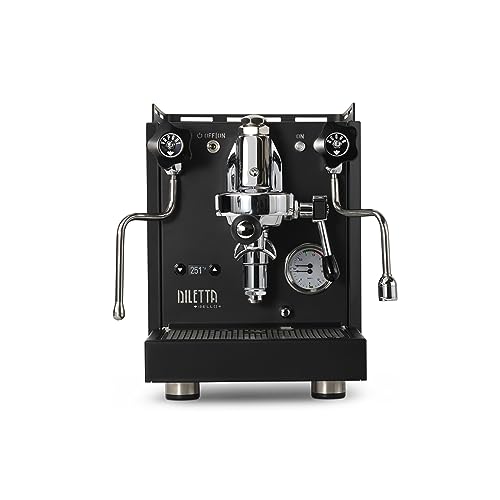
The Bello+ expresses the Italian answer to the single-group brief: one E61 group fed by a heat-exchanger boiler, so espresso and steam are both always ready, wrapped in hand-finished Italian casework with PID control and a shot timer. It suits the drinker who wants café flow — shot, steam, serve, repeat — with the tactile pleasure of the E61’s mechanical pre-infusion and a manual lever-style group valve. Among single-group machines it is the connoisseur’s aesthetic choice as much as a technical one.
Strengths
- Heat exchanger brews and steams simultaneously through one boiler.
- E61 group gives mechanical pre-infusion and huge accessory support.
- PID, shot timer, and programmable pre-infusion modernize the classic layout.
Trade-offs
- Heat-exchanger temperature management uses a cooling-flush ritual.
- Premium tier, and the footprint of a small café machine.
- No built-in grinder; budget accordingly.
| Spec | Detail (verified) |
|---|---|
| Group | E61 |
| Boiler type | Heat exchanger |
| Control | PID, shot timer, programmable pre-infusion |
| Origin | Handmade in Italy |
The Bello+ makes milk drinks feel like a performance instead of a queue. While one shot extracts, the milk for the next is already at texture; the E61’s brass mass smooths temperature in a way electronics alone cannot; and the whole machine communicates through feel — the group lever’s resistance, the steam valve’s sweep — in the language Italian cafés have spoken for sixty years. Shots skew sweet and full-bodied, the classic E61 signature. If your single group must serve a household of latte drinkers at breakfast pace, the Diletta Bello+ is the fluent choice. Its Italian lineage is explored further in Best Commercial Italian Espresso Machines.
Practical ownership: learn the cooling flush — a few seconds of water through the group after idle time — and the heat exchanger’s one ritual is mastered. Parts follow E61 standards shared across dozens of makers, so the long-term parts picture is the best in this guide alongside the Gaggia’s.
There is also a social dimension to the heat exchanger that spec sheets miss. Because the Bello+ never asks a guest to wait through a mode change, the person making drinks stays in the conversation instead of disappearing into a sequence of beeps and waits. Espresso at home is usually hospitality, and the machine that keeps the host present is doing quiet, important work. Combined with the E61’s forgiving pre-infusion — which smooths over the distribution flaws that happen when you are talking while tamping — the Bello+ is the most gracious entertainer in this guide.
Best for: milk-drink households wanting café flow from a single Italian group. / Not suited for: minimalists or anyone needing a compact machine.
Check the current price on Amazon
Rancilio Silvia — Best for Purists
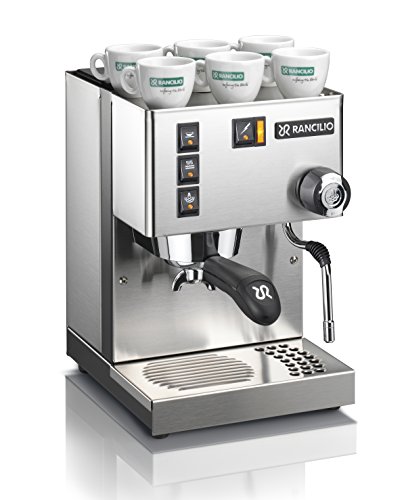
The Silvia is the single-group machine as commercial tool, minus decoration: one group, one brass boiler, an iron frame, and a steam wand that would not embarrass a café. Rancilio’s commercial division DNA is in every switch and fitting. It suits the purist who wants the fewest possible electronics between intention and extraction, and who values a machine their grandchildren could theoretically still descale. In single-group terms, it is the durability benchmark of this guide.
Strengths
- Brass boiler and iron frame: the heaviest-duty build in its tier.
- Commercial-pattern 58mm group with a vast accessory ecosystem.
- Steam power that teaches real café milk technique.
Trade-offs
- Single boiler: brewing and steaming alternate, with a temperature wait.
- No factory PID or timer — control is the operator’s job.
- Requires a serious separate grinder to show its quality.
| Spec | Detail (verified) |
|---|---|
| Portafilter | 58mm commercial style |
| Boiler | Brass, single |
| Frame | Iron, stainless panels |
| Maker | Rancilio, Italy |
What the Silvia offers a single-group buyer is thermal honesty. The brass boiler and group hold a steady temperature through the shot, and the machine tells you the truth about your grind and distribution because nothing electronic intervenes. Steam is its party piece: dry, forceful, and fast in a small pitcher, exactly the skill a one-group café lives on. Owners mod them, repair them, and keep them for decades; the secondhand market’s respect for old Silvias is the market’s verdict on the design. The Rancilio Silvia is the single-group machine for buyers who plan in decades.
Set expectations correctly: warm-up is a real half hour for full thermal saturation, and milk drinks for a table require rhythm and patience. For one or two drinkers, neither matters by the second week — the routine becomes muscle memory, and the shots justify everything.
The Silvia also makes an unusually good second-hand story in reverse: because they last, owners rarely sell them cheap, and a used Silvia with a service history is one of the few appliances that holds real value. Buying new simply starts that clock with you. Either way, the ownership proposition is the same — a machine whose every failure mode is known, documented, and fixable with parts that remain in production. In a category full of sealed boxes with five-year horizons, the Silvia’s open, mechanical honesty is a feature that compounds in value every year you keep it.
Best for: purists planning decade-long ownership of a commercial-pattern group. / Not suited for: high-volume milk service or automation seekers.
Check the current price on Amazon

Fellow Espresso Series 1 — Best for Pressure Profiling
Fellow built its name on design-led kettles and brewers; the Espresso Series 1 is its swing at the single-group crown, and the specification is ambitious: pressure profiling, a 58mm portafilter, temperature control, a steam wand for lattes and cappuccinos, and heat-up in under two minutes — café experimentation without the café warm-up. It suits the data-curious home barista who wants to explore how pressure shapes flavor, shot by shot, in a machine designed for a modern counter.
Strengths
- Pressure profiling opens flavor experiments no traditional rival here offers.
- 58mm portafilter keeps the full commercial accessory universe available.
- Heats in under two minutes — profiling without the boiler wait.
Trade-offs
- A new platform: long-term durability evidence is still accumulating.
- Profiling rewards experimenters; casual users may never open the menus.
- Premium tier for a first-generation machine.
| Spec | Detail (verified) |
|---|---|
| Portafilter | 58mm |
| Signature | Pressure profiling |
| Heat-up | Under 2 minutes |
| Controls | Temperature control, steam wand |
Profiling is not a gimmick; it is how top cafés coax sweetness from light roasts — gentle pressure early, a decline late — and the Series 1 puts that lever in home hands with an interface designed by people who make software-feeling hardware. The fast heat-up changes the machine’s role: it can be an occasional-use instrument, fired up for one considered shot, rather than a boiler you keep warm all morning. Early build impressions match Fellow’s kettle reputation for finish. The Fellow Espresso Series 1 is the single-group pick for experimenters who found traditional machines too finished — this one invites play.
The honest caveat is platform age. The Silvia’s twenty-year evidence base cannot be claimed by any new machine, Fellow’s included. Buyers who prize experimentation over track record will accept that trade happily; buyers who do not have two excellent traditional options above.
What can profiling actually do for a home drinker? Three things, concretely. It rescues light roasts, whose density resists flat pressure, by starting gently and letting the puck saturate before full force. It softens the finish of dark roasts by declining pressure late, trimming the bitter edge. And it turns every new bag of beans into a small research project with visible, tastable results — which, for the experimenter, is not a burden but the entire hobby. The Series 1’s fast heat-up means those experiments can happen on a whim, one shot at a time, instead of requiring a warmed boiler and a free morning.
Best for: experimenters who want pressure profiling and fast heat-up in a 58mm format. / Not suited for: track-record-first buyers or lever romantics.
Check the current price on Amazon

Gaggia Classic Pro (RI9380/47) — Best Value
Every category needs its gateway, and in single-group espresso the gateway wears a Gaggia badge. The Classic Pro delivers the commercial essentials — 58mm portafilter, traditional boiler, three-way solenoid valve — at the most accessible tier in this guide, in a compact Italian-made body. It suits first-time single-group buyers, small counters, and anyone who wants to learn the craft on real standards before spending flagship money. Its ceiling, raised by the largest modding community in espresso, is far above its entry point.
Strengths
- Full commercial 58mm standard at an entry tier.
- Solenoid valve enables backflushing and dry, knock-out-ready pucks.
- Compact footprint suits small home bars and offices.
Trade-offs
- Single-boiler pacing for milk drinks, like the Silvia.
- Basic stock temperature control; consistency is technique-led.
- Steam wand is good, not class-leading.
| Spec | Detail (verified) |
|---|---|
| Model | RI9380/47 |
| Portafilter | 58mm commercial style |
| Valve | Three-way solenoid |
| Origin | Made in Italy |
The Classic Pro’s value is not that it is cheap; it is that nothing essential was removed to make it so. The group standard is the real one, the boiler is a real boiler, and the skills you learn transfer unchanged to any machine in this guide. Start on the pressurized basket if you must, graduate to the traditional basket with fresh beans and a real grinder, and the shots become genuinely café-comparable. Later, if the hobby bites, the same machine accepts PID kits, pressure tuning, and precision baskets — growth without replacement. The Gaggia Classic Pro is the smartest first single-group machine most people can buy.
For offices and studios, its compact size and quick heat-up make it the one pick here that doubles as a workplace machine without a facilities conversation — a small commercial role it handles gracefully for a handful of daily users.
A word to the budget-conscious: the Classic Pro’s low entry tier does not make it the cheap option if you skip the grinder. Its honest requirement — a real burr grinder, fresh beans, a scale — is the same as the flagships’. What the Gaggia saves you is the machine premium, not the system cost, and buyers who understand that distinction are delighted; buyers who expected a magic box are the ones writing disappointed reviews of a genuinely good machine. Buy the system, and the Classic Pro is the best-value teacher in espresso.
Best for: first-time single-group buyers and small spaces wanting real standards. / Not suited for: back-to-back milk-drink service.
Check the current price on Amazon

La Pavoni Europiccola (EPC-8) — Best Lever
The Europiccola is the single group in its original form: one group, one small brass boiler, and a lever where the pump would be. You are the pump — raising the lever fills the group, and your arm’s pressure profile extracts the shot. Made in Italy in chrome and brass, it suits the drinker who wants espresso as a manual skill and a machine that occupies almost no counter. It is the oldest design in this guide and, in the right hands, still produces shots of rare sweetness.
Strengths
- Total manual control of pressure and flow — the original profiling.
- Near-silent, tiny-footprint, and mechanically simple to maintain.
- Brass and chrome construction with generational longevity.
Trade-offs
- The steepest learning curve here; early shots will disappoint.
- Small boiler limits consecutive drinks; heat management is manual.
- No pump, no electronics, no forgiveness features of any kind.
| Spec | Detail (verified) |
|---|---|
| Model | EPC-8 Europiccola |
| Type | Manual lever |
| Construction | Chrome and brass |
| Origin | Made in Italy |
Why does a lever belong in a commercial single-group guide? Because for the first decades of commercial espresso, the lever was the single group — café bars ran on human pressure before pumps took over, and the Europiccola preserves that entire technique in domestic form. The declining pressure of a well-judged pull spares the shot’s final seconds the harshness a flat pump profile can extract, which is why lever shots taste distinctly soft-edged and sweet. Ownership is a craft apprenticeship with a beautiful object. The La Pavoni Europiccola rewards exactly the buyers it warns off everyone else. Its larger sibling is covered in Best Commercial Italian Espresso Machines.
Practical notes: keep sessions to a few drinks, manage group temperature with a damp towel between rounds, and weigh your dose — small baskets punish estimation. Master those, and the Europiccola becomes the quietest, most satisfying corner of the kitchen.
Consider also what the Europiccola teaches that no other pick can: cause and effect, felt in the hand. When a shot runs fast, the lever tells you before the cup does — the resistance is wrong, and your arm knows it. That tactile feedback loop builds an intuition for extraction that transfers to every other machine and every café you will ever drink in. Owners describe the first month as tuition and every month after as fluency. If that sounds like a language you want to speak, there is no substitute on this page, at any price.
Best for: patient craft drinkers wanting the original single-group experience. / Not suited for: beginners in a hurry or group service.
Check the current price on Amazon
Comparison Table
| Pick | Badge | Key spec | Best for |
|---|---|---|---|
| Breville Dual Boiler | Best Overall | Dual boilers, PID | Precision and simultaneity |
| Diletta Bello+ | Best Heat Exchanger | E61 group, PID | Italian café flow |
| Rancilio Silvia | Best for Purists | Brass boiler, iron frame | Decades of service |
| Fellow Series 1 | Best for Pressure Profiling | Profiling, 58mm, fast heat | Experimenters |
| Gaggia Classic Pro | Best Value | 58mm, solenoid valve | First single-group buy |
| La Pavoni Europiccola | Best Lever | Manual lever, brass | Craft purists |
How to Choose a Single Group Espresso Machine
Start with simultaneity. If milk drinks for more than one person are routine, only the dual-boiler and heat-exchanger picks brew and steam together; everything else queues. Next, choose your control philosophy: electronic precision (Breville, Fellow), thermal tradition (Rancilio, Gaggia), or your own arm (La Pavoni). Finally, be honest about volume: a single group serves a household or a tiny counter beautifully and a brunch rush not at all.
Single boiler, heat exchanger, or dual boiler — which is right for one group?
Single boilers are simplest, cheapest to maintain, and sequential — ideal for espresso drinkers and one-latte households. Heat exchangers add simultaneous steam with one boiler’s simplicity, at the cost of a cooling-flush habit. Dual boilers give independent, PID-held temperatures for both jobs and the fastest milk workflow, at the highest price and complexity. Your drink mix, not your ambition, should decide.
Can a single group machine handle a small café or office?
The sturdier picks here — the Dual Boiler, Bello+, and Silvia — are genuinely used in micro-cafés, studios, and offices where volume means a drink every few minutes, not a queue. Add a commercial-grade grinder, a water filter, and a maintenance schedule, and one group can carry a small operation. A queue out the door is a two-group conversation.
What grinder does a single group machine deserve?
One with fine, repeatable adjustment and low retention — the machine’s ceiling is set at the burrs. None of the picks here includes a grinder, so treat the grinder as part of the purchase, not an accessory. Fresh beans, weighed doses, and a scale complete the café-in-miniature.
How much counter space does a single group setup need?
Plan a working zone, not just a machine footprint: the machine, a grinder beside it, and elbow room to tamp level, plus cabinet clearance to lift tanks and hoppers. The compact end of this list — the Gaggia, the Europiccola — fits a modest corner; the Dual Boiler and Bello+ want a dedicated coffee station. Measure before ordering, including the lever arc on the La Pavoni.
How to Run a Single Group Like a One-Person Café
Work in a fixed station layout: machine center, grinder on your strong side, knock box and scale within one step, cups warming on top. Warm the machine fully — a single group has less thermal reserve than a café machine, so a rushed warm-up shows in the cup. Pull shots in a steady rhythm: dose, distribute, tamp, lock, extract, and while the shot runs, stage the milk. On simultaneous machines, steam during extraction; on single boilers, steam immediately after and serve the drinks in the order the shots were pulled. Between drinks, a two-second group flush and a portafilter rinse keep flavors clean. End every session café-style: backflush if your machine supports it, wipe the wand, empty the tray. A single group rewards mise en place more than any other format, because you are the entire staff.
How to Dial In a Single Group Machine in the First Two Weeks
Week one is calibration, not judgment. Choose one fresh coffee and stay with it. Fix your dose by weight, pull a shot, and time it: under twenty seconds and sour means grind finer; over thirty-five and bitter means grind coarser. Change the grinder one small step at a time and pull a complete shot after each change, because retained grounds blur small adjustments. By the end of the week, a single-group machine’s honesty works in your favor — nothing is being auto-corrected, so when the shot lands in the sweet window, it stays there as long as your inputs do.
Week two adds milk and rhythm. Practice steaming to a vortex with the wand tip near the surface, then sink it to heat through, and pour immediately. Time a full two-drink cycle and notice where the machine — not you — is the bottleneck: on single boilers it is the steam transition; on simultaneous machines it is usually the human. Write your final recipe on a card: dose, yield, time, grind setting, milk notes. That card is your café’s recipe sheet, and it is what separates a home bar that is consistently good from one that is occasionally lucky. Every machine in this guide is capable of the former; the two weeks are how you claim it.
Common Buying Mistakes
- Expecting multi-group throughput. One group means one drink at a time; buy for your real queue length.
- Skipping the grinder budget. Every pick here needs a serious separate grinder to reach its ceiling.
- Choosing tradition when you needed speed. Single-boiler rituals delight hobbyists and frustrate rushed households; match the layout to your mornings.
- Ignoring water treatment in small venues. A café-used home machine scales like a café machine — filter the water.
- Buying a lever as a shortcut. The Europiccola is a craft commitment, not a convenience purchase.
Final Recommendation
For most serious home bars, the Breville Dual Boiler is the complete single-group answer: precision, simultaneity, and control in one chassis. Italian-flow lovers should choose the Diletta Bello+, purists the Rancilio Silvia, experimenters the Fellow Series 1, first-time buyers the Gaggia Classic Pro, and romantics the Europiccola. All six are one group, done properly. Whichever you choose, spend the first two weeks dialing in with one coffee, keep the water filtered and the wand wiped, and the machine will settle into the background of your mornings while the drinks stay in the foreground — the surest sign that a single group was the right size all along.
Widen the view with Best Commercial Espresso Machines For Home Use and Best Commercial Quality At Home Espresso Machines, or shrink it with Best Compact Espresso Machines.
What Does a Single Group Machine Need Around It?
The machine is the center of a system, and the system decides your results. First, the grinder: fine, repeatable adjustment with low retention, sized for your drink volume. Second, water: a filter pitcher or in-tank filter at minimum, because a single boiler or heat exchanger concentrates the effects of scale in a small volume. Third, the small tools cafés treat as infrastructure — a scale for doses, a knock box, a tamper that fits your basket properly, and a milk pitcher matched to your drink size. Fourth, fresh beans in quantities you finish within weeks. None of this is optional decoration; it is the difference between a single-group machine performing like café equipment and performing like an expensive kettle. Budget the system, not just the machine, and every pick in this guide will taste like the reviews promise.
How to Maintain One Group So It Lasts Like Commercial Equipment
Commercial machines survive on schedules, and one group is easy to keep on one. Daily: flush the group for two seconds before the first shot and after the last, purge and wipe the steam wand after every use, and empty the drip tray before it becomes a science project. Weekly: backflush with water where a three-way valve allows, soak the portafilter and baskets, and brush the shower screen. Monthly: detergent backflush, grinder chamber clean-out, and a check of the group gasket’s seal — drips at the portafilter during extraction mean the gasket’s year is up. Seasonally: descale or refresh filtration according to your water, and inspect steam tips and wand joints for milk residue. Keep the dates in a notebook by the machine. The reward for this modest discipline is the thing this entire category promises: a machine that pulls its ten-thousandth shot like its hundredth.
Single Group vs. Compact Machines: Where Is the Line?
Readers cross-shopping our compact roundup should understand the dividing line, because several compact machines are also single-group in the literal sense. The line is intent and construction. A commercial single-group machine is built around a full-size group and boiler hardware meant for continuous, serviceable duty; a compact machine is built around a footprint, using thermoblocks and smaller baskets to fit small kitchens. The Gaggia Classic Pro sits near the line from the commercial side — small body, real standards. The Dedica-class machines sit on the other side. Neither is wrong; they optimize different scarcities, counter space versus duty cycle. If your constraint is space, read the compact guide; if your constraint is performance per group, you are in the right article.
What Should a Small Business Know Before Buying One?
Three practical points for the offices, studios, and micro-cafés considering these machines commercially. First, health and electrical codes vary by venue; a home-rated machine in a public business can raise questions a light-commercial rating answers, so check your local requirements before the machine becomes infrastructure. Second, water filtration is not optional at commercial volumes — budget a proper filter, not a pitcher. Third, throughput math: one group, one drink every two to three minutes with milk, sustained. If your peak exceeds that, you do not need a better single group; you need a second group. Within those honest limits, the sturdier picks here serve small operations admirably and at a fraction of multi-group cost.
Who Should Skip the Single Group Format Entirely?
Three households, honestly. The large family that queues six milk drinks before school needs either a flagship automatic’s speed or a multi-group conversation this category cannot have. The drinker who wants espresso twice a month will never keep beans fresh enough to justify any of these machines — a compact model or a café habit serves them better. And the buyer with no interest in process at all — no weighing, no dialing, no wiping — should buy the best automatic their budget allows, because a single-group manual machine owned resentfully makes worse coffee than a good automatic owned gladly. For everyone else — the daily drinker, the hobbyist, the small business, the household of two to four — one commercial-pattern group is not a limitation. It is the size espresso was always meant to be at home.
Which Accessories Actually Matter for a Single Group Setup?
Four, in priority order. A scale that fits under your cup with a timer — it converts dialing-in from guesswork into arithmetic and costs less than a bag of good beans. A tamper that truly fits your basket; the 58mm standard makes this easy, and a sloppy fit channels shots no machine can rescue. A knock box, because rapping a portafilter on a trash can rim eventually bends something. And a milk pitcher sized to your usual drink — too large wastes milk and control, too small overflows. Beyond those, a distribution tool and a bottomless portafilter are the two upgrades that teach the most, in that order, and both exist because the commercial standard makes them universal. Everything else — mats, stands, designer cups — is garnish. Buy the four, master them, and add garnish when the drinks already deserve it.
A last word on expectations, because single-group machines attract two kinds of disappointment, both avoidable. The first is the buyer who expected café volume and found a queue; the format was never hiding that — one group is one drink at a time, gloriously. The second is the buyer who expected appliance ease and found a craft; again, the machines were honest, and the guided automatics in our companion guides exist for that reader. Come to a single group wanting what it actually is — café engineering at human scale, asking skill and returning mastery — and it is the most satisfying format in home espresso. That is why this category, alone among kitchen appliances, has owners who keep the same machine for twenty years and still describe morning coffee as the best part of the day.
Everything in this guide was checked against live catalog data before publication, and the picks will be revisited as models and listings change — espresso is a moving market, and a buying guide should move with it.
Frequently Asked Questions
What does “single group” mean on an espresso machine?
It means one group head — one portafilter station. Café machines run two to four groups for parallel drinks; a single-group machine serves one drink at a time, which matches a home bar or a very small commercial counter perfectly. The format’s constraint is also its charm: every drink gets the operator’s full attention, the machine’s full thermal reserve, and a workflow simple enough to master completely — three things that get harder, not easier, as machines grow.
Is one group enough for a family?
For two to four drinkers, yes, especially with a dual-boiler or heat-exchanger model that steams while it brews. For a household that queues six lattes at breakfast, the honest answer is that you will feel the format’s limit — choose the simultaneous machines and work in a rhythm.
Which single-group machine is best for a small café?
The Breville Dual Boiler and Diletta Bello+ handle light commercial duty most gracefully, with the Silvia as the durability-first alternative. All need filtered water, a commercial grinder, and scheduled maintenance to live a café life.
Do single-group machines need special plumbing or power?
None of these six does. All run on household power with refillable tanks, which is precisely their advantage over true commercial machines that demand water lines, drainage, and higher-amperage circuits.
Are single-group machines loud?
Vibration-pump models have a characteristic buzz during extraction; rotary-pump and lever machines are quieter, and the Europiccola is nearly silent. None approaches grinder noise, which remains the loudest thirty seconds of any coffee routine. If early-morning silence matters, the fast-heating and lever picks are the considerate choices for a sleeping household.
What is the difference between a heat exchanger and a dual boiler?
A heat exchanger runs one boiler at steam temperature and passes brew water through a coil inside it, giving simultaneous steam with one boiler. A dual boiler keeps two independent boilers at their own temperatures, giving the most precise control. Both beat a single boiler for milk-drink pace.
How long do single-group machines take to warm up?
It depends on the thermal design. Boiler classics like the Silvia want twenty to thirty minutes for full saturation — most owners use a smart plug on a timer so the machine is ready when they are. The Bello+’s E61 group similarly rewards a proper warm-up. The Fellow Series 1 is the exception in this guide, heating in under two minutes by design, and thermoblock-style machines elsewhere trade that speed against thermal mass. Match the warm-up to your routine: scheduled households suit boilers; spontaneous drinkers suit fast-heating designs.
Can I upgrade from the Gaggia to a flagship later without relearning?
Yes — that is the point of the 58mm standard. Dose, distribution, tamping, and milk skills transfer directly, and your accessories mostly transfer too. The Classic Pro is designed by its ecosystem to be a first machine, not a dead end. See also Best Commercial Espresso Machines For Home Use for the full landscape.


