Disclosure: airfryerkitchensupply.com is reader-supported. When you buy through links on our site, we may earn an affiliate commission at no extra cost to you.
Where to buy
Shopping for the best commercial espresso machines for home use starts with a shortlist you can trust, and the fastest route through it is to start with the two machines that cover most home bars: the Breville Barista Express if you want a grinder built in, and the Rancilio Silvia if you want commercial bones and already own a good grinder. Tinkerers should look at the Gaggia Classic Pro, speed-focused buyers at the Breville Barista Pro, guided-shot fans at the De’Longhi La Specialista Arte, and romantics at the La Pavoni Europiccola. Every model below was cross-checked against Amazon’s own catalog data before it earned a link, and stock on the Italian-built machines moves in waves, so check price on Amazon for the configuration you actually want.
Why “commercial” machines are crossing over into home kitchens
Shoppers hunting for the best commercial espresso machines for home use usually want one thing: a machine built like the ones cafés run all day, shrunk to fit a kitchen counter. That crossover market is real and growing, because the gap between a prosumer machine and a light-commercial machine is mostly about duty cycle, boiler metallurgy, and serviceability — not about the badge on the front panel. A true commercial machine is plumbed, runs on higher amperage, and is certified for continuous service; a commercial-style home machine borrows the 58mm portafilter standard, the heavy brass or stainless boiler, and the replaceable-everything construction, then runs it on a normal household outlet with a refillable tank.
That distinction matters for your wallet and your counter. Everything in this guide is genuinely usable at home without an electrician or a plumber, yet every pick shares DNA with café equipment: standard portafilter sizing, metal boilers instead of thermoblock-only toys, and parts you can actually buy years later. We also kept expectations honest. None of these machines will forgive stale beans or a cheap grinder, and the lever machine on this list will actively punish impatience for the first month. What they will do is pull shots that hold up next to a good café’s output, steam milk with real pressure behind the tip, and keep doing it for a decade if you descale and backflush on schedule.
One more reality check before the picks: “commercial” in a listing title is marketing as often as it is engineering. We filtered for substance — portafilter diameter, boiler material and size, pump type, and whether the manufacturer sells gaskets, screens, and switches as spare parts. Machines that failed that filter, however shiny, did not make the list.
In this guide
Quick Picks
- Best Overall: Breville Barista Express (BES870XL) — the complete home café station with a built-in grinder and a 67 oz removable tank. Check price on Amazon
- Best Commercial Build: Rancilio Silvia — a single-boiler machine derived from Rancilio’s commercial line, with a brass boiler and an iron frame that shrugs off decades. Check price on Amazon
- Best for Tinkerers: Gaggia Classic Pro (RI9380/47) — the modding community’s favorite, with a commercial-style 58mm portafilter and endless upgrade paths. Check price on Amazon
- Best for Fast Mornings: Breville Barista Pro (BES878) — near-instant heat-up and an intuitive interface that shortens the dial-in learning curve. Check price on Amazon
- Best Guided Experience: De’Longhi La Specialista Arte (EC9155M) — active tamping guidance and temperature control that help new users pull repeatable shots. Check price on Amazon
- Best Lever Machine: La Pavoni Europiccola (EPC-8) — a hand-pulled lever classic, chrome and brass, made in Italy since the design’s mid-century debut. Check price on Amazon
How These Picks Were Chosen
We started from the commercial end of the market and worked down, asking which machines a small café would recognize as relatives. The first filter was the group head: every pick uses or approximates the 58mm commercial portafilter standard, because that is where the deep aftermarket of baskets, tampers, and distribution tools lives. The second filter was thermal hardware — a metal boiler or a serious thermocoil — sized for back-to-back drinks rather than one shot and a long recovery sigh. Third came steam performance, judged by wand articulation, tip design, and how quickly the machine transitions between brewing and steaming. Fourth was serviceability: could we find the group gasket, shower screen, and pump listed as spare parts? Machines with sealed, disposable internals were cut.
Prices were deliberately left out of this article because they move constantly; the tier language in each review (mid-range, premium) tells you where a machine sits relative to the others, and the live listing tells you the rest. If a machine appears here without a link in some future update, that means verification lapsed — not that the machine got worse.
The 6 Best Commercial Espresso Machines for Home Use

Breville Barista Express (BES870XL) — Best Overall
The Barista Express is the machine that proved a home appliance could borrow commercial grammar — a 58mm-style portafilter workflow, a real steam wand, and dose control — and still be friendly enough for a first-time owner. It suits households that want one box on the counter instead of a separate grinder purchase, and it suits beginners who plan to grow: the pressure gauge, adjustable grind, and swappable baskets (single-wall for fresh beans, dual-wall for forgiving extraction) let your technique develop without replacing the machine. It is less suited to high-volume entertaining, because its thermocoil system brews or steams, not both at once.
Strengths
- Built-in conical burr grinder removes the second-appliance barrier entirely.
- Single-wall and dual-wall baskets included, so it grows with your skill.
- Analog pressure gauge gives honest feedback while you dial in.
Trade-offs
- Thermocoil design means brewing and steaming happen one at a time.
- The built-in grinder is good, not great — serious upgraders will outgrow it first.
- Large footprint once you account for the bean hopper and cup warmer.
| Spec | Detail (verified) |
|---|---|
| Model | BES870XL |
| Water tank | 67 oz removable |
| Grinder | Built-in conical burr |
| Baskets | Single-wall and dual-wall filter baskets |
What keeps the Express on top after all these years is shot quality per unit of effort. The low-pressure pre-infusion wets the puck gently before full pressure, which forgives minor distribution flaws, and the steam wand — a proper single-hole commercial-style wand, not a panarello sleeve — textures milk to a genuine microfoam with a bit of practice. In a home that makes two to six drinks a day, it behaves like a small café station: dose, tamp, lock, extract, steam, done. Maintenance is ordinary espresso hygiene: backflush with the included tablet routine, wipe the wand after every use, and descale on the machine’s reminder cycle. Owners who treat it that way routinely report many years of service, which is the real commercial trait — longevity through care, not through sealed-box luck. Order the Breville Barista Express if you want the shortest path from unboxing to café-style drinks.
Ownership is where the Express quietly wins friends. The cleaning cycle announces itself, the parts — drip tray, water tank, baskets, portafilter — come apart without tools, and the included accessories cover everything except a scale and a knock box. New owners should expect a week of mediocre shots while the grinder seasons and their tamping evens out; by week three, most households are producing drinks they would happily pay café money for. The dual-wall baskets deserve a special mention: they let you learn the machine’s rhythm with supermarket beans first, then graduate to fresh beans and the single-wall baskets when you are ready to taste what the machine can really do. That staged learning curve is a big reason this model converts more beginners into long-term home baristas than any rival here.
Best for: households wanting a complete, grow-with-you espresso station in one box. / Not suited for: hosts who need to steam and brew simultaneously for a crowd.
Check the current price on Amazon
Rancilio Silvia — Best Commercial Build
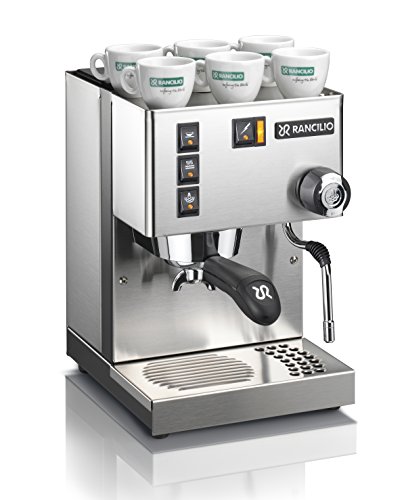
The Silvia is the closest thing on this list to a commercial machine that happens to be small. Rancilio builds café equipment for a living, and the Silvia inherits the family traits: an iron frame, a lead-free brass boiler, a commercial-grade 58mm portafilter, and a steam valve that feels machined rather than molded. It suits methodical home baristas who already own (or will buy) a capable grinder and who value a machine they can repair indefinitely. It does not suit anyone who wants push-button convenience — there is no PID from the factory, no shot timer, and temperature surfing is part of the ritual.
Strengths
- Brass boiler and iron frame deliver commercial durability at home scale.
- Articulating commercial-style steam wand produces true microfoam.
- Every wear part is available; the owner community documents every repair.
Trade-offs
- No built-in grinder and no factory PID — temperature management is manual.
- Single boiler means a wait between brewing and steaming.
- The drip tray is famously small; keep a towel nearby.
| Spec | Detail (verified) |
|---|---|
| Portafilter | 58mm commercial-style |
| Boiler | Brass, single boiler |
| Frame | Iron frame, stainless panels |
| Steam wand | Articulating, commercial style |
Shot quality is the Silvia’s argument. The heavy brass group and boiler hold temperature through the extraction in a way thermoblock machines cannot match, so sweet, syrupy shots are repeatable once your grinder is dialed. Steam power is the other headline: the wand tips milk over quickly, and the boiler’s recovery between drinks is honest café behavior scaled down. The ownership experience is old-school in the best sense — switches click, parts unscrew, and a machine bought today can plausibly be serviced in fifteen years with parts still on a shelf somewhere. Pair it with a serious grinder and it will embarrass machines costing far more in blind tastings. The Rancilio Silvia is the buy-once answer for purists.
Living with the Silvia means accepting two rituals and being rewarded for both. The first is the warm-up: give the boiler a genuine twenty to thirty minutes, or pull a blank shot through the portafilter to bring the group up to temperature, and your extractions will be noticeably sweeter. The second is temperature surfing — learning where in the boiler’s heating cycle to start your shot for the result you like. Owners who add a PID controller later describe it as the single best upgrade in home espresso, and the Silvia accepts that modification gracefully, which is precisely the point of buying a machine built from standard parts. The steam side needs no apology at all: dry, powerful steam that rolls milk in a small pitcher exactly the way a café wand does, once you learn to keep the tip near the surface for the first few seconds.
Best for: purists who want café hardware, café steam, and lifetime serviceability. / Not suited for: anyone who wants automation, a built-in grinder, or one-touch drinks.
Check the current price on Amazon

Gaggia Classic Pro (RI9380/47) — Best for Tinkerers
The Classic Pro is the hot rod of this list: a compact Italian single-boiler with a commercial 58mm portafilter, a traditional boiler, and the largest modification community in home espresso. It suits hands-on owners who enjoy the craft — and who may eventually add a PID, a pressure gauge, or a spring swap to tune the machine to their taste. In stock form it already pulls honest shots and steams respectably; its commercial-style portafilter and solenoid valve (which dries the puck and allows backflushing) put it a class above appliance-grade rivals. It is less suited to buyers who want the machine finished forever on day one.
Strengths
- Commercial 58mm portafilter and three-way solenoid valve at an accessible tier.
- Enormous parts, knowledge, and modification ecosystem.
- Compact footprint fits small counters and coffee corners.
Trade-offs
- Stock temperature control is basic; surfing is part of the routine.
- Single boiler, so milk drinks queue up one at a time.
- The steam wand is capable but less polished than the Silvia’s.
| Spec | Detail (verified) |
|---|---|
| Model | RI9380/47 |
| Portafilter | 58mm commercial style |
| Valve | Three-way solenoid |
| Origin | Made in Italy |
What makes the Classic Pro special is the ratio of ceiling to entry cost. The aluminum boiler heats quickly, the pump is a standard vibration unit you can replace on a kitchen table, and the group accepts the entire universe of 58mm baskets and tampers. New owners can start with the pressurized basket for forgiveness, graduate to the traditional basket, and keep the same machine through every stage. The Cherry Red finish of this listing also makes it the one machine here that doubles as counter décor. If your personality says “I will absolutely open this up someday,” the Gaggia Classic Pro is your machine.
The stock Classic Pro routine is simple to learn: let it warm up with the portafilter locked in, flush a second of water before locking in your dose, and watch the extraction rather than a timer you do not have. Shots that run pale and fast mean the grind is too coarse; shots that drip and choke mean it is too fine — the machine communicates honestly because nothing electronic is smoothing over your mistakes. That honesty is why the community loves it as a teaching tool. It is also genuinely Italian in the ways that matter: designed and assembled in Italy, with the traditional boiler layout that Gaggia has refined for decades. Add the wide availability of bottomless portafilters in the 58mm standard and you can watch your extractions from below, diagnose channeling at a glance, and improve faster than on any sealed appliance.
Best for: hands-on learners and modders who want commercial standards on a budget path. / Not suited for: set-and-forget buyers or high-volume milk-drink households.
Check the current price on Amazon
Breville Barista Pro (BES878) — Best for Fast Mornings
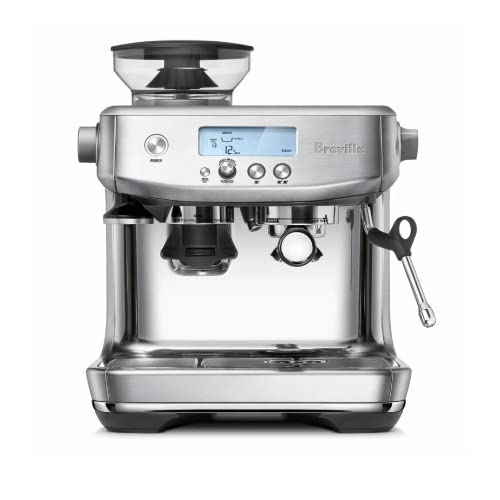
The Barista Pro takes the Express formula and fixes its two biggest frictions: heat-up time and feedback. Its ThermoJet system is ready in seconds rather than minutes, and the LCD interface walks you through grind amount, shot volume, and extraction timing with less guesswork. It suits busy households that make café drinks on weekday schedules — the machine that waits for you, not the other way around. Commercial credibility comes from the same 54mm portafilter workflow, stainless construction, and a proper steam wand. It is less suited to traditionalists who prefer a boiler’s thermal mass and the Silvia-style ritual.
Strengths
- ThermoJet heating is ready almost immediately — no warm-up ritual.
- Clear digital interface shortens the learning curve for new baristas.
- Built-in grinder and fast workflow make weekday lattes realistic.
Trade-offs
- 54mm portafilter ecosystem is smaller than the 58mm commercial standard.
- Thermocoil-style heating lacks a big boiler’s temperature inertia.
- More electronics on board than the purely mechanical rivals.
| Spec | Detail (verified) |
|---|---|
| Model | BES878, brushed stainless steel |
| Heating | ThermoJet fast heat-up |
| Grinder | Built-in, with grind size and amount controls |
| Interface | LCD display with shot guidance |
In daily use the Pro feels like the Express after a decade of user feedback. Shots pull with the same low-pressure pre-infusion gentleness, the steam wand is powerful for its class, and the whole drink cycle — grind, tamp, extract, steam — fits inside the time a kettle takes to boil. For a two-person household making morning lattes before work, that speed is not a luxury; it is the difference between using the machine daily and letting it gather dust. The Breville Barista Pro is the pragmatic pick when the calendar, not the palate, is the constraint.
The Pro’s interface deserves more credit than it usually gets. The display confirms grind amount and shot length in plain terms, so a second person in the household can reproduce your drink without a training session — a small thing that decides whether a machine becomes shared kitchen infrastructure or one person’s hobby corner. The automatic purge and fast recovery between drinks also mean a two-latte morning takes minutes, not a quarter hour. Where the Express asks you to build a ritual, the Pro tries to remove every second of friction between waking up and drinking well. If your household’s alternative is a daily café stop, the Pro’s speed is the feature that pays for the machine fastest, in both money and mornings.
Best for: busy households that want café drinks on a weekday schedule. / Not suited for: boiler traditionalists or 58mm-accessory collectors.
Check the current price on Amazon

De’Longhi La Specialista Arte (EC9155M) — Best Guided Experience
La Specialista Arte is De’Longhi’s answer to a real problem: most failed home espresso is a tamping and temperature problem, not a machine problem. Its guided approach — a tamping station concept, active temperature control, and a proper MyLatteArt steam wand — coaches consistency into the process. It suits newer home baristas who want commercial-style manual control without the months of uneven shots, and households that value a slim, handsome machine. It is less suited to purists who want zero electronic mediation between hand and puck.
Strengths
- Guided tamping and temperature control reduce beginner inconsistency.
- Dedicated MyLatteArt wand textures milk for latte art practice.
- Slim footprint and integrated grinder keep counters uncluttered.
Trade-offs
- Guidance systems add steps purists may find fussy.
- Single-circuit heating means brew and steam are sequential.
- Accessory ecosystem is brand-specific rather than universal 58mm.
| Spec | Detail (verified) |
|---|---|
| Model | EC9155M |
| Temperature | Active temperature control |
| Steam wand | MyLatteArt manual wand |
| Grinder | Built-in with dosing guidance |
The Arte’s party trick is repeatability. Shot after shot, the temperature stays where you set it and the tamp stays level, so when a shot tastes off you can blame the grind or the dose — variables you can actually fix. That feedback loop teaches faster than a fully manual machine does, which is why we recommend it to learners who are serious but not masochistic. Milk texture is a genuine highlight; the wand rewards practice with glossy microfoam suitable for hearts and tulips. Choose the De’Longhi La Specialista Arte if you want training wheels that do not look or feel like training wheels.
Two details separate the Arte from cheaper guided machines. First, the temperature control is active rather than a fixed thermoblock compromise, so light roasts — which need hotter water to extract their sweetness — are genuinely on the menu instead of a sour disappointment. Second, the tamping guidance produces a level, even puck, and a level puck is the unglamorous secret behind most café consistency. The machine’s cold-extraction and cold-brew style functions are a pleasant bonus for summer, but the core value is boring in the best way: the same shot, tasting the same, on a tired Tuesday as on a fresh Saturday. For learners, that stability turns guesswork into a controlled experiment, and controlled experiments are how palates get educated.
Best for: learners who want guided, repeatable manual espresso. / Not suited for: minimalists who want a purely mechanical machine.
Check the current price on Amazon

La Pavoni Europiccola (EPC-8) — Best Lever Machine
The Europiccola is espresso as craft object: a chrome-and-brass lever machine, made in Italy, whose design has been in production for generations. There is no pump. You raise the lever to fill the group, then pull it down with your own arm, feeling the extraction resist and yield. It suits patient romantics, small households, and anyone who wants to understand espresso at the level of pressure and feel. It does not suit anyone in a hurry, anyone making drinks for six guests, or anyone who expects the first month to taste good.
Strengths
- Manual lever control gives unmatched feel for pressure profiling.
- Brass boiler and chrome construction are beautiful and repairable.
- Near-silent operation and a tiny footprint by commercial standards.
Trade-offs
- The learning curve is the steepest on this list — weeks, not days.
- Small boiler limits back-to-back drinks; overheating management is manual.
- No automation of any kind: every variable is yours to control or ruin.
| Spec | Detail (verified) |
|---|---|
| Model | EPC-8 |
| Type | Manual lever, no pump |
| Construction | Chrome and brass |
| Origin | Made in Italy |
Why include a lever machine in a commercial roundup? Because before pumps, levers were commercial espresso — the original café machines worked exactly this way, and the Europiccola preserves that lineage in a home-sized form. When your technique lands — right dose, right grind, a smooth 25-to-30-second pull with steady resistance — the shots are famously sweet and textured, with a clarity pump machines struggle to copy. The ritual is the reward: this is the espresso equivalent of a manual transmission sports car. Buy the La Pavoni Europiccola for the journey as much as the destination.
A word about expectations, because the Europiccola inspires both devotion and classified-ad regret. Your first week of shots will range from sour to bitter, sometimes in the same cup, and the machine will get hot — the group is brass and it shows. Small rituals tame it: a cold portafilter swap or a wet towel on the group between drinks manages temperature, a kitchen scale keeps doses honest, and a two-drink session limit keeps the boiler in its sweet zone. What you are buying is not convenience but participation — the same direct connection to pressure and flow that café baristas had for half a century. Owners who embrace that framing keep these machines for decades and hand them down; owners who wanted a button sell them within a year. Know which person you are before ordering.
Best for: patient craft lovers who want total manual control and a design icon. / Not suited for: beginners in a hurry or anyone serving groups.
Check the current price on Amazon
Comparison Table
| Pick | Badge | Key spec | Best for |
|---|---|---|---|
| Breville Barista Express | Best Overall | Built-in grinder, 67 oz tank | Complete one-box home café |
| Rancilio Silvia | Best Commercial Build | Brass boiler, 58mm portafilter | Purists and lifetime ownership |
| Gaggia Classic Pro | Best for Tinkerers | 58mm portafilter, solenoid valve | Modders and hands-on learners |
| Breville Barista Pro | Best for Fast Mornings | ThermoJet heat-up in seconds | Weekday schedules |
| De’Longhi La Specialista Arte | Best Guided Experience | Active temperature control | Learners wanting consistency |
| La Pavoni Europiccola | Best Lever Machine | Manual lever, brass boiler | Craft romantics |
How to Choose a Commercial-Style Espresso Machine for Home
Start with the honest question: how many drinks, and how much ritual? A household making two morning lattes needs speed and forgiveness — the Barista Pro or La Specialista Arte. A household making weekend espresso as a hobby needs ceiling and feel — the Silvia, Classic Pro, or Europiccola. Everything else is refinement of that first answer.
Boiler, thermoblock, or thermocoil — what actually changes?
A metal boiler stores a volume of hot water, so temperature stays stable through a shot and steam is available with authority; the cost is warm-up time and, on single-boiler machines, a pause between brewing and steaming. Thermoblock and thermocoil systems heat water on demand — fast and compact, but with less thermal inertia, so technique matters more. Dual-boiler and heat-exchanger designs erase the brew-steam pause entirely, at a premium tier and a bigger footprint. For most homes, a good single boiler or a fast thermocoil is the sweet spot; the pause only hurts when you are serving a table of guests.
Why does the 58mm standard matter?
Because accessories are a long game. The 58mm commercial portafilter size gives you precision baskets, calibrated tampers, distribution tools, and replacement gaskets from dozens of makers, forever. Machines with proprietary sizes tie you to one brand’s catalog. If you expect espresso to become a hobby, buy into the standard; if you expect it to stay breakfast, the integrated Breville and De’Longhi ecosystems are perfectly fine.
How much grinder should you budget for?
The grinder decides your ceiling more than the machine does. If you buy a machine without a built-in grinder — Silvia, Classic Pro, Europiccola — reserve a serious share of the total budget for a burr grinder with espresso-fine, stepless or fine-stepped adjustment. Pre-ground coffee and blade grinders will make every machine on this list taste ordinary. Built-in grinder models trade a little ceiling for a lot of convenience, which is the right trade for most kitchens.
How to Set Up a Home Espresso Station That Works Like a Café
Placement first: put the machine where you can stand squarely in front of it, with the grinder (if separate) on your dominant-hand side and a knock box within one step. Fill the tank with filtered water — scale is the number-one killer of home espresso machines, and soft, filtered water slows it dramatically. On day one, run two blank shots to heat the group, then dial in with a single coffee you will finish before changing beans: adjust only the grind, keep dose constant, and taste every shot. Steam milk after the shot on single-boiler machines, purge the wand before and after, and wipe it immediately — baked milk is both a flavor and a hygiene problem. Weekly, backflush with water; monthly, backflush with espresso detergent and soak the portafilter and baskets. Write your working recipe (dose, yield, time) on a card by the machine; cafés run on written recipes, and your kitchen should too.
What Does the First Month of Ownership Actually Look Like?
Week one is humbling on every machine here except the most guided ones. Shots run fast, slow, sour, and bitter in rotation while you learn your grinder’s range and your tamp evens out. This is normal, and it is also where most returns happen — buyers mistaking the learning curve for a defective machine. Push through with one bag of one coffee, weighed doses, and notes on each shot, and the pattern emerges surprisingly fast.
Week two is when the first genuinely good shot lands, usually by accident, and the notes tell you how to repeat it. Week three is milk week: steam technique clicks in stages — first hot milk, then foam, then the glossy, paint-like microfoam that pours into a recognizable heart. By week four, the machine has a rhythm in your kitchen, the recipe card by the machine has your numbers on it, and the drinks are consistently better than the average café’s. That timeline is the honest price of commercial-style espresso at home, and it is why we steer true beginners toward the guided picks and purists toward the mechanical ones: the destination is the same, but the road should match your temperament.
Common Buying Mistakes
- Buying the machine and starving the grinder. A premium machine fed by a poor grinder produces expensive disappointment.
- Confusing “commercial” styling with commercial substance. Check the portafilter size, boiler material, and spare-parts availability, not the badge.
- Ignoring warm-up and workflow. A boiler machine you never wait for is a machine you stop using; match the design to your mornings.
- Skipping water quality. Hard water scales boilers and ruins shots; filtered water is the cheapest upgrade in espresso.
- Expecting café results in week one. Every machine here rewards a month of practice; budget the patience along with the money.
Final Recommendation
For most households, the Breville Barista Express remains the answer: complete, forgiving, and genuinely capable. If you already own a good grinder and want café hardware that outlives trends, buy the Rancilio Silvia. Tinkerers should start with the Gaggia Classic Pro and grow it. Busy mornings point to the Barista Pro, guided learners to the La Specialista Arte, and romantics to the Europiccola. Whichever you choose, pair it with fresh beans and filtered water, and it will earn its counter space. Keep exploring the cluster: Best Commercial Italian Espresso Machines, Best Commercial Single Group Espresso Machines, and Best Compact Espresso Machines each take one slice of this market deeper.
What Separates a True Commercial Machine From a Prosumer One?
Walk into a café and look at the machine on the bar: it is plumbed to a water line, drains to a floor drain, runs group after group without a recovery pause, and is built to be serviced in place by a technician who swaps a pump or a heating element between the morning rush and lunch. Its boilers are measured in liters, plural, and its frame is welded steel. Almost nothing about that package fits a home kitchen — not the power draw, not the plumbing, and not the expectation that a professional will maintain it monthly.
The prosumer machines in this guide borrow the parts of that formula that actually affect the cup and the ownership experience. The 58mm portafilter standard means your baskets and tampers are café parts. A brass or stainless boiler gives you the thermal stability that makes extraction repeatable instead of lucky. A commercial-style steam wand — articulated, with a proper tip — textures milk the way a café wand does, because it essentially is one. And the construction philosophy carries over: switches, valves, pumps, and gaskets that a competent owner or any espresso technician can replace with hand tools.
What you give up versus true commercial gear is throughput and simultaneity. A café machine brews and steams at the same time, indefinitely. A home single-boiler alternates, and even the fastest thermocoil design asks for a short transition. For a household making two to eight drinks a day, that trade is invisible. For a dinner party of ten milk drinks, you will feel it — which is why the buying guide below treats drink volume as the first decision, ahead of brand or budget.
What About Pumps, Power, and Plumbing?
Two pump families dominate this class. Vibration pumps are compact and affordable, build pressure with a characteristic ramp, and are inexpensive to replace when they eventually tire. Rotary pumps are quieter, deliver steadier pressure, and are the commercial standard — but they add cost, size, and complexity that most home machines skip. In the cup, a well-set vibration pump machine is not held back by its pump; grind and distribution matter far more. All six picks run on standard household power and refillable tanks, so no plumber or electrician is part of the purchase. Do leave counter clearance for the cup warmer and tank access, and measure your upper cabinets: lever machines like the Europiccola need vertical room for the full lever arc, and hopper-fed grinders need room to lift the lid.
How to Maintain a Commercial-Style Machine So It Lasts Like One
Commercial longevity is not magic; it is a maintenance schedule that cafés follow and home owners often skip. Daily: purge and wipe the steam wand after every drink, knock out the puck promptly, and rinse the portafilter. Weekly: backflush the group with plain water if your machine has a three-way solenoid valve, and wash baskets and the drip tray. Monthly: backflush with espresso-machine detergent, soak the portafilter and baskets, and clean the grinder’s burr chamber of stale oils. On your water’s schedule — every one to three months for most homes — descale or refresh the in-tank filter before scale starts insulating the boiler. Twice a year, inspect the group gasket: if the portafilter handle is rotating past its usual lock point or drips appear during extraction, a replacement gasket costs little and restores the seal. Keep a notebook with your descale dates and gasket changes. Owners who do this are the ones whose machines reach year ten still pulling sweet shots; owners who skip it meet the repair shop in year three.
Should You Buy a Used Commercial Machine Instead?
The classifieds always tempt: a retired café machine for the price of a new prosumer model. Sometimes it works out — for a buyer with a truck, a strong friend, a 220V circuit or a plumber’s number, and the budget for a professional descale and gasket overhaul before the first shot. More often it becomes a large, heavy project that also needs a commercial grinder to match. Our honest advice for most readers: buy the prosumer machine new, with a warranty and a tank you fill at the sink, and let the café machines stay in cafés. If you do go used, budget the service visit into the price and test steam pressure and group flow before money changes hands.
How to Pair These Machines With Beans and a Grinder
The machine is only the middle of the system. Behind it stands the grinder, and in front of it stand the beans, and both matter more to the final cup than the difference between any two machines on this list. Fresh beans — roasted within the last few weeks, ground seconds before extraction — are the single largest quality lever you control. A medium roast with a clear roast date will outperform an expensive stale bean on every machine here, every time. Store beans in their bag, sealed, away from heat, and buy in quantities your household finishes in two to three weeks.
For the machines without built-in grinders, choose a grinder by adjustment quality first and motor size second. Espresso lives in a narrow grind window, and the difference between a sour 18-second shot and a sweet 28-second shot can be a fraction of a millimeter of burr movement. Stepless adjustment, or fine steps clustered in the espresso range, is what you are paying for; timed dosing and low retention are what you enjoy daily. Flat burrs tend to emphasize clarity, conical burrs tend to emphasize body, and both can be excellent — buy the one whose workflow fits your counter and your patience for single-dosing versus a hopper.
Finally, weigh your doses. A small kitchen scale under the cup turns dialing-in from folklore into arithmetic: fix the dose, aim for roughly double that weight of espresso in the cup, and adjust only the grind until the shot lands in a 25-to-35-second window tasting balanced. Every café in the world works this way, and the home bar that adopts the habit is the one that stops blaming the machine.
One last piece of advice applies to every pick: buy the machine that matches the routine you actually have, not the one you imagine having in a quieter life. A fast, guided machine used daily beats a demanding classic used monthly, and a demanding classic in the hands of someone who loves the ritual beats everything. The hardware on this list is all capable of café-level drinks; the variable that decides your results is the match between machine, grinder, beans, and the person standing at the counter each morning.
Related guides
Frequently Asked Questions
Can a home kitchen actually run a commercial espresso machine?
A true commercial machine usually needs plumbing, drainage, and higher-amperage power. The machines in this guide are commercial-style prosumer models: café-grade groups, boilers, and portafilters adapted to a standard outlet and a refillable tank, which is the practical way to get café output at home.
Is a single boiler enough for milk drinks?
Yes, with a rhythm: pull the shot first, then switch to steam, texture the milk, and serve. The pause is roughly a minute. If you regularly make four or more milk drinks in a row, that pause is the argument for stepping up to a heat-exchanger or dual-boiler tier.
Do I really need a separate grinder?
Only if your machine lacks a built-in one. Espresso needs fine, consistent, adjustable grinding; a capable burr grinder is non-negotiable for the Silvia, Classic Pro, and Europiccola. Built-in grinder models like the Barista Express cover the requirement in one box.
How long do these machines last?
With descaling, backflushing, and gasket changes, the boiler machines here are routinely kept for a decade or more, precisely because their parts are replaceable. Longevity is the core reason to buy commercial-style construction.
What water should I use?
Filtered water with moderate mineral content. Distilled water tastes flat and can confuse level sensors; hard tap water scales boilers quickly. A simple carbon filter pitcher or an in-tank filter is enough for most homes.
Which pick is best for a small kitchen?
The Gaggia Classic Pro has the smallest footprint of the pump machines here, and the Europiccola is smaller still. If small is your top priority overall, see our companion guide: Best Compact Espresso Machines and Best Commercial Quality At Home Espresso Machines for the automatic side of the same question.

