Disclosure: airfryerkitchensupply.com is reader-supported. When you buy through links on our site, we may earn an affiliate commission at no extra cost to you.
Where to buy
Shopping for the best commercial bbq smokers grill rotisserie means shopping for freight-class equipment, so this guide links only to verified listings. Every linked pick below is sold through Amazon, which keeps ordering, delivery and returns in one place for a purchase this large. Use the links below to check price on Amazon and confirm the exact configuration before you commit:
- Broil King Baron 590 Pro Shadow 5-Burner Gas Grill — check price on Amazon
- Broil King Baron 490 Pro Shadow 4-Burner Gas Grill — check price on Amazon
- Broil King Baron S 590 Pro IR Gas Grill — check price on Amazon
- Monument Grills 77352 6+1 Burner Cabinet Gas Grill — check price on Amazon
- VEVOR 52-Inch Electric Rotisserie Grill Kit — check price on Amazon
- KEYO GRILL 29-Inch Barrel Charcoal Grill with Rotisserie — check price on Amazon
Commercial smokers are freight-class purchases for many buyers, so confirm liftgate delivery, pallet size and who unloads before checkout. A smoker that arrives on a pallet at the kerb is only a bargain if you have the staff and equipment to move it the last fifty feet.
Rotisserie changes what a smoker grill is for, and that is exactly why the best commercial bbq smokers grill rotisserie searches are so hard to shop honestly. A spit does three things a grate cannot: it bastes the meat in its own juices as it turns, it cooks whole animals and large roasts evenly from every side, and it turns the cooking itself into theatre that sells food before a single plate leaves the kitchen. The catch is that the heavy commercial rotisserie pits most people picture — the stainless gas rotisseries behind restaurant counters — are sold direct by their makers, not through Amazon. This guide is honest about that split: the linked picks are the largest verified grills and spit roasters with real rotisserie capability, and the buying guide explains the direct-sale class so you can shop both routes with open eyes.
Within the verified catalogue, rotisserie comes in three forms. Gas grills with a dedicated rear rotisserie burner give you a spit over controlled heat with the lid down — the closest thing to a counter rotisserie’s workflow. Barrel grills with manual or rack rotisseries pair charcoal smoke with turning meat for events and markets. And dedicated electric spit roasters — the big stainless frames rated for whole pigs and lambs — are pure rotisserie machines for caterers and festival cooks.
Choose by what actually goes on the spit. Whole birds and roasts under a lid suit the gas grills. Whole hogs and lambs for events demand the open spit roasters and the space to run them. The reviews below keep those jobs separate, because a rotisserie bought for the wrong animal is an expensive ornament.
In this guide
Quick Picks
If you need the short version of the best commercial bbq smokers grill rotisserie before the detail, start here. Each pick below earned its badge for a different commercial job, and the badge stays the same in the full review further down.
- Best Overall: Broil King Baron 590 Pro Shadow 5-Burner Gas Grill — restaurants adding proper rotisserie to a full-service gas grill line. — Check on Amazon
- Best for Smaller Kitchens: Broil King Baron 490 Pro Shadow 4-Burner Gas Grill — smaller restaurants and cafés that want real rotisserie without the largest footprint. — Check on Amazon
- Best Stainless Upgrade: Broil King Baron S 590 Pro IR Gas Grill — restaurants where the grill is visible to guests and presentation matters. — Check on Amazon
- Best for Grill Capacity: Monument Grills 77352 6+1 Burner Cabinet Gas Grill — high-volume outdoor kitchens that grill first and rotisserie second. — Check on Amazon
- Best for Whole Animals and Events: VEVOR 52-Inch Electric Rotisserie Grill Kit — caterers, festivals and restaurants running whole-animal events. — Check on Amazon
- Best Charcoal Rotisserie Combo: KEYO GRILL 29-Inch Barrel Charcoal Grill with Rotisserie — market stalls, pop-ups and small caterers wanting charcoal rotisserie on a budget-conscious footprint. — Check on Amazon
One rule before the detail: check the spit’s weight rating and the clearance under the lid or over the coals for the largest item you plan to cook, not the average one. Rotisserie regrets are almost always geometry regrets — a bird that will not clear the burner, a roast too heavy for the motor, a spit too short for the animal the menu promised.
How These Picks Were Chosen
Picks were chosen for genuine rotisserie hardware, not a spit-shaped accessory in the box. That means a motor and rod sized for food-service loads, a rear burner or heat layout designed for turning meat, and counterbalance or spit length appropriate to the job. Each pick was verified against the airfry site’s Amazon data before receiving a link, and the spec boxes quote only those verified listings.
Beyond the spit itself, commercial criteria applied as usual: cooking area for the non-rotisserie work the grill will also do, build weight that survives being moved and cleaned daily, and grease management, because rotisserie cooking rains fat continuously and a grill that cannot drain it will flare. Where a famous commercial rotisserie name is direct-sale only, it is covered in prose in the guide rather than given an invented link.
The 6 Best Commercial BBQ Smokers Grill Rotisserie Options Reviewed
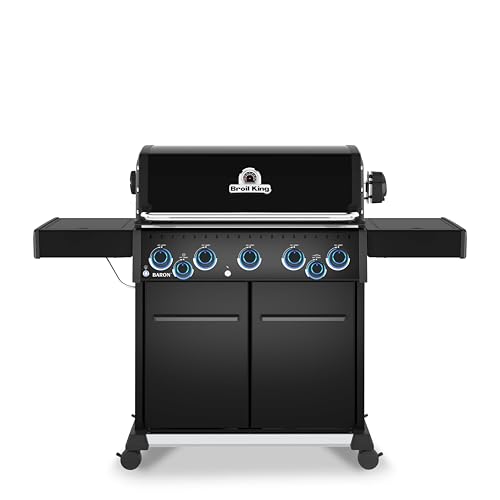
Broil King Baron 590 Pro Shadow 5-Burner Gas Grill — Best Overall
The Baron 590 Pro Shadow is the most complete rotisserie grill in this guide: a five-burner cabinet gas grill with a side burner and — the deciding feature — a dedicated rear rotisserie burner. That burner is what separates a true rotisserie station from a grill with a spit accessory: direct, even heat on turning meat with the lid down and the main burners free or off.
Strengths
- Dedicated rear rotisserie burner gives controlled, lidded spit cooking
- Five main burners plus a side burner cover the rest of the grill line
- Cabinet format fits a working restaurant patio or kitchen line
Trade-offs
- Gas rotisserie gives convenience, not wood-smoke depth
- Spit loads suit birds and roasts, not whole animals
- Large footprint for a grill whose rotisserie is one station among several
| Spec | Detail |
|---|---|
| Burners | 5 main burners plus side burner (per verified listing) |
| Rotisserie | Dedicated rear rotisserie burner |
| Fuel | Propane gas |
| Format | Cabinet-style gas grill |
In service terms, this is the rotisserie a line cook can run. Birds and roasts go on the spit, the rear burner does the work, and the five main burners keep the rest of the menu moving beside it. Add a smoker box with chips and the turning meat picks up gentle smoke without a second cooker. If rotisserie is a menu section rather than a special event, this is the machine that treats it that way.
Ownership and running costs: Ownership is where the Broil King Baron 590 Pro Shadow 5-Burner Gas Grill earns or loses its place after the first month. Its running costs are the ordinary ones for its class — fuel, chips or pellets where relevant, gaskets, probes and the occasional controller or burner part — and none of them should surprise a buyer who budgets a small maintenance line from day one. What protects the economics is routine: a five-minute check on a schedule catches the worn seal, the tired igniter or the ash-choked fire path while it is still a nuisance rather than a lost service. Kitchens that treat this machine as infrastructure, with a named owner and a log, report the familiar pattern of commercial equipment: boring reliability. Kitchens that treat it as a purchase, finished at checkout, meet the other pattern. The Broil King Baron 590 Pro Shadow 5-Burner Gas Grill rewards the first kind of owner, which is precisely the kind a business should be. The verified headline specification — 5 main burners plus side burner (per verified listing) — frames all of it: keep that number in view when you plan loads, staffing and space, and the machine will do the job its badge promises.
Best for: restaurants adding proper rotisserie to a full-service gas grill line / Not suited for: event cooks who need open whole-hog spit capacity
Check the current price on Amazon
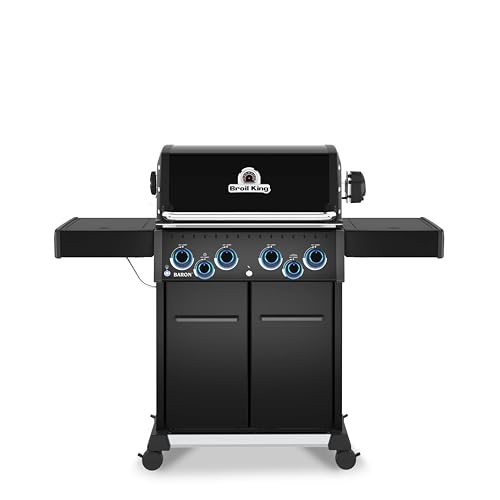
Broil King Baron 490 Pro Shadow 4-Burner Gas Grill — Best for Smaller Kitchens
The Baron 490 Pro Shadow keeps the feature that matters — the dedicated rear rotisserie burner — and trims the footprint around it. Four main burners plus a side burner is still a working grill line; it is simply the version for kitchens where the 590’s width is floor space they do not have.
Strengths
- Same rear-rotisserie-burner design as its bigger brother in a smaller footprint
- Side burner keeps sauces and sides at the grill station
- Four-burner line still covers a serious lunch service
Trade-offs
- Less grate space than the 590 for high-volume grilling
- Spit capacity sized for birds and roasts only
- Still a full cabinet grill to site and plumb
| Spec | Detail |
|---|---|
| Burners | 4 main burners plus side burner (per verified listing) |
| Rotisserie | Dedicated rear rotisserie burner |
| Fuel | Propane gas |
| Format | Cabinet-style gas grill |
Everything said about the 590’s workflow applies here at a smaller scale: lidded spit cooking on the rear burner, chips in a smoker box when the menu wants smoke, and the main grate free for service. Choose it when rotisserie is a strong menu section but the grill line shares space with other stations competing for the same metres.
Cleaning and daily care: Cleaning decides how long the Broil King Baron 490 Pro Shadow 4-Burner Gas Grill stays pleasant to run. Racks and drip paths want attention while they are still warm, when grease wipes rather than chisels; the fire or chip path wants its ash and residue cleared on a fixed rhythm rather than when performance visibly sags. Build both into the closing checklist with initials attached, because commercial cleaning that depends on memory happens exactly as often as memory allows. The good news is that nothing in this machine’s care routine is skilled work — it is timed work, ten minutes in the right places. The bad news is symmetrical: skip those ten minutes for a month and the machine will collect the debt in flavour, in temperature behaviour and eventually in a deep clean that takes an afternoon. Buyers choosing the Broil King Baron 490 Pro Shadow 4-Burner Gas Grill for smaller restaurants and cafés that want real rotisserie without the largest footprint should cost that daily ten minutes into the decision; it is the real subscription the machine charges. The verified headline specification — 4 main burners plus side burner (per verified listing) — frames all of it: keep that number in view when you plan loads, staffing and space, and the machine will do the job its badge promises.
Best for: smaller restaurants and cafés that want real rotisserie without the largest footprint / Not suited for: high-volume grill lines that need five burners of grate space
Check the current price on Amazon

Broil King Baron S 590 Pro IR Gas Grill — Best Stainless Upgrade
The Baron S 590 Pro IR is the presentable version of the same idea: stainless steel body, five burners, an infrared side burner for hard sears, and the rear rotisserie burner that defines this family. Where the grill line is visible — open kitchens, patios, chef’s counters — the stainless finish earns its keep.
Strengths
- Stainless build suits front-of-house and coastal environments
- Infrared side burner adds a true high-heat sear station
- Rear rotisserie burner matches the Pro Shadow’s spit workflow
Trade-offs
- Stainless shows every fingerprint and needs wiping to look its best
- Infrared searing is a bonus many menus will rarely use
- Same spit size class as the other Barons — birds and roasts
| Spec | Detail |
|---|---|
| Burners | 5 main burners (per verified listing) |
| Side burner | Infrared side burner |
| Rotisserie | Dedicated rear rotisserie burner |
| Body | Stainless steel |
The infrared side burner is the functional difference, not just the finish: it gives the station a genuine sear for finishing rotisserie items or cooking the steaks that share the menu. Workflow otherwise mirrors its siblings — spit on the rear burner, lid down, main burners working the rest of the ticket. Pick it when looks and the sear station both matter.
Staffing and workflow fit: In a working kitchen the Broil King Baron S 590 Pro IR Gas Grill is a colleague, and like a colleague it has a temperament the roster must fit. Its demands are predictable — loading, periodic checks, a defined cleaning moment — which makes it easy to write into prep sheets and shift plans. That predictability is worth more than raw capacity in most businesses, because the cook who runs it also runs three other things. Where this machine sits in the workflow matters too: close enough to the pass that checking it costs steps in single digits, far enough from the line’s traffic that its door is not opened by curiosity. Train the routine to two people, write the temperatures and timings on a card that lives with the machine, and the Broil King Baron S 590 Pro IR Gas Grill becomes the rare station that survives staff turnover intact. That, more than any feature, is what ‘commercial’ means in practice. The verified headline specification — 5 main burners (per verified listing) — frames all of it: keep that number in view when you plan loads, staffing and space, and the machine will do the job its badge promises.
Best for: restaurants where the grill is visible to guests and presentation matters / Not suited for: buyers who want the lowest-cost route into the Baron rotisserie line
Check the current price on Amazon

Monument Grills 77352 6+1 Burner Cabinet Gas Grill — Best for Grill Capacity
The Monument 77352 approaches rotisserie from the capacity side: a six-plus-one burner stainless cabinet grill — the biggest grate in this guide — with rotisserie included and a side burner on top. For an outdoor kitchen whose tickets are mostly grilling with a rotisserie section riding along, that order of priorities is correct.
Strengths
- Six-burner grate is the largest grill capacity in this guide
- Rotisserie included for birds and roasts alongside the grate work
- Cabinet style with side burner suits a full outdoor kitchen station
Trade-offs
- Biggest footprint here — needs a planned station
- Gas heat only; smoke needs a chip box and modest expectations
- Many burners mean many parts to clean and maintain
| Spec | Detail |
|---|---|
| Burners | 6 main burners plus 1 (per verified listing) |
| Rotisserie | Rotisserie included in listing |
| Extras | Side burner and built-in thermometer |
| Format | Stainless cabinet-style propane grill |
The honest way to read this pick is as a grill line that can turn a spit, rather than a rotisserie that can grill. The rear-spit cooking is competent for birds and roasts, and the sheer burner count means the station never becomes the bottleneck at peak. Kitchens whose rotisserie is the headline act should look at the Barons’ dedicated rear burner; kitchens whose headline is volume will prefer this.
Scaling and menu growth: Buyers rarely stay the size they were, so it is worth asking how the Monument Grills 77352 6+1 Burner Cabinet Gas Grill behaves as the programme grows. Its ceiling is honest: when loads regularly fill every rack and the schedule regularly wants a second run, the machine is telling you the programme has outgrown a single unit — at which point it typically becomes the second cooker rather than being replaced, handling overflow, specials or the delicate work while a larger unit takes the core. That graceful second life is a real economic virtue, and it is one reason to choose a recognised design over an obscure one: parts, knowledge and resale interest persist. Plan the growth path when you buy — where a second unit would stand, what it would be — and the Monument Grills 77352 6+1 Burner Cabinet Gas Grill stops being a purchase and becomes the first step of a system sized for high-volume outdoor kitchens that grill first and rotisserie second. The verified headline specification — 6 main burners plus 1 (per verified listing) — frames all of it: keep that number in view when you plan loads, staffing and space, and the machine will do the job its badge promises.
Best for: high-volume outdoor kitchens that grill first and rotisserie second / Not suited for: compact kitchens or whole-animal event cooking
Check the current price on Amazon

VEVOR 52-Inch Electric Rotisserie Grill Kit — Best for Whole Animals and Events
This is the specialist: a 52-inch stainless electric spit roaster rated at 132 lb, built for whole pigs and lambs over charcoal. Nothing else in the guide attempts this job, because it is a different job — open fire, whole animal, hours of turning, and a crowd watching it happen.
Strengths
- Purpose-built for whole pigs, lambs and large roasts at events
- Electric motor turns heavy loads steadily for hours
- Adjustable height manages heat as the charcoal fire evolves
Trade-offs
- Open-fire cooking demands a dedicated tender and a wind plan
- Needs outdoor space and a ground plan for dripping fat
- Charcoal only — no gas convenience for weekday service
| Spec | Detail |
|---|---|
| Capacity | 132 lb spit capacity (per verified listing) |
| Spit length | 52-inch electric rotisserie |
| Height | 4-level height adjustment |
| Body | Stainless steel, wheeled frame |
The four-level height adjustment is the working feature: as coals flare or fade across a long cook, you move the animal rather than rebuilding the fire. The wheeled frame matters at load-in, and the electric motor’s steady turn is what renders skin evenly instead of scorching the side that sat still. Staff it with one attentive tender, give it space and a drip plan, and it produces the kind of centrepiece cooking that sells an entire event.
Who should walk past it: Honesty about fit matters as much as enthusiasm, so here is the other side of the VEVOR 52-Inch Electric Rotisserie Grill Kit. It is the wrong machine for indoor or line-station rotisserie cooking, and no discount or deadline changes that. It is also the wrong machine for buyers who will not keep its small routines — the checks, the cleaning, the log — because its design assumes an owner who does. And it is the wrong machine bought for a menu that exists only in ambition: equipment should serve the programme you will actually run this season, with the next season’s growth handled by the scaling path rather than by overbuying today. Buyers whose needs match its badge — Best for Whole Animals and Events, aimed at caterers, festivals and restaurants running whole-animal events — will find it exactly as advertised. Buyers outside that description should take the compliment of a clear ‘not this one’ and choose from the other five with this guide’s blessing. The verified headline specification — 132 lb spit capacity (per verified listing) — frames all of it: keep that number in view when you plan loads, staffing and space, and the machine will do the job its badge promises.
Best for: caterers, festivals and restaurants running whole-animal events / Not suited for: indoor or line-station rotisserie cooking
Check the current price on Amazon
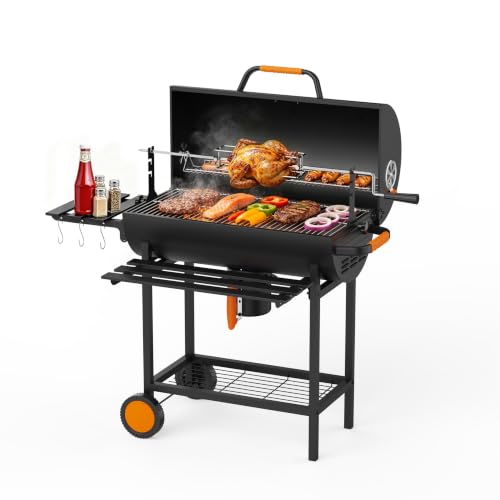
KEYO GRILL 29-Inch Barrel Charcoal Grill with Rotisserie — Best Charcoal Rotisserie Combo
The KEYO barrel is the scrappy event option: a 29-inch charcoal barrel that grills, smokes and turns a manual rotisserie fork, with a windproof ash collector for the long cooks. The manual spit is the honest trade — somebody turns the meat — in exchange for charcoal flavour and a price class the motorised machines do not visit.
Strengths
- Charcoal fire gives real smoke alongside the rotisserie
- Barrel format doubles as a smoker and grill when the spit is off
- Ash collector keeps a long event cook tidy
Trade-offs
- Manual rotisserie means a person turns the meat — no motor
- Smaller capacity than the dedicated spit roasters
- Charcoal management through a long cook is hands-on work
| Spec | Detail |
|---|---|
| Format | 29-inch barrel charcoal grill and smoker combo (per verified listing) |
| Rotisserie | Manual rotisserie fork |
| Ash handling | Detachable windproof ash collector |
| Fuel | Charcoal |
For market stalls and pop-ups, that trade often makes sense: the turning is part of the show, the loads are birds and joints rather than whole animals, and when the spit comes off, the barrel goes back to being a smoker-grill for the rest of the menu. It is the least automated pick here and, for the right small operator, the most charming one.
Delivery, siting and first month: The first month with the KEYO GRILL 29-Inch Barrel Charcoal Grill with Rotisserie decides its reputation in the building, so manage it deliberately. Confirm the delivery route and the final position before it arrives — door widths, floor, clearances and the utility it needs — then commission it empty, then with a cheap load, then with the real programme, in that order. Each stage teaches the team something the next stage depends on: the machine’s hot spots, its recovery habits, its voice. Write those lessons down while they are fresh; the card that lives with the machine is the difference between a cooker one person understands and a cooker the whole kitchen runs. Buyers who invest that first month get the boring, profitable years that follow. The KEYO GRILL 29-Inch Barrel Charcoal Grill with Rotisserie is built for those years — the commissioning is simply how you claim them. The verified headline specification — 29-inch barrel charcoal grill and smoker combo (per verified listing) — frames all of it: keep that number in view when you plan loads, staffing and space, and the machine will do the job its badge promises.
Best for: market stalls, pop-ups and small caterers wanting charcoal rotisserie on a budget-conscious footprint / Not suited for: hands-free service where the spit must turn itself
Check the current price on Amazon
Comparison Table
| Pick | Badge | Key spec | Best for |
|---|---|---|---|
| Broil King Baron 590 Pro Shadow 5-Burner Gas Grill | Best Overall | 5 main burners plus side burner (per verified listing) | restaurants adding proper rotisserie to a full-service gas grill line |
| Broil King Baron 490 Pro Shadow 4-Burner Gas Grill | Best for Smaller Kitchens | 4 main burners plus side burner (per verified listing) | smaller restaurants and cafés that want real rotisserie without the largest footprint |
| Broil King Baron S 590 Pro IR Gas Grill | Best Stainless Upgrade | 5 main burners (per verified listing) | restaurants where the grill is visible to guests and presentation matters |
| Monument Grills 77352 6+1 Burner Cabinet Gas Grill | Best for Grill Capacity | 6 main burners plus 1 (per verified listing) | high-volume outdoor kitchens that grill first and rotisserie second |
| VEVOR 52-Inch Electric Rotisserie Grill Kit | Best for Whole Animals and Events | 132 lb spit capacity (per verified listing) | caterers, festivals and restaurants running whole-animal events |
| KEYO GRILL 29-Inch Barrel Charcoal Grill with Rotisserie | Best Charcoal Rotisserie Combo | 29-inch barrel charcoal grill and smoker combo (per verified listing) | market stalls, pop-ups and small caterers wanting charcoal rotisserie on a budget-conscious footprint |
The table splits by design: rear-burner gas grills for lidded, controlled rotisserie work; the barrel and spit roasters for open-fire and whole-animal cooking. If your menu is birds and roasts, stay in the first group. If it is whole hogs at events, go straight to the spit roasters and plan space, fuel and staffing around them.
How to Choose a Commercial Rotisserie Smoker Grill
Start with the load. Rotisserie motors and spits are rated by weight and balance, and an unbalanced load burns out motors faster than a heavy balanced one. Trussing is not optional at commercial volume: meat tied tight to the spit turns as one mass, while a loose bird flops, cooks unevenly and fights the motor every revolution. Budget for forks, counterbalances and trussing twine as part of the machine, not accessories.
Then the heat layout. A rear infrared rotisserie burner heats the turning meat directly while the main burners stay off or low — that is the controlled, lidded method and the easiest to run in a kitchen rhythm. Open spits over charcoal give smoke and spectacle but demand a tender and a wind plan. Electric spit roasters with adjustable height split the difference for outdoor events, letting you raise the animal away from a flare instead of moving coals.
The Direct-Sale Commercial Rotisserie Class, Honestly
The stainless rotisserie pits behind serious barbecue counters — the class sold by makers such as Southern Pride and Ole Hickory — are genuine commercial machines with rotating racks, gas assist and capacities measured in hundreds of pounds. They are also sold through dealer networks and direct sales, priced by quotation, and they do not appear as verified Amazon listings. Any guide that links you to one through a shopping cart is inventing the link.
If your volume justifies that class, shop it deliberately: request quotations, ask about installation, gas and ventilation requirements, and service coverage in your area. The machines in this guide serve the tier below and beside it — restaurants adding rotisserie to a grill line, caterers and event cooks running whole animals, and kitchens testing whether rotisserie earns a permanent station before committing to a dealer-sold pit.
Grease, Clearance and the Unglamorous Specs That Decide
Rotisserie cooking sheds fat for hours. On a lidded gas grill that means the drip system carries a continuous load, and a neglected tray under a rear burner is a fire waiting for a busy Friday. On open spits it means a ground plan: where the fat lands, how it is contained, and what the surface underneath can tolerate. Ask these questions before the first whole animal, not during it.
Clearance is the second decider. Measure the largest item you will cook against the space between spit and burner, spit and lid, and spit and coals at the lowest height setting. A turkey that clears by an inch cold may not clear once trussed and turning. Finally, power: electric motors and spit roasters need a circuit where the event actually happens — a detail that has embarrassed more than one caterer at load-in.
Rotisserie as Theatre: The Commercial Case Beyond Flavour
Every other cooking method in this programme hides behind a door. Rotisserie performs. A turning pig at a market, birds glistening behind a counter, a roast rotating over coals at a festival — the cooking itself advertises, and experienced operators know the spit often sells the second hundred portions that the menu board alone would not. That theatre has operational value: it justifies price, it draws a crowd that buys drinks while it watches, and it turns a wait into part of the experience.
Theatre has costs, and they belong in the decision. A visible cook must look abundant and calm at all times, which means the spit is loaded generously and tended visibly; a sad, half-empty rotisserie in view of guests advertises the opposite of abundance. Staffing the performance — trussing, loading, carving in view — is choreography as much as cooking, and it wants rehearsal before the first paying audience.
Judge your venue honestly. Where guests see the cooking, rotisserie returns marketing value no other station matches. Where the cooking is hidden, buy purely on flavour and workflow, and the lidded rear-burner grills in this guide make their case without needing an audience.
Trussing, Balancing and Carving: The Skills That Make the Machine
A rotisserie is only as good as the hands that load it. Trussing is the foundational skill: poultry tied so wings and legs hug the body, roasts rolled and tied at intervals so the cylinder is true, whole animals secured at neck and hindquarters so nothing shifts as fat renders and the load lightens. An untrussed load cooks unevenly no matter how good the motor is, because geometry, not heat, is what rotation equalises.
Balancing follows. The load’s heavy side should not exist; if it does, a counterweight or a repositioning fixes it before the motor ever turns. Test by hand, always — one slow manual revolution reveals every flop and sag while fixing them is still free. Motors die young under unbalanced loads, and they die at the worst moment, mid-service, with a raw centre and a queue watching.
Carving is the final skill and the one guests judge. Rest the meat properly, then carve to order where the format allows: crisp skin on every portion, juices caught rather than lost, the carcass returning for stock rather than the bin. A rotisserie programme that trains these three skills gets the machine’s full value; one that buys the machine and skips the skills owns an expensive way to cook chicken unevenly.
Planning a Rotisserie Menu That Earns Its Station
A rotisserie station earns when the menu is built around rotation rather than decorated with it. Anchor it with one high-volume hero — the bird or roast your venue becomes known for — cooked in successive loads across service so the spit is never empty and never rushed. Support it with items that share the workflow: vegetables roasted in the dripping tray, potatoes in the fat, bread warmed at the station’s edge. The hero pays for the station; the supporting items are nearly pure margin cooked in energy already spent.
Portion planning deserves the same rigour as the cooking. Whole items yield what they yield; know your portions per bird and per roast to the piece, cost them honestly including the trussing labour and the carver’s time, and price the theatre in — guests demonstrably pay for food cooked in front of them, and underpricing the performance leaves the station’s best asset uncollected.
Rotate the hero seasonally if the venue suits it — lamb in spring, game birds in autumn, the whole-hog event as a monthly headline — and the station stays news. A rotisserie that never changes becomes furniture; one with a calendar becomes a reason to return.
Your Decision Checklist Before Buying a Rotisserie Setup
Begin with the animal, because everything follows from it. Write down the largest item the spit must turn in your first year — not your ambition’s largest, your menu’s — with its weight and its trussed dimensions. Match it against each candidate’s spit rating and clearance with margin to spare, and strike any machine that fits the item only in theory. A rotisserie bought exactly at its limit spends its life straining; one bought with headroom spends it cooking.
Second, the heat decision: lidded rear-burner control for a kitchen rhythm, or open charcoal for spectacle and smoke. This is a venue decision as much as a cooking one — sightlines, staffing, wind, and where the fat lands all vote. Third, the service pattern: successive birds across a lunch service reward the gas grills’ instant recovery; a single whole animal across an afternoon rewards the spit roasters’ capacity and height control. Buy for the pattern you will actually run weekly.
Fourth, the unglamorous audit: drip management, cleaning time for spits and forks, motor access for the day it needs service, and power or gas at the exact cooking position. Fifth, the skills audit: who trussing, who balances, who carves — named, trained, and backed up. A rotisserie programme is three skills wearing one machine, and the checklist that ignores the skills buys a very expensive ornament. Work the five steps honestly and the right machine from this guide’s six usually identifies itself.
Keeping the Rotisserie Turning: A Maintenance Rhythm
Rotisserie machinery has moving parts in a greasy, hot environment, which is a maintenance sentence all by itself. After every cook: spit, forks and drip system cleaned while warm, because rotisserie residue bakes into a glaze that laughs at cold water. Weekly: the motor’s mounting and drive checked for play, the spit rod inspected for true — a bent rod cooks unevenly forever — and burner ports or charcoal grates cleared so the heat pattern the menu depends on stays the heat pattern the machine delivers.
Monthly, exercise the whole system empty: run the motor, watch the rotation for hesitation, listen for the strain that announces a bearing or a balance problem developing. Motors rarely die silently; they complain first, at low volume, to owners who run this check. Keep the complaint cheap by hearing it early.
Seasonally, review the consumables of the craft: trussing supplies, spare forks, a backup motor plan for event season if whole-animal work is your headline, and the state of covers and storage for machines that live outdoors. The rotisserie station’s reliability is a rhythm, not a property — build the rhythm and the theatre never cancels.
One Last Test Before You Commit to the Spit
Before ordering, run the paper service on your rotisserie candidate: the hero item trussed on paper at its real weight, the loads sequenced across your real service hours, the carver named, the drip and cleaning moments placed in the closing list. Rotisserie failures are almost never heat failures — they are geometry, balance and choreography failures, and all three are visible on paper to anyone who bothers to draw the day. The machine that survives the drawing, with margin on the spit and a named human on every skill, is the one that will still be turning profitably when the novelty has worn off and only the food remains.
How to Set Up and Run a Rotisserie Cook for Service
Step 1: Truss tight. Tie the bird or roast firmly so nothing hangs or swings. Slide the forks in deep and test-turn by hand: the load should rotate without a heavy side that drops each revolution. Fix balance now, not after the motor starts straining.
Step 2: Set the heat for turning meat. On a rear-burner grill, light the rotisserie burner and keep main burners off or low; on charcoal, build the fire to the sides so dripping fat does not land directly in the coals. Place a drip pan under the load either way — it catches fat and becomes your basting base.
Step 3: Start early and rest properly. Rotisserie cooking is steady, not fast. Work backwards from service, hold finished items properly, and never rush the rest: a rested roast carves cleaner and loses less juice than one cut straight off the spit.
Step 4: Verify temperature in the thickest part. Turning meat cooks evenly but not magically; check internal temperature with the spit stopped, probe away from bone, and confirm before the item joins the pass.
Step 5: Clean while it is warm. Spits, forks and drip trays clean in a fraction of the time while warm. Build that into the close-down list and the rotisserie stays an asset instead of a sticky chore nobody volunteers for.
Common Buying Mistakes
Skipping the truss. Loose meat flops, cooks unevenly and eats motors. Two minutes with twine saves the cook and the machine.
Overloading the spit. Weight ratings assume a balanced load. An oversized, lopsided roast is the fastest route to a stripped motor mid-service.
Running every burner. Rotisserie wants gentle, directed heat. Full main burners under turning meat scorch the outside before the centre cooks.
No drip plan. Hours of falling fat with nowhere managed to go means flare-ups, smoke and a cleaning bill. Pan first, always.
Buying for the photo, not the menu. A whole-hog spit earns nothing on a menu of chicken thighs. Match the machine to the item you will actually turn weekly.
Forgetting the circuit. Electric spits and motors need power at the cooking position. Check the event site before the animal is on the rod.
Final Recommendation
For a restaurant grill line, the Broil King Baron 590 Pro Shadow is the complete answer: five burners, a side burner and a dedicated rear rotisserie burner in a lidded grill your team already knows how to run. For whole-animal event work, the VEVOR 52-inch electric rotisserie is the purpose-built tool. The rest of the commercial cluster is covered in Best Commercial Smokers, Best Commercial 2700 Smokers and Best Commercial Meat Smokers; gas-specific depth lives in Best Commercial Gas Smokers and Best Gas Grills With Rotisserie, and the combined grill-smoker view in Best Smokers And Grills.
Shortlist again, for convenience: Broil King Baron 590 Pro Shadow 5-Burner Gas Grill, Broil King Baron 490 Pro Shadow 4-Burner Gas Grill, Broil King Baron S 590 Pro IR Gas Grill. Each link goes to the verified listing used throughout this guide — check price on Amazon there and confirm the configuration before ordering.
Frequently Asked Questions
What makes a rotisserie better than a grate for whole birds?
The turning bastes the meat in its own juices and exposes every side to even heat, so skin renders uniformly and the meat stays moist without brining heroics. It is also forgiving: rotation smooths out the hot spots that punish static roasts.
Can a rear-burner gas grill really smoke?
It can cook low with wood chips in a smoker box while the rotisserie turns, giving gentle smoke alongside the spit. It will not match a dedicated offset for smoke depth, but for rotisserie birds and roasts the balance of smoke, control and convenience is the point.
How much weight can these spits handle?
Ratings vary by machine — the big electric spit roasters in this guide are listed at 132 lb capacity, while lidded grill spits suit birds and roasts rather than whole animals. Always cook within the listed rating and balance the load.
Are the big restaurant rotisserie pits sold on Amazon?
The dealer-sold stainless class is generally not sold through verified Amazon listings. This guide links only verified machines and discusses the direct-sale class in prose so you can request quotations from the makers instead.
Do I need a counterbalance?
For heavier or uneven loads, yes — a counterbalance keeps rotation smooth and protects the motor. Even loads of moderate weight turn happily without one, but the first lopsided roast will teach the lesson expensively.
What fuel do open spit roasters use?
Charcoal, typically banked to the sides of the load. Height adjustment on the electric spit frames lets you manage heat distance as the fire evolves through a long whole-animal cook.


