Disclosure: airfryerkitchensupply.com is reader-supported. When you buy through links on our site, we may earn an affiliate commission at no extra cost to you.
Where to buy
If you are shopping for the best food processors 3 cups, start here: every linked model below was cross-checked against Amazon’s catalog data for this site before this guide was written, and only confirmed models carry a buying link. Mini processors are sold under confusingly similar names, so confirm the exact model code and the cup capacity on the product page before ordering — a 3-cup, 3.5-cup, and 4-cup sibling often share a product family name.
- Cuisinart Mini-Prep Plus 3-Cup DLC-2A (Best Overall) — check price on Amazon
- Hamilton Beach 3-Cup Stack & Press Chopper (Best Budget) — check price on Amazon
- KitchenAid 3.5 Cup Food Chopper KFC3516 (Best for Everyday Versatility) — check price on Amazon
- Ninja Express Chop NJ100GR (Best for Nuts and Hard Foods) — check price on Amazon
- Cuisinart Mini-Prep Plus 4-Cup DLC-4CHB (Best Step-Up for Bigger Small Jobs) — check price on Amazon
- Hamilton Beach Stack & Snap 4-Cup Mini Food Processor 70510 (Best Step-Up for Slicing and Shredding) — check price on Amazon
The best food processors 3 cups in size exist for the jobs a full-size processor does badly: a single onion, a cup of nuts, a small batch of pesto, herbs for tonight’s sauce, a vinaigrette that needs emulsifying rather than whisking. A big machine’s bowl is too wide for small quantities — the blade spins above or below the food and throws it to the walls — while a 3-cup mini keeps ingredients in the blade’s path and finishes in seconds. If your cooking is full of small, frequent prep, this is the processor that will actually get used.
An honest note about the size class before the picks: the true 3-cup market is compact. A handful of excellent minis are built at exactly this capacity, and around them sits a penumbra of 3.5-cup and 4-cup siblings that serve the same counter and the same jobs. This guide leads with the genuine 3-cup machines, and then includes the two closest step-ups, clearly labelled, because for many kitchens a half-cup or a cup more is the right answer — but you deserve to know exactly which is which rather than discover it on the box.
What a 3-cup processor will not do also matters. It will not knead dough, slice a cabbage, or prep for a dinner party in one load; it works in small batches and asks you to cut food to size before it goes in. Bought for its real job — daily small prep, done fast, washed in a minute — it becomes the most-reached-for appliance on the counter. Bought as a cheap substitute for a full-size machine, it disappoints. The six picks below are ordered for the first kind of buyer.
A word on who should skip the category entirely: cooks who batch-cook for a crowd every week, bakers who need dough capacity, and households whose ‘small prep’ is genuinely a kilo at a time. For them the mini is a toy and the money belongs in a full-size machine from the start. Everyone else — which is most home kitchens, most days — will find a 3-cup processor quietly becoming the appliance they would replace first if it vanished.
Every pick was verified individually in Amazon’s catalog data for this site, and the spec boxes quote only what those verified listings state — capacity, wattage where the listing gives it, blade design, and speeds. Where a well-known mini could not be confirmed, it was left out rather than written from memory.
In this guide
Quick Picks
The shortlist at a glance. Badges match the detailed reviews below — note the two clearly labelled step-up sizes at the end of the list.
- Cuisinart Mini-Prep Plus 3-Cup DLC-2A — Best Overall. The defining 3-cup mini: a reversible stainless blade that chops one way and grinds the other, in a 3-cup bowl made for herbs, vegetables, and hard cheese. — Check on Amazon
- Hamilton Beach 3-Cup Stack & Press Chopper — Best Budget. The simplest control in the category — press the lid to chop — with a verified 350 watts, stainless blades, and dishwasher-safe parts. — Check on Amazon
- KitchenAid 3.5 Cup Food Chopper KFC3516 — Best for Everyday Versatility. A half-cup step up with two speeds plus pulse, a stainless multi-purpose blade, a dishwasher-safe bowl, and an easy cord wrap — in Empire Red. — Check on Amazon
- Ninja Express Chop NJ100GR — Best for Nuts and Hard Foods. A one-touch pulse chopper whose verified listing states a 3-cup capacity, with stainless blades built for garlic, herbs, and nuts, and dishwasher-safe parts. — Check on Amazon
- Cuisinart Mini-Prep Plus 4-Cup DLC-4CHB — Best Step-Up for Bigger Small Jobs. The 4-cup sibling of our Best Overall: same reversible-blade idea with a verified 250 watts and a dishwasher-safe bowl and lid. — Check on Amazon
- Hamilton Beach Stack & Snap 4-Cup Mini Food Processor 70510 — Best Step-Up for Slicing and Shredding. A 4-cup step-up that adds what minis usually lack — slicing, shredding, and puréeing — with a 250-watt motor, quad blade, and leak-proof bowl. — Check on Amazon
How These Picks Were Chosen
We filtered this category on the things that decide whether a mini processor delights or frustrates. Capacity honesty came first: the bowl had to be a true 3-cup, or the pick had to be labelled a step-up in plain sight. Blade design came second — a reversible blade that chops in one direction and grinds in the other, or a well-shaped multi-purpose blade, is what lets a small machine handle both herbs and hard cheese without turning one of them into paste or dust. Third came the working details: controls you can pulse precisely, a bowl and lid that lock without a wrestling technique, and parts that go in the dishwasher, because a mini that is annoying to wash will not survive its own convenience promise.
Verification followed the site’s standard discipline. Each brand and model was searched in Amazon’s catalog data for this site, the returned title was matched against the intended product, and only a confirmed match received a buying link. Wattage and capacity figures in this guide come only from those verified titles — several minis do not state wattage in their listings, and where that is the case the spec box says so by omission rather than filling the gap with a guess. The result is a short list, and that is correct: this is a small category with a few genuinely good answers.
The 6 Best Food Processors 3 Cups
The first four picks are true members of the 3-cup class or its nearest sibling; the last two are clearly labelled step-ups for kitchens that want a little more bowl. Each review covers fit, strengths, trade-offs, and verified specifications.

Cuisinart Mini-Prep Plus 3-Cup DLC-2A — Best Overall
The DLC-2A is the machine this category is named after in most cooks’ minds. Its 3-cup work bowl is sized exactly for the daily small jobs, and its reversible stainless blade is the clever core: run it one way to chop, reverse it to grind, so soft herbs and hard cheese each get the edge geometry they need. Cuisinart’s listing pitches it at herbs, vegetables, and hard cheese, and that trio is an honest summary of its working life.
Strengths
- Reversible blade chops and grinds — two tools in one bowl
- True 3-cup capacity, sized for daily small prep
- Simple, proven design from the category’s defining line
Trade-offs
- Chop-and-grind focus; no slicing or shredding discs
- Small batches only — party prep means many loads
- White finish shows turmeric and tomato stains over time
| Capacity | 3-cup work bowl (per verified listing) |
| Blade | Reversible stainless steel blade (per verified listing) |
| Model | DLC-2A Mini-Prep Plus (per verified listing) |
| Stated jobs | Herbs, vegetables, hard cheese (per verified listing) |
The reversible blade deserves more credit than it gets. Chopping wants a sharp edge moving through food; grinding nuts, spices, and hard cheese wants a blunter, more violent action that shatters rather than slices. Single-blade minis compromise one job or the other, usually producing herb purée when you wanted chopped herbs and dust when you wanted chopped nuts. The DLC-2A’s two-direction design is why owners keep it for a decade: it is genuinely good at both ends of its brief, and its controls — press to chop, press the other way to grind — could not be simpler to teach a household.
Its limits are the category’s limits, honestly worn. Feed it food cut to roughly even, modest pieces and it rewards you in seconds; overload it or feed it a whole onion quartered carelessly and any mini will struggle. Liquids need respect for the bowl’s fill line. Within those ordinary disciplines, this is the 3-cup benchmark — the machine against which the rest of this list is measured, and the first one most kitchens should consider.
Best for: Daily small prep — herbs, nuts, cheese, aromatics / Not suited for: Slicing, shredding, dough, or large-batch cooking
Check the current price on Amazon
Hamilton Beach 3-Cup Stack & Press Chopper — Best Budget
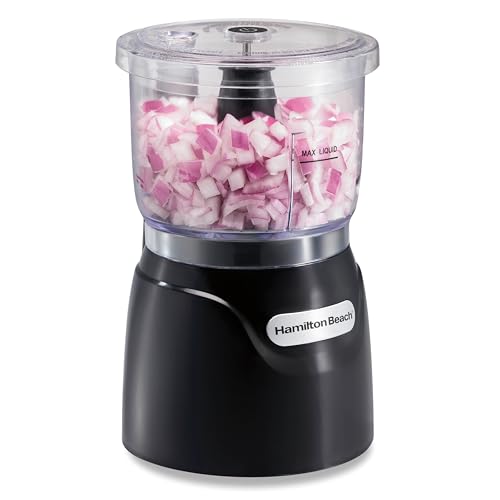
Hamilton Beach’s Stack & Press removes the last excuse for not owning a mini: there are no buttons to learn, because you press the lid to run it and release to stop, which makes pulsing — the core skill of good chopping — completely intuitive. The verified listing states 350 watts and stainless steel blades, aimed at dicing, mincing, and puréeing, with dishwasher-safe parts for the wash-up.
Strengths
- Press-to-run lid makes pulsing effortless and precise
- 350 watts stated in the verified listing — strong for the class
- Dishwasher-safe parts keep cleanup to a minute
Trade-offs
- No grind-specific blade mode like the Cuisinart’s reverse
- Plastic-forward build at this tier
- Stack-and-press seal rewards correct assembly
| Capacity | 3 cups (per verified listing) |
| Power | 350 watts (per verified listing) |
| Blades | Stainless steel (per verified listing) |
| Controls | Stack & Press — press lid to operate (per verified listing) |
Press-lid control sounds like a gimmick until you have pulsed an onion both ways. Buttons invite holding; holding makes purée. A lid you press in short taps makes the pulse rhythm physical and obvious, and beginners produce evenly chopped results on their first onion instead of their fifth. The 350-watt figure also matters more in a mini than buyers expect: small motors stall on hard cheese and dense carrots, and this one’s stated output is at the healthy end of the 3-cup class.
The Stack & Press name describes the assembly honestly — bowl, blade, lid stack in order and a press seats them — and once the motion is learned it is faster than threaded or locking lids. This is the pick for the budget-conscious and for second kitchens, holiday homes, and anyone buying a first mini to test whether the category fits their cooking. If it does, it will earn its place; if the household outgrows it, it remains a superb herb-and-nut specialist next to a bigger machine.
Best for: First-time mini buyers and budget-conscious kitchens / Not suited for: Cooks who want a dedicated grinding mode
Check the current price on Amazon

KitchenAid 3.5 Cup Food Chopper KFC3516 — Best for Everyday Versatility
KitchenAid’s chopper is the nearest sibling to the 3-cup class at 3.5 cups, and it earns its place by being the most versatile everyday tool here: two speeds plus pulse, a stainless multi-purpose blade, and a drizzle-friendly design language that suits sauces and dressings as well as chopping. The verified listing also notes the dishwasher-safe work bowl and an easy cord wrap — small things that decide whether a counter appliance stays out or gets exiled.
Strengths
- Two speeds plus pulse for finer control
- Half-cup more bowl than the true 3-cup class
- Cord wrap and dishwasher-safe bowl aid daily use
Trade-offs
- 3.5 cups — a step-up, not a true 3-cup bowl
- Empire Red finish will not suit every kitchen
- No slicing or shredding capability
| Capacity | 3.5 cups (per verified listing) |
| Speeds | 2 speeds plus pulse (per verified listing) |
| Blade | Stainless steel multi-purpose blade (per verified listing) |
| Extras | Dishwasher-safe bowl, easy cord wrap (per verified listing) |
Speed control is the real story. A single-speed mini gives you one violence setting and asks pulsing to do all the finesse; two speeds let you start gentle on herbs and soft fruit, then use the higher speed for nuts, cheese, and firm vegetables. Combined with pulse, that range covers the realistic mini repertoire — salsa with texture, breadcrumbs without dust, a curry paste that is fine but not soup. The extra half-cup is quietly useful too: the classic 3-cup failure is the recipe that is one onion too big, and 3.5 cups absorbs many of those.
KitchenAid ownership touches apply: the bowl and blade wash easily, the cord disappears instead of trailing, and the machine looks like it belongs next to the brand’s other counter appliances. Choose it when your small prep is varied and frequent and when the half-cup honesty does not bother you — it is a 3.5-cup machine, bought deliberately, and for many kitchens it is the sweet spot of the whole mini category.
Best for: Varied daily prep wanting speed control and a touch more room / Not suited for: Purists who need exactly a 3-cup bowl
Check the current price on Amazon
Ninja Express Chop NJ100GR — Best for Nuts and Hard Foods
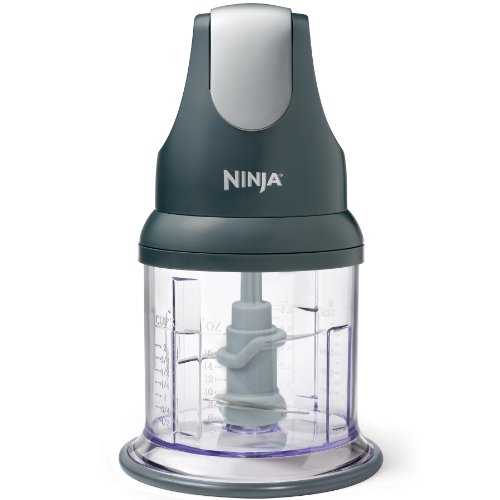
The Ninja Express Chop takes the opposite design path to the gentle minis: a tall, stacked blade arrangement and one-touch pulsing built to attack hard, dense ingredients — nuts, garlic, herbs — in a bowl whose listing states a 3-cup capacity. If your mini’s main employment is nut butters’ first stage, spice-adjacent grinding, and mountains of garlic, this is the temperament you want.
Strengths
- Stacked blade design excels at hard, dense foods
- One-touch pulse keeps operation foolproof
- Dishwasher-safe, per the verified listing
Trade-offs
- Aggressive action can over-process soft herbs quickly
- 16oz bowl naming in the title requires care — listing states 3-cup capacity
- Less finesse for delicate emulsions than speed-controlled rivals
| Capacity | 3-cup capacity stated in verified listing (16oz bowl) |
| Blade | Stainless blades (per verified listing) |
| Controls | One-touch pulse (per verified listing) |
| Care | Dishwasher safe (per verified listing) |
A note on the naming, because it confuses buyers: the listing describes a 16oz bowl and also states a 3-cup capacity for the machine. Read that as the difference between the bowl’s liquid measure and the machine’s working chopping capacity for solids, and size your batches by the conservative number — small loads, pulsed briefly. Within that discipline, the stacked blades are the point: they engage food at two heights, so hard pieces are cut before they can ride above a single low blade, which is the classic mini failure with nuts.
The trade-off is delicacy. Soft herbs under an aggressive blade go from chopped to bruised to puréed in a few pulses, so herb work here means very short taps and dry leaves. Cooks whose prep leans hard — nuts, seeds, garlic, ginger, hard cheese — will find that bargain delightful; cooks who live on salsas and herbs should take the Cuisinart or KitchenAid instead. Categories reward honesty about your own cooking, and this pick is a specialist wearing its specialism openly.
Best for: Nuts, garlic, and hard-ingredient prep in small batches / Not suited for: Delicate herb work and fine emulsions
Check the current price on Amazon

Cuisinart Mini-Prep Plus 4-Cup DLC-4CHB — Best Step-Up for Bigger Small Jobs
This is the honest step-up pick: the Mini-Prep Plus grown to 4 cups, keeping the auto-reversing stainless blade that chops and grinds, with 250 watts stated in the verified listing and a dishwasher-safe bowl and lid. It exists for the cook who read the 3-cup reviews, nodded along, and knows their ‘small’ jobs — a family salsa, a double pesto, breadcrumbs for a casserole — regularly overflow three cups.
Strengths
- Same reversible chop/grind blade as the 3-cup benchmark
- 4 cups absorbs the recipes that overflow a 3-cup bowl
- Dishwasher-safe bowl and lid, per the verified listing
Trade-offs
- It is a 4-cup machine — beyond this guide’s title size
- 250 watts is adequate, not class-leading
- Still a mini: no discs, no dough
| Capacity | 4-cup (per verified listing) |
| Power | 250 watts (per verified listing) |
| Blade | Auto-reversing stainless steel blade (per verified listing) |
| Care | Dishwasher-safe bowl and lid (per verified listing) |
The case for stepping up is batch arithmetic. A 3-cup bowl works best filled to about two-thirds for chopping, which means roughly two cups of finished prep per load; a surprising number of real recipes — a proper salsa, pesto for a family pasta night, a marinade paste for a whole chicken — live just above that line. The 4-cup Mini-Prep does those in one load instead of two, and the time saved is exactly the convenience the category exists to provide.
Everything else about the machine is the family recipe: reversible blade for chop and grind duties, simple press controls, parts that wash without ceremony. Buy it deliberately as the bigger mini, not accidentally as a mislabelled 3-cup — the listing is honest about its size, and so is this guide. Kitchens that regularly cook for four or more will find this, rather than the true 3-cup, is the mini that matches their ‘small’ jobs.
Best for: Family-size small jobs that overflow a 3-cup bowl / Not suited for: Singles and couples whose prep is genuinely tiny
Check the current price on Amazon

Hamilton Beach Stack & Snap 4-Cup Mini Food Processor 70510 — Best Step-Up for Slicing and Shredding
Our second step-up answers a different overflow: not volume, but function. Most minis only chop; this 4-cup Hamilton Beach Stack & Snap adds slicing and shredding to the repertoire, with a stainless quad blade, a leak-proof bowl for sauces, and 250 watts per its verified listing. For a small kitchen that wants one compact machine to cover chopping and a first taste of disc work, it is the bridge between mini and full-size.
Strengths
- Slices and shreds as well as chops and purées
- Leak-proof bowl suits sauces and dressings
- Easy-assembly Stack & Snap design, per the listing
Trade-offs
- 4-cup step-up size, beyond the 3-cup brief
- Disc work at this scale suits small quantities only
- More parts to wash than a chop-only mini
| Capacity | 4-cup (per verified listing) |
| Power | 250 watts (per verified listing) |
| Blade | Stainless steel quad blade (per verified listing) |
| Functions | Slice, shred, purée; leak-proof bowl (per verified listing) |
Judge the slicing and shredding by scale and it impresses: a couple of carrots, a small block of cheese, an apple for a slaw — the jobs that are tedious by hand and absurd in a full-size machine. That is a real gap in most kitchens, and this model fills it at a mini’s footprint and price tier. The leak-proof bowl is the second quiet win, because minis are constantly asked to make dressings and sauces, and a bowl that weeps vinaigrette onto the counter teaches owners to stop asking.
The compromises are arithmetic and washing-up. Four cups of shredded anything is a side dish, not a catering tray, and the disc parts add pieces to the sink on days you use them. But as a deliberate step-up — a mini that also slices — it has no direct rival on this list. Small kitchens with no room for a full-size processor should look at it very seriously before concluding that disc work is beyond them.
Best for: Small kitchens wanting mini size plus slicing and shredding / Not suited for: Purists wanting a chop-only true 3-cup machine
Check the current price on Amazon
Comparison Table
| Pick | Badge | Key spec | Best for |
|---|---|---|---|
| Cuisinart Mini-Prep Plus 3-Cup DLC-2A | Best Overall | 3-cup, reversible chop/grind blade | Daily small prep — herbs, nuts, cheese, aromatics |
| Hamilton Beach 3-Cup Stack & Press Chopper | Best Budget | 3-cup, 350W, press-lid control | First-time mini buyers and budget-conscious kitchens |
| KitchenAid 3.5 Cup Food Chopper KFC3516 | Best for Everyday Versatility | 3.5-cup, 2 speeds + pulse | Varied daily prep wanting speed control and a touch more room |
| Ninja Express Chop NJ100GR | Best for Nuts and Hard Foods | 3-cup capacity, stacked blades | Nuts, garlic, and hard-ingredient prep in small batches |
| Cuisinart Mini-Prep Plus 4-Cup DLC-4CHB | Best Step-Up for Bigger Small Jobs | 4-cup, 250W, reversible blade | Family-size small jobs that overflow a 3-cup bowl |
| Hamilton Beach Stack & Snap 4-Cup Mini Food Processor 70510 | Best Step-Up for Slicing and Shredding | 4-cup, 250W, slice/shred discs | Small kitchens wanting mini size plus slicing and shredding |
What can a 3-cup processor actually do — and what should it never be asked to do?
The honest job list is long: chopping onions, garlic, herbs, and nuts; grinding hard cheese and spices in small amounts; making pesto, salsa, chimichurri, and curry pastes; emulsifying vinaigrettes and mayonnaise in small batches; breadcrumbs from a slice or two; baby-food purées; whipped small quantities of cream or egg white on models with the right blade behaviour. Every one of those jobs shares a trait — the quantity is small and the alternative is a knife, a grater, or a mortar, used slowly.
The never list is equally clear. Dough of any kind: the bowl is too small and the motor is not geared for it. Large or hard whole vegetables fed uncut: everything must be pre-cut to modest, even pieces. Party-scale prep: a 3-cup bowl producing two cups at a time will make a dinner party’s salsa eventually, but you will resent it by the fourth load. Hot soups and liquids above the fill line: minis are not blenders and their lids are not pressure seals. Respect both lists and a mini is a delight; confuse them and any mini feels broken when it is only miscast.
How do you choose between 3, 3.5, and 4 cups?
Start from your two or three most common small jobs and their real volumes. Herbs, garlic, nuts, and a single onion live comfortably in 3 cups, and the true 3-cup machines are the most compact and usually the most affordable. If your recurring job is a sauce or salsa for a family — or you regularly double a pesto — the working capacity of a 3-cup bowl, which chops best at about two-thirds full, will pinch weekly, and the 3.5-cup or 4-cup step-ups stop being indulgences and become the correct size.
Counter and cupboard space argue the other way: the step-ups are larger in every dimension, and a mini’s whole charm is disappearing into a small kitchen. There is also a texture consideration — very small quantities, a single garlic bulb’s worth or a handful of herbs, process better in the smallest bowl that holds them, because the blade engages a larger share of the food. Households that cook small should stay small; households that cook family-size should step up without guilt. The dishonest choice is the one made by the title on a box rather than by your recipes.
Blade design, wattage, and controls: what actually matters in a mini?
Blade design matters most. A reversible blade that chops in one direction and grinds in the other — the Cuisinart pattern — covers the widest repertoire, because herbs and hard cheese want opposite treatments. Stacked dual-height blades, the Ninja pattern, engage hard pieces that ride above a single blade. A single low blade with two speeds, the KitchenAid pattern, trades those tricks for control. None is universally best; match the blade to your dominant job from the guide section above.
Wattage matters less than the numbers suggest, within limits. Mini motors in the 200–400 watt range all chop soft foods identically; wattage shows up at the hard end — cheese, nuts, carrots — where the stated 250–350 watt machines on this list hold their pace better. Controls matter daily: precise pulsing is the difference between chopped and puréed, so a press-lid, a responsive pulse button, or true speed settings are worth more than any programme list. Finally, washability is a specification: dishwasher-safe bowls and lids are the reason minis get used daily instead of weekly.
How to Use a 3-Cup Processor for Everyday Prep
Step 1 — Assemble in order. Bowl on the base, blade on the centre post, food in, lid locked. Every mini here refuses to run until it is correctly assembled — that interlock is a safety feature, not a fault, so learn your model’s seating motion once.
Step 2 — Pre-cut to even pieces. Cut onions, cheese, and vegetables to roughly even, modest chunks. Remove herb leaves from thick stems. Even input is the whole secret of even output.
Step 3 — Respect the two-thirds fill. Load to about two-thirds of the bowl for chopping, less for liquids, and never above the stated fill line for wet jobs like dressings.
Step 4 — Pulse, do not hold. Use short taps — a second on, a pause — checking texture between bursts. Five pulses is a chop; fifteen is a purée; know which one the recipe wants before you start.
Step 5 — Scrape once, finish briefly. Stop halfway, scrape the walls down with a small spatula, then give the batch its final few pulses. That single scrape is worth more than any extra power.
Step 6 — Use the right blade direction. On reversible-blade models, chop soft foods with the sharp direction and grind nuts, spices, and hard cheese with the reverse. On speed models, start low for herbs and finish high for hard foods.
Step 7 — Wash immediately, dry fully. Rinse bowl, lid, and blade straight away — thirty seconds now or ten minutes later — dry the blade by hand, and store the machine assembled and dry.
How to get even results from a small processor
Cut even, cut modest. A mini’s blade can only engage what falls to it. Pieces of roughly equal, marble-to-walnut size process evenly; a mixture of chunks and slivers guarantees some of each wrong texture. Thirty seconds with a knife before the machine saves the batch.
Fill to two-thirds, not the rim. Food needs room to circulate and fall back into the blade. An overfilled bowl processes the bottom layer to paste while the top rides untouched. Two correct loads beat one bad one, and a mini’s loads take seconds.
Pulse in taps, scrape once. Work in short pulses — one second on, a pause — and check early and often; you can always process more and never less. One scrape-down of the walls halfway through redistributes the strays that every bowl shape leaves behind.
Keep herbs dry and cold. Wet herbs bruise and smear instead of chopping. Pat leaves dry, work in small amounts, and use the shortest pulses you can. For nuts and cheese, cold and even slightly frozen pieces cut cleaner than warm, soft ones.
Add liquids late and little. For pastes and dressings, process the solids first, then add liquid a spoonful at a time until the texture turns. A mini reaches ‘too thin’ in one enthusiastic pour, and there is no road back.
Mini processor vs full-size processor vs knife: an honest division of labour
The knife remains undefeated for one onion when the board is already out, for herbs in chef quantities, and for anything where the cook wants a specific cut rather than a processed texture. Its costs are time, skill, and tears — and for garlic in quantity, nut chopping, and pastes, those costs are real every single day. The mini processor exists precisely for that territory: small, frequent, tedious jobs where the knife’s setup and cleanup exceed the job itself.
The full-size processor owns the opposite territory: dough, slicing and shredding in quantity, grating cheese by the block, and any recipe whose first line is a kilo of something. Its costs are size, washing-up, and terrible performance on small quantities, where food hides from the blade in a wide bowl. Most serious kitchens end up owning both sizes plus the knife, each doing what it is good at — and the mini, used daily, usually justifies itself first. Buy in that order if you are equipping from scratch: knife skills, then the mini for daily prep, then the full-size machine when your cooking genuinely scales.
How do you clean and store a mini processor so it lasts?
The bowl, lid, and blade of every pick here are designed for easy washing, and most are dishwasher-safe per their verified listings — but the blade deserves hand care regardless: wash it separately, dry it immediately, and store it in the bowl rather than loose in a drawer where its edge dulls and fingers find it. Rinse parts promptly after oily or pigmented jobs; pesto and turmeric left to dry become a scrubbing project and a stain.
Dry everything fully before assembly and storage, because a sealed, damp bowl grows the stale odour that owners misattribute to plastic. Store the machine assembled with the cord managed — the KitchenAid’s cord wrap exists for this — in the cupboard or counter spot closest to your chopping board, because proximity is destiny for small appliances. A mini stored at the back of a deep cupboard is a mini used monthly; the same machine at the front is used daily, and daily use is the entire point of the category.
How to read a mini-processor listing without being misled
Capacity claims need one question: is that the bowl’s brim volume or its working volume? Every processor chops best below its brim — around two-thirds full — so a ‘3-cup’ machine is really a two-cup worker, and honest comparisons use working volume. Listings that shout a large capacity for a physically small bowl are measuring to the rim; the verified listings behind this guide state capacities plainly, which is why the spec boxes here quote them as given and the guide text translates them into working terms.
Wattage claims need the same calm. A mini’s wattage is a ceiling, not a description of everyday chopping, and brands measure it differently. Use it only as a rough guide to hard-food stamina, and prefer a stated figure from a verified listing — as with the 250-watt and 350-watt models above — over an unstated one you would have to guess. Absence of a figure is itself information: several excellent minis do not publish wattage in their listings, and this guide leaves those boxes honestly blank rather than inventing a number.
Finally, treat function lists arithmetically. ‘Chops, minces, dices, purées, and grinds’ on a single-blade mini usually means one blade used with different pulse patterns — legitimate, but not five tools. Disc functions, by contrast, are physical: a slicing or shredding disc either is or is not in the box, which is why the Stack & Snap step-up’s disc work is called out separately in its review. Read listings for hardware, not verbs, and you will rarely be surprised by what arrives.
Common Buying Mistakes
Overfilling the bowl. The classic mini error. Food above the working fill cannot circulate, so the bottom purées while the top survives. Work in two loads and the problem — and the uneven batch — disappears.
Holding the button instead of pulsing. Continuous running is how onions become soup and herbs become bruised paste. Pulsing is not a suggestion; it is the technique the whole category is built around.
Feeding uncut or uneven food. A whole onion half will bounce on the blade while small pieces are destroyed beneath it. Even, modest pieces are the price of even results.
Asking a mini to do a full-size job. Dough, party batches, and cabbage-scale slicing belong to other tools. A mini forced into that work does not fail dramatically — it fails slowly, in your enthusiasm for using it at all.
Processing wet herbs. Waterlogged leaves smear and darken instead of chopping. Dry herbs, small loads, and short pulses produce the bright, distinct chop you actually wanted.
Buying by the box title instead of your recipes. A 3-cup, 3.5-cup, and 4-cup machine can share a family name and a shelf. Check the verified capacity against your two most common jobs before ordering, and the size debate settles itself in one honest minute.
Storing it dirty or damp. Yesterday’s pesto film becomes today’s stale flavour, and a sealed damp bowl grows odours. Wash, dry, and store assembled — a two-minute habit that protects every future batch.
Final Recommendation
Most kitchens should start with the Cuisinart Mini-Prep Plus 3-Cup DLC-2A — Best Overall: the true 3-cup size with the reversible blade that covers chopping and grinding in one bowl. Budget buyers and first-time mini owners get remarkable value from the Hamilton Beach Stack & Press — Best Budget, while cooks wanting speed control should step up slightly to the KitchenAid 3.5 Cup — Best for Everyday Versatility. Hard-ingredient specialists belong with the Ninja Express Chop — Best for Nuts and Hard Foods, and family-size small jobs with the two labelled step-ups: the Cuisinart 4-Cup DLC-4CHB for volume or the Hamilton Beach Stack & Snap 4-Cup for slicing and shredding.
When your prep outgrows the mini class, continue to Best Food Processors 700 Watt Or More and Best Blenders Food Processor Combo, and round out the counter with Best Coffee Grinders For Espresso Machines, Best Counter Top Ice Makers, and Best Commercial Kitchen Faucets.
Frequently Asked Questions
Is a 3-cup food processor big enough for everyday cooking?
For the small, frequent jobs — an onion, herbs, garlic, nuts, a sauce or dressing for tonight — yes, and it will outperform a full-size machine on those quantities because the blade actually engages small amounts. For family-scale sauces, dough, or slicing in quantity, step up to a 4-cup mini or a full-size processor.
Can a 3-cup processor grind nuts and hard cheese?
Yes, in small batches. Reversible-blade models like the Cuisinart use a dedicated grind direction for exactly this, and stacked-blade models like the Ninja are built for hard foods. Work in small loads, pulse rather than hold, and let hard cheese be cold for the cleanest result.
What is the difference between a food chopper and a mini food processor?
In this size class, very little — the names are used interchangeably for small electric chopping bowls. What matters is the verified capacity, the blade design, and the controls, not the label. This guide treats 3-cup choppers and mini processors as one category and compares them on those working facts.
Can I make pesto and salsa in a 3-cup processor?
They are two of the category’s best jobs. For pesto, process the solids first and add oil gradually for texture control. For salsa, use very short pulses and check constantly — the distance between chopped salsa and salsa soup is about three pulses in a small, fast bowl.
Are the bowls and blades dishwasher safe?
On most picks here, yes — the verified listings for the Hamilton Beach, KitchenAid, and Cuisinart step-up models all state dishwasher-safe parts. Blades still last longer washed and dried by hand, and prompt rinsing prevents the dried-on residue that makes any part hard to clean.
Why does my mini processor leave big pieces unchopped?
Almost always one of three causes: the bowl is overfilled so food cannot circulate, the pieces went in uneven, or the batch needed one scrape-down halfway through. Fill to two-thirds, pre-cut evenly, scrape once, and pulse again — the problem resolves without more power or a different machine.
Should I buy a 3-cup or a full-size processor first?
If your cooking is daily small prep for one to four people, the mini first — it will be used every day, while a full-size machine waits for weekends. Add the full-size model when dough, discs, and volume genuinely enter your cooking. Many households find the mini plus a good knife covers ninety percent of their prep permanently. Add a simple grater for the cheese jobs between mini and full-size territory, and the trio genuinely covers a home kitchen’s week.


