Disclosure: airfryerkitchensupply.com is reader-supported. When you buy through links on our site, we may earn an affiliate commission at no extra cost to you.
Where to buy
The fastest way to buy any of the best compact rice cookers in this guide is through Amazon, where stock and editions change often, so check the current price on Amazon on the product page rather than relying on any number printed elsewhere. These are the six verified picks in this guide:
- AROMA ARC-302NGP Mini Rice Cooker, 2-Cup Uncooked / 4-Cup Cooked — Check on Amazon
- Toshiba Mini Rice Cooker, 3 Cups Uncooked — Check on Amazon
- Zojirushi 3 Cup Rice Cooker/Steamer — Check on Amazon
- CUCKOO CR-0375FW Micom Rice Cooker, 3-Cup Uncooked — Check on Amazon
- AROMA ARC-363NG Rice Cooker, 3-Cup Uncooked / 6-Cup Cooked — Check on Amazon
- Panasonic SR-G06FGL Rice Cooker, 3-Cup Uncooked — Check on Amazon
Rice cooker capacities are quoted two ways — uncooked and cooked cups — and listings mix them freely. Every pick in this guide states both numbers where the manufacturer gives them, so compare like with like before you order. It is the most common sizing mistake in this category, and the easiest to avoid entirely.
The best compact rice cookers solve a specific problem: real rice, cooked properly, in kitchens and for households too small for a family-size machine. Compact here means three cups uncooked or less — enough for one to three people — in a footprint that fits a dorm shelf, a studio counter or the corner of a small apartment kitchen. Every pick in this guide lives in that class, and the differences between them are about brains, build and versatility, not size.
Why not just cook rice in a saucepan? You can, and the how-to section respects the skill. But a dedicated cooker removes the two things that make stovetop rice unreliable — attention and timing — and replaces them with a repeatable result on the worst weeknight. In a small household that eats rice several times a week, that reliability is the difference between rice as a staple and rice as an occasional project.
The compact class splits three ways. Simple one-touch cookers (the two AROMAs and the Zojirushi) run a fixed, proven cycle. Fuzzy-logic minis (the Toshiba and the CUCKOO) sense and adjust, for daily-rice households that taste the difference. And one versatile outlier (the Panasonic) trades a little rice purity for steamer and multi-cooker range. The reviews keep those lanes separate, because the best compact cooker for a dorm is not the best one for a rice-serious studio cook.
In this guide
Quick Picks
If you only read one section, read this one. These are the six best compact rice cookers we could verify with real Amazon listings, badged by the small-kitchen job each does best — solo cooking, smart texture, longevity, grain variety, budget, or versatility.
- Best for One Person: AROMA ARC-302NGP Mini Rice Cooker, 2-Cup Uncooked / 4-Cup Cooked — the smallest true rice cooker in this guide — a 2-cup-uncooked mini that cooks a single generous serving without leftovers taking over the fridge. Check on Amazon
- Best Smart Compact: Toshiba Mini Rice Cooker, 3 Cups Uncooked — a fuzzy-logic mini that thinks like a full-size premium cooker — scheduled, texture-aware cooking in a 3-cup frame. Check on Amazon
- Best Simple Premium: Zojirushi 3 Cup Rice Cooker/Steamer — the long-running Zojirushi 3-cup: no screens, no menus, just decades-refined one-switch cooking and a steamer tray. Check on Amazon
- Best for Texture Variety: CUCKOO CR-0375FW Micom Rice Cooker, 3-Cup Uncooked — a Korean micom cooker with fuzzy logic tuned for varied grains and textures, in a compact 3-cup body. Check on Amazon
- Best Budget Compact: AROMA ARC-363NG Rice Cooker, 3-Cup Uncooked / 6-Cup Cooked — the value anchor of the compact class: a proven 3-cup one-touch cooker that has fed students and small households for years. Check on Amazon
- Best Compact with Steamer Focus: Panasonic SR-G06FGL Rice Cooker, 3-Cup Uncooked — a 3-cup Panasonic that leans into its second job: steamer and multi-cooker for small complete meals. Check on Amazon
How These Picks Were Chosen
Picks were chosen for compact-class honesty. The hard filter was size: three cups uncooked or under, with both capacity numbers checked against the listing, because a “compact” cooker that cooks ten cups is a labeling trick, not a small appliance. Within that filter, we weighted the things small households feel daily: footprint, a keep-warm that behaves, an inner pot that cleans easily, and a control scheme matched to the buyer — one-touch for the minimalists, fuzzy logic for the texture-serious.
Every product here was checked against live retailer data for this site before a link was attached, and only listings matching the exact model earned one. Capacities and features in the spec boxes come from those listings and manufacturer descriptions; anything that could not be verified was left out. Prices are never printed — check the current price on Amazon on the listing itself.
A word about how the badges were assigned, because compact buyers cross-shop aggressively. Each badge names the buyer, not just the product: if you recognize yourself in a badge line — the solo cook, the texture-serious household, the budget-first student — that pick was effectively chosen for you, and the runners-up in your lane are discussed inside its review. The guide deliberately avoids a single overall winner, because in a class defined by constraints, the best cooker is the one whose compromises match the constraints you actually live with.
Two exclusions are worth explaining. Large “mini-styled” cookers that exceed the compact class were cut even when popular, because they answer a different question. And travel-only novelty cookers with no keep-warm and no verifiable brand support were cut for reliability: a compact cooker is a daily appliance, and daily appliances need a company standing behind them.
The 6 Best Compact Rice Cookers, Reviewed

AROMA ARC-302NGP Mini Rice Cooker, 2-Cup Uncooked / 4-Cup Cooked — Best for One Person
Most “compact” rice cookers are just smaller versions of family machines. The AROMA ARC-302NGP is different: it is designed from the start for one person. Two cups uncooked becomes about four cups cooked — a generous single meal with a lunch portion, not a week of leftovers slowly drying in the fridge. For dorm rooms, studio apartments, office desks and solo cooks, that sizing is the entire point.
Operation could not be simpler: rice, water, one press. There are no menus to learn and no settings to get wrong, which also makes it the pick most likely to be used daily rather than admired. Owners press it into service well beyond rice — morning oatmeal, a single serving of soup, steamed vegetables over the rice — and a cooker this size earns its counter space by being a small appliance, not a rice-only one.
The honest limits are capacity and finesse. It will not feed a family, and its keep-warm is a holding pattern rather than the texture-managed warming of the fuzzy-logic picks below. If your household is one or two people and your kitchen is measured in inches, neither limit matters much. This is the compact pick in its purest form.
A note on where it lives: at this size the cooker can stay out permanently, and permanent residence is what turns a rice cooker from an appliance into a habit. It fits beside a kettle, under most cabinets, and in the corner of a desk setup where a hot lunch otherwise means a microwave queue. Buyers in genuinely tiny spaces should measure the open-lid height as well as the footprint — the lid swings up, and a low shelf can cramp it. None of this diminishes the cooking itself: within its capacity, the mini produces the same fluffy, distinct grains as its bigger siblings, because the fundamentals — ratio, rinse, rest — do not scale down with the pot.
Cleanup is the other quiet virtue: the pot is small enough to wash in any sink, the lid area wipes in seconds, and there is no large reservoir of leftover rice to deal with. Appliances that are easy to clean get cleaned, and appliances that get cleaned last — the mini AROMA is engineered, accidentally or not, around that truth.
Strengths
- Genuinely compact: the footprint of a large mug, made for dorms, desks and tiny counters
- One-touch operation — load, press, walk away
- Cooks more than rice: oatmeal, soups and steamed vegetables in the same small pot
Trade-offs
- Capacity ceiling is real: this is a one-to-two-person cooker, full stop
- Basic keep-warm without the texture finesse of fuzzy-logic models
- Inner pot is small enough that family recipes must be scaled down carefully
| Capacity | 2 cups uncooked / 4 cups cooked |
| Operation | One-touch |
| Color | Pink (other colors in the same line) |
| Use | Rice, oatmeal, soups, steaming |
Best for: solo cooks, dorm rooms, office desks and tiny kitchens / Not suited for: families or anyone who batch-cooks rice for the week
Check on Amazon — check the current price on Amazon before you buy, because editions, bundles and stock change often.
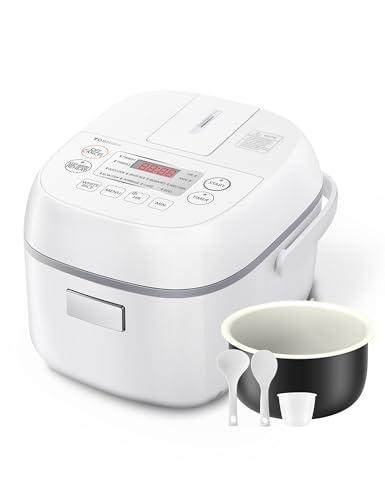
Toshiba Mini Rice Cooker, 3 Cups Uncooked — Best Smart Compact
The Toshiba Mini is the answer for the compact buyer who refuses to accept compact results. Its fuzzy-logic control does what the technology does in full-size premium cookers: it senses and adjusts through the cook, compensating for a slightly-off water measure or a different rice variety, instead of blindly running one fixed cycle. In a 3-cup-uncooked frame, that makes it the texture pick for people who eat rice daily and can taste the difference.
The supporting features match the brain. A delay timer means rice can be ready when you walk in, not started when you walk in; the steamer basket turns the same small footprint into a two-part meal — rice below, vegetables or fish above; and the grain settings acknowledge that compact kitchens still cook brown rice, porridge and mixed grains.
You pay for all of this, in money and in a menu to learn. Buyers who want one button should buy the AROMA above and be happy. Buyers whose standard is the rice itself — the daily-rice households, the texture-sensitive cooks — will find the Toshiba is the smallest cooker that meets it.
Small kitchens should also appreciate what the Toshiba does to the rest of the counter: by absorbing breakfast porridge, steamed sides and the daily rice into one small footprint, it retires the second small appliance many studios keep. In a compact kitchen, the best feature is often the one that lets you own less.
Battery of small decisions aside, the Toshiba’s core promise is repeatability: the same rice on a tired Tuesday as on a careful Sunday. Daily-staple cooking does not need excitement; it needs a result you can plan the rest of the meal around, and that is what the fuzzy-logic control is actually selling at this size.
Strengths
- Fuzzy logic adjusts cooking to the batch instead of running a fixed cycle
- Delay timer and keep-warm suit set-it-in-the-morning routines
- Steamer function and multiple grain settings widen its role beyond white rice
Trade-offs
- Costs more than the simple one-touch minis — you pay for the brain
- More settings mean a short learning curve the simple picks do not have
- White finish shows kitchen splashes in a busy small kitchen
| Capacity | 3 cups uncooked |
| Technology | Fuzzy logic |
| Functions | Multiple grain settings, steamer, warmer |
| Timer | Delay timer |
Best for: daily rice eaters in small households who care about texture / Not suited for: one-button minimalists and the tightest budgets
Check on Amazon — check the current price on Amazon before you buy, because editions, bundles and stock change often.
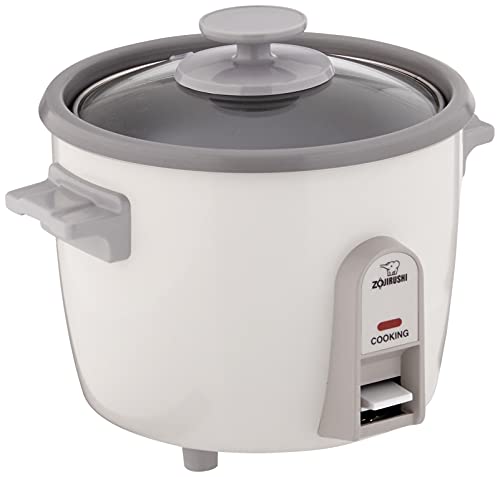
Zojirushi 3 Cup Rice Cooker/Steamer — Best Simple Premium
Zojirushi’s reputation in rice cookers borders on folklore, and this small cooker is a big reason why: it has been making households’ daily rice, with minimal fuss and minimal failure, for a very long time. The design philosophy is the opposite of the Toshiba’s — where Toshiba adds a brain, Zojirushi removes everything that is not needed. One switch. Rice cooks, switch pops, keep-warm holds.
What you get for the restraint is consistency and lifespan. The cooking curve in a cooker refined over this many years is dialed in for ordinary white rice in a way newer models chase with electronics. The steamer tray extends it to a simple meal. And when a Zojirushi is still running in year ten, the premium over a no-name mini reads differently than it did at checkout.
The trade-offs are the missing features, stated plainly: no delay timer, no grain menus, no fuzzy adjustments for an unusual batch. Cooks who set rice in the morning for the evening should buy the Toshiba. Cooks who press a switch when they get home and want perfect, uncomplicated rice for years should buy this.
It is also the easiest pick here to lend, gift or hand down — a graduating student, a first apartment, a parent downsizing — because there is nothing to explain. Put rice and water in, press the switch. In a category racing toward touchscreens, the Zojirushi’s refusal to change is its own kind of engineering confidence, and the secondhand market for these cookers quietly proves how long they run.
Strengths
- Zojirushi build quality and longevity are the benchmark in small cookers
- One-switch operation with automatic keep-warm — nothing to misconfigure
- Included steamer tray cooks vegetables and proteins with the rice
Trade-offs
- No timer or fuzzy logic — it cooks when you press, and that is all
- Premium-brand pricing for deliberately basic features
- Nonstick inner pan needs gentle utensils to stay pristine
| Capacity | 3 cups uncooked / 6 cups cooked |
| Operation | Single switch with keep-warm |
| Accessory | Steamer tray |
| Brand line | Zojirushi rice cooker/steamer |
Best for: small households wanting a buy-it-for-years simple cooker / Not suited for: anyone who needs a delay timer or grain programs
Check on Amazon — check the current price on Amazon before you buy, because editions, bundles and stock change often.

CUCKOO CR-0375FW Micom Rice Cooker, 3-Cup Uncooked — Best for Texture Variety
CUCKOO built its name in Korea, where rice is not a side dish but the center of the meal and the standard for a cooker is unforgiving. The CR-0375FW brings that heritage to the compact class: micom fuzzy-logic control, menus that distinguish between rice types and textures, and cooking curves tuned by a company that sells little else. For households cooking jasmine, short-grain, brown and mixed grains in rotation, that variety handling is the reason to pick it.
The compact body keeps the dorm-and-studio virtues — small footprint, 3-cup batches, one appliance doing the daily staple — while the finish and interface feel a class above the basic minis. It is the pick for the small kitchen that hosts real cooking, not just reheating.
Learning the menus is the price of the variety: the first week involves the manual more than the one-touch picks require. And while CUCKOO is a major brand in its home market, buyers in some regions will find Toshiba and Zojirushi support easier to reach. Where rice variety is the daily reality, those are acceptable trades.
One more audience for the CUCKOO: small households cooking for a baby or toddler, where porridge and soft-rice textures are a daily production. The menu depth that seems excessive for plain white rice becomes genuinely useful when the same small pot must produce congee-soft porridge in the morning and firm grains at night. Compact does not have to mean limited; this pick is the proof.
Strengths
- Micom fuzzy logic with menu options for different grains and textures
- CUCKOO is a rice-cooker specialist brand with deep expertise in Asian rice varieties
- Compact footprint with a more designed, appliance-grade look than basic minis
Trade-offs
- Menu system takes a few cooks to learn
- Specialist-brand support is thinner in some regions than Toshiba or Zojirushi
- Premium positioning within the compact class
| Capacity | 3 cups uncooked / 6 cups cooked |
| Technology | Micom fuzzy logic |
| Brand line | CUCKOO CR-0375FW |
| Use | White and mixed grains, porridge |
Best for: households rotating rice varieties and grains in a small kitchen / Not suited for: set-and-forget cooks who never change rice types
Check on Amazon — check the current price on Amazon before you buy, because editions, bundles and stock change often.

AROMA ARC-363NG Rice Cooker, 3-Cup Uncooked / 6-Cup Cooked — Best Budget Compact
Every category needs its honest value pick, and in compact rice cookers it is the AROMA ARC-363NG. It does the essential job — three cups uncooked, six cooked, one touch, a steam tray for vegetables or dumplings above the rice — at the friendliest position in this guide, from a brand that sells rice cookers by the million. For a first apartment, a dorm upgrade or a small household’s first dedicated cooker, it is the rational default.
Its longevity in the market is itself information: a model that stays in production this long does so because it works and because parts and replacements stay available. The cooking is a fixed cycle — measure honestly, use the cup and water lines provided, and it delivers the fluffy, unremarkable-in-a-good-way rice that most meals want.
Where it loses to the picks above is refinement: no fuzzy adjustment, a basic keep-warm that should be measured in a couple of hours rather than a workday, and looks that belong to a working kitchen rather than a styled one. None of those matter at its tier. Buy it for value; upgrade later only if rice becomes a daily ritual worth the Toshiba or CUCKOO treatment.
There is a sensible way to think about this pick’s place in a kitchen’s life: it is the cooker you buy to learn whether you are a rice-cooker household at all. If it runs daily for a year, you have your answer and the upgrade path above is clear. If it runs twice a month, you have spent the least possible money finding that out. Either way the ARC-363NG has done its job, which is more than most appliances at any tier can claim.
Strengths
- Lowest-cost route to a full 3-cup compact cooker from a major brand
- One-touch simplicity with a steamer tray for one-pot small meals
- Long-running model with a deep base of user knowledge and replacement parts
Trade-offs
- Fixed cooking cycle — no adjustment for unusual grains or small batches
- Keep-warm is basic; rice held for many hours dries at the edges
- Design is functional rather than handsome
| Capacity | 3 cups uncooked / 6 cups cooked |
| Operation | One-touch with keep-warm |
| Accessory | Steam tray |
| Brand line | AROMA pot-style rice cooker |
Best for: students, first apartments and budget-first small households / Not suited for: texture perfectionists and long keep-warm needs
Check on Amazon — check the current price on Amazon before you buy, because editions, bundles and stock change often.

Panasonic SR-G06FGL Rice Cooker, 3-Cup Uncooked — Best Compact with Steamer Focus
The Panasonic SR-G06FGL is the compact pick for people whose small kitchen must multitask. Its listing leads with three roles — rice cooker, steamer, multi-cooker — and that is the honest summary: in a studio or a small apartment where every appliance must justify its footprint twice, a cooker that also steams a full small meal and handles soups and one-pot dishes earns space the rice-only specialists cannot.
The glass lid is a small feature with daily value in that steaming role: you can see the dumplings, the fish, the vegetables, without lifting the lid and dumping the steam the meal is cooking in. Panasonic’s general appliance discipline shows in the fit and finish, and the brand’s support network stands behind it.
Rice purists should look up-list: the Toshiba and CUCKOO cook a bowl of plain rice with more electronic finesse, and the Zojirushi with more decades-honed simplicity. The Panasonic wins when the question is not “best rice only” but “most useful small cooker on a tiny counter” — a question small kitchens ask more often.
The Panasonic also suits a specific compact scenario the others do not: the single appliance allowed in a rented room, an office kitchenette or a short-stay apartment. Where the rules or the space permit exactly one cooking device, a rice cooker that also steams and simmers covers more meals than a specialist — rice and steamed fish, soup nights, oatmeal mornings — without breaking the one-appliance limit.
Steam discipline is the skill this cooker teaches: arrange dense items low and delicate items high in the tray, give the steam room to circulate, and resist lifting the glass lid to check — the window is there precisely so you do not have to. Master that, and the Panasonic quietly covers a surprising share of a small kitchen’s weekly cooking.
Strengths
- Steamer and multi-cooker roles make it a small-meal station, not just a rice pot
- Panasonic’s appliance build and support sit behind the name
- See-through glass lid lets you watch steaming without lifting and losing heat
Trade-offs
- Rice-only specialists above it cook plain rice with more finesse
- Glass lid needs the usual care in a crowded small-kitchen sink
- Feature balance favors versatility over rice purity
| Capacity | 3 cups uncooked / 6 cups cooked |
| Functions | Rice cooker, steamer and multi-cooker |
| Lid | Glass lid |
| Brand line | Panasonic SR-G06FGL |
Best for: studio apartments and small kitchens needing one versatile cooker / Not suited for: rice purists who want a specialist
Check on Amazon — check the current price on Amazon before you buy, because editions, bundles and stock change often.
Comparison Table
| Pick | Badge | Key spec | Best for |
|---|---|---|---|
| AROMA ARC-302NGP Mini Rice Cooker, 2-Cup Uncooked / 4-Cup Cooked | Best for One Person | 2-cup uncooked / 4-cup cooked, mini footprint | solo cooks, dorm rooms, office desks and tiny kitchens |
| Toshiba Mini Rice Cooker, 3 Cups Uncooked | Best Smart Compact | 3-cup uncooked, fuzzy logic, timer | daily rice eaters in small households who care about texture |
| Zojirushi 3 Cup Rice Cooker/Steamer | Best Simple Premium | 3-cup uncooked, one-switch, steamer tray | small households wanting a buy-it-for-years simple cooker |
| CUCKOO CR-0375FW Micom Rice Cooker, 3-Cup Uncooked | Best for Texture Variety | 3-cup uncooked, micom fuzzy logic | households rotating rice varieties and grains in a small kitchen |
| AROMA ARC-363NG Rice Cooker, 3-Cup Uncooked / 6-Cup Cooked | Best Budget Compact | 3-cup uncooked / 6-cup cooked, one-touch | students, first apartments and budget-first small households |
| Panasonic SR-G06FGL Rice Cooker, 3-Cup Uncooked | Best Compact with Steamer Focus | 3-cup uncooked / 6-cup cooked, steamer & multi-cooker | studio apartments and small kitchens needing one versatile cooker |
How to Choose a Compact Rice Cooker
Start with your real headcount and be honest about leftovers. One cup of uncooked rice makes roughly two cups cooked — a generous serving for one, a modest one for two. A 2-cup cooker therefore serves one person with a lunch leftover; a 3-cup serves two to three, or one person who meal-preps. Compact buyers chronically overbuy capacity “just in case” and end up cooking small batches in a big pot, which is exactly how compact rice goes wrong: too little rice in too big a cooker steams unevenly.
Next, choose your control philosophy. One-touch cookers run a fixed cycle perfected for standard white rice — cheapest, simplest, and genuinely excellent at the common case. Fuzzy-logic (micom) cookers measure and adjust through the cook, forgiving a sloppy water measure and handling brown rice, mixed grains and porridge with dedicated curves. If rice is an occasional side, one-touch is the smart money. If rice is a daily staple and you rotate grains, fuzzy logic earns its premium in texture you can taste.
Finally, audit the ownership details. Is the inner pot’s coating durable and the pot itself removable for serving and washing? Does the lid detach or open fully for cleaning — compact cookers live close to their cooks and get splashed? How long will you hold rice on keep-warm, honestly? A cooker that matches your real routine beats a cooker that matches your aspirational one.
One more filter, specific to this class: cord and lid logistics. Compact cookers often live in borrowed spaces — a desk, a dorm shelf, a rental counter — where the cord must reach an awkward outlet and the lid must open under a low cabinet. A cooker with a detachable or retractable cord and a lid that opens within your measured clearance will be used daily; one that fights its space will be used weekly, then monthly, then not at all. The specifications that decide a compact purchase are as much architectural as culinary.
What does “3-cup” actually mean? Reading rice cooker capacities
Rice cooker cups are not US measuring cups. The industry cup is about 180 ml — the traditional Japanese gō — and capacities are quoted in uncooked cups in the model name, then doubled (roughly) for cooked volume in the marketing. So a “3-cup” cooker takes three cooker-cups of raw rice and produces about six US cups of cooked rice. The listings in this guide state both numbers to keep comparisons honest.
The practical translation: one cooker-cup of raw rice is one generous adult portion. A single person who eats rice daily is perfectly served by a 2-cup model; a couple, by a 3-cup; and anyone regularly feeding four should leave the compact class entirely rather than overfilling a mini, because an overfilled compact cooker boils over and undercooks the top layer.
Is fuzzy logic worth it in a mini rice cooker?
Fuzzy logic is worth it for exactly two compact buyers. The first is the daily-rice household rotating varieties — jasmine on Monday, brown rice on Wednesday, a mixed-grain blend on Friday — because the micom models carry distinct curves for each and adjust mid-cook, where a fixed cycle treats them all as white rice and gets two of the three slightly wrong. The second is the imprecise measurer: fuzzy logic forgives the extra splash of water that turns one-touch rice soft.
It is not worth it for the occasional-rice household cooking standard long-grain white. There, the fixed cycle in a Zojirushi or AROMA produces rice most people cannot distinguish from the micom result, at a friendlier tier and with zero menus to learn. Spend the difference on better rice — the grain itself moves the result more than the electronics do at that point.
How long can rice stay on keep-warm in a compact cooker?
Keep-warm is a holding pattern, not a storage mode, and compact cookers hold smaller masses that cool and dry faster at the edges than family-size batches. As a working rule, rice from any pick here is at its best within the first couple of hours on warm; premium fuzzy-logic models manage longer holds more gracefully, but no cooker improves rice by holding it. The small-kitchen habit that actually works: cook what the meal needs (compact capacities make this easy), refrigerate leftovers promptly, and reheat with a sprinkle of water — reheated rice beats all-day-warmed rice every time.
Where do compact rice cookers actually live? Dorms, desks and small counters
The compact class exists because of three rooms. The dorm room, where a 2-cup cooker may be the only cooking appliance allowed and doubles as an oatmeal and soup machine — check your housing rules, since some dorms restrict heating appliances and others welcome rice cookers specifically. The office desk or kitchenette, where a mini cooker produces a hot lunch without the shared microwave, and where a model with a small footprint and a quiet cycle earns its place socially as much as culinarily. And the small home kitchen, where the cooker’s competition is not other cookers but the kettle, the toaster and the coffee maker, all bidding for the same two feet of counter.
Placement details decide whether a compact cooker gets used. It needs a few inches of steam clearance above the lid, a spot where the cord reaches without crossing the sink, and — in the smallest kitchens — a home it can stay in permanently, because a cooker that must be fetched from a cupboard gets used half as often. Measure your intended spot, including the open-lid height, before ordering; returns in this category are more often about centimeters than about cooking.
Power is rarely a problem: compact cookers draw modest wattage compared with kettles and microwaves, which is one reason dorms that ban hot plates often allow them. In an RV or a van setup, that modest draw matters even more, and the 2- and 3-cup class is the largest that small inverters and campsite hookups run comfortably alongside everything else.
How to Cook Perfect Rice in a Compact Rice Cooker
Step one: measure with the cooker’s own cup and lines. Use the cup that came with the cooker and fill water to the line inside the pot that matches your cup count — the manufacturer calibrated those lines for that pot. Mixing a US measuring cup with the pot’s lines is the single most common cause of “this cooker makes bad rice.”
Step two: rinse, then rest. Rinse the rice in the pot or a strainer until the water runs mostly clear; this removes surface starch and is the difference between separate grains and a gummy mass. If your routine allows, let the rinsed rice sit in its cooking water for 20 to 30 minutes before pressing start — the soak evens out hydration and noticeably improves texture, especially for brown rice in the fuzzy-logic models.
Step three: cook undisturbed. Press the button and leave the lid closed for the whole cycle; compact cookers have small thermal mass and lose proportionally more heat to a peek than big ones. When the cooker switches to warm, the rice is cooked but not finished.
Step four: rest, then fluff. Give the rice 10 to 15 minutes resting on warm with the lid closed — this finishing steam is where the texture sets. Then open, and fluff with the paddle using a cutting-and-folding motion, releasing surface steam so the grains stay separate. Serve from the pot, and move leftovers to the fridge within a reasonable window rather than holding them on warm for hours.
Step five: troubleshoot by symptom. Rice too wet: less water next time by a tablespoon or two, and make sure the rest ran its full course — most wet rice is under-rested, not over-watered. Rice too firm: add a splash more water and extend the pre-cook soak. Scorched bottom layer: the batch was likely too small for the pot, or the rice sat on warm too long after cooking. Write your adjusted numbers on a note kept with the cooker; two or three iterations dials any of these models in to your rice and your water, permanently.
Common Buying Mistakes
Buying a bigger cooker “just in case”. Small batches in an oversized pot cook unevenly and dry out. Compact means matched to your daily batch; guests are a saucepan problem, once a year
Mixing measuring systems. Using a US cup for the rice and the pot’s molded lines for water guarantees the wrong ratio. One system — the cooker’s own — every time
Skipping the rinse and the rest. Unrinsed rice turns gummy; unrested rice stays wet on the surface and firm in the middle. Ten minutes of resting after the switch to warm is part of the recipe, not a delay
Holding rice on warm all day. Texture and quality decline by the hour, fastest in small batches. Cook per meal, refrigerate leftovers, reheat with a sprinkle of water
Scouring the inner pot. Metal pads and utensils strip nonstick coatings, after which rice sticks forever. Wooden or silicone tools and a soak-first wash keep the pot nonstick for years
Final Recommendation
If you buy one cooker from this guide, match it to your household in one line: solo cooks get the AROMA ARC-302NGP Mini; texture-serious small households get the Toshiba Mini or the CUCKOO CR-0375FW if grains rotate; longevity-first buyers get the Zojirushi 3 Cup; budgets get the AROMA ARC-363NG; and tiny kitchens that need every appliance to multitask get the Panasonic SR-G06FGL.
Whichever badge fits, the compact class rewards honesty about headcount. Buy the size you will fill properly every day, rinse the rice, respect the rest, and a cooker the size of a kettle will quietly become the most-used appliance in a small kitchen — the one that asks the least, gives the most predictable result, and never once complains about the size of the room it works in.
Related guides on this site: Best 3 Cup Rice Cookers Best 4 Cup Rice Cookers Best 6 Cup Rice Cookers Best Commercial Rice Japanese Cookers Best Cookers For Oatmeal
Frequently Asked Questions
How many people does a 3-cup rice cooker feed?
Three cups uncooked makes about six cups cooked, which serves two to three adults as a main side, or one to two people with leftovers. A solo cook is usually better served by a 2-cup model, because small batches cook more evenly in a pot sized for them.
Can a compact rice cooker cook brown rice?
Yes, with more water and more time than white rice. The fuzzy-logic picks (Toshiba and CUCKOO) have dedicated settings that handle brown rice best. On one-touch models, use the brown-rice water line if marked, expect a longer cycle, and let the resting step run fully — brown rice benefits most from the soak before cooking.
What else can I cook in a mini rice cooker?
Oatmeal and other porridges, soups, steamed vegetables and dumplings in the tray, quinoa and other grains, and simple one-pot dishes like rice with frozen vegetables mixed in. Respect the capacity — small pots boil over with starchy or foamy loads filled too high — and keep experimenting at half batches first. Small cookers are also forgiving teachers: a failed experiment costs one cup of rice, not six, which is why so many confident grain cooks started on a mini. The same forgiving scale makes compact cookers a good first appliance to teach a teenager or a new cook: the stakes are one small pot, the feedback is immediate, and the core skills — measuring, rinsing, resting, seasoning — transfer directly to every larger pot they will ever use.
Is a rice cooker worth it for one person?
For a person who eats rice more than twice a week, yes — it is arguably more worth it than for a family, because it removes the attention cost that makes solo cooks skip rice or cook too much of it. The 2-cup AROMA exists precisely for this case: one meal, one small leftover, almost no washing up.
How do I stop rice sticking to the pot?
Rinse the rice, use the correct water line, let the cooked rice rest before fluffing, and serve with the included paddle rather than metal utensils. If sticking persists, a few drops of oil or butter in the cooking water helps — but check the coating first: a pot whose nonstick is already damaged by scouring will stick no matter what the recipe does.
Can I cook just one cup in a 3-cup cooker?
Yes — one-cup batches are the daily reality for many 3-cup owners and they cook well, provided you use the 1-cup water line and rinse as usual. Below one cup, results get erratic in any cooker because the thermal mass of the pot dwarfs the rice; that is the specific case the 2-cup AROMA mini exists for. Match the batch to the pot and both sizes cook honestly.
Why are there no prices in this guide?
Compact cooker prices shift with sales and color variants, and a printed figure would mislead quickly. Each pick links to its Amazon listing so you can check the current price on Amazon at the moment you buy, in the exact color and bundle you want. Compact models are frequent sale items around back-to-school season, when dorm demand peaks, so timing a purchase to late summer often helps a budget stretch.


