Disclosure: airfryerkitchensupply.com is reader-supported. When you buy through links on our site, we may earn an affiliate commission at no extra cost to you.
Where to buy
You can buy every pick in this best cookers for oatmeal guide through Amazon, where stock, delivery options and returns are easiest to manage for kitchen gear of this size. Start with our top recommendations: Instant Pot Duo 6 Qt 7-in-1 Electric Pressure Cooker, Dash Mini Rice Cooker 2-Cup (Black), Toshiba Mini Rice Cooker 3-Cup (White), CUCKOO CR-0375FW Micom Rice Cooker, AROMA ARC-914SBD Digital Rice Cooker, Zojirushi NHS-06 3-Cup Rice Cooker/Steamer. Prices and availability change often, so check price on Amazon on the product page before you order, and confirm the exact size, colour and configuration on the listing matches what you measured your kitchen for.
Finding the best cookers for oatmeal sounds like a niche problem until you have scraped one more pan of cemented oats off the stove, or microwaved a bowl that boiled over for the third morning in a row. Oatmeal is cheap, filling and healthy, but it is genuinely annoying to cook well: it foams, it sticks, it scorches on the bottom while the top stays watery, and steel-cut oats demand a long, gentle simmer that nobody wants to babysit at 6 a.m. A dedicated countertop cooker fixes all of that. You load oats and water the night before or first thing in the morning, press a button or set a timer, and walk away while the machine holds the exact low, steady heat oats need.
There is no single appliance category called an ‘oatmeal cooker’, which is why this guide exists. In practice, the machines that cook oatmeal best are small rice cookers with porridge-style cycles, fuzzy-logic mini cookers with delay timers, and multi-cookers with a porridge setting. Each of the six picks below was verified against Amazon’s own catalogue data before it earned a link here, and each one suits a different kind of oatmeal eater: the single-serving dorm cook, the steel-cut devotee, the family batch-cooking for the week, and the set-it-the-night-before commuter. We also tell you honestly where a cheap stovetop pot still wins, because for rolled oats cooked in four minutes, sometimes it does.
One honest warning up front: capacity numbers in this category are confusing. Rice cooker capacities are quoted in uncooked cups using a smaller 180 ml measuring cup, and oatmeal expands and foams far more than rice, so you should never fill any of these machines more than about halfway with oats and water combined. Every pick below is sized with that headroom rule in mind.
A note on what this guide is not: it is not a list of porridge gadgets with novelty settings and single-purpose designs. Every machine below also cooks rice, grains, soups or stews, because a single-use oatmeal appliance is hard to justify in a real kitchen. What separates the picks is how gracefully they handle oats specifically — foam management, gentle heat, timers, pot materials — tested against the way these machines are actually specified by their manufacturers and sold on Amazon. Where a famous name did not hold up on those criteria, it is not here, and where an unglamorous budget model genuinely earns its place, we say so.
In this guide
Quick Picks
If you only have a minute, these are the cookers for oatmeal worth shortlisting. Each one is reviewed in full further down, with strengths, trade-offs and a clear verdict on who it suits.
- Best Overall — Instant Pot Duo 6 Qt 7-in-1 Electric Pressure Cooker: The most versatile oatmeal machine on this list: pressure-cooks steel-cut oats fast, slow-cooks overnight oats gently, and keeps breakfast warm until everyone is up.
- Best for Singles and Dorms — Dash Mini Rice Cooker 2-Cup (Black): A personal-size cooker whose listing says the quiet part out loud — it cooks oatmeal — with a ceramic nonstick pot sized for one generous bowl.
- Best for Overnight Oats — Toshiba Mini Rice Cooker 3-Cup (White): Fuzzy logic plus a 24-hour delay timer: load it at night, and hot oatmeal is waiting when the alarm goes off.
- Best Premium Mini — CUCKOO CR-0375FW Micom Rice Cooker: A Korean micom cooker with nine cooking modes and the build quality to be the last small cooker you buy for years.
- Best Budget Digital — AROMA ARC-914SBD Digital Rice Cooker: The long-running budget favourite: digital controls, a 2-quart pot and enough capacity for two to four bowls of oatmeal.
- Best Simple One-Switch Cooker — Zojirushi NHS-06 3-Cup Rice Cooker/Steamer: One lever, no menus, legendary reliability: the minimalist Japanese cooker that makes fine oatmeal the unthinking way.
How These Picks Were Chosen
We started from the way people actually cook oatmeal and worked backwards to machines. The candidates had to do at least one of three things well: run a long, gentle porridge-style cycle for steel-cut oats; offer a delay timer so breakfast cooks itself; or be small and simple enough that a single serving is effortless. Every product recommended here was then verified on this site’s own Amazon integration — we searched by brand and model, matched the returned listing title to the product, and only then attached a buying link. Products the API could not confirm are not linked, and no prices or ratings are printed in this guide because both change constantly.
We also applied the halfway rule as a sizing filter. Oatmeal foams and expands far more aggressively than rice, so headline rice capacities were discounted heavily when judging how much oatmeal each machine can realistically cook. A 3-cup cooker is a one-to-two-bowl oatmeal machine, whatever the box implies, and our verdicts are written on that honest basis. Finally, we weighted cleanup heavily: an oatmeal cooker that is annoying to wash will be abandoned by February, so nonstick quality, removable pots and dishwasher-safe parts counted for as much as cooking modes.
The 6 Best Cookers for Oatmeal

Instant Pot Duo 6 Qt 7-in-1 Electric Pressure Cooker — Best Overall
The Duo is the right answer for households that eat oatmeal several times a week and in more than one style. Its 6-quart pot handles a family batch of rolled oats on the porridge-style cycle, pressure cooking collapses steel-cut oats from a 40-minute stovetop simmer into a hands-off cycle, and the slow-cook function turns it into an overnight oatmeal crock for wake-up-ready breakfasts. If your kitchen earns its counter space appliance by appliance, this is also the pick that replaces the most other gadgets.
Strengths
- Pressure cooking makes steel-cut oats genuinely weeknight-and-weekday practical, with no stirring and no boil-over risk
- Slow-cook and keep-warm functions cover the overnight-oats method that small rice cookers cannot match for batch size
- Stainless steel inner pot has no nonstick coating to wear out, and it goes straight in the dishwasher
Trade-offs
- Far bigger than a breakfast-only appliance needs to be; it will dominate a small counter
- Pressure cycles need natural release time for foamy grains, which eats into the headline speed advantage
- The sealing ring absorbs odours over time, so a dedicated ring for sweet breakfasts is a sensible extra
| Capacity | 6 Qt |
| Functions | 7-in-1: pressure cook, slow cook, rice, steam, sauté, warm, sterilize (per Amazon title) |
| Inner pot | Stainless steel |
What makes the Duo work for oatmeal specifically is control. Oats foam because their starches gelatinise and trap steam; under pressure that foam is contained, and a natural pressure release lets it subside before you open the lid, which is the single most important technique for pressure-cooked oats. Use roughly one part steel-cut oats to three parts liquid, add a pinch of salt and a little butter or oil to calm the foam, and let the pressure drop on its own for at least ten minutes. The result is the creamy, chewy texture that otherwise needs constant stovetop attention.
As a slow cooker it is equally convincing. Load rolled or steel-cut oats at night on the slow-cook setting and the keep-warm function holds them at a safe serving temperature until morning — the classic set-and-forget routine that makes weekday oatmeal realistic for families. The honest limitation is size and ceremony: for one person microwaving a single bowl, this is overkill, and the lid, ring and pot are three things to wash instead of one. But as the one machine that covers every oatmeal style at family scale, nothing else in this guide beats it.
Best for: families and steel-cut oat lovers who want one machine for every oatmeal style / Not suited for: single servings in a tiny kitchen, where a mini cooker below is smarter
Check the current price on Amazon

Dash Mini Rice Cooker 2-Cup (Black) — Best for Singles and Dorms
The Dash Mini is built for exactly one job: a single serving of hot cereal for one person, in a dorm room, studio flat, office kitchenette or camper. Its verified listing explicitly names oatmeal among the grains it cooks, which matters more than it sounds — most mini rice cookers scorch oats on a full-power rice cycle, while this one’s small pot and gentle keep-warm are tuned for small, starchy loads. One cup uncooked capacity translates to one deep bowl of oatmeal, which is the correct size for its audience.
Strengths
- Explicitly designed to cook oatmeal and other grains, not just rice, per the verified listing
- Ceramic nonstick pot releases starchy oat residue far more easily than bare aluminium pots
- Tiny footprint and simple one-switch operation suit dorms, desks and first flats
Trade-offs
- strictly one-serving territory; a second hungry person means a second batch
- No timer or delay start, so overnight oats are not its trick
- Basic cook/warm control only — no separate porridge programme to fine-tune texture
| Capacity | 2 cups cooked (1 cup uncooked) |
| Inner pot | Removable ceramic nonstick |
| Functions | Cook + keep warm (per Amazon title) |
Mini cookers succeed or fail on ratio discipline. In the Dash, half a cup of rolled oats to about one cup of water or milk gives a thick, spoonable bowl; go beyond roughly two-thirds of the pot with liquid and the foaming oats will find the lid vent. Milk makes a richer bowl but foams more than water, so a half-milk, half-water mix is the practical compromise, and stirring once when it switches to warm evens out the texture. Because the pot is ceramic nonstick, the morning-after cleanup is a rinse rather than a soak-and-scrape.
Set expectations correctly and this little machine is delightful: it is not a family appliance, it will not time-shift your breakfast, and steel-cut oats come out firmer than most people like because the cycle is short. For rolled oats, quick oats and instant oatmeal mixes for one, though, it removes every annoying part of the stovetop routine for less counter space than a kettle. Students and solo cooks who actually eat oatmeal daily will use it constantly.
Best for: solo cooks, students and dorm rooms making one bowl at a time / Not suited for: families, batch cooking or steel-cut oats
Check the current price on Amazon
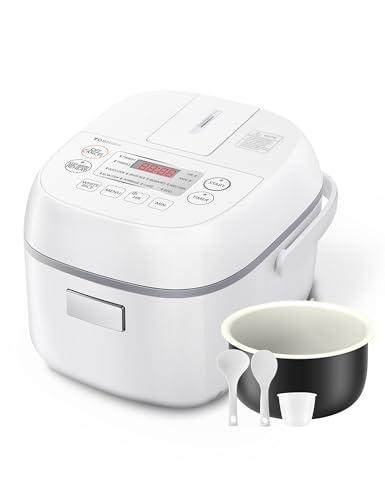
Toshiba Mini Rice Cooker 3-Cup (White) — Best for Overnight Oats
The Toshiba Mini is the pick for people whose oatmeal habit lives or dies on mornings being effortless. The verified listing confirms the two features that matter most for breakfast: fuzzy-logic cooking, which adjusts heat through the cycle instead of blasting at one temperature, and a 24-hour delay timer, so oats and water loaded at 10 p.m. finish cooking just before you wake. Its 3-cup uncooked size serves one to three people — the sweet spot for couples and small families.
Strengths
- 24-hour delay timer enables true load-it-the-night-before oatmeal
- Fuzzy logic control handles the low, steady heat phase that keeps oats from scorching on the base
- Auto keep-warm holds finished oatmeal safely until the household drifts downstairs
Trade-offs
- Costs more than a basic one-switch mini cooker, and the extra electronics are wasted if you never use the timer
- Fuzzy-logic cycles run longer than simple cookers; breakfast is planned, not spontaneous
- The 3-cup size is generous for one, small for a big family
| Capacity | 3 cups uncooked (for 1–3 people) |
| Control | Fuzzy logic, one-touch cooking |
| Timer | 24-hour delay timer + auto keep warm (per Amazon title) |
The delay timer changes the food-safety and texture conversation, so use it correctly. Oats sitting in water at room temperature for a few hours before a timed cycle are fine; oats sitting in milk overnight in a warm kitchen are a different matter. For timer cooking, use water as the cooking liquid and stir in milk, yoghurt or cream after cooking, or use a shelf-stable plant milk and keep the delay under about eight hours. Steel-cut oats are the big winners here: their long cook time, normally the deal-breaker on a weekday, disappears entirely when the machine starts itself at 5 a.m.
Fuzzy logic also earns its keep on texture. Simple cookers cycle between full heat and off, which is why their oatmeal welds itself to the pot base; the Toshiba modulates power through the absorption phase, giving a more even, less scorched result and a pot that rinses clean. Add the steamer basket in the verified listing and the same machine steams eggs or vegetables while the oats cook below — a genuinely complete small breakfast station.
Best for: couples and small households who want oatmeal ready on a schedule / Not suited for: buyers who want the cheapest possible one-button cooker
Check the current price on Amazon

CUCKOO CR-0375FW Micom Rice Cooker — Best Premium Mini
CUCKOO is the brand Korean households treat the way Americans treat a favourite cast-iron pan, and the CR-0375FW is its compact fuzzy-logic cooker: 3 cups uncooked, nine cooking modes, and a nonstick inner pot, all confirmed in the verified listing. For oatmeal, the micom (microcomputer) control is the story — it manages the soak, heat and rest phases that turn oats creamy instead of gluey, and the multiple modes let you match the cycle to rolled, steel-cut or mixed-grain porridges.
Strengths
- Nine cooking modes give real control over porridge-style textures, from quick rolled oats to long-cooked grains
- CUCKOO build quality and pot coating durability are a clear step above budget mini cookers
- Auto-clean function tackles the starchy residue oatmeal leaves behind better than a plain rinse
Trade-offs
- Premium pricing for a 3-cup machine; you are paying for control and longevity, not capacity
- The mode menu takes a weekend of use to learn properly
- Still bound by the halfway rule for foaming oats, so family batches belong in the Instant Pot
| Capacity | 3 cups uncooked / 6 cups cooked |
| Modes | 9 cooking modes |
| Inner pot | Nonstick; auto-clean function (per Amazon title) |
Where the CUCKOO justifies itself is repeatability. Oatmeal texture is a ratio-and-temperature problem, and a micom cooker solves it the same way every morning: same soak, same ramp, same rest. Once you find the mode and ratio that give you your preferred consistency — most owners land on a porridge-style mode at about one part oats to four parts water for steel-cut, leaner for rolled — the machine reproduces it without attention, which is precisely what a breakfast appliance should do.
The auto-clean cycle deserves a mention because oatmeal’s weakness as a food is the film it leaves on pots and lids. Running the cleaning cycle with water after a few porridge sessions keeps the lid plate and steam path from developing the stale smell that plagues neglected rice cookers. Pair that with a genuinely durable nonstick pot and this is the mini cooker most likely to still be on your counter in five years. It is a considered purchase rather than a bargain, and it behaves like one.
Best for: daily oatmeal eaters who value texture control and long service life / Not suited for: occasional oatmeal cooks who would not use the extra modes
Check the current price on Amazon

AROMA ARC-914SBD Digital Rice Cooker — Best Budget Digital
The ARC-914SBD has been AROMA’s entry digital cooker for years, and it remains the sensible budget route into programmed oatmeal. The verified listing confirms a 4-cup uncooked / 8-cup cooked grain cooker with steamer function in a 2-quart body — in oatmeal terms, that is two generous bowls or four modest ones per batch, with headroom for foaming if you respect the halfway rule. Digital controls bring a delay timer and keep-warm that the cheapest one-switch pots lack.
Strengths
- Digital timer and keep-warm at a budget tier where most rivals are simple on/off pots
- 2-quart capacity is the smallest size that still serves a couple plus seconds
- Stainless steel exterior wipes clean and looks tidy on the counter
Trade-offs
- Nonstick pot needs gentle utensils and hand-washing to keep its coating alive
- The white-rice cycle runs hot for delicate oats; the slower settings give better texture but take longer
- Condensation collects in the lid rim and needs a wipe after starchy cooks
| Capacity | 4 cups uncooked / 8 cups cooked, 2 Qt |
| Functions | Digital rice/grain cooker + steamer (per Amazon title) |
| Exterior | Stainless steel |
Budget digital cookers reward one habit: use the timer and the gentler cycles rather than forcing speed. Rolled oats on a programmed morning cycle come out evenly hydrated because they soak before the heat peaks, and the keep-warm holds them without the base continuing to cook — the failure mode of cheap pots left plugged in. For steel-cut oats, give them the longest cycle you have and a slightly wetter ratio; the AROMA will not match a pressure cooker’s texture, but it gets respectably close with zero supervision.
Ownership is straightforward. The inner pot and accessories are the consumables: treat the coating kindly, avoid metal spoons, and expect years of service from the base unit. As with every cooker here, rinse the lid and condensation collector after oatmeal — starch water left sitting is what makes small cookers smell stale. For the price tier, no other verified pick in this guide combines this capacity, a timer and digital control.
Best for: budget buyers who still want a timer and digital control / Not suited for: cooks who abuse nonstick coatings with metal utensils
Check the current price on Amazon
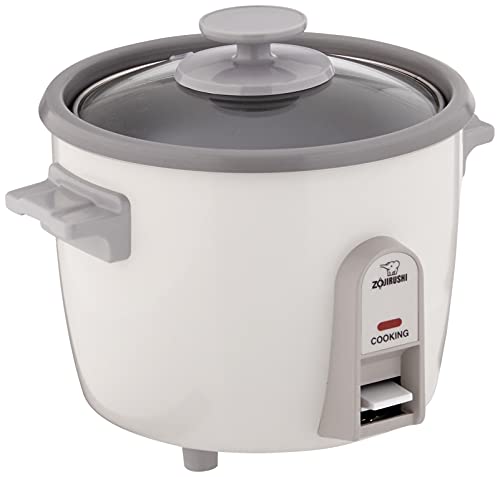
Zojirushi NHS-06 3-Cup Rice Cooker/Steamer — Best Simple One-Switch Cooker
The NHS-06 is the anti-gadget: a single lever, a glass lid, a steamer tray, and Zojirushi’s reputation for building small cookers that outlive trends. For oatmeal, its simplicity is the feature. There is no porridge programme to configure — you add rolled oats and water at a slightly wetter ratio than the rice lines suggest, push the lever, and the gentle full-pot heat cooks a small batch while you shower. It suits one or two people who want breakfast handled with zero decisions.
Strengths
- Dead-simple one-lever operation anyone in the house can run half-asleep
- Glass lid lets you watch foam behaviour, which is genuinely useful with oats and milk
- Zojirushi build quality at the small end of the range; these cookers run for years
Trade-offs
- No timer, no porridge mode, no fuzzy logic — timing breakfast ahead is not possible
- The nonstick pot is small; the halfway foam rule caps a batch at roughly two bowls
- Steel-cut oats need a pre-soak to cook through on its single cycle
| Capacity | 3 cups (per Amazon title) |
| Type | Rice cooker/steamer, one-switch |
| Lid | Glass (see-through) |
There is a real technique to one-switch oatmeal, and it is worth learning because it transfers to every basic cooker. Use rolled oats, keep the total fill below half the pot, add a small knob of butter or a few drops of oil to suppress foam, and rest the cooked oats for five minutes on warm with the lid on before stirring — the rest is where the texture sets. Pre-soaking steel-cut oats in the pot for an hour (or overnight in the fridge) compensates for the single cooking cycle, and a second short cycle after stirring finishes them properly.
Why choose this over the smarter Toshiba or CUCKOO above? Because every feature is a thing that can confuse, break or go unused, and the NHS-06 has almost none of them. It is the cooker you buy for a parent, a teenager or a holiday cabin, and the one most likely to be handed down. What it gives up in programmability it returns in decades-grade simplicity.
Best for: minimalists and small households who want one lever and no learning curve / Not suited for: anyone who needs a delay timer or hands-off steel-cut oats
Check the current price on Amazon
Comparison Table
| Pick | Badge | Key spec | Best for |
|---|---|---|---|
| Instant Pot Duo 6 Qt 7-in-1 Electric Pressure Cooker | Best Overall | 6 Qt, 7-in-1 pressure + slow cook | families and steel-cut oat lovers who want one machine for every oatmeal style |
| Dash Mini Rice Cooker 2-Cup (Black) | Best for Singles and Dorms | 2-cup cooked, ceramic nonstick pot | solo cooks, students and dorm rooms making one bowl at a time |
| Toshiba Mini Rice Cooker 3-Cup (White) | Best for Overnight Oats | 3-cup uncooked, fuzzy logic, 24h timer | couples and small households who want oatmeal ready on a schedule |
| CUCKOO CR-0375FW Micom Rice Cooker | Best Premium Mini | 3-cup uncooked, 9 modes, micom fuzzy logic | daily oatmeal eaters who value texture control and long service life |
| AROMA ARC-914SBD Digital Rice Cooker | Best Budget Digital | 4-cup uncooked / 2 Qt, digital + steamer | budget buyers who still want a timer and digital control |
| Zojirushi NHS-06 3-Cup Rice Cooker/Steamer | Best Simple One-Switch Cooker | 3-cup, one-switch cooker/steamer | minimalists and small households who want one lever and no learning curve |
How to Choose the Best Cooker for Oatmeal
Start with your oat type, not the appliance
Rolled oats are forgiving: almost any small cooker on this page handles them, because they hydrate fast and tolerate a simple rice cycle. Steel-cut oats are the demanding case — they need 30-plus minutes of sustained gentle heat, which means a porridge cycle, a fuzzy-logic programme, a slow cooker or a pressure cooker. Instant oatmeal, honestly, needs only hot water, and buying a machine for it alone is hard to justify unless the same machine also handles your grains and soups. Decide which oat you actually eat four mornings a week, and let that choose the category.
Capacity: translate rice cups into oatmeal bowls
Rice cooker cups are 180 ml measures of uncooked rice, and oatmeal’s foaming caps your real fill at about half the pot. As a working translation: a 2-cup mini makes one bowl; a 3-cup cooker makes one to two bowls; a 4-cup digital makes two to four bowls; and a 6-quart multi-cooker is the only format here that batch-cooks for a family or a week of meal prep. Buying one size up is sensible; buying three sizes up just means a bigger pot to wash every morning.
Timers and keep-warm are the real luxury features
The difference between an oatmeal habit that survives busy mornings and one that dies is the delay timer. Loading oats and water the night before and waking to cooked breakfast removes the only real friction in the routine. If you will use a timer, cook with water and add dairy afterwards for food-safety and texture reasons, and make sure the machine’s keep-warm holds food at a safe temperature rather than letting it drift lukewarm for hours.
Pot material decides your cleanup life
Nonstick pots release oatmeal’s starch film with a rinse, but coatings are consumables: they dislike metal utensils, harsh scouring and thermal shock. Ceramic-coated pots like the Dash’s are a middle path. Stainless steel, as on the Instant Pot, never wears out but needs a short soak after porridge. There is no wrong answer — only an honest match between the pot and how you actually wash up.
Lids, vents and the counter-space question
Oatmeal steam carries starch, so lid design matters more than in most categories. Hinged lids with removable inner plates, like the fuzzy-logic minis here, clean properly in the sink; loose glass lids, like the Zojirushi’s, are simpler and let you watch the foam but drip condensation on the counter when lifted. If your counter is small, measure the open-lid height too — a hinged cooker under low cabinets can be more awkward than its footprint suggests. None of this should decide the purchase alone, but in a machine you will open every single morning, these small frictions compound, and they are exactly the details spec sheets never mention.
What Is the Best Water-to-Oats Ratio in a Cooker?
Ratios shift in a closed cooker because almost no water evaporates, so use less liquid than stovetop recipes suggest. Start with 1 part rolled oats to 2 parts liquid for a thick bowl, 1 to 2.5 for a softer one. Steel-cut oats want 1 to 3 under pressure or on a long porridge cycle, and up to 1 to 4 for overnight slow cooking. Milk can replace up to half the water; all-milk batches foam harder and scorch faster, so reserve them for supervised cycles. Salt early — a pinch per serving transforms the flavour — and add sweeteners, fruit and nuts after cooking, both for texture and because sugars increase sticking during the cycle.
Expect to adjust once or twice for your specific machine. A cooker that runs slightly hot will thicken the same ratio more than a gentle one, and oat brands differ in absorbency. Write your winning ratio on a note inside the cupboard door; consistency is the entire point of owning the machine.
Can a Rice Cooker Really Cook Oatmeal Well?
Yes — with one caveat about cycles. A rice cooker’s job is to hold grains at a simmer until the water is absorbed, which is exactly oatmeal’s job description too. The caveat is foam: rice cycles are tuned for grains that do not foam like oats, so on a basic cooker you manage the foam yourself with headroom, a little fat in the pot, and restraint with milk. Cookers with fuzzy logic or dedicated grain modes manage the heat ramp more gently and need less babysitting. Either way, the result beats the microwave for texture and beats the stovetop for effort, which is the honest case for every machine in this guide.
Which Oatmeal Style Suits Which Cooker?
Overnight oats in the slow-cook sense — grains cooking slowly for hours — belong to the Instant Pot on its slow-cook function or a programmed cooker finishing on a timer. The texture is soft and pudding-like, ideal for batch cooking on Sunday for the week ahead, portioned into jars and reheated with a splash of milk. Baked oatmeal, by contrast, is not a countertop-cooker food at all; it needs an oven, and no pick here pretends otherwise.
Savoury oatmeal is the style more home cooks should try, and cookers make it easy: cook steel-cut oats in stock instead of water, then top with a fried egg, spring onions and chilli oil. A multi-cooker’s sauté function browns mushrooms or bacon in the same pot before the oats go in, which makes the Instant Pot the natural savoury pick. Porridge blends — half oats, half quinoa, millet or buckwheat — suit the multi-mode CUCKOO and Toshiba, whose grain programmes handle mixed hydration rates better than a single fixed cycle.
Finally, consider the people at your table. Babies and toddlers need oatmeal cooked very soft and served plain, which any pick here does well in small batches — the Dash and the Zojirushi earn their keep in that season of life. Athletes bulking up breakfasts will care about batch size and protein add-ins stirred in after cooking. The machine matters less than the match between its strengths and the style you will genuinely cook twice a week.
How Long Does Oatmeal Keep, and Can You Reheat Cooker Oatmeal?
Cooked oatmeal keeps well: cooled quickly, refrigerated in sealed containers, it holds its quality for around four to five days, which is what makes Sunday batch cooking in a 6-quart multi-cooker practical. It will set firm in the fridge — that is the starches doing their normal work, not spoilage. Reheat individual portions with a splash of water or milk, in the microwave or a small pan, stirring once halfway; the texture returns to something very close to fresh, especially for steel-cut oats, which reheat better than rolled.
Freezing works too. Portion cooked oatmeal into muffin tins or silicone cups, freeze solid, then bag the pucks; a frozen portion reheats from a few minutes in the microwave with liquid added. Flavour additions like fresh fruit are better added after reheating, while sturdy mix-ins — nut butters, seeds, dried fruit, spices — freeze and reheat without complaint. If a refrigerated batch smells sour or shows any mould, discard it; oats are cheap, and no breakfast is worth the gamble.
Do You Need a Dedicated Oatmeal Cooker at All?
Honesty section: if you eat rolled oats twice a month, you do not. A heavy saucepan, a wooden spoon and four minutes of attention will serve you fine, and the money is better spent on good oats, real maple syrup and toppings you actually look forward to. The case for a machine appears when oatmeal is a near-daily habit, when mornings are chaotic, when steel-cut oats are your preference, or when several people eat at staggered times and keep-warm stops being a luxury. That describes a lot of households, which is why this category exists at all.
There is also a middle path worth naming: the cooker you already own. Many readers reaching this guide have a rice cooker or multi-cooker in a cupboard that has never been tried on oats. Run one test batch with the ratios in this guide before buying anything — the halfway rule, a pinch of salt, a knob of butter, a five-minute rest. If the result pleases you, your search is over and this guide has still done its job. If the test batch foams over, scorches or comes out gluey, you now know exactly which limitation your new purchase needs to fix, and the picks above are organised by precisely those limitations.
How to Cook Oatmeal in a Countertop Cooker, Step by Step
The method below works, with ratio tweaks, in every pick in this guide. Master it once and breakfast becomes a loading task, not a cooking task.
- Measure honestly. Use the cup that came with the cooker or a standard measure, and keep oats plus liquid below half the pot depth — the foam rule is not negotiable.
- Add salt and a foam-tamer. A pinch of salt per serving and a small knob of butter or teaspoon of oil noticeably reduce foaming and sticking.
- Choose the gentlest suitable cycle. Porridge or grain modes first, slow or low cycles second, standard rice cycle last. For one-switch cookers, just press the lever.
- Set the timer if you have one. For morning cooking, load with water only and set the delay so cooking finishes at wake-up time.
- Rest before stirring. Give finished oatmeal five to ten minutes on keep-warm, lid closed. The texture sets and the base releases.
- Stir, enrich, serve. Stir through, then add milk, yoghurt, honey, fruit or nuts. Serve straight from the pot at the table for family batches.
- Rinse immediately. Oat residue rinses off in seconds when fresh and cements itself when dry. Fill the pot with warm water while you eat if nothing else.
For steel-cut oats under pressure, use the 1-to-3 ratio, cook on high pressure, and always allow a natural release of at least ten minutes — a quick release can spray starchy foam through the valve. For overnight slow-cooked oats, the 1-to-4 ratio on the lowest setting gives a soft, spoonable result by morning.
Common Buying Mistakes
Overfilling the pot. The most common failure in this category. Oats foam to roughly double their liquid volume; a pot filled to the rice line will vent starch water across your counter. Half full is the ceiling, always.
Cooking with all milk on a timer. Milk held warm for hours before cooking is a food-safety and curdling problem. Timer batches cook in water; dairy goes in at serving.
Using the rice ratio from the box. Cooker recipes printed for rice assume evaporation and non-foaming grains. Oatmeal in a sealed cooker needs its own, leaner ratios, as covered above.
Skipping the rest. Oatmeal stirred the second the cycle ends looks soupy and eats gluey. Five to ten minutes of resting is a cooking step, not a delay.
Letting residue dry in the pot. Dried oat film is why people abandon these machines. A rinse while you eat keeps the nonstick young and the cooker odour-free.
Final Recommendation
For most households, the Instant Pot Duo is the best cooker for oatmeal overall: it covers steel-cut, rolled and overnight styles at family scale, and its stainless pot will outlast coatings. If your mornings run on a schedule, the Toshiba Mini’s 24-hour timer is the feature that actually changes behaviour, and the CUCKOO is the premium mini to buy when texture control matters more than price. Solo cooks should start with the Dash Mini, budget buyers with the AROMA, and anyone who hates menus with the one-lever Zojirushi.
Whichever you choose, learn the halfway rule and your machine’s winning ratio in the first week. After that, the best cooker for oatmeal is simply the one that has breakfast ready before you are fully awake.
One last piece of buying advice: check the listing carefully before ordering, because several of these product families come in multiple sizes with near-identical names and photographs. Confirm the capacity in the title matches the size you measured for, keep the box until you have run two or three batches, and register the warranty if the brand offers one. Small cookers live hard lives of daily heat cycles and dishwasher trips; the brands in this guide have the service networks to back them, which is part of what you are paying for at every tier. Buy once, buy the right size, and breakfast takes care of itself from then on.
Keep exploring the rest of our coverage in this category: Best Rice Cookers Best Small Rice Cookers Best Slow Cookers Best Multi Cookers Best Cookers For Rice
Frequently Asked Questions
What is the best appliance for cooking oatmeal?
For most people, a multi-cooker with a porridge function or a fuzzy-logic rice cooker with a delay timer. Multi-cookers win on versatility and steel-cut oats; small fuzzy-logic cookers win on set-the-night-before convenience for one to three people.
Can you cook steel-cut oats in a rice cooker?
Yes, on a porridge or long grain cycle, or after a pre-soak in a basic one-switch cooker. Use about one part oats to three parts water, keep the pot under half full, and rest the oats before stirring.
Why does oatmeal boil over in my cooker?
Oat starch foams as it gelatinises. Overfilling, all-milk cooking liquid and aggressive full-power cycles make it worse. Halve the fill, add a little butter or oil, and use the gentlest cycle available.
Is it safe to leave oatmeal on keep-warm overnight?
Cooked oatmeal held on a proper keep-warm setting stays at a safe serving temperature for a morning, which is how overnight slow-cook recipes are designed to work. Raw ingredients sitting unheated for many hours before a timed start should be water-based, with dairy added after cooking.
How do I stop oatmeal sticking to the pot?
Use the correct ratio (too little water guarantees sticking), add a little fat, rest before stirring so the base releases, and rinse the pot straight after serving. Nonstick and ceramic pots make all of this easier.
Oatmeal cooker vs microwave: which is better?
The microwave is faster for one bowl of instant or quick oats. A cooker wins on texture for rolled and steel-cut oats, on batch size, on timers, and on not having to watch for boil-overs. Daily oatmeal eaters feel the difference within a week.


