Disclosure: airfryerkitchensupply.com is reader-supported. When you buy through links on our site, we may earn an affiliate commission at no extra cost to you.
Where to buy
Shopping for the best chopsticks for daily use? Buy where material where material, length and pair count are stated plainly on the listing, because those three facts decide whether a set survives your routine. Amazon carries all six verified sets below with those details on the listing page. Read the material line twice before ordering: bamboo, wood, fiberglass and steel all photograph alike and behave completely differently in a dishwasher.
- HIWARE 10 Pairs Fiberglass Chopsticks (Black) — Best Overall: Check on Amazon
- MUYOS Stainless Steel Chopsticks (Silver, 5 Pairs) — Best for Durability: Check on Amazon
- Antner 5 Pairs Natural Bamboo Chopsticks — Best Budget: Check on Amazon
- HuaLan Japanese Natural Wood Chopsticks (5 Pairs) — Best Wooden Feel: Check on Amazon
- GLAMFIELDS 10 Pairs Fiberglass Chopsticks — Best for Families and Guests: Check on Amazon
- 316 Stainless Steel Chopsticks, Square Profile (5 Pairs) — Best for Slippery Noodles: Check on Amazon
Introduction
Finding the best chopsticks for daily use is less about finding the prettiest pair and more about matching a material to the way your household actually eats and washes up. A set that is used twice a day, every day, lives a harder life than a gift set brought out for guests: it faces boiling broth, oily noodles, the dishwasher basket and the bottom of a cutlery drawer, in rotation, for years.
That is why this guide is organised by material first and looks second. Fiberglass is the low-maintenance modern answer, stainless steel is the buy-it-for-life answer, and bamboo and wood are the warm, traditional answers that ask for a little more care in return. All six picks below were verified against live Amazon listings, and each one is a set real households can eat with daily — not a novelty, a disposable sleeve or a cooking-only tool dressed up as tableware.
One honest note before the picks: there is no single winner for every kitchen. There is a winner for dishwasher households, a winner for noodle obsessives, a winner for learners and a winner for people who host. The badges below name those winners plainly so you can buy once, correctly, for your own table.
A final framing point: daily use rewards the middle of every range. The very longest, shortest, heaviest, lightest, cheapest and most decorative chopsticks all fail some ordinary Tuesday-night test, while the unglamorous middle — standard lengths, proven materials, textured tips, enough pairs — passes every one. This guide is deliberately a guide to that dependable middle, with each pick flagged where it leans toward a specialism your household may or may not share.
In this guide
Quick Picks
Six verified sets, six different daily-use jobs. Start with the badge that matches your household, then read that pick’s full review below.
- HIWARE 10 Pairs Fiberglass Chopsticks (Black) — Best Overall: Ten pairs of 9.5-inch fiberglass that shrug off the dishwasher, hot soup and clumsy beginners alike — the set most households can buy once and stop thinking about. Check on Amazon
- MUYOS Stainless Steel Chopsticks (Silver, 5 Pairs) — Best for Durability: Hollow-core stainless that stays light in the hand, with non-slip tips that fix the usual metal-chopstick complaint about escaping noodles. Check on Amazon
- Antner 5 Pairs Natural Bamboo Chopsticks — Best Budget: Classic Japanese-style bamboo at 8.8 inches — light, warm and grippy, and the lowest-cost way to put a proper reusable set on the table. Check on Amazon
- HuaLan Japanese Natural Wood Chopsticks (5 Pairs) — Best Wooden Feel: Natural wood with a non-slip design — the warm, traditional hand-feel pick for people who find fiberglass and metal cold or clinical. Check on Amazon
- GLAMFIELDS 10 Pairs Fiberglass Chopsticks — Best for Families and Guests: Another ten-pair fiberglass workhorse at 9.5 inches, badged here for households that host often and need matching pairs for a full table. Check on Amazon
- 316 Stainless Steel Chopsticks, Square Profile (5 Pairs) — Best for Slippery Noodles: Square-profile 316 stainless with laser-engraved grip — the maximum-friction option for ramen, pho and other escape-artist noodles. Check on Amazon
How These Picks Were Chosen
Every pick in this guide had to pass three tests. First, it had to be genuinely reusable tableware — no disposable sleeves, no training-only gimmicks, no cooking-length outliers pretending to be eating chopsticks. Second, its material, length and pair count had to be stated on its Amazon listing, verified, so the spec boxes in this article only repeat what the listing itself confirms. Third, it had to suit daily use specifically: dishwasher tolerance or an honest hand-wash case, a length between roughly 8.8 and 9.5 inches for table eating, and enough pairs for real household rotation.
We deliberately spread the six picks across four materials rather than crowning six near-identical fiberglass sets. Daily use is a routine, and routines differ: the right answer for a dishwasher-only family of five is the wrong answer for a couple who hand-wash two wooden pairs and eat delicate Japanese home cooking. Each review states who should skip the pick as plainly as who should buy it.
Prices are not printed in this article because they move constantly; each pick links to its live listing so you can check price on Amazon at the moment you buy. What does not move is the material behaviour described here, and that is what should drive the decision.
The 6 Best Chopsticks for Daily Use

HIWARE 10 Pairs Fiberglass Chopsticks (Black) — Best Overall
This is the set for anyone who wants one answer to the daily-use question and wants it to hold for years. Fiberglass does not warp in the dishwasher, does not splinter like tired bamboo and does not conduct wok heat into your fingers the way thin metal can. Ten pairs means a family of four still has clean pairs mid-week, and the 9.5-inch length suits both rice bowls and noodle pots without feeling like drumsticks.
| Material | Fiberglass |
|---|---|
| Length | 9.5 inches |
| Set size | 10 pairs |
| Care | Dishwasher safe (per listing title) |
Strengths
- Fiberglass body tolerates daily dishwashing without warping, cracking or fading
- 9.5-inch length is the versatile middle ground for bowls, plates and shared dishes
- Ten pairs per set covers family dinners plus guests without a mid-week wash panic
Trade-offs
- Smooth fiberglass can feel less grippy than textured wood on very oily noodles
- Black-only finish in this set will not suit buyers who want a natural table look
- Fiberglass lacks the warm hand-feel some traditionalists prefer from wood or bamboo
What makes fiberglass the daily-use material is boring reliability. It is the same family of material used in restaurant chopsticks across Japan precisely because it survives commercial dishwashers thousands of times. At home that translates into a set you can scrape into the dishwasher basket every night without the slow swelling, splitting and mould risk that ends most bamboo sets within a year or two of heavy use.
In the hand, the HIWARE profile is a middleweight taper: thick enough at the top not to roll off a bowl rim, fine enough at the tip for picking bones out of fish. If your household mixes confident users with one or two learners, this is the forgiving middle — grippy enough with the matte finish, cheap enough in a ten-pair bundle that a lost pair is an annoyance rather than a loss.
Best for: households that want one durable, dishwasher-safe set for every meal / Not suited for: buyers who specifically want natural wood or bamboo at the table
Check on Amazon — check price on Amazon for the current listing details.
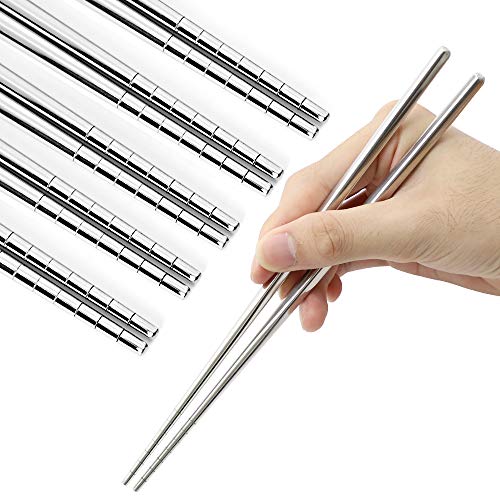
MUYOS Stainless Steel Chopsticks (Silver, 5 Pairs) — Best for Durability
Choose the MUYOS set if your priority is a pair that will essentially never wear out. Stainless steel cannot splinter, stain or absorb curry oil, and the hollow-core construction answers the standard objection that metal chopsticks feel like holding two knitting needles — these carry a balance much closer to wood. The textured tips matter more than the material: most dropped dumplings are a tip problem, not a skill problem.
| Material | Stainless steel, hollow core |
|---|---|
| Set size | 5 pairs |
| Tips | Non-slip tips (per listing title) |
| Care | Dishwasher safe (per listing title) |
Strengths
- Stainless steel is effectively lifetime-durable and never stains or absorbs odours
- Hollow core keeps the weight down so long meals do not tire the hand
- Non-slip tips grip noodles and dumplings far better than polished plain metal
Trade-offs
- Metal conducts heat, so resting them in a hot pot is a mistake bamboo forgives
- Five pairs is a small set for larger households or frequent guests
- The clink against ceramic bowls is louder than wood or fiberglass
Metal chopsticks are the Korean table standard for a reason: they pair with metal bowls, survive any washing regime and stay hygienic indefinitely. The MUYOS design softens the two real drawbacks. The hollow core cuts the fatiguing weight, and the matte non-slip tip section gives back the friction that polished steel loses, especially on wheat noodles in broth.
For daily use, think of these as the set for the cook who also eats with them straight from the pan — with one caution. Steel left leaning in a simmering pot will carry that heat to your fingers, so rest them on the rim or a rest, not in the soup. Households that eat a lot of hotpot often keep one metal set for the table and reach for fiberglass or wood at the pot itself.
Best for: buyers who want a buy-it-for-life set and eat a lot of Korean-style meals / Not suited for: hotpot-heavy households that leave chopsticks resting in the pot
Check on Amazon — check price on Amazon for the current listing details.
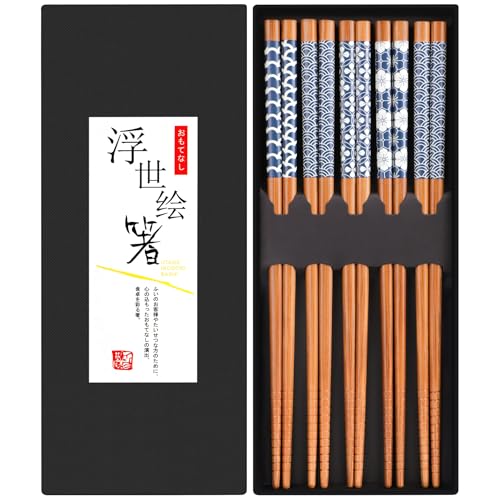
Antner 5 Pairs Natural Bamboo Chopsticks — Best Budget
The Antner set is the honest budget answer: real bamboo, a classic Japanese profile and a shorter 8.8-inch length that suits smaller hands and individual place settings. Bamboo is naturally light and slightly textured, which is why beginners often control bamboo better than any other material in their first month. It is also the kindest option against non-stick pans and delicate ceramics.
| Material | Natural bamboo |
|---|---|
| Length | 8.8 inches / 22.5 cm |
| Set size | 5 pairs |
| Care | Dishwasher safe (per listing title) |
Strengths
- Natural bamboo is light and naturally grippy for learners
- Shorter 8.8-inch Japanese profile suits smaller hands and place settings
- Budget tier pricing makes replacing a worn set painless
Trade-offs
- Bamboo has the shortest lifespan of the materials here under daily dishwashing
- Shorter length is less comfortable for serving from big shared platters
- Natural material varies slightly pair to pair in colour and finish
Bamboo’s weakness is water. Even with a dishwasher-safe listing, bamboo slowly takes on moisture at the tips, and after many months of daily machine washing most sets show whitening, roughness or fine splits. The practical way to own bamboo daily is to treat it as a renewable: hand-wash when you can, rotate pairs, and expect to refresh the set periodically — at this tier, that refresh costs very little.
Where bamboo wins outright is feel. It is warm, quiet against bowls and grippy on rice, tofu and noodles alike, and its lightness makes it the easiest material for children and new users to learn on. If your household is learning together, start here and graduate the keenest users to fiberglass or steel later.
Best for: beginners, smaller hands and anyone furnishing a first kitchen on a budget / Not suited for: buyers who want a single set to survive years of daily machine washing untouched
Check on Amazon — check price on Amazon for the current listing details.

HuaLan Japanese Natural Wood Chopsticks (5 Pairs) — Best Wooden Feel
Some people simply eat better with wood. The HuaLan set is for them: natural wood warmth, a classic profile and a non-slip design that addresses wood’s one weakness, which is a lacquered-smooth tip on oily food. Wood sits between bamboo and fiberglass on durability — denser and longer-lived than bamboo, but still happier with hand-washing than with a nightly dishwasher cycle.
| Material | Natural wood |
|---|---|
| Set size | 5 pairs |
| Design | Non-slip design (per listing title) |
Strengths
- Natural wood warmth and weight that many users find the most comfortable
- Non-slip design helps on oily noodles and glazed dishes
- Classic styling suits a traditional table setting
Trade-offs
- Wood lasts longest with hand-washing, which adds a daily chore
- Five pairs only — no spares for guests without a second set
- Natural grain means the finish ages visibly over time
Wood rewards a small amount of care disproportionately. A ten-second rinse and wipe after dinner, rather than a soak in the sink, keeps the tips tight and the finish even for years. Left soaking, wood swells at the tip, and that swelling is what eventually splits a pair — the failure is almost always soaking, not eating.
At the table, wood’s slight surface texture is its quiet advantage: it holds a piece of simmered pumpkin or a slice of tamagoyaki with less squeeze pressure than smooth synthetics, so food arrives intact instead of crushed. For households that eat a lot of delicate Japanese home cooking, that gentleness is the whole point of choosing wood for daily use.
Best for: wood lovers and delicate-food households willing to hand-wash / Not suited for: anyone committed to putting everything in the dishwasher every night
Check on Amazon — check price on Amazon for the current listing details.

GLAMFIELDS 10 Pairs Fiberglass Chopsticks — Best for Families and Guests
If your table regularly seats six to ten, mismatched pairs stop being charming and start being a nuisance. This GLAMFIELDS ten-pair set solves the hosting problem in one purchase: uniform 9.5-inch fiberglass pairs that go straight in the dishwasher after a hotpot night. The non-slip shaping helps guests who only use chopsticks a few times a year keep hold of their dinner.
| Material | Fiberglass |
|---|---|
| Length | 9.5 inches |
| Set size | 10 pairs |
| Care | Dishwasher safe, non-slip (per listing title) |
Strengths
- Ten matching pairs seat a full dinner party without mixing sets
- Fiberglass shrugs off dishwasher cycles and hotpot heat
- Non-slip shaping is forgiving for occasional users and guests
Trade-offs
- Uniform black styling is practical rather than decorative
- Fiberglass feel will not convert committed wood traditionalists
- Ten pairs of one length means no shorter pairs for young children
Hosting is where set size stops being a spec and becomes the product. A five-pair set plus a drawer of random takeaway pairs works until the night eight people sit down to dumplings. Uniform pairs also change behaviour: guests relax, nobody guards a favourite pair, and cleanup is one basket load rather than a sorting exercise.
The 9.5-inch length is the right hosting compromise — long enough for shared platters and a communal pot, short enough that a nervous guest is not fencing across the table. Pair this set with a couple of longer cooking chopsticks for the kitchen and the household’s chopstick drawer is genuinely finished.
Best for: households that host hotpot and dumpling nights for six or more / Not suited for: small households that would rather own five pairs they love than ten they like
Check on Amazon — check price on Amazon for the current listing details.
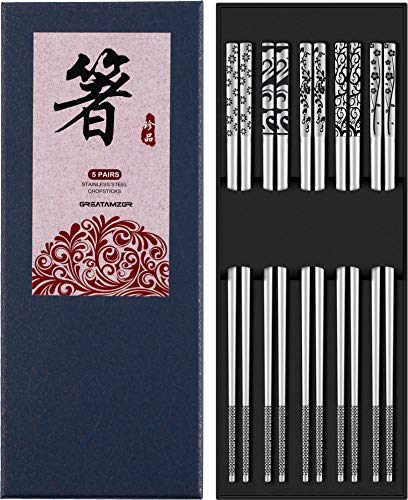
316 Stainless Steel Chopsticks, Square Profile (5 Pairs) — Best for Slippery Noodles
Square chopsticks do not roll, and engraved square tips bite. This 316 stainless set is the specialist for slippery food: wheat noodles in oil, glass noodles, konjac, anything that slides off round polished tips. The 316 grade is the more corrosion-resistant stainless, a small but real upgrade for a tool that lives in salty broth and dishwasher detergent.
| Material | 316 stainless steel, square profile |
|---|---|
| Length | 9.45 inches |
| Set size | 5 pairs |
| Finish | Laser-engraved non-slip (per listing title) |
Strengths
- Square profile cannot roll off the table or bowl rim
- Laser-engraved tips give the strongest grip here on oily noodles
- 316 stainless resists corrosion from broth, salt and detergents
Trade-offs
- Square edges feel angular to users raised on round wooden pairs
- Metal heat conduction applies — keep them out of the simmering pot
- Engraved styling is busier than minimalist table settings may want
Grip is geometry plus texture, and this set maxes both. A square tip presents flat faces to a noodle instead of a tangent line, and the engraving breaks the oil film that makes polished steel skate. In practice that means less squeeze pressure, which means noodles arrive unbroken and hands tire more slowly over a long ramen bowl.
The Korean-style length and flat profile also suit grilled meats and banchan service, where you are turning pieces rather than lifting broth-heavy loads. If your daily use leans Korean and noodle-heavy, this is arguably the most functional pick in the six — the badge goes to fiberglass only because most households eat a wider mix.
Best for: noodle-heavy and Korean-food households that prioritise grip above all / Not suited for: users who prefer the soft, round feel of traditional wooden pairs
Check on Amazon — check price on Amazon for the current listing details.
Comparison Table
| Pick | Badge | Key spec | Best for |
|---|---|---|---|
| HIWARE 10 Pairs Fiberglass Chopsticks (Black) | Best Overall | Fiberglass, 9.5 in, 10 pairs | Everyday family meals — Check on Amazon |
| MUYOS Stainless Steel Chopsticks (Silver, 5 Pairs) | Best for Durability | Stainless steel, hollow core, 5 pairs | Long-term durability — Check on Amazon |
| Antner 5 Pairs Natural Bamboo Chopsticks | Best Budget | Bamboo, 8.8 in, 5 pairs | Budget and beginners — Check on Amazon |
| HuaLan Japanese Natural Wood Chopsticks (5 Pairs) | Best Wooden Feel | Natural wood, non-slip, 5 pairs | Traditional feel — Check on Amazon |
| GLAMFIELDS 10 Pairs Fiberglass Chopsticks | Best for Families and Guests | Fiberglass, 9.5 in, 10 pairs | Families and hosting — Check on Amazon |
| 316 Stainless Steel Chopsticks, Square Profile (5 Pairs) | Best for Slippery Noodles | 316 stainless, square, 9.45 in | Grip on slippery food — Check on Amazon |
What material is best for chopsticks you use every day?
Material decides lifespan, grip, heat behaviour and washing rules all at once, so it is the first decision to make. Get it right and almost any well-made set in that material will serve you; get it wrong and even an expensive set will annoy you within a month.
Fiberglass: the dishwasher-proof modern standard
Fiberglass chopsticks are the restaurant industry’s answer to daily abuse. They do not warp, swell, splinter or fade, they tolerate commercial and home dishwashers indefinitely, and they stay cool enough at the handle end during normal table use. The trade-off is feel: smooth, slightly clinical, and on very oily noodles a matte or textured finish matters. For most households asking about daily use, fiberglass is the correct default.
Stainless steel: the lifetime option with two caveats
Steel never wears out, never stains and never absorbs odours, which is why it dominates Korean tables. Its caveats are heat and noise: steel conducts pot heat to your fingers and clicks against ceramic. Hollow-core designs fix the weight problem that made early metal chopsticks tiring, and engraved or matte tips fix the slipperiness. If those two caveats do not apply to your cooking style, steel is the last set you will buy.
Bamboo and wood: warmth in exchange for care
Natural materials are light, quiet, warm and naturally grippy — and they age. Bamboo ages fastest under daily machine washing; denser woods last much longer but still prefer hand-washing and, above all, not soaking. Choose them for feel and for delicate food, and accept the small care routine as the price of that feel.
How long should everyday chopsticks be?
Table chopsticks cluster between about 8.8 and 9.5 inches for a reason. Shorter Japanese-style pairs around 8.8 to 9 inches give fine control for individual bowls, fish and smaller hands. The 9.5-inch middle ground handles shared platters, noodle pots and bigger hands without feeling unwieldy. Beyond about 10 inches you are drifting toward serving and cooking territory, where the extra length helps at a stove and hinders at a place setting.
Match length to hand and menu, not to habit alone. If your household eats mostly individual rice bowls and miso soup, the shorter end feels precise. If shared dishes sit in the middle of the table every night, the longer end saves reaching and stretching. Mixed households often settle on 9.5 inches for adults and keep one shorter set for children — which is why several picks here are five-pair sets you can combine rather than one monolithic bundle.
Hand size matters more than cuisine labels. A useful test: hold a pair at your natural grip, roughly two-thirds up from the tip. If the butt end pokes far past your palm into the air, the pair is long for you and will feel clumsy on small items like peas, beans and fish bones, whatever the product name says.
How many pairs does a household actually need?
Count mouths, then add rotation. A pair in the dishwasher, a pair in the drawer and a pair in use is the minimum comfortable cycle per regular user, which is why ten-pair fiberglass sets are so popular with families: they end the nightly scavenge for a clean matching pair. Couples who hand-wash after dinner can live happily with five pairs and a slower rhythm.
Guests change the maths instantly. If you host chopstick meals even once a month, owning ten uniform pairs is cheaper than the accumulated cost of disposable sleeves and far nicer at the table. Several picks in this guide are five-pair sets, so two matching sets is a clean way to scale from couple to hosting household without mixing styles.
How to care for chopsticks so a daily set lasts
Daily-use chopsticks rarely die from eating; they die from washing and storage habits. Five minutes of routine, applied consistently, doubles or triples the life of natural sets and keeps synthetics looking new.
- Rinse promptly, never soak. A quick rinse after the meal stops broth and oil drying into the tips. Soaking is the single most destructive habit for wood and bamboo: water enters the tip grain, swells it, and the swelling is what eventually splits a pair.
- Dishwasher users: tips down, away from the element. Fiberglass and steel can go in every cycle. Stand pairs tips-down in the cutlery basket so water drains off the gripping end, and keep natural sets on the top rack if you machine-wash them at all.
- Hand-washers: mild soap, soft sponge, immediate dry. Wash wood and bamboo with a soft sponge rather than a scourer, which raises the grain. Dry with a towel straight away instead of air-drying in a damp jar, where the tips sit in pooled water.
- Store dry and loose. A drawer insert or a dry utensil pot keeps pairs from grinding against knives. Never store natural chopsticks in a sealed container while still damp — trapped moisture is what causes musty smells and dark spots.
- Retire pairs honestly. Splintered bamboo, cracked wood, or fiberglass with frayed, fuzzy tips should be replaced, not endured. Splinters and fraying harbour residue and can end up in food; at the prices of the budget picks here, replacement is cheap insurance.
Build the routine around your material rather than fighting it. Fiberglass and steel households can run everything through the dishwasher and think about care almost never. Natural-material households trade those five minutes of hand-washing for the feel they prefer — a fair trade when it is chosen deliberately, and a constant irritation when it is discovered by accident after buying the wrong set.
Should everyday chopsticks be dishwasher safe?
For most households, yes — and that answer quietly decides the material question. If every utensil in your kitchen goes into the dishwasher nightly, fiberglass and stainless steel are the only materials that will look the same in year three as in week one. Both appear at the top of our picks for exactly that reason.
Dishwasher-safe on a listing is a claim worth reading carefully for natural sets. Some bamboo and wood sets carry the claim and do survive machine washing, but they age visibly faster doing it — fading, whitening and rough tips within a year of daily cycles is normal rather than a defect. If you love wood and own a dishwasher, the compromise used by many households is a fiberglass set for weeknights and a wooden set, hand-washed, for weekends and guests.
Which chopsticks suit which daily meals?
Daily use is not one meal repeated; it is a rotation, and different items in that rotation reward different pairs. Thinking through your actual week of food is the fastest way to confirm a material choice before you buy.
Noodles in broth: ramen, pho, udon
Broth noodles are the grip test and the heat test at once. You need tips that hold wet wheat noodles without crushing them, and a material that will not punish you if it rests against a hot bowl rim. Textured fiberglass and engraved steel both pass; polished plain steel is the one combination that frustrates even experienced users, which is why every steel pick in this guide has a treated tip.
Rice bowls, donburi and everyday Japanese home cooking
Shorter pairs shine here. Delicate items — simmered vegetables, tofu, flakes of grilled fish — reward the fine control of an 8.8 to 9-inch pair and the soft touch of bamboo or wood, which lift without tearing. This is the meal pattern the Antner and HuaLan picks were chosen for, and it is the pattern where natural materials justify their small care routine most clearly.
Korean grills, banchan and shared plates
Metal’s home turf. Steel pairs work alongside metal bowls and grill plates, shrug off kimchi staining that would mark pale bamboo, and their length and flat or square profiles suit turning meat and serving from shared dishes. The square 316 pick and the MUYOS set both live naturally in this routine, with the caveat about resting steel in hot pots applying mainly to soups rather than grills.
Salads, dumplings and the mixed weeknight
Most households actually live here: a bit of everything, cooked fast, washed faster. This is fiberglass territory — indifferent to dressing oils, dishwasher-proof, grippy enough for a dumpling and sturdy enough for a poke bowl. If your week is genuinely mixed, stop optimising for a cuisine and optimise for the wash-up, which means the HIWARE or GLAMFIELDS sets.
How should you hold chopsticks for better control?
Many daily frustrations blamed on a set are actually a grip habit, and fixing the grip makes every pick in this guide perform better. The lower stick is the anchor: it rests on the ring finger and the base of the thumb and does not move at all. Only the upper stick moves, held between thumb, index and middle finger like a pen, pivoting to open and close the tips.
Two adjustments help most struggling users. First, grip higher than feels natural — around two-thirds of the way up — so small hand movements produce small tip movements. Second, keep the tips aligned: if the ends cross or scissor, slide the upper stick until the tips meet flat, because misaligned tips halve your grip on round items like peas, beans and quail eggs.
Practice food matters too. Peanuts, popcorn and marshmallows are the classic training progression because they are light, forgiving and increasingly awkward. Ten minutes across a few evenings usually converts a frustrated beginner into a competent one — after which the material and tip differences in this guide become preferences rather than lifelines.
How long do daily-use chopsticks last, material by material?
Lifespan is where the daily-use question gets concrete, because a set used twice a day accumulates roughly seven hundred meals a year. The honest expectations below assume that pace, normal home washing and no abuse beyond the ordinary accidents of a cutlery drawer.
Fiberglass: years, with appearance holding up
A fiberglass set in daily service should be measured in years. It does not absorb water, so there is no swelling cycle to fatigue it, and the surface does not open up the way natural fibres do. The realistic end of life is cosmetic or mechanical — a pair dropped behind the stove, a tip chipped against a garbage disposal — rather than material failure. This is the core of the Best Overall case for the HIWARE set.
Stainless steel: effectively indefinite
Steel pairs do not wear out in any normal household timeframe. Engraving can soften very slightly over years of dishwashing, and a pair can be bent in a drawer accident and bent back. Barring loss, a steel set bought today is a set your household can still be using a decade from now, which is why its higher upfront tier still works out as the cheapest cost per meal of any material here.
Wood: years with care, months without it
Dense wooden pairs that are rinsed, washed and dried promptly serve for years; the same pairs left soaking nightly can split within a season. Wood’s lifespan is therefore the widest range of any material — it is a direct readout of the owner’s routine. If your household’s honest routine is ‘everything waits in the sink until morning’, wood will punish that routine, and fiberglass is the truthful recommendation.
Bamboo: the renewable option
Bamboo in daily dishwasher service typically looks tired within a year — whitened, rougher at the tips — while hand-washed bamboo lasts considerably longer. Treat bamboo as the renewable material: its low tier cost and natural feel are the offer, and periodic replacement is part of the deal rather than a disappointment. The Antner pick is priced and positioned exactly for that understanding.
Across all four materials, the pattern is the same: washing and storage habits move lifespan more than brand does. Buy the material whose care routine matches the routine your household will actually keep, and the lifespan question largely answers itself.
What else belongs in a daily chopstick drawer?
A working daily set is a small system, not just pairs. Three inexpensive additions make the picks above noticeably easier to live with. First, chopstick rests: a rest keeps tips off the table between bites, keeps steel pairs from rolling away, and quietly solves the hygiene question at shared meals. Any small ceramic or wooden rest works; the material matters far less than the habit.
Second, one longer pair for the kitchen boundary. Several meals a week involve a moment — turning dumplings in a pan, fishing a pickle from a jar, retrieving toast-adjacent items — where table length is awkward and cooking length is right. Keeping a single longer wooden or fiberglass pair by the stove prevents the daily habit of abusing your best table pairs at the pan, which is where tips get scorched and finishes get ruined.
Third, a simple divider or insert for the drawer. Pairs stored loose among knives and openers get scratched, bent and separated; pairs stored together stay matched and visible, so you can see at a glance when rotation is running low and the wash needs to go on. None of this is essential, but together it is the difference between owning chopsticks and having a chopstick routine that runs itself.
Common Buying Mistakes
Buying disposable sleeves by mistake. Bulk bamboo listings photograph exactly like reusable sets. Check the pair count and the word disposable before ordering — a hundred pairs at a suspiciously low cost per pair is a takeaway sleeve, not a household set.
Choosing length by cuisine name alone. Japanese, Chinese and Korean labels hint at length, but hands differ more than cuisines do. Buy the length that fits your grip and your table, using the two-thirds grip test described above.
Putting wooden chopsticks in to soak. The post-dinner soak is what splits wooden and bamboo tips. Rinse, wash, dry — in that order, straight away — and natural sets last for years instead of months.
Judging metal chopsticks by an old, heavy pair. Solid, polished metal pairs are slippery and tiring, and they put many people off steel for good. Hollow-core, engraved-tip modern sets solve both problems; do not let one bad cafeteria pair decide the question.
Owning too few pairs. A two-pair household is one dishwasher cycle away from eating noodles with a fork. Five pairs is a workable minimum for a couple; ten is the comfortable number for families and hosts.
Final Recommendation
For most households, the HIWARE fiberglass set is the correct first purchase: dishwasher-proof, sensibly sized, and cheap enough in a ten-pair bundle that daily use holds no anxiety. Noodle-heavy and Korean-food households should look hard at the square 316 stainless pick instead, and learners and smaller hands will be happiest starting on the Antner bamboo.
Whichever material you choose, choose it deliberately, buy enough pairs for your rotation, and run the simple care routine in this guide. Do that and the question of daily chopsticks is settled for years.
Keep exploring the same cluster on this site: Best Chopsticks For Eating Best Chopsticks For Everyday Best Chopsticks For Beginners Best Chopsticks For Cooking Best Chopsticks Dishwasher Safe
Related guides
Frequently Asked Questions
What are the best chopsticks for daily use overall?
For most households, a 9.5-inch fiberglass set such as the HIWARE ten-pair pick. Fiberglass survives daily dishwashing without warping or splintering, stays grippy enough for noodles and rice, and a ten-pair bundle covers family rotation plus guests. Households that prioritise lifetime durability over everything else should choose stainless steel instead.
Are fiberglass chopsticks safe for everyday eating?
Fiberglass chopsticks sold for table use are made for food contact and are the standard in Japanese restaurants, where they are used and commercially washed daily. They do not leach flavours into food and they stay intact far longer than bamboo. Retire any pair whose tips become frayed or fuzzy, as you would with any worn utensil.
How often should you replace chopsticks used every day?
Replace by condition, not by calendar. Steel and fiberglass sets can serve for years; inspect tips monthly and retire pairs that splinter, crack, fray or stay rough after washing. Bamboo under daily machine washing typically shows its age first — whitening and fine splits at the tips are the signal to refresh the set.
Can you put wooden chopsticks in the dishwasher?
Some wooden sets are listed as dishwasher safe and will survive it, but they age faster: fading, raised grain and tip wear within a year of daily cycles is typical. Hand-washing wood takes under a minute per pair and keeps a set in good condition for years, which is why our wooden pick is recommended for households willing to hand-wash.
Why do noodles keep slipping from my chopsticks?
Slipping is usually a tip problem, not a technique problem. Polished round tips on oily noodles have almost no friction. Textured, matte, engraved or square-profile tips — like those on the 316 stainless pick — break the oil film and grip with far less squeeze pressure. A slightly higher grip position also helps while you adjust.
What length chopsticks should beginners start with?
Start shorter: around 8.8 to 9 inches. Shorter pairs move less at the tip for the same hand movement, which makes control easier while the grip is new. The Antner bamboo pick is a good learning set for exactly this reason, and many learners later move up to 9.5-inch fiberglass or steel once the basic grip is automatic.
Should every adult in the house use the same set?
They can, and uniform sets make washing and storage simpler, but they do not have to. Hands and habits differ: one partner may love the weight of steel while the other cooks and eats with wood. Because most picks here are five-pair sets, the practical pattern is a shared workhorse set for family meals plus one personal favourite pair per adult — matched expectations, no arguments, and the dishwasher still gets a uniform load most nights.

