Disclosure: airfryerkitchensupply.com is reader-supported. When you buy through links on our site, we may earn an affiliate commission at no extra cost to you.
How to Choose a Charcoal Smoker Under $500 by Capacity
Translate your biggest regular cook into a load list before you look at a single specification. Write it down: ‘two pork butts and two racks of ribs’ or ‘one brisket and a dozen chicken halves’. Now match formats to the shape of that load. Wide loads (briskets, full rib racks) want wide chambers — offsets and big barrels. Tall loads (racks on racks, birds, pans) want stacked shelves — verticals and bullets. Mixed loads with hanging (ribs and chickens) are drum territory. The format that fits your load’s shape gives you more usable capacity than a bigger number in the wrong shape.
Then divide by your real frequency. A cooker used at full capacity four times a year and at quarter capacity forty times is, in practice, a quarter-capacity cooker with a party trick. If that is your pattern, buy for the forty and solve the four with a second borrowed cooker, a rib rack, or batch cooking across two days — all cheaper than heating a cavern every Saturday.
How many square inches do you actually need?
As working rules: a pork butt wants roughly a 10-inch circle of grate; a full rack of ribs wants a 20-inch run or a rib rack slot; a brisket wants 24 inches of length lying flat. A family load of a butt plus two rib racks fits an 18-inch two-level bullet. A two-brisket load wants a 900-plus sq. in. offset or a wide cabinet shelf. Count your load in those units and the specification sheets start telling the truth.
What does extra capacity cost to run?
Roughly, fuel and time scale with chamber volume and steel area. A big offset can burn through two to three times the charcoal of a bullet on the same afternoon, and asks for fire checks the whole way. A stacked vertical is thriftier — one fire heating many shelves — which is why batch cooks love the format. When you compare prices, compare the season’s fuel bill too; the ‘cheaper’ big cooker sometimes is not.
When Is It Smarter to Buy Two Smaller Smokers Instead of One Big One?
More often than the industry admits. Two mid-size cookers give you two temperatures at once — ribs at one setting, chicken hotter — two smoke woods, a backup when one misbehaves, and the ability to run one small cooker for Tuesday instead of heating a chamber built for Saturday. The classic pairing in this guide’s terms is a bullet for capacity days and a Junior drum for everything else; together they cost less than many single big cookers and cover more real cooking.
The cases for one big cooker are genuine but specific: single loads that cannot be split (multiple whole briskets for an event), one fire to tend instead of two, and one footprint — though two small cookers often store more flexibly than one large one. If your big cooks are splittable and your small cooks are frequent, the two-cooker answer deserves a serious evening of thought before you buy the cavern.
Planning a Party Cook on a Charcoal Smoker: A Capacity Worked Example
Take a concrete brief: twenty guests, pulled pork and ribs, one smoker from this guide. On the Laredo 1100, the cook is straightforward — three pork butts overnight-style with fire tending, ribs in two waves through the afternoon, everything resting in a cooler while the chamber grills corn. On the vertical cabinet, the same menu runs as stacked production: butts on the lower shelves where heat works hardest, ribs rotated through the upper shelves, the warming tray earning its keep at service time. On the Smokey Mountain, the honest plan splits across two days: butts on Saturday (pulled pork reheats beautifully), ribs fresh on Sunday, and no heroics.
The lesson is not that one cooker wins; it is that every cooker in this guide can feed twenty people with a plan matched to its shape — and that the plan, not the square inches, is what guests taste. Buy the cooker whose planning style you enjoy, in the size your regular life justifies, and let events be an exercise in scheduling rather than a reason to own a chamber you heat empty all year.
The True Season Cost of a Big Smoker: Fuel, Time and Maintenance Compared
Capacity guides talk about purchase price because it is the easiest number, but a season of ownership tells the truer story. Consider fuel first. A bullet running a long cook burns one well-built charcoal ring; a stacked vertical burns a similar fire to cook three times the food, which is why batch cooks come out ahead per serving; a big offset burns splits and charcoal continuously for as long as the party menu demands, and its per-cook fuel bill can be several times the bullet’s. None of these is a reason not to buy — they are reasons to buy with your eyes open and your per-season maths done.
Time is the second cost, and it is not evenly distributed. The offset’s hours are attended hours: a fire checked and fed every 45 minutes is a half-day you have genuinely spent, which offset lovers count as the pleasure and everyone else should count as the price. The vertical’s hours are supervisory — shelf checks and one rotation. The bullet’s are nearly free. When a guide like this one calls a cooker ‘best for crowds’, part of the claim is that the crowd justifies the attended hours; for a quiet family Sunday, the same hours are simply a cost with no offsetting celebration.
Maintenance scales with size and seams. More steel area means more surface to keep ahead of rust; more doors and joints mean more gasket to inspect; more grates mean more cleaning after a full load than after a small one. The big cookers here are not fragile — they are proportionate: an hour of seasonal care per cooker becomes two on the largest. Add it up honestly — fuel, attended hours, upkeep — and the capacity bargain sometimes flips: the ‘expensive’ efficient cooker can be the cheaper season, and the ‘cheap’ cavern the dearer one. That is exactly the calculation this guide exists to help you run before the purchase, not after.
Storing and Moving Big Smokers: The Practicalities Nobody Mentions
A capacity purchase is also a furniture purchase, so measure before you buy: the big offset in this guide needs a permanent home with room to open its doors, swing its firebox lid and stand back with a chimney of lit coals. Check gate widths and paths, not just the patio — more than one large smoker has been assembled in a garden it could never have entered whole. Wheels help on the day and on cleaning day, but they do not make a 1,100-square-inch offset portable in any sense that matters; if your life involves moving house, tailgating or storing the cooker indoors, the cabinet and bullet formats will treat you far better.
Storage shapes lifespan as well as logistics. A cooker that lives under a fitted cover on a dry patio, ash emptied, will outlast a neglected one in a garage. A cooker that must be dragged across grass to a shed after every use will be dragged less and less, then not at all, then not used. Be honest about the friction: the best capacity is the capacity parked where you will actually light it, and the modest bullet by the back door will out-cook the giant at the bottom of the garden across any real season you measure.
One Last Capacity Check Before You Buy
Before you order, do the tape-measure test in your own kitchen: lay out the pans, boards and platters that match your biggest regular load, measure the rectangle they occupy, and compare it honestly against the grate dimensions in the reviews above. Then check the load against your cooker shortlist’s shape — wide, tall or hanging. Five minutes with a tape measure has saved more buyers from the wrong capacity than any review ever written, including this one.
Where to buy
The fastest way to compare the best charcoal smokers under 500 shortlisted below is Amazon, where every linked pick on this page was verified against the manufacturer listing before this guide was published. Prices move with seasons and promotions, so we do not print fixed prices here — use the links to check the current price on Amazon for the exact model, size and configuration you want.
- Pit Barrel Cooker Premier Series 18.5-Inch Drum Smoker — check price on Amazon
- Weber Smokey Mountain Cooker 18-Inch — check price on Amazon
- Oklahoma Joe’s Bronco Pro 21.5-Inch Charcoal Drum Smoker and Grill — check price on Amazon
- Oklahoma Joe’s Highland Reverse Flow Offset Smoker — check price on Amazon
- Dyna-Glo Wide Body Vertical Offset Charcoal Smoker (DGO1890BDC-D) — check price on Amazon
- Char-Griller AKORN 20-Inch Kamado Charcoal Grill and Smoker — check price on Amazon
At this level, watch for configuration differences between listings of the same model — cart included or not, cover included or not. The model number in the verified listing title is the ground truth; match it before you buy.
The best charcoal smokers under 500 dollars are where charcoal smoking stops being a compromise and starts being a choice. Everything in the tiers below this one asks you to accept something — thinner steel, smaller capacity, more tending. At under $500 the line-up changes character: the full-size drum from the category’s defining brand, the larger Bronco Pro, a reverse-flow offset, a wide-body vertical offset, and the benchmark bullet all fit inside the budget. You are no longer asking what you can get away with; you are asking which style of cooking you want to be good at.
That shift matters because the differences at this level are permanent ones. A smoker bought here is likely to be your smoker for a decade, and its format — drum, bullet, offset, vertical cabinet-style — will shape every cook you do on it. Our six picks therefore optimise for depth within a format rather than novelty: the best drum, the best bullet, the best reverse-flow offset, the best vertical offset, the best kamado-value and the best big drum for cooks who hang and grill in equal measure.
A note on honesty: a couple of famous names live right at this tier’s edge, and street prices drift above and below the line with promotions. Where a model’s position is genuinely borderline we say so in its review. Every pick below is a model sold in this band and verified against its live listing before publication — check the current price on Amazon, because in this tier a promotion can move a cooker between our under-$500 and under-$800 guides in a single weekend.
In this guide
Quick Picks
If you only read one section, make it this one. These are the six best charcoal smokers under 500 we would point a friend toward, each with a clear job. Every badge used here is repeated at the top of that pick’s full review further down, so the shortlist and the deep dives always agree.
- Pit Barrel Cooker Premier Series 18.5-Inch Drum Smoker — Best Overall: the original 18.5-inch porcelain-coated drum from Pit Barrel Cooker — hang ribs, chickens and more over the coals in the cooker that defined drum smoking. — check price on Amazon
- Weber Smokey Mountain Cooker 18-Inch — Best Bullet Smoker: the 18-inch porcelain-enameled Smokey Mountain — still the most controlled, best-supported water smoker you can buy at this price. — check price on Amazon
- Oklahoma Joe’s Bronco Pro 21.5-Inch Charcoal Drum Smoker and Grill — Best Drum for Grilling Too: the 21.5-inch Bronco Pro with 366 sq. in. — a heavy-duty drum that hangs meat for smoking, then converts to a proper charcoal grill. — check price on Amazon
- Oklahoma Joe’s Highland Reverse Flow Offset Smoker — Best Reverse Flow Offset: the Highland in reverse-flow form — 1,093 sq. in. with baffles that force heat and smoke under and across the chamber for even temperatures. — check price on Amazon
- Dyna-Glo Wide Body Vertical Offset Charcoal Smoker (DGO1890BDC-D) — Best Vertical Offset: Dyna-Glo’s wide-body vertical offset — a cabinet of stacked grates fed by a side firebox, built for big batches in a small footprint. — check price on Amazon
- Char-Griller AKORN 20-Inch Kamado Charcoal Grill and Smoker — Best Kamado Value: the 20-inch triple-wall insulated steel kamado — ceramic-style efficiency, range and cold-weather manners at a steel price. — check price on Amazon
How These Picks Were Chosen
Verification first, as always in this series: every linked pick was confirmed against its live listing — brand, model, dimensions and format matching the manufacturer’s own title — before a word was written. No ASIN appears in this guide unless the listing it resolves to is the product reviewed. Products we could not verify were excluded, however strong their reputations.
Scoring at this tier weighted format mastery: we were not looking for the six most similar good smokers, but for the cooker we would defend as the best expression of each style under $500 — drum, bullet, dual-purpose drum, reverse-flow offset, vertical offset and kamado. Within each style, build durability and sealing came before features, because at this price a cooker is a decade-long commitment and its failure modes are rust and leaks, not missing gadgets.
Finally, we checked each pick’s tier position honestly. The under-$500 band has fuzzy edges — promotions move models across it — so where a pick’s street price is known to wander, the review says so and the links let you check the current price on Amazon. What we will not do is pad the list with models that live permanently above the line and call them ‘close enough’.
The 6 Best Charcoal Smokers Under $500

1. Pit Barrel Cooker Premier Series 18.5-Inch Drum Smoker — Best Overall
The Pit Barrel Cooker 18.5-inch is the drum, full-size: a porcelain-coated steel barrel that cooks by hanging meat from hooks over a charcoal basket, supplemented by a grate for flat cooks. Its following is not marketing — drum owners genuinely cook differently, finishing ribs faster, hanging whole chickens that baste in rising heat, and producing a dripping-on-the-coals flavour no water smoker replicates. If the style appeals, buy the original at this tier rather than the copies below it.
Strengths
- Porcelain-coated steel — a clear durability step above painted budget drums
- Hanging system fits a surprising amount: multiple rib racks and chickens in an 18.5-inch footprint
- Simplest operating model in smoking — the drum’s designed airflow does most of the work
Trade-offs
- Runs hotter and faster than classic low-and-slow; purists of the 225°F school must adapt
- Temperature adjustment is coarse by design — you manage it with fuel and the intake, not dials
- A full brisket is a squeeze that asks for trimming and the grate rather than hanging
Key specs (from the verified listing)
- Size: 18.5-inch drum smoker
- Construction: porcelain coated steel
- Style: drum (UDS) cooker, hang-and-grate cooking
What you are buying with the Pit Barrel is a philosophy with a decade of proof behind it. The drum’s convection — heat rising straight past hanging meat, juices dripping onto coals and returning as vapour — produces a distinctive, deeply savoury result that its owners describe as the taste that made them stop shopping. Cooks run shorter than on a water smoker at the same tenderness, which quietly changes how often you smoke: a ribs cook that fits an afternoon gets lit far more often than one that owns a whole day.
The porcelain coating is the underappreciated upgrade at this price. Budget drums are painted or powder-coated and begin their slow rust negotiation immediately; the Pit Barrel’s enamelled finish, maintained with the basic cover-and-empty-ash routine, holds up for years. The limitations are the format’s, stated plainly in the trade-offs: this cooker has a temperature it likes, and your job is to load fuel consistently and let it be. Cooks who need to command 225.0°F should take the bullet below. Cooks who want ribs that convert sceptics should take this.
Best for: drum-style converts and ribs-and-chicken specialists who want the original, durable version / Not suited for: precision temperature controllers and brisket traditionalists who cook strictly at low set points
Check on Amazon — check the current price on Amazon before you decide, and confirm the size and configuration on the listing match what you measured at home.
2. Weber Smokey Mountain Cooker 18-Inch — Best Bullet Smoker
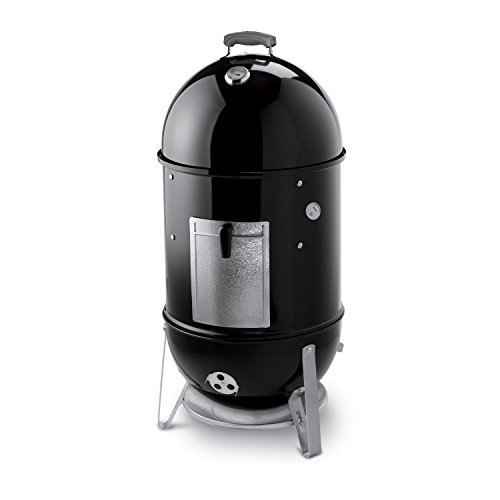
It says something about the Smokey Mountain 18 that it anchors both our under-$400 and under-$500 guides: there is simply no better bullet water smoker to recommend until ceramic and gravity-fed money. The porcelain-enameled stack, dual grates, water pan and properly sealing dampers deliver the steadiest manual smoking experience in this entire series of guides, backed by the deepest parts and knowledge ecosystem in charcoal cooking.
Strengths
- Benchmark temperature stability for a manual charcoal cooker
- Porcelain enamel and Weber parts support make it a genuine decade-plus purchase
- Two grates and a water pan handle the full family repertoire — butts, ribs, birds, brisket flats
Trade-offs
- Capacity is the ceiling: feeding a crowd means rib racks, stacking tricks or a second cooker
- The stock access door benefits from a gasket or latch upgrade
- No hanging mode — drum fans will miss it, though bullet loyalists never think about it
Key specs (from the verified listing)
- Size: 18-inch bullet (water) smoker
- Cooking grates: dual cooking grates
- Construction: porcelain-enameled kettle
- Air control: temperature control dampers
In an under-$500 guide the Weber’s role changes: it is no longer the stretch purchase but the safe centre of the market, and its case rests on repeatability. Owners develop a feel for its vents once and then reproduce cooks for years — same fuel load, same settings, same result — because the cooker seals well enough that nothing else varies. That repeatability is what separates a hobby that frustrates from one that compounds: every cook teaches you something the next cook can use.
Its limits are known and bounded. Eighteen inches is eighteen inches: a full packer brisket gets trimmed or draped, and a party for twelve is a logistics exercise. The door leaks a little until sealed. Neither issue has stopped this model from being the most recommended smoker in its class for years, and at this tier — where the alternatives are specialists — the generalist champion earns its slot on merit, not habit.
Best for: the buyer who wants one proven, controllable smoker for a decade of family cooks / Not suited for: crowd feeders and drum or offset specialists who already know their format
Check on Amazon — check the current price on Amazon before you decide, and confirm the size and configuration on the listing match what you measured at home.
3. Oklahoma Joe’s Bronco Pro 21.5-Inch Charcoal Drum Smoker and Grill — Best Drum for Grilling Too
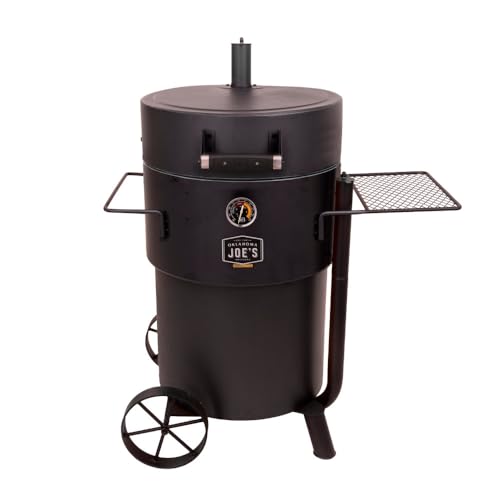
Oklahoma Joe’s Bronco Pro answers the drum question differently from the Pit Barrel: instead of a pure hanging cooker, it is a heavy-duty 21.5-inch drum built to smoke with hanging and grates, then convert to direct grilling with the charcoal raised. The extra diameter over the standard Bronco buys real capacity — 366 square inches — and the build is the heaviest-feeling in this guide. For households that grill as often as they smoke, it is the two-in-one drum.
Strengths
- Largest drum capacity here — 366 sq. in. across a 21.5-inch body
- Converts between smoking (hang or grate) and direct grilling in one cooker
- Heavy-duty construction with the solid feel its standard sibling is known for, scaled up
Trade-offs
- Conversion hardware means more parts to clean and keep track of than a pure drum
- Like all drums, its temperature personality is ‘close supervision early, then trust’
- Bigger and heavier than the Pit Barrel — less of a grab-and-go cooker
Key specs (from the verified listing)
- Cooking area: 366 sq. in.
- Size: 21.5-inch drum smoker and grill
- Build: heavy duty steel
The Bronco Pro’s argument is consolidation. A Pit Barrel plus a kettle grill is two cookers to store, cover and maintain; the Bronco Pro is one heavy drum that does both jobs credibly. Its smoking mode hangs ribs and uses grates like any good drum, with the dripping-on-coals flavour intact, and its intake system gives a little more deliberate control than the minimalist drum school prefers. Then the same body, charcoal tray raised, sears steaks and burgers for a crowd without apology.
Choose it over the Pit Barrel if your cooking is genuinely split between smoking and grilling, or if the extra capacity maps to your typical cook — the 21.5-inch grate takes the brisket the 18.5-inch drum argues with. Choose the Pit Barrel if smoking is the main event and you want the purest, simplest version of the drum idea. Both are honest answers; this guide’s job is to make sure you pick the one that matches your Saturdays.
Best for: households split between smoking and grilling that want one heavy, capacious drum / Not suited for: pure drum traditionalists, and anyone short on patio space or storage
Check on Amazon — check the current price on Amazon before you decide, and confirm the size and configuration on the listing match what you measured at home.

4. Oklahoma Joe’s Highland Reverse Flow Offset Smoker — Best Reverse Flow Offset
A reverse-flow offset solves the standard offset’s oldest problem — the hot end near the firebox — by routing heat and smoke under a baffle plate to the far end before it rises and crosses back over the food. The Highland Reverse Flow brings that competition-derived layout to 1,093 square inches at a consumer price. If you want offset flavour with measurably more even chamber temperatures and fewer rotate-the-meat chores, this is the pick.
Strengths
- Reverse-flow baffling evens out the chamber — less rotating, fewer burnt ends near the firebox
- 1,093 sq. in. handles multiple briskets or a full party load
- Offset flavour and bark with better manners than a standard offset at this price
Trade-offs
- Still an attended fire: reverse flow evens the heat, it does not automate it
- Large, heavy and hungry — charcoal and wood consumption is the highest in this guide
- Consumer-grade steel and seams still benefit from gasket and latch mods
Key specs (from the verified listing)
- Cooking area: 1,093 sq. in.
- Design: reverse flow offset charcoal smoker and grill
The physics is worth understanding before you pay for it. In a standard offset, the food nearest the firebox cooks in the fire’s first, hottest breath. The reverse-flow’s baffle turns the chamber into a loop: heat travels the length of the cooker under the plate (which itself becomes a radiant heat source), then returns across the grates. The result is not pellet-grill uniformity, but it is a genuine, noticeable evening-out — the difference between managing hot spots and merely knowing where they are.
Everything else about offset ownership applies unchanged: you will tend a fire, you will seal seams, you will burn more fuel than a bullet owner, and you will be rewarded with the most traditional barbecue in this guide. At under $500 the Highland Reverse Flow is the most offset you can buy without entering fabricator territory, and for the buyer who has already decided the offset life is theirs, it is the correct ceiling for this budget.
Best for: decided offset cooks who want reverse-flow evenness and party capacity / Not suited for: first-time smokers unsure about tending fires, and small patios
Check on Amazon — check the current price on Amazon before you decide, and confirm the size and configuration on the listing match what you measured at home.

5. Dyna-Glo Wide Body Vertical Offset Charcoal Smoker (DGO1890BDC-D) — Best Vertical Offset
The vertical offset is the capacity-per-square-foot champion, and Dyna-Glo’s Wide Body is its best-known consumer form: a tall cabinet of multiple grates with the firebox mounted low at the side, so smoke and heat rise through shelf after shelf of food. Briskets lie flat, ribs stack in levels, and the whole cooker occupies the patio footprint of a chair. If your constraint is space but your ambition is batch cooking — meal prep, big families, church and team events — this format was invented for you.
Strengths
- Stacked grates multiply capacity without multiplying footprint
- Side firebox keeps the fire tended without opening the cooking cabinet and dumping heat
- Wide-body shelves take full briskets and pans that narrow verticals cannot
Trade-offs
- Vertical cabinets leak at the door — gasket and latch attention is part of ownership
- Heat stratifies: top and bottom shelves cook at different rates until you learn your cabinet
- Thin consumer steel means wind and cold reach this big surface area quickly
Key specs (from the verified listing)
- Design: wide body vertical offset charcoal smoker
- Model: DGO1890BDC-D
Cooking in a vertical offset is a different skill: you are managing a column of heat. The shelves nearest the firebox run hottest, the door leaks if unsealed, and yet experienced owners produce remarkable volume — rotating shelves mid-cook the way bakers rotate trays, and using the stratification deliberately (butts low where the heat works hardest, chicken high where it finishes gently). The Wide Body’s shelves are sized for real food, which is its edge over narrow budget verticals that stack small grates and call it capacity.
Set expectations by the tier: this is a high-volume consumer cabinet, not a welded fabricator smoker. Seal the door, learn the shelf personalities over two or three cooks, shelter it from wind, and it will feed events that would need two bullets. Skip it if your typical cook is one butt for four people — a bullet does that job with less fuss and less fuel — but for the batch cook, nothing else at this price is close.
Best for: batch cooks, big families and event feeders who need volume in a small footprint / Not suited for: small households and anyone who wants minimal tending and learning curve
Check on Amazon — check the current price on Amazon before you decide, and confirm the size and configuration on the listing match what you measured at home.

6. Char-Griller AKORN 20-Inch Kamado Charcoal Grill and Smoker — Best Kamado Value
Every tier has a value disruptor, and in this one it is the AKORN: a kamado that delivers the format’s defining advantages — insulation, fuel efficiency, low-temperature stability and searing range — in triple-wall steel instead of ceramic, at a price the ceramic brands cannot approach. It repeats from our under-$400 guide because nothing under $500 displaces it; the next genuine step up is a ceramic kamado at roughly double the money, which is a different guide’s conversation.
Strengths
- Insulation gives the steadiest low temperatures and lowest charcoal bills here
- Full kamado range — gentle smoking to fierce searing — in one cooker
- Steel body shrugs off knocks and moves easily compared with ceramic
Trade-offs
- Round kamado grate fills quickly; crowd cooking needs planning and accessories
- Steel needs cover-and-clean care that ceramic does not
- Long cooks may want a charcoal top-up where a big ceramic would cruise through
Key specs (from the verified listing)
- Size: 20-inch kamado
- Construction: triple-wall insulated steel
- Grates: cast iron grates
The AKORN’s case at this tier is comparative. Against the bullet, it wins on efficiency, weather immunity and range. Against drums, it wins on control. Against offsets, it wins on effort. It loses — honestly — on capacity to all three, and on set-and-forget fuel depth to ceramic. For the very common household pattern of ‘smoke for the family most weekends, sear steaks on weeknights, occasionally feed eight’, that balance of wins is exactly right, and it is why this cooker keeps appearing in our guides at every tier it fits.
Ownership notes are brief: burn lump charcoal, not briquettes, to keep ash from choking the airflow that makes it precise; keep the ash drawer emptied and the body covered; approach target temperatures from below, because an overshot kamado sheds heat slowly. Do those things and the AKORN is the most versatile single cooker under $500 — the one we would choose if the brief were ‘one cooker, every season, no second purchase planned’.
Best for: all-season, all-purpose cooks who want kamado versatility without ceramic prices / Not suited for: volume cooks, and owners who want porcelain-or-ceramic levels of neglect tolerance
Check on Amazon — check the current price on Amazon before you decide, and confirm the size and configuration on the listing match what you measured at home.
Comparison Table
| Pick | Badge | Key spec | Best for |
|---|---|---|---|
| Pit Barrel Cooker Premier Series 18.5-Inch Drum Smoker | Best Overall | Size: 18.5-inch drum smoker | drum-style converts and ribs-and-chicken specialists who want the original, durable version |
| Weber Smokey Mountain Cooker 18-Inch | Best Bullet Smoker | Size: 18-inch bullet (water) smoker | the buyer who wants one proven, controllable smoker for a decade of family cooks |
| Oklahoma Joe’s Bronco Pro 21.5-Inch Charcoal Drum Smoker and Grill | Best Drum for Grilling Too | Cooking area: 366 sq. in. | households split between smoking and grilling that want one heavy, capacious drum |
| Oklahoma Joe’s Highland Reverse Flow Offset Smoker | Best Reverse Flow Offset | Cooking area: 1,093 sq. in. | decided offset cooks who want reverse-flow evenness and party capacity |
| Dyna-Glo Wide Body Vertical Offset Charcoal Smoker (DGO1890BDC-D) | Best Vertical Offset | Design: wide body vertical offset charcoal smoker | batch cooks, big families and event feeders who need volume in a small footprint |
| Char-Griller AKORN 20-Inch Kamado Charcoal Grill and Smoker | Best Kamado Value | Size: 20-inch kamado | all-season, all-purpose cooks who want kamado versatility without ceramic prices |
Compare formats, not just figures: the drum’s diameter, the offset’s chamber area and the kamado’s grate measure different geometries. The verdict column — who each cooker suits — is the comparison that predicts your satisfaction.
How to Choose a Charcoal Smoker Under $500
At this budget the decision is a format decision you will live with for years, so start from your cooking, not from reviews. List your ten most likely cooks. If they are ribs, chickens and the occasional butt, a drum or bullet serves you best. If brisket is your religion, the offset and the bullet are your candidates. If the list mixes smoking with weeknight grilling, the kamado or the Bronco Pro earns its place. If the list says ‘twenty people, four times a year’, the vertical offset is the honest answer even though it is oversized for Tuesday.
Then think about your tolerance for process. Every format here has a workload signature: drums are light, bullets are light-to-moderate, kamados are light once learned, offsets are a commitment, vertical offsets are moderate-plus with a learning curve. There is no wrong answer, but there is a wrong match — the graveyard of this hobby is full of excellent offsets bought by people who wanted bullets.
Should you buy a specialist or a generalist at this price?
Generalists (the Weber bullet, the AKORN) suit households whose cooking varies and whose interest is food-first. Specialists (the Pit Barrel, the reverse-flow) suit cooks who have found their style and want its best expression. If you are upgrading from a first smoker, you already know which you are — buy for the cook you have become, not the one the advertisements describe.
What separates this tier from under $300 and under $400?
Durability finishes (porcelain over paint), capacity at full size rather than compact, and formats that simply do not exist cheaper — reverse-flow offsets, wide-body verticals, full-size drums from the original maker. If none of those three gains maps to your cooking, the honest advice is to buy from the cheaper guides and spend the difference on fuel, meat and a good thermometer.
Is It Worth Paying More Than $500 for a Charcoal Smoker?
Sometimes — and our under-$800 guide covers that ground — but know what the money buys so you can decide whether you need it. Above this tier you find ceramic kamados with lifetime-grade materials, gravity-fed charcoal smokers that automate temperature while keeping charcoal flavour, thicker steel, and the first fabricator-built cabinets. Those are real gains in convenience, capacity and longevity. What you do not find above $500 is a higher ceiling on the food itself: a well-run cooker from this guide produces barbecue that experienced judges score happily.
The practical test is frequency. A household smoking forty times a year amortises convenience quickly — automation and insulation pay for themselves in saved attention and fuel. A household smoking eight times a year is buying capability it will rarely use. Count your realistic cooks, be honest, and let that number — not the showroom — set your tier.
Drum vs Bullet vs Offset: The Under-$500 Format Decision in Detail
Because this tier forces the format choice more than any other, it deserves one direct comparison. On flavour: drums give the most distinctive signature (drippings on coals), offsets the most traditional smoke profile (a live fire’s clean smoke drawn across the meat), bullets the gentlest, most rounded result (moist heat, buffered smoke). None is ‘best’ — they are different cuisines of smoke, and your preference is a legitimate deciding factor that no specification can overrule.
On workload: a bullet asks for a vent check every hour or so; a drum asks for even less once its fuel load is standardised; an offset asks for fire management every 45 minutes for the entire cook. On fuel: bullets and drums are frugal, offsets are not, and the vertical offset sits between. On learning curve: bullets forgive beginners, drums teach quickly, offsets teach thoroughly whether you enrolled or not. Line those four rows up against your life and the format picks itself — then the model shortlist in this guide does the rest.
Fuel Strategy for Long Cooks: Briquettes, Lump and Wood at This Tier
The cookers in this guide will only perform to their design on the right fuel, and the right fuel differs by format more than beginners expect. Bullets were designed around briquettes: uniform pieces, predictable burn, ash that falls clear of the ring. Run a Smokey Mountain on quality briquettes with the minion method and a full ring will carry a pork butt from morning to evening without intervention. Run the same cooker on irregular lump and the burn front wanders, taking your temperature curve with it. Neither fuel is ‘better’ — each is correct somewhere.
Kamados invert the rule: lump is mandatory in spirit if not in law, because briquette ash accumulates in the fire bowl and slowly strangles the airflow that makes a kamado precise. Drums accept either fuel but reward consistency — the Pit Barrel’s whole method assumes you load the same basket the same way every time, and changing fuel changes the drum’s cruising temperature. Offsets are the most demanding: a charcoal base for the coal bed, then wood splits for the live fire’s flavour, fed little and often so the smoke stays clean. Buying an offset means signing up to source decent smoking wood, which in some regions is a real logistics question worth answering before purchase.
Wood choice follows the same discipline. In bullets and drums, chunks buried in the charcoal release smoke steadily for hours. In offsets, splits are the fuel and the flavour at once, and species matters more: oak for the base note, hickory or fruitwood layered for character, mesquite sparingly and only for beef. In all formats, the rule that outranks species is dryness and cleanliness — seasoned wood, bark mostly off for long cooks, and a fire hot enough to burn the smoke clean rather than smoulder it onto the meat.
How do you know when to add fuel mid-cook?
Watch the trend, not the moment. A cooker that has begun a slow, steady fall despite open vents is running out of fire, not misbehaving — that is the time to add lit charcoal from a chimney, a few splits to the offset’s firebox, or a topped-up basket at a planned lid opening. Adding fuel during a panic, with the lid up and the temperature crashing, turns one problem into two. The experienced pattern is boring: anticipate, prepare the chimney early, and refuel once, calmly, at the moment the cook plan said you probably would.
A Note on Covers, Storage and Making This Tier Last
Every cooker in this guide is a five-to-fifteen-year purchase whose lifespan will be decided less by its steel than by its storage. Porcelain enamel and powder-coated finishes both fail the same way: a chip or seam admits moisture, rust blooms underneath, and the finish lifts. The countermeasures are unglamorous and total about ten minutes a cook — empty the ash once cool (damp ash is corrosive paste against any steel), brush grates warm, wipe the exterior when you remember, and keep a fitted cover on the cooker whenever it is not in use. Garage or shed storage doubles the benefit where you have it.
Once a season, walk around your cooker like an inspector: dampers moving freely, door seals intact, fire bowl and charcoal grate — the highest-wear parts in any smoker — checked for thinning. On the branded picks in this guide every one of those parts is replaceable, which is the quiet reason they dominate the list. A smoker you can re-grate and re-gasket in year seven is a different financial object from one you cannot, whatever the showroom prices said.
The Short Version
Pressed for the one-paragraph version: under $500, charcoal smoking stops being a compromise and becomes a choice of format — drum, bullet, offset, cabinet or kamado — and the cooker you will love is the one whose daily workload matches your life, not the one with the longest feature list in its title.
How to Hang Meat in a Drum Smoker (and Run the Other Formats Well)
Hanging is this tier’s signature technique, so here it is properly. The method below is written for the Pit Barrel and Bronco Pro; bullet, kamado and offset owners will find the same principles — fuel consistency, patience, cooking to tenderness — in the closing notes.
- Load the charcoal basket evenly and light it the same way every time — consistency of the fire is the drum’s only real control, so make it a ritual.
- Let the drum settle with the lid on until the smoke runs thin and pale; hanging meat into thick white smoke is the one drum mistake that flavours a whole cook badly.
- Hook ribs through the thick end between bones, chickens through the cavity with the hook secure, and hang them from the rods with space between pieces for air to circulate.
- Close the lid and leave it closed. Drums are designed around minimal intervention; check near the expected finish, not throughout.
- Cook to tenderness: ribs should bend deeply and crack their bark when lifted, chicken should reach a safe internal temperature with juices running clear, and butts should probe soft.
- Rest everything — ribs briefly, large cuts for a full hour wrapped — before cutting. Drum cooks finish fast; resting is where the juices settle back.
- For bullet owners: the same discipline means a full water pan, a settled fire and a closed lid. For offset owners: small, clean fires fed little and often beat big, smouldering ones every time.
Master one format’s ritual before borrowing another’s. The cookers in this guide reward routine more than talent — the tenth cook on any of them, run your standard way, will beat the first cook on a ‘better’ smoker you do not know yet.
Common Buying Mistakes
Buying a format for its image instead of its workload. Offsets look like barbecue’s soul and drums look like its folk art, but the one that fits your Saturdays is the right one. Mismatched format, not bad hardware, is the top cause of abandoned smokers at this price.
Assuming under $500 means no mods or care. Sealing an offset’s doors and covering any steel cooker remain part of ownership at this tier. The money buys better starting points, not immunity from physics.
Judging a drum by a thermometer’s precision. Drums are designed around a cruising range, not a set point. Owners who fight for an exact number with constant vent changes make worse food than owners who standardise their fuel and relax.
Filling a vertical offset on day one. Learn a new cabinet with one or two items and a notebook. A full load cooked by a stranger to the cooker’s shelf personalities wastes more meat than a season of gasket tape costs.
Skipping the reverse-flow learning curve. Reverse-flow chambers cook differently from standard offsets — more even, slightly different bark formation. Give it three cooks before concluding anything; first impressions on a new flow pattern mislead.
Final Recommendation
Our headline advice: the Pit Barrel Cooker is this tier’s most distinctive buy and our overall pick for the cook who wants drum flavour done properly; the Smokey Mountain remains the safest pair of hands in charcoal smoking; and the reverse-flow Highland, wide-body Dyna-Glo, Bronco Pro and AKORN each own a legitimate niche that the reviews above map honestly. There is no bad cooker on this list — there are only mismatches, and the guide’s job was to prevent yours.
If your budget stretches further, the next real steps are gravity-fed automation and ceramic — see Best Charcoal Smokers Under $800 Dollars. If it does not, compare downwards honestly via Best Charcoal Smokers Under $400 and the differently-angled sibling of this guide, Best Charcoal Smokers Under $500 Dollars, which weights capacity per dollar. Vertical-format shoppers should also read Best Charcoal Vertical Smokers.
- Pit Barrel Cooker Premier Series 18.5-Inch Drum Smoker — check price on Amazon
- Weber Smokey Mountain Cooker 18-Inch — check price on Amazon
- Oklahoma Joe’s Bronco Pro 21.5-Inch Charcoal Drum Smoker and Grill — check price on Amazon
Related guides
Frequently Asked Questions
Is a drum smoker better than a bullet smoker?
Neither — they are different. Drums cook faster with a distinctive dripping-on-coals flavour and minimal controls; bullets cook gentler with a water pan’s buffer and finer vent control. Ribs-and-chicken cooks lean drum; brisket-and-precision cooks lean bullet. This guide’s top two picks are one of each, deliberately.
What does reverse flow actually do?
It routes heat and smoke under a baffle to the far end of the chamber before it crosses the food, evening out the hot spot every standard offset has near its firebox. You rotate meat less and lose less of the chamber’s edges to overcooking. It does not reduce the tending an offset needs — only the unevenness.
Can these smokers handle a full packer brisket?
The offsets and the vertical cabinet take one easily. The 21.5-inch Bronco Pro manages with care; the 18-inch bullet and 18.5-inch drum ask for trimming, separating point and flat, or draping until the meat shrinks. The kamado fits a trimmed flat or a small packer. Match the cooker to your brisket ambitions if brisket is your main cook.
How much charcoal will I use at this tier?
Bullets and drums typically run a long cook on a single well-built load. Kamados use the least of all. Offsets use the most — a big chamber and a live fire are thirsty by design — and the vertical offset sits in between. Fuel is a real running cost; the efficient picks repay part of their price every season.
Are these smokers a good upgrade from a budget bullet?
Yes, if you choose by what frustrated you. Outgrew capacity? The vertical offset or Bronco Pro. Hated temperature fuss? The AKORN or the Weber’s sealing. Wanted offset flavour? The reverse-flow. An upgrade chosen against a named frustration satisfies; one chosen by price alone often does not.
Do I still need a separate grill?
Only if you sear often at volume. The Bronco Pro and AKORN both grill genuinely well; the bullet and drum can grill small batches with accessories or direct setups; the offsets grill in their fireboxes or chambers for modest quantities. Many owners in this tier happily run one cooker for everything.


