Disclosure: airfryerkitchensupply.com is reader-supported. When you buy through links on our site, we may earn an affiliate commission at no extra cost to you.
Where to Buy
Comparing best convection counter top ovens options? Start with the verified shortlist below.
Every oven below was verified against its live Amazon listing before this guide was written. Counter top convection ovens range from compact two-slice models for one-person kitchens to commercial-grade countertop units, and this guide covers that range honestly rather than pretending one size serves everyone.
- Breville Mini Smart Oven BOV450XL (Best Overall): Check the current price on Amazon
- TOSHIBA 10-in-1 Convection Toaster Oven, 6-Slice (Best Value for Families): Check the current price on Amazon
- Oster Compact Air Fryer Toaster Oven, 18 Qt (Best Compact Air Fry Combo): Check the current price on Amazon
- Elite Gourmet ETO236 Compact 2-Slice Toaster Oven (Best for Tiny Spaces and Budgets): Check the current price on Amazon
- KoolMore KM-CTCO-15 Commercial Countertop Convection Oven (Best Commercial Counter Top): Check the current price on Amazon
- Kratos Half-Size Electric Convection Oven 29M-002 (Best Commercial Capacity per Tier): Check the current price on Amazon
The best convection counter top ovens earn their permanent place on the counter by doing the everyday jobs — toast, bake, roast, reheat, a small pizza, a tray of vegetables — faster and more evenly than a full-size oven, without heating the whole kitchen. The fan is the defining feature: moving air means even browning, quicker cooking and results that still-air toaster ovens struggle to match.
This guide spans the category’s real breadth. At one end sit compact domestic ovens for small households and tight counters; at the other, commercial countertop convection units from KoolMore and Kratos that bring half-size pan capacity to cafés and serious home producers. In the middle are the versatile family models — Breville’s Mini Smart Oven and Toshiba’s 10-in-1 — that most households will rightly choose between.
The discipline this category demands is measurement. Counter top ovens are bought by features and returned over inches: depth with the door open, height under cabinets, clearance for heat. Every review below speaks to footprint and role as plainly as to cooking, because the right oven is the one that fits your kitchen and your cooking at the same time.
In this guide
Quick Picks
Six ovens cover the counter top convection landscape: Breville’s Mini Smart Oven for premium compact cooking, Toshiba’s 10-in-1 for feature-rich family value, Oster’s compact air fry model, Elite Gourmet’s tiny two-slice, and KoolMore and Kratos commercial units for half-size capacity.
- Breville Mini Smart Oven BOV450XL — Best Overall. Breville’s Mini brings the Smart Oven line’s element intelligence to a compact footprint: eight functions, even baking and toasting, and build quality a clear tier above budget countertop ovens. Check price on Amazon
- TOSHIBA 10-in-1 Convection Toaster Oven, 6-Slice — Best Value for Families. Toshiba packs ten functions — including rotisserie — into a 6-slice, 1500W convection oven with LCD knob controls and six accessories included, at a family-friendly tier. Check price on Amazon
- Oster Compact Air Fryer Toaster Oven, 18 Qt — Best Compact Air Fry Combo. Oster’s compact entry focuses on doing five things well in 18 quarts: air frying at the centre, with pizza and oven basics around it, in a footprint small kitchens can accept. Check price on Amazon
- Elite Gourmet ETO236 Compact 2-Slice Toaster Oven — Best for Tiny Spaces and Budgets. The smallest honest oven in this guide: a 2-slice compact for dorms, RVs and single-person kitchens, with bake, broil and toast and a simple 15-minute timer. Check price on Amazon
- KoolMore KM-CTCO-15 Commercial Countertop Convection Oven — Best Commercial Counter Top. A commercial counter top convection oven in the full sense: half-size pans on four racks, 1600W, stainless steel and ETL listing — for businesses and producers, not toast. Check price on Amazon
- Kratos Half-Size Electric Convection Oven 29M-002 — Best Commercial Capacity per Tier. Kratos matches the half-size class leaders on paper — four sheet pans, 1.5 cubic feet, ETL certified, 120V at 1600W — at a value commercial tier. Check price on Amazon
How These Picks Were Chosen
Products were verified connection: brand and model searched, returned listing titles matched to the products described, and only then linked. Spec boxes quote only verified title information — capacities, wattages and function counts as the listings state them.
Ranking balanced cooking quality against countertop reality. A counter top oven is a permanent resident, so footprint per unit of useful capacity mattered as much as raw performance. Commercial models were included deliberately — many buyers type this query are equipping cafés, offices and food businesses — and are labelled as commercial so home buyers can weigh them knowingly.
Ease of daily use ran through every judgement: door design, control clarity, crumb tray access and interior cleaning. These unglamorous factors decide whether a counter top oven is used daily or quietly exiled to a cupboard, which is the true failure mode of the category.
Models were also compared on cord length and control placement — unglamorous details that decide whether an oven can sit where the kitchen needs it, facing the way the cook needs it, without stretching a cable across a worktop or hiding its controls against a wall.
Accessories included in the box were inventoried for every model, because a missing basket or rack converts an attractive price into an immediate second purchase; the reviews reflect the true out-of-box capability, not the capability after a shopping trip.
The 6 Best convection counter top ovens Picks Reviewed
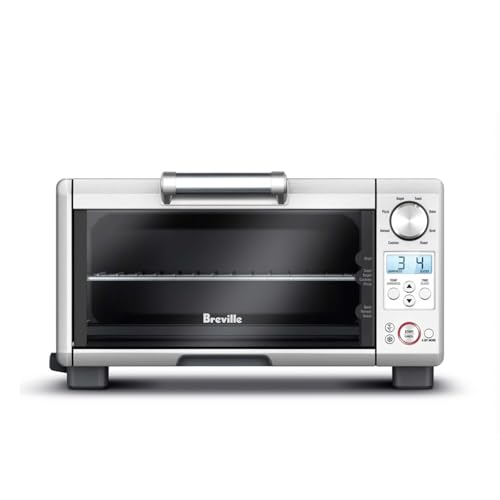
1. Breville Mini Smart Oven BOV450XL — Best Overall
Choose the Mini Smart Oven if you cook for one to three people and refuse to accept that small means mediocre. It is the compact oven for people who actually cook — proper baking, roasting and broiling in a footprint a small kitchen can host.
Strengths
- Breville’s element control delivers unusually even results for the size
- Eight well-chosen functions cover the real domestic repertoire
- Compact footprint with premium build and controls
Trade-offs
- Capacity suits small households; family batches need its bigger siblings
- Premium tier for a compact oven
- No dedicated air fry function in this generation of the design
| Specification | Detail (from verified listing title) |
|---|---|
| Model | BOV450XL |
| Functions | 8 cooking functions |
| Design | Space-saving countertop oven and toaster |
| Finish | Brushed stainless steel |
The Mini’s virtue is that Breville shrank the oven without shrinking the engineering. Its element management — the same philosophy as the flagship Smart Oven line — pulses and balances heat by function, so a small cavity produces the even baking and consistent toast that cheap compact ovens notoriously miss.
For couples, small households and serious solo cooks, it hits a sweet spot: big enough for a small roast, a modest pizza or a tray bake; small enough to justify its counter claim in kitchens where the flagship models simply cannot go. If your household is bigger, step up within the Breville line rather than across to a lesser brand.
In ownership terms, the Breville Mini Smart Oven BOV450XL asks little beyond what this guide has already described: keep its verified specification — 8 functions, compact premium convection — in mind when you set it up, and judge it by the job named in its verdict, small households wanting premium results in a compact oven. Owners who match a tool to its designed work rarely regret the purchase; owners who ask it to be a different product usually do.
Best for: Small households wanting premium results in a compact oven / Not suited for: Family-size batches
Check on Amazon — check the current price on Amazon before ordering, and confirm the listing matches the model described here.

2. TOSHIBA 10-in-1 Convection Toaster Oven, 6-Slice — Best Value for Families
The Toshiba fits the family that wants one oven to do everything: toast on school mornings, pizza on Fridays, a rotisserie chicken on Sunday. If your cooking is varied and your budget is sensible, this is the shortlist topper.
Strengths
- Rotisserie at this tier is a genuine differentiator for whole chickens
- Ten functions with six accessories included cover nearly every counter top job
- LCD knob controls blend digital information with tactile simplicity
Trade-offs
- Feature depth means more to learn than a basic toaster oven
- 1500W is strong but not class-leading; preheats reward a little patience
- Accessory storage becomes your problem — six pieces need a home
| Specification | Detail (from verified listing title) |
|---|---|
| Functions | 10-in-1 including bake, broil, rotisserie and pizza |
| Capacity | 6-slice |
| Power | 1500W |
| Controls | LCD knob controls |
| Included | 6 accessories |
Rotisserie changes what a counter top oven means to a household: a self-basting chicken rotating in convection heat is a Sunday centrepiece from an appliance that toasts on Monday. Toshiba including it — with the accessories in the box — at this tier is the model’s core argument, and it is a strong one.
Around that headline, the oven is a competent modern all-rounder: convection baking, broiling, pizza and toast with clear LCD-assisted controls. Families should still measure for it — 6-slice ovens are not small — but for those with the counter, it replaces the most appliances per unit of money in this guide.
A word on living with the TOSHIBA 10-in-1 Convection Toaster Oven, 6-Slice beyond the first week: its character is defined by 10-in-1, 6-slice, rotisserie, 1500W, and that character does not change with familiarity — it simply becomes predictable, which is what experienced owners actually want. Bought for families wanting maximum versatility per budget, it will settle into routine quickly and stay there.
Best for: Families wanting maximum versatility per budget / Not suited for: Minimalists who dislike feature depth
Check on Amazon — check the current price on Amazon before ordering, and confirm the listing matches the model described here.
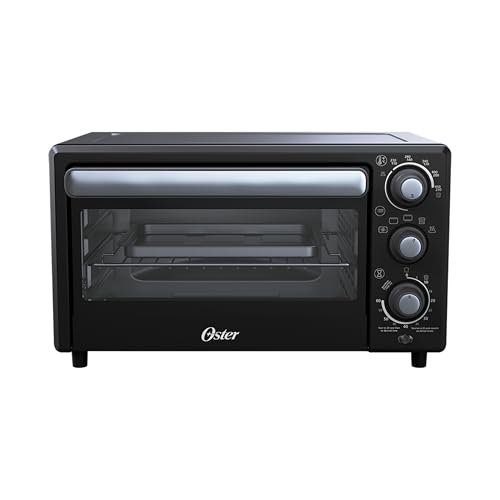
3. Oster Compact Air Fryer Toaster Oven, 18 Qt — Best Compact Air Fry Combo
Pick the Oster if air frying is your main event and oven functions are the supporting cast — a small household that crisps several nights a week and bakes or reheats occasionally, in a kitchen without room for a full-size unit.
Strengths
- Air fry performance is the design priority, not an added preset
- Compact 18 Qt footprint suits apartments and small counters
- Adjustable rack positions add flexibility for different foods
Trade-offs
- Five functions is a focused set; no rotisserie or dehydrate
- Capacity limits family-size batches
- Oster’s tier means functional rather than premium materials
| Specification | Detail (from verified listing title) |
|---|---|
| Capacity | 18 Qt, compact |
| Functions | 5 cooking functions |
| Air fry | Dedicated air fry performance focus |
| Racks | Adjustable rack positions |
Focus is underrated in this category. By centring air frying and a tight function set, Oster avoids the bloat that makes many multi-function ovens mediocre at everything. The result is a compact unit whose main job — crisping — it does with conviction, while still covering pizza night and basic baking.
The adjustable racks matter more than they appear to: in a compact cavity, rack position is the difference between food in the fan’s sweet spot and food sulking in a corner. Owners who learn those positions get results that belie the oven’s size and tier.
Long-term satisfaction with the Oster Compact Air Fryer Toaster Oven, 18 Qt follows a familiar pattern in this category: the buyers who thrive are those who bought it precisely for small kitchens wanting air fry plus oven basics and who maintain it on the simple schedule its design assumes. Its headline specification — 18 Qt compact with air fry focus — is the right lens for every later judgement about whether it was money well spent.
Best for: Small kitchens wanting air fry plus oven basics / Not suited for: Users needing rotisserie or many functions
Check on Amazon — check the current price on Amazon before ordering, and confirm the listing matches the model described here.

4. Elite Gourmet ETO236 Compact 2-Slice Toaster Oven — Best for Tiny Spaces and Budgets
The Elite Gourmet is for the spaces other ovens cannot enter — a dorm room, an RV galley, a studio kitchenette, an office. If your cooking is a toasted sandwich, a small bake or a reheated portion, it does that job in a footprint measured in inches.
Strengths
- Genuinely tiny footprint for the tightest counters
- Simple controls and timer suit occasional, single-portion use
- Budget tier makes it a low-risk addition to small living spaces
Trade-offs
- Two-slice capacity is a hard ceiling — this is a personal oven
- Short timer and basic controls limit serious cooking
- Not a convection showcase; it covers the basics at small scale
| Specification | Detail (from verified listing title) |
|---|---|
| Model | ETO236 |
| Capacity | 2-slice, compact |
| Timer | 15-minute timer |
| Use | Small kitchens, dorms and RVs |
Every category needs its honest minimum, and the ETO236 is this one’s. It will not host a family roast and does not pretend to; it toasts, bakes small items and broils for one person in spaces where a full oven is a fantasy. In an RV or dorm, that is not a compromise — it is the difference between cooking and not cooking.
Set expectations by its tier and timer and it satisfies. Buy it as a personal appliance for small spaces, and consider the larger picks the moment your household or ambitions outgrow two slices.
In ownership terms, the Elite Gourmet ETO236 Compact 2-Slice Toaster Oven asks little beyond what this guide has already described: keep its verified specification — Ultra-compact 2-slice, dorm/RV friendly — in mind when you set it up, and judge it by the job named in its verdict, dorms, RVs, offices and single servings. Owners who match a tool to its designed work rarely regret the purchase; owners who ask it to be a different product usually do.
Best for: Dorms, RVs, offices and single servings / Not suited for: Anyone cooking for more than one or two
Check on Amazon — check the current price on Amazon before ordering, and confirm the listing matches the model described here.

5. KoolMore KM-CTCO-15 Commercial Countertop Convection Oven — Best Commercial Counter Top
Choose the KoolMore if your counter top oven works for a living — café bake-off, restaurant support cooking, market production — or if you are a home baker whose batches have honestly become production.
Strengths
- Half-size pan standard unlocks real batch capacity
- ETL safety and sanitation listing suits commercial premises
- Stainless build tolerates commercial cleaning and duty
Trade-offs
- Commercial controls assume a professional user
- 1600W needs a circuit with real spare capacity
- Oversized and over-specified for domestic weeknight cooking
| Specification | Detail (from verified listing title) |
|---|---|
| Model | KM-CTCO-15 |
| Size | 23 inch, half-size pans, 4 racks |
| Power | 1600W |
| Certification | ETL listed |
| Finish | Stainless steel |
Searches for counter top convection ovens mix two audiences, and this KoolMore serves the professional one without apology. Half-size pans, four racks and certified stainless construction make it a small business tool that happens to sit on a counter, with throughput no domestic oven in this guide can approach.
Home buyers should read it as a boundary marker: if its capacity sounds exciting rather than excessive, your cooking may genuinely have crossed into production, and commercial equipment is the honest purchase. If it sounds like a lot, it is — and the domestic picks above exist for you.
A word on living with the KoolMore KM-CTCO-15 Commercial Countertop Convection Oven beyond the first week: its character is defined by Half-size commercial, 4 racks, ETL, and that character does not change with familiarity — it simply becomes predictable, which is what experienced owners actually want. Bought for cafés, small restaurants and production home bakers, it will settle into routine quickly and stay there.
Best for: Cafés, small restaurants and production home bakers / Not suited for: Domestic users wanting presets and gentle pricing
Check on Amazon — check the current price on Amazon before ordering, and confirm the listing matches the model described here.

6. Kratos Half-Size Electric Convection Oven 29M-002 — Best Commercial Capacity per Tier
The Kratos suits the budget-led commercial buyer: a start-up, concession or test kitchen that needs genuine four-pan half-size capacity and certification, and is willing to verify performance in its first weeks in exchange for the tier.
Strengths
- Four half-size pans and 1.5 cubic feet is flagship-class capacity
- ETL certification keeps it legitimate for commercial premises
- 120V operation avoids electrical upgrades
Trade-offs
- Value commercial brand; verify temperatures and evenness on arrival
- 1600W draw demands a suitable circuit
- No domestic convenience features whatsoever
| Specification | Detail (from verified listing title) |
|---|---|
| Model | 29M-002 |
| Capacity | 1.5 cubic feet; holds four half-size sheet pans |
| Power | 120V, 1600W |
| Certification | ETL certified |
On specifications, the Kratos stands beside ovens costing considerably more: same pan standard, same capacity class, same certification, same convenient 120V supply. That parity is its entire proposition, and for a business watching capital, it is a compelling one.
The professional approach to value equipment applies: commission it properly, map its hot zones with test bakes, confirm temperatures with a thermometer, and keep documentation. An oven verified in week one and understood by its operator will out-cook a premium oven used carelessly.
Long-term satisfaction with the Kratos Half-Size Electric Convection Oven 29M-002 follows a familiar pattern in this category: the buyers who thrive are those who bought it precisely for value-focused commercial buyers needing four-pan capacity and who maintain it on the simple schedule its design assumes. Its headline specification — 4 half-size pans, 1.5 cu ft, 1600W — is the right lens for every later judgement about whether it was money well spent.
Best for: Value-focused commercial buyers needing four-pan capacity / Not suited for: Domestic kitchens
Check on Amazon — check the current price on Amazon before ordering, and confirm the listing matches the model described here.
Comparison Table
| Pick | Badge | Key Spec | Best For |
|---|---|---|---|
| Breville Mini Smart Oven BOV450XL | Best Overall | 8 functions, compact premium convection | Small households wanting premium results in a compact oven |
| TOSHIBA 10-in-1 Convection Toaster Oven, 6-Slice | Best Value for Families | 10-in-1, 6-slice, rotisserie, 1500W | Families wanting maximum versatility per budget |
| Oster Compact Air Fryer Toaster Oven, 18 Qt | Best Compact Air Fry Combo | 18 Qt compact with air fry focus | Small kitchens wanting air fry plus oven basics |
| Elite Gourmet ETO236 Compact 2-Slice Toaster Oven | Best for Tiny Spaces and Budgets | Ultra-compact 2-slice, dorm/RV friendly | Dorms, RVs, offices and single servings |
| KoolMore KM-CTCO-15 Commercial Countertop Convection Oven | Best Commercial Counter Top | Half-size commercial, 4 racks, ETL | Cafés, small restaurants and production home bakers |
| Kratos Half-Size Electric Convection Oven 29M-002 | Best Commercial Capacity per Tier | 4 half-size pans, 1.5 cu ft, 1600W | Value-focused commercial buyers needing four-pan capacity |
How to Choose a Convection Counter Top Oven
Measure first, shop second. Record your counter depth, the height to your cabinet undersides, and the space with a door fully open. Then shop capacities in the language of your cooking: slices for toast-led households, quarts or cubic feet for general use, pizza diameter for Friday nights, and pan sizes if you bake in batches. An oven that fits the kitchen and the menu beats a superior oven that fits neither.
Match the function set to your week. Toast, bake, broil and reheat are the universal core. Air fry earns its premium if you crisp often; rotisserie if whole chickens are a ritual; dehydrate and proof only for the households that will genuinely use them monthly. Every unused function is counter space and money spent on a brochure.
Finally, weigh controls and cleaning. Knobs are fast; digital controls are precise; both are fine if legible. Crumb trays that slide out from the front, interiors with sensible coatings, and accessories that fit a dishwasher decide long-term affection in this category more reliably than any cooking specification.
Counter Top Convection vs Your Full-Size Oven
The counter top oven wins on speed, energy and convenience for small-to-medium loads: it preheats in minutes, heats a fraction of the air volume, and keeps cooking heat out of the kitchen in summer. The full-size oven wins on absolute capacity, very tall items, and multi-dish holiday logistics. The two are complements, and most households settle into exactly that division within a month of ownership.
Energy deserves a plain word: for a single tray or a small roast, the counter top oven’s smaller cavity and shorter preheat use meaningfully less energy than bringing a full range oven to temperature. Across a year of weeknight cooking, that difference is real — one of the quieter financial arguments for the category.
Sizing Guide: From Two Slices to Half-Size Pans
Think of the category as four steps. Personal ovens (2-slice class) serve one person in minimal space. Compact family ovens (around 6 slices or 18 quarts) cover most households’ daily cooking. Large domestic ovens add whole chickens, big pizzas and two-rack cooking. Commercial countertop units (quarter and half-size pans) leave domestic language behind entirely and serve production.
The common error is buying one step too large “just in case”, then resenting the counter it consumes every day for the sake of a monthly batch. Buy for the weekly reality; the full-size oven remains your overflow for the exceptional meal. That single discipline produces more satisfied owners than any brand choice.
The Counter Space Economy: Earning a Permanent Place
A counter top oven is not bought once; it is re-bought every day it justifies the counter it occupies. Appliances earn that place by frequency — the oven used for breakfast toast, lunch reheating and dinner roasting never feels like clutter — and lose it by friction: awkward doors, cryptic controls, accessories stored in three cupboards. When choosing between models, weigh the daily friction honestly, because it compounds faster than any cooking specification.
Placement strategy helps an oven earn its keep. Give it a home with the clearance it needs and an outlet it does not share with a kettle, near the prep area rather than exiled to a far corner. Keep its two or three core accessories with it, not in general storage. An oven that is ready in ten seconds gets used; an oven that needs assembly gets admired.
If counter space is truly contested, consider the household’s appliance census before adding: a counter top convection oven can honestly retire a toaster and a basket air fryer for many families, netting space while gaining function. Consolidation, not accumulation, is how small kitchens win.
Convection Settings Demystified: Fans, Elements and Honest Labels
Not all “convection” in this category is equal. True convection pairs a dedicated element around the fan with the fan itself, delivering genuinely heated moving air. Fan-assisted ovens move air heated by the main elements, which still improves evenness substantially. The practical difference shows in recovery time after the door opens and in low-temperature work like dehydrating, where a dedicated convection element holds gentle heat far better.
Element configuration shapes results too. Ovens with both upper and lower elements, independently managed, brown tops and bottoms in balance; single-element designs ask the user to compensate with rack position. None of this appears on the front of the box, which is why this guide’s reviews speak to cooking behaviour — evenness, recovery, browning balance — rather than repeating mode lists.
Temperature ranges tell a similar hidden story. A wide range, reaching genuinely low temperatures, enables proofing, dehydrating and slow roasting; a high maximum with strong elements enables real broiling and pizza. Check the range against your cooking rather than assuming all ovens span the same territory — in this category, they emphatically do not.
Toaster Oven, Air Fryer Oven or Convection Oven: Untangling the Labels
Retail naming in this category is a swamp, and untangling it saves real money. A toaster oven is the base appliance: elements, a cavity, a timer. Add a fan and it becomes a convection toaster oven, cooking faster and more evenly. Add aggressive fan power, a perforated basket and marketing conviction and it is sold as an air fryer oven — but the underlying machine is the same family, differentiated by airflow intensity and accessories rather than by any separate technology.
The buying implication is liberating: shop the machine, not the label. A well-built convection toaster oven with a basket accessory air fries respectably; a cheap “air fryer oven” with a weak fan and no basket does not. The specifications that predict performance are fan and element design, cavity geometry, temperature range and the included cooking surfaces — all of which this guide’s reviews address directly, model by model.
Microwave combinations sit adjacent to this family and are covered in their own guide in this series; they add microwave speed to the convection idea at the cost of cavity size. Full-size range ovens remain the capacity ceiling. Within the counter top family itself, the honest ladder runs from personal toaster ovens through convection models to the commercial countertop units — and the right rung is the one your weekly cooking actually occupies.
One final label deserves suspicion: function counts. “10-in-1” and its escalating cousins mostly enumerate combinations of the same elements, fan and timer. Two ovens with identical hardware can wear different counts. When a decision narrows to two models, compare what each physically contains — elements, fan, racks, baskets, cavity — and let the arithmetic of marketing cancel itself out.
Electrical Reality: Circuits, Wattage and Shared Kitchens
Counter top convection ovens are among the heaviest loads a kitchen circuit carries, typically drawing between roughly 1400 and 1800 watts — most of a standard circuit’s comfortable capacity. The practical consequence is pairing discipline: an oven sharing a circuit with a kettle, microwave or espresso machine will eventually introduce you to your breaker panel mid-recipe. Where possible, give the oven a circuit whose other loads are lights and small appliances, and never run it from an extension lead or a multi-way adapter.
Older kitchens deserve an extra moment of honesty. Wiring and outlets installed decades ago may be rated for the circuit but worn in their contacts, and a sustained near-maximum draw is exactly the load that finds a loose connection. An outlet that feels warm after twenty minutes of oven use is giving information, not ambience; have it checked. The oven is rarely the problem — it is the messenger that arrives with a heavy, honest load.
None of this should deter a purchase; it should schedule one. Knowing your circuit layout before the oven arrives turns installation into unboxing rather than troubleshooting, and it protects every other appliance that shares the kitchen’s power. Treat the electrical check as step zero of the buying process, the way this guide treats counter measurement.
What to Cook First: A First-Week Curriculum for a New Oven
New ovens teach their owners fastest through a deliberate sequence. Begin with toast at several settings to map browning evenness — the cheapest diagnostic in cooking. Follow with a tray of vegetables at a known temperature to learn the fan’s effect on timing, then a simple bake such as muffins to test rise and uniformity. By the fourth cook, a roast chicken or its equivalent will tell you how the cavity handles mass, moisture and an hour of sustained heat.
Record each result in a few words: setting, time, rack, outcome. That small log becomes the oven’s personal manual, worth more than the printed one within a month, because it describes your unit, your pans and your food. Owners who keep it stop experiencing surprises; owners who rely on memory re-learn the same lessons at the cost of the same meals.
Only after that curriculum should the oven be trusted with an occasion — guests, a celebration bake, a holiday side dish. Appliances earn trust in private before they are asked to perform in public, and a week of deliberate cooking is a small premium for that confidence.
Replacement Parts and When an Oven Is Worth Repairing
Counter top ovens fail in a predictable shortlist of ways: elements lose output, fans grow noisy, door hinges and latches wear, and control boards succumb to years of steam and heat. The repairability question is decided less by the fault than by the brand’s parts ecosystem. Makers with long model runs and stocked accessories — the Breville class of this guide — keep ovens economically repairable for years; anonymous models may be unrepairable the month after purchase for want of a ten-dollar part.
A sane decision rule follows. If the fault is an accessory, a tray or a knob, repair always. If it is an element or fan on a premium model within its first several years, repair usually. If it is a control board on a budget model out of warranty, replacement with the lessons of this guide in hand is usually the honest economics. Buying with parts availability in mind at the start — one more unglamorous criterion — is what makes any of those answers available later.
How to Set Up and Use a Counter Top Convection Oven
A short setup routine and a few cooking habits will get you professional-looking results from any oven in this guide.
- Position with clearance: place the oven on a stable, heat-safe surface with the manual’s clearance on all sides, and never under a cabinet that traps its exhaust heat. Plug it directly into an outlet — no extension leads for a heating appliance.
- Burn off before first food: run the empty oven hot for a short cycle per the manual to clear manufacturing residues, with the kitchen ventilated. Every new counter top oven needs this; skipping it seasons your first meal with factory smell.
- Learn the rack positions: middle for general baking, lower for tall items and pizza bottoms, upper for broiling. In convection mode the fan evens things considerably, but position still governs browning intensity.
- Preheat for anything baked or crisped: a few minutes brings the cavity to honest temperature. Toast and reheating forgive skipping it; pastry, pizza and air-fried foods do not.
- Convert recipes and check early: reduce conventional temperatures modestly or shorten times, and set your first check well before the recipe’s endpoint. Note the adjustments that worked; your oven will repeat them faithfully.
- Use a thermometer for proteins and verify oven temperature once: an inexpensive oven thermometer reveals your unit’s dial offset in one session, and an instant-read thermometer ends doneness guessing permanently.
- Clean on the five-minute rule: crumb tray out after toasting sessions, interior wiped while warm, accessories washed before grease bakes on. Counter top ovens reward this rhythm disproportionately.
Within a few weeks these steps become reflex, and the oven becomes what it should be: the appliance you use without thinking, several times a day, because it is faster and easier than every alternative for the jobs it owns.
Common Buying Mistakes
Skipping the measuring tape. Depth with the door open and height under cabinets eliminate more models than any feature comparison. Measure your space before falling in love with a specification sheet.
Buying commercial capacity for domestic cooking. Half-size commercial ovens are wonderful tools that dominate a home counter and a home circuit. Buy them for production, not for potential.
Crowding food and blocking the fan’s work. Convection needs air paths. Single layers, gaps between items, and pans sized to the cavity produce the even browning you bought the fan for.
Forgetting the burn-off cycle. New ovens carry manufacturing residues that belong in a ventilated empty run, not in your first roast chicken. Ten minutes of patience before first use is the whole fix.
Letting the crumb tray become a fire story. Crumbs accumulate exactly where the heat is. Empty the tray routinely — it is a thirty-second habit that is also a safety practice.
Final Recommendation
For most households, the decision narrows to two: the Breville Mini Smart Oven for premium compact cooking for one to three people, and the Toshiba 10-in-1 for families wanting maximum versatility — rotisserie included — at a sensible tier. The Oster serves air-fry-led small kitchens, and the Elite Gourmet honestly covers dorms, RVs and single servings.
Commercial buyers should look to the KoolMore for certified mid-tier reliability or the Kratos for four-pan capacity at a value tier. Measure your counter, size to your weekly cooking rather than your annual feast, and the oven you choose will justify its permanent place within the first week.
One final encouragement for the undecided: in this category, a good decision made this week beats a perfect decision researched for a season, because the oven pays its way in daily use from the day it lands. The models above are all defensible choices within their classes; the differences that will matter to you in year two are fit, fit and fit — to your counter, your circuit and your cooking. Trust the measurements you took, choose the class your week actually lives in, and start cooking.
Trust, finally, the evidence of your own kitchen over any guide’s ordering, including this one: the measurements, the circuit check and the honest audit of your weekly cooking outrank every badge awarded above, and an oven chosen by those lights will serve you faithfully whichever name is on its door.
The counter is precious, the cooking is daily, and the right oven honours both facts at once.
That discipline — measure, match, then buy — is the closest thing this category has to a guarantee.
The picks at a glance:
- Breville Mini Smart Oven BOV450XL — Best Overall. Small households wanting premium results in a compact oven.
- TOSHIBA 10-in-1 Convection Toaster Oven, 6-Slice — Best Value for Families. Families wanting maximum versatility per budget.
- Oster Compact Air Fryer Toaster Oven, 18 Qt — Best Compact Air Fry Combo. Small kitchens wanting air fry plus oven basics.
- Elite Gourmet ETO236 Compact 2-Slice Toaster Oven — Best for Tiny Spaces and Budgets. Dorms, RVs, offices and single servings.
- KoolMore KM-CTCO-15 Commercial Countertop Convection Oven — Best Commercial Counter Top. Cafés, small restaurants and production home bakers.
- Kratos Half-Size Electric Convection Oven 29M-002 — Best Commercial Capacity per Tier. Value-focused commercial buyers needing four-pan capacity.
Related reading in this series: Best Convection Air Fryer Ovens; Best Convection Cooking Ovens; Best Convection Microwave Ovens Countertop; Best Countertop Ovens; Best Toaster Ovens.
Frequently Asked Questions
What size counter top convection oven do I need?
For one to two people, a compact model around 4 slices or under suits daily cooking. Families of three to five should look at 6-slice or roughly 18–25 quart models. Buy for your weekly meals; your full-size oven remains the overflow for exceptional ones.
Does convection really cook faster in a small oven?
Yes — the fan evens the temperature and strips the insulating air layer from food surfaces, so cooking is both faster and more uniform than a still-air toaster oven. Apply the standard conversion: modestly lower temperature or shorter time, checked early.
Can a counter top oven bake a cake properly?
A good convection counter top oven bakes cakes evenly and well, provided the pan fits with airflow clearance and you apply the temperature conversion. The compact Breville and Toshiba class models handle standard cake pans comfortably.
How much clearance does a counter top oven need?
Follow the specific manual, but plan on several inches on all sides and above for heat escape, and never run one sealed under low cabinets. Heat management is the main placement rule in this category.
Are commercial countertop ovens worth it for home bakers?
Only if your baking is genuinely production-scale — frequent large batches, market sales, or daily volume. For ordinary home baking they consume counter, circuit capacity and budget that a good domestic oven would not.
Why does my convection oven brown one side more?
Every oven has a stronger zone. Rotate pans halfway through, avoid blocking airflow with oversized pans, and confirm you are not overloading the cavity. Persistent severe unevenness on a new oven is worth a thermometer check and, if extreme, a warranty conversation.