Disclosure: airfryerkitchensupply.com is reader-supported. When you buy through links on our site, we may earn an affiliate commission at no extra cost to you.
Where to buy
All six picks in this guide to the best commercial vacuum sealers are sold on Amazon, including the chamber machines that many buyers assume are dealer-only. Commercial sealers are configuration-sensitive — seal bar length, pump type, and included bag starter kits vary by listing — so confirm the exact model number from the links in the Quick Picks, the reviews, and the comparison table, and check price on Amazon on that exact listing. For a business purchase, also confirm the seller’s warranty handling before ordering, because uptime matters more than the last few dollars of purchase price.
What “commercial” really means in a vacuum sealer
The word “commercial” gets printed on a lot of plastic. In vacuum sealing, it should mean three specific things: a pump and motor rated for back-to-back cycles without mandatory cool-down rests, a seal bar wide enough and hot enough to lay a reliable seal on thick commercial bags all day, and a construction standard — stainless housings, serviceable pumps, replaceable wear parts — that assumes the machine is a tool of business rather than a kitchen gadget. The best commercial vacuum sealers divide into two architectures. Chamber sealers place the whole bag inside a vacuum chamber, which lets them seal liquids, marinades, and soups as easily as dry goods, and their bags cost a fraction of what textured external-sealer bags cost. External (clamp-style) sealers pull vacuum from the bag’s edge; they handle very long items a chamber cannot swallow, start faster for occasional use, and cost less up front, but they cannot truly seal liquids and their bag costs run higher forever.
This guide covers both architectures honestly: three chamber machines from VacMaster spanning the serious commercial range, a compact chamber unit from Avid Armor for smaller operations, and two wide-format Weston external sealers for the workloads chambers cannot do. Every model was verified connection to Amazon — searched by brand and model, matched against the returned listing title — before it earned a purchase link here. If your workload is a restaurant line, a butcher counter, a food truck, a meal-prep business, a fishing or hunting operation, or a farm stand, one of these six machines matches it; the buying-guide sections below will help you identify which, and just as importantly, which popular choice would be wrong for you.
A note on expectations: commercial sealing is a consumables business. Bags, seal-bar tape, gaskets, and pump oil (on oil-pump models) are recurring costs and maintenance items, and the total cost of ownership differences between chamber and external machines are driven mostly by bag economics over thousands of cycles. We address those economics directly in the guide sections, in qualitative terms, because that is where the real money in this category quietly moves. We also close the guide with the two topics buyers most often wish someone had raised before the purchase: the maintenance rhythm that keeps a commercial machine at full vacuum for years, and the certification question your health inspector may ask about.
In this guide
Quick Picks
- Best Overall Commercial — VacMaster VP320. A 1/2 HP oil-pump chamber machine with a 16-inch seal bar taking bags up to 16 x 18 inches — the high-throughput centerpiece for restaurants, butchers, and serious processors. Check price on Amazon
- Best for Mid-Size Restaurants — VacMaster VP230. The same oil-pump architecture in a 12.25-inch seal bar format for bags up to 12 x 15 inches — commercial duty cycle, more manageable footprint. Check price on Amazon
- Best Maintenance-Free Chamber — VacMaster VP210. A maintenance-free dry-piston chamber sealer with a 10.25-inch seal bar for 10 x 13 inch bags — chamber benefits without oil changes, for smaller kitchens and cafés. Check price on Amazon
- Best External Sealer for Wide Bags — Weston Pro-3000. A programmable, fan-cooled 1020W clamp sealer with an extra-wide 5mm seal bar for bags up to 15 inches wide — for long cuts and items no chamber fits. Check price on Amazon
- Best for Game and Bulk Meat — Weston Pro-2300. The Pro-3000’s sibling: same 15-inch, 1020W, fan-cooled platform in a simpler control scheme, built for hunting season and bulk processing days. Check price on Amazon
- Best Compact Chamber — Avid Armor USVXL. An 11.5-inch seal bar chamber machine with an accessory hose, sized for small restaurants, food trucks, and serious home processors who seal liquids and jars. Check price on Amazon
How These Picks Were Chosen
We started from the commercial end of the vacuum sealer market — machines sold for business duty cycles — rather than promoting household sealers with “commercial” in their marketing. Every candidate had to be confirmable connection: searched by brand and model, with the returned Amazon listing title matched to the exact machine before its ASIN was used. That verification discipline matters in this category, where model numbers differ by a digit and listings aggregate confusingly similar machines.
Within the verified field, we ranked on the specifications that decide commercial usefulness: pump type and duty cycle (oil rotary pumps for the heaviest continuous work, dry piston pumps for maintenance-free moderate work, fan-cooled motors on external sealers for back-to-back cycles), seal bar length and seal width, maximum bag size, chamber dimensions where relevant, and the practical ecosystem around the machine — bag availability and cost structure, replaceable gaskets and seal wires, and the manufacturer’s support reputation among commercial users. We deliberately included both chamber and external architectures rather than declaring one universally better, because the right architecture depends on the workload, and the guide sections below explain that dependency in detail.
Two standing rules apply. No fixed prices appear anywhere in this guide, because commercial equipment pricing moves with promotions and configuration; use the links to check the current price on Amazon. No star ratings or review counts appear either. Specifications in the mini spec boxes come only from the verified listing data for each machine.
The 6 Best Commercial Vacuum Sealers

VacMaster VP320 Chamber Vacuum Sealer — Best Overall Commercial
The VP320 is the machine a small restaurant, butcher shop, or serious processing operation builds its sealing station around. Its 1/2 HP oil pump pulls a deep, fast vacuum cycle after cycle, and its 16-inch seal bar accepts bags up to 16 x 18 inches — large enough for whole primals broken into retail cuts, family-size meal prep, and bulk dry goods. Because it is a chamber machine, it seals liquids, marinades, sauces, and soups as calmly as it seals dry product, which makes it as useful to a kitchen doing sous vide production as to a processor packing meat.
Strengths
- 1/2 HP oil pump delivers the strongest, most consistent vacuum in this guide and is built for continuous commercial cycling.
- 16-inch seal bar and 16 x 18 inch bag capacity handle the largest formats any pick here can chamber-seal.
- Chamber architecture seals liquids and marinades and uses smooth, low-cost chamber bags instead of textured external bags.
Trade-offs
- Size and weight make this a dedicated station machine, not a move-it-daily counter appliance.
- Oil pumps need periodic oil changes and inspection — a modest maintenance routine that is part of owning this class.
- Highest commitment tier in the guide; small operations may never use its capacity and should size down to the VP230 or VP210.
Key specs (verified): Chamber sealer; 1/2 HP oil pump; 16-inch seal bar; bags up to 16 x 18 inches; suited to sous vide, liquids, and meat.
The VP320’s real advantage shows up at volume. On a processing day — a side of beef becoming retail cuts, a restaurant portioning a week’s proteins, a meal-prep business running hundreds of bags — cycle consistency is money: every failed seal is product reworked or lost, and every slow cycle is labor. The oil pump’s deep vacuum also extends freezer life on long-stored product by removing more air per cycle. Operations sealing more than a few dozen bags a day will find this class of machine pays for its tier in labor and bag savings; the detailed economics are in the chamber-versus-external section below. Check price on Amazon
Best for: restaurants, butcher counters, meal-prep businesses, and high-volume processors. / Not suited for: occasional users, small counters, or anyone unwilling to do basic oil-pump maintenance.

VacMaster VP230 Chamber Vacuum Sealer — Best for Mid-Size Restaurants
The VP230 applies the same commercial formula — 1/2 HP oil pump, chamber architecture, VacMaster’s commercial build — at a 12.25-inch seal bar for bags up to 12 x 15 inches. That size covers the great majority of restaurant portioning: proteins for service, sauce and soup batches, marinade bags, and sous vide production for a dining room rather than a commissary. For a mid-size kitchen, food truck with a prep base, or a growing meal-prep operation, it is the sweet spot where genuine commercial duty cycle meets a footprint a real kitchen can house.
Strengths
- Oil-pump vacuum strength and duty cycle equal in kind to the flagship VP320, sized for typical restaurant portions.
- 12 x 15 inch bag capacity covers most protein, sauce, and sous vide work without wasted chamber volume.
- Full chamber benefits: liquids, marinades, and low-cost smooth bags.
Trade-offs
- Oversize items — whole large primals, extra-long cuts — exceed its chamber and belong to the VP320 or an external sealer.
- Oil maintenance applies, as with any oil-pump machine.
- Still a serious, heavy appliance that wants a permanent home in the kitchen.
Key specs (verified): Chamber sealer; 1/2 HP oil pump; 12.25-inch seal bar; bags up to 12 x 15 inches; suited to sous vide, liquids, and food storage.
Choosing between the VP230 and VP320 is a measuring exercise, not a quality decision: bag your three largest regular items, measure them, and buy the chamber that fits them with room to spare. Most restaurants discover their largest routine item — a portioned salmon side, a batch of short ribs, a soup batch bag — sits comfortably inside 12 x 15, which makes the VP230 the rational flagship for their line. Operations whose signature work is bigger should not compromise; chamber fit is absolute, and the VP320 exists precisely for them. Check price on Amazon
Best for: mid-size restaurants, caterers, and meal-prep operations with standard portion sizes. / Not suited for: extra-large format work or buyers avoiding oil-pump maintenance.

VacMaster VP210 Chamber Vacuum Sealer — Best Maintenance-Free Chamber
The VP210 is the chamber machine for businesses that want chamber results without chamber-machine maintenance. Its dry piston pump is explicitly maintenance-free — no oil to check, change, or spill — and its 10.25-inch seal bar handles 10 x 13 inch bags, a size that covers cafés, delis, small restaurants, cheese and charcuterie programs, and serious home processors. It seals liquids, marinades, and sous vide portions like any chamber machine, at a scale and upkeep level a small operation can absorb without thinking about it.
Strengths
- Maintenance-free dry piston pump removes the only routine chore oil-pump ownership involves.
- True chamber sealing — liquids, soups, and marinades included — in the smallest VacMaster format here.
- 10 x 13 inch bag size matches small-portion commercial work: deli cuts, cheeses, single proteins, sauce portions.
Trade-offs
- Dry piston pumps pull a slightly less deep vacuum than oil pumps and are happiest at moderate daily volumes.
- The chamber’s bag ceiling is firm — anything beyond 10 x 13 inches needs a bigger machine.
- Not the choice for all-day continuous production lines; that workload belongs to the oil-pump models.
Key specs (verified): Chamber sealer; maintenance-free dry piston pump; 10.25-inch seal bar; bags up to 10 x 13 inches; suited to sous vide, liquids, and food storage.
The VP210’s buyers are businesses whose sealing is daily but not industrial: a café sealing house-cured salmon and soups, a deli portioning charcuterie, a small restaurant doing modest sous vide. For them, the machine’s virtue is that it disappears into the routine — switch it on, seal, switch it off, never schedule an oil change, never dedicate a station the size of a dishwasher. It is also the most sensible first chamber machine for a growing operation that wants to learn chamber economics — especially the dramatically cheaper smooth bags — before committing to oil-pump scale. Check price on Amazon
Best for: cafés, delis, small restaurants, and first-time chamber buyers who value zero pump maintenance. / Not suited for: high-volume production or large-format items.
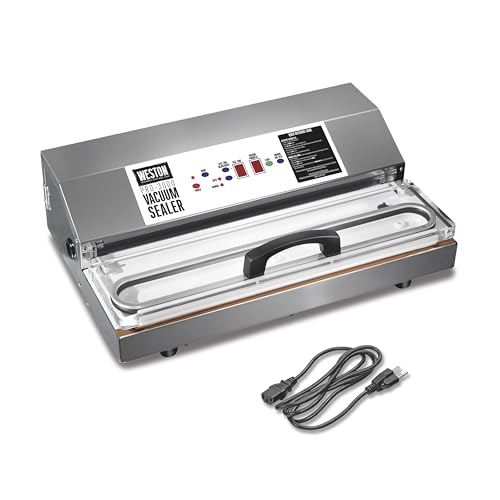
Weston Pro-3000 Vacuum Sealer — Best External Sealer for Wide Bags
Some commercial work simply does not fit in a chamber: whole salmon, long sausage coils, briskets, oversized cuts, and any item longer than it is wide. That work belongs to external sealers, and the Weston Pro-3000 is the strongest external pick in this guide — a 1020W, fan-cooled machine with an extra-wide 5mm seal bar accepting bags up to 15 inches wide, plus programmable controls that let an operator dial in repeatable vacuum and seal times for a production run. The fan-cooled motor matters: it is what allows back-to-back sealing through a pile of product without the thermal rest cycles that slow household machines.
Strengths
- 15-inch bag width and an extra-wide 5mm seal handle the long, large items chamber machines cannot accept.
- Fan-cooled 1020W motor supports continuous back-to-back cycles on processing days.
- Programmable settings give repeatable results across a batch — set it once, run the pile.
Trade-offs
- External architecture cannot truly seal liquids; wet items need pre-freezing or careful manual control.
- Requires textured (embossed) bags, whose ongoing cost runs well above smooth chamber bags.
- Vacuum depth on dense loads is a step behind a chamber machine’s even, all-around evacuation.
Key specs (verified): External sealer; bags up to 15 inches wide; extra-wide 5mm seal bar; 1020 watts; fan-cooled motor; programmable; stainless steel; model 65-0420-W.
The Pro-3000 earns its keep in operations whose signature items are long: smokehouses, sausage makers, whole-fish processors, hunters breaking down large game, and farms packing oversized cuts for market. Its programmability is the quiet production feature — a crew can standardize the exact cycle for each product and reproduce it across hundreds of bags and multiple operators. Pair it with quality rolls so bag length is cut to the item rather than wasted, and its economics improve further. Check price on Amazon
Best for: smokehouses, processors, and any operation sealing long or oversized items in volume. / Not suited for: liquids and marinades, or buyers who want chamber-bag economics.

Weston Pro-2300 Vacuum Sealer — Best for Game and Bulk Meat
The Pro-2300 shares the Pro-3000’s muscular platform — 15-inch bag width, extra-wide 5mm seal bar, 1020W fan-cooled motor, stainless build — with a simpler, more direct control approach. That combination is exactly what seasonal, high-intensity processing wants: deer season, a hog harvest, a bulk club-store breakdown, a fishing trip’s catch. The machine comes out, runs hard for hours sealing large cuts in wide bags, and goes back to storage without a programmable interface standing between the operator and the work.
Strengths
- Same wide-format, fan-cooled hardware as the Pro-3000 — 15-inch bags, 5mm seal, 1020W — built for processing-day volume.
- Simple controls suit gloved, messy, fast-moving work where programmable menus are friction.
- Stainless construction wipes down after the kind of sessions that define its use case.
Trade-offs
- No programmable cycle memory; consistent results depend on operator technique across a long session.
- External-only sealing — liquids and wet marinades need workarounds.
- Textured bag costs apply, as with every external machine.
Key specs (verified): External sealer; bags up to 15 inches wide; extra-wide 5mm seal bar; 1020 watts; fan-cooled motor; stainless steel; model 65-0220-W.
Hunters and bulk buyers measure a sealer in seasons, not weeks: does it survive the November weekend when three deer become two hundred bags, and does every seal hold through a year in the freezer? The Pro-2300’s wide seal and cooled motor are aimed squarely at that test. The 5mm seal width deserves emphasis — on thick commercial bags holding heavy cuts, a wide seal is the difference between a package that survives freezer stacking and one that silently loses vacuum in month four. For game and bulk duty, that reliability is the product. Check price on Amazon
Best for: hunters, homesteaders, and bulk-meat processors running intense seasonal sessions. / Not suited for: liquids, precision-programmed production runs, or chamber-bag budgets.

Avid Armor USVXL Chamber Vacuum Sealer — Best Compact Chamber
Avid Armor built its name on chamber sealers sized for real kitchens rather than industrial floors, and the USVXL is its larger compact entry: an 11.5-inch seal bar, a chamber that handles wet foods, soups, and marinades, and an accessory hose that extends the machine to external containers and mason jars — the listing specifically calls out sealing mason jars and rapid-marinating proteins. For a food truck, a small restaurant, a catering operation, or a serious home processor, it delivers the chamber feature set at the most approachable scale in this guide.
Strengths
- Full chamber capability — liquids, soups, marinades — in a compact footprint a small operation can house.
- Accessory hose adds jar and canister sealing, widening the machine’s usefulness beyond bags.
- 11.5-inch seal bar covers most small-business portion sizes.
Trade-offs
- Compact chamber means compact ceiling: large-format items belong to the VacMaster VP230/VP320 class.
- Pump capacity is matched to moderate duty; all-day production lines should step up.
- Avid Armor’s commercial support network is smaller than VacMaster’s — a consideration for mission-critical single-machine businesses.
Key specs (verified): Chamber sealer; 11.5-inch seal bar; accessory hose included; seals mason jars; suited to wet foods, soups, and marinades.
The USVXL’s sweet spot is versatility per square foot. A food truck can portion proteins, seal the day’s sauces, vacuum-marinate in minutes rather than hours, and put up jars — all from one compact machine that does not demand a prep kitchen’s footprint. Home processors graduating from a household external sealer will feel the same jump: liquids stop being a problem, bags get cheaper, and the mason-jar hose quietly becomes a weekly tool for pantry and refrigerator storage. It is the gentlest on-ramp to chamber sealing in this guide. Check price on Amazon
Best for: food trucks, small restaurants, caterers, and serious home processors wanting compact chamber versatility. / Not suited for: large-format items or all-day industrial production.
Comparison Table
| Pick | Badge | Key spec | Best for |
|---|---|---|---|
| VacMaster VP320 | Best Overall Commercial | Chamber, 1/2 HP oil pump, 16-inch bar, bags to 16 x 18 in | High-volume restaurants and processors |
| VacMaster VP230 | Best for Mid-Size Restaurants | Chamber, 1/2 HP oil pump, 12.25-inch bar, bags to 12 x 15 in | Mid-size kitchens and meal-prep operations |
| VacMaster VP210 | Best Maintenance-Free Chamber | Chamber, dry piston pump, 10.25-inch bar, bags to 10 x 13 in | Cafés, delis, zero-maintenance buyers |
| Weston Pro-3000 | Best External for Wide Bags | External, 15-inch bags, 5mm seal, 1020W, programmable | Long and oversized items in volume |
| Weston Pro-2300 | Best for Game and Bulk Meat | External, 15-inch bags, 5mm seal, 1020W, fan-cooled | Hunters and seasonal bulk processing |
| Avid Armor USVXL | Best Compact Chamber | Chamber, 11.5-inch bar, accessory hose, jar sealing | Food trucks and small operations |
How to Choose a Commercial Vacuum Sealer
Choose the architecture first, because it constrains everything else. If your work includes liquids, soups, sauces, or marinades — or if you seal enough volume that bag costs matter — you need a chamber machine. The chamber evacuates air from the whole environment around the bag, so liquid stays put instead of being dragged toward the seal, and the smooth bags chamber machines use are the cheapest format in the category per bag. If your work is dominated by items too long or irregular for a chamber — whole fish, briskets, sausage coils, large game quarters — you need an external machine with a wide seal bar, and you accept textured-bag costs as the price of that geometry.
Size the machine to your largest routine item, not your largest imaginable one. For chamber sealers, measure the bags your biggest weekly task requires and buy the seal bar that fits them with margin; an item that does not fit the chamber does not get sealed, full stop. For external sealers, width is the constraint: a 15-inch bar covers the wide cuts and family-size portions that defeat household machines. Buying one size up from your measured need is sensible insurance; buying two sizes up is counter space and budget spent on capacity that returns nothing.
Match the pump and motor to your duty cycle. Oil rotary pumps (the VacMaster VP230 and VP320) pull the deepest vacuum and are built for continuous daily production, at the cost of periodic oil changes. Dry piston pumps (the VP210) trade a little ultimate vacuum for zero maintenance and suit moderate daily volume. On external machines, a fan-cooled motor is the line between a commercial tool and a household machine in a steel jacket — it is what permits the hundredth consecutive seal on a processing day. Count your honest peak-day volume, not your average day, and buy for the peak.
Finally, price the ecosystem, not just the machine. Confirm that bags in your format are stocked by multiple suppliers, that gaskets, seal wires, and Teflon tape for your model are orderable as spare parts, and that the manufacturer supports commercial users with reachable service. A commercial sealer is a five-to-ten-year tool; the machine is the down payment, and the ecosystem is the mortgage.
Chamber vs. external: the bag economics that decide total cost
The least visible and most decisive number in commercial sealing is the per-bag cost, because it repeats thousands of times. Chamber machines use smooth, flat bags — a commodity product made in enormous volume — while external machines require textured, embossed bags whose channels let air escape past the clamp, and that embossing makes them permanently more expensive per bag of the same size. The gap is not subtle: at commercial volumes, operations routinely find their annual bag spend on an external machine rivaling the price difference between the external machine and a chamber unit. A business sealing a few dozen bags a week may never feel it; a business sealing a few hundred a day is paying for a chamber machine whether it owns one or not.
There are honest counterweights. External machines start cheaper, handle unlimited item length (a roll lets you cut bags to fit a whole fish or a full rack), and ask nothing of counter depth. Chamber machines demand the item fit inside a fixed box, cost more up front, and — in oil-pump form — ask for maintenance. The crossover calculation is simple in structure: estimate your bags per week, multiply the per-bag cost difference by a year of weeks, and compare that figure with the purchase-price difference between the architectures. Most operations that seal daily cross over within the first year or two, which is why this guide’s overall pick is a chamber machine while still respecting the external Westons for the geometry-driven work chambers cannot do.
One more economic factor: seal reliability is a cost line. A failed seal discovered at packing time costs a bag and a minute; a failed seal discovered in a customer’s freezer costs the product and the trust. Wide seals (like the Westons’ 5mm bar) and the even pressure of chamber sealing both exist to push failure rates toward zero, and at volume, reliability differences compound exactly like bag costs do.
How to Use a Commercial Vacuum Sealer: setup and daily workflow
Set the machine on a stable, level surface with room behind it for the lid’s full opening arc (on chamber units) and a bag-staging area in front. On an oil-pump chamber machine, check the oil sight glass before the first run and on a weekly rhythm thereafter; on any machine, inspect the seal bar’s tape surface and the lid gasket before a production session — a nicked gasket or worn tape is the root cause of most “mystery” weak vacuums, and both are cheap, quick replacements.
For chamber sealing: place the filled bag inside the chamber with its open end laid flat across the seal bar, free of wrinkles and product smears — a contaminated seal area is the top cause of failed seals, so wipe the bag mouth or fold it outward while filling. Close the lid and run the cycle; for liquids, watch the first runs to learn how your machine’s vacuum level behaves, since an aggressive vacuum can make liquids surge — many operators lower the vacuum slightly or chill liquids first for a calmer cycle. For external sealing: cut roll bags with enough headroom, keep the bag’s textured side oriented as the manual specifies, seal one end first on roll stock, fill without overfilling, and keep the seal zone dry and flat before starting the cycle.
Build two habits into the workflow. First, test-seal at the start of every session: run one bag, then try to pull its seal apart by hand and inspect it for a smooth, uniform, translucent band with no channels or wrinkles. Second, label as you go — product, date, and weight — because a freezer full of anonymous bags is inventory you cannot manage. End the session by wiping the chamber or seal area, leaving the chamber lid ajar (or as the manual directs) so the gasket is not stored under compression, and logging any seals that failed so a pattern gets caught while it is still a tape-or-gasket problem rather than a product-loss problem.
Maintenance schedule: keeping a commercial sealer at full vacuum
A commercial sealer’s performance decays through its cheapest parts first, which is good news if you maintain it and expensive news if you do not. The lid gasket is the prime example: it compresses every cycle, absorbs oils and food acids, and eventually leaks just enough to soften every vacuum while the pump sounds perfectly healthy. Inspect it weekly — run a finger around its full length feeling for nicks, flat spots, and embedded debris — and replace it at the first sign of damage or at the manufacturer’s interval, whichever comes first. Store the machine with the lid unlatched or ajar where the manual allows, so the gasket rests uncompressed overnight; a gasket stored under pressure ages in dog years.
The seal system is the second wear path. Seal wires fatigue and Teflon tape scorches and wrinkles, and both show up first as intermittent seal failures — the most dangerous kind, because they pass casual inspection and fail later in a customer’s freezer. Replace tape at the first visible scorch or wrinkle rather than nursing it, keep a spare wire and tape kit at the sealing station, and treat the session-start test seal described in the workflow section as non-negotiable. On external machines, also clean the vacuum channel and drip tray area after wet sessions; liquid pulled into the channel is the leading cause of the gradual vacuum loss owners blame on the pump.
Pump care divides by architecture. Oil pumps want a weekly sight-glass check and oil changes at the manufacturer’s interval or whenever the oil darkens and clouds — dark oil is contaminated oil, and contaminated oil costs vacuum depth and pump life simultaneously. Use the specified oil, not a hardware-store substitute. Dry piston machines like the VP210 skip all of this, which is their entire maintenance argument, but their filters and chamber still deserve the same weekly wipe-down and gasket inspection. Across all machines, a monthly deep clean of the chamber or seal area, a check of power cords and hinges, and a short log entry — date, oil status, parts replaced, failure count — turns maintenance from folklore into a system. Businesses that keep that log discover their sealer’s patterns months before those patterns become downtime.
Vacuum sealing for sous vide production: what commercial kitchens should know
Sous vide is the workload that converts many kitchens to chamber sealers, because the chamber’s even, gentle evacuation is exactly what a water bath wants: bags with minimal trapped air float less, cook more evenly, and do not need the double-sealing anxiety that external machines inspire when a seal will spend hours submerged. If your kitchen runs baths daily, size the chamber to your largest protein in its cooking bag, and standardize bag sizes across the menu so staff are not improvising formats mid-service.
A few production disciplines matter more than machine choice. Chill or partially freeze sauces and marinades that will be sealed with proteins if your machine’s vacuum makes liquids surge; a calmer liquid seals cleaner. Leave headspace in the bag — ingredients expand and shift in the bath, and a bag filled to its seal line is a bag whose seal is stressed for the entire cook. Double-seal the bags destined for long cooks if your machine supports a second pass; the cost is seconds, and the failure it prevents is a bath full of leaked product. Label every bag with product, weight, cook temperature, and time before it enters the bath, because a sealed bag is anonymous by design.
Food safety discipline is the kitchen’s responsibility, not the machine’s: vacuum packaging removes oxygen, which changes which microbes matter, so sealed raw proteins belong in disciplined refrigeration, cooked product needs prompt chilling in an ice bath while still sealed, and storage times should follow your local health code and HACCP plan rather than folklore. The sealer’s contribution to safety is consistency — a strong, uniform seal, cycle after cycle — and that is precisely the quality the commercial machines in this guide are built to deliver.
Common Buying Mistakes
The most expensive mistake is buying a household sealer with “commercial” in its marketing and discovering its duty cycle in the middle of a production day — thermal shutdowns, weak seals on thick bags, and a motor that needs rest the schedule cannot give. The second is the reverse: buying an industrial chamber machine for a workload of twenty bags a week, tying up capital and counter space that a VP210-class or compact chamber unit would have handled for years. Size and duty cycle should match the real peak workload, measured in bags per day.
Third, ignoring bag economics at purchase time — comparing machine prices while never pricing the bags each machine eats. Fourth, forgetting that a chamber is a hard size ceiling: the one item that does not fit becomes a permanent workaround, so measure before you buy. Fifth, skipping spare parts in the initial order. A commercial machine down for a week awaiting a gasket is far more expensive than the gasket; businesses should stock a spare gasket, seal wire, and tape from day one. Sixth, neglecting the maintenance that does exist — oil checks on oil pumps, gasket and tape inspection everywhere — because “commercial grade” describes build quality, not immunity to upkeep.
Do you need a certified or listed machine for your health inspector?
Businesses sometimes discover at inspection time that their jurisdiction cares about the equipment marks on food-contact machinery. Requirements vary widely — many areas accept any cleanable, food-safe commercial equipment, while some inspectors look for NSF/ANSI certification or an equivalent listing on equipment used in licensed food premises, and large institutional buyers (schools, hospitals, commissaries) often write such marks into their purchasing rules regardless of local code. A vacuum sealer also sits in a gray zone in some jurisdictions because vacuum packaging itself can require a variance or a HACCP plan for certain products, particularly reduced-oxygen packaging of raw proteins held under refrigeration.
The practical advice is to ask before you buy, not after: one call to your local health department or your inspector, asking what they require for vacuum packaging equipment and for the specific products you plan to seal, costs nothing and prevents the most expensive kind of surprise. If a listing mark is required in your area, confirm the exact model’s certification with the manufacturer before ordering — do not infer it from marketing language — and keep the documentation with your HACCP paperwork. The machines in this guide are commercial-duty equipment from established manufacturers; matching their paperwork to your jurisdiction’s rules is the buyer’s final verification step, and it is a quick one when done in the right order.
Final Recommendation
For a business buying one machine to build around, the VacMaster VP320 is the commercial benchmark in this guide: oil-pump power, a 16-inch bar, and chamber economics at full scale. Mid-size restaurants get the same architecture right-sized in the VacMaster VP230, while cafés and delis that want zero pump maintenance should choose the VacMaster VP210. Operations whose work is long and wide belong with the Weston Pro-3000 (programmable production) or the Weston Pro-2300 (game and bulk sessions), and small-footprint businesses get the friendliest chamber on-ramp in the Avid Armor USVXL. Decide by architecture, size to your largest routine item, and price the bags — in that order — and the machine will pay its way.
Related guides in this cluster: Best Chamber Vacuum Sealers, Best Commercial Grade Vacuum Sealers, Best Industrial Vacuum Sealers, Best Professional Vacuum Sealers, Best Heavy Duty Vacuum Food Sealers.
Frequently Asked Questions
Is a chamber vacuum sealer worth it for a small business?
If the business seals daily, works with liquids or marinades, or runs sous vide production, almost always yes. Chamber machines seal liquids cleanly, pull an even vacuum that extends storage life, and use smooth bags that cost far less per unit than the textured bags external machines require. At daily volumes, bag savings alone commonly close the purchase-price gap within the first year or two of operation.
What size vacuum sealer does a restaurant need?
Measure the largest items you seal every week and buy the seal bar that fits those bags with margin. Most restaurant portioning fits a 12 x 15 inch bag (the VP230 class); operations sealing large primals or bulk batches should step up to a 16-inch bar (the VP320 class). Cafés and delis with small portions are well served by a 10 x 13 inch format. The chamber is a hard ceiling, so measure the actual bags, not the food alone.
How long do vacuum-sealed foods last?
Vacuum sealing typically extends freezer storage several times over compared with ordinary wrapping, because removing air slows freezer burn and oxidation; refrigerated storage gains a more modest extension, and shelf-stable dry goods gain protection from moisture and pests. Exact times depend on the food, its condition when sealed, and storage temperature discipline. Vacuum sealing preserves quality — it does not sterilize food, and perishables still require proper refrigeration or freezing.
Do oil-pump chamber sealers need much maintenance?
Routine maintenance is modest: check the oil level on the sight glass regularly, change the oil at the manufacturer’s intervals or when it darkens, and keep the lid gasket and seal bar tape in good condition. In exchange, an oil pump delivers the deepest vacuum and the longest continuous duty cycle in this category. Businesses unwilling to do even that should choose a maintenance-free dry-piston model like the VP210 and accept a moderate duty cycle.
Can a commercial external sealer seal liquids?
Not properly. External sealers draw air — and liquid — toward the seal area, which weakens or ruins the seal and can pull liquid into the machine. The standard workarounds are pre-freezing liquids into solids before sealing, sealing with the bag hanging off a counter edge to slow the liquid’s rise, or using the machine’s pulse control with close attention. Businesses sealing liquids routinely should buy a chamber machine instead of fighting the workaround.
What bags should I buy for a commercial sealer?
Match the bag to the architecture: smooth chamber bags for chamber machines, textured/embossed bags or rolls for external machines — they are not interchangeable. Choose a thickness appropriate to the product (bone-in and sharp-edged products deserve heavier film), buy from suppliers who stock your format consistently, and for external machines consider rolls so bag length matches the item and waste stays low. Keep at least one spare format size on hand for odd jobs.

