Disclosure: airfryerkitchensupply.com is reader-supported. When you buy through links on our site, we may earn an affiliate commission at no extra cost to you.
Where to buy
The best coffee and espresso combo machines share one idea — one footprint that brews a carafe of drip coffee and pulls pump espresso — and they are a small category dominated by De’Longhi, with pod-based combos from Ninja and Cuisinart widening the field. Start with the De’Longhi COM530M All-In-One for the classic two-in-one, or the Ninja DualBrew Prestige if your household runs on capsules and convenience.
Check the current price on Amazon through the links in this guide, and confirm which side of the machine does what before ordering: ‘combo’ covers everything from dual-boiler-style true combos to pod stations, and they are not interchangeable. The guide below separates them honestly.
Introduction
The best coffee and espresso combo machines exist because most households are divided: one person wants a pot of drip coffee that lasts the morning, another wants a cappuccino, and nobody wants two machines eating the counter. A combo machine answers with one footprint and one water reservoir’s worth of compromise. The honest framing, before any picks: a combo will not out-brew a dedicated espresso machine or out-pot a dedicated drip brewer at the extremes — it wins on the household arithmetic of space, cost and mornings where both drinks happen at once.
The category splits into two families. True combos, all from De’Longhi here, pair a drip brewer with a real pump espresso side and a steam wand. Pod combos, from Ninja and Cuisinart, pair drip or single-serve coffee with capsule espresso — faster, cleaner, and capped at capsule quality. All six picks were verified against their manufacturers’ Amazon listings. Choose your family first; the rankings inside each family follow.
In this guide
Quick Picks
1. De’Longhi COM530M All-In-One Combination Coffee and Espresso Machine — Best Overall Combo. The reference true combo: drip coffee on one side, pump espresso with a frother on the other, in De’Longhi’s dual-heating design.
2. De’Longhi COM630BK All-In-One Combination Coffee and Espresso Machine — Best Premium Combo. The step-up combo with De’Longhi’s Advanced Cappuccino System — better milk, same two-in-one architecture.
3. De’Longhi Combi BCO430 Coffee and Espresso Machine — Best Value True Combo. The long-running value combo — drip and espresso in one unit, at the friendliest tier of the true-combo family.
4. Ninja DualBrew Prestige Espresso & Coffee Maker (CFN801) — Best Pod-Based Combo. Capsule espresso in three styles plus ground-coffee brewing in one 2-in-1 system — the convenience family’s flagship.
5. Cuisinart Coffee Center Barista Bar 4-in-1 (SS-4N1NAS) — Best 4-in-1 Versatility. Carafe coffee, single-serve pods and espresso functions in one Cuisinart station — the widest drink coverage in the guide.
6. De’Longhi All-in-One Espresso & Coffee Maker (10-Cup) — Best for Simultaneous Brewing. A dual heating system and a 10-cup pot: the combo built for the moment both drinks are wanted at the same time.
How These Picks Were Chosen
We required a combo to genuinely produce both drinks from one machine: a carafe or single-serve coffee function and an espresso function, in one housing, from one purchase. Machines that merely froth milk beside a drip brewer were excluded, as were ‘espresso-style’ coffee makers with no pressure brewing on either side. Each surviving model was verified against its manufacturer’s listing.
Within the category we ranked by the household each machine serves: the family that brews a pot daily and makes weekend cappuccinos, the capsule household that wants espresso without a portafilter ritual, and the entertainer who needs both drinks flowing for guests. De’Longhi’s dominance of the true-combo family is a market fact, not an editorial preference — they are close to the only major maker still building them — and the guide says where that leaves buyers who want alternatives.
A note on what ‘verified’ means here, since combo listings are a swamp of recycled model names: each pick’s identity, function set and headline features in this guide come from the manufacturer’s own current Amazon listing as returned by the listing — not from review roundups, which in this category routinely describe discontinued variants. If a configuration detail matters to your purchase, the listing linked from each pick is the authority, and it is one click away throughout the article.
The 6 Best Coffee and Espresso Combo Machines

1. De’Longhi COM530M All-In-One Combination Coffee and Espresso Machine — Best Overall Combo
The COM530M is the machine this search was invented for. One side brews a carafe of drip coffee; the other is a genuine pump espresso maker with a milk frother for cappuccinos and lattes. De’Longhi’s dual-heating approach means the two sides are not fighting over one boiler — the household can have its pot and its espresso in the same morning window, which is the entire promise of the category, kept.
It suits the divided household in its classic form: daily drip drinkers plus a weekend (or daily) espresso person, on one footprint and one purchase. As the best-selling architecture in true combos, it also carries the deepest owner knowledge base of any pick here.
Strengths
- True pump espresso side plus full drip brewer in one unit
- Dual heating lets both sides work the same morning
- The category’s reference design, with deep owner support
Trade-offs
- Espresso side is entry-class — pressurised baskets, modest steam
- One machine means one point of failure for both drinks
- Footprint is compact for two machines, large for one
| Type | True combo: drip + pump espresso |
| Water | 47 oz class reservoir |
| Milk | Frother for cappuccino and latte |
The COM530M’s virtue is balance. Neither side embarrasses itself: the drip side brews a proper pot with programmable convenience for mornings, and the espresso side makes honest espresso drinks that satisfy anyone short of a hobbyist. Households consistently report the same discovery — the machine ends the two-appliance negotiation and both drinkers feel served rather than compromised.
Its ceiling is the category’s ceiling: the espresso side will not grow with a developing hobbyist, and if one side fails, both drinks are down while it is serviced. Bought as a household appliance rather than a hobby platform, it is the most defensible combo purchase in the guide.
Best for: divided households wanting one true two-in-one machine / Not suited for: espresso hobbyists or anyone wanting a dedicated machine’s ceiling
Check the current price on Amazon

2. De’Longhi COM630BK All-In-One Combination Coffee and Espresso Machine — Best Premium Combo
The COM630BK takes the COM530M formula and upgrades the part households use most at weekends: the milk. Its Advanced Cappuccino System is De’Longhi’s name for a frothing setup designed to produce cappuccino foam more easily and consistently than a basic wand, narrowing the skill gap between the espresso person and everyone else in the house.
It suits households where milk drinks are the espresso side’s main job — cappuccinos for two on Saturday, lattes for guests — and where a modest premium for easier milk is worth paying once. The drip side remains the family workhorse; the espresso side simply arrives better dressed.
Strengths
- Advanced Cappuccino System makes milk drinks easier for novices
- Same proven dual-function architecture as the COM530M
- Premium finish suits visible kitchen counters
Trade-offs
- Premium over the COM530M buys milk ease, not espresso transformation
- Same shared-failure-point reality as all combos
- Espresso side remains entry-class for hobbyist purposes
| Type | True combo: drip + pump espresso |
| Milk | Advanced Cappuccino System |
| Maker | De’Longhi |
Milk is where combo machines live or die socially: the drip side is invisible competence, but the cappuccino handed to a guest is the machine’s reputation. The COM630BK’s frothing system targets exactly that moment, producing presentable foam with less technique than the base model’s wand. For households that entertain, that difference is worth more than any spec on the espresso side.
Choose it over the COM530M when milk drinks outnumber straight espressos in your house — the common case — and when the machine will sit visibly in a kitchen whose look matters. The premium is modest, targeted, and honestly described, which is more than most step-up models offer.
Best for: entertaining households where cappuccinos are the point / Not suited for: straight-espresso drinkers who’d never use the milk upgrade
Check the current price on Amazon

3. De’Longhi Combi BCO430 Coffee and Espresso Machine — Best Value True Combo
The BCO430 is the elder statesman of true combos: a straightforward De’Longhi two-in-one that has served divided households for years, pairing a full drip brewer with a pump espresso side and a frother. It lacks the newer models’ polish, and in exchange it perennially occupies the value position of the family.
It suits budget-first households who need both drinks and refuse to buy two machines, plus second homes and rental properties where a single appliance must cover every guest’s preference. Its long catalogue life means parts, descaler guidance and owner knowledge are easy to find.
Strengths
- True combo functionality at the family’s value tier
- Long production run — deep parts and knowledge base
- Simple controls every household member can run
Trade-offs
- Older design — fewer refinements than the COM530M and COM630BK
- Espresso side is basic pressurised-basket class
- Styling and materials show its generation
| Type | True combo: drip + pump espresso |
| Model | BCO430 Combi |
| Milk | Frother |
Value in combos is not just the sticker: it is the avoided second machine, the avoided second footprint, and the avoided second maintenance routine. The BCO430 maximises that arithmetic. Its drinks are honest rather than thrilling — a good pot, a decent cappuccino — and for the households it targets, honest drinks from one box beat excellent drinks from a negotiation.
If your budget reaches the COM530M, its refinements are real; if it doesn’t, the BCO430 is not a booby prize but the same idea in an older suit. That is the correct way to read its place in this guide.
Best for: budget households needing both drinks from one box / Not suited for: buyers wanting the newest design and easiest milk
Check the current price on Amazon

4. Ninja DualBrew Prestige Espresso & Coffee Maker (CFN801) — Best Pod-Based Combo
The DualBrew Prestige redefines ‘combo’ for the capsule generation: one side brews single-serve coffee from grounds, the other pulls espresso from Nespresso-compatible capsules in three brew styles. No portafilter, no tamping, no milk ritual unless you add it — just both drinks, quickly, from one slim machine.
It suits households whose espresso drinker values speed and variety over craft, and whose coffee drinker wants grounds rather than pods for the morning cup. Students, busy families and offices gravitate here, and the capsule ecosystem’s variety is the menu.
Strengths
- Capsule espresso in three styles with zero technique
- Brews ground coffee too — not locked to pods for the coffee side
- Fast, clean, consistent — ideal for rushed mornings
Trade-offs
- Capsule espresso has a quality ceiling below fresh-ground pump espresso
- Capsule running costs exceed beans per drink
- No steam wand — milk drinks need a separate frother solution
| Type | 2-in-1: capsule espresso + ground coffee |
| Espresso styles | 3 brew styles |
| Capsules | Nespresso compatible |
The Prestige’s insight is that most ‘espresso’ drinkers at home want the drink, not the process. Capsule espresso at its best — which Ninja’s system approaches with its three styles, including richer extractions — satisfies that want with total consistency and no cleanup beyond a capsule bin. Paired with a grounds brewer for the pot-and-mug crowd, it covers a household’s real behaviour more honestly than a portafilter combo covers a household that never tamps.
The trades are structural: per-drink cost, capsule waste, and a ceiling on quality that no capsule has yet broken. Households that accept those terms get the most convenient machine in this guide. Households that don’t are the De’Longhi family’s customers. The guide’s job is to make you choose consciously, and the Prestige makes the convenience case at its strongest.
Best for: capsule households wanting espresso plus real ground coffee / Not suited for: fresh-bean purists or steam-wand milk drinkers
Check the current price on Amazon

5. Cuisinart Coffee Center Barista Bar 4-in-1 (SS-4N1NAS) — Best 4-in-1 Versatility
The Barista Bar is the maximalist answer: a Coffee Center that brews a full carafe, single-serve cups from pods, and espresso-side drinks, in three brewing sizes, from one countertop station. Where the De’Longhi combos serve two drinkers, the Cuisinart serves a crowd with incompatible preferences — the carafe person, the pod person, and the espresso person all queue at the same machine.
It suits offices, guest-heavy households and families whose coffee habits genuinely span every format. Cuisinart’s kitchen-appliance support stands behind the complexity, which matters: a 4-in-1 has more to maintain than any other pick here, and the brand’s service reality is part of the purchase.
Strengths
- Four functions cover carafe, single-serve and espresso drinkers
- Three brewing sizes fit mugs through travel cups
- One station replaces a counter of single-purpose machines
Trade-offs
- Most complex machine here — most cleaning and descaling surface
- Espresso side is convenience-class, not portafilter craft
- Jack-of-all-trades ceiling applies to every function
| Functions | 4-in-1 coffee center |
| Sizes | Three brewing sizes |
| Pods | Single-serve pods compatible |
Versatility machines live or die on whether the household truly uses the versatility. Audit your home honestly: if three formats get used weekly, the Barista Bar’s consolidation is a genuine win in space and cost. If one format dominates, a dedicated machine plus a cheap secondary beats a 4-in-1 idling three of its talents.
Within its brief, the Cuisinart executes the consolidation competently and with a mainstream brand’s support. It is the pick for the household that has stopped pretending it agrees about coffee — which, if we’re honest, is most households with more than two adults in them.
Best for: mixed-format households and small offices / Not suited for: single-format households or espresso craft seekers
Check the current price on Amazon
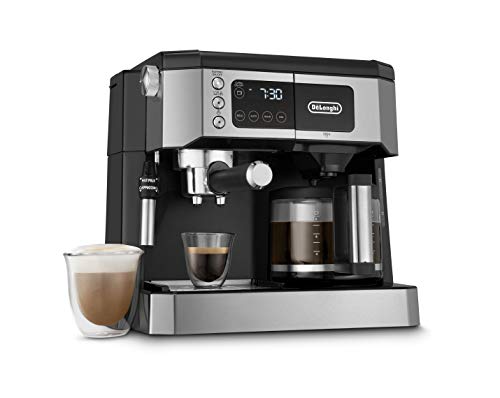
6. De’Longhi All-in-One Espresso & Coffee Maker (10-Cup) — Best for Simultaneous Brewing
This All-in-One variant leans into the combo’s defining scenario with its dual heating system and a full 10-cup pot: coffee brewing for the table while the espresso side pulls shots and froths milk for the cappuccino drinker, simultaneously rather than in sequence. For brunch households and entertainers, that simultaneity is the difference between a relaxed host and a short-order cook.
It suits households whose peak moment is social — weekend breakfasts, dinner parties ending with both coffee and espresso orders, and family mornings where the pot and the cappuccino are both non-negotiable. In stainless and compact for its class, it is designed to live visibly and work socially.
Strengths
- Dual heating system brews both sides at once
- Full 10-cup pot serves a table, not just a couple
- Milk frother completes the guest-drink repertoire
Trade-offs
- Overlaps the COM530M closely — compare current listings carefully
- Espresso side remains entry-class beneath the convenience
- Simultaneity is wasted on households that never peak
| Pot | 10-cup |
| Heating | Dual heating system |
| Milk | Frother |
Why does dual heating matter enough to anchor a pick? Single-heater combos make the second drink wait for the first’s temperature regime, which is how a brunch host ends up apologising to the table. Two heating systems erase the queue: the pot percolates along while shots pull at espresso temperature. It is an invisible feature until the first time six people want drinks at once, after which it is the only feature.
Between this and the COM530M, the choice is about your peak pattern and the current listings: both are De’Longhi dual-function machines from the same family tree. If simultaneous service is your life, weight this one; if your drinks rarely collide, the COM530M’s reference status wins ties.
Best for: brunch and entertaining households with simultaneous demand / Not suited for: staggered-morning households that never brew both at once
Check the current price on Amazon
Comparison Table
| Pick | Badge | Key spec | Best for |
|---|---|---|---|
| De’Longhi COM530M All-In-One Combination Coffee and Espresso Machine | Best Overall Combo | Drip + pump espresso, dual heating, 47 oz | The classic combo brief |
| De’Longhi COM630BK All-In-One Combination Coffee and Espresso Machine | Best Premium Combo | True combo with Advanced Cappuccino System | Milk drinks and guests |
| De’Longhi Combi BCO430 Coffee and Espresso Machine | Best Value True Combo | Value true combo, drip + espresso | Lowest-cost true combo |
| Ninja DualBrew Prestige Espresso & Coffee Maker (CFN801) | Best Pod-Based Combo | Nespresso-compatible espresso + grounds brewing | Convenience without compromise on the coffee side |
| Cuisinart Coffee Center Barista Bar 4-in-1 (SS-4N1NAS) | Best 4-in-1 Versatility | 4-in-1: carafe, single-serve, espresso functions | Maximum household coverage |
| De’Longhi All-in-One Espresso & Coffee Maker (10-Cup) | Best for Simultaneous Brewing | Dual heating, 10-cup pot, espresso + frother | Both drinks, same moment |
How to Choose a Coffee and Espresso Combo Machine
Choose your family first. True combos (the De’Longhi picks) brew drip coffee and pull real portafilter espresso with steam wands: they suit households that drink both drinks seriously and accept a manual espresso routine. Pod combos (Ninja, Cuisinart) trade the portafilter for capsules and single-serve convenience: they suit households that want the drinks without the ritual. Cross-family comparisons are meaningless until that decision is made, because the families optimise different lives.
Then audit your peak moment and your counter. How many drinks, of which kind, in your busiest fifteen minutes — and does the machine’s heating design serve them simultaneously or in sequence? Measure the footprint honestly, including the height under cabinets with the lid open for filling. Finally, price the consumables: capsules versus beans is a per-drink cost difference that compounds for years and matters more than small gaps in machine price.
- Decide true combo vs pod combo before comparing models
- Confirm the espresso side is real pump or capsule — know which you’re buying
- Check dual heating if both drinks happen at the same moment
- Measure counter depth and cabinet height, lid open
- Run the capsule-vs-beans cost for your household’s weekly count
True Combo vs Pod Combo: The Honest Trade-Offs
True combos make the better drinks. Fresh-ground pump espresso with steamed milk beats capsule espresso with frothed milk in any blind tasting, and drip from a dedicated brewer side is a known quantity. They also demand the most: grinding, tamping, wand cleaning, descaling two systems in one chassis. Pod combos make the faster, cleaner, more consistent drinks, at a per-cup cost and a quality ceiling, with waste that some households refuse on principle.
Neither family is the ‘serious’ choice in the abstract — seriousness is matching the machine to the household’s actual behaviour. A true combo whose espresso side is never used is a drip brewer with an expensive ornament; a pod combo in a craft household is a daily small disappointment. The happiest combo owners we see in this category are the ones who chose by behaviour, and this guide’s picks are organised to force exactly that honesty.
What a Combo Can’t Do: Setting Expectations
A combo’s espresso side is an entry-class manual machine: pressurised baskets, modest steam recovery, no path to the precision of a dedicated prosumer rig. Its drip side is a competent home brewer, not a specialty-certified showpiece. If your household contains a developing espresso hobbyist, the combo will be outgrown on that side first — plan for the combo to become the household machine and the hobbyist to graduate to a dedicated setup, a succession many families execute happily.
The shared-chassis risk deserves plain words: when a combo needs service, both drinks stop. Mitigations are mundane — descale on schedule, keep a kettle-and-pour-over or a stovetop pot as the household’s emergency plan, and buy from brands with real service networks, as every pick here is. Combos reward households that maintain them like the two-machines-in-one they are.
Counter Space, Plumbing and the Practicalities of One Big Box
A combo replaces two footprints with one larger one, and the saving is real but smaller than the brochure suggests: you still need working room for a carafe pull-out, a portafilter swing, and milk pitchers. Measure depth with the carafe removed forward, height with the reservoir lid open, and width with the portafilter handle’s swing. All six picks here are tank-fed, so no plumbing is needed — the combo category’s quiet advantage over plumbed espresso — but tanks need filling access, which is what the lid-open height check protects.
Weight matters for cleaning day: combos are moved to be descaled and wiped behind, so be sure the household’s cleaner can shift it safely. And place the machine where both its users naturally go — a combo exiled to a far counter because it ‘looked big’ serves neither drinker, which is the saddest and most common combo outcome of all.
The Economics: Combo vs Two Dedicated Machines
Run the comparison properly and the combo usually wins the first purchase: one chassis, one reservoir system, one warranty, and a price below the sum of a decent drip brewer plus a decent entry espresso machine. The dedicated pair wins the second decade: each machine can be repaired, replaced or upgraded independently, and neither drink’s quality is capped by the other’s budget. Households that replace appliances as units favour combos; households that curate favour pairs.
Consumables tilt the ledger by family. True-combo households buy beans and paper or metal filters — the cheapest per-drink profile in coffee. Pod-combo households pay capsule prices per espresso while often still buying grounds for the coffee side, a hybrid cost profile worth modelling with your real weekly counts before purchase. The machine price difference that dominates reviews is, over three years, usually the smallest number in the decision.
The History of the Combo Machine — and Why De’Longhi Owns It
Combination coffee-espresso machines are an old idea that most manufacturers abandoned: through the 1990s and 2000s, many brands sold a two-in-one, then quietly exited as households split into pod convenience on one side and espresso hobbyism on the other. De’Longhi stayed. The Italian company kept refining the format — the BCO line giving way to the COM designs with dual heating — because its home market never stopped drinking both drip-style and espresso coffee from the same kitchen. The result is the market shape you see in this guide: one committed maker defining the true-combo family, while Ninja and Cuisinart reinvent the idea around capsules and single-serve formats.
For buyers, the history carries a practical lesson: parts, filters and knowledge concentrate around the surviving lines. A BCO430 or COM530M bought today sits inside a decades-deep ecosystem of owner experience and service familiarity, while an orphaned combo from a departed brand becomes unserviceable the day an unusual part fails. In a category built on consolidation, buy the consolidation that the market itself consolidated around.
Programming, Timers and the Morning Features That Matter
Combo machines earn their keep at 7 a.m., so judge their convenience features by the morning they create. A programmable drip side that has the pot ready when the alarm ends is worth more than any espresso-side flourish, because it serves the household’s majority drink with zero labour. Delay-brew, auto-start and keep-warm behaviour on the coffee side, plus a reservoir that can be filled the night before, are the features combo owners actually praise after a year — not the launch-day novelties.
On the espresso side, the morning features are humbler: fast heat-up so a cappuccino doesn’t need planning, a frother that behaves predictably at half-attention, and controls that a second household member can operate without a tutorial. The pod combos win this section outright — a capsule and a button is the minimum viable morning — which is precisely their design intent. Read each pick’s review above with your own household’s 7 a.m. in mind; it is a more reliable test than any specification table, including ours.
Cleaning a Combo Machine: The Two-System Routine
Owners underestimate combo cleaning until the first descale warning, so here is the whole obligation in one place. Daily: empty and rinse the drip tray, knock out and rinse the portafilter, wipe the frother or wand, and empty the carafe rather than leaving coffee to bake on the warmer. Weekly: wash the carafe and brew basket properly, rinse the reservoir, and wipe the machine’s splash zones. On schedule: descale both water paths — they may share a reservoir but they scale as two systems — and replace the water filter if your model uses one.
Pod combos trade some of this for capsule-bin and drip-tray discipline plus the same descaling duty. The universal rule is that the espresso side’s hygiene is the non-negotiable part: milk residue and coffee oils turn in days, not weeks, and a combo whose espresso side has gone rancid gets used as a drip brewer while its owner resents the wasted half. Fifteen minutes a week, total, keeps a combo a pleasure. That is the real maintenance price of the two-in-one idea, and it is cheaper than maintaining two separate machines — one more entry in the combo’s honest ledger.
Combo Machines for Guests: Brunches, Holidays and the Coffee Crowd
The combo machine’s finest hour is a house full of guests dividing, as guests do, into coffee people and espresso people with a few cappuccino requests floating between. A dedicated espresso machine leaves the coffee crowd to a kettle; a drip brewer leaves the espresso crowd wistful. The combo serves the room from one station, and the dual-heating picks serve it without sequencing delays. If your household entertains monthly or more, weight this scenario heavily — it is where the category’s premium models repay their difference in a single holiday morning.
Set the station up for guests as caterers do: cups, spoons, sugar and milk staged beside the machine, the capsule bin or puck routine invisible, and one household member owning the espresso side while the drip side self-serves. Guests operate drip brewers instinctively and portafilters not at all, so the division of labour writes itself. Run that play and a combo machine stops being an appliance and becomes the household’s hospitality infrastructure — which, for a great many buyers, was the actual purchase all along.
When a Combo Is the Wrong Purchase
Honesty requires the negative case, and it has three clear forms. First, the single-drink household: if nobody has ordered a cappuccino in your home in a year, a combo’s espresso side is a costly ornament, and a better drip brewer plus the money saved serves you more. Second, the committed hobbyist: if espresso is becoming a craft pursuit, the combo’s entry-class side will chafe within months, and starting with a dedicated machine avoids buying twice. Third, the heavy dual-demand household: two drinks in constant parallel production all day will wear a shared chassis and queue at its single stations, and a dedicated pair is the grown-up answer.
Notice what these cases share: they are about behaviour and volume, not about quality snobbery. The combo category is neither a compromise to apologise for nor a universal solution to evangelise — it is the correct engineering answer to a specific household shape, the divided-but-moderate coffee home. If that is your shape, buy with confidence from the picks above. If it isn’t, our linked guides to dedicated espresso machines and coffee makers will serve you better, and this guide has still done its job.
Water, Filters and Taste: Getting the Best From Both Sides
Both sides of a combo drink the same water, so water quality is the cheapest taste upgrade available to the whole machine. Hard water scales both systems and dulls coffee; heavily chlorinated water flavours everything. A simple carbon filter — in the reservoir if the model supports it, or a filter jug for filling — improves both drinks at once, which makes it the highest-leverage accessory a combo owner can buy. Pair it with beans bought in quantities your household finishes within a few weeks, and the drip side in particular will taste like a different machine.
Temperature discipline helps the espresso side: warm the cup, run the group briefly before the first shot of the day, and don’t ask the frother for milk the second the machine wakes. On the drip side, grind size is the lever — too fine and the pot turns bitter and slow, too coarse and it washes out thin. None of this requires new equipment, just the understanding that a combo is two brewers sharing a counter, and each still obeys its own drink’s rules. Treat both sides properly and the ‘compromise’ machine produces drinks neither side of the household feels compromised by.
How to Run Both Sides of a Combo Machine on a Busy Morning
A combo machine’s busiest moment is a household morning where the pot and the cappuccino are wanted together. Run it like a system:
- Fill the reservoir and start the drip side first — the pot brews unattended while you work the espresso side
- While coffee brews, prep the espresso: dose and tamp, stage cold milk in the pitcher, and set out cups for both drinks
- Pull the espresso shots as the drip cycle finishes; on dual-heating models there is no temperature queue to manage
- Froth milk last and build the milk drinks immediately — textured milk waits for no one
- Serve the table, then do the sixty-second reset: knock out the puck, rinse the portafilter, wipe the wand or frother, and top up the reservoir for the next round
For pod combos the rhythm is simpler — start the carafe or the first single-serve, run capsules while it brews, and keep the capsule bin emptied before it becomes archaeology. In both families, the reset habit is what separates a combo that feels like a café station from one that feels like a chore with two spouts.
Evening-before preparation is the combo owner’s force multiplier: fill the reservoir, load and programme the drip side if your model supports timers, stage the espresso cups and the milk pitcher, and leave the portafilter clean and dry in its group. The morning then contains no setup at all — only brewing — which is the difference between a machine that gets used daily and one that gets used on weekends. Households that adopt the night-before ritual report the highest satisfaction in this entire category, on every model in this guide.
Common Buying Mistakes
Assuming ‘combo’ means café espresso. The espresso side of any combo is entry-class. Buy it for household drinks, and it delights; buy it for a hobby, and it frustrates.
Ignoring the capsule cost model. Pod combos are cheap to buy and dear to feed. Model your weekly capsule count before choosing the family.
Forgetting both sides need descaling. A combo is two water systems in one box. Descale both on schedule or the neglected side fails first — usually during guests.
Buying versatility nobody uses. A 4-in-1 serving one format is a big single-format machine. Audit the household’s real formats first.
Skipping the footprint check. Lid-open height and carafe pull-out depth kill more combo purchases than any spec. Measure the actual space, open.
Treating the two sides’ water as one system. Shared reservoir, separate scaling. A descale that only runs the drip path leaves the espresso boiler to fail on its own schedule — run the full procedure for both, every time.
Final Recommendation
For the classic brief — one machine, real drip coffee, real espresso — the De’Longhi COM530M is the combo to buy, with the COM630BK earning its premium when cappuccinos lead, the BCO430 serving strict budgets, and the dual-heating All-in-One answering simultaneous demand. For the convenience brief, the Ninja DualBrew Prestige is the pod combo done right, and the Cuisinart Barista Bar covers households whose formats multiply beyond two.
Check the current price on Amazon through the links above, then confirm the exact configuration on the listing, and measure your counter carefully before the box arrives. A combo machine is a household treaty between two different kinds of coffee drinker — choose the one both sides of your kitchen can happily sign.
And if your household is still negotiating, one practical tiebreaker: count last week’s drinks. Whichever side of the machine would have made more of them deserves the bigger say in the model choice — the espresso-led home leans De’Longhi and milk systems, the coffee-led home leans capacity and timers, and the truly split home, which is most of you, is exactly who the COM530M was built for.
Keep exploring: Best Coffee And Espresso Machines Best Cheaper Espresso Machines Best Calphalon Espresso Machines Best Catering Espresso Machines
Frequently Asked Questions
Do combo machines make good espresso?
Good household espresso, yes — the De’Longhi picks use real pump extraction through portafilters, with pressurised baskets that keep results forgiving. They do not match dedicated prosumer machines for consistency and control, and capsule combos sit a step below the pump models. Judge combos against the household’s actual standard, and they satisfy it.
Can a combo machine brew coffee and espresso at the same time?
Dual-heating models — the All-in-One pick and the COM family design — are built to run both sides in the same window rather than forcing a temperature queue. Pod combos similarly interleave single-serve and capsule drinks. On any combo, ‘at the same time’ means one operator working both sides in rhythm, which the how-to section above choreographs.
Are combo machines hard to maintain?
They carry two systems’ worth of maintenance in one chassis: descaling for both water paths, wand or frother hygiene, and drip-side cleaning. None of it is difficult, but skipping the espresso side’s care because ‘we mostly brew drip’ is how combos fail. Budget ten minutes a week and a descale per schedule, total, for both sides.
Combo machine or two separate machines?
Combo for the first purchase, shared households, and tight counters: cheaper, smaller, simpler. Two machines for hobbyists, heavy users of both drinks, and anyone who wants independent repair and upgrade paths. Many households start combo and split later when one drink’s volume or ambition outgrows the shared chassis — a normal, healthy progression.
Do pod combo machines waste more than true combos?
Capsule espresso generates per-drink packaging waste that bean-based brewing doesn’t, though capsule recycling programmes exist for major systems. True combos produce only grounds and the occasional filter. If waste is a deciding value in your household, it points firmly to the De’Longhi family — one of several honest reasons the families in this guide suit different homes.
What size household suits a combo machine?
Two to five coffee drinkers is the sweet spot: enough demand to justify both functions, not so much that either side’s pace becomes the bottleneck. Single drinkers usually do better with a dedicated machine for their one drink, and very large or entertaining-heavy households should consider the dual-heating pick or a dedicated pair.
Can I use my own ground coffee in a pod combo machine?
On the coffee side of the Ninja DualBrew Prestige, yes — brewing from grounds is one of its defining features. The espresso side of pod combos runs on capsules by design; refillable capsule accessories exist but sit outside the manufacturers’ intended use and this guide’s recommendations. If using your own beans for espresso matters, choose a true combo from the De’Longhi family.
How long do combo machines last?
With both systems descaled on schedule and milk parts kept clean, a combo from a major maker should serve a household for years of daily use. The failure pattern to avoid is asymmetric neglect — the less-used side quietly scaling or souring until it fails and takes the machine’s reputation with it. Run both sides at least weekly, even if only to flush them, and the shared chassis ages as one healthy appliance.
Which combo is best for a small kitchen?
Measure first: the pod combos, particularly the Ninja DualBrew Prestige, generally present the slimmest profile, while the true De’Longhi combos are compact for two machines but substantial as one. In a genuinely small kitchen, the honest contenders are the Prestige for capsule households and the COM530M for true-combo households — both chosen by families after footprint, not before it.


