Disclosure: airfryerkitchensupply.com is reader-supported. When you buy through links on our site, we may earn an affiliate commission at no extra cost to you.
Where to buy
The fastest way to buy any faucet in this guide is through Amazon, where finish, hole configuration and included accessories are listed on each product page and stock changes daily. Start with our top pick for best chrome kitchen faucets: Check on Amazon
- Moen Adler Pull-Down Kitchen Faucet 87233 (Chrome) — Check on Amazon
- Moen Essie Pull-Down Kitchen Faucet 87014 (Chrome) — Check on Amazon
- Delta Nicoli Pull-Down Kitchen Faucet 19867LF (Chrome) — Check on Amazon
- Delta Finnridge Pull-Down Kitchen Faucet 19730LF (Chrome) — Check on Amazon
- Delta Windemere Two-Handle Kitchen Faucet 21996LF (Chrome) — Check on Amazon
- American Standard Southport Pull-Down Kitchen Faucet 7441300.002 (Chrome) — Check on Amazon
The best chrome kitchen faucets start from the oldest finish in the modern kitchen: chrome has been the default since indoor plumbing grew up, because it is bright, hard, inexpensive to apply well, and reflective enough to make any sink area look cleaner than it is. Chrome’s reputation problem is the opposite of obscurity — it is so familiar that buyers assume all chrome faucets are alike, when the spread between a well-made chrome Moen or Delta and a thin-plated budget casting is the difference between a twenty-year fixture and a two-year disappointment with shiny beginnings.
This guide ranks chrome by the faucet underneath the finish. The picks are Moen’s Adler and Essie, Delta’s Nicoli, Finnridge and two-handle Windemere, and American Standard’s Southport — six faucets whose valves, docking systems and parts support justify their shine. Chrome itself needs no sales pitch, but it does need honest handling: it shows water spots and fingerprints more readily than brushed finishes, it rewards a wipe habit, and in return it is the easiest finish in the world to match, because chrome is chrome in every catalogue and every decade.
One more chrome virtue deserves naming before the picks, because it decides real purchases: chrome is the finish of rental standards, resale staging and builder packages precisely because it offends nobody and coordinates with everything — stainless appliances, white sinks, any hardware already in the room. Buyers furnishing for longevity of taste rather than longevity of trend will find chrome’s neutrality is not blandness; it is the finish that lets a kitchen change around it for decades without ever looking wrong.
In this guide
Quick Picks
Six chrome faucets with real engineering underneath: Moen’s Adler as the all-round pull-down, the Essie for a lower profile, Delta’s Nicoli for modern lines, the Finnridge for spray power, the two-handle Windemere for traditional decks, and American Standard’s Southport as the alternative-brand pick.
- Best Overall: Moen Adler Pull-Down Kitchen Faucet 87233 (Chrome) — Moen’s high-arc Adler pull-down in chrome with Power Clean spray — the mainstream chrome benchmark. Check on Amazon
- Best Compact Chrome: Moen Essie Pull-Down Kitchen Faucet 87014 (Chrome) — the Essie’s friendlier, slightly lower profile in chrome — for sinks where the Adler’s arc is more faucet than the space wants. Check on Amazon
- Best Modern Chrome: Delta Nicoli Pull-Down Kitchen Faucet 19867LF (Chrome) — Delta’s Nicoli in chrome — modern single-hole lines with Delta’s valve and docking engineering underneath. Check on Amazon
- Best Spray Power in Chrome: Delta Finnridge Pull-Down Kitchen Faucet 19730LF (Chrome) — the Finnridge’s high-pressure ProClean spray in chrome — for kitchens whose rinsing is heavy work. Check on Amazon
- Best Traditional Chrome: Delta Windemere Two-Handle Kitchen Faucet 21996LF (Chrome) — a two-handle chrome faucet with side sprayer for 4-hole decks — deliberate control, classic looks, verified dimensions. Check on Amazon
- Best Alternative Brand: American Standard Southport Pull-Down Kitchen Faucet 7441300.002 (Chrome) — American Standard’s Southport in chrome — 1.8 GPM, memory position valving and a metal body, for buyers beyond the big two. Check on Amazon
How These Picks Were Chosen
Chrome picks were verified by brand-and-model search, with the returned title matched to the exact model and finish — chrome model families sit adjacent to stainless and black siblings under near-identical listings, so the finish in the Amazon title was checked for every ASIN before a link was attached. One search result set in this batch even returned replacement spray heads among the faucets; those were excluded, because a guide to faucets links faucets.
Judging concentrated on what separates chrome faucets once the finish is equal: valve and cartridge quality, docking systems, spray performance, installation flexibility and parts depth. Moen and Delta dominate the list because their chrome lines carry the same engineering as their premium finishes — the chrome versions are not de-contented — and American Standard’s Southport earns the sixth slot as the credible alternative with a verified 1.8 GPM specification.
The Windemere’s inclusion is deliberate: chrome demand includes a large traditional segment with multi-hole decks and two-handle preferences, and a guide that only listed single-hole pull-downs would fail them. Its verified specifications — dimensions, hole pattern, a cartridge tested to half a million uses per the listing features — made it the strongest traditional chrome candidate in the research.
Chrome research returned the widest field in this batch, including — in one search — replacement spray heads and nozzles listed among complete faucets, a reminder that chrome’s enormous catalogue rewards verification discipline. Every pick below is a complete faucet whose model and finish were matched in its listing record. Equally, several budget chrome faucets with unnamed bodies and valves were passed over despite attractive listings: in chrome, where the finish itself is nearly free, the entire price difference between tiers is the faucet underneath, and an unnamed underneath is the one thing a chrome buyer cannot afford.
The 6 Best Chrome Kitchen Faucets

Moen Adler Pull-Down Kitchen Faucet 87233 (Chrome) — Best Overall
The Adler in chrome is the faucet equivalent of a default setting done right: Moen’s high-arc pull-down with Power Clean spray, a single handle, and the company’s mature docking and cartridge ecosystem, wearing the finish that matches everything and costs nothing extra to coordinate. For the majority of kitchens — especially those being refreshed rather than reimagined — this is the chrome faucet against which the others justify themselves.
Strengths
- Power Clean spray rinses above its flow class
- Moen’s mature platform and universal parts availability
- Chrome matches every appliance and hardware finish in the room
Trade-offs
- Chrome shows water spots and fingerprints — a wipe habit applies
- Styling is safe rather than distinctive
- No included soap dispenser in this configuration
| Finish | Chrome |
| Configuration | One-handle high arc pull-down (Amazon title) |
| Spray | Power Clean (Amazon title) |
Power Clean is the working detail: Moen’s spray concentrates the available pressure into a stream that rinses stuck-on food with noticeably more authority than the flow rate alone suggests, which matters in chrome’s heartland of family kitchens and rental upgrades alike. The Adler’s styling is friendly contemporary — curved enough for transitional cabinets, clean enough for modern ones. Moen’s parts depth completes the ownership story: cartridges and wands for a faucet this widely installed are stocked everywhere, which is a build-quality fact disguised as a logistics one.
Best for: most kitchens wanting a proven chrome pull-down / Not suited for: buyers who want a statement finish or included accessories Check on Amazon

Moen Essie Pull-Down Kitchen Faucet 87014 (Chrome) — Best Compact Chrome
The Essie is the Adler’s gentler sibling: a pull-down in chrome with a slightly softer, lower presence that suits smaller sinks, galley kitchens and spaces where a tall high-arc faucet would crowd the cabinets or the cook. It carries the same Moen platform virtues — docking, cartridge, parts — in a body that knows when to be quiet.
Strengths
- Lower, friendlier profile suits compact kitchens
- Full pull-down function without the tall-arc crowding
- Same Moen platform and parts depth as the Adler
Trade-offs
- Less clearance for the tallest stockpots
- Chrome’s spot-showing nature applies in full
- Fewer headline features than the flagship models
| Finish | Chrome |
| Configuration | Pull-down (Amazon title) |
Compact pull-downs solve a real geometry problem: above many sinks there is a cabinet, a shelf or a window frame at a height that makes full-size faucets feel imposed, and in a shallow basin a tall arc is a splash generator. The Essie’s scale answers both while keeping the pull-down function that makes a modern sink work. Chrome on this friendlier silhouette reads bright and clean — the classic small-kitchen combination. Buyers with deep farmhouse basins should take the Adler’s arc instead; buyers measuring in centimetres of clearance will understand exactly why this pick exists.
Best for: smaller sinks and lower-clearance kitchens / Not suited for: deep farmhouse basins needing maximum arc height Check on Amazon

Delta Nicoli Pull-Down Kitchen Faucet 19867LF (Chrome) — Best Modern Chrome
The Nicoli is Delta’s modern answer in chrome: clean single-hole lines, a single handle, and the company’s valve and docking engineering carried into a contemporary silhouette. Where the Moens in this guide are friendly, the Nicoli is crisp — the chrome pick for flat-panel cabinets, quartz counters and kitchens whose other lines are equally straight.
Strengths
- Crisp modern styling that chrome flatters
- Delta valve, docking and parts ecosystem
- Single-hole cleanliness for contemporary decks
Trade-offs
- Multi-hole decks need a plate or a different pick
- Modern lines fight traditional cabinetry
- Chrome upkeep: spots show, wiping applies
| Finish | Chrome |
| Configuration | Single hole, single handle (Amazon title) |
Delta’s ownership virtues travel with the model: a valve platform designed for long drip-free service, magnetic docking discipline in the line’s pull-down design, and the deepest spare-parts ecosystem in the industry standing behind both. Chrome suits the Nicoli’s modernism particularly well — the bright finish emphasises the clean geometry in a way brushed finishes soften — and it coordinates with the stainless appliances modern kitchens already run. As with any single-hole modern faucet, multi-hole decks will need the deck-plate conversation; within its intended setting, the Nicoli is the complete modern chrome buy.
Best for: modern kitchens wanting Delta engineering in bright chrome / Not suited for: traditional multi-hole installations Check on Amazon

Delta Finnridge Pull-Down Kitchen Faucet 19730LF (Chrome) — Best Spray Power in Chrome
The Finnridge’s headline, straight from its Amazon title, is its High Pressure ProClean spray — a sprayhead tuned for the kitchens where rinsing is not a gentle rinse but a daily campaign against roasting pans, sheet trays and blender jars. In chrome, on a modern single-hole body, it is the working cook’s pick in this guide.
Strengths
- ProClean high-pressure spray for serious rinsing work
- Delta platform, docking and parts support
- Modern chrome body suits contemporary working kitchens
Trade-offs
- High-pressure spray can splash in shallow basins
- Chrome shows the evidence of hard work until wiped
- Single-hole format for modern decks
| Finish | Chrome |
| Spray | High Pressure ProClean (Amazon title) |
| Configuration | Single hole, single handle (Amazon title) |
High-pressure spray modes earn their place by trading the wand’s gentleness for directed force, and the cooks who need them know who they are: if your sink regularly hosts the aftermath of a roast, a stockpot or a baking day, the Finnridge’s spray shortens the worst chore in the kitchen. The rest of the faucet is Delta-standard — valve platform, docking discipline, parts depth — which matters because a hard-worked faucet is precisely the one whose cartridge and wand must be replaceable in year eight. Chrome’s brightness over a hard-working sink means the wipe habit applies double; the Finnridge’s owners tend to be the type who wipe as they go anyway.
Best for: serious cooks who rinse hard and often / Not suited for: shallow sinks or gentle-use kitchens Check on Amazon

Delta Windemere Two-Handle Kitchen Faucet 21996LF (Chrome) — Best Traditional Chrome
Chrome’s traditional heartland gets its pick: the Windemere, a two-handle faucet with a side sprayer built for the 4-hole, 8-inch-center decks that fill older and traditionally styled kitchens. Its verified specifications are reassuringly complete — full dimensions, the hole pattern stated, and an API feature note that its cartridge was tested to 500,000 uses, the kind of number that separates a fixture from a fitting.
Strengths
- Built for real 4-hole traditional decks, sprayer included
- Cartridge endurance stated in the verified features
- Individually serviceable, classic architecture
Trade-offs
- No pull-down modes or modern features
- Lower arc limits the tallest pots
- Chrome on a traditional faucet asks for regular wiping to stay bright
| Finish | Chrome |
| Configuration | Two-handle, 4-hole, 8 in centers |
| Height | 11.63 in |
| Dimensions | 8 x 10.25 x 11.63 in |
| Cartridge | Tested to 500,000 uses (API features) |
Two-handle control in a working kitchen is a considered preference, not a compromise: each valve’s position becomes a remembered setting, the side sprayer delivers a strong simple jet exactly where a hand expects it, and every component is individually serviceable. The Windemere’s modest 11.63-inch height suits the shallower sinks and lower clearances of the kitchens it was designed for, where a tall pull-down would splash and crowd. For a traditional deck being refreshed in chrome — the finish those decks were born with — this is the correct, complete answer.
Best for: traditional multi-hole decks preferring two-handle control / Not suited for: single-hole modern sinks Check on Amazon
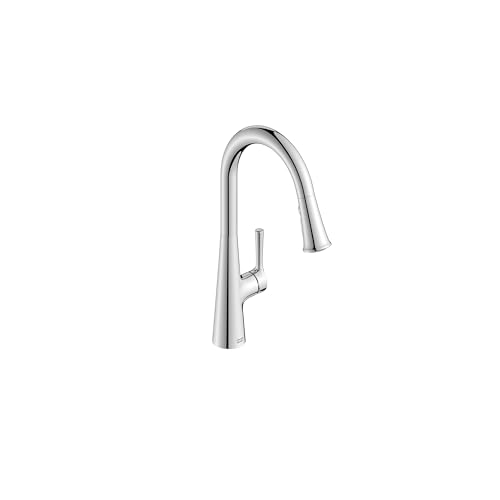
American Standard Southport Pull-Down Kitchen Faucet 7441300.002 (Chrome) — Best Alternative Brand
A chrome guide with only Moen and Delta would be a duopoly report, so the Southport earns the final slot on verified merit: American Standard’s pull-down in chrome with a stated 1.8 GPM flow, a metal body, memory position valving — the handle returns to your habitual temperature position — and a deckplate in the box for flexible fitting. It is the credible third brand’s complete chrome offer.
Strengths
- Memory position valving — a daily convenience owners keep noticing
- Metal body and full 1.8 GPM flow, both stated in the listing
- Deckplate included for flexible installation
Trade-offs
- Brand ecosystem smaller than Moen’s or Delta’s in faucets
- Contemporary-neutral styling breaks no new ground
- Chrome care rules apply as ever
| Finish | Chrome |
| Flow | 1.8 GPM (Amazon title) |
| Body | Metal body (Amazon title) |
| Valve | Memory position valving (Amazon title) |
| Included | Deckplate (Amazon title) |
Memory position valving is the detail owners end up valuing: in households where the faucet is set to roughly the same washing-up temperature every day, a valve that remembers removes a small daily hunt, multiplied by years. American Standard’s plumbing heritage is the support story — a maker whose parts culture comes from the trade side of the industry. The Southport’s styling is contemporary-neutral, sitting comfortably beside the Moens and Deltas here, and its full-flow specification suits buyers who find water-saving faucets slow. In chrome, it completes the guide’s promise: every tier and taste, with the engineering verified.
Best for: buyers wanting a credible third brand in chrome / Not suited for: buyers who want the deepest consumer parts network Check on Amazon
Comparison Table
| Pick | Badge | Key spec | Best for |
|---|---|---|---|
| Moen Adler Pull-Down Kitchen Faucet 87233 (Chrome) | Best Overall | Chrome, high arc, Power Clean spray, single handle | most kitchens wanting a proven chrome pull-down |
| Moen Essie Pull-Down Kitchen Faucet 87014 (Chrome) | Best Compact Chrome | Chrome, pull-down, single handle | smaller sinks and lower-clearance kitchens |
| Delta Nicoli Pull-Down Kitchen Faucet 19867LF (Chrome) | Best Modern Chrome | Chrome, single hole, single handle (Amazon title) | modern kitchens wanting Delta engineering in bright chrome |
| Delta Finnridge Pull-Down Kitchen Faucet 19730LF (Chrome) | Best Spray Power in Chrome | Chrome, ProClean high-pressure spray (Amazon title) | serious cooks who rinse hard and often |
| Delta Windemere Two-Handle Kitchen Faucet 21996LF (Chrome) | Best Traditional Chrome | Chrome, two-handle, side sprayer, 4-hole 8 in centers, 11.63 in tall | traditional multi-hole decks preferring two-handle control |
| American Standard Southport Pull-Down Kitchen Faucet 7441300.002 (Chrome) | Best Alternative Brand | Chrome, 1.8 GPM, metal body, deckplate included (Amazon title) | buyers wanting a credible third brand in chrome |
Five pull-downs and one traditional two-handle: the chrome table splits by deck and by temperament rather than by finish, because the finish is the constant. Moen brings spray concentration and platform maturity, Delta brings valve and docking engineering in two flavours of modern, American Standard brings memory valving — and the Windemere reminds everyone that chrome’s oldest customers still run two-handle decks and deserve a verified pick.
How to Choose Chrome Kitchen Faucets
With chrome, the finish decision is the easy part — it matches everything and always has. The real choosing is the same engineering-and-geometry discipline as any faucet: deck pattern, height, spray behaviour, and the tier honesty that separates a fixture from a fitting in a finish too cheap to hide behind.
Chrome quality is plating quality
Chrome is a plating, and platings have grades: a properly applied chrome layer over a sound body is hard, corrosion-proof and decades-durable, while thin plating over a cheap casting pits, flakes and shows its base metal at the edges within a few years. You cannot measure plating thickness from a listing, so buy it by proxy — the maker’s name, the body’s named material, and a parts ecosystem that implies the maker expects the faucet to survive. This is the entire reason this guide’s chrome list is brand-led.
Living with chrome’s honesty about water
Chrome shows every water spot and fingerprint at full contrast; that is the finish’s one true cost, and it is paid in wipes. A soft cloth by the sink and a ten-second habit keep chrome at its mirror best, and no abrasive or acidic cleaner should ever touch it — chrome is hard but thin, and scouring goes through it. Households that know they will not wipe should choose brushed nickel with a clear conscience; households that wipe as they cook will find chrome the most rewarding finish per minute of care in the kitchen.
Deck patterns and the traditional segment
Chrome spans every deck: single-hole pull-downs for modern sinks, deck-plated retrofits for three-hole patterns, and genuine two-handle faucets with side sprayers for the four-hole traditional decks that still fill a large share of homes. Count the holes and measure the centers before choosing the silhouette, and remember that the spare hole is an asset — it takes a soap dispenser or an air gap — not a problem to be plated over by default.
Spray systems in chrome’s heartland
Chrome’s heartland is the working family kitchen and the rental, and its spray needs are practical: a concentrated rinse (Moen’s Power Clean), a high-pressure mode for roasting-day aftermath (Delta’s ProClean), or a simple side sprayer that never docks wrong because it never docks at all. Match the system to the mess your cooking actually makes; chrome buyers, sensibly, tend to under-buy features and over-buy platform, and the picks here reward that instinct.
Chrome for rentals, resale and the long neutral
No finish stages a kitchen like chrome: it reads clean, new and neutral to every eye, coordinates with whatever appliances a tenant or buyer brings, and costs the least to replace like-for-like in ten years because chrome is always in every catalogue. For investment properties and resale preparation it is close to a default answer — provided, always, that the faucet underneath is a real one, because a flaking budget chrome faucet stages a kitchen as a warning instead.
Chrome and coloured sinks: composite, black and copper pairings
Chrome’s neutrality is tested most by statement sinks. Against black composite it is the classic bright accent and the pairing reads deliberate. Against a copper sink, chrome is the cool counterpoint — handsome if the room has other cool notes, jarring if copper was meant to own the palette. Against coloured ceramic, chrome steps back and lets the sink be the colour, which is usually the correct hierarchy. The rule is that chrome never competes; it either accents or recedes, and choosing which role it plays in your sink wall is the whole decision.
Two-handle chrome and accessibility
The traditional two-handle pattern in this guide deserves an accessibility note: lever-style two-handle faucets are among the easiest controls for arthritic or limited-grip hands, because each valve turns with a light, separate motion and the temperature can be preset by position. Cross handles are the harder option despite their period charm. Households planning to age in place should weigh the Windemere pattern’s ergonomics alongside its looks — chrome’s traditional segment is, quietly, its most accessible one.
Chrome in hard-water postcodes: the pragmatic protocol
Hard water is chrome’s hardest environment, and the protocol that makes it work is specific: wipe the faucet when the counters are wiped, descale the aerator monthly by soaking it off the faucet, and consider a point-of-use softener for the kitchen line if the whole house will not get one. Households that run this protocol keep chrome mirror-bright indefinitely; households that will not should take this guide’s repeated advice and choose brushed nickel instead, without any sense of defeat — matching finish to water is engineering, not taste.
Chrome Versus Brushed Nickel: The Two Defaults Compared
Most kitchen faucet purchases end at one of these two finishes, so the comparison deserves precision. Chrome is brighter, cooler and harder; brushed nickel is warmer, softer and more forgiving. Chrome shows water spots and fingerprints at full contrast and wipes clean in seconds; brushed nickel hides them between weekly wipes and never quite reaches chrome’s mirror. Chrome is cheaper to produce well, so at equal money a chrome faucet often carries the better internals; brushed nickel’s treatments and tones add cost that buys appearance management rather than mechanics.
Coordination runs opposite to intuition: chrome is the more exact colour — it is the same in every catalogue — but its coolness can clash with warm metals elsewhere in the room, while brushed nickel’s small variations across brands are forgiven by its neutrality toward both stainless appliances and warm hardware. Kitchens evolve piece by piece in real life, and brushed nickel tolerates that evolution slightly better; kitchens designed in one stroke can exploit chrome’s exactness.
The deciding temperament is maintenance honesty. Chrome rewards the wipe-as-you-go household with the brightest, cleanest-looking sink in the neighbourhood and quietly punishes the other kind. Brushed nickel asks almost nothing and gives back a permanently decent appearance. Neither answer is wrong; the wrong answer is buying chrome for a household that will resent it, or brushed nickel for one that would have loved the shine.
Chrome’s economics explain its eternal default status. The plating process is mature, the finish material inexpensive, and the result — over a proper body — is the hardest surface in the residential aisle. That means a chrome faucet from a major maker concentrates its price in the valve, the body and the parts programme rather than in the finish, which is why the chrome versions of the Adler, Nicoli and their peers are often the value sweet spot of their own lines: identical engineering, the finish that costs least, in the colour that matches everything. Buyers who do not need a warmer tone are, in effect, paid to choose chrome.
The staging and resale industries understand this instinctively, and their logic transfers to ordinary owners: a bright chrome faucet photographs as ‘new kitchen’ more reliably than any other finish, because the eye reads its reflections as cleanliness. In a home being prepared for market, a quality chrome faucet on a real platform is among the cheapest credible refreshes in the room. In a home being kept, the same quality reads as permanence. Either way the requirement is identical — the shine must be the surface of a genuine faucet, because buyers and tenants alike have learned to spot the flaking impostor at a glance.
Chrome’s brightness does quiet work in a kitchen’s lighting design that is rarely credited: a chrome faucet is a small reflector at the room’s working centre, bouncing task light into the sink basin and lifting the whole area’s perceived brightness. In kitchens with a single window or north light, that contribution is noticeable; in under-cabinet-lit modern kitchens, chrome’s sparkle is part of why the sink area reads as the cleanest zone in the room. Brushed finishes absorb where chrome reflects, and designers who light kitchens professionally treat the faucet’s finish as a minor luminaire whether the client knows it or not.
There is also a hygiene perception — and partly a hygiene reality — to chrome’s shine. A surface that shows everything is a surface whose cleanliness can be verified at a glance, which is why commercial and medical-adjacent settings standardised on it. In a home kitchen the same property cuts both ways: chrome displays the splash from rinsing greens, and it also displays, reassuringly, that the sink area was just cleaned. Households that entertain in the kitchen often value exactly this legibility; the faucet becomes evidence of the standard the cook keeps.
And chrome remains the finish of the future tense: it is the easiest surface to return to. A kitchen that tires of a coloured or themed faucet scheme can come back to chrome in an afternoon, with any platform, at any tier, and the room resets to neutral. No other finish offers that exit. For owners who renovate experimentally, chrome is not the absence of a decision — it is the decision that keeps every later decision available.
Chrome’s last underappreciated virtue is repair invisibility: because chrome is chrome in every decade, a replacement wand, handle or escutcheon fitted in year twelve matches the surviving parts in a way that batch-sensitive finishes cannot promise. Warm metals drift between production runs; a bronze or brass part bought years later can arrive a half-tone from its siblings. Chrome’s industrial consistency makes the long service life of a good platform cosmetically seamless as well as mechanically sound — the faucet that was repaired looks exactly like the faucet that never needed it.
Finally, a word for the buyer choosing chrome in a design-led kitchen who has been warned it is the unimaginative option. Chrome’s century at the top of the category is not an accident of habit; it is the accumulated result of the finish being bright, hard, cheap to do well and impossible to mismatch — a combination no challenger has beaten on all four axes at once. The kitchens in design magazines that look effortlessly right very often have a chrome faucet doing invisible work at the sink while the drama happens elsewhere, in stone, timber and light. Choosing chrome is not declining to make a statement. It is deciding, correctly, that the faucet does not have to be the statement — and buying the best-engineered version of that decision, which is what the six platforms in this guide are for.
One practical chrome note completes the picture: because chrome is the standard finish, it is also the easiest faucet to insure, appraise and replace like-for-like after damage — a burst hose in year nine is answered by the identical model, still catalogued, still stocked, in the identical finish. Owners of discontinued colours and limited finishes learn this the hard way; chrome owners never learn it at all. Permanence of availability is an unglamorous virtue, and over a fitting’s life it may be the one that matters most.
How to Install a Chrome Kitchen Faucet and Keep It Mirror-Bright
Chrome installation is the standard faucet sequence with one finish-specific discipline: chrome is hard but thin, and a wrench slip or an abrasive pad leaves a permanent record. The steps below include the protections, plus the flushing routine every new cartridge deserves.
- Shut off both supplies, drain and remove the old faucet, photograph connections, and clean the deck to a flat, bare surface.
- Identify every chrome surface a tool might touch and wrap it in a soft cloth before the first wrench appears.
- Mount the faucet for your deck pattern — single-hole, deck plate, or multi-hole with sprayer/dispenser — hand-starting every threaded connection.
- Route the pull-down hose in a clean loop with its weight placed as marked, clear of pipes and stored items.
- Connect supplies, open the valves slowly with the aerator removed, and flush until the water runs perfectly clear; refit the aerator.
- Test stream and spray modes, exercise the dock, and check every joint with dry paper.
- Wipe the entire faucet dry with a soft microfibre cloth as the final step — a chrome faucet should begin its life spotless, and microfibre, never an abrasive pad, is its lifelong cleaning tool.
Set the chrome habit on day one: the microfibre cloth lives at the sink, spots get wiped when the counters do, and limescale at the aerator is handled by removing and soaking the aerator alone — never by applying descaler or scouring to the finish. Chrome cared for this way stays mirror-bright for decades; chrome scoured once can be marked forever.
Chrome-specific caution for the mounting step: never let a bare wrench jaw rest against a chrome escutcheon ‘just for a second’ while you reach for something. Chrome records that second permanently. The cloth wrap in the steps above is not ceremony — it is the difference between a faucet that looks installed-by-a-professional and one that tells on its installer at every glance.
Common Buying Mistakes
Assuming all chrome faucets are the same faucet. Chrome is a finish, not a specification. The spread between a plated brand platform with stocked parts and a thin-plated casting is measured in decades. Buy the maker and the mechanics; let the shine be the bonus it is.
Cleaning chrome with abrasives or acids. Scouring pads cut through plating; acidic descalers dull it. Microfibre, mild soap and water handle everything a kitchen deposits, and the aerator — removed — is the only part that ever meets a descaler.
Buying chrome for a household that will not wipe. Spots on chrome are not a defect; they are water drying in public. If nobody in the house will ever wipe a faucet, brushed nickel is the honest finish and will look better every single day.
Letting a tall chrome faucet splash a shallow sink. Height plus shallow basin equals a permanently wet counter, in the finish that shows water best. Match the arc to the basin’s depth with actual measurements.
Forgetting the traditional deck in a pull-down world. Four-hole, two-handle kitchens are a huge share of chrome’s real market. Forcing a plated-over pull-down onto a deck that wants a Windemere-style faucet serves neither the sink nor the owner.
Pairing a chrome faucet with warm metals at random. Chrome’s neutrality has limits: dropped into a scheme of brass hardware and bronze lighting with no other cool note, it reads as the piece that was on sale. Give chrome one ally in the room — stainless appliances are usually enough — or commit the sink wall to the warm scheme and choose its finish instead.
Final Recommendation
The one-answer pick is the Moen Adler in chrome: proven platform, concentrated spray, universal parts, a finish that matches the world. Compact kitchens take the Essie; modern ones take the Nicoli; hard-rinsing cooks take the Finnridge; traditional decks take the Windemere; and buyers who like a third brand’s thinking take the Southport and its memory valve.
Chrome’s promise is simple and it keeps it: brightness, hardness, neutrality and a century of coordination with everything. Buy it on a real platform, wipe it like you mean it, and it will look — as it has in kitchens for a hundred years — like the faucet that was always supposed to be there.
Chrome asks the least imagination of any finish and repays the most care. Choose it on a platform with a real valve and a real parts programme, give it the microfibre it asks for, and it will do what it has done in kitchens for a century: make the sink look like the cleanest, brightest, most deliberate corner of the room.
- Best Overall — Moen Adler Pull-Down Kitchen Faucet 87233 (Chrome): Check on Amazon
- Best Compact Chrome — Moen Essie Pull-Down Kitchen Faucet 87014 (Chrome): Check on Amazon
- Best Modern Chrome — Delta Nicoli Pull-Down Kitchen Faucet 19867LF (Chrome): Check on Amazon
- Best Spray Power in Chrome — Delta Finnridge Pull-Down Kitchen Faucet 19730LF (Chrome): Check on Amazon
- Best Traditional Chrome — Delta Windemere Two-Handle Kitchen Faucet 21996LF (Chrome): Check on Amazon
- Best Alternative Brand — American Standard Southport Pull-Down Kitchen Faucet 7441300.002 (Chrome): Check on Amazon
Related guides in this series: Best Brushed Nickel Kitchen Faucets; Best Brass Kitchen Faucets; Best Bronze Kitchen Faucets; Best Ceramic Disk Kitchen Faucets; Best Built Kitchen Faucets.
Frequently Asked Questions
Does chrome show water spots more than other finishes?
Yes — chrome’s mirror surface shows water spots and fingerprints at full contrast, more than any brushed finish. The countermeasure is a simple habit: a soft microfibre cloth at the sink and a quick wipe when counters are done. Never use abrasive pads or acidic cleaners, which damage the plating itself.
Is chrome a durable finish?
Properly applied chrome over a sound body is one of the hardest, most corrosion-resistant finishes in plumbing and lasts for decades. The failures people associate with chrome — pitting and flaking — are thin plating over cheap castings. Buying a reputable maker’s chrome faucet, as every pick in this guide is, avoids that failure mode.
Does chrome match stainless steel appliances?
Very well in practice. Chrome is brighter and cooler than brushed stainless, so the two read as a deliberate bright accent against a softer field rather than an exact match — an effect kitchens have used successfully for decades. Brushed nickel is the closer tone match; chrome is the brighter contrast.
What is the best chrome faucet for a traditional kitchen?
A two-handle model built for the deck: the Delta Windemere in this guide fits 4-hole, 8-inch-center patterns with a side sprayer and a cartridge tested to half a million uses per its verified features. Traditional decks should not be forced into plated-over pull-downs when a proper pattern exists.
Can chrome faucets be repaired like other finishes?
Yes — the finish does not change the mechanics. Cartridges, wands, hoses and aerators on the major brands here are stocked spare parts. Keep the model number recorded and a chrome faucet’s wear items stay replaceable for many years.
Is chrome a good choice for a rental or resale property?
It is close to the default answer: chrome reads clean and neutral to every viewer, coordinates with any appliances, and is inexpensive to replace like-for-like later because it is always catalogued. Choose a genuine brand platform underneath, since a flaking budget faucet undermines the entire staging effect.
Why are chrome faucets often cheaper than other finishes of the same model?
Because chrome plating is the least expensive quality finish to apply — the process is mature and the material cheap — while warmer and treated finishes add cost. The saving is real and buys identical internals: on the major platforms in this guide, the chrome version carries the same valve and parts as its pricier finished siblings.
Can I stop chrome from spotting without wiping constantly?
Partly. A water softener removes the minerals that make spots; keeping the aerator clean reduces the splash patterns that dry into them; and a quick squeegee of the sink area after washing up catches most of the rest. But chrome’s bargain is brightness for a wipe habit — if zero wiping is the requirement, brushed nickel is the honest alternative.
Will chrome peel or flake over time?
On a quality faucet from a major maker, properly applied chrome over a sound body does not peel in normal service — the pitting and flaking people associate with chrome belong to thin plating over cheap castings. This is the core reason the guide’s chrome list is brand-led: in the finish where plating quality is the whole game, the maker’s process is the specification that matters.
Is chrome safe and lead-free in modern faucets?
Modern chrome faucets from major makers are built to the same lead-free standards as every other finish — the chrome is a surface plating, and the wetted pathway is governed by the same NSF/ANSI 372 requirements across the catalogue. The certifications named in a listing, not the finish, are the evidence to check, and the brand-led picks in this guide carry them as standard.


