Disclosure: airfryerkitchensupply.com is reader-supported. When you buy through links on our site, we may earn an affiliate commission at no extra cost to you.
Where to buy
The fastest way to buy any faucet in this guide is through Amazon, where finish, hole configuration and included accessories are listed on each product page and stock changes daily. Start with our top pick for best built kitchen faucets: Check on Amazon
- Kraus Oletto Pull-Down Kitchen Faucet KPF-2820SFS — Check on Amazon
- Moen Arbor Pulldown Kitchen Faucet 7594SRS — Check on Amazon
- Delta Essa Pull-Down Kitchen Faucet 9113-AR-DST — Check on Amazon
- Kohler Simplice Pull-Down Kitchen Faucet K-596-BL — Check on Amazon
- Kingston Brass Heritage Bridge Kitchen Faucet KS1278ALBS — Check on Amazon
- Moen M-Dura Commercial Kitchen Faucet 8287 — Check on Amazon
Read plainly, the best built kitchen faucets are the best-built kitchen faucets: the ones whose construction — body material, valve, hose, docking hardware — is engineered to keep working when lesser faucets start to drip, sag and shed their finish. This guide takes the keyword at exactly that meaning and ranks six faucets by build quality alone: what the body is cast from, what the valve is made of, how the moving parts are put together, and how repairable the whole assembly is when a wear part eventually needs replacing.
Build quality in a faucet is mostly invisible in a product photo, which is why this category collects disappointed buyers. A heavy faucet can be heavy because of a thick brass body or because of a weighted plastic shell; a smooth handle can mean a ceramic valve or a well-greased cheap cartridge. The evidence that separates them is in verified specifications — body material named by the maker, valve type, commercial certifications, serviceable architecture — and every pick below was chosen on that evidence, gathered verification, rather than on heft or shine.
The six span the ways a faucet can be well built: Kraus’s brass body and ceramic cartridge, Moen’s mature Arbor platform, Delta’s diamond-valve Essa, Kohler’s ceramic-disc Simplice, Kingston’s fully serviceable solid-brass bridge, and Moen’s commercial M-Dura — a faucet line built for institutional abuse, included because nothing answers ‘best built’ quite like the model specified where faucets are used hundreds of times a day.
In this guide
Quick Picks
Six construction-first picks: Kraus’s brass-bodied Oletto, Moen’s proven Arbor, Delta’s DIAMOND Seal Essa, Kohler’s ceramic-disc Simplice, Kingston’s serviceable solid-brass bridge, and Moen’s commercial-grade M-Dura for the hardest use of all.
- Best Built Overall: Kraus Oletto Pull-Down Kitchen Faucet KPF-2820SFS — brass body, ceramic cartridge, spot-free finish and full flow — the most completely specified build in the residential class. Check on Amazon
- Best Proven Platform: Moen Arbor Pulldown Kitchen Faucet 7594SRS — the Arbor platform — years of refinement, Power Boost, Reflex docking — in Spot Resist Stainless. Check on Amazon
- Best Valve Engineering: Delta Essa Pull-Down Kitchen Faucet 9113-AR-DST — Delta’s DIAMOND Seal valve technology and MagnaTite docking in the refined Essa — build quality expressed as valve science. Check on Amazon
- Best Ceramic Disc Build: Kohler Simplice Pull-Down Kitchen Faucet K-596-BL — Kohler’s ceramic disc valves, DockNetik magnetic docking and a three-function sprayhead in matte black. Check on Amazon
- Most Serviceable Build: Kingston Brass Heritage Bridge Kitchen Faucet KS1278ALBS — solid traditional bridge architecture: every wear part separate, standard and replaceable from above the deck. Check on Amazon
- Best Commercial Build: Moen M-Dura Commercial Kitchen Faucet 8287 — Moen’s M-Dura commercial line: 2.2 GPM, vandal-resistant hardware, certified commercial construction — built for institutional abuse. Check on Amazon
How These Picks Were Chosen
Verification followed the programme standard — brand-and-model search, title matched, link attached only to a confirmed ASIN — but the judging criteria here were purely structural. Body material had to be named and credible: brass or stainless, not ‘premium material’. The valve had to be a named technology: ceramic cartridge, ceramic disc, or Delta’s diamond-embedded seal. Commercial or certification evidence counted heavily, because a faucet specified for institutional use has survived a harder design review than any residential model.
Repairability was scored as a build virtue in its own right. A faucet whose cartridge, wand, hose and aerator are stocked, standard parts is better built for a thirty-year life than a marginally fancier sealed unit, because the best-built faucet is the one still in service — repaired, not replaced — in year twenty. That is why a traditional bridge earns a place beside the pull-downs: its architecture is the most serviceable in the industry.
Finish and styling were deliberately demoted: they appear in the reviews for completeness, but no pick earned its slot on looks. Where a pick’s build story has a genuine weakness — a plastic component in a high-wear place, a thinner parts network — the review says so.
Two categories of product were researched and deliberately excluded. The first is the heavy-but-hollow segment: faucets whose weight comes from ballast in a shell body, which heft convincingly in a showroom and reveal themselves at the first cartridge change. Without a named body material in the verified record, weight was treated as no evidence at all. The second is the feature-stacked flagship segment — excellent faucets whose price buys electronics, lighting and voice control rather than construction. Those features have their own guides; a build-quality ranking that rewards them would be measuring the wrong thing, and every pick here earned its place on structure alone.
The 6 Best Built Kitchen Faucets

Kraus Oletto Pull-Down Kitchen Faucet KPF-2820SFS — Best Built Overall
The Oletto wins this category the straightforward way: it is the residential pull-down whose verified specification names the right answer at every structural question. Brass body — not a shell. Ceramic cartridge — the valve technology that shrugs off grit and hard water. A spot-free finish over the top, full 1.8 GPM flow, and Kraus’s hose geometry keeping the wand working across the sink. Build quality is a checklist, and this is the faucet that ticks every box on it.
Strengths
- Brass body and ceramic cartridge — the core durability pairing
- Full-size, full-flow specification with no quiet downgrades
- Spot-free finish protects the investment cosmetically
Trade-offs
- Parts network thinner than Delta or Moen’s
- Tall profile needs overhead clearance checks
- Contemporary styling only — no traditional variant in this build
| Body | Brass body (API features) |
| Valve | Ceramic cartridge (API features) |
| Flow | 1.8 GPM |
| Height | 16.625 in |
| Spout | 8.75 in height, 8.875 in reach |
| Hose | Reach Technology (API features) |
The brass body deserves emphasis because it is the component everything else hangs from: threads that do not strip at installation, a casting that absorbs the knocks of sink life, and corrosion resistance measured in decades. Kraus built its reputation supplying exactly this formula — commercial materials discipline in residential dress — and the Oletto’s height and reach numbers confirm it is a full-size instrument, not a scaled-down imitation. The honest caveat is ecosystem: Kraus’s parts network, while real, is not Delta’s or Moen’s continent-wide depth, so record the model and keep the documentation.
Best for: buyers who want the strongest mainstream build / Not suited for: traditional kitchens or owners who prize the deepest parts network Check on Amazon

Moen Arbor Pulldown Kitchen Faucet 7594SRS — Best Proven Platform
There is a kind of build quality that only time can certify: a platform that has been installed in enormous numbers, whose weak points have been found and engineered out across production years. The Arbor is that faucet in Moen’s catalogue — a transitional pull-down with Power Boost spray and the Reflex docking system, finished in Spot Resist Stainless. Buying the Arbor is buying the absence of surprises.
Strengths
- Mature platform with years of production refinement
- Reflex docking has no clips or magnets to wear out
- Wear parts stocked virtually everywhere
Trade-offs
- Design is evolutionary, not cutting-edge
- Power Boost adds complexity some minimalists avoid
- Spot Resist finish is stainless-toned only in this model
| Finish | Spot Resist Stainless |
| Height | 15.5 in |
| Dimensions | 7.88 x 10.25 x 15.5 in |
| Spray | Power Boost |
| Docking | Reflex system |
Reflex docking illustrates the maturity argument: Moen’s system uses the hose’s natural geometry and a weighted return so the wand seats smoothly without magnets to demagnetise or clips to fatigue, and it has been refined across the line for years. The same applies to the cartridge ecosystem — Moen’s widespread installed base means the Arbor’s wear parts are stocked everywhere plumbing parts are sold. In a category judged on construction, a proven platform with universal parts availability is a legitimate form of ‘best built’: the faucet most likely to be repaired in an afternoon, anywhere, in year fifteen.
Best for: buyers who value a mature, debugged design / Not suited for: buyers chasing the newest features Check on Amazon

Delta Essa Pull-Down Kitchen Faucet 9113-AR-DST — Best Valve Engineering
Delta’s build argument is concentrated in the valve: the DIAMOND Seal platform embeds diamond in the valve’s contact surface, so the moving parts polish rather than wear as they cycle — a direct engineering answer to the drip that ends most faucets’ lives. In the Essa’s clean single-hole silhouette with magnetic MagnaTite docking, that valve science comes in the most refined package in this guide.
Strengths
- Diamond-embedded valve surface designed to polish, not wear
- Magnetic docking resists the sag of ageing hoses
- Deepest manufacturer support ecosystem in the category
Trade-offs
- Feature set is deliberately restrained at this configuration
- Premium pricing follows the engineering
- Single-hole format needs a plate for multi-hole decks
| Finish | Arctic Stainless |
| Height | 15.25 in |
| Dimensions | 1.25 x 11 x 15.25 in |
| Docking | MagnaTite magnetic |
| Installation | Single hole (Amazon title) |
The supporting cast matches the headline: InnoFlex supply lines are integrated rather than added, the magnetic dock keeps the wand seated against hose ageing, and Delta’s support infrastructure is the deepest in the industry — a build-quality fact in itself, since a faucet’s service life is partly a property of the company behind it. The Essa’s restraint is its only real limitation: it offers no powered spray modes or touch features in this configuration, because its budget was spent on the valve and the dock. For construction-first buyers, that is the correct allocation.
Best for: buyers who want the valve engineered hardest / Not suited for: feature hunters or strict budgets Check on Amazon

Kohler Simplice Pull-Down Kitchen Faucet K-596-BL — Best Ceramic Disc Build
Kohler’s Simplice brings the other great valve tradition to this guide: ceramic disc valves, the technology Kohler has refined for decades, paired with DockNetik magnetic docking and a three-function sprayhead whose Boost mode raises flow for filling and blasting. In matte black it is also the design-forward pick — but it is here because of the discs, not the colour.
Strengths
- Ceramic disc valves — the hardest-wearing seal technology
- Three-function sprayhead with a genuine Boost mode
- Magnetic DockNetik docking
Trade-offs
- Verify dimensions on the listing — published figures vary
- Matte black shows water spots and suits modern schemes only
- Premium tier pricing
| Valve | Ceramic disc valves (API features) |
| Spray | 3-function: stream, Sweep, Boost (+30% flow on Boost) |
| Docking | DockNetik magnetic (API features) |
| Finish | Matte black |
Ceramic discs earn their reputation through hardness: the ground ceramic surfaces that seal a disc valve are harder than the grit in any water supply, so the seal does not score the way rubber and plastic internals do. Kohler’s implementation adds temperature memory and a well-sorted sprayhead — Sweep’s blade of water genuinely moves debris across a sink better than a conventional spray. One data honesty note: the listed unreliable dimensions for this model, so this guide prints no size box figures for it — check the listing’s measurements against your sink before ordering, as with any tall faucet.
Best for: buyers who want Kohler’s valve craft and spray versatility / Not suited for: traditional kitchens or buyers who dislike matte black Check on Amazon
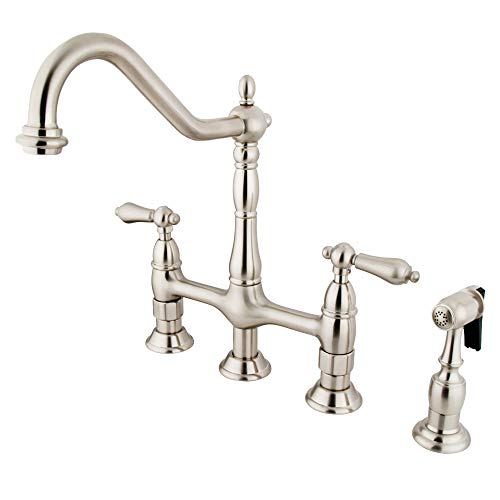
Kingston Brass Heritage Bridge Kitchen Faucet KS1278ALBS — Most Serviceable Build
The bridge earns its place in a build-quality guide on architecture: two separate valve bodies, an exposed bridge waterway, a spout, and a brass side sprayer — every one of them a standard component that can be serviced or replaced individually, from above the deck, with ordinary tools. Against sealed modern units, this is the difference between a faucet that is repaired and a faucet that is landfilled.
Strengths
- Every wear part is separate, standard and replaceable
- Brass sprayer and traditional materials throughout
- Failures are repairs, not replacements — for decades
Trade-offs
- No pull-down spray modes or modern features
- Demands the 8-inch spread plus sprayer hole
- Two-handle operation is a deliberate, slower habit
| Configuration | 8-inch bridge, two-handle |
| Sprayer | Brass side sprayer |
| Spout reach | 8-3/4 in |
Kingston’s Heritage execution supports the architecture with traditional materials discipline: the sprayer is brass, the pattern’s connections are standard, and the whole assembly assumes a thirty-year conversation between owner and plumber. The build trade-offs are the pattern’s own — no pull-down convenience, a deck that must provide the 8-inch spread and sprayer hole, and two-handle mixing. Judged purely as construction for the long term, though, the bridge is the strongest argument in this guide: the best-built faucet is the one whose every failure mode is a fifteen-minute repair.
Best for: decades-long owners who maintain rather than replace / Not suited for: modern kitchens or pull-down devotees Check on Amazon

Moen M-Dura Commercial Kitchen Faucet 8287 — Best Commercial Build
If ‘best built’ is the question, the commercial catalogue is the honest place to look, and Moen’s M-Dura line is its residential-accessible face: a chrome two-handle faucet engineered for institutional duty, with a 2.2 GPM flow, vandal-resistant fasteners, certified commercial construction and the heft — just under six pounds — of a tool rather than an ornament. It is included for buyers whose kitchens genuinely punish faucets.
Strengths
- Commercial certification and institutional cycle design
- Vandal-resistant, facilities-serviceable hardware
- High 2.2 GPM flow for volume work
Trade-offs
- Utilitarian chrome appearance — no design ambitions
- Flow exceeds residential water-saving standards
- Two-handle commercial format suits utility, not fine kitchens
| Flow | 2.2 GPM |
| Weight | 5.95 lb |
| Connections | 1/2 in IPS (API features) |
| Certification | CSA B-125 / ASME A112.18.1M (API features) |
| Hardware | Vandal-resistant torx screws (API features) |
Commercial build means different priorities: cycle counts in the hundreds of thousands, parts that a facilities plumber can swap in minutes, finishes chosen for chemical resistance rather than fashion, and no delicate features to break. The M-Dura gives up everything decorative to get those things — it looks like what it is, a working faucet — and its 2.2 GPM flow exceeds residential water-saving norms, which suits utility and high-volume use but not every household’s conservation goals. For a rental portfolio, a community kitchen, a workshop sink or a home that hosts constant volume cooking, this is the build that ends the replacement cycle.
Best for: the hardest-use kitchens: rentals, institutions, serious volume cooking / Not suited for: design-led residential remodels Check on Amazon
Comparison Table
| Pick | Badge | Key spec | Best for |
|---|---|---|---|
| Kraus Oletto Pull-Down Kitchen Faucet KPF-2820SFS | Best Built Overall | Brass body, ceramic cartridge, 1.8 GPM, 16.625 in tall | buyers who want the strongest mainstream build |
| Moen Arbor Pulldown Kitchen Faucet 7594SRS | Best Proven Platform | Spot Resist Stainless, Power Boost, Reflex docking, 15.5 in tall | buyers who value a mature, debugged design |
| Delta Essa Pull-Down Kitchen Faucet 9113-AR-DST | Best Valve Engineering | Arctic Stainless, DIAMOND Seal platform, MagnaTite docking, 15.25 in | buyers who want the valve engineered hardest |
| Kohler Simplice Pull-Down Kitchen Faucet K-596-BL | Best Ceramic Disc Build | Ceramic disc valves, DockNetik docking, 3-function spray | buyers who want Kohler’s valve craft and spray versatility |
| Kingston Brass Heritage Bridge Kitchen Faucet KS1278ALBS | Most Serviceable Build | Bridge pattern, brass sprayer, 8-3/4 in reach | decades-long owners who maintain rather than replace |
| Moen M-Dura Commercial Kitchen Faucet 8287 | Best Commercial Build | Commercial grade, 2.2 GPM, 5.95 lb, CSA/ASME certified (API features) | the hardest-use kitchens: rentals, institutions, serious volume cooking |
Three philosophies of build share this table: materials-first (Kraus), platform maturity (Moen Arbor, Delta Essa), and serviceability (Kingston bridge, Moen M-Dura). They converge on one point — named valve technology and a body you can identify — and diverge on features, which is exactly the right shape for a build-quality decision: choose the philosophy that matches how long you keep things and who maintains them.
How to Choose Built Kitchen Faucets
Judging build quality without a showroom full of faucets to heft is a learnable skill: it is the discipline of reading specifications for the five things that decide service life. The sections below are that discipline, in order.
Body material: the first and loudest signal
A faucet’s body takes the installation torque, the knocks, the thermal cycles and the water itself. Brass and stainless steel are the credible materials; the giveaway of a lesser build is a listing that will not name one — ‘premium construction’ and ‘high-quality material’ are the phrases used when the answer is zinc alloy or plastic. Weight corroborates but does not prove: heft from a thick brass casting is build quality, while heft can also be added to a shell. Named material first, weight second, shine last.
The valve is the faucet’s lifespan
Nearly every faucet death is a valve death — a drip that becomes a stream. The technologies that resist it are ceramic discs and cartridges, whose ground ceramic surfaces are harder than waterborne grit, and engineered variants like Delta’s diamond-embedded seal, which polishes in use. Rubber-washer and basic compression valves belong to another era and another price tier. When a listing names its valve technology proudly, that is build evidence; when it hides the valve entirely, draw the conclusion.
Hoses, wands and docks: the moving parts
On a pull-down, the hose flexes thousands of times and the dock holds the wand against gravity forever. Braided, kink-resistant hoses with smooth travel, wands with metal where hands grip, and docks that locate positively — magnetic or well-engineered geometric systems — are the visible signs of a build that considered year five. A wand that docks loosely in the showroom is telling you its future; believe it.
Serviceability: the best-built faucet can be fixed
Ask of any faucet: when the cartridge wears in year twelve, is the part stocked, standard and reachable? Major makers publish parts diagrams and sell cartridges, wands and hoses for decades; traditional patterns like bridges use standard components by design; sealed or obscure models can turn a small wear item into a full replacement. Build quality includes the manufacturer’s commitment to the faucet’s future, and it is checkable before purchase.
Certifications and commercial siblings
Listings that name their certifications — cUPC, NSF/ANSI standards for lead and materials, ASME performance standards — are offering verifiable build evidence, and commercial lines from residential brands are a shortcut to proven construction: a model specified for institutions has passed a harder review than any showroom test. Neither guarantees a perfect faucet, but both beat adjectives, and in a category this full of adjectives, evidence is the whole game.
Reading a faucet listing like an engineer
Five lines of any listing carry the build evidence: the body material sentence, the valve sentence, the certification line, the parts or warranty language, and the weight. Read those five and skip the adjectives between them. A listing that names brass, a ceramic cartridge, cUPC or NSF certification and a parts programme has told you a complete build story; a listing of equal length that names none of them has told you a complete one too, in the other direction. This five-line discipline, applied ruthlessly, is the entire skill this guide exists to teach.
Installation quality is half the build
The best-cast faucet installed with cross-threaded lines, a kinked hose and an unflushed cartridge will fail like a cheap one, while a mid-tier faucet installed cleanly will outlive its reputation. Budget the installation as part of the build: an unhurried hour, flushed lines, even torque, and a paper-towel test at every joint. Owners who cannot give a faucet that hour should hire it — the labour is small, and it protects the entire premium paid for construction.
Warranty language, decoded
Faucet warranties are build evidence written by lawyers, so read them for structure rather than length. A lifetime finish-and-function warranty from a major maker signals a platform the company expects to support forever; a short warranty on a no-name faucet signals the opposite expectation. More telling than either is the parts programme behind the words: a warranty that sends a cartridge in the post is worth more than one that offers a discount on a replacement faucet, because the first describes a serviceable product and the second describes a disposable one.
How Long Should a Kitchen Faucet Last? Setting Honest Expectations
A well-built residential kitchen faucet should serve fifteen to twenty years, with one cartridge or wand service along the way; a commercial unit in a home can exceed that comfortably; a budget faucet should be expected to serve five to eight years before its wear parts and finish part company. These are not guarantees — water chemistry, usage volume and installation quality all vote — but they are the ranges the construction in this guide is priced and built around, and they expose the real arithmetic of the category: cost per year, not cost per box.
Water is the variable buyers underestimate. Hard water attacks every faucet through mineral scale on aerators, spray faces and valve seats; ceramic and diamond valve surfaces resist the valve damage, but no faucet is immune to a clogged aerator, and the two-minute habit of cleaning it is the cheapest longevity measure in plumbing. Aggressive water — very soft, acidic supplies — argues for stainless and brass wetted parts over plated internals, another point in favour of named body materials.
Installation quality is the other hidden variable: a superb faucet cross-threaded, over-torqued or installed with kinked lines will fail like a cheap one, while a mid-tier faucet installed cleanly will outlive its reputation. Best-built, in practice, is a partnership between what the maker cast and what the installer did — which is why the installation section below is part of a build-quality guide and not an afterthought.
A useful field test separates construction claims from construction facts, and it can be applied to any faucet not in this guide: find its parts diagram. A maker who publishes an exploded diagram with numbered, orderable components — cartridge, wand, hose, aerator, mounting kit — is telling you the faucet was designed to be serviced, which is the operational definition of well built. A maker who offers only a warranty phone number is telling you the opposite. The diagram test takes two minutes per candidate and predicts the ownership experience better than any review, including this one, because it reveals the manufacturer’s own expectation of the faucet’s future.
The second field test is the cartridge’s identity. Well-built faucets use a named, standard cartridge shared across a line — Moen’s, Delta’s and Kohler’s platforms, Kraus’s ceramic units — so the part is stocked by every plumbing counter in the country. Proprietary, unnamed or model-unique cartridges are the quiet mechanism by which an otherwise solid faucet becomes disposable. When you compare two faucets of similar price, the one whose cartridge you can buy today, off a shelf, in your town, is the better-built purchase in the only sense that will matter in year twelve.
Finally, build quality has a water-quality dimension that spec sheets rarely state: in aggressive water — very hard, very soft-acidic, or grit-laden well supplies — the ranking of constructions shifts. Ceramic and diamond valves gain further advantage, stainless and brass wetted parts outlast plated internals by wider margins, and commercial builds like the M-Dura justify themselves fastest. Tell your supplier your water honestly; the best-built faucet for city water in a new suburb and the best-built faucet for a rural well are cousins, not twins.
Build quality also has a sound and a feel, and experienced buyers shop by them instinctively. A well-built faucet’s handle moves with even, damped resistance and stops without play; its spout swivels on a bearing’s smoothness rather than a washer’s drag; its wand seats with a sound that suggests a latch, not a hope. None of these sensations appear in a specification, which is why the picks in this guide lean on makers whose platforms are known quantities — but when you handle any faucet in a showroom, your hands are running a legitimate test. Trust the wobble. A faucet that feels approximate on day one is telling you exactly how it was built.
Weight distribution tells a subtler story than weight alone. A brass-bodied faucet carries its mass in the body and spout, where structure lives; a ballasted imitation carries it low and dead, in the base. Lift a faucet by its mid-body and the difference is palpable — one feels like a tool, the other like a container. Combined with the parts-diagram test and the named-material rule, this gives a buyer three independent checks that no amount of listing photography can fake, and they are the checks this guide’s selections were built to pass.
It is worth closing the build argument with the environmental one, because it is the same argument: the greenest faucet is the one that is not replaced. Every faucet in a landfill represents a casting, a cartridge, a hose set and a finish that served a fraction of their design life. A best-built faucet repaired twice across twenty-five years displaces three lesser faucets entirely. Durability is rarely marketed as sustainability, but in plumbing — heavy, material, shipped in boxes across oceans — it is the only sustainability claim that survives arithmetic.
One more build habitat deserves recognition: the outdoor and utility kitchen, where faucets face freeze-thaw cycles, dust, and hoses dragged across concrete. The constructions that survive there are the same ones this guide ranks — brass and stainless bodies, ceramic valves, commercial siblings — and the M-Dura’s presence in this list is partly for those sinks. If a second sink in a workshop, garden or rental outbuilding is part of the project, specifying it from the commercial end of this guide costs little more than a domestic fitting and removes an entire category of seasonal failure.
It is worth stating plainly what this guide did not rank: the most expensive faucets in the category. Several flagship models cost multiples of every pick here, and their construction, while fine, is not multiples better — their price buys design authorship, exotic finishes and electronics. A buyer whose goal is literally the best-built faucet, measured in decades of service per purchase, will find that goal reached inside this list, most completely in the Kraus and the commercial Moen. Spending beyond them is legitimate — for beauty, for features, for the pleasure of an object — but it should be spent knowing it is no longer buying build. The summit of construction is lower and more affordable than the summit of price, and knowing where it sits is the whole value of a guide like this one.
How to Install a Kitchen Faucet So Its Build Quality Survives Installation
More good faucets are damaged by installation than by use: cross-threaded connections, over-torqued mounting nuts that distort valve seats, kinked hoses and grit flushed straight into a new cartridge. The steps below are the standard sequence performed with the care a well-built faucet deserves — they take an unhurried hour and protect a twenty-year purchase.
- Shut off both supplies, drain the old faucet, photograph the connections, and remove the old unit; clean the deck completely flat.
- Inspect the new faucet before installing: run a finger over threads, confirm every seal and washer is present, and identify the cartridge access for future reference.
- Feed hoses through the deck first, seat the faucet, and tighten mounting hardware evenly — firm hand-tight plus a modest tool turn; distorted seats start drips that get blamed on the valve.
- Route the pull-down hose in a clean, generous loop with the weight at the marked position and nothing under the sink pressing on it.
- Connect supplies without cross-threading — every connection should start by hand for several turns before a wrench is invited.
- Open the valves slowly, remove the aerator, and flush until the water runs perfectly clear before refitting; this keeps line debris out of the new cartridge.
- Test all functions and joints with dry paper, exercise the wand dock twenty times, and re-check the under-sink joints that evening.
Record the model number, valve type and purchase date in the house file before the box is recycled. The best-built faucet in the world is only repairable in year twelve if someone can identify its cartridge — and that someone, holding this note, will be grateful you wrote it down.
Keep the packaging’s parts diagram — or photograph it — with the house file at installation. It names every component by number, and in year twelve that page is the difference between ordering the right cartridge in one attempt and playing guess-and-return with a dripping sink. Well-built faucets reward owners who keep their paperwork; be that owner from day one.
Common Buying Mistakes
Judging build by weight alone. Heft can be cast brass or added ballast in a shell. Named body material is evidence; weight is a hint. Buy the faucet whose listing commits to brass or stainless in writing.
Ignoring the valve because it is invisible. The valve decides when the faucet starts dripping, which decides when it gets replaced. Ceramic discs, ceramic cartridges and diamond-embedded seals are the technologies with a lifespan argument; an unnamed valve is a decision to find out later.
Over-torquing at installation. Mounting nuts and connections have a correct tightness, and past it lie distorted seats, cracked nuts and leaks that masquerade as product defects. Firm, even, and finished by hand-feel is the standard.
Skipping the pre-cartridge flush. Installation stirs debris into supply lines. Running a new faucet without flushing first feeds that grit directly into the valve you paid a premium for. Remove the aerator, flush clear, then enjoy.
Buying sealed when you keep things for decades. A faucet whose wear parts are unlisted and unstocked is a disposable with a long fuse. Long-term owners should weight parts diagrams and serviceable architecture as heavily as any specification.
Judging build by the showroom handle test alone. A smooth handle can hide a mediocre cartridge behind fresh grease, and a stiff one can be a superb cartridge running dry on a display with no water. Handle feel is one signal among several — use it alongside named materials, valve type and the parts diagram, never instead of them.
Final Recommendation
For most buyers the answer is the Kraus Oletto: the most completely specified residential build — brass body, ceramic cartridge, honest dimensions. Risk-averse buyers take the Arbor’s proven platform or the Essa’s valve science; Kohler loyalists take the Simplice’s discs; keepers and maintainers take the bridge; and the hardest-use kitchens take the commercial M-Dura and end the conversation.
Whichever you choose, judge like an engineer and install like a craftsman: named materials, named valve, stocked parts, clean connections. A kitchen faucet is used more than almost any object in the house — building it properly, and installing it properly, is the least glamorous and most rewarding money in the kitchen.
Buy the faucet whose maker expects to meet it again in twenty years — in a parts catalogue, not a landfill. That expectation, visible in diagrams, cartridges and commercial siblings, is the whole content of the phrase ‘best built’, and every pick in this guide was chosen because its maker demonstrably holds it.
- Best Built Overall — Kraus Oletto Pull-Down Kitchen Faucet KPF-2820SFS: Check on Amazon
- Best Proven Platform — Moen Arbor Pulldown Kitchen Faucet 7594SRS: Check on Amazon
- Best Valve Engineering — Delta Essa Pull-Down Kitchen Faucet 9113-AR-DST: Check on Amazon
- Best Ceramic Disc Build — Kohler Simplice Pull-Down Kitchen Faucet K-596-BL: Check on Amazon
- Most Serviceable Build — Kingston Brass Heritage Bridge Kitchen Faucet KS1278ALBS: Check on Amazon
- Best Commercial Build — Moen M-Dura Commercial Kitchen Faucet 8287: Check on Amazon
Related guides in this series: Best Brushed Nickel Kitchen Faucets; Best Ceramic Disk Kitchen Faucets; Best Ceramic Kitchen Faucets; Best Bridge Kitchen Faucets; Best Chrome Kitchen Faucets.
Frequently Asked Questions
What makes a kitchen faucet ‘well built’?
Four things: a body cast from a named, durable material (brass or stainless), a valve built on ceramic disc, ceramic cartridge or diamond-embedded technology, moving parts — hose, wand, dock — engineered for thousands of cycles, and wear parts that are stocked and replaceable. A listing that names all four is offering evidence; one that offers only adjectives is not.
Is a heavier faucet always better built?
No. Weight from a thick brass casting is a good sign, but weight can also be added to a lightweight shell. Treat heft as a hint and named body material as the evidence — and check the valve technology, which matters more to lifespan than any amount of mass.
How long should a well-built kitchen faucet last?
Fifteen to twenty years is a fair expectation for a quality residential faucet, usually with one cartridge or wand service in that span. Commercial-grade models used in homes can exceed it. Budget faucets should be expected to serve five to eight years. Water quality and installation care move every one of those numbers.
Are commercial faucets a good idea in a home?
For genuinely hard use — volume cooking, rentals, utility sinks — yes: commercial lines like Moen’s M-Dura are built for institutional cycle counts and facilities-style servicing. The trades are utilitarian looks, two-handle formats and higher flow rates that exceed residential water-saving norms, so they suit working kitchens better than design-led ones.
Which valve type lasts longest?
Ceramic disc and ceramic cartridge valves are the longevity standard because their sealing surfaces are harder than the grit that wears lesser valves. Delta’s diamond-embedded seal pursues the same goal by polishing in use. All of them outlast rubber-washer designs by years, especially on hard or gritty water.
Can a well-built faucet be repaired instead of replaced?
That is rather the point of buying one. On the major brands and traditional patterns in this guide, cartridges, wands, hoses and aerators are stocked, standard parts. Keep the model number recorded and a well-built faucet’s failures stay fifteen-minute repairs for decades.
Is a commercial faucet overkill for a home?
For most homes, yes — and for the right home, no. If your kitchen runs like a small institution — constant volume cooking, many users, a rental’s turnover — commercial construction pays for itself by ending the replacement cycle. If your kitchen is ordinary, a well-built residential platform gives the same decades with better looks and water manners. Match the build to the duty, not to the anxiety.
What is the single best sign of a well-built faucet?
A published parts diagram with orderable components. It proves the maker designed the faucet to be serviced and expects it to be worth servicing. Named body material runs a close second; between the two of them, they predict ownership better than any other evidence available before purchase.
Does a well-built faucet need a plumber to install it?
Not necessarily — the picks here are designed for competent DIY installation, and their build quality actually makes installation easier: true threads, honest tolerances and complete hardware. What a well-built faucet does need is an unhurried installer, professional or not, who flushes the lines and resists over-torquing. The faucet cannot tell who tightened it; it can only tell how.
Are expensive faucets always better built?
No — price buys features and finishes as readily as construction, and some expensive faucets are mid-built platforms in costly dress. The reverse also holds: some moderately priced faucets, the Kraus pattern in this guide among them, concentrate their cost in the body and valve. Price is a hint; named materials, named valves and published parts are the evidence. Judge the five lines of the listing, not the size of the number beside it.

