Disclosure: airfryerkitchensupply.com is reader-supported. When you buy through links on our site, we may earn an affiliate commission at no extra cost to you.
Where to buy
Shopping for the best chopsticks ceramic or stainless? Three ceramic and three stainless sets, every one verified against Amazon’s catalogue data before linking — materials, lengths and pair counts below come from those verified listings. If a set’s material matters to you, the listing titles here state it outright, which is more than can be said for much of this category.
- Porcelain Ceramic Chopsticks, Blue Peony, 5 Pairs (Best Ceramic Overall) — Check the current price on Amazon
- MUYOS Stainless Steel Chopsticks, Silver, 5 Pairs (Best Stainless Overall) — Check the current price on Amazon
- LEETOYI Ceramic Chopsticks, White Porcelain, Set of 5 (Best Ceramic Value) — Check the current price on Amazon
- 316 Stainless Steel Chopsticks, Square, 5 Pairs (Best Grip in Steel) — Check the current price on Amazon
- Bone China Chopsticks, 5 Pairs, 9.5 Inches (Best Ceramic for Delicate Dining) — Check the current price on Amazon
- BALWOO Korean Stainless Steel Chopsticks, 5 Sets (Best Korean-Style Steel) — Check the current price on Amazon
The best chopsticks ceramic or stainless debate is really two different philosophies of the same tool. Ceramic — porcelain and bone china — is the traditionalist’s upgrade: smooth, cool in the hand, beautiful on the table, completely non-reactive, and honest about its one weakness, which is that it can chip or break if dropped on a hard floor. Stainless steel is the pragmatist’s answer: effectively unbreakable, dishwasher-proof forever, modern in look and feel, and honest about its weaknesses too — it conducts heat, it can feel slippery with oily food, and it sings against ceramic bowls in a way some diners love and others cannot forgive.
This guide refuses to declare a fake winner. Instead it reviews the three strongest verified sets on each side — porcelain and bone-china ceramics against hollow-core, 316-grade and Korean stainless — and scores them on the criteria that actually separate chopsticks in daily use: grip on slippery food, weight and balance, length for eating versus cooking, heat behaviour, care, and how the set will look after a year of dishwashers. The buying guide then settles the material question by diner, dish and household, which is the only honest way it can be settled.
One category warning before the picks: this corner of Amazon is full of fiberglass sets wearing ceramic-adjacent descriptions and ‘steel’ sets of unstated grade. Every set below was verified through the catalogue data with its material stated in its own listing title — porcelain, bone china, or a named stainless grade — so the comparison you are reading is between the materials on the label, not materials as imagined.
A note on who this comparison is for: the diner leaving disposable and wooden chopsticks behind. Wood and bamboo have their own virtues and their own guide elsewhere on this site; the question here assumes you have already decided on a hard, non-porous, dishwasher-proof material and are choosing which one. That framing matters, because ceramic and stainless are best understood not as upgrades on wood but as two different answers to the same modern brief — permanence, hygiene and a set that looks intentional on the table.
In this guide
Quick Picks
Porcelain Ceramic Chopsticks, Blue Peony, 5 Pairs — Best Ceramic Overall. The ceramic standard-bearer: a 9.7-inch porcelain gift set in blue peony, positioned by its maker as high-grade bone china — the set that makes the strongest case for ceramic as a material. Check the current price on Amazon
MUYOS Stainless Steel Chopsticks, Silver, 5 Pairs — Best Stainless Overall. The steel benchmark: hollow-core construction that keeps metal chopsticks light, non-slip tips that answer steel’s grip problem, and a clean silver finish for daily meals. Check the current price on Amazon
LEETOYI Ceramic Chopsticks, White Porcelain, Set of 5 — Best Ceramic Value. Plain white porcelain at 9.6 inches — ceramic’s virtues without the gift-set ceremony, in the colour that matches every table you already own. Check the current price on Amazon
316 Stainless Steel Chopsticks, Square, 5 Pairs — Best Grip in Steel. Square-profile 316-grade steel with laser-engraved texture — the set engineered hardest against steel’s slipperiness, in the most corrosion-resistant grade in this guide. Check the current price on Amazon
Bone China Chopsticks, 5 Pairs, 9.5 Inches — Best Ceramic for Delicate Dining. A 9.5-inch bone china gift set — the lightest, finest expression of the ceramic side, for diners who treat the table as a place of small ceremonies. Check the current price on Amazon
BALWOO Korean Stainless Steel Chopsticks, 5 Sets — Best Korean-Style Steel. Made-in-Korea 430-grade steel in the flat Korean profile — the authentic article for Korean tables, from the country that never stopped eating with metal chopsticks. Check the current price on Amazon
How These Picks Were Chosen
Verification came first, as always on this site: each set’s listing was confirmed, and the material, length and pair count in every review are taken from that verified title. Sets whose listings would not state a material plainly were excluded — in a comparison article, an unverifiable material is a disqualification, not a detail. No prices or ratings are printed; both drift, and the tier language in each review positions the sets instead.
The shortlist was balanced three-and-three by design. On the ceramic side: a bone-china porcelain gift set, a clean white porcelain set, and a second bone-china set at an everyday tier. On the steel side: a hollow-core lightweight set in silver, a 316-grade square-profile set, and a Korean-made 430-grade set — three genuinely different steel philosophies. All are reusable, all are positioned as dishwasher safe by their makers, and lengths cluster in the standard dining band around nine and a half inches, so the comparison turns on material behaviour rather than sizing accidents.
Grip was tested on paper, so to speak, by design features: textured or squared tips and profiles score against smooth round steel, while ceramic’s natural slight texture scores against its fragility. The reviews keep both ledgers open for every pick.
The scoring, for the record: grip on the category’s test foods — dumplings, noodles in broth, peanuts, leafy greens in oil — weighted first, because a chopstick that cannot hold dinner is jewellery. Material honesty second: every set’s material had to be stated in its own verified listing, with grade named where steel claimed one. Balance and hand-feel third, length appropriateness fourth, and care burden last — both materials are easy, but ceramic’s chip risk is a care fact, not a footnote. Price tier separated near-equals only; in a purchase measured in years of daily use, the cheapest set is rarely the cheapest outcome.
The 6 Best Chopsticks Ceramic or Stainless, Reviewed

Porcelain Ceramic Chopsticks, Blue Peony, 5 Pairs — Best Ceramic Overall
If ceramic wins you, it wins you with a set like this. The porcelain body — positioned by its maker as high-grade bone china, the densest and most translucent of the ceramic family — has the qualities wood and bamboo imitators chase: a surface that releases food oils with a rinse, takes no stain from chilli or turmeric, carries no taste of its own into the next meal, and feels cool and precise between the fingers. At 9.7 inches it sits at the generous end of the dining band, which confident users prefer for shared dishes and noodle bowls.
Strengths
- Bone-china body is smooth, dense and completely non-reactive with food
- 9.7-inch length suits both dining and light serving
- A genuinely beautiful table set — the gift-set positioning is earned
Trade-offs
- Ceramic chips: a drop onto tile or stone can end a pair
- Heavier in the hand than hollow steel
- Patterned glaze will not suit every table aesthetic
| Material | Porcelain, positioned as high-grade bone china |
| Length | 9.7 inches |
| Quantity | 5 pairs |
| Care | Dishwasher safe per maker |
The blue peony pattern does real work too: it makes the set a deliberate table choice rather than a utensil-drawer default, and it is why this set, of the three ceramics here, is the one to give as a gift. The ledger’s other side is ceramic’s eternal entry — it is a mineral, and minerals chip. Over a wooden floor and a careful household, a set like this lasts for years; over stone tiles with a toddler clearing the table, buy the steel below and do not look back.
Within the ceramic camp, this is the flagship. The plainer LEETOYI set below is the same argument at an everyday tier; this is the argument at full strength.
Best for: ceramic devotees and anyone buying a chopstick gift set / Not suited for: households with stone floors and small children clearing tables
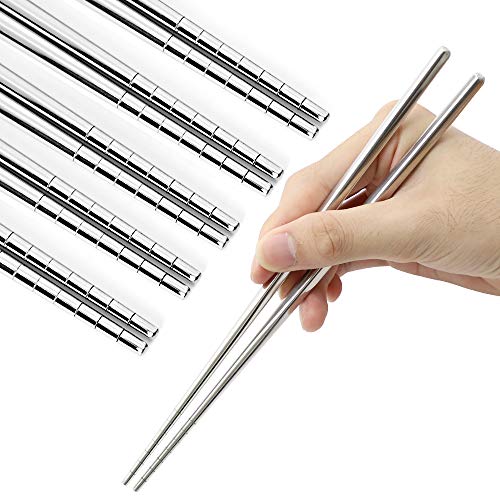
MUYOS Stainless Steel Chopsticks, Silver, 5 Pairs — Best Stainless Overall
MUYOS understood the assignment that defeats most steel chopsticks: weight and grip. Solid steel sticks are tiring and clumsy; these are hollow-core, so they land in the hand with something closer to a wooden pair’s lightness, and the non-slip tips address the other classic complaint — that steel skates off dumplings and noodle bundles. For daily meals, which is exactly what the maker positions them for, that combination makes this the steel set most likely to convert a sceptic.
Strengths
- Hollow core removes the wrist-heavy feel of solid steel
- Non-slip tips grip noodles and dumplings credibly
- Effectively unbreakable and dishwasher-proof for years
Trade-offs
- Steel conducts heat from hot broth and hot pots
- Can feel clinical beside warm tableware
- Clicks against ceramic bowls — some diners mind, some do not
| Material | Stainless steel, hollow-core |
| Quantity | 5 pairs |
| Tips | Non-slip tips per maker |
| Care | Dishwasher safe per maker |
Steel’s remaining traits are physics, not flaws to be engineered away. It will carry the heat of a hotpot to your fingers if you rest the tips in broth, and it makes its small metallic music against porcelain bowls. Households that eat a lot of soup noodles learn to hold steel higher on the shaft; households that hate the sound choose ceramic and accept the chipping risk.
As the everyday steel default — five pairs, silver, dishwasher, done — this is the set this guide hands to the pragmatist majority.
Best for: daily users wanting unbreakable, low-maintenance steel / Not suited for: hotpot devotees who rest chopsticks in the broth

LEETOYI Ceramic Chopsticks, White Porcelain, Set of 5 — Best Ceramic Value
Not every ceramic buyer wants peonies. LEETOYI’s white porcelain set is the material argument stripped to essentials: a 9.6-inch Chinese-style pair, five to a set, in the white that disappears into any table setting you already own. What you are buying is porcelain itself — non-reactive, stain-proof, odour-proof, and washable to a true clean in a way porous materials never quite reach.
Strengths
- All of ceramic’s hygiene virtues at an everyday tier
- White porcelain matches any existing tableware
- 9.6-inch length is the classic Chinese dining standard
Trade-offs
- Chips like all ceramic — no pattern to hide a nick
- Plain styling will not elevate a table setting
- Smooth glaze can be slicker than textured rivals when oily
| Material | Porcelain ceramic |
| Length | 9.6 inches |
| Quantity | Set of 5 |
| Style | White, Chinese style |
The value framing cuts both ways and the review should say so: at this tier the set is priced for real life, which includes the occasional chip. Porcelain’s fragility is a statistical fact of the material, and a sensibly tiered set turns a dropped pair from a small tragedy into a shrug. Many households run exactly this strategy — everyday porcelain for the family, the gift set above for guests.
If your heart says ceramic and your household says chaos, this is the reconciliation: the material you want at a tier that forgives the material’s nature.
Best for: everyday ceramic users and porcelain-first households / Not suited for: anyone wanting a statement or gift presentation
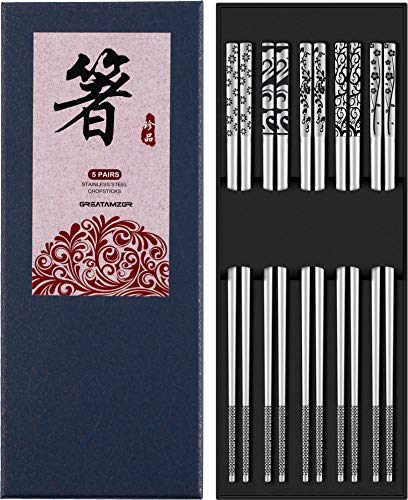
316 Stainless Steel Chopsticks, Square, 5 Pairs — Best Grip in Steel
This set reads like a point-by-point rebuttal of steel’s critics. Slippery? The profile is square and the surface laser-engraved, so edges and texture do the gripping that round polished steel cannot. Corrosion? The grade is 316, the marine-and-medical step up from standard stainless, chosen for exactly the salty, acidic, dishwasher-heavy life chopsticks lead. Rolling off the table? A square stick lies where it is put. At 9.45 inches in the Korean style — slightly shorter, flatter, made for metal’s traditional home — it is the most deliberately engineered steel set here.
Strengths
- Square profile and engraving give steel real grip
- 316 grade is the corrosion-resistance upgrade
- Flat profile never rolls off the table
Trade-offs
- Square edges feel unfamiliar to round-chopstick hands
- Engraving traps a little more residue — brush occasionally
- Heavier presence than hollow-core rivals
| Material | 316 stainless steel |
| Profile | Square, laser engraved |
| Length | 9.45 inches |
| Quantity | 5 pairs |
| Style | Korean chopstick design |
The costs are feel and familiarity. Square edges announce themselves to fingers raised on round bamboo, and the first week involves a small re-education of the grip. The engraving, like all texture, asks for an occasional brush in washing, though the maker’s dishwasher-safe positioning covers ordinary care.
For the diner who wants steel’s permanence with the grip question answered rather than apologised for, this is the connoisseur’s steel pick.
Best for: grip-first users and anyone upgrading from basic steel / Not suited for: traditionalists who want a round profile in the hand

Bone China Chopsticks, 5 Pairs, 9.5 Inches — Best Ceramic for Delicate Dining
Bone china is where ceramic chopsticks stop being an alternative material and become a statement about how a household eats. The body is finer and lighter than standard porcelain, with the slight translucency that gives the material its name in quality, and at the standard 9.5 inches these pairs feel less like tools and more like tableware — which, in the Chinese and Japanese traditions that invented them, is precisely what fine chopsticks are.
Strengths
- Bone china is the lightest and most refined ceramic body
- 9.5-inch standard length suits precise, delicate eating
- Gift-set presentation for formal tables
Trade-offs
- The most fragile pick in this guide — handle as china, because it is
- Refinement is wasted on a rough-and-tumble family table
- Smooth fine tips demand a confident technique
| Material | Bone china |
| Length | 9.5 inches |
| Quantity | 5 pairs |
| Care | Dishwasher safe per maker |
That refinement prices itself in care. These are dishwasher safe by their maker’s word, and they will still live longest washed gently and stored unknocked; they are, self-evidently, the wrong purchase for a student house or a toddler’s training years. The guide includes them because the ceramic-or-stainless question is often asked by exactly the diner they serve: someone setting a deliberate table, for whom the cool, fine, silent touch of china against a bowl is the entire point.
Silent is the operative word. Against ceramic bowls, china makes almost no sound — the acoustic opposite of the steel sets here, and for some diners the deciding factor in the whole comparison.
Best for: formal tables and diners who prize finesse and quiet / Not suited for: busy family tables and children’s hands

BALWOO Korean Stainless Steel Chopsticks, 5 Sets — Best Korean-Style Steel
Context is this set’s superpower. Korea is the one great chopstick culture that standardised on metal, and its flat, mid-length profile evolved for its own cuisine — gripping slippery kimchi, portioning grilled meat, handling noodles in steel and stone bowls that would punish wood. A made-in-Korea set like BALWOO’s carries that design heritage in a way a generic metal pair does not, and for households that eat Korean food weekly, the profile is not a style choice but the correct tool.
Strengths
- Authentic Korean profile from a Korean maker
- Flat shape excels at Korean dishes — kimchi, grilled meats, noodles
- Steel’s full durability for daily family use
Trade-offs
- 430 grade is a step below 316 in corrosion resistance
- Flat profile is a learned taste for round-stick users
- Shorter Korean length may feel brief for Chinese-style serving
| Material | 430 stainless steel, premium positioning |
| Origin | Made in Korea |
| Quantity | 5 sets |
| Style | Korean flat-profile tableware |
The 430 grade deserves its honest line: it is a legitimate, widely used stainless that sits a step below 316 in corrosion resistance — irrelevant for most tables, worth knowing for dishwasher-every-day households near the sea air. In exchange, 430 is the grade much of Korea’s own tableware actually uses, which tells you how the trade-off resolves in practice.
Choose BALWOO when the table is Korean, or when you want the flat profile’s grip and table manners — it never rolls, never wanders — in an authentic form.
Best for: Korean-food households and flat-profile converts / Not suited for: buyers wanting the maximum corrosion grade in 316
Comparison Table
| Pick | Badge | Key spec | Best for |
|---|---|---|---|
| Porcelain Ceramic Chopsticks, Blue Peony, 5 Pairs | Best Ceramic Overall | Porcelain, positioned as high-grade bone china | ceramic devotees and anyone buying a chopstick gift set |
| MUYOS Stainless Steel Chopsticks, Silver, 5 Pairs | Best Stainless Overall | Stainless steel, hollow-core | daily users wanting unbreakable, low-maintenance steel |
| LEETOYI Ceramic Chopsticks, White Porcelain, Set of 5 | Best Ceramic Value | Porcelain ceramic | everyday ceramic users and porcelain-first households |
| 316 Stainless Steel Chopsticks, Square, 5 Pairs | Best Grip in Steel | 316 stainless steel | grip-first users and anyone upgrading from basic steel |
| Bone China Chopsticks, 5 Pairs, 9.5 Inches | Best Ceramic for Delicate Dining | Bone china | formal tables and diners who prize finesse and quiet |
| BALWOO Korean Stainless Steel Chopsticks, 5 Sets | Best Korean-Style Steel | 430 stainless steel, premium positioning | Korean-food households and flat-profile converts |
Ceramic vs Stainless: The Material Decision, Settled by Diner
Strip away the marketing and the two materials divide on four honest axes. Fragility: steel wins absolutely — it does not chip, crack or break in any scenario a dining table can produce, while every ceramic set in this guide can lose a pair to one bad drop on a hard floor. Hygiene and taste: ceramic wins on feel — porcelain and bone china are completely non-reactive, take no stain or odour, and present a smooth, cool surface that many diners simply prefer against the lips and teeth, though stainless is equally non-reactive in practice and equally dishwasher-proof. Heat: ceramic wins — it insulates, where steel conducts a hotpot’s temperature straight to your fingers. Sound and sensation: ceramic is silent against bowls; steel clicks, which reads as modern to some diners and as cutlery-noise to others.
Grip is the axis where design beats material. Smooth round steel is the slipperiest chopstick in common use; squared, engraved or textured steel — the 316 set in this guide — grips as well as most ceramics. Ceramic’s slight natural texture helps it, but a glazed porcelain pair with oily food is no vice either. If grip is your deciding anxiety, choose by profile and tip design within either material, not by material alone.
So the settlement is biographical, not technical. Households with children, stone floors, dishwashers run by teenagers, or camping kits: steel, and enjoy never thinking about it again. Households that eat deliberately, entertain, prize the table’s feel, and handle their tableware like tableware: ceramic, in the tier that matches your drop-risk. Mixed households — most of us — run the guide’s own answer: an everyday steel or value-porcelain set for the week, a fine ceramic set for the table you set on purpose.
Length, Weight and Profile: The Numbers That Shape a Pair
Chopstick length follows cuisine. Chinese dining pairs run longest — the 9.5 to 9.7 inches of the ceramic sets here — because shared dishes sit at a distance and hotpots reward reach. Korean pairs run shorter and flatter, as the BALWOO and the 9.45-inch 316 set show, because Korean place settings keep dishes close and metal is traditional. Japanese pairs run shorter still and more tapered, a size this comparison’s sets do not cover — worth knowing if your table is primarily Japanese, where a 9.7-inch pair will feel like serving tongs.
Weight divides by construction, not just material. Hollow-core steel, like the MUYOS set, lands near wooden weights and suits smaller hands and long meals; solid and square steel feels more substantial, which some users read as quality and others as fatigue. Ceramic sits in between — bone china lightest, porcelain a touch denser — with a balance that tends toward the tip, which precise users love for picking single grains and bones.
Profile is the quiet decider. Round is the classic hand-feel; square cannot roll, presents edges to slippery food, and announces itself to your fingers until habit forms. If you are buying your first reusable set after a life of disposable bamboo, the gentlest transitions are round porcelain or hollow round steel; if you are upgrading specifically to fix grip, go square and give your hands a week.
Care, Longevity and the True Cost of Each Material
Both materials are dishwasher safe across every set in this guide, per their makers — and both reward a small amount of sense. Ceramic lasts longest loaded without hard knocks against stoneware and pans; steel lasts longest dried without prolonged soaking in salty water, a courtesy even 316 appreciates. Neither material should be used as a cooking tool over high heat unless the maker says so: these are dining sets, and the long cooking chopstick is a different, usually wooden or steel, instrument.
Longevity arithmetic favours steel in rough households and is closer than expected in careful ones. A steel set’s realistic failure mode is loss, not damage — it will outlive the table. A ceramic set’s life is actuarial: each pair survives until its drop, and in a careful adult household that is routinely years, which is why porcelain sets in continuous use are unremarkable in the cultures that invented them. Price the risk by your floor: wood and laminate forgive; tile and stone collect.
One last care note applies to both: store pairs together, tips protected. Ceramic tips chip against each other in a rattling drawer, and steel tips scratch finishes they share a compartment with. A simple chopstick rest or case — several of these sets arrive as gift sets with presentation in mind — is the cheapest longevity upgrade either material can be given.
A Short Cultural History of Metal and Porcelain Chopsticks
Neither material is a modern invention, and their histories explain their forms. Porcelain chopsticks emerged with porcelain itself — the fine ceramic that China perfected and exported to the world — as tableware for households whose tables were set with matching refinement; a porcelain pair beside a porcelain bowl is one of material culture’s quiet harmonies, and bone china later carried the idea to its lightest extreme. They were always the formal option: beautiful, cool, silent, and handled with the care china receives.
Metal’s homeland is Korea, where stainless steel chopsticks became the national standard in the twentieth century for reasons that were practical before they were traditional: metal survives boiling sanitisation, suits a cuisine of communal hot dishes and grills, and lasts essentially forever in family service. The flat Korean profile in this guide is that history in your hand — shorter, because Korean settings keep food close; flat, because flat does not roll and grips grilled and pickled foods with an edge.
Knowing the histories resolves the comparison’s false tension. Ceramic is the formal Chinese table’s answer; steel is the working Korean table’s answer. The modern diner choosing between them is not picking a winner of history but a lineage to join — and the sets in this guide were chosen as faithful representatives of each.
Chopsticks for Children, Learners and Mixed Tables
Mixed tables are where material strategy gets practical. Children drop things, learners squeeze too hard and chase food around the bowl, and both groups benefit from the material that forgives: stainless, ideally a lighter hollow-core set, in a shorter length if small hands are involved. Training chopsticks with connectors are their own product class, but once a child is on real pairs, steel removes the breakage anxiety that makes adults hover — and a dropped steel pair is a noise, not a loss.
Learners of any age should start on grip-friendly design regardless of material: textured tips, a square or matte finish, a mid-range length. The common beginner failure — food launched across the table — is a grip-design problem far more often than a talent problem, and the sets in this guide with engineered tips exist partly for this reader.
The elegant mixed-table solution mirrors the guide’s overall verdict: steel for the everyday places, ceramic for the adult and guest settings, and no apology for the division. Households have always run everyday and good tableware in parallel; chopsticks simply join a very old system.
Chopstick Rests, Cases and the Table System Around the Pair
A set of permanent chopsticks acquires a small supporting cast, and the cast decides how permanent the set feels. The rest — hashioki in Japanese service — keeps tips off the table and the table off the tips, and for ceramic pairs it has a second function: a designated parking place is where pairs survive meals unchipped, rather than rolling to the floor. Choose rests in the same material family as the pairs for a set table, or in deliberate contrast; either reads as intention, and intention is the whole aesthetic game.
Cases serve the travelling pair — several steel sets in this guide are bought for work bags and travel as much as for home — and they protect ceramic pairs in a drawer better than any divider. A household that stores its good ceramic sets in their gift boxes between dinner parties is not being precious; it is applying the storage logic that keeps china alive across decades.
Finally, buy the household’s real number. A five-pair set serves a family that eats together; a household that entertains eight needs the second set bought in the same season, in the same design, before the pattern or the production run changes. Chopsticks are tableware, and tableware is bought in services, not in singles.
A Final Word on Commitment
Whichever material you choose, choose it completely: retire the disposables, put the permanent sets where the table is set, and let habit form around them. A reusable set only becomes the sustainable, economical, pleasurable choice it promises to be when it is the default rather than the special occasion — and defaults are built in the first fortnight of use. Both materials in this guide reward that commitment for years; the only losing move is the drawer full of good intentions beside a fresh pack of throwaway sticks.
How to Choose and Use Your First Ceramic or Stainless Set
The material decision made, a few practical checks turn a good purchase into the set your hand reaches for without thinking.
- Decide by floor and household first: hard floors plus children or chaotic dishwashing points to steel; careful adult tables point to ceramic. Let the drop-risk vote before the aesthetic one.
- Match length to cuisine: around 9.5 to 9.7 inches for Chinese-style shared dishes and noodles; the shorter, flatter Korean profile for Korean tables; and avoid very long pairs for children’s hands.
- Test grip on the foods that defeat you — for most diners, dumplings, peanuts and noodle bundles in broth. If steel tempts you, choose textured, square or non-slip-tipped designs, like the 316 and MUYOS sets here.
- Hold the pair correctly from day one: the lower stick rests still on the ring finger and the base of the thumb; only the upper stick moves, driven by index and middle fingers. Good form makes every material grip better.
- Practise the heat rule with steel: never rest the tips soaking in hot broth or a hotpot, and lift noodles to cool briefly — steel conducts, and it teaches this lesson exactly once.
- Wash and store with the material in mind: ceramic unknocked in the dishwasher and stored tips-protected; steel dried after washing and kept from long salty soaks.
- Wash a new set before its first meal — warm water, ordinary detergent, a full dry — whatever its material. Manufacturing and packing residues are nobody’s seasoning, and the first meal with a permanent set deserves a clean start.
Give any new profile — especially square steel or your first ceramic pair — a full week of dinners before judging it. Hands learn in days, and the set that feels strange on Monday is frequently the favourite by the following one.
Troubleshooting the first month with a new set: food slipping usually means the tips are too smooth for your current technique or the pair is being held too close to the tips — move your grip up the shaft and let the textured section work. Steel feeling uncomfortably hot means the tips are living in the broth; lift, rest on the bowl’s edge, and let the pair cool. A ceramic pair that chips at the tip was almost certainly struck in the dishwasher or drawer — change the storage before blaming the set, and retire a chipped pair from food use, since a rough tip harbours residue and scratches bowls.
If a new steel set feels fatiguing, check your grip height before blaming the weight: most fatigue comes from holding any pair too close to the tips, which forces the fingers to work at their weakest leverage. Slide the hand back until the upper third of the pair extends behind your hand, and the same set will feel a grade lighter. If a ceramic pair feels slippery with oily dishes, the answer is technique rather than texture — a slightly wider finger spread and a slower lift — because porcelain’s surface is a constant and the hand is the variable.
Common Buying Mistakes
Buying smooth round steel as a first set. It is the slipperiest configuration in the category, and it convinces beginners that metal chopsticks are the problem. Textured, square or non-slip tips are steel done properly.
Putting ceramic in a chaotic dishwasher load. Dishwasher safe means the material survives the wash, not that a falling pan cannot chip it in the rack. Load ceramic where it cannot be struck — or hand-wash the good sets.
Using dining chopsticks as cooking chopsticks. Nine-and-a-half-inch dining pairs over a wok or a fryer are too short for safety and, in ceramic’s case, thermally shocking. Cooking chopsticks are longer and are a separate purchase.
Judging by material instead of profile. Grip, balance and comfort live in the profile, length and tip design. A well-designed set in your second-choice material beats a badly designed set in your first choice, every meal.
Buying one set for two different tables. The Tuesday family table and the Saturday dinner-party table want different things. An everyday set plus a fine set — the strategy this guide’s picks are arranged to serve — costs less than one compromise that satisfies neither.
Matching the chopsticks to the bowls carelessly. Steel on thin porcelain makes the loudest table in the world and can mark delicate glazes over time; ceramic on stoneware is a chip risk at every contact. Pair steel with sturdy bowls and ceramic with compatible ones, and both materials live longer and sound better.
Final Recommendation
The honest verdict is that both materials win, for different households. Steel takes the guide’s practical crown: the MUYOS hollow-core set for everyday ease, the square 316 set for grip and corrosion resistance, the BALWOO for Korean tables. Ceramic takes the experiential crown: the blue peony bone-china set as the flagship, LEETOYI’s white porcelain as the everyday value, and the fine bone china set for tables set on purpose.
Decide by your floor, your dishwasher’s chaos level and the way you like a meal to feel — then commit, because either material, well chosen, ends the disposable-chopstick era in a kitchen permanently. The wider chopstick guides below cover bamboo, fiberglass and the rest of the family.
Shortlist: Porcelain Ceramic Chopsticks, Blue Peony, 5 Pairs (Best Ceramic Overall) · MUYOS Stainless Steel Chopsticks, Silver, 5 Pairs (Best Stainless Overall) · LEETOYI Ceramic Chopsticks, White Porcelain, Set of 5 (Best Ceramic Value)
Best Chopsticks Best Ceramic Chopsticks Best Bamboo Chopsticks Best At Home Chopsticks Best Chef Chopsticks
Frequently Asked Questions
Are ceramic or stainless steel chopsticks better?
Neither, absolutely — they win on different axes. Stainless is unbreakable, maintenance-free and ideal for children, hard floors and chaotic dishwashers. Ceramic is silent against bowls, insulating against hot food, and finer in the hand, at the price of chipping if dropped on hard floors. Most mixed households end up owning both: steel for everyday, ceramic for set tables.
Do stainless steel chopsticks get hot?
They conduct heat, so tips rested in hot broth or a hotpot will warm noticeably — the standard technique is to avoid soaking the tips and to hold the pair higher on the shaft. In normal eating, where contact with hot food is brief, heat is a minor consideration; at a hotpot table it is the main argument for ceramic or wood.
Are ceramic chopsticks fragile?
They are china, and they behave like it: perfectly durable in eating, washing and years of careful use, vulnerable to a drop onto tile or stone. Bone china is the finest and most delicate; standard porcelain is a little sturdier. On wooden floors in adult households, ceramic sets routinely serve for years.
Which chopsticks grip slippery food best?
Design beats material. Square profiles, laser-engraved texture and non-slip tips — the 316 steel set and the MUYOS set in this guide — grip dumplings and noodles as well as any ceramic. Smooth round polished steel is the one configuration to avoid. Correct grip technique improves every pair more than any purchase can.
Can both materials go in the dishwasher?
Yes — every set in this guide is positioned as dishwasher safe by its maker. Ceramic should be loaded where it cannot be knocked by heavy items, and steel benefits from drying rather than long soaking. Neither material needs the hand-washing that wood and bamboo demand, which is a large part of both materials’ appeal.
What length chopsticks should I buy?
Match the cuisine: roughly 9.5 to 9.7 inches for Chinese-style dining with shared dishes, the shorter flatter profile for Korean tables, and shorter still for Japanese place settings. The sets in this guide cluster in the Chinese and Korean bands. When in doubt for a mixed table, the standard nine-and-a-half-inch pair is the versatile choice.
Do stainless steel chopsticks leave a metallic taste?
Quality stainless steel is non-reactive and leaves no taste in normal use — the grades in this guide, including 316 and 430, are food-contact standards. A persistent metallic taste usually indicates a damaged or very low-grade surface, or food held in contact far longer than a meal. Ceramic and bone china are, by their nature, the zero-taste guarantee for the especially sensitive.
Are heavier chopsticks better than lighter ones?
Neither — balance is what the hand judges, not mass. Hollow-core steel and bone china suit smaller hands and long, delicate meals; denser porcelain and square steel suit users who like a substantial presence and mostly eat hearty dishes. If a pair tires your hand before the meal ends, it is the wrong weight for you, whatever the material.
How many pairs should a household own?
At minimum, a pair per regular diner plus spares for guests — which is why the sets in this guide come in fives. Households that entertain should hold a full service in one design. Owning too few permanent pairs is what quietly returns a kitchen to disposables, one guest night at a time.
Can ceramic or stainless chopsticks be used for cooking?
Short dining pairs of either material should stay at the table: they are too short for safe wok or fryer work, and ceramic risks thermal shock over direct heat. Long cooking chopsticks are a separate tool, usually in wood, bamboo or steel. Stainless dining pairs tolerate being used to stir a small pot in a pinch; ceramic pairs should not be asked to.


