Disclosure: airfryerkitchensupply.com is reader-supported. When you buy through links on our site, we may earn an affiliate commission at no extra cost to you.
Where to buy
The fastest way to buy any faucet in this guide is through Amazon, where finish, hole configuration and included accessories are listed on each product page and stock changes daily. Start with our top pick for best bridge kitchen faucets: Check on Amazon
- Kingston Brass Heritage Bridge Kitchen Faucet KS1278ALBS — Check on Amazon
- Kingston Brass Heritage Bridge Kitchen Faucet KS1273ALBS — Check on Amazon
- Kingston Brass Bridge Kitchen Faucet KS1275AXBS — Check on Amazon
- Kingston Brass Heritage Bridge Kitchen Faucet KS1276ALBS — Check on Amazon
- WOWOW Brass Bridge Kitchen Faucet with Side Sprayer (Polished Nickel) — Check on Amazon
- WOWOW Brass Bridge Kitchen Faucet with Sprayer (Oil Rubbed Bronze) — Check on Amazon
The best bridge kitchen faucets all share one unmistakable silhouette: two separate handles standing on the counter, joined by an exposed horizontal pipe — the bridge — with the spout rising from its centre. It is the oldest faucet architecture in the kitchen, older than the single-handle cartridge era by decades, and it has come back for reasons that are more practical than nostalgic. A bridge faucet gives each supply its own valve, keeps every working part above the deck where it can be serviced, and turns the plumbing itself into the design feature instead of hiding it.
Shopping for one requires unlearning modern faucet habits. There is no pull-down wand on a classic bridge; rinsing power comes from a separate side sprayer, traditionally in brass, parked in its own hole. Temperature is set with two hands or one practised hand across both handles, not nudged with a wrist. Hole patterns are non-negotiable: a bridge needs its 8-inch spread, full stop. Buyers who accept those terms get a faucet with a particular kind of longevity — individual valves and sprayers that can be serviced or replaced one piece at a time, in solid brass bodies that outlast fashion cycles because they predate most of them.
Kingston Brass dominates this category the way a specialist should: its Heritage line is essentially a bridge-faucet catalogue in every serious finish, and four of the six picks below are Heritage bridges in brushed nickel, antique brass, oil rubbed bronze and polished nickel. Two solid-brass WOWOW bridges round out the list as the value route into the pattern. The guide that follows explains how to choose between them, what the installation really involves, and the mistakes — mostly hole-pattern mistakes — that bridge buyers make.
In this guide
Quick Picks
Six bridges, split by finish and budget: the brushed-nickel Heritage as the all-round pick, antique brass and oil rubbed bronze Heritage models for warm traditional schemes, a polished-nickel Heritage for cool bright kitchens, and two solid-brass WOWOW bridges that bring the pattern to a value tier without giving up the brass body or the side sprayer.
- Best Overall: Kingston Brass Heritage Bridge Kitchen Faucet KS1278ALBS — the Heritage bridge in brushed nickel with brass sprayer and an 8-3/4 inch spout reach — the default bridge, in the easiest finish to live with. Check on Amazon
- Best Antique Brass Bridge: Kingston Brass Heritage Bridge Kitchen Faucet KS1273ALBS — the Heritage bridge in true antique brass — the browned, aged finish that makes a bridge look inherited rather than installed. Check on Amazon
- Best Oil Rubbed Bronze Bridge: Kingston Brass Bridge Kitchen Faucet KS1275AXBS — the bridge pattern in deep oil rubbed bronze with brass sprayer, for kitchens pairing dark bronze hardware and lighting. Check on Amazon
- Best Polished Nickel Bridge: Kingston Brass Heritage Bridge Kitchen Faucet KS1276ALBS — polished nickel’s warm mirror shine on the Heritage bridge — brighter than chrome, warmer in tone, unmistakably classic. Check on Amazon
- Best Value Bridge: WOWOW Brass Bridge Kitchen Faucet with Side Sprayer (Polished Nickel) — a solid-brass 4-hole bridge with side sprayer in polished nickel at a value tier — the pattern’s essentials without the premium name. Check on Amazon
- Best Budget Bronze Bridge: WOWOW Brass Bridge Kitchen Faucet with Sprayer (Oil Rubbed Bronze) — the solid-brass WOWOW bridge in oil rubbed bronze — farmhouse drama and a sprayer, at the friendliest tier in this guide. Check on Amazon
How These Picks Were Chosen
Bridge faucets were verified the same way as every pick in this programme: searched by brand and model, with the returned title matched against the intended faucet — finish included — before any link was attached. Bridge searches are a trap for the careless, because one Kingston model family covers a dozen finishes and two sprayer configurations under near-identical listings; each pick below was checked so that the finish in the Amazon title is the finish in the review.
Selection then weighed what actually differs between bridges: body material (solid brass versus plated alternatives), the sprayer — its material, since a brass sprayer and a plastic one age very differently — handle style and swing clearance, spout reach over the sink, and how serviceable the valves are. Bridges are bought for decades, so repairability counted heavily: a faucet whose valves, sprayer and hose are standard, replaceable parts will outlive a sealed unit every time.
Finishes were spread deliberately across the six picks because bridge buyers are usually matching a scheme, not shopping a spec sheet: warm kitchens get antique brass and oil rubbed bronze, neutral kitchens get brushed nickel, bright classic kitchens get polished nickel, and the two WOWOW models give the value tier a genuine solid-brass option in polished nickel and bronze.
The research for this guide also surfaced the bridge pattern’s imitators — single-handle faucets styled with a decorative horizontal bar that mimics the bridge silhouette while keeping a modern single-valve layout. They were excluded, not from snobbery but from definition: a bridge faucet is an architecture, two valves joined by an exposed waterway, and its serviceability — the quality that justifies the pattern’s price and deck demands — exists only in the genuine construction. Buyers who want the look without the deck requirements should shop single-handle traditional faucets knowingly, under their own name.
The 6 Best Bridge Kitchen Faucets
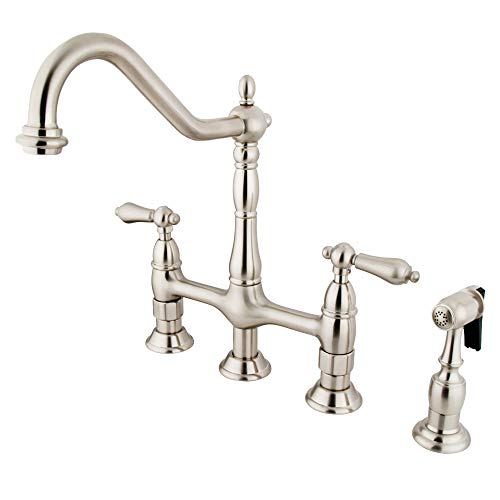
Kingston Brass Heritage Bridge Kitchen Faucet KS1278ALBS — Best Overall
If a bridge faucet has a default setting, this is it: Kingston’s Heritage pattern — exposed bridge, gooseneck spout with an 8-3/4 inch reach, two handles, and a brass side sprayer — finished in brushed nickel, the finish that asks the least of its owner. Brushed nickel’s soft warmth suits traditional kitchens without committing to a strong colour statement, hides water spots better than any polished surface, and sits comfortably next to the stainless appliances most kitchens already have.
Strengths
- Classic Heritage bridge pattern in the most forgiving finish
- Brass side sprayer — a separate, standard, replaceable component
- Exposed, serviceable architecture: valves and sprayer can be repaired individually
Trade-offs
- Requires an 8-inch spread plus a sprayer hole
- No pull-down spray modes — the sprayer is a single jet
- Two-handle mixing is a deliberate, two-step habit
| Configuration | 8-inch bridge, two-handle |
| Finish | Brushed nickel |
| Spout reach | 8-3/4 in |
| Sprayer | Brass side sprayer |
The Heritage pattern’s virtues are structural. Every component is exposed and standard: the valves live in the handle bases where a future plumber can reach them, the sprayer is a separate unit on a standard hose, and the bridge pipe itself is the waterway — no hidden manifold to fail inside a casting. Owners who keep houses for decades tend to love this architecture for exactly those reasons. The 8-3/4 inch reach centres the stream over most double-bowl sinks, and the gooseneck height clears stockpots without the extreme tower of a modern pull-down.
Best for: most traditional kitchens wanting the classic bridge pattern / Not suited for: single-hole sinks or cooks who rely on pull-down spray modes Check on Amazon
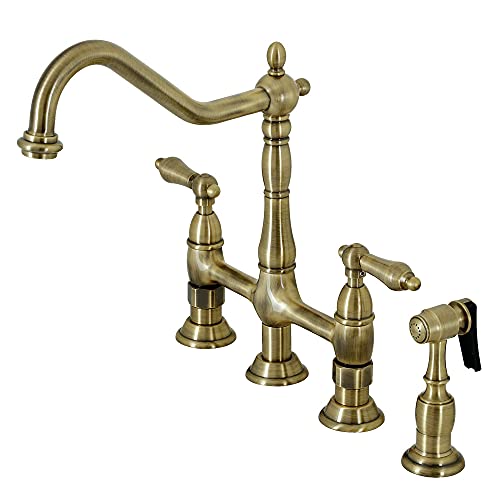
Kingston Brass Heritage Bridge Kitchen Faucet KS1273ALBS — Best Antique Brass Bridge
Antique brass and the bridge pattern were made for each other: the architecture is a century old, and the browned, low-lustre finish makes a new faucet look like it has served the kitchen for decades. In a period renovation or a warm farmhouse scheme with wood counters and a ceramic sink, this is the combination that reads as correct rather than themed — the faucet looks discovered, not decorated.
Strengths
- True antique brass — the finish that suits bridge architecture best
- Aged surface hides fingerprints and blends daily marks
- Full Heritage serviceability: separate valves, sprayer and hose
Trade-offs
- Warm dark tone clashes with cool grey, chrome-heavy schemes
- Needs the full bridge deck pattern: spread plus sprayer hole
- Water spots still show on close inspection; a wipe-down habit helps
| Configuration | 8-inch bridge, two-handle |
| Finish | Antique brass |
| Sprayer | Brass side sprayer |
Antique brass is also a practical finish in disguise. Its mottled, dark surface hides fingerprints and light water spots far better than polished metals, and because the tone is already aged, the small marks of daily life blend into the finish instead of standing out as damage. The trade is coordination: antique brass wants warm company — wood, cream ceramics, aged hardware — and can look muddy against cool grey schemes where brushed nickel would be cleaner. As with every Heritage bridge here, the sprayer is brass, the valves are individually serviceable, and the deck requirement is an honest 8-inch spread plus the sprayer hole.
Best for: warm traditional and period kitchens built around aged brass / Not suited for: cool-toned modern kitchens or single-hole decks Check on Amazon

Kingston Brass Bridge Kitchen Faucet KS1275AXBS — Best Oil Rubbed Bronze Bridge
Oil rubbed bronze is the darkest traditional finish — near-black at a glance, with warm bronze edges that appear where light and hands touch it — and on a bridge faucet it produces the most dramatic version of the pattern. Kitchens built around bronze cabinet hardware, bronze pendants and dark wood are exactly its home; the bridge silhouette keeps the dark finish from reading as modern, anchoring it in the traditional register where bronze belongs.
Strengths
- Deepest, most dramatic traditional finish on the classic pattern
- Coordinates with the huge installed base of bronze hardware and lighting
- Serviceable two-valve bridge architecture with brass sprayer
Trade-offs
- Pale hard-water spots show clearly on the dark surface
- Rubbed highlights develop with touch — character to some, wear to others
- Dark finish can visually shrink a small, dim kitchen
| Configuration | Bridge, two-handle |
| Finish | Oil rubbed bronze |
| Sprayer | Brass side sprayer |
Living with dark bronze means accepting its two habits. It shows pale water spots more visibly than mid-tone finishes, because the contrast is built in, and its rubbed highlights develop where hands land most — which owners either read as the finish settling in or as wear, depending on temperament. A soft-cloth wipe after heavy use keeps both habits graceful. Mechanically this is the same honest Heritage-family architecture: two serviceable valves, a brass sprayer on a standard hose, and a body built for the long term rather than the warranty period.
Best for: kitchens matching oil rubbed bronze hardware throughout / Not suited for: hard-water homes unwilling to wipe, or bright minimalist schemes Check on Amazon

Kingston Brass Heritage Bridge Kitchen Faucet KS1276ALBS — Best Polished Nickel Bridge
Polished nickel is the connoisseur’s bright finish: like chrome it mirrors, but its undertone is warm rather than blue, which makes it the classic partner for marble counters, white ceramic sinks and the whole bright-traditional palette. On the Heritage bridge it delivers the period look at full brightness — the version you see in historic-house kitchens where every metal surface was polished and meant to be seen.
Strengths
- Warm mirror shine that suits marble and ceramic traditional schemes
- Coordinates across warm and cool metals better than chrome
- Full-size Heritage bridge with brass sprayer and serviceable valves
Trade-offs
- Shows every fingerprint and water spot — a wipe-as-you-go finish
- Full-scale dimensions need a sink and deck that can carry them
- Premium positioning within the bridge range
| Configuration | 8-inch bridge, two-handle |
| Finish | Polished nickel |
| Dimensions | 13.88 x 8.56 x 13.13 in (Amazon listing) |
| Sprayer | Brass side sprayer |
The listing dimensions underline that this is a full-scale faucet, and polished nickel’s upkeep matches its presence: fingerprints and water spots are visible immediately, and the finish rewards a household that wipes as it goes. In exchange, polished nickel has one advantage over chrome that matters in traditional schemes — it coordinates with both warm and cool neighbours without the jarring temperature clash chrome can cause next to brass or bronze elsewhere in the room. Serviceability is the Heritage standard: individual valves, a brass sprayer, standard connections throughout.
Best for: bright classic kitchens that want shine without chrome’s coldness / Not suited for: low-maintenance households or small sinks Check on Amazon

WOWOW Brass Bridge Kitchen Faucet with Side Sprayer (Polished Nickel) — Best Value Bridge
The honest question about value bridges is what gets cut to reach the price, and this WOWOW model’s Amazon title answers the important part first: solid brass construction. A 4-hole, 8-inch centreset bridge with a side sprayer in polished nickel, built from brass rather than the zinc-and-plastic recipe that gives budget faucets their reputation — that is the correct place to spend less, because the body is the part you cannot upgrade later.
Strengths
- Solid brass body at a value tier — the essential spec is not cut
- Complete 4-hole pattern with side sprayer included
- Polished nickel finish suits bright traditional schemes
Trade-offs
- Thinner long-term parts and support ecosystem than heritage brands
- Finish matching for future replacement parts is less certain
- Fewer handle and trim variations than the Kingston catalogue
| Configuration | 4-hole bridge, 8-inch centreset, two-handle |
| Body | Solid brass construction (Amazon title) |
| Finish | Polished nickel |
| Sprayer | Side sprayer included |
Where a value brand does ask for compromise is in the long tail of ownership: finish consistency across replacement parts years from now, the depth of the spare-parts catalogue, and support channels are thinner than a heritage maker’s. The smart way to buy this tier is to treat the sprayer and valves as the standard, replaceable components they are, and to keep the model details on file. For a rental-grade remodel, a first farmhouse kitchen, or any project where the budget has harder claims than the faucet, solid brass at this tier is a defensible, even savvy, buy.
Best for: budget-conscious traditional remodels that refuse plastic bodies / Not suited for: buyers who prioritise decades-deep manufacturer parts support Check on Amazon

WOWOW Brass Bridge Kitchen Faucet with Sprayer (Oil Rubbed Bronze) — Best Budget Bronze Bridge
Farmhouse style and tight budgets meet constantly in real remodels, and this is the bridge built for that meeting: solid brass construction, the full 4-hole pattern with side sprayer, and an oil rubbed bronze finish that delivers the dark, warm farmhouse look. It is the most accessible route in this guide to a genuine bridge silhouette — not a bridge-look single-handle imitation, but the real two-valve architecture.
Strengths
- Real bridge architecture and solid brass at the lowest tier here
- Oil rubbed bronze delivers the farmhouse look completely
- Side sprayer included in the 4-hole pattern
Trade-offs
- Dark finish shows hard-water spots; needs the wipe habit
- Future parts matching is approximate at this tier
- Support and documentation thinner than heritage brands
| Configuration | 4-hole bridge, 8-inch centreset, two-handle |
| Body | Solid brass construction (Amazon title) |
| Finish | Oil rubbed bronze |
| Sprayer | Side sprayer included |
The bronze finish at this tier behaves like bronze everywhere: handsome, warm, and honest about water spots, so the wipe habit matters as much here as on the premium Kingston bronze. What the value tier cannot promise is the same depth of finish matching if you replace the sprayer in eight years — keep the model number recorded and expect a near match rather than a perfect one. Judged on what a bridge must do — move water for decades from a body that will not corrode out — solid brass at this price is the right allocation of a limited budget.
Best for: farmhouse kitchens wanting dark bronze on a controlled budget / Not suited for: perfectionists matching finishes across decades of parts Check on Amazon
Comparison Table
| Pick | Badge | Key spec | Best for |
|---|---|---|---|
| Kingston Brass Heritage Bridge Kitchen Faucet KS1278ALBS | Best Overall | 8-3/4 in spout reach, brushed nickel, brass sprayer | most traditional kitchens wanting the classic bridge pattern |
| Kingston Brass Heritage Bridge Kitchen Faucet KS1273ALBS | Best Antique Brass Bridge | 8-inch bridge, antique brass, brass sprayer | warm traditional and period kitchens built around aged brass |
| Kingston Brass Bridge Kitchen Faucet KS1275AXBS | Best Oil Rubbed Bronze Bridge | Bridge, oil rubbed bronze, brass sprayer | kitchens matching oil rubbed bronze hardware throughout |
| Kingston Brass Heritage Bridge Kitchen Faucet KS1276ALBS | Best Polished Nickel Bridge | Bridge, polished nickel, 13.88 x 8.56 x 13.13 in (API dimensions) | bright classic kitchens that want shine without chrome’s coldness |
| WOWOW Brass Bridge Kitchen Faucet with Side Sprayer (Polished Nickel) | Best Value Bridge | Solid brass, 4-hole, 8-inch centreset, side sprayer | budget-conscious traditional remodels that refuse plastic bodies |
| WOWOW Brass Bridge Kitchen Faucet with Sprayer (Oil Rubbed Bronze) | Best Budget Bronze Bridge | Solid brass, 4-hole, 8-inch centreset, oil rubbed bronze | farmhouse kitchens wanting dark bronze on a controlled budget |
Four Kingston Heritage bridges split by finish, two WOWOW bridges split by value. Mechanically the six are closer than the finishes suggest — two valves, an exposed bridge, a separate sprayer — so choose by deck first (all need the 8-inch spread and sprayer hole), then by finish family, then by how much you value a heritage maker’s parts catalogue over a value brand’s solid-brass essentials.
How to Choose Bridge Kitchen Faucets
A bridge faucet is a commitment to an architecture, not just a finish, so the choosing order matters: confirm the deck can take one, decide how you will rinse without a pull-down wand, then pick finish and tier. The sections below follow that order.
The deck decides first: spreads and holes
A bridge faucet mounts its two valves on an 8-inch spread, centre to centre, with the spout assembly between them and — on every pick in this guide — a fourth hole for the side sprayer. Measure your existing spread before anything else; a 4-inch centreset sink cannot accept a bridge without a new sink or deck work, and no adapter changes that. Also check behind the sink: bridge handles sweep a wider arc than modern levers, and a tight backsplash can clip the cold handle’s travel.
Living without a pull-down wand
Bridge buyers trade the pull-down sprayer for a side sprayer, and should make that trade with open eyes. A side sprayer is a strong, simple jet on a hose — excellent for rinsing pans, sweeping the sink, filling buckets on the floor — but it has one mode, and it parks beside the faucet rather than docking in the spout. Cooks who constantly switch between stream and spray while the head is in the sink are pull-down people; cooks who rinse in bursts and value simplicity tend to prefer the sprayer within a week.
Why solid brass matters more in a bridge
A bridge exposes its waterway: the horizontal pipe between the valves is the plumbing, visible and touchable, which makes body material a structural question rather than a hidden one. Solid brass handles the thermal cycling and the occasional knock from a stockpot without complaint, resists corrosion for decades, and gives the faucet its characteristic weight. Zinc or plastic-bodied lookalikes exist at tempting prices; in a pattern designed to last thirty years, the body is the last place to economise — which is why even the value picks here are solid brass.
Handles: levers, crosses and clearance
Bridge handles come as levers or crosses, and the choice is practical before it is decorative. Levers are faster and kinder to wet or arthritic hands; crosses are the period-correct look and give fine, deliberate control. Either way, check the swing: handles rotate toward the backsplash on most patterns, so measure the space behind your sink and imagine the handle at full hot with a wet hand. Handles that foul the backsplash are the most common bridge complaint, and it is entirely a measuring failure, not a product failure.
Serviceability is the bridge superpower
Every wear part on a bridge — valve cartridges, sprayer, sprayer hose, aerator — is a separate, standard, replaceable component reachable from above the deck. When you compare bridges, you are really comparing how easily the next thirty years of small repairs will go: standard connections and a maker (or a pattern) with a deep parts catalogue win. This is the heritage brands’ quiet advantage and the thing value buyers should plan around by recording model numbers at install time.
Cross handles or lever handles?
Cross handles are the period-correct choice and give fine, two-finger control of each valve; they are slower with wet hands and harder for anyone with grip limitations. Levers are the practical evolution — faster, easier at any age, and still entirely in keeping with the pattern. Heritage lines offer both on the same bodies, so the decision can be made purely on hands and habit. In a household spanning generations, levers are the kinder default; in a strict period restoration, crosses are the honest one.
What about wall-mounted bridges?
The bridge pattern also exists in wall-mounted form — one Kingston wall-mount model appeared in this guide’s research — where the valves and bridge sit on the wall above a sink with no deck holes at all. Wall mounting frees the counter completely and suits vessel and farmhouse sinks in renovations where the plumbing can be roughed into the wall. It was left out of the picks because it is a renovation decision, not a faucet swap: supply positions, wall structure and future access all change. If your project is already opening walls, it is the most striking version of the pattern; if it is not, deck-mount is the sane route.
Budget allocation within a bridge purchase
When the budget forces choices inside a bridge purchase, protect the body and the valves first, the sprayer second, and the handle styling last. A solid-brass body with standard valves can wear any handles and outlive any sprayer — both are replaceable in minutes. The reverse allocation, premium trim over a lesser body, spends the money on the parts that matter least to the faucet’s thirtieth year. The value picks in this guide follow exactly this logic, which is why they were chosen over prettier alternatives.
Bridge Faucets and Farmhouse Sinks: Getting the Pairing Right
Bridges and farmhouse (apron-front) sinks are paired so often that they are worth discussing as one decision. The apron sink’s wide, deep basin is exactly what a bridge’s fixed spout and separate sprayer were designed around — the spout reach centres over the basin, and the sprayer covers the corners a fixed stream cannot. The pairing fails only on geometry: an apron sink pushed forward on the cabinet can leave a narrow deck strip behind it, and a bridge needs its full spread plus room for handle swing on that strip. Measure the deck depth from the sink’s rear edge to the backsplash before ordering either piece.
Height is the second geometry. A bridge’s gooseneck is tall by modern standards, and under a window that usually delights; under a low cabinet or a shelf it can crowd. The spout height also decides splash: a high arc dropping into a shallow basin splashes more than the same arc into a deep farmhouse bowl, which is another reason the pattern suits deep sinks. None of this is a warning off — it is the measuring list that separates the kitchens where a bridge feels inevitable from the ones where it feels imposed.
Stylistically, the rule is simple: a bridge faucet is a strong traditional signal, and it asks the rest of the sink area to meet it halfway — a ceramic or fireclay basin, honest hardware, nothing aggressively minimal. In a kitchen that meets it, a bridge does not look retro; it looks permanent, which is the quality most remodels are actually chasing.
A bridge faucet also changes the soundscape and ritual of a kitchen in ways owners mention surprisingly often. Two valves give a finer, more deliberate control of the mix — the temperature is set by two positions your hands learn — and the separate sprayer has a decisive on-off character quite unlike a pull-down’s graduated trigger. Cooks who work by routine tend to love this deliberateness; cooks who work one-handed with a pan in the other tend to miss the lever. Neither reaction is about quality. It is about which century of kitchen rhythm your habits were formed in, and it is worth a moment’s honesty before the deck is drilled.
On cost, bridges reward a whole-life view. The pattern’s premium over a comparable single-handle faucet buys solid traditional construction and a parts future measured in decades; its installation can cost more if a deck must be adapted, which is the number buyers forget to include. Priced honestly — faucet, any deck work, and twenty years of cartridge-level repairs instead of one full replacement — the bridge is frequently the cheapest faucet in this entire programme per year of service. That arithmetic, more than nostalgia, is why the pattern never actually disappeared.
Bridge faucets also deserve a word about water pressure and flow, because the pattern predates modern flow regulation and owners sometimes worry the architecture wastes water. It does not: the valves and aerators in contemporary bridges are regulated like any modern faucet, and the exposed bridge pipe is simply a waterway, not a larger one. What the pattern does change is feel — two-valve control lets a cook crack the hot side with a precision that suits filling and washing rituals, and the side sprayer’s unregulated-feeling blast is in fact the same rated flow, concentrated by a simpler nozzle.
Consider also who else uses the sink. Bridges are quietly excellent for children learning kitchen tasks, because each handle does exactly one legible thing — this one hot, this one cold — and for older users who find single-lever mixing, with its combined temperature-and-flow gesture, genuinely confusing. The pattern’s legibility is a safety feature in disguise: there is no mode, no detent, no surprise. In multigenerational houses, that clarity is worth as much as the architecture’s looks.
And the pattern keeps one more promise modern faucets rarely can: it can move house. A bridge unbolts as a set of standard components, and owners genuinely do reinstall beloved bridges in their next kitchen — the fittings are standard, the parts replaceable, the style older than every trend it will meet there. Few purchases in a remodel carry that option. It is the ultimate expression of the bridge’s design philosophy: nothing sealed, nothing disposable, nothing that cannot be understood by the next plumber who meets it.
One more practical bridge consideration belongs in any complete guide: the under-sink reality. A bridge’s two supply connections and sprayer hose are all standard, but the sprayer hose needs its smooth loop respected exactly as a pull-down’s does — stored bottles and bins shoved against it will eventually kink or chafe it. The good news is that when a bridge sprayer hose does finally age out, it is the cheapest, most standard hose in the plumbing aisle, replaceable in minutes with the water off and no other part disturbed. Even the pattern’s wear items are on the owner’s side.
How to Install a Bridge Kitchen Faucet
Bridge installation is well within careful DIY range, with one difference from modern faucets: you are assembling a small plumbing system — two valves, a bridge, a spout, a sprayer — rather than dropping in a single unit, so dry-fitting and patience matter more than speed. Work through the steps in order and test before you call it done.
- Shut off both supplies, drain the old faucet, and photograph every connection before removal.
- Remove the old faucet and clean the deck to bare, flat surface; measure and confirm the 8-inch spread and the sprayer hole one final time.
- Dry-assemble the bridge on the counter: valves, bridge pipe and spout together, so you understand how the unions align before you are under the sink.
- Set the valves into their holes with seals in place, then fit the bridge and spout, tightening unions evenly — alternate sides a little at a time so the bridge sits level.
- Mount the side sprayer in its hole and route its hose in a smooth loop with nothing kinked and nothing resting on the hose under the sink.
- Connect the supply lines, open the valves slowly, and flush through the spout before fitting the aerator, to clear any debris.
- Test everything: both handles through their full swing, the sprayer (which should divert fully and return cleanly), the spout swivel, then a dry-paper check at every joint.
- Leave the under-sink area empty for the first day and re-check joints that evening; bridge unions sometimes seat fully only after a few hot-water cycles.
If a handle’s swing clips the backsplash, do not force it — most bridge valves allow the handle’s rest position to be indexed during installation, and a small adjustment at the valve stem moves the whole arc. That five-minute fix at install time is the difference between a faucet that feels designed for the kitchen and one that annoys its owner daily for decades.
After the first week of use, re-check the bridge unions once more with dry paper after running hot water. Thermal cycling seats traditional union joints fully over the first several heat-ups, and a quarter-turn now — while everything is new and accessible — is the cheapest insurance in the whole installation.
Common Buying Mistakes
Assuming the deck fits because the old faucet had two handles. Two-handle faucets come in 4-inch centreset and 8-inch widespread as well as bridge spreads. Only an actual centre-to-centre measurement of 8 inches accepts a bridge; guessing from the silhouette is how faucets get returned with the sink already torn apart.
Forgetting the sprayer hole. Every pick in this guide includes a side sprayer that needs its own hole. A three-hole deck forces a choice between the sprayer and a soap dispenser — or a hole drilled in stone, at stone-drilling prices. Count all the holes, including the one you forgot the dispenser uses.
Buying a bridge for a pull-down workflow. If your cooking genuinely depends on switching spray modes mid-rinse with the head moving around the sink, a bridge will frustrate you no matter how beautiful it is. The side sprayer is a different tool — excellent, but different. Choose the architecture your habits need.
Economising on the body material. Bridge lookalikes in zinc or plastic exist at startling prices, and in a pattern bought for decades they are false economy: the exposed bridge pipe takes knocks and thermal stress that a cheap casting handles badly. Solid brass — including at the value tier — is the floor for this category.
Skipping the dry assembly. A bridge’s unions must align without force. Assembling it first on the counter reveals the order and the alignment; discovering them under the sink, upside down, is how cross-threaded unions and slow weeps are born.
Final Recommendation
The short answer: the brushed-nickel Heritage is the bridge for most kitchens — classic pattern, easiest finish, brass sprayer, serviceable everything. Warm schemes take the same faucet in antique brass or oil rubbed bronze; bright classic kitchens take polished nickel; controlled budgets take the solid-brass WOWOW in either finish and record the model number for future parts.
Whichever bridge you choose, buy it as the long-term fixture it is: confirm the spread, count the holes, check the handle swing, and keep the paperwork. A bridge faucet installed on the right deck is one of the few kitchen purchases that can plausibly outlast the kitchen around it — and be reinstalled, still working, into the next one.
If you take one measurement from this guide, make it the spread; if you take one idea, make it serviceability. A bridge faucet is the rare purchase that gets better justified every year it serves, because every year is another year a sealed faucet might have been replaced and yours was only ever maintained.
- Best Overall — Kingston Brass Heritage Bridge Kitchen Faucet KS1278ALBS: Check on Amazon
- Best Antique Brass Bridge — Kingston Brass Heritage Bridge Kitchen Faucet KS1273ALBS: Check on Amazon
- Best Oil Rubbed Bronze Bridge — Kingston Brass Bridge Kitchen Faucet KS1275AXBS: Check on Amazon
- Best Polished Nickel Bridge — Kingston Brass Heritage Bridge Kitchen Faucet KS1276ALBS: Check on Amazon
- Best Value Bridge — WOWOW Brass Bridge Kitchen Faucet with Side Sprayer (Polished Nickel): Check on Amazon
- Best Budget Bronze Bridge — WOWOW Brass Bridge Kitchen Faucet with Sprayer (Oil Rubbed Bronze): Check on Amazon
Related guides in this series: Best Brass Kitchen Faucets; Best Bronze Kitchen Faucets; Best Brushed Nickel Kitchen Faucets; Best 2 Handle Kitchen Faucets; Best Antique Kitchen Faucets.
Frequently Asked Questions
What sink does a bridge faucet need?
A deck with an 8-inch spread between the handle holes, plus a fourth hole for the side sprayer on the models in this guide. Farmhouse and traditional double-bowl sinks commonly provide exactly this pattern. Single-hole and 4-inch centreset sinks cannot take a bridge without replacing the sink or reworking the deck.
Do bridge faucets have sprayers?
Classic bridges use a separate side sprayer rather than a pull-down wand — a simple, strong jet on its own hose, parked in its own deck hole. It rinses pans, sweeps the sink and fills buckets well, but offers one spray pattern. The picks here include brass or matched sprayers; on Kingston models the sprayer itself is brass.
Are bridge faucets hard to install?
They are more involved than a single-unit faucet because you assemble two valves, the bridge and the sprayer, but every step is standard plumbing and the parts are accessible from above the deck. A careful DIYer with an hour or two and a dry-fit on the counter first will manage; the detailed steps in this guide cover the sequence.
Why do bridge faucets cost more than regular faucets?
More metal, more parts, more finishing: two valve bodies, an exposed bridge waterway, a spout and a separate sprayer, usually in solid brass. You are also paying for serviceability — each part can be repaired or replaced individually, which spreads the cost across decades instead of one replacement cycle.
Can a bridge faucet be repaired, or is it replaced whole?
Repaired — that is the pattern’s great virtue. Valve cartridges, the sprayer, its hose and the aerator are all standard, separate components. A drip in year nine is a cartridge, not a new faucet, which is why bridges suit owners who keep homes long-term.
Do bridge faucets suit modern kitchens?
The silhouette is unmistakably traditional, and in a minimalist kitchen it will read as a deliberate vintage accent rather than blending in. Some owners love exactly that contrast — especially in brushed nickel — but if the goal is an invisible, contemporary fixture, a single-handle or pull-down format is the honest choice.
Can a bridge faucet work with a dishwasher air gap or water filter tap?
Yes, with hole planning. A bridge with sprayer already uses four holes; an air gap or filter tap needs a fifth, which some decks have and others do not. Decide the full hole census — faucet, sprayer, dispenser, air gap, filter — before choosing the sink, because the sink is where the holes live and it is the hardest piece to change later.
Do bridge faucets come in modern finishes like matte black?
The pattern is catalogued overwhelmingly in traditional finishes — the nickels, bronzes, brass and chrome in this guide — because that is where its demand lives. A matte black bridge would be a deliberate period-modern collision; some owners carry it off in industrial schemes, but buyers should expect the traditional finish range and choose within it.
How much deck space does a bridge faucet need behind the sink?
Enough for the handle swing: most bridge handles rotate through an arc that needs roughly two to three inches of clear deck behind the valve centres, varying by model and handle style. Measure from your valve holes to the backsplash and compare with the model’s stated dimensions — this single measurement prevents the most common bridge installation regret.
Are bridge faucets out of fashion?
They are out of the mainstream and into the classic category, which is a different thing: fashion cycles pass through classics without displacing them. A bridge installed today will look traditional in ten years — exactly as it looks traditional today — while a faucet bought at the peak of a micro-trend will look dated. Buyers who keep kitchens long-term generally prefer the classic’s stability to the trend’s brief novelty.


