Disclosure: airfryerkitchensupply.com is reader-supported. When you buy through links on our site, we may earn an affiliate commission at no extra cost to you.
Where to buy
The fastest way to compare the best bluetooth thermometer for smokers in this guide is on Amazon, where each verified pick below links straight to its product page so you can check the current price on Amazon, confirm the exact configuration, and read the full manufacturer listing before you commit. Stock and configurations on smokers and smoker accessories shift through the season, so confirm dimensions, fuel type, and included accessories on the listing itself rather than relying on any roundup — including this one.
All six picks were verified through Amazon’s catalog before earning a link. This guide focuses on pit monitoring — chamber temperature as well as food — so note which picks include a dedicated ambient or pit probe arrangement as you compare.
- ThermoWorks Signals BBQ Alarm Thermometer — Check the current price on Amazon
- MEATER Pro Duo WiFi & Bluetooth Thermometer — Check the current price on Amazon
- INKBIRD IBT-4XS Bluetooth Meat Thermometer — Check the current price on Amazon
- MEATER Block WiFi Smart Meat Thermometer — Check the current price on Amazon
- Govee Bluetooth Meat Thermometer, 6 Probes — Check the current price on Amazon
- CHEF iQ Sense Smart Wireless Thermometer (2-Probe, Gen3) — Check the current price on Amazon
Ask experienced pitmasters what separates consistent barbecue from lucky barbecue and they give the same answer: knowing the temperature where the food actually is. The best bluetooth thermometer for smokers exists to give you that knowledge continuously — pit air and meat, graphed on your phone, with alarms for the moments that matter. The best bluetooth thermometer for smokers is not really about the meat’s number; it is about the chamber’s behavior across twelve hours: the slow sag of a dying fire, the spike after a fuel addition, the true temperature your brisket lives in versus the fiction on the lid gauge. That is the data that makes a cook repeatable.
This guide approaches Bluetooth thermometers from the pit-monitoring side: multi-channel units that dedicate a channel to chamber air, wireless probes whose ambient end reports the pit from inside, and systems with the alarms and history to run an overnight cook like a process instead of a vigil. All six picks were verified through Amazon’s catalog data before earning links, and the reviews are candid about range physics, probe counts, and which cooks each system truly serves. If our companion meat-thermometer guide is about the food, this one is about the fire’s report card.
In this guide
Quick Picks
If you only read one section, make it this one. These are the six best bluetooth thermometer for smokers we would point a friend toward, each with a clear job. The detailed reviews further down explain the reasoning, the trade-offs, and who should skip each one.
- ThermoWorks Signals BBQ Alarm Thermometer — Best Overall Pit Monitor. Multi-channel alarming with WiFi and Bluetooth — the pit monitor against which the rest of this guide is measured. Check the current price on Amazon.
- MEATER Pro Duo WiFi & Bluetooth Thermometer — Best Wireless Two-Probe System. Two fully wireless probes with six sensors each, WiFi and Bluetooth, and 1000°F resistance — pit and meat from inside the chamber. Check the current price on Amazon.
- INKBIRD IBT-4XS Bluetooth Meat Thermometer — Best Value Multi-Channel Monitor. Four channels — one for the pit, three for food — a rechargeable magnetic base, and a 150 ft Bluetooth link at a value price. Check the current price on Amazon.
- MEATER Block WiFi Smart Meat Thermometer — Best Standalone Wireless System. Four wireless probes in a bamboo block with its own display and standalone mode — monitoring that does not even need your phone. Check the current price on Amazon.
- Govee Bluetooth Meat Thermometer, 6 Probes — Best Channel Count for Crowd Cooks. Six channels with a 230 ft Bluetooth rating and stored cook data — pit, both briskets, the butt, the ribs, and one to spare. Check the current price on Amazon.
- CHEF iQ Sense Smart Wireless Thermometer (2-Probe, Gen3) — Best Guided-Cooking Wireless System. Two ultra-thin wireless probes with five sensors each, WiFi unlimited range, and app guidance that coaches the cook. Check the current price on Amazon.
How These Picks Were Chosen
We chose for monitoring completeness. A pick had to do more than report a steak’s center: it needed a credible pit-temperature story — a dedicated ambient channel, a wireless probe’s ambient sensor, or multi-probe capacity that lets you spare a channel for grate-level air — plus alarms configurable for both high and low excursions, because a fire fading at 4 a.m. and a fire running away after refueling are the two events that ruin overnight cooks. App quality mattered as an instrument panel: a readable graph, history you can review, and alerts that break through a sleeping phone.
Verification followed the same discipline as every guide in this program: brand and model searched, listing title matched to the intended product, ASIN used only from that verified match, and spec boxes quoting only the verified title details — probe counts, stated ranges, sensor counts, and connectivity as the makers publish them. No product prices or fixed ratings are printed; each pick links out for a live check instead. We also favored systems with replaceable probes and established makers, because a monitoring system is a multi-year relationship, not a single purchase.
A note on sharing data across seasons closes the method: keep one running note — a phone note, a notebook by the smoker — where each cook contributes a single line: date, cut, pit behavior, one lesson. The systems here generate the numbers; that one line is where the numbers become knowledge. Review it when the seasons change and you will find your own voice as a pitmaster written in it, which no app update can give you and no equipment change can take away.
The 6 Best Bluetooth Thermometers for Smokers

1. ThermoWorks Signals BBQ Alarm Thermometer — Best Overall Pit Monitor
For pure monitoring, Signals is the reference instrument in this guide: a BBQ alarm thermometer with WiFi and Bluetooth, multiple channels to divide between pit air and food, and alarms engineered to be taken seriously. The WiFi half of its connectivity is what elevates it as a pit monitor — chamber behavior streams to your phone anywhere, so a fire’s slow decline at hour nine is visible from the office, the store, or the bedroom, with time to act. Bluetooth covers the backyard when the network is down or the pit is off-grid.
It suits the cook who treats smoking as a process to be controlled: caterers, competitors, and home pitmasters running overnight cooks on a schedule. The wired architecture keeps sensing at the end of replaceable probes, and the unit’s test-instrument build matches that professional brief. If your budget reaches one premium thermometer in this guide, and your cooks are long, valuable, and scheduled, this is the one the professionals would hand you.
Strengths
- WiFi + Bluetooth monitoring from anywhere
- Multi-channel layout dedicates a channel to pit air
- Professional alarms, build, and replaceable probes
Trade-offs
- Premium price position
- Wired probes require careful routing
- Interface prioritizes function over flair
| Specification | Detail |
|---|---|
| Connectivity | WiFi and Bluetooth |
| Type | BBQ alarm thermometer |
| Channels | Multi-channel |
Run the pit channel with asymmetrical alarms — a low alarm tight enough to catch a fading fire early, a high alarm loose enough to ignore refueling spikes — and Signals becomes less a thermometer than a supervision system. Review its graphs after cooks and you will know your smoker’s fuel appetite to the half hour.
Ownership note: keep one spare air probe; the pit channel is the one you can least afford to lose mid-cook, and it is also the one living closest to the fire.
Best for: Serious cooks wanting anywhere monitoring of pit and food / Not suited for: Casual cooks wanting the simplest possible gadget
Check on Amazon — check the current price on Amazon and confirm the configuration before ordering.

2. MEATER Pro Duo WiFi & Bluetooth Thermometer — Best Wireless Two-Probe System
The Pro Duo answers the wireless monitoring question properly: two probes, each carrying six sensors — meat temperatures along the probe plus ambient readings at its end — connected by both WiFi and Bluetooth, and rated to 1000°F. In a smoker, that means two cuts monitored internally while their ambient ends report the chamber conditions right at the food, with no cables anywhere and a bamboo charger keeping both probes ready. WiFi lifts the range limit that constrains pure-Bluetooth wireless probes, which is the upgrade overnight cooks actually feel.
It suits the two-cut household — brisket and butt, turkey and ham — and the rotisserie cook for whom cables are impossible. Six sensors per probe also means the system can find the meat’s coldest point more intelligently than a single-tip reading. The honest trade is that ambient readings come from the probe’s position beside the meat, which is exactly where purists want pit temperature measured anyway; cooks wanting a separate grate probe across the chamber should look at the multi-channel wired picks.
Strengths
- Two wireless probes, six sensors each, including ambient
- WiFi and Bluetooth remove the range ceiling
- 1000°F heat resistance for flare headroom
Trade-offs
- Ambient reading is at the meat, not across the chamber
- Two probes cap very large mixed loads
- Premium system pricing
| Specification | Detail |
|---|---|
| Probes | 2 wireless probes |
| Sensors | 6 sensors per probe |
| Heat resistance | 1000°F |
| Connectivity | WiFi & Bluetooth |
| Charger | Bamboo |
Place the two probes in different cuts on different parts of the grate and their ambient readings together sketch your chamber’s gradient — an accidental feature that teaches you your smoker’s hot side within two cooks. Few monitoring tools give you that map without a single cable.
Ownership note: alternate the two probes’ roles between cooks — flat one time, point the next — so both age evenly and both stay familiar in your hands.
Best for: Two-cut and rotisserie cooks wanting wireless WiFi monitoring / Not suited for: Huge mixed loads needing four-plus channels
Check on Amazon — check the current price on Amazon and confirm the configuration before ordering.
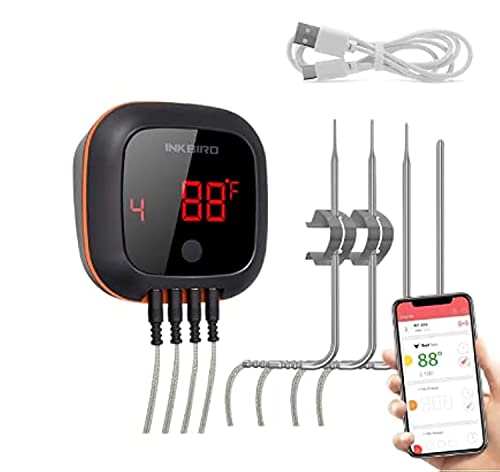
3. INKBIRD IBT-4XS Bluetooth Meat Thermometer — Best Value Multi-Channel Monitor
As a pit monitor, the IBT-4XS’s four channels are its whole charm: dedicate channel one to a grate-level pit probe and the remaining three cover a brisket flat, its point, and a pork butt — the classic full smoker load — all reporting to one app over a Bluetooth link rated at 150 feet. The rechargeable base, with its backlit display and magnetic mount, lives on the smoker itself, so the pit’s vital signs are readable at a glance even before you reach for your phone.
It suits the data-hungry home pitmaster and the learner building a mental model of their cooker, at the most accessible position in this guide. The Bluetooth-only link is its boundary: keep the phone within honest range, which for most house-and-yard layouts the rating covers comfortably. Probe cables cross the seal, as with all wired systems — route them once, carefully, and the IBT-4XS will quietly supervise hundreds of cooks.
Strengths
- Four channels: pit plus three foods
- Rechargeable, magnetic, backlit base station
- Value pricing for multi-channel monitoring
Trade-offs
- Bluetooth only — no WiFi reach
- Cables cross the smoker seal
- Open-air range rating shrinks indoors
| Specification | Detail |
|---|---|
| Probes | 4 probes |
| Range | 150 ft (maker rating) |
| Base | Rechargeable, LED backlit, magnetic |
The pit channel is the education: graph a full cook and you will see your smoker’s true cycle — the overshoot after lighting, the sag before refueling, the stall-era stability — rendered as a line. Cooks who study three of those graphs stop fighting their fire and start scheduling it.
Ownership note: label the four probes at the connector end on day one; multi-probe systems punish improvisation at 2 a.m. and reward boring consistency.
Best for: Home pitmasters wanting pit + multi-meat data on a budget / Not suited for: Cooks needing monitoring from beyond Bluetooth range
Check on Amazon — check the current price on Amazon and confirm the configuration before ordering.

4. MEATER Block WiFi Smart Meat Thermometer — Best Standalone Wireless System
The MEATER Block is the wireless system for cooks who want monitoring independence: four wireless probes housed in a bamboo charging block that itself carries a display and a standalone mode, so the system reports temperatures at the pit without any phone at all — and adds long-range WiFi when you do want the app, plus conveniences like watch and voice-assistant compatibility. At a crowded event or a competition, a glanceable block beside the smoker serves the whole crew, not just the phone’s owner.
It suits hosts, competitors, and multi-cut cooks who want wireless freedom at four-probe scale. Each probe reports meat and ambient, so four probes sketch the chamber as well as the food. The trades are the flagship ones: a premium position, four probes to keep charged and accounted for, and ambient readings taken at each probe’s location rather than from a dedicated pit probe. As a complete, self-contained monitoring station, nothing else in this guide matches its independence.
Strengths
- Four wireless probes with a standalone display block
- Works without a phone; WiFi when you want the app
- Ambient sensing at every probe position
Trade-offs
- Premium system price
- Four probes to charge and track
- No single dedicated grate-probe channel
| Specification | Detail |
|---|---|
| Probes | 4 wireless probes |
| Mode | Standalone mode with display |
| Connectivity | WiFi, long range |
| Extras | Bamboo charging block |
Standalone mode quietly changes event cooking: the block sits on the prep table calling temperatures to anyone who glances at it, while the app keeps the record. For team cooks and big family events, that shared visibility prevents the six people asking the pitmaster for updates every twenty minutes.
Ownership note: the block’s standalone display makes it the household’s shared instrument — park it where the crew passes, not in a drawer with the owner’s phone habits.
Best for: Hosts and teams wanting phone-free, four-probe wireless monitoring / Not suited for: Solo single-cut cooks (a single probe serves better)
Check on Amazon — check the current price on Amazon and confirm the configuration before ordering.
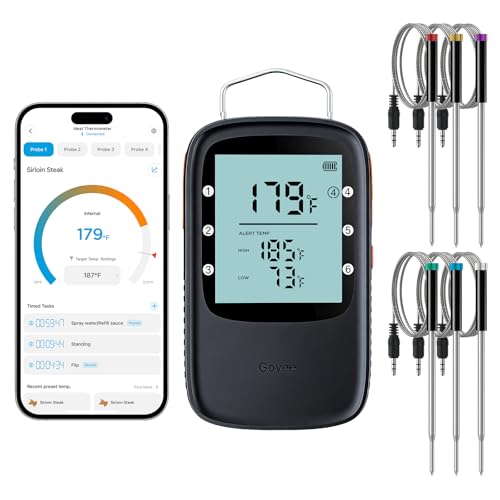
5. Govee Bluetooth Meat Thermometer, 6 Probes — Best Channel Count for Crowd Cooks
Monitoring a truly full smoker is a channel-count problem, and the Govee is the channel-count answer: six probes over a Bluetooth link rated at 230 feet, with app timers and alerts and free data storage for reviewing cooks afterward. Dedicate one channel to grate-level pit air and five remain for food — enough for the holiday load that defeats four-probe systems. The base’s backlit LCD keeps the essentials visible at the pit between phone checks.
It suits the crowd cook and the methodical learner: the stored data turns every cook into a record you can compare against the next, which is how pit habits actually improve. Cable management is the standing cost — six wired probes reward a fixed routing and labeling system — and Bluetooth’s real-world range applies here as everywhere. For loads of one or two cuts it is more system than you need; for the cooks that define a family’s year, it is the right size.
Strengths
- Six channels cover pit plus a full crowd load
- Data storage supports cook-to-cook learning
- 230 ft maker-rated Bluetooth with app alerts
Trade-offs
- Six cables need a labeling and routing system
- Oversized for small everyday cooks
- Bluetooth range is an open-air rating
| Specification | Detail |
|---|---|
| Probes | 6 probes |
| Range | 230 ft (maker rating) |
| Display | Smart LCD backlight |
| App | Timers, alerts, data storage |
Use the spare channel creatively: a second pit probe at the far end of the chamber maps your gradient, turning the Govee into a diagnostic tool for baffle and tuning experiments. That is monitoring as craft, and it is where a six-channel system earns its drawer space.
Ownership note: export or screenshot your best cook graphs before app updates and phone changes; your history is a training asset and it deserves a backup.
Best for: Crowd cooks and data-driven learners / Not suited for: Minimalists cooking one cut at a time
Check on Amazon — check the current price on Amazon and confirm the configuration before ordering.

6. CHEF iQ Sense Smart Wireless Thermometer (2-Probe, Gen3) — Best Guided-Cooking Wireless System
The CHEF iQ Sense approaches monitoring as coaching: two ultra-thin wireless probes — thin matters, because a slender probe leaves a smaller mark in delicate cuts and slices of brisket — each carrying five sensors, rated heat-safe to 1000°F, and connected over WiFi with unlimited range in the sense that your network, not a radio hop, sets the limit. The app’s guided cooking is the personality: it estimates, prompts, and walks a cook toward a finish time, which newer smokers experience as having a calm friend watching the graph with them.
It suits learners who want guidance as much as data, and cooks whose monitoring happens from genuinely far away — WiFi systems do not care which building you are in. Two probes serve the common two-cut smoker load; ambient sensing rides along with each probe. If your style is raw data and manual judgment, the Signals’ instrument approach may suit you better; if you want the system to help you learn while it monitors, the Sense is the most encouraging teacher in this guide.
Strengths
- Ultra-thin probes with five sensors each
- WiFi monitoring without backyard range limits
- Guided cooking app coaches timing and doneness
Trade-offs
- Two probes cap very large loads
- Guidance-forward app may exceed what data purists want
- Wireless probes must respect the heat rating near flames
| Specification | Detail |
|---|---|
| Probes | 2 ultra-thin wireless probes |
| Sensors | 5 sensors per probe |
| Heat rating | 1000°F heat safe |
| Connectivity | WiFi |
Let the guidance run your first few cooks end-to-end, then compare its calls against your own judgment as the season progresses. The Sense’s real product is the intuition it builds in its owner — after a dozen guided briskets and butts, you will find you need the coaching less, which is the mark of a teaching tool that works.
Ownership note: let the guided system run the whole cook a few times before overriding it — its estimates are trained on more cooks than any of us will ever run, and the disagreements are where the learning lives.
Best for: Learners wanting guided, WiFi-based monitoring / Not suited for: Data purists wanting a bare instrument interface
Check on Amazon — check the current price on Amazon and confirm the configuration before ordering.
Comparison Table
Use this table to narrow the best bluetooth thermometer for smokers list to two or three finalists, then read those full reviews above. The key specification column only uses details confirmed in the manufacturer’s Amazon listing title, so it stays honest even where a maker publishes fuller spec sheets elsewhere.
| Pick | Badge | Key spec | Best for |
|---|---|---|---|
| ThermoWorks Signals BBQ Alarm Thermometer Check price | Best Overall Pit Monitor | WiFi + Bluetooth, multi-channel pit monitoring | Serious cooks wanting anywhere monitoring of pit and food |
| MEATER Pro Duo WiFi & Bluetooth Thermometer Check price | Best Wireless Two-Probe System | 2 wireless probes, 6 sensors, WiFi + Bluetooth | Two-cut and rotisserie cooks wanting wireless WiFi monitoring |
| INKBIRD IBT-4XS Bluetooth Meat Thermometer Check price | Best Value Multi-Channel Monitor | 4 channels, 150 ft Bluetooth, rechargeable base | Home pitmasters wanting pit + multi-meat data on a budget |
| MEATER Block WiFi Smart Meat Thermometer Check price | Best Standalone Wireless System | 4 wireless probes, standalone block, WiFi | Hosts and teams wanting phone-free, four-probe wireless monitoring |
| Govee Bluetooth Meat Thermometer, 6 Probes Check price | Best Channel Count for Crowd Cooks | 6 channels, 230 ft Bluetooth, cook data storage | Crowd cooks and data-driven learners |
| CHEF iQ Sense Smart Wireless Thermometer (2-Probe, Gen3) Check price | Best Guided-Cooking Wireless System | 2 thin wireless probes, 5 sensors, WiFi | Learners wanting guided, WiFi-based monitoring |
How to Choose the Best Bluetooth Thermometer for Smokers
Decide what you are monitoring first: the food, the pit, or — as this guide recommends — both, deliberately. A system earns the title of pit monitor only if a channel can live at grate level full-time, whether that is a wired probe on a clip or a wireless probe’s ambient end stationed in a cut. Count your channels against your biggest regular load plus one for the pit: two-cut cooks need three channels to do this properly, which is why the four-channel systems anchor this guide’s value end and the six-channel Govee anchors its capacity end.
Then choose your radio by your geography. Bluetooth serves the classic yard-and-house layout and keeps setup trivial, but its ratings are open-air numbers that shrink through steel and walls. WiFi systems — Signals, the MEATER Pro Duo and Block, the CHEF iQ Sense — replace that arithmetic with your network’s coverage and add monitoring from genuinely anywhere, which matters for cooks that run while you work, shop, or sleep across the house. If your smoker lives at the edge of Bluetooth plausibility, do not negotiate with physics; buy WiFi.
Finally, weigh the unglamorous system costs: replacement probe price and availability, app update history, alarm flexibility, and whether the maker treats thermometers as its core business. A monitor supervises hundreds of dollars of meat per cook; its own reliability and support are worth more than any single feature, and the makers in this guide were chosen with that ledger in mind.
Setting Up Pit Monitoring That Actually Tells the Truth
A pit probe tells the truth only from the right address: clipped to the grate, a few inches from the food, in open air. Too close to the wall reads the wall’s radiation; dangling near the stack reads the draft; resting on the grate reads the steel. Wireless ambient sensors read where the meat is, which is arguably the most honest address of all — but remember they report one neighborhood, and a big chamber has several. On large offsets, two air readings (or one air probe moved between cooks) will map a gradient that explains years of ‘mystery’ unevenness in a single afternoon.
Alarms deserve the same care as placement. Set the pit low alarm to catch a fading fire while recovery is still easy — typically a modest drop below your band, not a collapse — and the high alarm above the normal refueling spike so it only cries wolf when a wolf exists. Alarm fatigue is real: a monitor that nags falsely gets muted, and a muted monitor is furniture. Tune alarms over your first three cooks until they are boring, then trust them with your sleep.
Reading the Graph: What Your Smoker Is Trying to Tell You
The temperature graph is the most educational object in barbecue. A healthy charcoal cook draws a recognizable signature: a climb, a small overshoot, a long steady band with gentle saw-teeth at each refuel, and the meat’s own plateau at the stall. Deviations are diagnoses. A slow downward creep across hours is fuel exhaustion arriving early — your loads are small or your coal is ashing over. Sharp spikes after every door opening mean the fire is air-starved and gulping when fed. A band that widens week by week can be a probe drifting — which is why the seasonal ice-water check in our mistakes section matters.
Keep the history. The systems here that store cook data let you compare this brisket against the last one with the weather noted, and that comparison habit — not any single gadget — is what turns smoking from an art of anecdotes into a repeatable craft. After five logged cooks, you will predict your smoker’s behavior in new weather instead of discovering it, and your guests will taste the difference as consistency.
From Data to Instinct: A Season With a Pit Monitor
The first month with a pit monitor is revelation: your smoker’s lid gauge is optimistic, the fire sags before refueling by more than you thought, and the stall lasts exactly as long as it lasts. The second month is calibration — of alarms, of fuel loads, of your own expectations — as the graphs turn surprises into patterns. By the third month, something subtler happens: you start predicting the graph before you look at it. You know what this wind does, what this coal load does at hour six, when this brisket will stall. The monitor has stopped being a crutch and become a teacher whose lessons you have absorbed.
That arc is the real return on any pick in this guide, and it is why we urge keeping the history turned on and reviewing it. The cooks who plateau in barbecue are usually the ones cooking from memory and anecdote; the cooks who keep improving are the ones with records. A pit monitor, used this way, is less an accessory than a training program that happens to prevent ruined briskets while it teaches.
Sharing the Watch: Monitoring for Teams, Families, and Events
Monitoring changes social cooking as much as technique. At an event, a shared display or a second phone with the app ends the era of one anxious pitmaster answering ‘how’s the brisket?’ forty times — the data is simply visible, and the crew can rotate the watch like any other duty. At home, alarms distributed to a partner’s phone mean the overnight cook survives one person sleeping through a notification. Several systems here support exactly that sharing through their apps or standalone displays, and it is worth setting up before the first big cook rather than during it.
There is a courtesy layer, too: a monitor makes your cooking legible to the people learning from you. A teenager or a friend watching the graph while you explain the stall is receiving the best barbecue education ever devised — real data, real food, real time. If your smoker life includes teaching, choose a system whose display and app make the invisible visible to more eyes than yours.
Building a Monitoring Setup That Grows With You
Start where your cooks are, not where your ambitions point. A household smoking a butt or a brisket most weekends is fully served by a four-channel wired system or a two-probe wireless one, with one channel married to the pit. That setup, learned deeply over a season, teaches more than a flagship system skimmed for a year — because monitoring skill is interpretation, and interpretation is built from repetitions on familiar gear. Resist upgrading until you can name the specific information your current system cannot give you: range beyond the yard, two more channels for the holiday load, a standalone display for the crew. Those sentences, when you can say them, are your upgrade specification.
When you do expand, expand compatibly. A second system that shares probes, chargers, or an app with the first halves the learning and the drawer clutter; a blower controller from our companion guide pairs with any of these thermometers as an independent cross-check, and that pairing — one system governing the fire, another auditing it — is the architecture serious cooks converge on. Keep the old unit when you upgrade: a backup thermometer on brisket night is not clutter, it is insurance with a probe.
Maintain the system like the instrument it is: probes verified seasonally, cables inspected when you coil them, batteries and firmware tended on calm days, and the whole kit stored together in one place so that cook day begins with cooking rather than searching. The households whose monitoring actually improves their barbecue are not the ones with the most channels; they are the ones whose gear is always ready, always verified, and always read by someone who kept the history.
That is the endpoint this guide is really selling — not a product, but a practice: a smoker whose behavior you know, a record that proves it, and food whose quality stopped being a surprise a long time ago.
Monitoring Etiquette: Alarms, Phones, and Sleep
A monitoring system shares your house, so tune it like a housemate. Set notification sounds you will recognize instantly but that will not train the whole household to dread brisket night, and use your phone’s scheduled-focus features deliberately: the pit’s alarms should break through, and nothing else should. If a partner shares the overnight watch, put the app on their phone too and agree whose alarm is primary — duplicated alarms with no agreement produce two tired people and one ignored brisket.
Finally, protect the phone itself: a phone face-down on a greasy prep table, or dead by 3 a.m. because it streamed graphs all evening, is a monitoring failure with a human cause. Charge it, place it deliberately, and let the system do the watching it was bought to do.
How to Set Up a Bluetooth Thermometer for Pit and Meat Monitoring
This setup sequence gives you trustworthy pit and food data from any system in this guide, wired or wireless.
- Verify the probes first. Stir each probe in ice water and confirm a near-freezing reading; a monitor you have verified is a monitor you can believe at hour ten.
- Assign channels before the cook. Channel one is always pit air; the rest follow a fixed order for meats. Consistency turns data into intuition.
- Place the pit probe at grate level. Clip it near the food, clear of walls, steel contact, and the direct draft path to the stack.
- Insert meat probes at the center of the thickest muscle. Clear of bone and fat seams, placed once before the lid closes.
- Position the base, block, or relay for its best signal. Near the smoker, up high, dry, with the clearest path toward where you and your phone will be.
- Set alarms asymmetrically. Pit low alarm close enough to catch a fading fire early; pit high alarm above normal refuel spikes; meat alarms as tenderness-check summons, not finish lines.
- Do a signal walk before the food goes on. Phone in hand, visit the rooms you will occupy — kitchen, couch, bedroom — and confirm live data in each.
- Review the graph after the cook. Five minutes with the history, one note about fuel or weather, and the next cook starts smarter.
That final review step is the one most owners skip and the one that compounds. Monitoring hardware is common; cooks who study their own data are rare, and they are the ones whose barbecue keeps getting better year after year.
Common Buying Mistakes
Monitoring only the meat and never the pit
Most ruined cooks are pit events — a faded fire, a runaway — discovered through the meat an hour too late. A dedicated pit channel is the earliest warning system in barbecue; use one.
Mounting the pit probe where it reads the wrong air
Against a wall, in the stack draft, or touching steel, a pit probe reports fiction with total confidence. Grate level, near the food, in open air — placement is accuracy.
Setting alarms so tight they cry wolf
Alarms that fire at every refueling spike train you to ignore alarms. Widen them to catch real events only, and the one night they sound, you will move like you mean it.
Believing the lid gauge over your probe — or vice versa, blindly
They measure different places and both can drift. Verify probes seasonally in ice water, learn your smoker’s personal offset between gauge and grate, and then trust the verified instrument at the food.
Losing the data after the cook
Deleting or ignoring cook history throws away the tuition you just paid in fuel and hours. Skim the graph, note one lesson, and let the record build your intuition.
Final Recommendation
For the most complete monitoring in this guide, the ThermoWorks Signals remains the professional standard — WiFi certainty, multi-channel discipline, alarms that mean business. The MEATER Pro Duo and Block bring that monitoring into the wireless world at two and four probes, the CHEF iQ Sense adds genuine coaching, the Inkbird IBT-4XS delivers pit-plus-food data at the friendliest price, and the Govee covers the fullest smokers with channels to spare. Choose by your load size and your geography, and every pick here will make your smoker legible.
That legibility is the real product. A smoker you can read is a smoker you can repeat, and repeatability — brisket as good as last time, on purpose — is the whole point of putting a thermometer on the pit.
Close with the simplest test of whether a monitoring system was worth buying: three months from now, will your barbecue be more repeatable than it is today? The systems in this guide all pass that test when they are used as this guide describes — a channel married to the pit, alarms tuned to real events, history kept and skimmed, probes verified like instruments. None of them passes it from inside a drawer. So the real recommendation is procedural, not commercial: pick the system your load size and geography point to, install it on the next cook rather than the perfect cook, and start the record now. Barbecue knowledge compounds exactly like the data does — quietly, cook over cook, until one day a friend asks how your brisket comes out the same every time, and you realize the honest answer is that you stopped guessing a long time ago. That is the moment every pick in this guide is ultimately selling, and it is worth every probe it takes to get there.
Start with the shortlist: ThermoWorks Signals BBQ Alarm Thermometer — Check on Amazon; MEATER Pro Duo WiFi & Bluetooth Thermometer — Check on Amazon; INKBIRD IBT-4XS Bluetooth Meat Thermometer — Check on Amazon.
Keep exploring the cluster: Best Bluetooth Meat Thermometer For Smokers Best Bbq Smokers Under $1000 Best Blower Kit For Offset Smokers Best Bbqs And Smokers Best Bbq Wood Smokers
Frequently Asked Questions
What is the difference between this and a meat thermometer?
Emphasis. A meat thermometer centers on the food’s internal temperature; a smoker thermometer system also dedicates a channel to the pit air at grate level, with alarms and history for the chamber itself. The best setups — and every pick here — do both, because cooks fail from the pit side more often than the meat side.
Where exactly should the pit probe go?
Clipped to the cooking grate, a few inches from the food, in open air — not touching steel, walls, or the food itself, and out of the direct path to the exhaust. That position reads the environment your food actually cooks in.
Is WiFi worth it over Bluetooth for a smoker?
If your smoker is far from your living space, your house eats Bluetooth, or your cooks run while you are out, yes — WiFi removes the range question entirely. For a compact yard-and-house layout, Bluetooth systems serve perfectly well at lower complexity.
How many channels do I need for pit monitoring?
Your biggest regular meat load plus one for the pit. Two cuts means three channels minimum done properly; the four-channel systems here are the sweet spot for most households, and six serves full holiday loads.
Can wireless probes really monitor pit temperature?
Yes — their ambient end reads the air at the meat’s location, which many pitmasters consider the most relevant pit temperature of all. What they cannot do is report a second location across a large chamber; big offsets benefit from a wired grate probe as well.
How often should I verify my thermometer?
Seasonally, or whenever a reading surprises you: ice water should read near freezing, and boiling water near boiling at your altitude. A two-minute check protects every cook that follows it.
What is a good first cook to learn a pit monitor on?
A pork butt on a Saturday, started in the morning. It is long enough to show you the full graph — startup overshoot, steady band, stall, finish — forgiving enough that your attention can go to the data instead of rescuing dinner, and cheap enough that the lesson costs little if the day goes sideways. Log the vent and fuel events beside the graph and you will finish the day knowing your smoker measurably better than you did at breakfast.


