Disclosure: airfryerkitchensupply.com is reader-supported. When you buy through links on our site, we may earn an affiliate commission at no extra cost to you.
Where to buy
The fastest way to compare the best bluetooth meat thermometer for smokers in this guide is on Amazon, where each verified pick below links straight to its product page so you can check the current price on Amazon, confirm the exact configuration, and read the full manufacturer listing before you commit. Stock and configurations on smokers and smoker accessories shift through the season, so confirm dimensions, fuel type, and included accessories on the listing itself rather than relying on any roundup — including this one.
Every thermometer below was verified through Amazon’s catalog before earning a link. Range claims are the makers’ figures from the verified listings — real-world range through a steel smoker and house walls is always shorter, which the reviews discuss honestly.
- MEATER Pro Smart Meat Thermometer — Check the current price on Amazon
- INKBIRD IBT-4XS Bluetooth Meat Thermometer — Check the current price on Amazon
- MEATER Plus Smart Meat Thermometer — Check the current price on Amazon
- ThermoWorks Signals BBQ Alarm Thermometer — Check the current price on Amazon
- Govee Bluetooth Meat Thermometer, 6 Probes — Check the current price on Amazon
- TempPro TempSync Bluetooth Meat Thermometer — Check the current price on Amazon
A thermometer is the difference between smoking meat and guessing at it, and the best bluetooth meat thermometer for smokers removes the last excuse for guessing: it watches the meat and the pit continuously and reports to your phone. The best bluetooth meat thermometer for smokers has to survive a specific gauntlet — probes that live in a hot, greasy, smoky chamber for twelve hours, a signal that must escape a steel box and reach a phone indoors, and alarms that must wake you when a brisket finishes early or a fire fades at 4 a.m. Ordinary kitchen thermometers fail that gauntlet in ways that only appear mid-cook, which is why this category deserves its own guide.
We verified six picks through Amazon’s catalog data, spanning the two design families: truly wireless probes that live entirely inside the meat and transmit from within the smoker, and wired-probe base stations that trade a cable for brute signal reliability and multi-probe capacity. Both families earn places here because smokers’ needs differ — a wireless probe is liberation on a rotisserie and a rib rack, while a four-probe base station is command central for a brisket-plus-butts cook. Each review states its pick’s real range behavior and its honest limitation.
In this guide
Quick Picks
If you only read one section, make it this one. These are the six best bluetooth meat thermometer for smokers we would point a friend toward, each with a clear job. The detailed reviews further down explain the reasoning, the trade-offs, and who should skip each one.
- MEATER Pro Smart Meat Thermometer — Best Overall Wireless Probe. A fully wireless probe rated to 1000°F with long range and certified accuracy — the single-probe benchmark for smokers. Check the current price on Amazon.
- INKBIRD IBT-4XS Bluetooth Meat Thermometer — Best Multi-Probe Value. Four wired probes, a 150 ft Bluetooth link, rechargeable base with a backlit display and magnetic mount — the brisket-and-butts command station. Check the current price on Amazon.
- MEATER Plus Smart Meat Thermometer — Best Single-Probe Simplicity. The original wireless-probe formula with a 165 ft Bluetooth range via its charger relay, in a walnut-finish charger block. Check the current price on Amazon.
- ThermoWorks Signals BBQ Alarm Thermometer — Best Pro-Grade WiFi + Bluetooth. A four-channel alarm thermometer with WiFi and Bluetooth from the maker professionals trust — built for serious smoker duty. Check the current price on Amazon.
- Govee Bluetooth Meat Thermometer, 6 Probes — Best for Very Large Cooks. Six probes, a 230 ft Bluetooth rating, app timers and alerts, and data storage — maximum coverage for crowd cooks. Check the current price on Amazon.
- TempPro TempSync Bluetooth Meat Thermometer — Best Long-Range Budget Pick. Two probes and a headline 450 ft Bluetooth rating — the range-per-dollar pick for spread-out yards. Check the current price on Amazon.
How These Picks Were Chosen
We chose by smoker-specific criteria, not kitchen criteria. Heat tolerance came first: a probe inside a smoker must withstand hours at cooking temperatures and the occasional flare when a lid opens, so we favored designs whose verified listings state high heat resistance or smoker duty explicitly. Second, signal architecture: Bluetooth range figures are measured in open air, and a steel smoker is a radio shadow, so designs that relay, repeat, or park a base station near the pit earned credit. Third, the app: alarms you can customize, a graph you can read at a glance, and doneness guidance that helps rather than nags.
Every product was cross-checked — brand and model searched, listing title matched, ASIN taken only from the verified result — and the spec boxes quote only those verified titles: probe counts, stated ranges, and heat ratings as the makers publish them. No prices or fixed ratings appear anywhere in this guide; thermometer prices move with sales, so each pick links to a live check. We also weighted probe replacement availability, because a probe is a consumable in a smoker’s life and a thermometer whose probes cannot be replaced is a disposable with good marketing.
And a brief note for gift buyers, because thermometers from this guide are bought as presents as often as for oneself: a thermometer is one of the few barbecue gifts that improves every cook its recipient already makes, fits every smoker they own, and asks nothing of their yard, budget, or storage. Match the architecture to their habits — wireless for the brisket devotee, multi-probe for the holiday host — and you have given them better barbecue for years, which is more than can be said for another bottle of sauce.
The 6 Best Bluetooth Meat Thermometers for Smokers

1. MEATER Pro Smart Meat Thermometer — Best Overall Wireless Probe
The MEATER Pro is what the wireless thermometer category promises when it works: a single probe with no cable at all — the sensor lives in the meat, the transmitter in the probe’s end — rated to 1000°F of heat resistance, with Bluetooth long range and certified accuracy, and an app that estimates finish times and manages resting. In a smoker, cable-free matters more than anywhere: no cable crossing the door seal leaking smoke, no cable to snag when you rotate a brisket, nothing between you and a clean spritz.
It suits the cook whose typical load is one hero cut — a brisket, a butt, a prime rib — cooked with full attention to that one result. The Pro’s heat rating gives it flare-up headroom that first-generation wireless probes lacked, and its app guidance genuinely helps newer smokers time a meal. Its honest limits are the single-probe ones: one probe means one cut monitored (plus its ambient reading), so multi-meat cooks need either more probes or a different pick below.
Strengths
- Fully wireless — no cable through the smoker door seal
- 1000°F heat resistance gives real flare-up headroom
- Certified accuracy with finish-time estimates in the app
Trade-offs
- One probe monitors one cut at a time
- Bluetooth range shrinks through steel and walls — keep the phone reasonably near
- Premium position among single probes
| Specification | Detail |
|---|---|
| Heat resistance | 1000°F |
| Connectivity | Bluetooth, long range |
| Accuracy | Certified accuracy |
| Use | Smoker, grill, oven, air fryer, sous vide |
Insert it past the safety line into the thickest part of the cut, keep the ambient end clear of direct flame paths, and the Pro disappears into the cook — which is the highest praise a thermometer can earn. For the brisket-only household, this is the pick we would buy first and replace last.
Ownership note: keep the probe’s ambient end out of the direct drip line of a brisket — a fat-coated sensor reads its own little weather, not the pit’s.
Best for: Single-hero-cut cooks wanting true wireless freedom / Not suited for: Multi-meat cooks needing several probes at once
Check on Amazon — check the current price on Amazon and confirm the configuration before ordering.
2. INKBIRD IBT-4XS Bluetooth Meat Thermometer — Best Multi-Probe Value
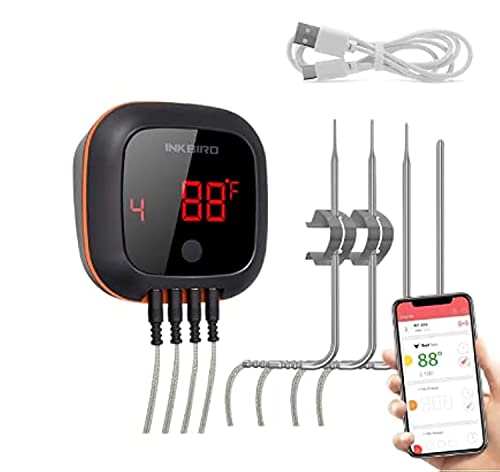
The IBT-4XS is the wired-probe philosophy at its best value: a rechargeable base station with an LED backlit display and a magnetic back for sticking to the smoker’s leg, four probes so the pit and three cuts all report at once, and a Bluetooth link rated at 150 feet to the app. On a real smoker cook — brisket flat, brisket point, pork butt, pit air — four probes is not excess; it is the difference between knowing and assuming, and this unit delivers it at the friendliest position in this guide.
It suits multi-meat cooks, learners who want data from everywhere while they build intuition, and anyone whose smoker sits within honest Bluetooth distance of the house. The wired probes cross the door seal — route them through the stack-side gap or a probe port if your smoker has one, and accept the whisper of smoke leak as the format’s standing trade. Inkbird’s app handles alarms and graphs competently, and replacement probes are easy to source, which matters in year two.
Strengths
- Four probes cover pit plus three cuts simultaneously
- Rechargeable base with backlit display and magnetic mount
- 150 ft Bluetooth rating with app alarms and graphs
Trade-offs
- Wired probes must cross the smoker seal
- Bluetooth range is open-air rating — walls shorten it
- Probe cables need care to avoid kinks and door pinches
| Specification | Detail |
|---|---|
| Probes | 4 probes |
| Range | 150 ft (maker rating) |
| Base | Rechargeable, LED backlit, magnetic |
| Use | Grill, smoker, oven, drum |
Label your probes by position and keep the same probe in the same role every cook; consistent placement turns raw numbers into intuition within a season. Judged as information per dollar for a working smoker, nothing in this guide beats the IBT-4XS.
Ownership note: the magnetic base will live on your smoker; wipe its back and the mounting spot occasionally, because grease films defeat magnets slowly and then suddenly.
Best for: Multi-meat cooks wanting maximum data at a value price / Not suited for: Cable-haters and rotisserie cooks (go wireless)
Check on Amazon — check the current price on Amazon and confirm the configuration before ordering.

3. MEATER Plus Smart Meat Thermometer — Best Single-Probe Simplicity
The MEATER Plus refines the original wireless probe with a trick smokers appreciate: its wooden charger block doubles as a Bluetooth relay, extending the working range to a maker-rated 165 feet when the block sits near the smoker. That relay architecture answers the wireless category’s core problem — a probe transmitting from inside a steel box — by giving the signal a nearby partner before the long hop to your phone. The probe itself reads both the meat and the ambient pit temperature, and the app’s guided cooks walk newer smokers through setup to slicing.
It suits the one-cut cook who wants the cleanest possible workflow: probe in, lid down, phone out. The walnut charger looks at home on a kitchen counter, charges the probe between cooks, and keeps the whole system to two objects. Choose the Pro above it if you need the higher heat ceiling for searing-adjacent work; choose the Plus for the classic smoking life of briskets, butts, ribs, and chickens at honest smoking temperatures, where its relay range is the more useful gift.
Strengths
- Charger block relays Bluetooth for a 165 ft maker-rated range
- Fully wireless probe reads meat and ambient temperature
- Guided cook system helps newer smokers time meals
Trade-offs
- Single probe, single cut
- Relay block must stay near the smoker for best range
- Lower heat ceiling than the Pro model
| Specification | Detail |
|---|---|
| Range | 165 ft (maker rating, via relay) |
| Connectivity | Bluetooth |
| Probe | Wireless, dual-sensor |
| Charger | Walnut block, doubles as relay |
Park the charger block on the smoker’s side shelf — close to the probe, in sight of the house — and the Plus delivers the most forgiving range behavior of the single wireless probes here. It remains the easiest recommendation in this guide for a first wireless thermometer.
Ownership note: charge the Plus’s probe in its block after every cook as a ritual — a wireless system that is always charged is a system that is always used.
Best for: First-time wireless buyers cooking one cut at a time / Not suited for: High-heat searing cooks (choose the Pro)
Check on Amazon — check the current price on Amazon and confirm the configuration before ordering.

4. ThermoWorks Signals BBQ Alarm Thermometer — Best Pro-Grade WiFi + Bluetooth
ThermoWorks is the name caterers and competition teams reach for when a thermometer absolutely cannot be the weak link, and Signals is its smoker flagship: a BBQ alarm thermometer with both WiFi and Bluetooth, multiple channels for pit and food probes, and alarms designed to be heard and heeded. WiFi is the differentiator for smokers — your brisket reports from the pit to your phone anywhere your network reaches, not merely within Bluetooth’s backyard radius, which changes overnight cooking from a proximity hobby into a supervised process.
It suits serious cooks, competitors, and anyone whose smoker sits far from the house or whose cooks run while life happens elsewhere. The wired-probe architecture is the reliability-first choice: no transmitter cooking inside the chamber, probes that are individually replaceable, and a base built like test equipment. The trade is the professional one — a professional price position and a utilitarian interface that values function over flair. For cooks whose meat budget justifies it, Signals is the end of the thermometer search.
Strengths
- WiFi plus Bluetooth removes range anxiety entirely
- Multi-channel alarm design built for BBQ duty
- Professional build, calibration pedigree, replaceable probes
Trade-offs
- Premium price position
- Wired probes cross the smoker seal
- Utilitarian interface over app polish
| Specification | Detail |
|---|---|
| Connectivity | WiFi and Bluetooth |
| Type | BBQ alarm thermometer |
| Channels | Multi-channel (pit + food) |
Set the pit channel’s high and low alarms generously — wide enough to ignore normal cycling, tight enough to catch a dying fire — and Signals becomes the night watchman of your smoker. This is the pick we would hand a caterer whose reputation rides on a brisket, without a moment’s hesitation.
Ownership note: buy one spare probe in your second season, before you need it; Signals owners who cater treat probes as the consumables they are and never lose a cook to a cable.
Best for: Serious, competition, and catering cooks needing WiFi range / Not suited for: Budget buyers or single-probe minimalists
Check on Amazon — check the current price on Amazon and confirm the configuration before ordering.
5. Govee Bluetooth Meat Thermometer, 6 Probes — Best for Very Large Cooks
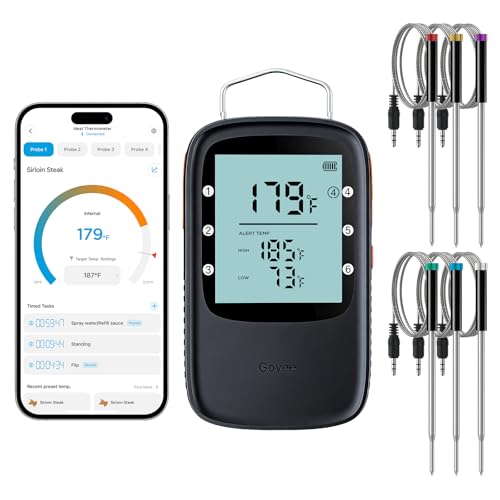
When the smoker holds two briskets, a butt, a rack of ribs, and a chicken, four probes stop being enough — and that is the Govee’s entire argument: six probes reporting through a Bluetooth link rated at 230 feet, with app timers and alerts, a backlit LCD on the base, and free data storage so you can review how a cook actually went. For the household that cooks big on holidays and hosts, probe count is not a spec-sheet flourish; it is the difference between monitoring the whole load and spot-checking the parts you can reach.
It suits event cooks and data lovers, and its per-probe value is remarkable in this guide. The honest trades: managing six wired probes is cable choreography that must be planned (label them, route them together, keep them out of the door’s bite), and Bluetooth’s open-air rating shrinks against a steel smoker and house walls like every pick here. If your cooks are single-cut, this is overkill; if your smoker regularly looks like a deli case, it is the only pick sized to your life.
Strengths
- Six probes monitor an entire crowd-size load
- 230 ft Bluetooth rating (maker figure) with app alerts
- Data storage lets you review and learn from past cooks
Trade-offs
- Six cables demand deliberate routing and labeling
- Overkill for single-cut cooks
- Base-station format keeps you within Bluetooth reality
| Specification | Detail |
|---|---|
| Probes | 6 probes |
| Range | 230 ft (maker rating) |
| Display | Smart LCD backlight |
| App | Timers, alerts, data storage |
Adopt a fixed probe map — probe one always pit, two always brisket, and so on — and write it on the base with a marker. Six channels of consistent data across a season will teach you your smoker’s hot spots and your cuts’ habits faster than any other tool in this guide.
Ownership note: write your probe map on the base in marker — six channels only help if channel four is always the same thing.
Best for: Crowd cooks running full smokers on holidays and events / Not suited for: Single-cut cooks who value simplicity
Check on Amazon — check the current price on Amazon and confirm the configuration before ordering.

6. TempPro TempSync Bluetooth Meat Thermometer — Best Long-Range Budget Pick
The TempSync’s proposition is printed in its name: a Bluetooth thermometer rated by its maker at 450 feet, with two probes for the classic pit-plus-meat or two-meat setup, aimed at grilling and smoking duty. Big properties, smokers parked at the yard’s far end, and houses that eat Bluetooth signals are its home turf. Two probes is the right count for the majority of smoker cooks — one hero cut and the pit air — and TempPro’s value position makes it the easiest pick here to justify as a first remote thermometer.
Treat the 450-foot figure the way you should treat every range claim in this guide: as an open-air best case. Through a steel smoker, across a yard, and into a house, expect a fraction of it — which is precisely why starting with the largest rating is a rational strategy for difficult layouts. It suits the spread-out household and the budget-conscious beginner; cooks needing four-plus probes or WiFi should step up to the Inkbird or the Signals above.
Strengths
- 450 ft maker-rated range suits large yards and distant smokers
- Two probes cover the classic pit-plus-meat setup
- Strong value position for a first remote thermometer
Trade-offs
- Real-world range is a fraction of the open-air rating
- Two probes cap multi-meat monitoring
- Bluetooth only — no WiFi fallback
| Specification | Detail |
|---|---|
| Probes | 2 probes |
| Range | 450 ft (maker rating) |
| Use | BBQ, oven, grill, smoker |
Do a range walk before your first big cook: probe in the running smoker, phone in your hand, walk your house and note where the signal holds. Knowing your own dead zones in advance turns range from a gamble into a plan — and on most properties, this TempPro covers the rooms that matter.
Ownership note: do the range walk again after any change — a new smoker position, a new phone, a metal shed where none stood — because range is a property of the whole layout, not the box.
Best for: Large yards and budget buyers wanting maximum rated range / Not suited for: Multi-meat cooks or WiFi seekers
Check on Amazon — check the current price on Amazon and confirm the configuration before ordering.
Comparison Table
Use this table to narrow the best bluetooth meat thermometer for smokers list to two or three finalists, then read those full reviews above. The key specification column only uses details confirmed in the manufacturer’s Amazon listing title, so it stays honest even where a maker publishes fuller spec sheets elsewhere.
| Pick | Badge | Key spec | Best for |
|---|---|---|---|
| MEATER Pro Smart Meat Thermometer Check price | Best Overall Wireless Probe | Wireless probe, 1000°F rated, Bluetooth | Single-hero-cut cooks wanting true wireless freedom |
| INKBIRD IBT-4XS Bluetooth Meat Thermometer Check price | Best Multi-Probe Value | 4 wired probes, 150 ft Bluetooth, rechargeable base | Multi-meat cooks wanting maximum data at a value price |
| MEATER Plus Smart Meat Thermometer Check price | Best Single-Probe Simplicity | Wireless probe, 165 ft relay range | First-time wireless buyers cooking one cut at a time |
| ThermoWorks Signals BBQ Alarm Thermometer Check price | Best Pro-Grade WiFi + Bluetooth | WiFi + Bluetooth, multi-channel alarms | Serious, competition, and catering cooks needing WiFi range |
| Govee Bluetooth Meat Thermometer, 6 Probes Check price | Best for Very Large Cooks | 6 probes, 230 ft Bluetooth, data storage | Crowd cooks running full smokers on holidays and events |
| TempPro TempSync Bluetooth Meat Thermometer Check price | Best Long-Range Budget Pick | 2 probes, 450 ft maker-rated Bluetooth | Large yards and budget buyers wanting maximum rated range |
How to Choose the Best Bluetooth Meat Thermometer for Smokers
Start with architecture, because it decides your whole experience. Truly wireless probes (the MEATER picks) put everything in the meat: no cables, no seal leaks, perfect for rotisseries and crowded grates — but one probe per cut and a signal that must escape the chamber. Wired base stations (Inkbird, Signals, Govee, TempPro) keep the electronics outside the heat, run four to six probes, and cost less per channel — at the price of cables crossing the door. Neither is better; they are tools for different cooks, and many serious households eventually own one of each.
Then discount every range claim by reality. Bluetooth figures are measured outdoors with clear sight lines; your signal must exit a steel box, cross a yard, and penetrate walls. Relay designs (the MEATER Plus’s charger block), base stations mounted high on the smoker, and WiFi models (Signals) are the three honest answers to that physics. If your smoker is far from where you spend cook time, buy WiFi or the longest-rated Bluetooth you can — and do a range walk with your own phone before the brisket that matters.
Finally, judge the app and the alarms, because at 4 a.m. they are the product. You want: custom high/low alarms for the pit channel, target alarms per meat probe, a clear temperature graph, and notifications that actually wake you. Probe replacement cost and availability belong in the decision too — a thermometer is a system you will maintain, and the makers in this guide all support their probes as replaceable parts.
Probe Placement: Where Accuracy Is Actually Decided
The best thermometer in this guide reads wrong if the probe sits wrong. For meat, the tip belongs in the geometric center of the thickest part, clear of bone and fat pockets — bone conducts heat and reads high, fat reads erratically, and a tip near the surface reads the cooker’s mood instead of the meat’s. On a brisket, probe the flat’s thick end at an angle; on a butt, beside but not touching the bone; on poultry, the inner thigh without touching the joint. For wireless probes, respect the maker’s insertion line: too shallow risks the electronics, too deep misses the center.
For pit temperature, the probe belongs at grate level, a few inches from the food — not above it in the stack draft, not against the wall, and never resting on the grate metal itself, which conducts. Clip it, keep it in the same spot every cook, and you will build the one dataset that matters: what your smoker’s air actually does where your food lives, as opposed to what its lid gauge claims.
Bluetooth vs WiFi for Smokers — and the Overnight Test
The overnight brisket is the exam every thermometer here must pass, so judge connectivity by it. Bluetooth serves the classic pattern — smoker in the yard, cook in the house, phone on the nightstand within honest range. It fails when distance, walls, or a metal-sided house intervene, and it fails silently if your phone sleeps the app. WiFi removes the distance question entirely and adds cloud history, at the cost of setup and dependence on your network. Relay-assisted Bluetooth, as on the MEATER Plus, is the thoughtful middle path for most suburban layouts.
Whichever you choose, rehearse before it matters: run a daytime cook with alarms set, confirm notifications wake your phone from sleep, and learn where your signal dies. A thermometer you have rehearsed with is equipment; one you unbox on brisket night is a hope.
Care, Calibration, and Making Probes Last
Probes die from abuse, not age, and the abuse is predictable: cables slammed in steel doors, cables kinked at the probe joint, transmitters and bases left out in rain, and probes plunged into cold water straight from a hot smoker. The care routine is correspondingly simple. Route cables once, gently, through the same path every cook. Wipe probes clean while they are warm, wash them as the maker directs, and never submerge a part the maker says to keep dry. Coil cables loosely for storage, charge wireless probes after cooks rather than letting them sit flat for months, and keep bases and blocks indoors between cooks.
Calibration is a two-minute seasonal habit: stir the probe in a glass of ice water and confirm it reads at or near freezing. A probe that has drifted tells you so during this test, in your kitchen, for free — instead of during the brisket, at hour nine, at a cost. Keep a note of each probe’s offset if it has a consistent one; consistent probes can be trusted with a correction, wandering probes should be replaced, and every maker in this guide sells replacements for exactly that reason.
Pairing a Thermometer With a Blower Controller
Thermometers and blower controllers — the subject of our companion guide — are natural partners, and many smokers run both: the controller governs the fire with its own pit probe, while an independent thermometer system watches the meat and cross-checks the chamber. That redundancy is not paranoia; it is how you catch a drifting probe or a controller chasing a badly placed sensor before the meat pays for it. When the two systems agree, cook with total confidence. When they disagree, believe the one whose probe placement you verified most recently, and investigate at the next natural lid opening rather than tearing the cook apart.
If you are buying in sequence, buy the thermometer first. It improves every cook on any smoker, teaches you your pit’s true behavior, and tells you whether your fire management actually needs a controller’s help. Many cooks discover their ‘temperature problem’ was a measurement problem all along — and the ones who still want the controller after a season of data buy it with clear eyes and a clear job for it to do.
Thermometer Techniques for Specific Cuts
Brisket is two muscles pretending to be one cut, and it thermometers accordingly: the flat cooks faster and dries sooner, the point forgives everything. Where you have two probes, give each muscle one and pull by the flat’s tenderness, not the point’s temperature. With a single wireless probe, the flat’s thick end is the address that matters — it is the slice your guests will judge. Either way, start probing for feel when the flat approaches the finishing zone; temperature schedules the check, tenderness signs the certificate.
Pork butt is the patient cut: probe beside the bone without touching it, expect a long stall, and judge doneness by the bone’s willingness to slide and the probe’s easy entry in several spots, because a butt is a committee of muscles that finish at slightly different moments. Ribs barely use thermometers at all — the bend test and bone pull-back are the instruments — but a pit probe earns its keep on rib cooks by holding the chamber honest, which is where rib texture is actually decided. Poultry is the safety cut: thigh at the joint, never touching bone, cooked to a safe temperature with carryover in mind, and rested so the juices you measured stay in the meat.
Fish, jerky, and the delicate end of the smoker’s repertoire reward the thin-probe and ambient precision of the better picks here: fish by gentle flake more than number, jerky by dryness and bend, cheese by keeping the chamber cool enough that temperature monitoring is the entire cook. Across all of it, the pattern holds — the thermometer’s job is to tell you when to start using your hands and eyes, and the cooks who internalize that pattern stop arguing with their equipment and start finishing like professionals.
Keep a one-line record per cut in your log — probe position, finishing behavior, result — and within a season your thermometer technique becomes personal in the best way: fitted to your smoker, your cuts, and your table’s taste, rather than copied from anyone’s chart.
What to Do When Readings Disagree
Sooner or later two instruments will disagree — the thermometer against the lid gauge, one probe against another, the number against your instincts. Work the disagreement like a checklist instead of an argument. First, placement: is one probe touching bone, steel, or a fat seam? Second, verification: which instrument last passed an ice-water check? Third, physics: is the ‘wrong’ reading actually measuring a different place — lid air versus grate air can honestly differ by a wide margin, and both can be telling the truth about their own neighborhood.
When the disagreement survives the checklist, trust the verified probe at the food and cook on, noting the incident in your log. Patterns matter more than incidents: a probe that disagrees once is a placement story; a probe that disagrees increasingly across a season is a replacement story, and catching that trend early is exactly what the log is for.
How to Use a Bluetooth Thermometer for an Overnight Brisket
This workflow turns any pick in this guide into a full night’s sleep with a brisket on the smoker.
- Charge and update everything the day before. Probes, base stations, and the app — no firmware surprises at midnight.
- Test the signal path first. With the smoker running, walk the phone to your bedroom and confirm a live reading before the meat ever goes on.
- Insert probes before the lid closes. Meat probe centered in the flat’s thick end, pit probe clipped at grate level nearby — placed once, then left alone.
- Set three alarms. Pit low (fire fading), pit high (runaway), and meat target (start checking tenderness) — the trio that covers every overnight failure mode.
- Keep the relay or base positioned deliberately. Charger blocks and base stations sit near the smoker, high and dry, with the clearest path toward the house.
- Let the graph teach you the stall. Watch the plateau arrive without opening the lid; the data replaces the peek, and the bark thanks you.
- Start tenderness checks at target, not by time. The alarm summons you; the probe’s feel decides. Technology schedules, hands judge.
- Rest and review. After slicing, look at the cook graph while it is fresh — where the fire dipped, when the stall broke — and note one improvement for next time.
Three overnight cooks run this way will recalibrate your instincts permanently. After that, the thermometer stops being a gadget you check and becomes the quiet confidence that lets you host brisket brunch without having lived on the patio since midnight.
Common Buying Mistakes
Trusting the headline range figure
Every range number in this category is an open-air measurement. Plan for a fraction of it through steel and walls, position relays and bases well, and rehearse the signal path before an important cook.
Probing next to bone or in a fat seam
Both lie — bone reads hot, fat reads strange — and both have ended briskets early. Center of the thickest muscle, every time, verified with a gentle reposition if a reading looks suspicious.
Cooking to temperature instead of tenderness
A thermometer tells you when to start checking, not when meat is done. Butts and briskets finish across a temperature range; the probe should slide in with almost no resistance. Numbers schedule the check; feel makes the call.
Letting cables take the door’s bite
Pinched probe cables are the leading cause of thermometer death in smokers. Route cables together through the gentlest path, keep them out of hinge lines, and never slam a steel door on them.
Skipping the ice-water sanity check
Once a season, stir a probe in ice water and confirm it reads near freezing. A drifting probe discovered during calibration costs nothing; discovered during a wedding brisket, it costs the brisket.
Final Recommendation
Buy the MEATER Pro if your smoker life is one great cut at a time and you want the finest wireless probe here; buy the MEATER Plus if you want that freedom with a relay’s range forgiveness. Buy the Inkbird IBT-4XS for multi-meat data at a value price, the Govee when your loads outgrow four probes, the TempSync when your yard is the problem, and the ThermoWorks Signals when the cook truly matters and WiFi certainty is worth a professional price. Every pick here will make your smoking measurably better within one cook.
Then use it on everything for a month — including the cooks you think you know by heart. The data will surprise you at least twice, and those surprises are the tuition this category charges for mastery.
A last word about what all this measurement is for. It is tempting, armed with graphs and alarms, to chase a perfectly engineered cook — and worth remembering that the thermometer’s highest purpose is the opposite of fussiness: it is permission to leave the smoker alone. Every hour you do not spend lifting the lid to check is an hour the bark sets undisturbed; every night the alarms stand watch is a night you arrive at the table rested enough to enjoy what you cooked. Buy the system that matches your loads and your layout, rehearse it once, verify it seasonally, and then let it fade into the background of your cooking where all good instruments belong. The brisket does not care how elegant your data is. Your guests will never see a graph. What they will taste is the calm consistency of a cook who knew — and knowing, could finally relax.
Start with the shortlist: MEATER Pro Smart Meat Thermometer — Check on Amazon; INKBIRD IBT-4XS Bluetooth Meat Thermometer — Check on Amazon; MEATER Plus Smart Meat Thermometer — Check on Amazon.
Keep exploring the cluster: Best Bbq Smokers Under $1000 Best Bbqs And Smokers Best Blower Kit For Offset Smokers Best Bluetooth Thermometer For Smokers Best Bbq Wood Smokers
Frequently Asked Questions
Do Bluetooth thermometers really work through a steel smoker?
Yes, with realistic expectations. The signal escapes through seams and the stack, and designs differ in how well they manage it — relay blocks, external base stations, and WiFi models handle it best. Expect less than the open-air rated range and position components thoughtfully.
Wireless probe or wired base station — which is better for smoking?
Wireless wins on freedom and rotisserie use; wired wins on probe count, price per channel, and keeping electronics out of the heat. Most cooks should start with the architecture matching their typical load: single cuts wireless, mixed loads wired.
How many probes do I actually need?
Two covers the classic setup — pit air plus one meat. Four covers a brisket (flat and point separately) plus a butt and the pit. Six is for full holiday loads. Buy for your biggest regular cook.
Can I leave a wireless probe in the smoker for a whole brisket?
That is what the picks here are designed for — but respect each model’s heat rating, keep the probe’s ambient end out of direct flame, and never exceed the stated limit during searing or flare-ups. The MEATER Pro’s high heat rating exists precisely for headroom.
Why does my thermometer read differently from my smoker’s gauge?
Because they measure different places. The lid gauge reads hot air near the lid; your probe reads grate level beside the food. Trust the probe at the food — and consider the difference your smoker’s personal offset, worth noting for future cooks.
How do I make probes last?
Keep cables unpinched and unkinked, wipe probes clean after cooks, never submerge parts the maker says to keep dry, and store probes straight rather than coiled tight. Treat them as instruments and they will serve for years.
Should my first thermometer be wireless or wired?
Match it to your typical cook. One hero cut at a time, or any rotisserie work, argues for a wireless probe and the freedom it gives. Mixed loads — a brisket plus a butt plus the pit — argue for a wired multi-probe base, which also costs less per channel. Neither choice locks you out of the other later; most experienced smokers eventually own one of each and use them for different cooks.


