Disclosure: airfryerkitchensupply.com is reader-supported. When you buy through links on our site, we may earn an affiliate commission at no extra cost to you.
Where to buy
If you are shopping for the best beginner cookware sets, start here: every set in this guide is sold on Amazon, and beginner sets are frequently bundled in slightly different piece counts and colours, so check the exact configuration on the listing before you order. If you want one safe first purchase, start with the Cuisinart Chef’s Classic 11-piece set; if you know you want nonstick and lots of pieces for the money, look at the T-fal Ultimate Hard Anodized 17-piece set; and if your kitchen is tiny, the stackable CAROTE 21-piece detachable-handle set solves the storage problem first and the cooking problem second.
Prices on beginner cookware move constantly with promotions, so this guide never prints a fixed price. Use the links throughout the article to check the current price on Amazon for the exact set you are comparing, and remember that a set’s piece count includes lids and utensils, not just pots and pans.
Introduction
Searching for the best beginner cookware sets usually means you are stocking a first kitchen, replacing a worn-out hand-me-down pan collection, or finally cooking at home enough that one skillet and one saucepan no longer cut it. The beginner market is genuinely crowded: stainless steel sets that last decades sit next to nonstick sets that are forgiving for the first two years and ceramic sets that look beautiful in photos. The honest starting point is that there is no single right material for a beginner. There is only the right match between how you actually cook, how much maintenance you will honestly do, and how much storage you have.
This guide picks six sets that cover the realistic beginner profiles: a stainless all-rounder, a big nonstick bundle, a tri-ply upgrade, a detachable-handle set for small kitchens, a ceramic nonstick option, and a disc-base stainless set with the friendliest handles in the group. Every set below was verified against Amazon’s own catalogue data before it earned a link, and the buying guide further down explains the trade-offs in plain language so you can overrule our ranking with confidence if your cooking looks different from the average beginner’s.
In this guide
Quick Picks
1. Cuisinart Chef’s Classic Stainless Steel 11-Piece Set (77-11G) — Best Overall. A stainless set with an aluminium disc base, cool-grip handles and induction compatibility — the learn-once, keep-for-years default for a first kitchen.
2. T-fal Ultimate Hard Anodized Nonstick 17-Piece Set — Best Nonstick Bundle. Seventeen pieces of hard-anodized nonstick, including the extras most bundles skip — the easiest possible first month of cooking.
3. Tramontina Tri-Ply Clad Stainless Steel 10-Piece Set — Best Upgrade Pick. Fully clad tri-ply construction at a starter-set budget — the set beginners graduate to, bought first.
4. CAROTE 21-Piece Pots and Pans Set with Detachable Handles — Best for Small Kitchens. Handles click off, pans nest into a single stack, and the whole set doubles as oven dishes and storage containers.
5. GreenLife 16-Piece Ceramic Nonstick Cookware Set — Best Ceramic Nonstick. A ceramic-coated aluminium set for beginners who want nonstick convenience without a traditional nonstick coating.
6. Calphalon Classic Stainless Steel 10-Piece Set — Best Everyday Stainless. Impact-bonded bases, stay-cool handles and oven safety to 450°F — the big-brand stainless set with the friendliest ergonomics here.
How These Picks Were Chosen
We chose these six sets by starting from the questions beginners actually ask after their first month of cooking: Will eggs stick? Can I put it in the oven? Does it work on my stove? How much cupboard does it eat? Each candidate set was checked for a sensible spread of vessels — at least two skillets, two saucepans, and a larger pot for pasta and soup — because a beginner set that lacks a stockpot or a second skillet fails at ordinary weeknight cooking no matter how good the coating is.
Every product recommended with a link in this article was verified against the manufacturer’s own listing title, so the piece counts and materials quoted here come from the listing itself rather than from round-up sites copying each other. We deliberately excluded sets built around novelty colours, celebrity branding with no construction behind it, and ultra-cheap unbranded bundles whose coatings have no track record. Where a tier is thin — genuinely good cast iron beginner sets, for example — we say so rather than padding the list.
The 6 Best Beginner Cookware Sets

1. Cuisinart Chef’s Classic Stainless Steel 11-Piece Set (77-11G) — Best Overall
The Chef’s Classic 77-11G is the set we point to when a beginner says ‘just tell me what to buy.’ It is stainless steel, which means nothing about it is fragile: no coating to baby, no special utensils, and no expiry date on the cooking surface. The aluminium disc bonded into each base spreads heat well enough for everyday cooking, and the handles are shaped to stay comparatively cool on the stovetop.
It suits beginners who expect to still be cooking in five years and want one purchase to cover that span. It is a harder first month than nonstick — eggs and fish demand a bit of technique — but the technique is learnable in a week, and the payoff is a set that never needs replacing because a coating wore out.
Strengths
- Stainless cooking surface never wears out, peels or needs replacing
- Induction compatible, so it survives a future stove change
- Cool-grip handles and a sensible spread of everyday vessels
Trade-offs
- Disc base heats less evenly up the sidewalls than fully clad sets
- Eggs and delicate fish stick until you learn preheating and fat timing
- Shiny stainless shows water spots and needs a wipe to look its best
| Pieces | 11 |
| Material | Stainless steel with aluminium disc base |
| Induction compatible | Yes |
| Handles | Cool-grip stainless |
What makes this set beginner-appropriate rather than just cheap is the forgiveness of its sizing. The saucepans are big enough to boil pasta water for two without sloshing, the sauté pan takes a full chicken breast layout, and the stockpot handles soup batches that smaller ‘starter’ sets force you to split. Beginners outgrow undersized sets faster than they outgrow materials, and this one is sized for real meals from day one.
The honest limitation is the disc base. On a wide burner turned up high, the sidewalls of the skillet run cooler than the centre, so a pan sauce reduces unevenly if you never move the pan. For the way beginners actually cook — soups, pasta, stir-fries, pan-fried proteins at medium heat — it is a non-issue, and it is exactly the compromise that keeps this set in the starter tier instead of the upgrade tier occupied by the Tramontina below.
Best for: first-time buyers who want one durable set for all everyday cooking / Not suited for: anyone who wants eggs to slide around with zero technique from day one
Check the current price on Amazon

2. T-fal Ultimate Hard Anodized Nonstick 17-Piece Set — Best Nonstick Bundle
If the Cuisinart is the buy-it-for-life answer, the T-fal Ultimate is the make-cooking-easy answer. Hard-anodized aluminium bodies heat quickly and evenly enough for weeknight cooking, the nonstick surface forgives every beginner mistake from dry pans to scrambled eggs, and the 17-piece count means the box includes the griddle, steamer and utensils that other sets make you buy separately.
It suits beginners who are building cooking habits and know that friction kills habits. When cleanup takes thirty seconds, you cook again tomorrow. The trade is lifespan: every nonstick coating is a consumable, and this set should be bought with the understanding that the skillets are on a multi-year clock, not a lifetime one.
Strengths
- Genuinely nonstick surface makes eggs, fish and sauces stress-free
- Generous 17-piece bundle covers specialty pieces other sets omit
- Hard-anodized bodies are sturdier than cheap painted aluminium sets
Trade-offs
- Coating is a consumable — expect skillet replacement in a few years
- Not the set for high-heat searing or broiler finishing
- Piece count includes utensils and lids, so read the contents list
| Pieces | 17 |
| Material | Hard-anodized aluminium |
| Surface | Nonstick |
T-fal’s beginner-friendly detail is heat indication: the brand’s Thermo-Spot style indicators and even-heating bases take the guesswork out of preheating, which is the single skill that separates beginners who burn food from beginners who don’t. Combined with riveted handles that feel secure with a full pan, the set is engineered around the first six months of cooking rather than around spec-sheet bragging.
Treat the coating properly — medium heat, no aerosol sprays, no metal utensils — and the pans stay slick for years. Abuse it on maximum heat and it will go the way of every abused nonstick pan. For a beginner whose alternative is ordering takeaway because cooking feels like a chore, this set is the pragmatic choice, and there is no shame in the pragmatic choice.
Best for: new cooks who prioritise easy food release and fast cleanup / Not suited for: buy-it-for-life shoppers or high-heat searing enthusiasts
Check the current price on Amazon

3. Tramontina Tri-Ply Clad Stainless Steel 10-Piece Set — Best Upgrade Pick
The Tramontina Tri-Ply Clad is the set experienced cooks recommend when a beginner has a slightly bigger budget and no interest in buying twice. Instead of an aluminium disc only in the base, aluminium runs through the entire body — base and sidewalls — sandwiched between stainless layers. The result is the even, responsive heating people associate with far more expensive clad cookware.
It suits the beginner who already enjoys cooking, cooks most nights, and wants the set to keep up as skills grow. Ten pieces sounds modest next to the T-fal’s seventeen, but every piece here is a vessel you will use weekly, and the construction quality is a clear class above disc-base sets.
Strengths
- Fully clad tri-ply body heats evenly up the sidewalls
- Performs like sets costing far more; a genuine buy-once option
- Stainless surface sears, deglazes and browns beautifully
Trade-offs
- Ten pieces means fewer specialty vessels in the box
- Heavier than nonstick sets, especially the larger pans when full
- Same stainless learning curve for eggs and delicate foods
| Pieces | 10 |
| Construction | Tri-ply clad stainless steel |
| Core | Aluminium, full-body |
The practical difference shows up in sauces and grains. A disc-base pan can scorch a ring of rice at the base edge while the centre simmers; the clad Tramontina heats its sidewalls, so the whole pot behaves like one thermal unit. Beginners burn fewer things in clad pans without knowing why, which quietly makes this the easiest stainless set to learn on despite its ‘upgrade’ label.
If your budget stretches to exactly one splurge in a first kitchen, this is where experienced cooks put it — ahead of knives, ahead of gadgets. Pans are the tool you touch every single meal, and this set removes cookware as a variable for a decade or more.
Best for: beginners with a bigger budget who want to buy once and grow into the set / Not suited for: shoppers who need maximum piece count or nonstick convenience
Check the current price on Amazon

4. CAROTE 21-Piece Pots and Pans Set with Detachable Handles — Best for Small Kitchens
The CAROTE set solves the problem that actually dominates small first kitchens: not cooking, but storage. Every pan shares detachable handles that clip on for stovetop use and come off for stacking, so twenty-one pieces nest into roughly the footprint of one ordinary stockpot. For studio apartments, dorms, RVs and anyone whose ‘pantry’ is one deep drawer, that is transformative.
The pans are induction compatible and oven safe once the handles are off, which turns each pan into a baking dish and each saucepan into a fridge container with a lid. It is a clever system first and a cookware set second — but the cooking itself, nonstick eggs-and-pancakes weeknight fare, is perfectly competent.
Strengths
- Detachable handles let the whole set nest into one compact stack
- Pans convert to oven dishes and lidded fridge storage
- Induction compatible and dishwasher safe for low-effort routines
Trade-offs
- Nonstick coating carries the usual lifespan limits
- Clip-on handles feel less planted than fixed riveted handles when pans are full
- Not built for very high-heat searing or heavy daily abuse
| Pieces | 21 |
| Handles | Detachable, shared |
| Induction compatible | Yes |
| Oven safe | Yes, handles removed |
Living with the system teaches you its rhythm quickly: handle on to cook, handle off to serve, stack, store. The failure mode to avoid is treating the clip mechanism casually with a full, heavy pan — always support the base when moving a loaded vessel, the same advice that applies to any pan but matters more here. Within those limits, owners in tight spaces consistently rate the reclaimed cupboard as worth more than any spec on the box.
Choose this set when square footage, not searing performance, is your binding constraint. A beginner in a small apartment who can actually store and reach their pans will cook more than one whose premium set lives in an inaccessible pile.
Best for: apartment, dorm and RV cooks with minimal storage / Not suited for: anyone wanting heavy, fixed-handle pans for high-heat work
Check the current price on Amazon

5. GreenLife 16-Piece Ceramic Nonstick Cookware Set — Best Ceramic Nonstick
GreenLife built its name on ceramic nonstick: a sand-derived coating on aluminium bodies, marketed to buyers who want easy release while avoiding conventional nonstick coatings. The 16-piece set wraps that pitch in a complete beginner bundle — skillets, saucepans, a stockpot and utensils — in a soft-touch, stay-cool handle design that feels friendly from the first meal.
Ceramic coatings release food beautifully when new, and eggs genuinely slide. The honest caveat every beginner should hear: ceramic nonstick loses its slickness faster than quality conventional nonstick, typically becoming a merely decent pan rather than a slippery one over time. Bought with eyes open, as an affordable and pleasant starter set, it makes sense.
Strengths
- Ceramic coating gives easy release without a conventional nonstick surface
- Lightweight aluminium bodies are easy for new cooks to handle
- Complete 16-piece bundle with utensils included
Trade-offs
- Ceramic slickness fades faster than premium conventional nonstick
- Aluminium bodies are not the induction-friendly option in this guide
- Bright coatings can stain with high-heat oils and spices
| Pieces | 16 |
| Material | Aluminium |
| Surface | Ceramic nonstick |
The cooking experience in month one is excellent: omelettes fold, rice doesn’t cement, and cleanup is a wipe. The set’s soft-grip handles stay comfortable, and the light weight matters more than spec sheets suggest for beginners who are still building wrist confidence with full pans. Where the set asks for care is heat discipline — ceramic coatings age fastest under repeated maximum-heat use, so medium heat and a little patience extend its life significantly.
Position it in your mind as a two-to-four-year starter set with a pleasant, low-fuss personality, not as an heirloom. At its tier, that is a fair trade, and it is the right pick for beginners whose top priority is a coating choice they feel good about.
Best for: beginners who prefer ceramic nonstick and cook mostly at medium heat / Not suited for: induction owners or anyone expecting a decade of slick performance
Check the current price on Amazon
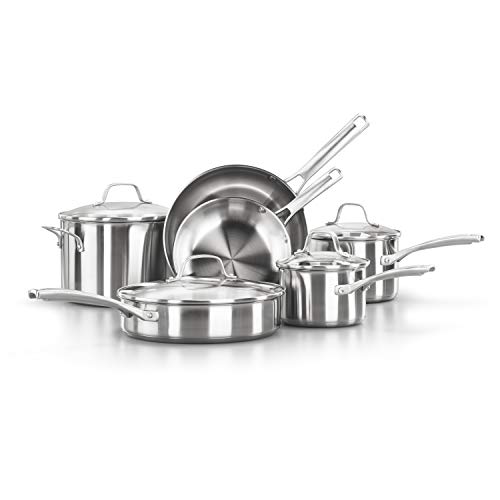
6. Calphalon Classic Stainless Steel 10-Piece Set — Best Everyday Stainless
Calphalon’s Classic stainless set takes the same disc-base formula as the Cuisinart and polishes the details: an impact-bonded aluminium base for even heating, long stay-cool handles, and measuring marks and pour-friendly shaping on the saucepans that beginners genuinely appreciate when following recipes. Oven safety to 450°F means a pan can start on the stove and finish in the oven without a second thought.
It suits beginners who want stainless durability but found raw stainless sets a bit austere. Between this and the Cuisinart, the cooking performance is close; the Calphalon wins on handle comfort and little usability touches, the Cuisinart on its 11-piece configuration and induction compatibility.
Strengths
- Stay-cool long handles are the most comfortable in this roundup
- Oven safe to 450°F for stove-to-oven recipes
- Impact-bonded base heats evenly for everyday cooking
Trade-offs
- Disc base, so sidewall heating trails fully clad sets
- Check induction compatibility for your specific stove before buying
- Stainless learning curve applies, as with the Cuisinart
| Pieces | 10 |
| Material | Stainless steel, impact-bonded aluminium base |
| Oven safe | Up to 450°F |
| Handles | Stay-cool stainless |
Ergonomics sound boring until you are carrying a full pot of pasta water across a kitchen. The Calphalon handles — long, rounded and genuinely cooler at the grip point — reduce the two most common beginner accidents: the fumbled pan and the grabbed-hot-handle burn. Add etched measurement markings inside the saucepans and you get a set designed by people who watched beginners cook.
As a long-term proposition it sits in the same durable class as the Cuisinart: the stainless surface cannot wear out, and the bonded base is a proven construction. Pick between them on stove type and handle feel, and you will not go wrong either way.
Best for: beginners who value handle comfort and stove-to-oven flexibility / Not suited for: induction households that have not confirmed base compatibility
Check the current price on Amazon
Comparison Table
| Pick | Badge | Key spec | Best for |
|---|---|---|---|
| Cuisinart Chef’s Classic Stainless Steel 11-Piece Set (77-11G) | Best Overall | 11-piece stainless, disc base, induction ready | Most beginners, long-term value |
| T-fal Ultimate Hard Anodized Nonstick 17-Piece Set | Best Nonstick Bundle | 17-piece hard-anodized nonstick bundle | Easy-release cooking, big households |
| Tramontina Tri-Ply Clad Stainless Steel 10-Piece Set | Best Upgrade Pick | 10-piece fully clad tri-ply stainless | Buy-once quality on a budget |
| CAROTE 21-Piece Pots and Pans Set with Detachable Handles | Best for Small Kitchens | 21-piece nonstick, detachable handles, nests flat | Tiny kitchens and RVs |
| GreenLife 16-Piece Ceramic Nonstick Cookware Set | Best Ceramic Nonstick | 16-piece ceramic nonstick on aluminium | Ceramic-coating preference |
| Calphalon Classic Stainless Steel 10-Piece Set | Best Everyday Stainless | 10-piece stainless, oven safe 450°F | Ergonomics and everyday ease |
How to Choose a Beginner Cookware Set
Start with your stove, not with the pans. Induction burners only heat pans with a magnetic base, so an induction household should filter for induction-compatible sets first — in this guide that points you to the Cuisinart, the Tramontina or the CAROTE. Gas and radiant electric are forgiving and accept every set here. Glass-top owners should favour flat, heavy bases that sit flush and don’t skate.
Next, be honest about your maintenance personality. Stainless steel asks for a little technique and rewards you with a surface that lasts indefinitely. Conventional nonstick asks for gentle heat and soft utensils and rewards you with effortless eggs for a few years. Ceramic nonstick sits between: pleasant and easy, with slickness that fades sooner. None of these is the ‘correct’ answer; the correct answer is the one matching the cook you actually are on a tired Tuesday.
- Decide your material first — it determines lifespan, care and cooking feel more than brand does
- Count vessels, not pieces: lids and utensils inflate the number on the box
- Check you get two skillets, two saucepans and one large pot at minimum
- Confirm oven-safe temperature if you finish dishes under heat
- Measure your largest burner and your storage space before ordering
Stainless vs Nonstick vs Ceramic: A Beginner’s Plain-Language Guide
Stainless steel is a skill surface. Food sticks at first contact, then releases as it browns — which is why stainless sears meat better than any coating. The beginner mistakes are a pan that is too cold (food welds on) and impatience (prying before the crust forms). Learn the preheat-and-wait rhythm and stainless becomes the most versatile surface you own, safe for metal utensils, deglazing, the oven and the dishwasher.
Nonstick is a convenience surface. It trades ultimate searing and lifespan for a guarantee that breakfast will not become a scrubbing project. Modern hard-anodized nonstick, like the T-fal in this guide, is tougher than the flimsy pans that gave nonstick a bad name, but the coating still defines the product’s life. Ceramic nonstick is the third way: a mineral-based coating with excellent early release and a gentler ingredient story, ageing faster than conventional nonstick. Choose with your eyes open and each surface serves a beginner well.
What the Piece Count Really Means
Manufacturers count every lid and utensil as a piece, so a 17-piece set may contain nine actual vessels. When comparing sets, list the vessels: skillet sizes, saucepan sizes, whether a stockpot or Dutch oven is included, and whether lids are shared between pieces. A beginner’s daily cooking uses a medium skillet, a small saucepan and a large pot for the overwhelming majority of meals; sets that double down on those, like the Cuisinart and Calphalon here, serve better than sets padded with novelty pieces.
Also weigh what is missing. Most beginner sets omit a dedicated egg pan, a grill pan and bakeware — correctly, since those are second purchases. Buy the core set now, cook for three months, and let your actual habits tell you which single extra pan to add. That sequence saves more money than any sale.
Budget Tiers for Beginner Sets, Explained Honestly
Beginner sets fall into three broad tiers, and the keyword framing matters more than any single brand. In the budget tier you get thin aluminium or basic disc-base stainless: perfectly cookable, with handles and lids that feel a step down and bases that punish high heat. The GreenLife and CAROTE sets in this guide live at the friendly end of this tier, where design thought compensates for material cost. Expect this tier to be a two-to-five-year purchase for the most-used pieces.
The mid tier is where this guide concentrates, because it is where value peaks: hard-anodized nonstick with real substance, impact-bonded stainless, and entry tri-ply. The Cuisinart, T-fal and Calphalon sets all sit here. Construction is honest, warranties are meaningful, and the cooking experience is close to premium for everyday meals. The premium tier — fully clad sets like the Tramontina and beyond — buys even heating, heavier build and heirloom lifespan. Beginners who cook daily can justify it; beginners still deciding whether they like cooking should start mid-tier and upgrade with knowledge.
Handles, Lids and Rims: The Details Beginners Notice Daily
Spec sheets talk about materials; daily cooking talks about handles. A handle that stays cool, fills the hand and doesn’t twist under a full pan prevents more ruined dinners than any coating. In this guide the Calphalon and Cuisinart handles are the standouts, while the CAROTE’s clip-on system trades some solidity for its storage magic. When you compare sets in person or in photos, look at how the handle joins the body: rivets you can clean around beat mystery welds, and a helper handle on the big pot is worth real money.
Lids matter more than beginners expect. Glass lids let you watch rice and sauces without lifting and losing steam, but they cap oven temperature and can chip at the rim; stainless lids are tougher and oven-proof but blind. Several sets here mix both approaches across pieces. Finally, check the rim: a flared, rolled rim pours sauces and pasta water without the drip down the outside that plagues straight-sided cheap pans. These are small things — and you will touch them every single day you own the set.
The Three Pans to Add After Your First Set
A beginner set is a foundation, not a finished kitchen. After a few months of cooking, three additions cover almost every gap owners report. First, a cast iron skillet: it sears steaks, bakes cornbread and survives heat that no set pan should face, and it lasts generations. Second, a small nonstick egg pan if you chose a stainless set — breakfast insurance that costs little and gets used daily. Third, a large roasting or sheet pan setup for the oven, since set cookware is stovetop-centric and oven cooking is where weeknight cooking gets easier.
Resist buying these on day one. Your first set will teach you what you actually cook, and the right second purchase for a stir-fry enthusiast (a wok) is wrong for a soup enthusiast (a bigger Dutch oven). The sets in this guide are chosen to leave those doors open rather than to lock you into one brand’s ecosystem.
How These Six Sets Handle the Five Meals Beginners Cook Most
Fried eggs and omelettes separate the guide into two camps instantly. The T-fal, CAROTE and GreenLife release eggs with no technique at all; the Cuisinart, Tramontina and Calphalon demand a properly preheated pan and a film of fat, then release cleanly once the whites set. If breakfast is your main meal, weight the nonstick camp heavily. If breakfast is occasional, the stainless camp’s advantages everywhere else outweigh one fussy meal.
Pasta and grains reward capacity and lid fit. Every set here boils pasta water competently, but the stainless sets’ heavier bases hold a steadier simmer for rice and sauces, and their lids seal better for absorption cooking. Searing — chicken thighs, pork chops, burgers — is stainless and clad territory: the Tramontina browns deepest, the Cuisinart and Calphalon close behind, while the coated pans should stay at medium heat and produce gentler colour. Stir-fries favour the Tramontina’s responsive clad skillet and the T-fal’s easy release for sauced proteins. Soups and one-pot meals are a tie across the guide, decided by stockpot size rather than material, which is why we weighted vessel spread so heavily when choosing these six.
Matching a Set to Your Kitchen: Storage, Stove and Household Size
Measure before you buy: the largest skillet in most sets needs a burner and a cupboard that fit it, and a stockpot needs a shelf with real vertical clearance. Apartment cooks with one deep drawer should look seriously at the CAROTE’s nesting system, while cooks with a pot rail or open shelving can let the stainless sets live on display, where they genuinely look good. Households of one or two can thrive on a 10-piece set; families of four or five should favour the bigger bundles — the T-fal’s 17 pieces or the Cuisinart’s 11 — because two skillets running at once is a normal Tuesday, not a special occasion.
Also think about who else cooks. A set shared with teenagers or housemates will be abused: put through dishwashers, heated empty, and scraped with whatever utensil is nearest. Stainless survives that household; coatings suffer in silence and then fail. In shared kitchens, the Cuisinart’s boring durability is a feature, and the money saved on replacements buys the communal egg pan everyone actually fights over.
Warranties, Replacement Pieces and the True Cost of a Set
A beginner set’s price is not its cost. The real figure is cost per year of service, and that is where the materials diverge sharply. A stainless set from this guide — Cuisinart, Tramontina or Calphalon — has no scheduled replacement: divide its price by fifteen or twenty years and it is the cheapest cookware you can buy. A nonstick set divides by the life of its coating, realistically three to five years for the skillets, less for a set used daily on high heat. Neither answer is wrong, but run the arithmetic before deciding which tier ‘saves money.’
Practical ownership details matter too. Check whether the brand sells individual replacement pieces and lids — Cuisinart, Calphalon and Tramontina all have long retail track records, which is part of why they anchor this guide. Keep your receipt and register the set if the brand offers it; warranty claims on bonded bases and handle welds do happen and are painless with proof of purchase. And when a nonstick skillet does reach the end, replace just the skillet rather than the whole set: the saucepans and stockpot, which live gentler lives, are usually still going strong.
Cleaning and Care by Material: What Actually Wears a Set Out
Stainless steel rarely wears out; it just accumulates cosmetic evidence. The rainbow heat tint wipes away with vinegar, white mineral spots vanish with a splash of acid in the rinse, and stubborn browned oil yields to a baking-soda paste and patience. What actually kills stainless pans is warping from thermal shock — a screaming-hot pan plunged into cold water — so let every pan cool on the stove before it meets the sink. Do that and the Cuisinart, Tramontina and Calphalon in this guide are effectively permanent.
Coated pans die by a thousand small cuts: metal utensils, stacking without protection, aerosol cooking sprays whose additives bake into a gummy film, and the dishwasher’s harsh detergents and knocking racks. Hand-wash nonstick and ceramic with a soft sponge, store them with a liner between surfaces, and keep them at medium heat. None of this is burdensome — it is ninety seconds of habit per meal — but it is non-negotiable if you want the T-fal, CAROTE or GreenLife sets to reach the far end of their expected life instead of the near end.
How to Set Up and Use a New Cookware Set in Its First Week
Unbox and wash everything in warm soapy water before first use to remove manufacturing residue, then run this simple first-week plan to learn your set’s personality:
- Day one: boil salted water in the largest pot and cook pasta — you learn boil speed and lid fit with zero risk
- Day two: fry eggs at medium heat in a skillet; on stainless, preheat first, add fat, then eggs, and wait for the edges to set before moving them
- Day three: sear chicken thighs skin-side down and do not touch them for five minutes — the release when the crust forms teaches you how your surface works
- Day four: make a pan sauce by deglazing with stock or wine after searing; stainless and clad pans shine here
- Day five: simmer a soup or sauce for thirty minutes to learn your burner’s low-end behaviour with each saucepan
Care rules that apply to every set in this guide: let pans cool before washing to protect bases from warping, dry stainless promptly to avoid water spots, keep nonstick and ceramic at medium heat for daily cooking, and store pans with a cloth or paper layer between stacked nonstick surfaces. Five minutes of habit in week one is what separates a set that looks new in year three from one that looks tired in month six.
One more first-week habit worth building: learn each pan’s empty weight and balance before it is full of boiling water. Pick up every vessel with its intended load in mind, practise the two-hand lift on the stockpot, and note which handles need a towel even off the heat. Beginners burn themselves on unfamiliar cookware far more often than experienced cooks expect, and ten unhurried minutes of handling during setup week quietly prevents most of it. By the end of the week you should know which pan you reach for without thinking — that instinct is the real beginning of cooking confidence, and it only comes from a set whose pieces fit your hands, your stove and your cupboards.
Common Buying Mistakes
Buying the biggest piece count. A 21-piece box padded with utensils and duplicate lids is not more cookware than a focused 10-piece set of real vessels. Compare vessel lists, not headline numbers.
Cranking every burner to maximum. Beginners equate heat with speed. Most cooking happens at medium; maximum heat warps bases, ages coatings and burns food in every material.
Ignoring your stove type. An aluminium set on an induction hob is a sculpture, not a pan. Confirm compatibility before ordering, not after unboxing.
Expecting nonstick to be forever. Every coating is a consumable. Buy nonstick for convenience with a replacement horizon in mind, or buy stainless for permanence — but choose deliberately.
Skipping the large pot. Sets without a stockpot fail at pasta night, soup batches and corn season. The big pot looks optional in the box and is essential by month two.
Final Recommendation
If you want one recommendation: buy the Cuisinart Chef’s Classic 11-piece set. It is induction-ready, durably built, sensibly sized, and its stainless surface will still be cooking when every coating in this guide has retired. Beginners willing to spend a little more for a lot more pan should skip straight to the Tramontina Tri-Ply Clad, the genuine buy-once option. If easy release matters more than longevity, the T-fal Ultimate bundle is the friendliest first month in cooking, and small kitchens should look hard at the CAROTE detachable-handle system before buying anything that needs a cupboard. Ceramic loyalists get a fair, affordable deal in the GreenLife set, and anyone who prioritises comfortable handles and stove-to-oven ease will be happy with the Calphalon Classic.
Whichever set you choose, check the current price on Amazon through the links above before ordering, confirm the piece list matches the configuration you expect, and give yourself the first-week plan in this guide. A beginner set is not a lifetime commitment to a material — it is the tool that teaches you how you cook.
Keep exploring: Best Cast Iron Cookware Sets Best Anodized Cookware Sets Best Affordable Nonstick Cookware Sets Best Backpacking Cookware Sets
Frequently Asked Questions
What cookware material is best for a complete beginner?
There are two good answers. Nonstick is best if you want cooking to feel easy immediately and accept replacing skillets in a few years. Stainless steel is best if you can spend one week learning preheating and want a set that lasts indefinitely. Most beginners who cook daily end up happiest with stainless plus one nonstick skillet.
How many pieces does a beginner actually need?
Five vessels cover nearly everything: a medium and a large skillet, a small and a medium saucepan, and a large stockpot, plus lids. Boxed sets count lids and utensils as pieces, so a 10- to 12-piece set usually contains exactly that core. Bigger counts mostly add specialty pieces you may use monthly.
Are expensive beginner sets worth it?
Up to a point. The jump from the cheapest sets to the mid-tier buys real construction — clad bodies, bonded bases, better handles — that you feel every meal. Beyond the Tramontina-level of this guide, extra money buys refinement rather than capability, and beginners are better served saving it for a good knife.
Can beginner cookware sets go in the oven?
Stainless sets in this guide can, with the Calphalon rated to 450°F. Nonstick and ceramic sets have lower and more variable limits, and detachable-handle sets like the CAROTE are oven safe only with handles removed. Always confirm the rating on the specific listing before a pan goes under a broiler.
How do I stop food sticking to stainless steel?
Preheat the dry pan over medium heat until a flick of water beads and dances, then add oil, let it shimmer, and add food. Then wait: protein releases itself once a crust forms. Most ‘stainless sticks’ complaints are a cold pan, cold oil, or food moved thirty seconds too early.
When should a beginner replace a cookware set?
Replace nonstick when food starts sticking in the centre of the pan or the coating is visibly damaged. Replace any pan, in any material, when the base warps enough to spin or rock on the burner. Stainless vessels themselves rarely need replacing — which is the entire argument for learning on them.
Should a beginner buy a set or individual pans?
A set, almost always, for the first purchase: the per-piece cost is far lower than buying individually, the lids are guaranteed to fit, and you start with a coherent core. Buy individual pans afterwards to fill the gaps your cooking reveals — a cast iron skillet, a wok, a bigger Dutch oven. The exception is the confident cook who already knows they want clad stainless; even then, the Tramontina set in this guide beats piecing together equivalents.
Do beginner sets work on glass-top stoves?
Yes, provided the bases are flat and you lift rather than drag them. Every set in this guide has a machined, flat base suited to glass tops. Avoid sliding cast iron or rough-based pans across the surface, keep the cooktop clean so grit doesn’t grind under a hot pan, and match pan diameter to the element marking for the most even results.

