Disclosure: airfryerkitchensupply.com is reader-supported. When you buy through links on our site, we may earn an affiliate commission at no extra cost to you.
Where to buy
The fastest way to buy any pick in this guide is through Amazon, where stock, colours and bundle configurations change often, so check the current price on Amazon on the product page rather than relying on any number printed elsewhere. These are the verified picks in this guide to the best backpacking cookware sets:
- Stanley Adventure All-in-One 2 Bowl Cook Set — Check on Amazon
- MalloMe 10-Piece Camping Cookware Mess Kit, 1 Liter — Check on Amazon
- GSI Outdoors Glacier Stainless Camper, 4 Person Set — Check on Amazon
- Snow Peak Titanium Camping Cook Set — Check on Amazon
- Odoland 19pcs Camping Cookware Mess Kit for 2 — Check on Amazon
- Bulin Camping Cookware 13 PCS Set for 3-4 — Check on Amazon
Availability in this category moves quickly, especially for seasonal colours and smaller brands. If a first choice is out of stock, the alternatives in this guide are ranked so that the next pick down is a sensible substitute rather than a compromise, and every linked pick below was confirmed against Amazon’s own catalogue data before this guide was written.
The best backpacking cookware sets are exercises in subtraction. Every gram rides on your back, every cubic centimetre competes with food and shelter, and the set that wins is rarely the one with the most pieces — it is the one whose pot boils fast, nests tight, cleans with a wipe and survives being dropped on granite. Home cookware logic inverts out here: a 17-piece set is a liability, a single perfect pot is a treasure, and the right answer depends entirely on whether you hike solo or with a partner, boil water for freeze-dried meals or actually cook, and count grams like money or like trivia. This guide is organised around those honest differences.
Materials frame the whole category. Hard-anodised aluminium is the workhorse — light, cheap, even-heating and tough. Stainless steel is heavier but nearly indestructible and indifferent to campfires. Titanium is the ultralight aristocrat: featherweight and strong, but expensive and prone to hot spots that scorch anything thicker than water.
Prices are not printed — check the current price on Amazon — because outdoor gear pricing swings with seasons and sales. What does not swing is physics: pot diameter decides boil time and fuel use, nesting decides pack space, and handle design decides whether dinner ends up in the dirt. The reviews and guide sections concentrate on those durable truths, so the set you choose earns its place in your pack on every trip, not just the first.
In this guide
Quick Picks
If you are short on time, these are the six picks that matter for best backpacking cookware sets, each with the job it does best. The detailed reviews further down explain the reasoning, the trade-offs and the ownership details behind every line here.
- Stanley Adventure All-in-One 2 Bowl Cook Set — Best Overall for Two: Stanley’s nesting stainless system for two: a pot, bowls and the brand’s century of camp-kitchen credibility in one packed bundle. — Check on Amazon
- MalloMe 10-Piece Camping Cookware Mess Kit, 1 Liter — Best Budget Solo: A one-litre, ten-piece aluminium mess kit with bowls, a folding spork and a carry bag: the complete solo starter kit at a budget tier. — Check on Amazon
- GSI Outdoors Glacier Stainless Camper, 4 Person Set — Best for Groups: A complete stainless cook-and-dinnerware system for four: pots, pan and table settings that pack into one bundle for group trips and basecamps. — Check on Amazon
- Snow Peak Titanium Camping Cook Set — Best Ultralight Premium: Snow Peak’s titanium craftsmanship: an ultralight, exceptionally made cook set for hikers who count grams and keep gear for decades. — Check on Amazon
- Odoland 19pcs Camping Cookware Mess Kit for 2 — Best Complete Kit for Two: The everything kit for two: nonstick pot and pan, a 27oz kettle, stainless cups, plates and cutlery — a camp kitchen in one bag. — Check on Amazon
- Bulin Camping Cookware 13 PCS Set for 3-4 — Best Family Backpacking: A family-sized aluminium system: 2.6L and 1.6L pots, a 1.3L pan and a 1L kettle, sized for three to four people at a weight one pack can carry. — Check on Amazon
How These Picks Were Chosen
Selection began with the trail realities: weight, packed size and stove compatibility. Each candidate had to nest into itself or a sensible stuff sack, sit stably on a typical backpacking stove’s supports, and have handles or a lifter that work with cold, gloved or tired hands. Materials were judged by use case rather than fashion — titanium had to justify its premium with genuine weight saving, steel with genuine durability, aluminium with the balance of both that has made it the default.
Cooking behaviour came next. A backpacking pot’s first job is boiling water efficiently, so diameter, lid fit and heat-spreading were weighed heavily; its second job, for the sets that claim it, is real cooking — simmering, frying, feeding a group — and the larger picks were assessed on whether their extra pieces earn their grams in meals actually cooked rather than carried. Every linked set was verified by brand and model before inclusion.
Finally, ranking reflects the category’s honest segmentation. Solo ultralight hikers, pairs who cook real food, and groups or families basecamping with backpacks need different sets, and a guide that crowns one winner for all three serves none of them. The badges below therefore name the job each set does best, and the buying guide gives you the arithmetic — per-person weight, litres per diner, fuel per boil — to check our choices against your own trips.
The 6 Best Backpacking Cookware Sets

Stanley Adventure All-in-One 2 Bowl Cook Set — Best Overall for Two
Stanley has been feeding people outdoors for over a century, and this cook set shows what that experience buys: a stainless pot sized for two people’s real meals, two bowls nested inside, and a system that packs into itself with the rattle-free tidiness of a design that has been refined rather than merely drawn. Stainless steel is the deliberate choice here — heavier than aluminium, and in exchange indifferent to campfire soot, drops, scrubbing with sand and a decade of trips. For couples and pairs who cook actual food rather than only boiling water, this is the set around which a camp kitchen happily organises itself.
Strengths
- Complete nesting system for two with bowls included
- Stainless construction shrugs off campfires and rough handling
- Stanley’s build quality and outdoors heritage
Trade-offs
- Stainless weight adds up for gram-counting solo hikers
- Steel’s heat spread is less even than aluminium for delicate cooking
- Sized for two; groups need a bigger system
| Specification | Detail |
|---|---|
| Material | Stainless steel |
| System | All-in-one nesting cook set for two |
| Includes | Pot and 2 bowls |
| Brand | Stanley |
The Stanley’s virtue is integration. Backpacking cook kits fail in the small hours of packing — the lid that fits nothing, the bowl that rides loose and rattles, the handle that folds the wrong way — and an all-in-one system from a maker who thinks in kits eliminates that friction entirely. On the stove the pot boils with the steadiness steel’s mass provides, the bowls are proper bowls rather than apologetic cups, and the whole set cleans with the rough affection camp cooking allows. It also crosses over gracefully to car camping and canoe trips, where its durability matters more than its weight.
Weight is the honest trade, and it should be made knowingly. A solo thru-hiker counting every gram will find this set heavy; a pair splitting it between two packs will find it trivial. That is the correct way to judge all group-capable gear — per person, per meal — and by that arithmetic the Stanley is efficient. As the guide’s overall pick for the most common backpacking unit there is, two people cooking real food, it earns the badge on system design and longevity rather than on any single specification.
Best for: Pairs who cook real meals and split the carrying / Not suited for: Solo ultralight hikers counting every gram
Check on Amazon — check the current price on Amazon before you decide, because configurations and included accessories vary by listing.
MalloMe 10-Piece Camping Cookware Mess Kit, 1 Liter — Best Budget Solo
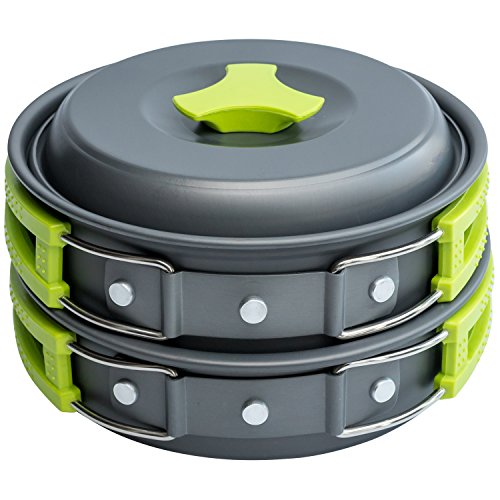
Every backpacker starts somewhere, and the MalloMe kit is designed to be that somewhere: a one-litre pot with a pan lid, bowls, a folding spork and a nylon carry bag, in lightweight aluminium, for less than most single premium pots. It suits the solo hiker whose menu is boiled water, noodles, oats and the occasional real meal, and whose priority is a complete, compact kit that works now rather than a perfect one assembled over years. Scouts, beginners and budget travellers will find everything they need in the bag and nothing they cannot understand.
Strengths
- Complete solo kit: pot, pan, bowls, spork and bag
- Lightweight and compact one-litre format
- Budget tier makes it the easiest entry into trail cooking
Trade-offs
- Aluminium is thin; expect dents and treat it accordingly
- One litre limits cooking to solo portions and water boiling
- Fit and finish are a step below the premium brands
| Specification | Detail |
|---|---|
| Capacity | 1 litre pot |
| Pieces | 10-piece mess kit |
| Includes | Bowls, folding spork, nylon carry bag |
| Material | Aluminium |
Judged as a system, the MalloMe does the beginner’s jobs in the right order. The pot boils a solo meal’s water without wasting fuel on excess volume, the pan doubles as lid and as an actual small frying surface for the morning egg or pancake, and the bowls mean dinner does not have to be eaten from the pot you must also wash. Everything nests, the bag contains the rattle, and the whole kit disappears into a pack corner. For freeze-dried and just-add-water cooking — the majority of backpacking meals — it is not a compromise at all; it is the correct amount of cookware.
The limits are material and scale. Thin aluminium dents, and a dented pot still boils water, which tells you where this kit’s priorities lie; the one-litre ceiling rules out cooking for two except in shifts. Owners who fall in love with the trail will eventually upgrade the pot and keep the kit’s accessories in service, which is a fine lifecycle for a budget purchase. As the lowest-risk way to start cooking outdoors, the MalloMe earns its badge honestly.
Best for: Beginners, scouts and solo hikers on a budget / Not suited for: Pairs cooking together or durability-first buyers
Check on Amazon — check the current price on Amazon before you decide, because configurations and included accessories vary by listing.
GSI Outdoors Glacier Stainless Camper, 4 Person Set — Best for Groups
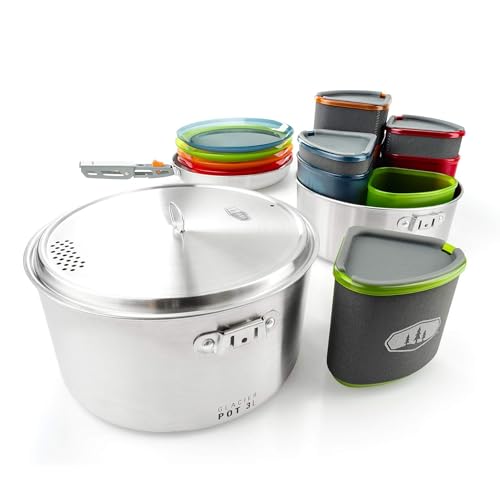
Cooking for four in the backcountry is a logistics problem, and GSI’s Glacier Stainless Camper is the logistics solved: cookware and dinnerware for four people, designed as one packable system by a company that specialises in exactly this. Stainless steel carries the durability brief — this set will be dropped, scorched, scrubbed and lent for years — and the inclusion of real dinnerware means a group eats like people rather than passing one pot in a circle. It suits scout troops, families, guided groups and friends who basecamp or split loads across several packs.
Strengths
- Complete cooking and eating system for four people
- Glacier stainless durability for years of group use
- Packs as one organised bundle rather than loose pieces
Trade-offs
- Far too heavy and bulky for solo or pair backpacking
- Stainless needs care to avoid hot spots on delicate dishes
- Best split across packs or used at basecamp
| Specification | Detail |
|---|---|
| Material | Stainless steel (Glacier series) |
| Capacity | Cookware and dinnerware for 4 people |
| Style | Packable nesting system |
| Brand | GSI Outdoors |
Group cookware earns its weight differently from solo gear, and the Glacier Camper understands the assignment. Divided among four hikers, the per-person carry is modest; what the group gains is a real kitchen — pots that cook a communal meal in one pass and settings that let everyone eat at once, hot, like a dinner rather than a queue. GSI’s nesting design keeps the bundle coherent in a pack, and the stainless construction tolerates the particular abuse of group gear, which is always borrowed, always hurried and always cleaned by whoever lost the argument.
Used solo it would be absurd, and the guide says so plainly; used by its intended four it is the most capable system here. Heat management needs a cook’s attention, as with all stainless, and the set rewards a basecamp or short-approach style of trip over a long thru-hike. For troops, families and friend groups, it converts camp cooking from a chore rotation into one of the pleasures of the trip, which is precisely what group gear should do.
Best for: Groups of four, troops, families and basecamp cooking / Not suited for: Solo and pair backpacking
Check on Amazon — check the current price on Amazon before you decide, because configurations and included accessories vary by listing.

Snow Peak Titanium Camping Cook Set — Best Ultralight Premium
Snow Peak is the name ultralight hikers say the way watch people say certain Swiss words: titanium worked with a precision that turns a pot into an heirloom. This cook set is for the experienced hiker who has already lightened everything else — the one for whom a hundred grams is a decision, not a rounding error — and who boils, simmers simply and wants kit that will outlast a decade of trails. Titanium’s virtues are all here: extraordinary strength for its weight, total corrosion indifference, and a neutrality that never flavours food or water.
Strengths
- Ultralight titanium construction of exceptional quality
- Corrosion-proof and strong enough for a decade of trips
- Snow Peak design and manufacturing refinement
Trade-offs
- Premium pricing, as titanium always commands
- Titanium’s poor heat spread scorches thick foods; it is a boiler first
- Capacity suits the solo or pair minimalist menu
| Specification | Detail |
|---|---|
| Material | Titanium (per product name; Amazon title text also references steel construction — see sources note) |
| Style | Ultralight backpacking cook set |
| Brand | Snow Peak |
| Use | Boil water or cook outdoors per Amazon listing |
Titanium must be judged by its own physics. It conducts heat poorly compared with aluminium, so a titanium pot boils water superbly — water does not care about hot spots — and punishes porridge, rice and sauces with a scorched centre if the cook is careless. Within that truth, Snow Peak’s execution is flawless: the walls are worked to the minimum that still feels like an object rather than foil, the handles and lids fit with machined grace, and the set nests like it was designed by people who pack bags for a living. For the boil-and-rehydrate menu that dominates serious backpacking, it is close to perfect.
The premium is real and should be paid only by the hiker it serves: the one whose pack is already light, whose trips are long and whose menu is water-based. That hiker will carry this set for ten years and the cost per trip will become trivial. Everyone else should buy aluminium and spend the difference on food and fuel. Best Ultralight Premium means exactly that — the best of a specialised material, for the specialist it suits.
Best for: Experienced ultralight hikers with water-based menus / Not suited for: Trail chefs who simmer sauces, or budget buyers
Check on Amazon — check the current price on Amazon before you decide, because configurations and included accessories vary by listing.

Odoland 19pcs Camping Cookware Mess Kit for 2 — Best Complete Kit for Two
Some hikers want to assemble a system piece by piece; others want to buy the kitchen. The Odoland 19-piece kit is for the second group: a nonstick pot and pan for cooking, a kettle for the morning’s coffee and the evening’s tea, and stainless cups, plates and cutlery for two people to eat like civilised beings. It suits couples starting out, car-supported backpackers and picnic-minded hikers who value completeness over gram-counting, and who would rather carry a little more than improvise a plate from a lid one more time.
Strengths
- Genuinely complete for two, including kettle and tableware
- Nonstick pot and pan make real cooking and cleaning easy
- Stainless cups, plates and cutlery feel like a proper kitchen
Trade-offs
- Heavier than minimalist kits; completeness has a weight
- Nonstick surfaces need care on camp stoves and fires
- Nineteen pieces is more than fast-and-light hikers will use
| Specification | Detail |
|---|---|
| Pieces | 19-piece kit for 2 |
| Kettle | 27 oz |
| Tableware | 304 stainless steel cups, plates, cutlery |
| Cookware | Nonstick pot and pan |
The Odoland’s case is the morning after you buy it: open the bag at a campsite and cook breakfast, boil the kettle, serve on plates, drink from cups, and wash a nonstick pan in thirty seconds. Nothing is missing, nothing is improvised, and for couples whose trips mix hiking with lingering — the long lunch, the two-coffee morning — that completeness is the luxury the weight buys. The kettle deserves its own praise; hot drinks are the morale system of outdoor life, and a dedicated kettle keeps the cooking pot free and the coffee untainted by last night’s noodles.
The trade is written on the scale. Nineteen pieces weigh what they weigh, and a fast-and-light pair will look at this kit the way a racing cyclist looks at a picnic hamper. Nonstick also asks for a stove rather than an open fire and for soft utensils. Within its intended life — two people, real meals, unhurried camps — the Odoland is the most complete answer in this guide, and its many owners are not wrong.
Best for: Couples and completeness-first campers who cook and linger / Not suited for: Fast-and-light hikers minimising every piece
Check on Amazon — check the current price on Amazon before you decide, because configurations and included accessories vary by listing.

Bulin Camping Cookware 13 PCS Set for 3-4 — Best Family Backpacking
Families who backpack face a specific arithmetic: children eat like adults and carry like children, so the cook kit must feed three or four from one person’s pack space. Bulin’s 13-piece set answers with volume — a 2.6-litre main pot for the communal dinner, a 1.6-litre second pot, a 1.3-litre pan and a 1-litre kettle — in lightweight aluminium that keeps the whole system carryable. It suits family trips, small groups and picnic-hikers whose cooking is communal and whose menu goes beyond rehydration to real one-pot meals for a crowd.
Strengths
- Genuine 3-4 person capacity with a 2.6L main pot
- Two pots, a pan and a kettle cover communal cooking properly
- Lightweight aluminium keeps family volume carryable
Trade-offs
- Bulky for solo or pair use
- Aluminium needs the usual care against dents
- Bowls and utensils are basic; some families will supplement
| Specification | Detail |
|---|---|
| Pots | 2.6L and 1.6L |
| Pan | 1.3L |
| Kettle | 1L |
| Capacity | For 3-4 people per Amazon listing |
The Bulin’s intelligence is in its sizes. A 2.6-litre pot is the difference between cooking dinner for four in one batch and running a stove in shifts while hungry children circle; the second pot handles the side, the sauce or the second course, and the kettle keeps drinks flowing without evicting the food. Aluminium keeps this flotilla light enough for one adult to carry alongside the family tent, which is the logistical fact the whole set is designed around. On the stove the pots behave like the honest aluminium they are — quick to boil, even enough for one-pot cooking, and forgiving of camp technique.
It is not a precision instrument: the metal is working-weight rather than expedition-grade, and the included bowls and spoon are serviceable rather than lovely. Families, sensibly, care more that dinner happens. Against the GSI group set above, the Bulin trades stainless immortality for aluminium lightness and a friendlier tier — the right trade for most family trips, where the kit is carried by a parent rather than divided among a troop. As the family pick, it is the set that makes backpacking with kids feel feasible.
Best for: Families and small groups cooking communal meals / Not suited for: Solo hikers or durability-obsessed buyers
Check on Amazon — check the current price on Amazon before you decide, because configurations and included accessories vary by listing.
Comparison Table
| Pick | Badge | Key spec | Best for |
|---|---|---|---|
| Stanley Adventure All-in-One 2 Bowl Cook Set | Best Overall for Two | Stainless steel | Pairs who cook real meals and split the carrying |
| MalloMe 10-Piece Camping Cookware Mess Kit, 1 Liter | Best Budget Solo | 1 litre pot | Beginners, scouts and solo hikers on a budget |
| GSI Outdoors Glacier Stainless Camper, 4 Person Set | Best for Groups | Stainless steel (Glacier series) | Groups of four, troops, families and basecamp cooking |
| Snow Peak Titanium Camping Cook Set | Best Ultralight Premium | Titanium (per product name; Amazon title text also references steel construction — see sources note) | Experienced ultralight hikers with water-based menus |
| Odoland 19pcs Camping Cookware Mess Kit for 2 | Best Complete Kit for Two | 19-piece kit for 2 | Couples and completeness-first campers who cook and linger |
| Bulin Camping Cookware 13 PCS Set for 3-4 | Best Family Backpacking | 2.6L and 1.6L | Families and small groups cooking communal meals |
Read the table as a shortlist, not a ranking carved in stone: the right answer for best backpacking cookware sets depends on the size of your household, the space you actually have and how you really cook week to week, which is exactly what the buying guide below works through.
How to Choose the Best Backpacking Cookware Set
Start with your menu, because it decides everything. If your trail food is freeze-dried meals, instant noodles and coffee, your cookware is a water boiler: one pot, roughly a litre for solo or a litre and a half for two, with a lid and a mug. Every piece beyond that is weight without purpose. If you cook — real rice, real sauces, pancakes, a fish you caught — you need a pan as well as a pot, more volume, and materials that spread heat. Be honest about which hiker you are on your actual last three trips, not the hiker in the trip report you admired.
Then do the weight arithmetic properly. A set’s cost is its weight divided by the people it feeds and the nights it serves. A group set that looks heavy on the product page can be the lightest per person in this guide; an ultralight solo pot is unbeatable for one and useless for four. Volume follows the same logic: plan on roughly three-quarters of a litre to a litre of pot per diner for real cooking, less for boiling only. Finally, confirm the set nests with your stove and fuel inside it if possible — the classic backpacking trick that turns dead pack space into your kitchen cupboard.
- A pot sized to your menu and your party, no larger
- Material matched to cooking style: aluminium all-round, steel for durability, titanium for boiling
- Handles or a lifter that work with gloves and tired hands
- A lid that doubles as a pan, or a pan that doubles as a lid
- Nesting that swallows your stove and fuel canister
- A stuff sack or strap that silences the rattle
Stove fit is the check buyers forget. Wide pots boil faster and sit more stably on small stove supports; tall, narrow pots suit integrated stove systems and save fuel in wind. Match the pot’s base to your stove’s flame pattern — a pot much wider than the flame wastes heat up its sides, and one much narrower wastes it into the air. The sets in this guide cover the mainstream stove styles, but the five minutes spent checking your own pairing is the best-invested five minutes in the whole purchase.
Aluminium vs Stainless Steel vs Titanium on the Trail
Hard-anodised aluminium is the balanced default: light, affordable, the best heat spread of the three, and tough enough for years of trips. Its weaknesses are denting and a surface that eventually shows its age. For most backpackers, most of the time, it is the correct answer, which is why the budget and family picks in this guide are aluminium. Stainless steel is the durability answer: heavier, with poorer heat spread that demands a cook’s attention, but effectively immortal and happy over open fires that would punish coatings and thin aluminium alike. Troops, groups and fire-cookers should weight it heavily, as the Stanley and GSI picks do.
Titanium is the specialist: the lightest strong material in the category, corrosion-proof and beautiful in the hands of a maker like Snow Peak, but expensive and a poor heat spreader that scorches anything beyond water and thin soups. Buy titanium when your pack is already light, your menu is water-based and your trips are long enough for grams to compound into comfort. Buy it for simmering sauces and you will curse it nightly. The material is never the mistake; the mismatch is.
Coatings deserve a word. Nonstick interiors, like the Odoland’s, make trail cooking and cleaning wonderfully easy and pair best with canister stoves and gentle utensils; they dislike open flames and metal scraping. Uncoated sets forgive everything and demand a little more technique and oil. Choose by your stove and your patience, in that order.
Packing, Fuel and Camp Kitchen Routine
A cook set earns its keep in the packing as much as the cooking. Nest the stove and a fuel canister inside the pot, wrap a small cloth between pieces to kill rattle and double as a pot holder, and keep the lighter, spoon and a tiny bottle of soap in the same bundle so the kitchen is one grab from the pack. On trail, the routine that saves fuel is simple: cook with the lid on, shelter the stove from wind, and bring only the water you need to temperature — boiling a litre to make a mug of coffee is the classic beginner’s fuel leak.
Cleaning outdoors is a Leave No Trace exercise. Use minimal biodegradable soap, strain wash water and scatter it widely away from streams and lakes, and pack out food scraps rather than feeding the local wildlife a new habit. A set that wipes clean — nonstick, or steel scrubbed with a handful of sand and water — makes that routine easy to do properly. The best backpacking cookware set, in the end, is the one whose whole lifecycle, from pack to stove to wash, fits the way you actually travel.
How to Cook a Real Meal With a Backpacking Cook Set
A pot, a pan and a little sequencing turn trail ingredients into dinner. This is the basic pattern behind most successful camp cooking.
- Set up on a flat, sheltered spot, with water, ingredients and utensils laid out before the stove is lit — camp cooking forgives no mid-recipe rummaging
- Boil the pot’s water first and set the kettle or pot aside insulated, so drinks and rehydration are handled while you cook
- Use the pan for the flavour work: oil, aromatics, anything that benefits from a fry, cooked in batches small enough not to steam
- Combine in the pot for the simmer, lid on, heat low, stirring more often than you would at home because trail stoves concentrate heat
- Rest the pot off the heat for a few minutes before serving; grains finish, sauces settle and flavours marry
- Wash up immediately with minimal water and soap, strain and scatter the grey water widely, and pack the set dry
Two habits elevate every trail meal. The first is seasoning in layers — salt the cooking water, taste at the end, carry one small luxury like chilli crisp, parmesan or good olive oil, which weighs grams and transforms dinners. The second is planning the second use: tonight’s leftover grains are tomorrow’s fried lunch, and the pot that cooked dinner can warm the morning’s oats while the tent comes down. Cook that way and a simple set feeds you like a kitchen, which is the entire ambition of the gear in this guide.
Common Buying Mistakes
Buying pieces instead of a system. A pile of unmatched pots wastes pack space and rattles for a hundred miles. Nesting sets exist precisely because the trail punishes clutter.
Taking titanium to simmer school. Titanium boils brilliantly and scorches sauces. Match the material to the menu or spend dinner scraping.
Oversizing the pot ‘just in case’. A half-empty pot wastes fuel on every boil. Size to your party and your real menu; borrow volume for the exceptional trip.
Forgetting the wind. More trail fuel is lost to wind than to cooking. Shelter the stove, use the lid, and watch boil times — and fuel budgets — transform.
Washing up in the stream. Soap and food scraps belong away from water sources, strained and scattered. The easiest-cleaning set is the one that makes doing this properly painless.
Final Recommendation
Pairs who cook should start with the Stanley system and build their camp kitchen around it. Solo beginners and budget hikers should take the MalloMe and start walking this weekend. Groups and troops need the GSI Glacier Camper’s complete four-person organisation, families need the Bulin’s carryable volume, couples who love completeness will be happiest with the Odoland, and the experienced ultralight hiker already knows why the Snow Peak is in this guide.
Underneath the badges, the rule is one sentence: buy the smallest, lightest set that cooks your real menu for your real party, in the material that matches how you cook. Do that, and your cook set will disappear into your pack and reappear, trip after trip, as dinner.
Related guides in this series: Best Anodized Cookware Sets Best And Worse Cookware Sets Best Camping Cookware Sets Best Titanium Cookware Sets Best Cookware Sets For Two
Solo, Pair or Party: Three Worked Examples From Real Pack Lists
Abstract advice becomes useful when it is weighed. Consider the solo hiker first: three nights, freeze-dried dinners, oats and coffee. Their entire kitchen can be the MalloMe kit or a single titanium pot, a spork and a mug, and anything beyond that is charity carried for the trail’s benefit. The correct optimisation is ruthless subtraction — one vessel, boiled water, food eaten from the pouch or the pot — and the weight saved becomes food, warmth or simply a kinder third day. This is the hiker the Snow Peak pick serves at the premium end and the MalloMe at the honest beginning, and both are right answers at different budgets to the same correctly understood question.
The pair who cook are the category’s centre of gravity. Two people, real dinners — rice, pasta, a sauce, pancakes on the layover morning — justify a pot around two litres, a pan or lid-pan, two bowls or mugs and a shared stove, split between two packs so neither hiker carries the kitchen alone. The Stanley system was designed for exactly this unit, and the Odoland serves the pair who would rather carry completeness than assemble it. The per-person weight of either, divided by two and multiplied by the pleasure of real food at altitude, is among the best trades in backpacking.
The group of four closes the argument. Four appetites served in shifts from a solo pot is a morale disaster measured in cold dinners; the GSI system, divided four ways, costs each hiker less than a spare jumper and returns communal meals eaten together, hot, at the same time — which veterans will tell you is half of why groups hike at all. The Bulin makes the same point for the family whose loads cannot be divided evenly. Read across the three examples and the guide’s structure explains itself: there is no best backpacking cookware set, only the best match between a party, a menu and a map, and now you have the arithmetic to find yours.
Check on Amazon · Check on Amazon · Check on Amazon — the shortlisted picks most relevant to this section, with current pricing on their Amazon pages.
A last piece of arithmetic ties the whole guide together: cost per trip. A premium titanium set looks expensive on the day it is bought and trivial by its fiftieth night out, while a budget kit that splits, warps or loses its handle in season two has to be bought again — in money, in pack space given to its replacement, and in the small erosion of trust that makes a hiker double-check gear instead of simply walking. None of that makes the budget picks here poor choices; the MalloMe and Bulin kits are honestly built for their tiers and will serve their owners well. It means the right question is never what a set costs, but how many dinners it will cook before it asks for anything. Choose the set whose answer matches the trips you are actually planning, and the trail will do the rest.
One habit separates hikers who love their cook sets from hikers who tolerate them: the shakedown meal. Before any trip that matters, cook one full trail dinner at home, on the stove you will carry, in the set you are deciding about. Time the boil, watch the simmer, notice whether the handle inspires confidence with a full pot and whether the pan fits the flame pattern. Fifteen minutes in a kitchen will tell you more than a specification table, and it will tell you while returns are still possible and the trip is not yet depending on the answer. Every set in this guide would pass that test for its intended hiker — the exercise exists so you can confirm, personally, which intended hiker you are.
Frequently Asked Questions
What size pot do I need for backpacking?
For boiling water and solo meals, around one litre is the sweet spot. Two people cooking real food want roughly one and a half to two litres; groups and families should look at two and a half litres and above, as in the Bulin pick. Oversizing wastes fuel on every boil, so match the pot to your party.
Is titanium cookware worth the money?
For the ultralight hiker with a water-based menu and long trips, yes — its weight saving compounds daily and it lasts for years. For simmering, saucing or group cooking, aluminium gives better results for far less, and the premium is better spent elsewhere in your kit.
Can I cook on a campfire with these sets?
Stainless steel sets like the Stanley and GSI handle open fires happily. Aluminium tolerates them with soot and care. Nonstick coatings and titanium are better kept to canister stoves — nonstick because flames damage coatings, titanium because its thin walls and poor spread make fire cooking frustrating.
How do I stop my cook set rattling in my pack?
Nest everything tightly, wrap a cloth or bandana between pieces — it doubles as a pot holder — and use the set’s stuff sack or a strap. Storing the stove and fuel canister inside the pot both saves space and braces the set from inside.
Do I need a kettle for backpacking?
Not need, but many hikers love one: it keeps drinks free of food flavours and lets the pot stay on dinner duty. Complete kits like the Odoland and Bulin include one. Gram-counters skip it and drink from the pot’s second mug of water without regret.
How should I clean cookware in the backcountry?
Wipe first, wash with minimal biodegradable soap and a little water, strain out food particles to pack out, and scatter the grey water widely at a good distance from any stream or lake. Nonstick and smooth steel sets make this routine quickest, which is an environmental feature as much as a convenience.

