Disclosure: airfryerkitchensupply.com is reader-supported. When you buy through links on our site, we may earn an affiliate commission at no extra cost to you.
Where to buy
Battery testers are tools you want before the troubleshooting session, not during it, so ordering on Amazon and having the tester on the shelf is the right pattern. Check the current price on Amazon for each pick, and match the tester type to your vehicles first — the guide below explains why a home user and a shop need different instruments that happen to share a name.
- TOPDON BT100 12V Car Battery Tester — Check the current price on Amazon
- TOPDC 100A Battery Load Tester — Check the current price on Amazon
- ANCEL BA101 Car Battery Tester — Check the current price on Amazon
- Clore Automotive Solar 1874 500 Amp Carbon Pile Tester — Check the current price on Amazon
- OEMTOOLS 24336 500 Amp 12V Battery Load Tester — Check the current price on Amazon
- FOXWELL BT705 Battery Tester, 12V/24V — Check the current price on Amazon
Choosing the best 12 volt battery load tester starts with understanding that two different instruments share the job title. The classic load tester — the carbon pile — actually loads the battery with a heavy, adjustable current and watches how its voltage holds up, which is the closest thing to asking the battery to do its real job. The modern digital tester loads nothing; it measures conductance or internal resistance and calculates the battery’s condition in seconds, with the battery still in the car. Both are legitimate. They answer the same question — ‘is this battery actually good?’ — by different physics, and the right choice depends on who is asking.
This guide includes both families deliberately: three carbon-pile and analog load testers for owners and shops who want the definitive under-load answer, and three digital analyzers for owners who want a fast, safe, in-car verdict on battery, cranking, and charging system together. Every model was verified against Amazon’s catalog data before being linked, and the spec boxes quote only what the verified listings state.
Why own one at all? Because voltage alone lies. A battery can show a healthy resting voltage and collapse the moment a starter asks for real current — the classic ‘it read fine yesterday’ no-start. A load tester, of either kind, is the tool that separates a battery that needs charging from a battery that needs replacing, which is the most common diagnostic fork in all of vehicle ownership.
In this guide
Quick Picks
Best Overall: TOPDON BT100 12V Car Battery Tester — A digital analyzer covering 100–2000 CCA with battery, cranking, and charging system tests — the complete home diagnosis in one tool. Check price on Amazon
Best Budget Load Tester: TOPDC 100A Battery Load Tester — A true analog 100-amp load tester for 6V/12V batteries rated 100–1000 CCA — the classic test at an entry price. Check price on Amazon
Best Value Digital Analyzer: ANCEL BA101 Car Battery Tester — A digital analyzer spanning 100–2000 CCA that tests battery, alternator, and cranking for cars through marine and RV use. Check price on Amazon
Best Carbon Pile for Serious Use: Clore Automotive Solar 1874 500 Amp Carbon Pile Tester — The classic 500-amp carbon pile from the Solar line — the definitive under-load test for batteries up to serious truck sizes. Check price on Amazon
Best Variable-Load with Alternator Testing: OEMTOOLS 24336 500 Amp 12V Battery Load Tester — A 500-amp variable load tester for batteries to 1,000 CCA that also load-tests the regulator and alternator. Check price on Amazon
Best for 12V and 24V Systems: FOXWELL BT705 Battery Tester, 12V/24V — A digital analyzer spanning 100–2000 CCA across both 12V and 24V systems, with a long 5.9 ft cable for trucks, RVs, and boats. Check price on Amazon
How These Picks Were Chosen
We selected across both tester families on purpose, then judged each within its kind. For carbon-pile testers, the criteria were load capacity in amps, the CCA range that capacity honestly covers, gauge clarity, and whether the unit also evaluates starters and alternators under the same load. For digital analyzers, the criteria were the CCA test range, whether cranking and charging system tests are included — a battery verdict without a charging verdict is half a diagnosis — cable length, and plain-language results a home user can act on.
Every pick was verified through the Creators API on this site’s Amazon integration, with listing titles matched before any link was assigned. Spec boxes quote only verified listing data. We excluded pocket voltmeters that claim to ‘test’ batteries by voltage alone, because that is the misleading measurement this category exists to replace.
The six picks form a decision ladder: an affordable analog load tester for the home garage, two digital analyzers at two depths of analysis, the classic 500-amp carbon pile for serious DIY and small-shop work, a variable-load tester with regulator and alternator evaluation, and a wide-range digital unit that also serves 24V systems in trucks, RVs, and boats.
The 6 Best 12 Volt Battery Load Testers

1. TOPDON BT100 12V Car Battery Tester — Best Overall
For most owners, this is the tester to buy. It answers the three questions that matter — is the battery good, does the starter draw correctly, is the alternator charging — in a few minutes, in the car, with no heavy load and no removed battery. It suits cars, trucks, motorcycles, ATVs, SUVs, boats, and RVs. The only users who should look elsewhere are those who specifically need a true carbon-pile load, covered by the Solar and OEMTOOLS picks below.
Strengths
- Tests battery, cranking, and charging systems — the full diagnostic trio, not just the battery
- Wide 100–2000 CCA range covers small powersports through large truck batteries
- Digital conductance method is fast, safe, and works with the battery installed
Trade-offs
- Conductance testing estimates condition; it does not apply a true starter-scale load
- Results depend on entering the battery’s rated CCA correctly
- Deeply discharged batteries should be charged before testing for a fair verdict
| Specification | Detail |
|---|---|
| Test range | 100–2000 CCA |
| System | 12V |
| Tests | Battery, cranking, charging |
The BT100 represents what most battery testing should look like now: connect, enter the battery’s rating, and get a structured verdict on the whole starting system. That breadth matters because batteries are often replaced for alternator sins — a weak charging system murders a new battery in months, and a battery-only tester would have sent you shopping. Conductance testing has earned its place in professional shops for routine screening, and for home use its safety and speed are decisive advantages. Keep the carbon-pile picks in mind if you are chasing an intermittent under-load failure, but for the annual health check and the no-start diagnosis, this is the guide’s default recommendation.
Best for: home users and DIYers wanting the complete diagnosis / Not suited for: shops needing true high-amp load testing
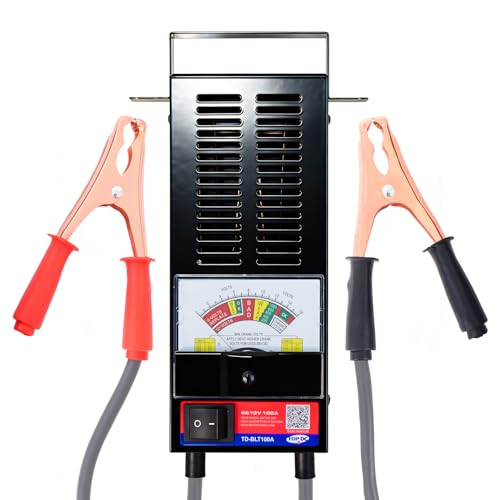
2. TOPDC 100A Battery Load Tester — Best Budget Load Tester
This is the pick for the owner who wants a real load test — the battery actually working against a load — without shop-tool money. It suits cars, RVs, motorcycles, boats, and ATVs with batteries in its stated range. It is not the tool for the largest diesel batteries or for users who want digital readouts and stored results; it is a gauge, a load, and your judgment, which generations of mechanics have found sufficient.
Strengths
- Applies a genuine 100A load — the test that reveals batteries voltage checks miss
- Covers 6V and 12V batteries rated 100–1000 CCA, including classics and powersports
- Also checks charging and starting systems in analog fashion
Trade-offs
- Analog gauge reading takes a little practice to interpret confidently
- 100A load ceiling suits typical car batteries, not the biggest truck and diesel units
- Load tests generate heat; follow the duty-cycle limits in the manual
| Specification | Detail |
|---|---|
| Load | 100A |
| Systems | 6V / 12V |
| Range | 100–1000 CCA |
| Type | Analog load tester |
There is enduring value in the simplest instrument that answers the question honestly, and a 100-amp load tester is exactly that. Clip it on, apply the load for the specified seconds, and watch whether the voltage holds in the good zone or dives — a weak battery cannot hide from real work. The TOPDC packages that test at an entry price with charging and starting checks included, in a form factor home garages have used for decades. Respect its limits — its range tops out at 1000 CCA batteries and its load is sized for cars and light vehicles — and it will settle more driveway arguments than any tool costing several times more.
Best for: budget-minded DIYers who want a true load test / Not suited for: diesel and heavy-truck owners beyond its range

3. ANCEL BA101 Car Battery Tester — Best Value Digital Analyzer
Choose the BA101 if you want the digital analyzer experience — guided tests, plain results, no load heat — at a value position. It covers the same wide CCA span as our overall pick and addresses trucks, boats, RVs, and marine vehicles alongside cars. Users who want the newest interface can step up to the TOPDON; users who need a true carbon-pile load should look at the analog picks instead.
Strengths
- 100–2000 CCA digital testing for battery, charging, and cranking systems
- Explicitly aimed at truck, boat, RV, and marine use as well as cars
- Guided digital workflow suits first-time testers
Trade-offs
- Conductance method, like all digitals, estimates rather than truly loads the battery
- Charge a flat battery before testing or the verdict reflects the discharge, not the battery
- Interface is functional rather than modern
| Specification | Detail |
|---|---|
| Test range | 100–2000 CCA |
| System | 12V |
| Tests | Battery, alternator, cranking |
The BA101 has been a default recommendation in this niche for years because it gets the fundamentals right: a wide test range, the three-system diagnosis, and results a non-mechanic can act on — good, recharge, or replace. For a household maintaining several vehicles and a boat or RV, it pays for itself the first time it prevents either an unnecessary battery purchase or a necessary one discovered at the launch ramp. Its method is conductance, with the standard caveat that a battery should be reasonably charged before testing. Within those terms, it is the value anchor of the digital side of this guide.
Best for: households with several vehicles, boats, or an RV / Not suited for: users who specifically want a true carbon-pile load test

4. Clore Automotive Solar 1874 500 Amp Carbon Pile Tester — Best Carbon Pile for Serious Use
When a battery passes a digital screen but the vehicle still cranks weakly, the carbon pile is the court of appeal: a real, adjustable 500-amp load that reproduces starter demand and shows exactly how the battery holds up. This suits serious DIYers, small shops, and fleet maintainers. It is more tool than a once-a-year home user needs, and its operation demands the respect any high-current device deserves.
Strengths
- True variable carbon-pile load to 500 amps — the reference test for starting batteries
- Solar is a long-established name in professional battery service equipment
- Settles borderline cases that conductance testers flag as uncertain
Trade-offs
- Requires correct procedure and duty-cycle discipline; the load generates serious heat
- Overkill for owners who only need an annual health check
- Analog interpretation is a skill the user must build
| Specification | Detail |
|---|---|
| Load capacity | 500 Amp |
| Type | Carbon pile load tester |
Carbon pile testers persist in professional use because physics is persuasive: a battery that holds voltage under a genuine 500-amp draw is a good battery, full stop. The Solar 1874 is the widely used expression of that idea, with the load control and gauging to test everything from a car battery to a heavy pickup’s. It also evaluates the vehicle’s starting and charging performance under the same real load, which is how experienced technicians separate battery faults from starter and alternator faults. Buy it if you test batteries often, maintain several vehicles or a small fleet, or simply want the answer rather than an estimate. Learn its procedure properly and observe its cooling intervals — it is a professional tool and rewards professional handling.
Best for: serious DIYers, small shops, and fleet maintainers / Not suited for: casual owners needing only a quick annual check

5. OEMTOOLS 24336 500 Amp 12V Battery Load Tester — Best Variable-Load with Alternator Testing
This pick adds system-level load testing to the carbon-pile formula: beyond the battery, it evaluates the alternator and regulator under load, which is where charging faults actually reveal themselves. It suits diagnosticians — home or shop — chasing the ‘new battery died too’ complaint. If your needs stop at the battery itself, the Solar above is the more focused tool.
Strengths
- Variable 500-amp load for batteries rated to 1,000 CCA
- Load-tests alternator and regulator, not just the battery
- Combines battery voltage metering with true load evaluation
Trade-offs
- Same heat and duty-cycle discipline as any carbon-pile tester
- System load testing requires following the procedure for the vehicle
- More capability than a simple annual check requires
| Specification | Detail |
|---|---|
| Load capacity | 500 Amp |
| Battery range | To 1,000 CCA |
| Tests | Battery, regulator, alternator load |
The most expensive sentence in battery ownership is ‘we replaced the battery and it died again,’ and it is usually a charging-system fault wearing a battery costume. The OEMTOOLS 24336 is built for that investigation: load the battery to prove it, then load-test the alternator and regulator to find the real culprit before installing another battery to be murdered. Its 1,000 CCA ceiling covers the consumer fleet including large trucks. Like the Solar, it is a real tool that generates real heat and demands its manual be read — and like the Solar, it returns certainty that screening tools cannot. For the methodical troubleshooter, it is the most complete analog instrument in this guide.
Best for: troubleshooters chasing repeat battery failures / Not suited for: owners who only test a battery once a year
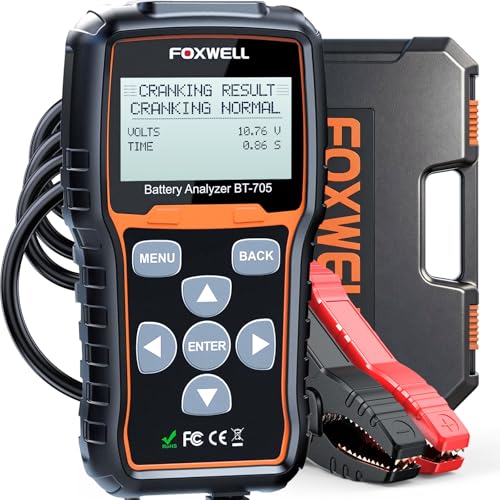
6. FOXWELL BT705 Battery Tester, 12V/24V — Best for 12V and 24V Systems
Most testers stop at 12V. The BT705 also serves 24V systems — heavy trucks, some RV and marine setups, and equipment — which makes it the pick for mixed fleets and big-vehicle owners. Its long cable reaches awkward battery locations without an assistant. Pure 12V car owners can save with the TOPDON or ANCEL; this one’s premium is its voltage range and reach.
Strengths
- Covers both 12V and 24V systems in one analyzer — rare in this class
- 100–2000 CCA range with cranking and charging analysis
- 5.9 ft cable suits trucks, RVs, and boats with remote battery placement
Trade-offs
- Priced above 12V-only analyzers
- Conductance method still estimates rather than truly loading the battery
- More menu depth than a first-time user may want
| Specification | Detail |
|---|---|
| Test range | 100–2000 CCA |
| Systems | 12V / 24V |
| Tests | Battery, alternator, cranking, charging |
| Cable | 5.9 ft (per listing) |
Owners of anything with a 24V system discover quickly that consumer testers abandon them, and end up either guessing or paying shop rates for a five-minute test. The BT705 closes that gap with a single analyzer that treats a compact car and a 24V truck as equal citizens, and its long cable acknowledges that big vehicles hide their batteries in inconvenient places. The analysis depth — battery, cranking, charging — matches our other digital picks, so the choice here is purely about voltage coverage and reach. If your world includes a diesel truck with a 24V system, an RV with complex battery placement, or a boat, this is the digital tester built for it.
Best for: owners of 24V trucks, RVs, boats, and mixed fleets / Not suited for: 12V-only car owners who can buy the simpler analyzers
Comparison Table
| Pick | Badge | Key spec | Best for |
|---|---|---|---|
| TOPDON BT100 12V Car Battery Tester | Best Overall | 100–2000 CCA digital analyzer, 3-system tests | home users and DIYers wanting the complete diagnosis |
| TOPDC 100A Battery Load Tester | Best Budget Load Tester | 100A analog load, 6V/12V, 100–1000 CCA | budget-minded DIYers who want a true load test |
| ANCEL BA101 Car Battery Tester | Best Value Digital Analyzer | 100–2000 CCA digital analyzer | households with several vehicles, boats, or an RV |
| Clore Automotive Solar 1874 500 Amp Carbon Pile Tester | Best Carbon Pile for Serious Use | 500A carbon pile load tester | serious DIYers, small shops, and fleet maintainers |
| OEMTOOLS 24336 500 Amp 12V Battery Load Tester | Best Variable-Load with Alternator Testing | 500A variable load, to 1,000 CCA | troubleshooters chasing repeat battery failures |
| FOXWELL BT705 Battery Tester, 12V/24V | Best for 12V and 24V Systems | 100–2000 CCA, 12V/24V digital analyzer | owners of 24V trucks, RVs, boats, and mixed fleets |
How to Choose a 12 Volt Battery Load Tester: Carbon Pile vs Digital
Decide which physics you want. A carbon-pile or analog load tester applies a real, heavy current — 100 amps in the home units, up to 500 in the serious ones — and watches the battery’s voltage under genuine work. It is the most direct evidence of starting ability and the traditional shop standard, at the cost of heat, procedure, and a little skill. A digital conductance tester applies no meaningful load; it measures the battery’s internal characteristics and calculates condition, state of charge, and cranking health in seconds, in the vehicle, with complete safety.
For most home users, the digital tester is the right default: it also tests the cranking and charging systems, which catches the alternator faults that kill replacement batteries, and it asks nothing dangerous of its operator. For shops, fleets, and diagnosticians chasing intermittent or borderline failures, the carbon pile remains the final word — a battery can occasionally screen acceptably and still fold under a true load, and the pile is how you find out.
Match ranges either way. A tester’s CCA span must cover your battery’s rating: the digital picks here span 100–2000 CCA, the analog load tester covers 100–1000 CCA, and the carbon piles address batteries up to 1,000 CCA with loads to 500 amps. Owners of 24V systems have exactly one pick in this guide — check your system voltage before buying anything.
How to Get a Truthful Test Result
Every tester lies when used carelessly, so observe the ritual. Test a battery that is reasonably charged — a battery fresh off a long discharge will fail any test, and the verdict will describe its charge, not its health. If the vehicle sat or the battery was drained, charge it first, let it rest to shed surface charge, then test. Enter the battery’s rated CCA correctly into a digital tester; the calculation is only as honest as that input, and the rating is printed on the battery’s label.
Connections decide analog tests. A carbon-pile or load test through corroded clamps measures the corrosion, not the battery. Clean the terminals, clamp tight, and follow the load duration and rest intervals in the manual — carbon piles generate serious heat and are built for seconds of load with cooling between tests, not continuous punishment.
Interpret in context. A battery that tests marginal in a vehicle that also charges poorly is a system diagnosis, not a shopping list: fix the charging fault first, retest, and only then condemn the battery. Keep a dated log of results per vehicle; a battery’s trend across annual tests predicts its failure season far better than any single reading.
Battery, Cranking, and Charging: Test the System, Not the Part
The starting system is a triangle — battery, starter, alternator — and each corner can imitate another’s failure. A weak alternator undercharges the battery, which then ‘fails’ a test it never deserved. A failing starter draws excessive current, which makes a healthy battery look weak under load. This is why the better testers in this guide, digital and analog alike, evaluate all three, and why replacing parts one at a time on suspicion gets expensive.
Learn the simple signatures. Slow cranking with a battery that load-tests well points at the starter or at cable resistance. A battery that repeatedly tests discharged in a daily-driven car points at the alternator or a parasitic drain. A battery that tests well, charges well, and still dies overnight is a drain hunt, not a battery purchase. The tester’s job is to give you numbers for each corner so the signature is readable.
Make testing seasonal. A five-minute test each autumn, logged, catches the battery that will strand you in January while it is still a planned purchase in October. That habit, more than any single instrument, is what separates owners who replace batteries on schedule from owners who replace them on the roadside.
How to Load-Test a 12V Battery, Step by Step
The steps below cover a traditional load test; digital analyzers replace the middle steps with a guided menu, but the preparation and interpretation are the same. Work with eye protection, no sparks or flames nearby, and the vehicle’s transmission in park with the brake set.
- Charge the battery fully if it has been discharged, then let it rest for several hours — or remove surface charge per your tester’s instructions — so the test measures the battery, not the last charge.
- Inspect and clean the terminals. Note the battery’s rated CCA from its label; you will need it to set or interpret the test.
- With the tester disconnected, check resting voltage to establish the baseline and confirm the battery is in a testable state of charge.
- Connect the tester clamps firmly — red to positive, black to negative — with the tester switched off or its load control at zero.
- For a carbon-pile or analog load tester, apply the specified load (commonly half the battery’s CCA rating, or the tester’s fixed load) for the specified seconds, watching the voltage at the end of the load period.
- Read the result against the tester’s chart at the battery’s temperature. A healthy battery holds voltage in the pass zone under load; a sustained dive means the battery cannot do its job.
- Release the load and allow the tester to cool for the interval the manual specifies before any retest. Carbon piles get genuinely hot.
- For digital analyzers, select the battery type and rated CCA, run the battery test, then run the cranking test by starting the engine, and the charging test as prompted — the three results together are the diagnosis.
- Record the date and results in the vehicle’s log, and act on the system verdict: charge, repair charging, or replace — in that diagnostic order.
If results conflict — a digital pass with weak real-world cranking, for instance — believe the symptom and escalate to a true load test or a shop visit. Testers inform judgment; they do not replace it.
Interpreting Results: Good, Marginal, and the Honest Middle
Test results come in three bands, and the middle band is where judgment lives. A clear pass — battery holds its load voltage comfortably, conductance near its rating — means the battery is not your problem; look at cables, starter, and charging. A clear fail — voltage collapses under load, conductance a fraction of rating — means replacement, and no amount of charging will negotiate. The marginal battery, testing at perhaps two-thirds of its rating, is the interesting case: it will start the car today and strand you in the first cold snap.
Treat marginal as a scheduling decision rather than a verdict. In a daily-driven vehicle with easy service access, a marginal battery in spring may serve through summer. The same battery in a vehicle heading into winter, or one that must not fail — the boat, the RV, the car a family member drives alone at night — should be replaced on your schedule, in your driveway, at your chosen price. Testing converts battery failure from an emergency into an appointment, but only if marginal results are acted on.
Record the band, not just the binary. A battery that tested strong last year and marginal this year is telling you its trajectory, and trajectory is the best predictor of the failure season. This is why the log matters more than the instrument: any tester in this guide can produce a number, but only your records turn numbers into foresight.
Testing Batteries Beyond the Car: RVs, Boats, and Deep-Cycle Reality
The testers in this guide are built around starting batteries and CCA, but owners inevitably point them at the deep-cycle batteries in boats, RVs, and trailers. Use them there with understanding. A conductance tester can still give a useful health indication on a deep-cycle battery, and a load tester still reveals a battery that collapses under demand — but CCA is not the rating deep-cycle batteries live by, and a house battery’s real question is capacity over hours, which neither instrument fully answers.
For deep-cycle duty, interpret conservatively: a house battery that tests weak by starting-battery standards is certainly done, while one that tests strong may still have lost meaningful capacity. The thorough method for a suspect house battery is a timed discharge test at a known load — the battery equivalent of the trolling-motor log — and owners of expensive lithium banks should rely on the BMS data their battery reports, which counts actual amp-hours.
None of that diminishes the instruments here; it locates them. They are starting-system instruments of genuine precision, and general battery-health indicators of useful honesty. Knowing which question you are asking is the difference between a diagnosis and a number.
From Test Result to Decision: A Simple Protocol
A tester earns its shelf space only when its readings change what you do, so adopt the protocol before you need it. Test every vehicle’s battery twice a year and log the result with the date and the battery’s age. A strong result means forget the battery until the next test. A marginal result on a young battery means investigate charging and connections first — youth plus weakness is a system fault until proven otherwise. A marginal result on an old battery means schedule the replacement within the season, sooner if winter or a critical trip approaches.
A failed result has its own etiquette: charge the battery fully and retest once before condemning it, because a discharged healthy battery mimics a failed one, and the retest is cheap. If it fails charged, replace it without nostalgia and recycle the core. Then test the new battery after installation and log its baseline — the number every future test will be compared against. That baseline habit is what turns a tester from a gadget into an instrument.
Share the protocol with the household. The person who drives the car most is the person who will notice the first slow crank, and a household that knows ‘slow crank plus a marginal log entry equals a battery this weekend’ does not produce roadside phone calls. Instruments inform; protocols protect.
Digital Tester Literacy: Standards, Ratings, and Settings
Digital analyzers ask the operator for two inputs that decide everything: the battery’s rating standard and its value. Batteries are rated in CCA under standards whose initials appear on the label — the common ones in North American service are CCA itself and its cousins — and the tester must be set to the same standard the label uses, or the verdict is quietly wrong. This is the most common digital-testing error and the easiest to avoid: read the label, match the setting, then test.
Battery type is the second input where testers offer it: flooded, AGM, and gel batteries have different internal characteristics, and selecting the construction you actually have sharpens the estimate. Take the ten seconds. The broader literacy point is that a digital tester is a calculator wearing a clamp: its outputs are only as honest as its inputs, which is why this guide keeps returning to the label on the battery as a primary source.
Temperature is the silent third input. Batteries test weaker in deep cold because they are weaker in deep cold — the chemistry genuinely delivers less — and a winter marginal result should be read as the battery’s honest winter self, not dismissed as weather. That reading is precisely the one that predicts the January no-start, which makes the cold-weather test the most valuable one of the year.
Building a Home Battery Bench: Tester, Charger, and Logbook
A load tester becomes twice as useful when it stops traveling alone. The complete home battery bench is three items: the tester from this guide, a smart charger or maintainer appropriate to your batteries, and a logbook — paper or phone — where results live. The charger matters to testing because the protocol demands a charged battery; the logbook matters because a single test is a photograph and a series of tests is a diagnosis. Assembled once, the bench answers nearly every battery question a household generates, from the mower that will not start in April to the truck that cranked slowly in November.
The bench also changes purchasing behavior in a way owners appreciate: batteries stop being bought in emergencies at emergency prices. A marginal log entry in October becomes a planned purchase researched at leisure — often one of the batteries elsewhere in this program — installed on a chosen Saturday. The savings across a decade of household batteries are real, and they begin with the discipline of testing on a schedule rather than on a suspicion.
Keep the bench honest with one calibration habit: test a battery you know is new and healthy once a year and confirm the instrument still reads it as such. Instruments drift, clamps corrode, and a tester that has started flattering every battery is worse than none. The known-good check takes two minutes and protects every other verdict the bench produces.
When to Stop Testing and Start Replacing: The Economics of Certainty
There is a point in every battery’s story where further testing is a way of avoiding a decision, and recognizing it is a diagnostic skill. A battery that has failed a fair test — charged, rested, correctly measured — has given its answer; retesting it monthly in hope is not diligence but delay, and the delay is spent in the currency of reliability. The tester has done its job at that moment, which is to move the replacement from the roadside to the schedule. Owners who internalize that find their battery costs drop, because planned replacements are bought on price and fit rather than on availability at the nearest open store.
The economics run the other way too: a battery that passes fairly should be defended against suspicion. Vehicles develop starting symptoms from corroded cables, tired starters, and charging faults, and a passing battery in a symptomatic vehicle is evidence pointing elsewhere — evidence owners ignore at the price of a new battery that changes nothing. The tester’s verdict, logged and dated, is the discipline that keeps a household from buying batteries as a diagnostic method, which is the most expensive diagnostic method there is.
Close the loop at replacement: test the new battery, log its baseline, recycle the old one through the retailer’s core system, and note the date. The next test, six months later, now has something to be compared against — and comparison, repeated calmly over years, is the entire philosophy this guide has been recommending, one instrument at a time.
A Note on Safety Around Batteries and Load Testing
Battery work is safe work when it is deliberate work, and load testing concentrates the reasons into a few minutes. A starting battery can deliver enormous current; a tool slipped across its terminals becomes a welding accident, which is why rings and watches come off, clamps are handled one at a time, and connections are made in the order the procedure specifies. Batteries also vent hydrogen in normal charging and more under stress, so the test area is ventilated and free of sparks and flames — the oldest sentence in battery safety, and still the one that matters.
Carbon-pile testers add heat to the list: the load element becomes genuinely hot in normal use, so it is set down on nothing flammable, allowed its cooling intervals, and never left connected and unattended. Digital testers remove the heat and the heavy current from the operator’s side of the equation, which is a legitimate part of their appeal for home users. Eye protection belongs in both worlds, because batteries and the acid some contain do not negotiate. None of this is meant to make testing sound forbidding — mechanics do it daily without incident — but the incidents that do happen share a profile: haste, jewelry, and skipped steps. Test slowly, and the instrument stays boring, which is what instruments are for.
Common Buying Mistakes
Testing a discharged battery and condemning it. A flat battery fails every test. Charge first, rest, then test — the verdict must be about health, not charge.
Trusting resting voltage as a health check. Voltage alone cannot reveal a battery that collapses under load. That false confidence is the entire reason load testers exist.
Entering the wrong CCA rating in a digital tester. The calculation anchors on the rating you enter. Read it off the battery label, not from memory.
Ignoring the charging system. Replacing a battery into a vehicle with a failing alternator buys a second failure. Test all three corners of the system.
Abusing a carbon pile’s duty cycle. Loads are for seconds with cooling intervals. Continuous loading overheats the tester and can damage it — and invalidates the test.
Testing through dirty terminals. Corrosion adds resistance that masquerades as battery failure. Clean connections are part of the instrument.
Final Recommendation
For most owners, the TOPDON BT100 is the best 12 volt battery load tester in the practical sense: battery, cranking, and charging verdicts in minutes, in the car, across a 100–2000 CCA range. The ANCEL BA101 delivers the same digital trio for less. Owners who want a true load on a budget should take the TOPDC 100A, diagnosticians the OEMTOOLS for its alternator load testing, shops and fleets the Solar 1874 carbon pile, and 24V owners the FOXWELL BT705.
Whichever you choose, use it on a schedule and write the results down. A tester used twice a year is a maintenance system; a tester used once in a panic is just a witness.
Related reading: Best 12 Volt Battery Jumper Pack; Best 12 Volt Battery Maintainer; Best 12 Volt Battery For Travel Trailer; Best 12 Volt Battery For Trolling Motor
Frequently Asked Questions
Can a battery show good voltage and still be bad?
Yes — that is the most common battery deception. Resting voltage reflects charge, not capacity or cranking strength. A load test or conductance test reveals the collapse that voltage hides.
Is a digital tester as accurate as a carbon pile?
For routine screening, digital conductance testing is reliable and is used professionally. For borderline or intermittent cases, a true carbon-pile load is the more direct evidence. Many shops use both, digital first.
Should I remove the battery from the car to test it?
Digital analyzers are designed for in-car testing and also evaluate cranking and charging, which requires the battery installed. Traditional load testing also works in place with good connections. Removal is only needed for bench charging or replacement.
How often should I test my battery?
Twice a year is a good rhythm — before winter and before summer, the two seasons that kill marginal batteries. Log the results so you can see the trend.
What CCA range do I need?
It must cover your battery’s label rating. Most car and light-truck batteries fall within 100–2000 CCA digital ranges; the analog testers here cover batteries to 1,000 CCA. Check your battery’s label before choosing.
Can these testers check my alternator too?
The digital analyzers and the OEMTOOLS load tester evaluate charging performance as part of their system tests. That matters: an alternator fault is a leading cause of repeat battery failure.


