Disclosure: airfryerkitchensupply.com is reader-supported. When you buy through links on our site, we may earn an affiliate commission at no extra cost to you.
Where to buy
If you are shopping for the best audio mixers for live performance, start with the shortlist below. Every board in this guide is a current model sold through Amazon, which is where we recommend buying live-sound gear in this class: the listing states the exact variant — channel count, effects version, powered or unpowered — and returns are painless if a fader arrives scratchy or a channel arrives noisy. Start with the Mackie ProFX16v3 if you need one board that covers most gigs, and check the current price on Amazon under the full model name, because every brand here sells the same family in several sizes.
- Mackie ProFX16v3 — check the current price on Amazon and confirm the exact configuration on the listing before you order.
- Yamaha MG16XU — check the current price on Amazon and confirm the exact configuration on the listing before you order.
- Allen & Heath ZED-16FX — check the current price on Amazon and confirm the exact configuration on the listing before you order.
- Soundcraft EFX12 — check the current price on Amazon and confirm the exact configuration on the listing before you order.
- Behringer Europower PMP500 — check the current price on Amazon and confirm the exact configuration on the listing before you order.
- Peavey PVi 6500 — check the current price on Amazon and confirm the exact configuration on the listing before you order.
The best audio mixers for live performance solve a problem that studio mixers never face: everything happens once, in front of an audience, with no undo. A live board has to survive being carried in a van, set up in twenty minutes, sound-checked with a nervous singer, and run for three hours in a room whose acoustics change as it fills with people. It needs enough microphone inputs for the whole band, EQ that can carve out feedback frequencies fast, effects that flatter a voice without washing it out, and outputs for both the main speakers and the monitors the musicians hear themselves through. The six boards in this guide were chosen for exactly that job, and they split into two honest camps: unpowered analog consoles that feed separate amplifiers or powered speakers, and powered mixers with the amplifier built in for small venues that want one box and a pair of passive speakers.
One counting warning before anything else, because it decides whether a board fits your band: a “16-channel” live mixer does not give you sixteen microphone inputs. The typical layout is eight to eleven true mic preamps plus stereo line channels for keyboards and playback. Count your microphones first — every vocal, every drum mic, every amp you plan to mic instead of running direct — and only then look at channel counts. Every review below states its board’s real layout in plain language so you can do that arithmetic before you spend anything.
All six picks were verified as current Amazon listings on 2026-11-20. They cover the working range of live sound: a versatile mid-size console that records over USB, a famously clean-sounding Yamaha, a premium British analog board, a compact Soundcraft built around excellent effects, and two powered mixers for rooms that want amplification inside the box. None of them is a DJ mixer, none is a recording interface pretending to be a console, and all of them can run a real gig tonight.
In this guide
Quick Picks
- Best Overall — Mackie ProFX16v3: eleven Onyx mic preamps, a proper GigFX effects engine, USB recording to a laptop, and the aux sends a working band actually needs. The default answer for most live acts.
- Best for Sound Quality — Yamaha MG16XU: D-PRE preamps and a metal chassis that shrugs off road life. The cleanest, quietest board here for acoustic acts, worship, and theater.
- Best Premium Analog — Allen & Heath ZED-16FX: DuoPre preamps, swept mid EQ on every mono channel, and build quality that touring engineers trust. The buy-once board.
- Best for Small Bands — Soundcraft EFX12: twelve channels wrapped around genuine Lexicon effects, in a footprint that fits a duo or trio’s car boot with room to spare.
- Best Powered Mixer — Behringer Europower PMP500: a 500-watt amplifier inside a 12-channel mixer with feedback detection. One box, two passive speakers, done.
- Best Budget Powered — Peavey PVi 6500: an all-in-one powered mixer from a brand that has equipped small venues for decades. Simple controls, honest power, easy setup.
How These Picks Were Chosen
We started from the way live mixers are actually used rather than from spec sheets. A board earned its place by meeting five tests. First, real microphone capacity: enough preamps for a full small band without borrowing channels from stereo inputs with adapters. Second, monitor capability: at least two aux sends on the larger boards, because the lead singer and the drummer never want the same mix, and a board that cannot feed two different monitor mixes will cause arguments at every soundcheck. Third, usable onboard effects — a live vocal without a touch of reverb sounds exposed, and carrying a separate effects rack is a burden small acts should not accept in this decade. Fourth, feedback tools: sweepable midrange EQ or a graphic EQ on the main output, because ringing out a room is the single most valuable skill a live mixer can support. Fifth, survivability: metal chassis or proven road construction, faders that do not feel like toys, and a power supply that will not hum in a bar with questionable wiring.
We deliberately mixed powered and unpowered designs because “live performance” covers both the coffeehouse duo with two passive speakers and the five-piece band feeding powered mains and wedges. We excluded pure recording interfaces, DJ mixers, and digital stage boxes that require a tablet to operate — not because they are bad, but because this search asks for mixers a performer can walk up to and run with physical faders under stage lighting. Every product named below was cross-checked against Amazon listing data on 2026-11-20; the ASIN, the listing title, and the exact variant were confirmed before a single link was placed.
The 6 Best Audio Mixers for Live Performance
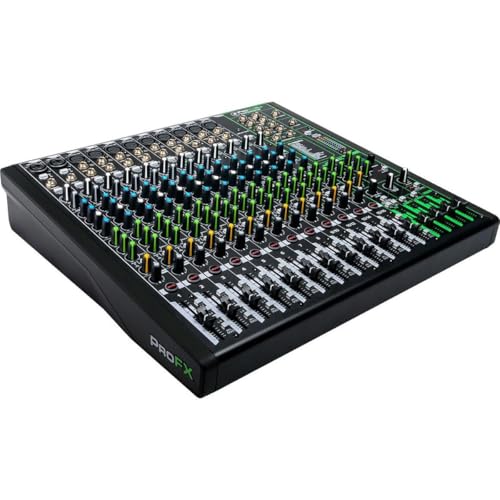
Mackie ProFX16v3 — Best Overall
The ProFX16v3 is the board we would hand to a working band that plays bars, weddings, and small festivals and cannot afford a bad night. It suits acts with up to eleven microphones — a full drum kit miked sensibly, three or four vocals, and instruments — plus stereo channels for keys or tracks. It does not suit engineers who need more than its aux configuration offers for complex in-ear monitor rigs, and it is more board than a solo acoustic act will ever use.
Strengths
- Eleven Onyx mic preamps with generous headroom, so loud singers and close-miked drums do not clip the input stage.
- The GigFX effects engine gives you editable reverbs, delays, and chorus that genuinely flatter live vocals instead of sounding like a bathroom.
- USB recording captures the stereo mix to a laptop, so every gig can become a live demo or a board tape for the band to review.
Trade-offs
- The USB feed is a stereo mix, not multitrack — you cannot remix individual channels after the show.
- At 16 channels it is a substantial carry; a duo will find it oversized for café corners.
- The effects are shared across channels through sends rather than inserted per channel, which is normal at this tier but limits exotic processing.
Key specs: 16 channels · 11 mic preamps · USB recording · GigFX onboard effects · unpowered (feeds powered speakers or external amps)
What makes the ProFX16v3 the overall pick is balance. The Onyx preamps are the same family Mackie builds its reputation on, and in a live context that headroom matters more than studio purity: a drummer who hits harder in the second set, a singer who leans into the chorus — the input stage absorbs it. The channel EQ is musical rather than surgical, which is the right priority when you are mixing by ear in a loud room. Subgroup routing lets you park all the vocals on one fader and all the drums on another, so mid-show adjustments become one-finger moves instead of a hunt across the board. The built-in compression on the first channels is a quiet hero for wedding speeches and unpredictable guest vocalists. In short, it behaves like a board designed by people who have actually mixed a Saturday night.
Best for: working bands, wedding and event acts, and venues that host varied lineups / Not suited for: engineers needing multitrack recording or large in-ear monitor systems
Check the current price on Amazon

Yamaha MG16XU — Best for Sound Quality
The MG16XU is the quiet professional of this group. It suits acoustic ensembles, worship teams, theater productions, and any live act where the material is dynamic and the audience is listening rather than shouting — its D-PRE preamps are famously clean, and the whole board has a low noise floor that rewards careful gain staging. It does not suit acts that want flashy effects variety; its SPX effects are excellent but restrained, and it is not the board for a DJ-adjacent performance style.
Strengths
- D-PRE discrete preamps deliver a clean, detailed sound that flatters acoustic instruments and voices.
- A solid metal chassis and confident faders make it the board here that feels most like permanent-install equipment.
- One-knob compressors on the key channels tame peaks instantly, which is invaluable with volunteer operators at worship and school events.
Trade-offs
- The effects selection is tasteful rather than deep; tweakers will want more parameters.
- It is unpowered, so budget for powered speakers or an amplifier if you do not already own them.
- The layout is dense — new operators should label channels until the layout becomes muscle memory.
Key specs: 16 inputs · D-PRE mic preamps · SPX onboard effects · USB audio interface · unpowered
Yamaha’s MG series has been a default recommendation for so long that it is easy to overlook how good the current generation is. The MG16XU’s strength in a live setting is what it does not add: no hiss creeping in during a quiet passage, no grain on a fingerpicked guitar, no sense that the board is the weakest link. The one-knob compressors deserve special mention for live work — a single control that a volunteer can be taught in thirty seconds, and which prevents the two classic live disasters, the shouted chorus clipping and the quiet verse disappearing. Aux sends are sufficient for mains plus two monitor mixes in typical use. If your performances are about the material rather than the spectacle, this is the board that gets out of the way.
Best for: worship teams, acoustic acts, theater, and school productions / Not suited for: acts wanting deep editable effects or built-in amplification
Check the current price on Amazon

Allen & Heath ZED-16FX — Best Premium Analog
The ZED-16FX is the connoisseur’s choice: a British analog console built for people who mix with their ears and keep equipment for a decade. It suits serious semi-pro bands, small touring acts with their own engineer, and venues that want a house board nobody complains about. It does not suit buyers who need USB multitrack recording — its USB is a simple stereo interface — or anyone counting every dollar, because you pay for the build and the sound.
Strengths
- DuoPre preamps and a swept midrange EQ on the mono channels give precise control over feedback-prone frequencies and vocal presence.
- Exceptional build: individual channel boards, a proper internal power supply, and faders with a smooth, weighted feel.
- The onboard effects were modelled on dedicated rack units and sit naturally in a live mix.
Trade-offs
- Stereo-only USB — fine for capturing the show, useless for post-production remixing.
- Heavier and deeper than rivals of the same channel count; check your case or gig bag dimensions.
- Premium tier pricing within this group, justified by construction rather than feature count.
Key specs: 16-channel analog console · DuoPre preamps · swept mid EQ · onboard FX · stereo USB I/O · unpowered
Allen & Heath built its name in live sound, and the ZED-16FX shows why engineers stay loyal. The swept mid EQ is the headline for live work: feedback almost always lives in the midrange, and being able to sweep a narrow cut to the exact ringing frequency — instead of guessing with fixed bands — is the difference between a board that fights the room and a board that tames it. The preamps have a forgiving, slightly warm character that flatters rock vocals and DI’d acoustic guitars. Every control feels deliberate. This is the board you buy when you have rented one too many times and decided to own the good one.
Best for: semi-pro and touring bands, serious house venues, engineers who mix by ear / Not suited for: multitrack recordists or tight budgets
Check the current price on Amazon

Soundcraft EFX12 — Best for Small Bands
The EFX12 wraps a 12-channel Soundcraft console around a genuine Lexicon effects engine, and that combination makes it the sweet spot for duos, trios, and compact bands. It suits acts with up to eight microphones who play listening rooms, restaurants, and small clubs, and who want their vocals to sound expensive. It does not suit larger bands — eight mic inputs is a hard ceiling — and it has no USB recording, so capturing the show means another device.
Strengths
- Real Lexicon reverbs and delays, the same algorithms lineage found in studio rack gear, tuned for voices.
- GB30 mic preamps, designed by Soundcraft’s founders’ circuit tradition, are clean and quiet at real-world gains.
- A compact footprint and sensible layout make it the fastest board here to set up and sound-check.
Trade-offs
- No USB interface at all — no laptop recording, no digital playback channel.
- Eight mic inputs cap the band size; a drummer wanting full kit miking will outgrow it.
- Monitor sends are adequate for one or two mixes but not for a full wedge setup.
Key specs: 12 channels · 8 mic preamps · Lexicon effects engine · unpowered · no USB
Effects are where small live mixers usually embarrass themselves — a metallic, splashy reverb that makes a good singer sound like they are performing in a stairwell. The EFX12 is the exception at its tier because Lexicon’s hall and plate algorithms have genuine depth. Set a medium plate on the lead vocal and the song lifts. The rest of the board is classic Soundcraft: a musical three-band EQ with a swept mid on the mic channels, a sensible aux structure, and a layout a guest engineer can read at a glance under stage lights. For a small band that travels light, it is the board that makes the fewest apologies.
Best for: duos, trios, and small bands in listening rooms / Not suited for: larger lineups or anyone needing USB recording
Check the current price on Amazon

Behringer Europower PMP500 — Best Powered Mixer
The PMP500 puts a 500-watt Class-D amplifier inside a 12-channel mixer, which changes the whole economics of a small live rig: one box, two passive speakers, a pair of speaker cables, and you are performing. It suits solo acts, duos, small bands, houses of worship, and community events that own passive speakers or want the simplest possible setup. It does not suit acts feeding powered speakers — the amplifier would be wasted — or engineers who need flexible monitor routing for a full band.
Strengths
- Built-in 500-watt amplification removes a separate power amp, its cables, and its setup time from your rig.
- FBQ feedback detection lights up the offending frequency band on the graphic EQ, so beginners can ring out a room by following the lights.
- Klark Teknik effects and per-channel compression deliver a polished sound without outboard gear.
Trade-offs
- Powered mixers lock you into passive speakers; if you later switch to powered mains, the amp section is dead weight.
- Monitor flexibility is basic compared with the unpowered consoles here.
- The amplifier’s real output depends on your speakers’ impedance — match them properly to get the rated performance.
Key specs: 12 channels · built-in 500W Class-D amplifier · Klark Teknik FX · FBQ feedback detection · graphic EQ on mains
Powered mixers survive because the math is unbeatable for small venues: the PMP500 replaces a mixer, an amplifier, an effects unit, and a feedback suppressor with a single carry. The FBQ system deserves emphasis for live performance — feedback is the number one sound problem at real gigs, and a system that visually identifies the ringing band on the graphic EQ turns a panic moment into a ten-second fix. Wireless microphone readiness and an MP3-friendly input round out a box clearly designed for the way small events actually run. If your speakers are passive and your stages are modest, this is the most performance per trip from the car.
Best for: small venues, solo and duo acts, and worship or community events with passive speakers / Not suited for: rigs built on powered speakers or complex monitor needs
Check the current price on Amazon
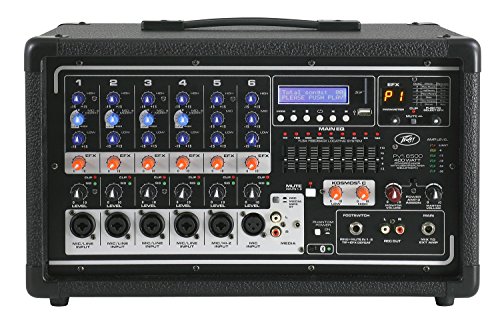
Peavey PVi 6500 — Best Budget Powered
The PVi 6500 is Peavey’s all-in-one answer for small live performance: a powered mixer with onboard effects, a straightforward layout, and the kind of durability that made Peavey the default brand in rehearsal rooms and small clubs for decades. It suits karaoke hosts who take live singers, small bands starting out, school and church events, and anyone who wants amplification and mixing in one affordable box. It does not suit recording-minded buyers — this is a performance tool, not an interface — or acts whose monitor and routing needs have already grown professional.
Strengths
- All-in-one design with amplification and effects keeps the total rig cost and setup complexity at the floor.
- Controls are deliberately simple — a new operator can run a competent event after one walkthrough.
- Peavey’s small-venue heritage means sensible features: feedback control, usable reverbs, and connections where you expect them.
Trade-offs
- Fewer routing options and less EQ precision than the unpowered consoles in this guide.
- Like all powered mixers, it pairs with passive speakers only.
- The sound is workmanlike rather than refined; critical acoustic acts should step up to the Yamaha.
Key specs: powered mixer format · onboard digital effects · feedback control · designed for passive speaker systems
There is a specific buyer the PVi 6500 serves perfectly: the person who has been put in charge of sound for a venue, a school, or a band and needs something that works every time without a learning curve. Peavey voices these boxes for exactly that user — the effects are pre-tuned to flatter, the feedback control addresses the problem every beginner actually has, and the whole unit tolerates being moved, stacked, and borrowed. It will not win a shootout against the Allen & Heath on a quiet stage, but it will run a Friday night reliably for years, and for a first powered rig that reliability is the feature that matters.
Best for: first live rigs, karaoke with live singers, schools, churches, and small bands on a budget / Not suited for: recording use or advanced monitor routing
Check the current price on Amazon
Comparison Table
| Pick | Badge | Key spec | Best for |
|---|---|---|---|
| Mackie ProFX16v3 | Best Overall | 11 Onyx preamps, GigFX, USB recording | Working bands and varied lineups |
| Yamaha MG16XU | Best for Sound Quality | D-PRE preamps, one-knob compression | Worship, acoustic, theater |
| Allen & Heath ZED-16FX | Best Premium Analog | Swept mid EQ, DuoPre preamps | Semi-pro and touring acts |
| Soundcraft EFX12 | Best for Small Bands | Lexicon effects, 8 mic preamps | Duos, trios, listening rooms |
| Behringer Europower PMP500 | Best Powered Mixer | 500W built-in amp, FBQ feedback detection | Small venues with passive speakers |
| Peavey PVi 6500 | Best Budget Powered | All-in-one powered format, simple controls | First rigs, schools, karaoke hosts |
How to Choose the Best Audio Mixer for Live Performance
Start with the decision that shapes everything else: powered or unpowered. If you own or plan to buy powered speakers — the modern default, with amplifiers matched to the drivers inside each cabinet — buy an unpowered console like the Mackie, Yamaha, Allen & Heath, or Soundcraft here. If you own passive speakers, or you are building a fixed small-venue rig from zero and want the fewest boxes, a powered mixer like the PMP500 or PVi 6500 collapses the system into one unit. Mixing the two worlds wastes money: an amplifier you cannot use, or speakers that still need one.
Next, count microphones honestly. List every source in your loudest, largest configuration: lead vocal, backing vocals, kick, snare, toms, overheads, guitar amp mics or DIs, bass DI, keys, and the talkback or MC mic everyone forgets. That number, not the headline channel count, is your requirement. Then add one spare mic input, because guests, failures, and new band members are facts of live life. A board that exactly fits today’s lineup is a board you replace next year.
Monitor sends deserve more attention than they get. Each distinct mix a performer hears needs its own aux send: one for the front wedges, one for the drummer, one for an in-ear system. Two auxes is the practical minimum for a band; four is comfortable. Check whether the sends are pre-fader — they must be, so that your front-of-house fader moves do not change what the band hears mid-song.
Finally, weigh the unglamorous things: weight and case fit if you tour in a car, an internal power supply versus a wall wart that will get lost, and whether the effects can be muted by footswitch between songs so the singer’s between-song chat is not echoing like a cave announcement. These details decide whether a mixer is loved or tolerated after fifty gigs.
How to Set Up a Live Mixer and Ring Out a Room
Setup order matters and prevents most live disasters. First, with all faders down and gains at minimum, connect the main outputs to your speakers or amplifier, then connect every microphone and instrument. Second, power on in the right sequence: mixer and outboard first, amplifiers and powered speakers last, so turn-on thumps never reach the drivers. Third, set gains one channel at a time: have the performer play or sing at their loudest real level, raise the gain until the channel meter peaks healthily without clipping, then pull it back a touch for headroom. Fourth, build the mix from the kick drum and lead vocal outward, adding instruments underneath rather than stacking everything at unity and fighting the sum.
Ringing out the room is the skill that separates a competent live engineer from a hopeful one. With the band off stage, raise the lead vocal microphone’s level slowly until the first feedback ring appears, note its pitch, and cut that frequency narrowly — with a swept mid EQ or the graphic EQ on the mains — by a few decibels. Repeat until you have found two or three rings; you now have several decibels of extra level before feedback, which is the difference between a vocal that sits on top of the band and one buried beneath it. Powered mixers with feedback detection, like the PMP500 in this guide, light the offending band for you. Walk the room while you do this: the mix position lies, and the corners of a real room are where the audience actually sits.
A Soundcheck Sequence That Actually Works
Soundcheck in the order the audience hears importance, not the order musicians wander onto the stage. Start with the kick drum alone: gain it, gate nothing (these boards are analog — use placement and tuning), and EQ it for weight without boom. Add the snare, then the rest of the kit briefly, then bass, checking that the kick and bass occupy different low-end space rather than summing into mud. Guitars and keys come next, panned slightly apart if you run stereo mains. Vocals go last and get the most time: set the lead vocal’s gain with the singer performing at full show volume — ask for the loudest chorus, not a spoken “check one two,” because a gain staged on speech will clip on singing. Build monitor mixes one performer at a time, asking each person the only useful question — “what do you need more or less of?” — rather than playing their whole channel list at them.
Finish with a full-band run of the loudest song, walk the room during it, and make your final EQ decisions from the worst seat, not the mix position. Then write down or photograph every setting. If anything gets bumped during load-in tomorrow, the photograph rebuilds your show in minutes. This sequence takes twenty disciplined minutes and prevents the two failures audiences actually remember: a first song ruined by feedback, and a vocal that never surfaces above the band.
Common Buying Mistakes
- Buying the headline channel count. Sixteen channels with eight mic preamps does not mic a nine-microphone band. Count preamps, not channels.
- Forgetting the monitors. A mixer that sounds glorious out front but feeds one shared monitor mix will make the band play worse. Aux sends are a headline feature, not a footnote.
- Double-amplifying. Running a powered mixer’s speaker outputs into powered speakers can damage equipment. Know which half of your rig contains the amplifier — exactly one half should.
- Ignoring the case. An unprotected mixer in a car boot loses faders and knobs. Budget for a padded bag or case from day one.
- Choosing effects quantity over quality. Ninety-nine presets you would never use lose to a handful of reverbs that flatter a voice. The Lexicon and GigFX engines in this guide exist for that reason.
- No spare input. The guest vocalist, the borrowed keyboard, the failed channel — live performance guarantees surprises. One spare mic input is the cheapest insurance in audio.
Monitor Mixes, Aux Sends, and Why the Band Cares More Than the Audience
Ask a room of live engineers what separates a good night from a bad one and monitors come up before sound quality does. The audience hears the main mix; the band hears the monitor mix, and a band that cannot hear itself plays tentatively, sings flat, and rushes tempos. Every mixer in this guide was screened for monitor capability for exactly this reason. An aux send is a separate, independent mix tapped from each channel: turn up the singer in aux one and she hears more of herself in her wedge without the audience hearing any change. Pre-fader sends are essential for monitors, because they isolate the monitor mix from your front-of-house fader moves; post-fader sends are for effects, where the reverb should follow the channel’s level in the main mix.
How many do you need? A solo performer needs one. A duo usually shares one or splits into two. A full band ideally gets three or four: one for the front line, one for the drummer — who sits behind the amplifiers and hears the worst sound in the building — and one or two for in-ear systems. In-ear monitors change the equation in your favor: they cut stage volume dramatically, which reduces feedback, which lets the whole system run cleaner. But they multiply the value of aux sends, because every in-ear user wants a personal mix, and a stereo in-ear mix consumes two sends. If your band is heading toward in-ears, monitor routing — not channel count — is the specification that will retire your current board, so buy sends generously.
There is also a human factor worth stating plainly: the fastest way to lose a band’s trust is to change their monitor mix mid-song while chasing the front-of-house sound. Boards with clearly laid-out aux masters, like the Mackie and Yamaha in this guide, make it easy to keep your hands honest — one section for the audience, one for the stage, never confused under pressure.
Budget Tiers for Live Mixers, Explained Honestly
Live mixers sort into three practical tiers, and knowing what each tier actually buys prevents both overspending and the more common error — underspending into a board you replace within a year. The entry tier is where the powered Peavey in this guide lives: simple routing, basic effects, amplification included in the powered designs. It buys reliability and immediacy, and for a first rig, a school hall, or a karaoke night with live singers, it is genuinely sufficient. What it does not buy is EQ precision, monitor flexibility, or recording.
The mid tier — the Mackie ProFX, Yamaha MG, and Soundcraft EFX boards here — is where live mixers become professional tools. The money buys better preamps with more headroom, effects you would choose rather than tolerate, enough aux sends for real monitor mixes, subgroups for one-fader control of vocals or drums, and USB capture of the show. Most working bands should land here; the step up from entry tier is audible in the room and obvious in the band’s confidence.
The premium tier, represented here by the Allen & Heath ZED, buys construction and control: swept midrange EQ for surgical feedback work, channel build quality that survives a decade of load-ins, and a sound that engineers describe as forgiving. It does not buy more channels or longer feature lists. Buy premium when the board is a long-term instrument rather than a stepping stone — when you already know your lineup, your venues, and your workflow, and simply want the best version of exactly that.
One last tier note: the used market in live mixers is genuinely good, because analog consoles age gracefully and bands upgrade constantly. But buy used only when you can test every channel, every aux, and the effects engine in person — a single dead preamp or a scratchy master fader converts a bargain into a repair bill, and intermittent faults are exactly the kind sellers do not mention. New from a retailer with painless returns, which is how this guide’s picks are linked, remains the safer default for a board your performances depend on.
The Supporting Gear Nobody Budgets For
A mixer is the center of a live rig, not the whole of it, and the most common financial mistake in this category is spending the entire budget on the console and then discovering the cables cost real money too. Budget honestly for the supporting cast. Microphone cables: one per microphone, plus two spares, because cables fail at gigs with theatrical timing and a spare XLR is the difference between a story and a disaster. Speaker cables if you run a powered mixer into passive speakers — and note that these are not instrument cables; using a guitar lead as a speaker cable is a genuine equipment risk, not a superstition. A DI box or two for acoustic guitars and keyboards, so unbalanced sources arrive at the board cleanly. A power conditioner or at least a robust power strip with surge protection, because bar wiring and generator power at outdoor events are unkind to electronics.
Then protection: a padded bag at minimum, a hard case if the board travels weekly. Faders and knobs are the parts that break in transit, and they are the parts you cannot perform without. Finally, the cheapest high-value item in live sound: a roll of console tape and a marker. Label every channel at every gig. Under stage lighting, mid-show, with the singer asking for more of herself in the wedge, the engineer who labeled the board at soundcheck looks like a genius and the one who did not looks like a cautionary tale. None of this gear is glamorous, and all of it together typically costs less than the step from one mixer tier to the next — while improving your actual show more than that step would.
Final Recommendation
For most performers, the answer is the Mackie ProFX16v3: it covers the widest range of real gigs, records the show over USB, and its preamps forgive loud sources. If your material is quiet, dynamic, and listened to closely, step to the Yamaha MG16XU for its cleaner sound, or to the Allen & Heath ZED-16FX if you want the premium analog board you keep for a decade. Small bands that travel light should take the Soundcraft EFX12 and its Lexicon effects. And if your rig is built on passive speakers, skip the separate amplifier entirely: the Behringer PMP500 for flexibility, the Peavey PVi 6500 for the tightest budget. Whichever you choose, count your microphones once more before ordering — that single habit prevents nearly every wrong purchase in this category.
Keep exploring the cluster: Best Audio Mixers For Outdoor · Best Audio Mixers For Recording Music · Best 12 Channel Audio Mixers · Best 16 Channel Mixers · Best Audio Mixers For Podcasting
Frequently Asked Questions
How many channels do I need for a live band?
Count microphones, not channels. A typical four-piece band with three vocals, a sensibly miked drum kit, bass DI, and one guitar amp mic lands between nine and twelve mic inputs, plus a stereo channel for keys or tracks. A 16-channel board with ten or eleven preamps is the practical sweet spot; duos can live happily on a 12-channel board with eight preamps.
What is the difference between a powered and an unpowered mixer?
A powered mixer contains an amplifier and drives passive speakers directly. An unpowered mixer outputs line-level signal and needs powered speakers or a separate amplifier. Neither is better in absolute terms — the right choice is whichever matches the speakers you own, and you must never connect a powered mixer’s speaker outputs to powered speakers.
Do I need onboard effects for live performance?
For vocals, practically yes. A modest amount of reverb or delay is part of the expected sound of a live voice, and onboard effects save carrying and wiring a separate processor. Look for quality over quantity: a few good halls, plates, and delays cover nearly every live situation.
How do I stop feedback at gigs?
Start with placement — speakers in front of the microphones, never behind — then ring out the room at soundcheck by raising levels until ringing starts and cutting those frequencies narrowly with swept EQ or a graphic EQ. Keep stage volume low so the mixer is not fighting the amplifiers, and use one monitor mix per performer area rather than one loud mix for everyone.
Can a live mixer also record?
Several boards here record the stereo main mix over USB to a laptop, which is ideal for live demos and board tapes. If you need multitrack recording — every channel separately for later remixing — you need a board or interface designed for it, such as the multitrack-USB Mackie Onyx class or a digital console; that is a different purchase from a straightforward live analog mixer.
Should I buy a digital mixer instead?
Digital mixers add scene recall, remote tablet control, and deep processing, and they are the right tool for engineers running varied shows from the back of the room. For performers mixing themselves from stage and small venues with rotating operators, the immediacy of physical faders and knobs on an analog board is a genuine advantage — every control is visible and grabbable under stage lights.
What size mixer do I need for a church or school auditorium?
Count the maximum simultaneous sources at your largest event — a worship band with several vocalists, or a school musical with a pit and a cast — rather than the average Sunday or assembly. Fixed venues benefit from headroom: a 16-channel board with ten or more mic preamps, at least two monitor sends, and simple one-knob compression for volunteer operators covers nearly all of it. The Yamaha MG16XU in this guide is the archetype of that purchase.


