Disclosure: airfryerkitchensupply.com is reader-supported. When you buy through links on our site, we may earn an affiliate commission at no extra cost to you.
Where to buy
Every linked pick in this guide to the best automatic kitchen faucets was verified against Amazon’s catalog on 2026-11-20, so the model numbers below are the exact touchless models you will land on. Start with the Moen Arbor with MotionSense Wave (7594EWSRS) for the most forgiving all-round automatic faucet, the Kohler Sensate (K-72218-WB-BL) for the most precise sensor in the category, and the Kohler Maxton Touchless (R26281-SD-CP) for the most accessible entry into brand-name touchless. Check the current price on Amazon for each pick — we never print static prices, and automatic faucets are promoted aggressively in sales seasons.
First, a vocabulary rescue, because “automatic” covers three different technologies that listings blur together — and the blurring is not accidental, since a tap faucet photographed mid-gesture looks identical to a sensor faucet in a listing thumbnail. Knowing which technology a model actually uses is the first and cheapest piece of research in this category, and the model suffixes give it away once you know the brands’ codes, which the reviews below decode as they go. A true automatic (touchless) faucet uses an infrared sensor: wave a hand or hold a pot in the sensor zone and water runs; move away and it stops — Moen’s MotionSense Wave, Kohler’s Response and Sensate systems work this way. A touch faucet (Delta’s Touch2O) runs when you tap the spout or handle with a wrist or forearm — not automatic, but hands-free in the ways that matter when your fingers are covered in raw chicken. A hybrid does both. This guide ranks the true automatics, includes Delta’s touchless-capable Essa as the hybrid pick, and explains the differences in use, because the right choice depends on whether you want water that anticipates you or water that obeys a tap.
In this guide
Quick Picks
- Best Overall: Moen Arbor MotionSense Wave (7594EWSRS) — one wave sensor on top, a proven pull-down underneath, battery or optional AC power.
- Best Modern Design: Moen Sleek MotionSense Wave (7864EWSRS) — the minimalist Sleek body with the same Wave sensor system.
- Best Sensor Precision: Kohler Sensate (K-72218-WB-BL) — AC-powered sensor with a fast, tightly tuned response zone and no handle at all.
- Best Pull-Down Touchless: Kohler Simplice Response (K-22036-VS) — Response sensor in the spout base, full pull-down spray head, familiar lever as backup.
- Best Value Brand-Name Touchless: Kohler Maxton Touchless (R26281-SD-CP) — touchless activation and a soap dispenser in the box, at the friendliest tier of the name-brand sensor class.
- Best Touch + Touchless Hybrid: Delta Essa Touchless with Touch Technology (9113TL-AR-DST) — tap-anywhere Touch2O plus hands-free proximity, on the MagnaTite pull-down platform.
How These Picks Were Chosen
Automatic faucets fail differently from manual ones, so our selection criteria added an electronics audit to the usual plumbing checks. Every candidate was verified by brand and model, with the returned title matched before we took an ASIN — in this category that step matters doubly, because the same faucet family often exists in manual, touch, and touchless versions whose model numbers differ by two letters. Then we required four things. First, a manual fallback: every pick here can run water with the electronics off or dead, because a faucet that bricks itself when a battery dies is a liability, not a convenience. Second, a parts pipeline for the electronics: the sensor, solenoid, and control box must be replaceable by model number from a real manufacturer. Third, a sane sensor design — a defined activation zone that does not trigger when you walk past with a laundry basket. Fourth, the underlying faucet had to be a good faucet: cartridge, hose, and docking judged by the same standards as our manual guides.
Those criteria did real work. They excluded the entire budget import touchless class — feature-stacked sensor faucets from brands with no parts catalogs, which we dissect in our best and worst faucets guide — because their sensors and solenoids are unreplaceable and their failure disables the faucet. They also shaped the ranking among the survivors: Moen’s Wave system, with its single top-mounted sensor, is the most learnable; Kohler’s Sensate, AC-powered with the sensor in the spout, is the most precise; Kohler’s Response, with the sensor at the spout base, is the most conventional to live with. The six picks below are the automatic faucets we would plumb into our own kitchens, in the order we would choose them for the households described.
The 6 Best Automatic Kitchen Faucets

Moen Arbor MotionSense Wave (7594EWSRS) — Best Overall
Moen’s MotionSense Wave puts a single sensor on top of the spout: wave a hand over it to start or stop the water, or simply use the handle like any normal faucet — the two control paths coexist without arguing. Underneath the electronics sits the Arbor platform from our American made guide: Reflex docking, Power Boost spray, Spot Resist Stainless finish. The combination is why this is the best overall automatic: the sensor learning curve is one gesture, guests can ignore the sensor entirely and use the lever, and when the batteries eventually fade the faucet remains a complete manual pull-down. It suits family kitchens, raw-meat-and-produce cooks who want hands-free starts, and households that want touchless benefits without touchless weirdness. It is not the most design-forward body here — that is its Sleek sibling — and the top sensor can be triggered by an enthusiastic reach across the spout until the household learns its geography.
Strengths
- Single top sensor with one learnable gesture; no under-spout zone to memorize or accidentally trigger while washing.
- Full manual operation at all times — the handle works regardless of battery or sensor state.
- Proven Arbor platform underneath: Reflex docking, Power Boost, Duralock installation.
Trade-offs
- Battery power as standard; the optional AC adapter is a separate purchase for those who want it.
- Traditional Arbor styling will not anchor a minimalist kitchen.
- The electronics add an under-sink control box; crowded cabinets need planning.
| Spec | Detail |
|---|---|
| Model | 7594EWSRS (verified via API) |
| Activation | MotionSense Wave top sensor + manual handle |
| Power | Battery (included) with optional AC adapter |
| Platform | Arbor pull-down, Power Boost, Reflex docking |
Daily life is where the Wave earns its ranking. Filling a pot: hold it under the spout and wave — no, simpler, the sensor starts the flow and the auto-shutoff discipline of the system means a forgotten faucet is a smaller risk than a forgotten manual one. Rinsing hands mid-recipe: one wave, no handle contamination, no cross-touching the lever with chicken hands. Cleaning: the sensor ignores the cloth moving around the spout base because its zone is on top, a subtle design decision that owners appreciate every single day. This is the automatic faucet for people who want the technology to disappear into a good faucet, and it is the one we recommend first.
Best for: families and hands-free cooking without a learning curve / Not suited for: minimalist styling or cabinets with no room for a control box. Check the current price on Amazon.

Moen Sleek MotionSense Wave (7864EWSRS) — Best Modern Design
The Sleek takes the same MotionSense Wave system and wraps it in Moen’s minimalist single-hole body: straight lines, a slim profile, Spot Resist Stainless. For contemporary kitchens — handleless cabinets, waterfall islands, the whole serene vocabulary — this is the automatic faucet that does not look like a gadget, which is precisely the aesthetic problem with most touchless designs. Functionally it mirrors the Arbor pick: wave on top, handle always available, Power Boost spray in the wand, battery power with optional AC. The trade-offs are the Sleek platform’s own: compact lever travel that asks a day of adjustment, proportions tuned to standard sinks rather than oversized farmhouse bowls, and a single-hole-first design that needs a deck plate to sit happily on a 3-hole deck.
Strengths
- The cleanest industrial design of any mainstream automatic faucet; the sensor is integrated, not appended.
- Same forgiving Wave gesture and full manual fallback as the Best Overall pick.
- Spot Resist finish keeps the slim body free of the fingerprints minimalism cannot hide.
Trade-offs
- Compact lever offers less leverage for limited-grip users when used manually.
- Contemporary styling is all-or-nothing; it will not blend into a traditional kitchen.
- Standard-depth sink proportions; very deep bowls should verify spout reach.
Choose the Sleek when the kitchen design is the brief and the household still wants the raw-chicken advantage of a wave. In ownership it behaves exactly like its Arbor sibling — same control box logic, same battery discipline, same parts channel — so the decision is purely architectural: this faucet is the one your eyes asked for, with the same brain as the one your hands would have chosen.
Best for: contemporary and minimalist kitchens / Not suited for: traditional decor or limited-grip households. Check the current price on Amazon.

Kohler Sensate (K-72218-WB-BL) — Best Sensor Precision
The Sensate is the purist’s automatic faucet: no handle at all. An AC-powered sensor in the spout reads the presence of hands, pots, and dishes in its zone and runs water only while something is there — the interaction model of a commercial restroom faucet, refined for a kitchen, in a sculptural body finished here in matte black. AC power is the point: no batteries to fade, a sensor that can afford to be fast and always alert, and a response tuned tightly enough that the water feels connected to your intent. It suits serious cooks who want both hands permanently free, design-led kitchens that can give the faucet a starring role, and households with an outlet under the sink. It demands commitment in return: no outlet means an electrician or a different pick; guests will need a five-second orientation; and the handle-free life, while liberating, removes the manual fallback ritual some users rely on during a power outage — the faucet’s behavior on dead power should be understood before purchase, as with any AC appliance.
Strengths
- AC-powered sensor: instant, consistent response with no battery maintenance, ever.
- Presence-based operation — water runs while the task is in the zone and stops when it leaves; the most water-disciplined interaction here.
- Handle-free design is the category’s design statement and its easiest surface to keep clean.
Trade-offs
- Requires an under-sink outlet; battery operation is not the design.
- No manual handle: a genuine learning curve for guests and a consideration during outages.
- Premium tier positioning — the sensor precision is what the money buys.
The Sensate rewards a specific kind of cook: the one who plates with both hands, rinses as they go, and treats the sink as a workstation. For that user, the absence of a handle stops being a missing feature within a week and becomes the point — there is nothing to touch, nothing to clean chicken off, nothing to bump. Kohler’s support for the electronic components, sold as parts through its normal channels, is what separates this from the disposable sensor faucets: the precision is serviceable. If your kitchen has the outlet and your cooking has the tempo, this is the automatic faucet at its most realized.
Best for: serious cooks with under-sink power and a taste for the future / Not suited for: battery-only installs, guest-heavy households, or the outage-anxious. Check the current price on Amazon.
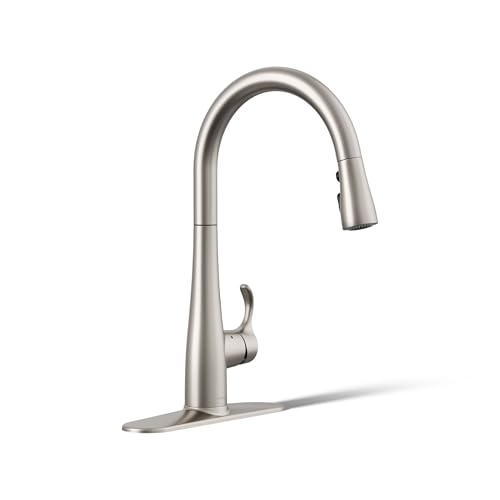
Kohler Simplice Response (K-22036-VS) — Best Pull-Down Touchless
Kohler’s Response technology puts the sensor at the front of the spout base, in the zone your hands naturally enter when you approach the sink, and the Simplice wraps it in the brand’s most popular pull-down: a high-arch body in Vibrant Stainless with a three-function spray head (stream, Sweep spray, and Boost) and DockNetik magnetic docking. The lever remains, and it matters — temperature is set with the handle in the conventional way, and the sensor handles the on-off work your hands are too dirty for. It suits households that want touchless starts with zero change to how temperature is managed, and kitchens already in the Kohler finish ecosystem. The base-mounted sensor zone takes a little more learning than Moen’s top wave: hands washing low in the bowl are in its world, and exuberant dish-piling can keep water running longer than intended until the household calibrates.
Strengths
- Response sensor positioned where hands naturally arrive; activation feels like the faucet noticing you.
- Three-function spray head with Sweep’s blade-like rinse and a Boost mode for stubborn pans.
- Full pull-down platform with magnetic DockNetik docking and Kohler ceramic disc valving.
Trade-offs
- Base sensor zone can be triggered by activity at the sink front; placement discipline is learned, not instant.
- Vibrant Stainless is a Kohler-specific tone for suite matching.
- Premium positioning alongside the Sensate; the Maxton below is the value door into Kohler touchless.
The Simplice Response is the automatic faucet for the household that hosts: guests understand a lever, the sensor reveals itself the first time someone reaches to rinse, and nobody is stranded. Its spray head is the best rinsing tool in this guide — Sweep genuinely moves food — and the docking is positive enough to trust one-handed while carrying a pan. If the Sensate is the future and the Arbor Wave is the diplomat, the Simplice is the all-rounder with a Kohler accent.
Best for: hosting households and Kohler suites wanting full pull-down function / Not suited for: buyers who want the absolute simplest sensor geometry. Check the current price on Amazon.

Kohler Maxton Touchless (R26281-SD-CP) — Best Value Brand-Name Touchless
The Maxton is the pick that proves our parts-and-support criteria do not require a flagship budget: a Kohler touchless pull-down — sensor activation, a pull-down sprayer, and a soap dispenser in the box — at the friendliest tier of the name-brand automatic class; check price on Amazon for the current number. The finish here is polished chrome, the format is the familiar high-arch pull-down, and the sensor system is Kohler’s, which means the control components exist in a real parts catalog. It suits first-time touchless buyers who want the technology from a company that will answer the phone, rentals at the nicer end, and kitchen refreshes where the faucet budget is shared with a sink or counters. The compromises are the honest ones of its tier: chrome-only in this verified listing, a simpler spray head than the Simplice’s three-function unit, and less sculptural design.
Strengths
- Real Kohler sensor system and parts support at the class’s accessible tier.
- Soap dispenser included — the fourth deck hole is usefully filled out of the box.
- Conventional pull-down format and lever keep the household learning curve near zero.
Trade-offs
- Simpler spray functions than the flagship Kohler models.
- Chrome finish only in this listing; stainless kitchens should compare the Simplice.
- Fewer premium materials cues than the tier above — this is the value engineering working as intended.
Every category needs its honest doorway, and in automatic faucets the doorway matters more than usual because the alternative doorway — the anonymous budget sensor faucet — leads to the disposable trap we warn about elsewhere in this cluster. The Maxton is how a careful buyer experiments with touchless: real sensor, real brand, real parts, at a price of admission that does not require faith. If the experiment converts you, the upgrade path inside Kohler’s line is obvious; if it does not, you own a good pull-down with a sensor you can simply stop using.
Best for: first-time touchless buyers and value-conscious refreshes / Not suited for: buyers wanting flagship spray features or stainless finishes. Check the current price on Amazon.

Delta Essa Touchless with Touch Technology (9113TL-AR-DST) — Best Touch + Touchless Hybrid
Delta’s entry earns its place by refusing to choose: the Essa 9113TL combines Touch2O tap-anywhere activation — touch the spout or handle with a wrist, forearm, or knuckle to start and stop — with a hands-free proximity mode, on the Essa platform our other guides rank for its MagnaTite docking and DIAMOND Seal valving. The hybrid model suits households divided on the question: the cook who wants proximity sensing, the partner who trusts a deliberate tap, the guests who will use the handle like it is 1995 (which also works). It is also the answer for cooks whose hands are not just dirty but occupied — a forearm tap with a sheet pan in both hands is a genuinely different capability from a wave. The costs are complexity and education: two activation systems mean two sets of habits, a battery pack to maintain, and a household conversation about which mode the faucet is in.
Strengths
- Two activation philosophies in one faucet — tap control and hands-free proximity — plus a normal handle.
- Essa platform strengths: MagnaTite docking, ShieldSpray-family rinsing, InnoFlex supplies.
- Tap activation works with any body part and through most kitchen gloves, where pure sensors can hesitate.
Trade-offs
- Most complex control logic here; the household must learn which mode is active.
- Battery dependence for the electronic modes (handle remains manual).
- Premium tier; buyers certain they want only one activation style can pay less for it.
| Spec | Detail |
|---|---|
| Model | 9113TL-AR-DST (verified via API) |
| Activation | Touch2O tap + hands-free touchless + manual handle |
| Mounting | Single hole (verified via API) |
| Platform | Essa pull-down, MagnaTite docking |
Think of this pick as the committee-proof faucet. In real households, technology adoption fails at the second user, and the Essa’s redundancy is engineered against exactly that failure: nobody in the house is wrong, because every interaction style works. Delta’s parts and support depth — the same network behind the manual Essa — covers the electronics as numbered components. If your household argues about gadgets, this is the automatic faucet that ends the argument by agreeing with everyone.
Best for: mixed-preference households and forearm-tap cooks / Not suited for: minimalists who want one simple gesture. Check the current price on Amazon.
Comparison Table
| Pick | Badge | Key spec | Best for |
|---|---|---|---|
| Moen Arbor MotionSense Wave | Best Overall | Top wave sensor, battery/AC optional, Reflex | Families, easy adoption |
| Moen Sleek MotionSense Wave | Best Modern Design | Wave sensor in minimalist body | Contemporary kitchens |
| Kohler Sensate | Best Sensor Precision | AC-powered presence sensor, handle-free | Serious cooks with an outlet |
| Kohler Simplice Response | Best Pull-Down Touchless | Base sensor, 3-function head, DockNetik | Hosting households |
| Kohler Maxton Touchless | Best Value Brand-Name | Touchless + dispenser included, chrome | First-time touchless buyers |
| Delta Essa Touchless | Best Hybrid | Touch2O tap + proximity, MagnaTite | Mixed-preference households |
How to Choose an Automatic Kitchen Faucet
Choose the activation philosophy first, because you will live inside it daily. Wave sensors (Moen) ask for a deliberate gesture and otherwise leave you alone — the calmest system for households that fear false triggers. Presence sensors (Kohler Sensate) remove the gesture entirely and reward workstation-style cooking, at the price of a learning curve and AC power. Base-zone sensors (Kohler Response) split the difference, noticing hands at the sink front. Tap systems (Delta Touch2O) trade the sensor’s magic for certainty: nothing runs unless touched, which some households — especially those with pets tall enough to trip a sensor zone, or toddlers conducting water experiments — actively prefer. Hybrids exist for households that cannot agree, and there is no shame in that answer.
Power second. Battery systems install anywhere and run for long stretches between changes, but they add a maintenance ritual and a control box that must stay accessible; put the battery pack where you can reach it without emptying the cabinet. AC systems never need batteries and can run faster, always-alert sensors, but they need an outlet — and note that a garbage disposal’s outlet is usually switched and shared, so plan a proper constant-power receptacle with your electrician if you go the Sensate route. Either way, confirm the manual fallback with your own eyes in the product documentation: the faucet must run water with the electronics off. Every pick in this guide passes that test; much of the wider market does not, and that single check eliminates most of the category’s horror stories.
Third, the faucet under the gadget. Sensor aside, you are buying a pull-down (or not), a cartridge, a hose, a dock, and a finish, and those should be judged by the standards of our manual guides: replaceable cartridge, positive docking, metal in the water path, parts by model number. The automatic premium buys the sensor system; it should never excuse a lesser faucet underneath. Finally, the household test: count the users, their ages, and their patience. The best automatic faucet is the one the whole household will actually use as designed — a Wave in a family kitchen, a Sensate in a chef’s, a hybrid in a democracy.
How to Install and Set Up an Automatic Faucet
Installation follows the manual pattern — deck the faucet, connect supplies — with three added acts. First, the control box: mount it to the cabinet wall where the manual specifies, with slack loops in the hoses and wires arranged so nothing kinks or chafes, and where you can reach it later without unloading the cabinet; your future self, changing batteries at year two, is the audience for this decision. Second, power: load the battery pack (or plug in the AC adapter) only after the water connections are tested dry, and route cables away from the disposal’s vibration and the pull-down hose’s travel path. Third, calibration and education: run the sensor through its paces with the kinds of objects your kitchen actually presents — steel pots, black pans (some sensors read dark, matte objects less eagerly), glass, and hands at various heights — and adjust placement or expectations accordingly. Then teach the household, including the manual fallback, in one deliberate minute. Most “my sensor is possessed” stories are uncalibrated zones and untaught users, not defective faucets.
Maintenance thereafter is light but real: keep the sensor window clean (a film of kitchen grease is the leading cause of sluggish response), replace batteries on a schedule rather than on failure — mark the date on the pack with a pen — and if response ever turns erratic, power-cycle the control box before concluding anything is broken. Keep the manual handle in regular use too; a faucet whose lever never moves is a faucet whose cartridge ages untested, and the fallback you never exercise is the fallback that surprises you.
The Honest Case About Hygiene and Water Saving
Automatic faucets are sold on hygiene and conservation, and both claims deserve a calibrated hearing. Hygiene: the genuine win is narrower and realer than the advertising. A touchless faucet removes the specific moment of cross-contamination — raw-protein hands on the handle — and removes the handle from the list of things to disinfect after messy cooking. It does not sterilize anything else, and a household that handles food safely with a manual faucet and a handwash will not become safer by sensor alone. Buy it for the convenience of that one moment, repeated daily, and the claim holds up.
Conservation: presence-based systems like the Sensate’s genuinely cut the classic waste pattern — water running while you scrub, reach, or turn away — because the default state is off and the water follows the task. Gesture systems save less automatically, since they run until gestured off, though their auto-shutoff timers cap the forgotten-faucet scenario. The honest summary: the technology can save water in the patterns where kitchens waste it, and the size of the saving is a household habit question, not a specification. Buy the interaction you will enjoy; let the conservation be a dividend, not the justification.
Sensor Troubleshooting: The Five Complaints and Their Fixes
Ownership of an automatic faucet includes a small repertoire of mysteries, and nearly all of them resolve without parts. Complaint one: the sensor stopped responding. Work the order — batteries first (test or replace, do not trust the indicator alone), then clean the sensor window with a damp cloth, then power-cycle the control box by disconnecting it for a full minute. Complaint two: the faucet triggers by itself. Look for a reflective surface newly placed in the sensor’s field — a steel pot left in the bowl, a foil pan, a moved appliance — and for direct sunlight striking the window at a new hour; repositioning the object or the faucet’s rest angle usually ends the haunting. Complaint three: it will not see black pans or glass. Some infrared systems read dark, non-reflective objects weakly; the fix is behavioral — present a hand with the pan, or use the handle for that fill — and it is worth discovering during your setup calibration rather than mid-recipe.
Complaint four: the water stops mid-task. Presence systems are doing exactly what they were told if the task left the zone; gesture systems with auto-shutoff timers will close a long, unattended fill by design — fill big pots in attended bursts, or use the manual handle for the canning kettle. Complaint five: temperature is wrong even though the sensor works. Touchless systems separate the questions — the sensor governs on and off, the handle or its set position governs temperature — so a faucet that runs cold on sensor starts is telling you where the handle lives, not that the electronics failed. Set the handle to your household’s default temperature and leave it there; that is the intended operating posture of every hybrid design in this guide. If a complaint survives these checks, that is when the parts pipeline you paid for earns its keep: the sensor module, solenoid, and control box on every pick here are replaceable by model number.
Automatic Faucets for Special Households
For aging in place and limited-mobility households, an automatic faucet is not a gadget but an accessibility tool: no grip strength is needed to start water, no lever must be reached across a hot stove-side sink, and the auto-shutoff removes the flooded-sink risk of a forgotten tap. The Wave’s single top gesture is the easiest to teach and the hardest to trigger wrongly; the Sensate removes gestures entirely but removes the manual fallback with them, which cuts both ways for this audience — choose with the specific user’s abilities, and favor the model whose fallback they can operate. For households with young children, the calculus inverts: a sensor a child can trigger is a water-play invitation, and the tap-activated or hybrid models — where a deliberate touch is required and a parent can disable the electronic mode — are the grown-ups’ choice until the children are older.
Multigenerational homes, the hardest case, are why the hybrid pick exists. Grandparents get a handle that behaves exactly as handles always have; parents get the wave or tap for the messy work; children get supervised discovery rather than a mystery appliance. When you brief the household, brief the fallback first and the feature second — everyone should know how to get water with the electronics off before anyone learns the gesture. That ordering, repeated across every technology in the home, is the difference between a smart kitchen and a fragile one.
Common Buying Mistakes
- Buying sensor faucets from brands with no parts catalog. When the solenoid dies, the faucet dies. This is the category’s number-one trap.
- Skipping the manual-fallback check. If the faucet cannot run water with dead electronics, it is a appliance with a plumbing costume. Verify before purchase.
- Choosing AC power without an outlet plan. The Sensate-class faucets need constant power under the sink; the disposal’s switched outlet is not it.
- Burying the battery pack. Mount it reachable. You will change batteries, in the dark, under a sink, and you will have opinions about your past self.
- Expecting the sensor to read every object equally. Dark matte pans and glass can read weakly on some systems; calibrate with your own cookware during setup.
- Forgetting the household vote. A sensor only the buyer understands becomes a manual faucet with extra steps for everyone else in the house, and the resentment lands on the technology rather than on the missing one-minute lesson. Teach it on day one — gesture, temperature default, and manual fallback — or choose the hybrid and let every user pick their own door.
Budget Tiers in the Automatic Class, in Plain Terms
We do not print static prices, so here is the class’s ladder in words. The value tier of legitimate automatics is the Maxton’s: a major brand’s sensor system on a conventional pull-down, with the parts catalog intact. The middle tier — the Moen Wave models and the Delta hybrid — buys better faucets underneath the electronics: docking systems, spray technology, and finishes that match a serious kitchen. The premium tier, the Sensate and the flagship Response models, buys sensor sophistication itself: AC power, presence detection, and design that treats the faucet as a workstation instrument. The tier that does not exist, whatever the listings claim, is a legitimate automatic below the value floor: the sensor, solenoid, control box, and a serviceable faucet cannot be built and supported at disposable prices, and the products pretending otherwise are the trap dissected in our best and worst guide. In this category, the floor is the story — buy at or above it, and check price on Amazon for the current numbers at each rung.
Final Recommendation
Most households should start with the Moen Arbor MotionSense Wave: the calmest sensor, the fullest manual fallback, and a proven faucet underneath. Design-led kitchens take the Sleek Wave; serious cooks with an outlet take the Kohler Sensate; hosting households take the Simplice Response; careful first-timers take the Maxton; and households that cannot agree take the Delta Essa hybrid. Related cluster reading: Best Automatic Kitchen Sink Faucets, Best American Made Kitchen Faucets, Best And Worst Kitchen Faucets, Best Basic Kitchen Faucets, Best Bar Style Kitchen Faucets.
Frequently Asked Questions
What is the difference between automatic, touchless, and touch faucets?
Automatic and touchless mean the same thing in this category: an infrared sensor starts and stops the water without contact — Moen MotionSense Wave and Kohler Response/Sensate are examples. A touch faucet, like Delta’s Touch2O, starts when you tap the spout or handle with any skin contact — hands-free in practice, but not contact-free. Hybrids combine both. All three keep your dirty fingers off the controls; they differ in gesture, false-trigger behavior, and feel.
Are automatic faucets safe with children and pets?
Yes, with the activation caveat covered in this guide: a sensor faucet delivers the same temperature the handle is set to, so the household’s normal scald discipline — setting the water heater sensibly and parking the handle at a moderate default — applies unchanged. For pets, the risk is novelty, not harm: a tall dog can learn a sensor zone, and a cat will definitely investigate one. If that becomes a household comedy you did not budget water for, tap-activated and hybrid models restore deterministic control. There are no sharp, hot, or electrical hazards introduced by the sensor systems themselves; the electronics are low-voltage and sealed.
Do automatic faucets work when the power or batteries die?
The ones in this guide do — each pick retains manual handle operation with the electronics off, which we treated as a non-negotiable criterion. Much of the wider market does not pass this test: some budget sensor faucets cannot run water at all with a dead battery or failed control box. Verify the fallback in the documentation of any model you consider; it is the difference between an inconvenience and a kitchen without water.
How long do the batteries last in a touchless faucet?
It varies with household traffic, but mainstream systems are designed for long intervals — typically measured in years of normal use rather than months, with the faucet signaling low power before it fails. The practical disciplines matter more than the number: keep spare batteries in the kitchen, write the install date on the pack, and mount the pack where you can reach it. AC-powered models like the Sensate remove the question entirely.
Will a touchless faucet trigger accidentally?
Well-designed systems are tuned against it: wave sensors require a deliberate gesture in a small zone, presence sensors watch a defined field at the spout, and base sensors read the sink-front area. Pets, passersby, and steam occasionally fool any of them during the household’s learning week; placement and calibration settle it. If your kitchen has a giant dog who drinks from the tap’s height or toddlers in a water phase, a tap-activated or hybrid model gives you deterministic control.
Will steam or sunlight fool the sensor?
Occasionally, and the fixes are mundane. Dense steam from a boiling pot directly under a spout sensor can register as activity on some systems — vent the steam or angle the pot, and the phantom activations stop. Direct sun through a window striking the sensor window at a particular hour can do the same; a blind adjustment during that hour, or accepting the behavior, resolves it. These are infrared physics, not defects, and every system in this guide is tuned to make them rare; if a faucet triggers constantly with no environmental cause, that is a warranty conversation, and the brands here are the ones that answer it.
How do I clean around the sensor without triggering or damaging it?
For routine cleaning, work with the faucet off at the handle where the model allows it, or simply accept a few activations as you wipe — water is the medium, after all. Keep the sensor window itself clean with a soft damp cloth; never use abrasive pads or solvent sprays directly on the window, because a clouded sensor eye is a sluggish sensor. Descale the aerator and spray face as you would on a manual faucet, and wipe the control-box area dry if you are working under the sink. The electronics are sealed against kitchen humidity, but they are not sealed against being hosed down, so clean the faucet like an appliance, not like a pipe.
Are automatic faucets worth it for a rental property?
Generally no, with a narrow exception. Tenants will not maintain batteries, teach themselves the sensor, or report early weirdness, and the service call for an electronic faucet costs more than for a manual one. The exception is the value brand-name tier — a Maxton-class faucet in an upscale rental where the feature supports the rent — with the landlord keeping the battery schedule. For standard rentals, a quality manual faucet remains the rational buy.
Do automatic faucets use more water or less?
It depends on the activation type and the household, which is why we distrust blanket claims. Presence-sensor models cut the running-while-you-turn-away pattern and tend to save. Gesture models run until stopped, saving mainly by capping forgotten-faucet events with auto-shutoff. Tap models are neutral — they change how water starts, not how long it runs. In all cases the household’s habits dominate the technology; buy the interaction you enjoy and treat any saving as a bonus.
What happens to a touchless faucet during a power outage?
Battery-powered models do not notice the outage at all — the sensor keeps working on its pack, which is an underappreciated resilience argument for battery systems. AC-powered models like the Sensate lose their sensor with the house power, and their behavior then depends on the model’s design — understand it before purchase if outages are common in your area. In all cases, municipal water pressure usually persists through an outage, so a model with a true manual path keeps the kitchen supplied; another reason the fallback criterion tops our list.
Can I retrofit my existing faucet with a touchless adapter?
Under-sink sensor adapters exist that intercept the supply and add a sensor control, and they can be a legitimate experiment. Their limits are integration: temperature still lives at the existing handle, the sensor placement is improvised, and the parts ecosystem is the adapter brand’s alone. Treat an adapter as a trial of the touchless life; if the household converts, a purpose-built automatic faucet from this guide is the durable form of the idea.


