Disclosure: airfryerkitchensupply.com is reader-supported. When you buy through links on our site, we may earn an affiliate commission at no extra cost to you.
Where to buy
All six sets below are sold on Amazon. This guide takes the hard-anodized, durability-first view of affordable non-stick: coatings on substantial metal, bought to last as long as non-stick honestly can. The strongest starting points are the T-fal Ultimate Hard Anodized 17-Piece Set, Ninja NeverStick Premium 12-Piece C39800, Calphalon Premier Nonstick 11-Piece MineralShield. Also linked in this guide: the Rachael Ray Cucina 12-Piece Aluminum Nonstick, Ninja NeverStick 13-Piece C39600, Tramontina PrimaWare 18-Piece Nonstick. Check the current price on Amazon for each pick before you order, and confirm the exact configuration on the product page, because bundles and colourways change.
Introduction
The best affordable non-stick cookware sets are not the cheapest coated pans on the page — they are the ones whose coating sits on metal substantial enough to survive real cooking. Non-stick fails in two ways: the surface wears, and the pan underneath warps, scratches or heats so unevenly that the coating is blamed for the body’s sins. This guide ranks affordable non-stick by the whole pan, with hard-anodized aluminium bodies at the top of the logic.
Hard-anodized aluminium is the affordable non-stick sweet spot. The anodizing hardens the body, resists warping and corrosion, and gives the coating a stable foundation, while the pans stay lighter than stainless and cheaper than clad. Ceramic coatings enter this guide too, but the emphasis here is durability per spend: which sets will still be releasing eggs cleanly in year three, not just month three.
Every pick is a complete set with a documented vessel list, verified. Read the trade-offs as carefully as the strengths — honest non-stick advice always includes the coating’s finite life and the habits that extend it.
In this guide
Quick Picks
- Best Overall — T-fal Ultimate Hard Anodized 17-Piece Set: The hard-anodized benchmark: a deep vessel list on durable bodies, including the griddle most sets omit.
- Best Premium Non-Stick — Ninja NeverStick Premium 12-Piece C39800: The durability upgrade: hard-anodized NeverStick bodies rated to 500°F with a coating built for metal utensils.
- Best Hard-Anodized Alternative — Calphalon Premier Nonstick 11-Piece MineralShield: The Calphalon route: hard-anodized bodies with the MineralShield nonstick system and stackable design heritage.
- Best Lightweight — Rachael Ray Cucina 12-Piece Aluminum Nonstick: The light, friendly set: aluminium bodies that are easy to lift, with a warm enamel look and grippy handles.
- Best Coverage Upgrade — Ninja NeverStick 13-Piece C39600: The bigger NeverStick box: thirteen pieces of the same durable system for larger households.
- Best Maximum Coverage Value — Tramontina PrimaWare 18-Piece Nonstick: The equip-everything value play: eighteen pieces covering every vessel a new kitchen needs, at the lowest commitment here.
How These Picks Were Chosen
Selection weighted body construction first — hard-anodized over plain aluminium wherever the tier allowed — then coating type and stated oven limits, vessel coverage, handle design, and whether the brand supports the line with replacements. Sets that padded their count with utensils were judged on vessels alone.
The six picks run from the hard-anodized benchmark through ceramic alternatives to the maximum-coverage value play, so the guide serves both the durability-first buyer and the equip-a-kitchen buyer without mixing their priorities.
The 6 Best Affordable Non-Stick Cookware Sets

T-fal Ultimate Hard Anodized 17-Piece Set — Best Overall
T-fal’s Ultimate Hard Anodized line is the reference affordable non-stick set: hard-anodized bodies that stay flat and resist abuse, a durable nonstick interior, and a 17-piece list that includes a griddle alongside the standard vessels. T-fal’s heat-indicator frypans take the guesswork out of preheating, the single most useful beginner feature in non-stick cooking.
Strengths
- Hard-anodized bodies are the durability foundation affordable non-stick needs
- Heat-indicator frypans teach correct preheating and protect the coating
- Griddle inclusion covers breakfast cooking most sets leave unserved
Trade-offs
- 17 pieces includes lids in the count — still a genuinely deep vessel list
- Nonstick remains a finite-life surface; high-heat searing belongs in another pan
- Dark finish hides wear, so inspect the coating deliberately every few months
| Specification | Detail |
|---|---|
| Pieces | 17 (per Amazon title) |
| Body | Hard anodized nonstick (per Amazon title) |
| Includes | Fry pans, saucepans, sauté pan, griddle (per Amazon title) |
What separates this set in year two is the body. Cheap non-stick warps, then rocks on the hob, then heats in a hot crescent that burns food and coating together. The Ultimate’s anodized bodies resist that spiral, which is why owners report longer useful coating life from this line than from thinner rivals at similar tiers.
Use it within its design: medium heat for most cooking, the indicator as your preheat signal, and a cast iron or stainless pan reserved for true high-heat searing. That division of labour makes this set last and keeps its convenience total.
Best for: Most households wanting affordable non-stick that lasts / Not suited for: Cooks who sear everything at maximum heat
Check the current price on Amazon
Ninja NeverStick Premium 12-Piece C39800 — Best Premium Non-Stick
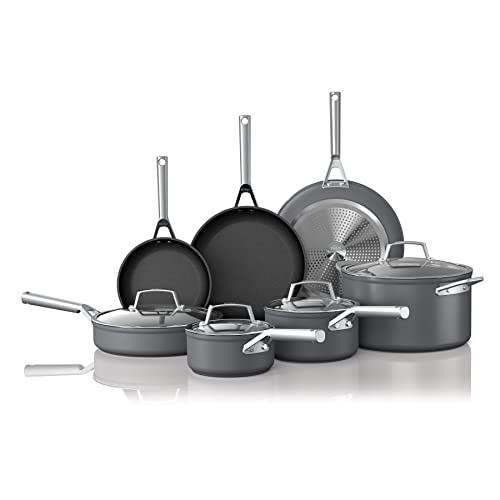
Ninja’s NeverStick Professional set is affordable non-stick’s durability flagship: hard-anodized bodies, a coating system engineered to resist scratching and flaking, and an oven rating to 500°F that most nonstick cannot match. It sits at the top of this guide’s tier and argues that paying more once beats replacing bargain sets repeatedly.
Strengths
- Coating system designed for durability — the strongest longevity claim in this guide
- 500°F oven rating enables stovetop-to-oven finishes other nonstick forbids
- Substantial hard-anodized bodies heat evenly and resist warping
Trade-offs
- Highest tier here — check price on Amazon and judge it as a multi-year purchase
- Heavier than basic nonstick; smaller cooks should handle a pan before committing
- Even durable coatings reward silicone or wooden tools over metal habits
| Specification | Detail |
|---|---|
| Pieces | 12 (per Amazon title) |
| Body | Hard-anodized nonstick (per Amazon title) |
| Oven safe | To 500°F (per Amazon title) |
The NeverStick proposition is cost per year. If a bargain set lasts eighteen months and this set lasts five years, the flagship is the cheaper purchase — and the better cooking experience throughout. Its oven rating also removes the classic nonstick frustration of a dish that must change pans to finish under heat.
Choose it if non-stick is your primary cooking surface rather than a supplement. Households that mostly cook in stainless and keep one nonstick frypan should not buy any full set — buy the single pan and save the difference.
Best for: Non-stick-first cooks wanting maximum coating life / Not suited for: Stainless-first kitchens needing only one nonstick pan
Check the current price on Amazon

Calphalon Premier Nonstick 11-Piece MineralShield — Best Hard-Anodized Alternative
Calphalon’s Premier line brings the brand’s hard-anodized expertise to affordable non-stick with its MineralShield surface system, an 11-piece vessel list aimed at real cooking rather than count inflation, and the sturdy feel Calphalon built its name on. It is the natural alternative for buyers who have owned Calphalon before and trust its handles and balance.
Strengths
- Hard-anodized construction with a current-generation nonstick system
- Sensible 11-piece coverage without utensil padding
- Brand support and replacement availability are strong
Trade-offs
- Premium-affordable tier — compare its day price with the Ninja set
- Stacking-friendly designs still need pan protectors to guard coatings
- Not the set for induction unless your listing confirms a magnetic base
| Specification | Detail |
|---|---|
| Pieces | 11 (per Amazon title) |
| Surface | MineralShield nonstick (per Amazon title) |
| Body | Hard-anodized (Premier line) |
Calphalon’s appeal is continuity: cooks replacing a worn Calphalon set get familiar balance and handle shapes with a newer surface. In a category full of anonymous brands, that lineage and its support network are worth a modest premium to many buyers.
As with every pick here, longevity is a partnership — the MineralShield surface is durable, and medium-heat discipline plus soft tools will still decide whether it serves three years or six.
Best for: Calphalon loyalists and durability-focused upgraders / Not suited for: Induction owners — verify base compatibility first
Check the current price on Amazon

Rachael Ray Cucina 12-Piece Aluminum Nonstick — Best Lightweight
The Cucina set serves the cooks other sets forget: anyone who finds hard-anodized or stainless sets heavy. Its aluminium nonstick bodies are light in the hand, the enamel exteriors bring colour to the kitchen, and the handles are designed for a secure, comfortable grip. For smaller households cooking daily meals without heavy searing, it is a genuinely kind set to live with.
Strengths
- Lightest full set here — kind to wrists and smaller cooks
- Comfortable grippy handles and pour-friendly shapes
- Colourful enamel exterior that suits open-shelf kitchens
Trade-offs
- Plain aluminium bodies warp more readily than hard-anodized rivals
- Not induction compatible — aluminium needs a magnetic base this line lacks
- Coating and enamel reward gentle handling and storage
| Specification | Detail |
|---|---|
| Pieces | 12 (per Amazon title) |
| Body | Aluminum nonstick (per Amazon title) |
| Colourway | Agave Blue listing; other colours share the line |
Weight is a real specification. A set that hurts to lift gets avoided, and avoided cookware is the worst value of all. The Cucina’s lightness, paired with competent nonstick and sensible vessels, makes it the daily-driver pick for cooks who prioritise comfort.
Keep it off maximum heat, store pans with protectors, and it will serve cheerfully for years. Cooks who sear steaks weekly should look at the hard-anodized picks above instead.
Best for: Cooks who prioritise light weight and comfort / Not suited for: Induction owners and high-heat searing enthusiasts
Check the current price on Amazon

Ninja NeverStick 13-Piece C39600 — Best Coverage Upgrade
The 13-piece NeverStick set extends the C39800 formula with broader coverage for bigger households — more vessels in the same hard-anodized, durability-first system. Choose it over its 12-piece sibling when your cooking regularly needs the extra saucepan or the larger stockpot, rather than for the headline number alone.
Strengths
- Same durable NeverStick system with family-scale coverage
- One purchase equips a large household’s nonstick needs completely
- Consistent handles and lids across a deep vessel list
Trade-offs
- Largest storage footprint of the nonstick sets here
- Top-tier pricing within the affordable brief — verify the vessel list justifies it
- Still a coating: plan on eventual replacement of the hardest-used frypan first
| Specification | Detail |
|---|---|
| Pieces | 13 (per Amazon title) |
| System | NeverStick hard-anodized nonstick |
Coverage questions are household questions. A family that runs two saucepans and a stockpot simultaneously will use every piece here; a couple will not. Audit a fortnight of your cooking before choosing between the two NeverStick boxes.
Whichever box you choose, the ownership pattern is identical: the frypans work hardest and age fastest, so rotating two frypans rather than flogging one extends the set’s prime noticeably.
Best for: Large households wanting the durable system at full coverage / Not suited for: Small households — the 12-piece or T-fal set fits better
Check the current price on Amazon
Tramontina PrimaWare 18-Piece Nonstick — Best Maximum Coverage Value
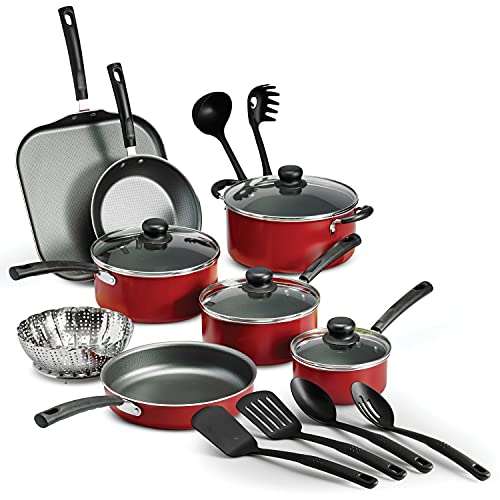
PrimaWare is the set for equipping a kitchen from zero: eighteen pieces spanning frypans, saucepans, a stockpot and the extras, in light aluminium nonstick at the most accessible tier in this guide. Its API check noted availability varies by seller, so confirm the exact bundle on the product page — contents drift between boxes more at this tier than any other.
Strengths
- Unmatched vessel coverage for a first kitchen at this tier
- Light pans that anyone in the household can handle
- Low commitment — ideal while you learn what you actually cook
Trade-offs
- Thinner bodies than the hard-anodized picks; heat discipline matters
- Bundle contents vary — verify the piece list before ordering
- Coating life at this tier is the shortest here; buy it as a starter set
| Specification | Detail |
|---|---|
| Pieces | 18 (per Amazon title) |
| Body | Aluminium nonstick |
| Colourway | Red listing (per Amazon title) |
Starter-set logic is sound: a year of cooking in a complete cheap set teaches you exactly which two or three premium pans your real cooking deserves. PrimaWare’s breadth makes it the best teacher in this guide, and many households happily run it for years with gentle treatment.
One caution from our verification notes: this listing’s stock status fluctuated at check time. If the exact 18-piece box is unavailable, the T-fal set above is the nearest durable alternative rather than an unfamiliar substitute bundle.
Best for: First kitchens and students equipping from zero / Not suited for: Experienced cooks replacing a worn premium set
Check the current price on Amazon
Comparison Table
| Pick | Badge | Key spec | Best for |
|---|---|---|---|
| T-fal Ultimate Hard Anodized 17-Piece Set | Best Overall | 17-piece hard-anodized nonstick, griddle included | Most households wanting affordable non-stick that lasts |
| Ninja NeverStick Premium 12-Piece C39800 | Best Premium Non-Stick | 12-piece hard-anodized, oven safe to 500°F | Non-stick-first cooks wanting maximum coating life |
| Calphalon Premier Nonstick 11-Piece MineralShield | Best Hard-Anodized Alternative | 11-piece hard-anodized with MineralShield surface | Calphalon loyalists and durability-focused upgraders |
| Rachael Ray Cucina 12-Piece Aluminum Nonstick | Best Lightweight | 12-piece aluminium nonstick, enamel exterior | Cooks who prioritise light weight and comfort |
| Ninja NeverStick 13-Piece C39600 | Best Coverage Upgrade | 13-piece NeverStick hard-anodized range | Large households wanting the durable system at full coverage |
| Tramontina PrimaWare 18-Piece Nonstick | Best Maximum Coverage Value | 18-piece aluminium nonstick, maximum coverage | First kitchens and students equipping from zero |
How to Choose Affordable Non-Stick That Actually Lasts
Buy the body, then the coating. Hard-anodized aluminium is the affordable durability standard: it stays flat, spreads heat and gives any coating its best chance. Plain aluminium sets are lighter and cheaper but warp sooner, and a warped pan destroys its own coating through uneven heat. If a listing hides the body material behind adjectives, treat that as your answer.
Check three numbers in every listing: the oven-safe ceiling, which separates serious sets from fragile ones; the vessel list counted without lids and utensils; and whether the frypans — the pieces that will die first — are sold separately for later replacement. A brand that sells the single frypan supports the set’s second act.
Match the set to your hob. Most affordable non-stick is aluminium-bodied and not induction-ready unless a magnetic base is explicitly stated. Induction owners should start from our induction guide’s shortlist rather than adapting this one.
The Habits That Double Non-Stick Life
Heat is the enemy, not utensils. Preheat on medium, never blast an empty nonstick pan, and keep a stainless or cast iron pan for true searing. Silicone or wooden tools, soft sponges, and cooling before washing protect the surface; stacking with cloth or paper protectors prevents the rim chips that start peeling.
Finally, inspect honestly. A coating that is scratched through, flaking or persistently sticking despite correct heat has finished its service. Replace the frypan, keep the saucepans, and let the set retire piece by piece rather than all at once.
How to Season, Preheat and Store Non-Stick Pans Correctly
Wash new pans warm with a soft sponge and dry them fully. Some coatings benefit from a one-time light oil wipe before first use; follow the maker’s instruction for your set rather than folklore.
Preheat on medium for one to two minutes — T-fal’s indicator, where fitted, exists precisely for this — then add a small amount of fat and the food. Food added to a correctly heated nonstick pan releases cleanly; food added to a cold pan or a overheated pan sticks for opposite reasons.
Cook at the lowest heat that does the job. Nonstick conducts the cooking at medium settings on most hobs; high heat is for the boil in a stockpot, not for frying in a coated pan.
Cool before washing, wash soft, and store separated. A protector, cloth or paper towel between stacked pans prevents the edge damage that becomes flaking. Hung storage is better still where space allows.
Common Buying Mistakes
The headline mistake is buying non-stick by piece count and coating adjectives while ignoring the body metal — then blaming the coating when a warped pan cooks unevenly. The second is using nonstick as a searing pan: repeated maximum-heat work shortens any coating’s life dramatically.
Aerosol cooking sprays are the quiet third mistake; their propellants and additives bake into a residue that makes nonstick stick. Use bottled oil with a brush or pump sprayer instead. Fourth is dishwasher complacency — many sets tolerate it, but hand washing is always the longer-life choice for coatings.
Final Recommendation
For most households, the T-fal Ultimate Hard Anodized 17-piece is the best affordable non-stick cookware set: durable bodies, honest coverage, a fair tier. Buyers wanting maximum coating life should step to the Ninja NeverStick sets or the Calphalon Premier; cooks prioritising light weight should take the Cucina; and first kitchens should start with PrimaWare’s coverage. Check price on Amazon, verify the vessel list on the product page, and cook on medium — your coating will thank you.
Ceramic-first buyers should read the sister guide linked below, which ranks the same brief from the ceramic side.
Start your shortlist here: T-fal Ultimate Hard Anodized 17-Piece Set Ninja NeverStick Premium 12-Piece C39800 Calphalon Premier Nonstick 11-Piece MineralShield. Check price on Amazon for each, read the configuration carefully, and buy the one whose trade-offs you can live with longest.
Best Affordable Nonstick Cookware Sets Best Affordable Cookware Sets Best Affordable Induction Cookware Sets Best All Clad Cookware Sets Best Aluminum Cookware Sets
Living With Each Pick: Durability Notes
T-fal Ultimate Hard Anodized 17-Piece Set
Ultimate owners develop the indicator habit without thinking: the spot changes, the food goes in, and the results stay consistent. The griddle becomes weekend infrastructure for pancakes and grilled sandwiches. After the first year, the set’s bodies still sit flat — the detail owners contrast with the thin set it replaced — and the coating’s condition tracks almost exactly with how faithfully the household kept to medium heat.
Ninja NeverStick Premium 12-Piece C39800
NeverStick owners are the category’s relaxers: metal utensils appear occasionally without drama, pans finish in a hot oven without a second thought, and the coating’s prime stretches on. The set’s weight surprises buyers upgrading from thin nonstick — it feels like cookware, not camping gear — and that substance is the point. Owners replacing a single tired frypan years later can match the line, which keeps the set coherent.
Calphalon Premier Nonstick 11-Piece MineralShield
Premier owners tend to be repeat Calphalon buyers who value the familiar balance and handle shape. The MineralShield surface earns praise for releasing without the fragility theatre of delicate coatings, and the set’s stacking-friendly design suits the smaller kitchens many owners bought it for — provided protectors are used between the pans, as our guide insists.
Rachael Ray Cucina 12-Piece Aluminum Nonstick
Cucina owners cook daily and lift happily: the set’s lightness is mentioned in almost every long-term account, especially by cooks who found premium sets a strain. The enamel colours stay cheerful, the handles stay grippy, and the pans’ fast response suits the quick breakfasts and sauces they were bought for. Owners who respect the gentle-heat rule report the set ageing far better than its tier suggests.
Ninja NeverStick 13-Piece C39600
The 13-piece NeverStick serves the big-household pattern: multiple saucepans in simultaneous service, a stockpot that earns its shelf, and frypans rotated so no single pan takes every day’s punishment. Owners note that rotation visibly extends the set’s prime — the two-frypan household’s coating lasts noticeably longer than the one-frypan household’s, a small logistics lesson with a real payoff.
Tramontina PrimaWare 18-Piece Nonstick
PrimaWare owners are equippers and learners: students, first flats, and households discovering their real cooking repertoire. The set’s breadth means a missing vessel never blocks a recipe, and its lightness suits every cook in the house. Long-term accounts divide exactly as our guide predicts — gentle households get years, rough households get a tuition in heat discipline and move up to hard-anodized next time.
The Non-Stick Replacement Economy: Planning the Second Act
Every non-stick set has a second act, and planning it at purchase is the difference between value and disappointment. The frypans will tire first — they work hottest and oftenest — while saucepans and stockpots, living gentler lives with liquids, can serve twice as long. A brand that sells its frypans separately, as the major lines in this guide do, lets you refresh the set’s hardest workers for a fraction of a new set’s cost.
Time the refresh by performance, not appearance. A coating that still releases with a little fat is in its useful middle age; a coating that grips eggs despite correct preheating has finished. Replace that pan, keep the rest, and the set’s cost per year drops with every cycle — the arithmetic that makes even premium non-stick, like the NeverStick picks, genuinely affordable over a decade.
When the second act ends and a full replacement is due, replace by family, not by habit. Households often discover their cooking has changed — more searing, an induction hob, fewer delicate dishes — and the correct new set may be stainless or induction-built rather than a like-for-like non-stick box. Our linked guides exist for exactly that reassessment moment.
Heat Management Masterclass for Coated Pans
Coated pans fail by temperature long before they fail by time. The physics is simple: coatings degrade fastest when overheated, and they overheat fastest when empty, because food and liquid are heat sinks that cap a pan’s temperature. An empty non-stick pan on high heat can pass its safe range in a couple of minutes; the same pan with food in it rarely approaches it. That is why every durable habit in this guide reduces to one rule — never leave an empty coated pan on a hot burner.
Preheating technique follows from it: warm the pan briefly on medium, add fat as your temperature witness — butter foaming gently or oil shimmering means ready — then add food. T-fal’s indicator, where fitted, automates the judgement. On powerful hobs, especially induction with an adapter base or a future hob change, treat medium as the new high for coated pans.
Cooling is the other half of heat management. A hot pan under cold water warps at the base and shocks the coating; a pan left to cool on the hob, then washed warm, suffers neither. Two minutes of patience at the end of cooking is the cheapest coating insurance available, and the households with five-year-old non-stick are, without exception, the ones who practise it.
Non-Stick and Your Hob: Gas, Electric and the Induction Question
On gas, non-stick aluminium is in its element: flames lick around bases without harming anodized bodies, response is instant, and the only discipline is keeping flames from climbing the sides and overheating the coating at the edges. Use a burner sized to the base and gas is the kindest hob this category knows.
On radiant and coil electric, flatness becomes the whole game. A warped pan rocks, spins and heats in patches; a flat anodized pan sits in full contact and cooks evenly. This is why the hard-anodized picks dominate this guide for electric households, and why the cooling-before-washing habit — the anti-warp habit — matters more on electric than anywhere else.
On induction, most aluminium non-stick simply does not register, and the honest advice is redirection: the induction-ready nonstick sets in our linked induction guide, including hard-anodized induction models, are the correct purchase. Adapters and discs exist, but they waste the hob’s efficiency and the pan’s response. Buy the pan your hob deserves rather than mediating between mismatched tools.
The Frypan Rotation: A Small System With a Large Payoff
Households with two non-stick frypans in rotation keep their sets slick markedly longer than households with one, for simple arithmetic reasons: each pan works half as often, cools fully between uses, and is never pressed into service while still hot from the last job — the moment when coatings are most vulnerable and most abused. The rotation also ends the desperate scrubbing of a pan needed again in ten minutes.
The system costs little to adopt: most sets in this guide include two frypan sizes, and the discipline is merely to alternate them deliberately rather than reaching for the favourite daily. When one pan eventually tires, it retires to reheating duty and a single replacement restores the pair. Owners who adopt rotation describe their sets as lasting implausibly long; the mechanism is not mysterious, just kind.
Apply the same logic to the hardest-used saucepan in sauce-heavy households. Liquid cooking is gentle, so saucepans rarely need rotation — but the principle generalises: distribute work across the set you bought, and the whole set ages at the pace of its average piece rather than its hardest-worked one.
Choosing by Household: Who Should Buy What
For a family replacing a worn set
The T-fal Ultimate is the like-for-like upgrade that fixes the old set’s sins: flat bodies, honest coverage, an indicator to teach the household gentler habits. It is the replacement purchase this guide makes most confidently.
For a non-stick devotee
Step to NeverStick — 12-piece for full coverage, 13-piece for the largest households — and treat it as the multi-year appliance it is priced as. The premium buys prime length, and prime length is the product.
For a light-use second kitchen
The Cucina or PrimaWare, by whether colour or coverage matters more. Holiday kitchens, rentals and second homes need competence and lightness, not heirlooms.
What Counts as a Piece: Decoding Non-Stick Set Arithmetic
Set arithmetic is marketing’s favourite playground. A 17-piece box may contain ten vessels, five lids and two utensils; a competing 12-piece box may contain ten vessels and two lids — and be the larger cookware purchase in every way that matters. The only honest count is vessels in the sizes you will use, which is why this guide’s reviews name the frypans, saucepans, sauté pans and stockpots explicitly.
Lids deserve a subtler judgement: a lid that fits two vessels is worth more than two lids that fit one each, and glass lids trade a little durability for the ability to watch a simmer. Count lids by the vessels they serve, and the arithmetic of any box becomes transparent in a minute.
Disposing and Replacing Responsibly
A retired non-stick pan is not a failure; it is a consumable that completed its service. Metal bodies are widely recyclable once coatings are the recycler’s concern, and many manufacturers and retailers run take-back schemes worth checking before a pan goes to general waste. The saucepans and stockpots of a retired set often have years left — donate or redeploy them rather than discarding the set as a unit.
Replacement timing is a safety-adjacent judgement: a coating that is flaking into food, or a base warped into rocking instability, has finished regardless of remaining slickness. Replace that piece promptly, keep the set’s sound members in service, and let the set retire the way it aged — piece by piece, honestly.
Non-Stick for Families: Safety Habits and Household Systems
Family kitchens run non-stick harder than any other environment: multiple cooks, mixed skill levels, pans pressed into service back-to-back. The family system that works is explicit and simple — medium heat as the house rule, soft tools in the drawer beside the hob rather than across the kitchen, and the two-frypan rotation described in this guide so no pan is ever scrubbed in a panic while still hot.
Children learning to cook are non-stick’s best students and its greatest risk. The surface forgives their timing and releases their eggs, teaching success; the heat rule protects both the child and the coating, and it should be taught as the first rule of the pan, before any recipe. A household that teaches one rule — never blast the coated pan empty — will keep its sets years longer than one that teaches ten.
Batch family cooking argues for the larger boxes in this guide, but with a nuance: family wear concentrates on two or three pieces, so a mid-size set plus one separately bought workhorse frypan often out-serves a giant box. The T-fal and NeverStick lines both sell pieces individually, which is what makes that strategy available; anonymous sets do not, which is a hidden cost of their lower tier.
Storage in family kitchens is a contact sport. Hanging rails or a pan organiser are not indulgences here; they are the difference between coatings that chip in the cupboard and coatings that age only at the stove. Fit the storage when you fit the set, not after the first rim chip appears.
Finally, families should schedule the honest inspection: every few months, hold the main frypan to the light and judge its surface. A family that replaces one tired pan on schedule keeps a permanently capable set; a family that waits for total failure cooks for months on a pan that has stopped doing its one job.
Reader Questions, Answered in Depth
Are expensive non-stick sets worth it is the question this category cannot escape, and the answer is arithmetic rather than opinion. A value set replaced every eighteen months and a premium set replaced every five years cross in cost sooner than most buyers expect, and the premium set cooks better in every one of those months. The NeverStick and Calphalon picks in this guide are priced as appliances; the T-fal and PrimaWare picks are priced as equipment. Both pricings are honest — the error is expecting appliance service from equipment money, or paying appliance money for a kitchen that cooks twice a week.
Readers ask whether non-stick can sear, and the precise answer is that it can brown. A hard-anodized pan at correct preheat will colour chicken and fish respectably. What it should not do is sustained maximum-heat searing of thick steaks, because that duty shortens coating life out of proportion to the pleasure gained. The mixed kitchen — one iron or steel pan for violence — remains this guide’s standing recommendation, and it converts the question from a limitation into a division of labour.
The dishwasher question deserves a straight answer: most sets here tolerate it and all of them last longer without it. Dishwasher chemistry is hard on coatings and finishes in slow motion, invisible month to month and decisive year to year. A household that hand washes its main pans adds measurable life to every set in this guide; a household that cannot should weight the dishwasher-safe listings heavily and accept the shorter prime as the price of the routine.
Confusion between this guide and its ceramic sister is common, so the distinction bears repeating: this guide ranks traditional non-stick on hard-anodized and aluminium bodies, optimising for durability; the sister guide ranks ceramic coatings, optimising for PFAS-free chemistry and delicate cooking. Households often own one of each across a kitchen’s life. Neither guide’s winner invalidates the other’s; they answer different first questions.
On safety, readers ask about coatings and high heat in one breath, and the practical answer is the heat rule that runs through this guide: cook on medium, never overheat an empty coated pan, and retire a pan whose surface is damaged. Those habits keep any modern non-stick system operating in its intended range, and they are the same habits that maximise its lifespan — safety and durability, in this category, are the same discipline viewed from two sides.
Which set, finally, is the question the whole guide exists to answer, and its answer is short enough to repeat: T-fal Ultimate for most households, NeverStick for maximum life, Calphalon for the brand-loyal, Cucina for light weight, PrimaWare for first-kitchen coverage. Recognise your household in one phrase and the decision is done; the rest is checking the vessel list and the day’s price.
A Final Word on Honest Non-Stick
Non-stick is the most honestly judged category in cookware when buyers drop two illusions: that a coating is permanent, and that a low price is the same as low cost. Shed both, and the category becomes simple — substantial bodies, credible coatings, heat discipline, and a refresh plan. Every pick in this guide satisfies those terms at its tier, which is why the guide can recommend a set at the bottom of its range and a set at the top with equal sincerity.
The households that love their non-stick are not the ones that bought the most expensive set; they are the ones whose habits match their pans. Medium heat, soft tools, patient cooling, protected storage — a small liturgy, repeated daily, that turns a consumable surface into a multi-year companion. Learn the liturgy and even the value picks will surprise you with their service.
Choose by your household’s real pattern, verify the vessel list with your own eyes, and let the first fortnight build the habits. After that, the set disappears into the cooking — which is all any cookware, at any price, has ever honestly offered.
One More Consideration: The Second Kitchen Test
A useful way to audit any set in this guide is the second kitchen test: would this set still be your choice in a holiday rental you owned, a parent’s kitchen you were equipping, or a first flat for a child leaving home. Sets that pass that test — competent under strangers’ habits, replaceable without pain, complete without excess — are the sets whose value is real rather than specified. The T-fal Ultimate passes it most completely, which is another way of stating this guide’s main verdict.
Sets that fail the test fail instructively. The fragile bargain set fails on durability under unfamiliar hands; the giant premium box fails on excess for a kitchen that cooks simply. Running the test on your own shortlist takes a minute and often settles the final hesitation between two good options, because it strips away your own expertise and asks what the pans themselves contribute.
One last habit ties every section of this guide together: buy the set, then spend the first fortnight cooking in it deliberately — eggs at medium heat, a sauce in the saucepan, a family dinner across two pans at once — so its strengths and its one or two genuine weaknesses reveal themselves while returns are still simple and your impressions are still honest. A set that survives that fortnight with your respect intact will keep it for years. A set that does not has told you so at the cheapest possible moment, which is its own kind of value.
That fortnight test, applied honestly, is the closest thing cookware buying has to a guarantee — and it costs nothing but attention.
Frequently Asked Questions
How long should affordable non-stick cookware last?
With medium-heat cooking and soft tools, a hard-anodized set should serve three to five years before the hardest-used frypan tires; plain aluminium sets typically give less. Longevity is mostly habit, not brand luck.
Is hard-anodized non-stick worth the extra over plain aluminium?
For most households, yes. The bodies stay flatter, heat more evenly and protect the coating from the warping spiral that kills cheap sets early. The exception is cooks who strongly prioritise the lightest possible pans.
Can I use metal utensils on non-stick?
Some durable systems tolerate metal utensils, but silicone and wood remain the longer-life choice for every coating. Treat metal tolerance as insurance against accidents, not as a daily method.
Why did my non-stick pan start sticking?
Usually heat damage or spray residue rather than age alone. A pan overheated empty or coated in baked-on aerosol film loses release. Correct preheating, bottled oil and medium heat prevent most cases; a flaking or deeply scratched surface means replacement time.
Are these sets induction compatible?
Most aluminium-bodied non-stick sets are not, unless a magnetic base is explicitly stated. Induction owners should choose from the dedicated induction guide linked in this article rather than assuming compatibility.
Should I buy a full non-stick set or individual pans?
Buy a set when non-stick is your main cooking surface. Buy a single frypan when stainless or cast iron does your core cooking — a full set would duplicate vessels you already own in better materials.

