Disclosure: airfryerkitchensupply.com is reader-supported. When you buy through links on our site, we may earn an affiliate commission at no extra cost to you.
Where to buy
Every machine in this guide to the best blenders 100 dollars can buy is sold through Amazon, and that is where we recommend buying: listings show the current configuration and — important at this tier — the live price, because models in this bracket drift above and below the hundred-dollar line with promotions. Start with our top pick, the Ninja Professional Plus BN701, or jump directly to the machine that best matches your kitchen and your blending habits: the Ninja Professional BL610 for a big pitcher at the gentle end of the tier, the nutribullet Pro 900 for personal smoothies, the Oster Pro 1200 for a glass jar, the Ninja Professional Blender 2.0 for Auto-iQ programs, and the Hamilton Beach Blender and Food Processor Combo if one base should also chop and process. Check the current price on Amazon for the model you choose — at this tier, checking is not a formality, it is the whole game.
One honest note about how this guide handles the number in the search: a fixed price printed in an article goes stale the week it is published, so we never print one. What we can tell you truthfully is which machines live in the hundred-dollar class — the tier where full-size power, real ice crushing, and useful presets begin — and which specific models to watch at that line. Some sit a little under it most of the year, some hover a little above it and dip down on promotion. Buy the machine that fits your blending, and time the purchase to the tier, not the other way around.
Introduction: Why the 100 Dollar Line Is Where Blenders Get Serious
If you are shopping for the best blenders 100 dollars can buy, you have picked the most competitive line in the category. Below this tier, blenders compromise on the fundamentals: motors that strain at frozen fruit, plastic drive components, jars that cloud, and ice that survives the blend. At this tier, the compromises end. A hundred-dollar-class blender gets you a motor in the 1000–1400 peak-watt class, blade systems designed for crushing rather than stirring, family-size pitchers or serious personal cups, and — on the Ninja models that dominate this bracket — preset programs that run an experienced user’s pulse pattern for you.
What this tier does not buy, and honesty requires saying so, is premium texture and premium longevity. Vitamix and Blendtec machines a tier up still blend smoother (seeds and fibers fully erased), run quieter in pitch if not in volume, and are built to be serviced for a decade. The hundred-dollar class is instead the value peak of the category: the point where each additional dollar buys the most capability, and where most households’ actual recipes — smoothies, frozen drinks, soups, sauces, shakes — are fully covered. If your hardest regular recipe is a frozen-fruit smoothie or a pitcher of margaritas, this tier is not a compromise. It is the answer.
The six picks below split the tier by format and philosophy: three big-pitcher Ninjas with different control styles, a glass-jar Oster for traditionalists, a personal nutribullet for solo routines, and a Hamilton Beach combo that adds food processing. Every one was verified — searched by brand and model, matched to the returned listing title, ASIN taken from the listing response. Prices are never printed here; check the current price on Amazon at the listing, where it belongs.
In this guide
Quick Picks
Six machines in the hundred-dollar class, badged by job: family pitchers, personal cups, glass jars, and a combo that processes too — each one the strongest expression of its format at this tier. If you read nothing else, read the trade-offs column of your shortlist: at this level every machine is capable, and the differences that decide satisfaction are the honest limitations, not the headline features. A family that hosts frozen-drink nights and a solo commuter with a protein habit can both buy ‘the best blender at this tier’ and should walk away with different machines.
- Best Overall at This Tier: Ninja Professional Plus Blender BN701 — 1400 peak watts, a 72 oz pitcher, and three Auto-iQ presets — the most complete blender in the hundred-dollar class and the default recommendation for families.
- Best Big-Pitcher Value: Ninja Professional Blender BL610 — The long-running classic of the tier: 1000 watts, Total Crushing blades, and the same 72 oz family pitcher, with simple manual speeds instead of smart programs.
- Best Personal Blender at This Tier: nutribullet Pro 900 — 900 watts of extractor power in a personal cup format — the strongest solo smoothie machine in the hundred-dollar class, with texture its pitcher rivals cannot match at single servings.
- Best Glass Jar at This Tier: Oster Pro 1200 Blender — A glass jar, seven speeds, a dual-direction blade that reverses to pull food in, and a 24 oz smoothie cup in the box — the traditionalist’s pick with a modern trick.
- Best with Auto Programs: Ninja Professional Blender 2.0 BR201AMZ — 1200 watts, Total Crushing blades, an Auto-iQ Crush program, and four manual speeds — the thinking user’s Ninja, splitting the difference between the BN701’s presets and the BL610’s simplicity.
- Best Blender-Processor Combo: Hamilton Beach Blender and Food Processor Combo 58163 — A 700W peak base that drives a 40 oz glass blender jar, a 3-cup food chopper, and a travel cup — three appliances’ worth of counter coverage in one tier-priced base.
How These Picks Were Chosen
Every candidate was verified: searched by brand and model, the returned listing title matched against the machine we intended to recommend, and the ASIN taken from the listing response. Because this tier is defined by a price line, we applied one additional rule: a model only qualifies if it genuinely lives in the hundred-dollar class — the bracket its configuration normally sells in — rather than being a premium machine that once touched the line in a clearance or a basic machine padded with accessories. Readers should still check the current price on Amazon at purchase time; tiers drift, and promotions move individual models across the line in both directions.
We scored the survivors on what this tier must deliver. Crushing and frozen performance first — the capability that separates this class from basic blenders. Format fit second: the tier serves both family pitchers and personal routines, and each pick was judged inside its format. Controls third — presets that earn their keep versus manual simplicity honestly offered. Then jar material and cleanup, and finally parts and platform longevity, because a hundred-dollar blender should be a multi-year purchase. The six picks are the strongest expression of each format at this level, not the six cheapest machines we could stretch into the bracket.
We excluded two seductive categories deliberately: premium machines ‘on sale’ (a discount is an event, not a tier, and a guide cannot promise it will be there when you shop) and accessory-bloated bundles whose base blender is a basic-tier machine in a big box. What remains is the honest hundred-dollar class.
A final methodology note, because readers of price-tier guides deserve it: membership in this class was judged on each model’s normal selling position for its standard configuration, not on a snapshot taken on any single day. If you find one of these machines dramatically below the class line, that is a promotion to take advantage of, not evidence the guide misclassified it — and if you find one above the line, the same logic applies in reverse. Machines endure; prices flicker.
The 6 Best Blenders 100 Dollars Can Buy, Reviewed

Ninja Professional Plus Blender BN701 — Best Overall at This Tier
The BN701 is what the hundred-dollar tier looks like when it is done right. A 1400 peak-watt motor drives Ninja’s stacked Total Crushing blade column through a 72 oz pitcher, so ice and frozen fruit are cut at every level of the jar at once, and three Auto-iQ presets — smoothie, frozen drink, ice cream — run timed pulse-pause-ramp patterns that produce consistent results without technique. This is the machine for families, party hosts, and anyone whose blending is measured in pitchers. If you blend for one, the nutribullet below is the smarter shape of the same money. If you blend for a household, start here and stop shopping.
Strengths
- The strongest crushing performance in this guide — frozen drinks and smoothies come out uniform, batch after batch, in one program cycle.
- Auto-iQ presets genuinely work: the pulse patterns mimic what an experienced user does by hand, so results repeat.
- A true family-size 72 oz pitcher with dishwasher-safe parts — capacity and cleanup both solved.
Trade-offs
- Loud at full power, like every high-output machine in this class.
- The stacked blade column is sharp along its length; hand-washing needs care, though the dishwasher removes the issue.
- Peak watts are a momentary rating, not continuous power — it is a superb drink machine, not a nut-butter factory.
Key specs (verified)
- Motor: 1400 peak watts
- Pitcher: 72 oz
- Programs: 3 Auto-iQ presets
- Cleaning: dishwasher-safe parts
The BN701’s dominance at this tier is about the blade column. Conventional blenders cut at the jar’s base and rely on a vortex to deliver ingredients downward; frozen loads bridge, ride, and stall. Ninja’s stacked blades cut through the whole column simultaneously, so a full pitcher of frozen strawberries and ice reaches uniformity in a single Auto-iQ cycle — the difference between a frozen drink and a drink with frozen bits. At this price class, nothing else processes volume this decisively. The machine’s honest limits are finesse limits: it crushes brilliantly and purees adequately, but delicate emulsions and truly silky green smoothies belong to the premium tier above. Within the drinks-and-smoothies brief that defines this tier, it has no serious rival here.
The center of the hundred-dollar class: buy it for family pitchers and frozen drinks. Check the current price on Amazon — Ninja sells several Professional Plus variants, so confirm the BN701 model number on the listing.
Best for: families, frozen-drink and smoothie pitchers, party hosts / Not suited for: solo users, nut-butter regulars, quiet-morning households
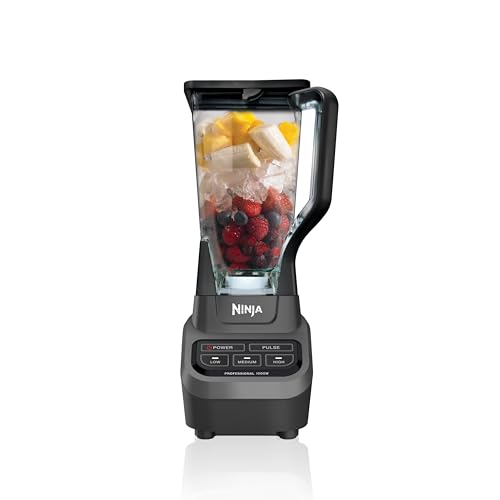
Ninja Professional Blender BL610 — Best Big-Pitcher Value
The BL610 is the pick for buyers who want the big-pitcher Ninja experience with simple controls and the gentlest position in this tier. It pairs a 1000W motor with the same Total Crushing stacked-blade idea and the same XL 72 oz pitcher as its newer sibling, but trades Auto-iQ programs for straightforward manual speeds and pulse. For smoothies, frozen drinks, and sauces in family batches, that trade costs little — the blade column does the heavy lifting — and the model’s long production run means a mature design with parts and pitchers everywhere. If you love presets, the BN701 above is worth its step up. If you would rather drive the machine yourself and keep the change, the BL610 is the value play of this guide.
Strengths
- Total Crushing stacked blades and a 72 oz pitcher: family batches of frozen drinks and smoothies, handled decisively every time.
- Manual speeds plus pulse give direct, honest control — no programs to learn, no menus, nothing to outsmart.
- A long-running, widely owned model: replacement pitchers and parts are easy to find years later.
Trade-offs
- No Auto-iQ: consistency across batches depends on your timing rather than a program’s.
- 1000 watts is strong but a step behind the BN701 on the densest frozen loads.
- Shares the family-format traits: loud at full power, and overkill for a single small smoothie.
Key specs (verified)
- Motor: 1000W
- Pitcher: 72 oz
- Technology: Total Crushing
- Cleaning: dishwasher-safe parts
The BL610 has survived in Ninja’s lineup while fancier models came and went, and the reason is that its formula matches what most families actually do: big smoothies, frozen drinks, the occasional sauce or soup, all in volume, all without ceremony. The manual controls turn out to be a feature for many owners — three speeds and a pulse are instantly understandable, and the blade column forgives imperfect technique by processing the whole pitcher at once. Judged against its sibling, you give up preset convenience and some top-end power; judged against the tier, you give up nothing that matters for drinks. It is the blender equivalent of the previous-generation flagship phone: yesterday’s top specification at today’s value position.
The value center of the big-pitcher world. Check the current price on Amazon — the BL610 has been sold in several retail configurations, so confirm the 72 oz pitcher version on the listing.
Best for: families on a firm budget, manual-control preferrers, batch smoothie prep / Not suited for: preset lovers, solo users, the densest frozen loads daily

nutribullet Pro 900 — Best Personal Blender at This Tier
The nutribullet Pro 900 is the pick for the solo smoothie drinker who wants this tier’s money spent on texture instead of capacity. Its 900W base drives an extractor blade in a personal cup, and that combination — serious power in a small vessel where ingredients cannot escape the blades — produces the finest single-serving smoothies in this guide: berry seeds and greens processed properly, not just chopped. The workflow is the classic nutribullet one: fill the cup, twist on the blade, blend, drink from the same cup. If you blend for anyone besides yourself, the pitchers above are your format. If the smoothie is a personal daily ritual and quality at one serving is the whole point, this is where the hundred-dollar class peaks.
Strengths
- 900 watts in a personal cup is this tier’s texture weapon — seeds, skins, stems, and fibrous greens are genuinely processed rather than merely chopped.
- The blend-and-drink cup workflow is the fastest morning routine here, with minimal washing.
- Compact footprint: it lives on the counter permanently, which is where daily habits are built.
Trade-offs
- One serving at a time, by design — a second smoothie is a second cycle and a rinse between.
- Not a hot-liquid or soup tool; sealed cups and steam are a dangerous combination.
- Plastic cups will tint with berry and turmeric use over time — the known tax of the format.
Key specs (verified)
- Motor: 900W
- Format: personal extractor cup system
- Blade: extractor blade
- Role: single-serving smoothies and shakes
Personal extractors punch above their wattage for a geometric reason: in a small cup, every ingredient passes the blades constantly, so the effective processing per ounce far exceeds a big pitcher’s. The Pro 900 exploits that with enough wattage to keep the cup’s vortex violent through frozen fruit, which is where lesser personal blenders spin a cavity and quit. The result is the one format in this guide where a green smoothie with kale and flax genuinely rivals premium-machine texture at single servings. Its limits are format limits, plainly: volume, hot liquids, and sharing are outside the design. Inside the design — one person, one excellent smoothie, every morning — it is arguably the best use of this entire tier’s budget.
The solo smoothie perfected at this tier. Check the current price on Amazon — the Pro 900 appears in special-edition colors and bundle variants, so confirm the 900W base and cup set on the listing.
Best for: solo smoothie devotees, gym and protein routines, small kitchens / Not suited for: families, soup makers, anyone blending for a table
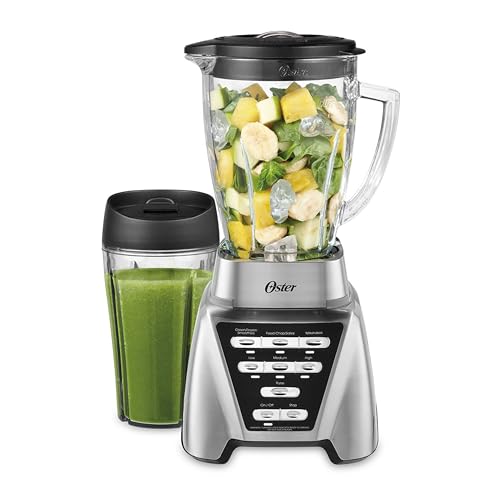
Oster Pro 1200 Blender — Best Glass Jar at This Tier
The Oster Pro 1200 is the pick for buyers who want this tier’s power in the classic format: a glass jar on a metal-drive Oster base. Its signature is the dual-direction blade, which reverses direction to pull ingredients down into the cutting zone — a mechanical answer to the bridging problem that plagues jar blenders — across seven speeds with pre-programmed settings for common jobs. The box adds a 24 oz smoothie cup, giving it a personal format alongside the family jar. Oster’s all-metal drive heritage applies here too, which matters for longevity at this tier. If you want maximum crushing violence, the Ninjas out-muscle it. If you want glass, control, and a brand that services what it sells, this is your hundred-dollar blender.
Strengths
- A glass jar at this tier: no stains, no lingering odors, confident with hot liquids, and still clear after years of use.
- Dual-direction blade technology actively pulls ingredients into the blades — fewer stalls, less tamper work.
- Seven speeds plus programmed settings, and a 24 oz smoothie cup included for solo servings.
Trade-offs
- Crushing power is strong but a half-step behind the stacked-blade Ninjas on full pitchers of ice.
- Glass is heavy and breakable — the eternal trade for its cleanliness advantages.
- The control panel’s programmed settings are useful but less polished than Ninja’s Auto-iQ equivalents.
Key specs (verified)
- Jar: glass jar
- Speeds: 7 + programmed settings
- Blade: dual-direction
- Included: 24 oz smoothie cup
The Pro 1200’s dual-direction blade deserves explanation, because it solves a real problem elegantly. In a conventional jar, thick mixtures form a stable bridge above the blades and the vortex dies; users respond with tampers and stirring. By reversing the blade’s rotation in its programmed patterns, the Oster collapses the bridge mechanically — ingredients tumble, re-enter the cutting zone, and the blend proceeds. Combined with glass-jar virtues (soup confidence, stain immunity) and Oster’s parts ecosystem, the Pro 1200 is the pick for households whose blending extends beyond drinks into cooking, and who distrust plastic jars for hot work. It concedes the frozen-drink crown to Ninja and takes the all-purpose crown instead.
Glass, control, and a clever blade — the traditionalist’s tier-topper. Check the current price on Amazon — Oster packages the Pro 1200 with varying cup and accessory sets, so verify the contents on the listing.
Best for: glass-jar loyalists, soup and sauce makers, all-purpose kitchens / Not suited for: maximum ice-crushing demands, drop-prone households, plastic-light packers

Ninja Professional Blender 2.0 BR201AMZ — Best with Auto Programs
The BR201AMZ is the pick for buyers who want both philosophies in one machine: Auto-iQ’s programmed Crush cycle for walk-away frozen drinks, and four manual speeds for recipes that go off-script. Its 1200W motor sits between the BL610 and BN701 in output, driving the same stacked Total Crushing blade column through the same 72 oz family pitcher. Think of the three Ninjas in this guide as a dial: BL610 for manual simplicity, BR201AMZ for the blend of both, BN701 for maximum preset power. If your household makes standard drinks most days and experiments on weekends, the middle position is the honest fit — and the BR201AMZ is it.
Strengths
- Auto-iQ Crush program plus four manual speeds — automation when you want it, control when you do not.
- 1200 watts through the stacked blade column: frozen drinks and fresh-fruit blends come out uniform.
- The 72 oz pitcher covers family batches, and parts are dishwasher safe for painless cleanup.
Trade-offs
- Positioned between two siblings, it is neither the cheapest Ninja here nor the most powerful — choose it for its balance, not a headline.
- Loud at full power, with the stacked blade’s careful-washing caveat shared across the Ninja line.
- Big-pitcher format remains clumsy for a single small smoothie.
Key specs (verified)
- Motor: 1200W
- Pitcher: 72 oz
- Programs: Auto-iQ Crush + 4 speeds
- Blades: Total Crushing
The interesting question with the BR201AMZ is whether one programmed cycle is enough, and for most households the answer is yes. The Crush program covers the highest-frequency automated job — frozen drinks and icy smoothies — with the pulse pattern that job needs, while the four manual speeds handle everything else an experienced user would do by feel. Against the BN701, you trade two presets and some peak power for a gentler position in the tier; against the BL610, you gain the program and 200 watts for a modest step up. It is the least extreme machine in this guide and, for mixed-use households, plausibly the most correctly specified one.
The balanced Ninja: programs plus control in one pitcher. Check the current price on Amazon — confirm the BR201AMZ model number on the listing, as the Professional 2.0 line has close relatives.
Best for: mixed-use households, frozen-drink regulars who also experiment, families / Not suited for: solo users, budget-firm buyers (see BL610), preset maximalists (see BN701)
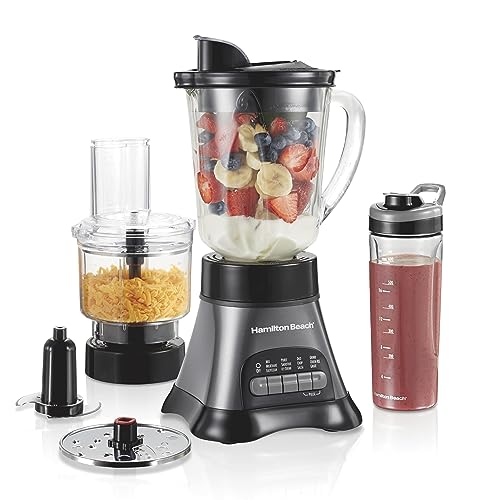
Hamilton Beach Blender and Food Processor Combo 58163 — Best Blender-Processor Combo
The 58163 Combo is the pick for small kitchens where the hundred-dollar decision must cover more than blending. One 700W peak base drives three attachments: a 40 oz glass blender jar for smoothies and shakes, a 3-cup chopper bowl for onions, nuts, salsa, and breadcrumbs, and a travel cup for a solo drink. As a pure blender it is the gentlest machine in this guide — 700 peak watts is basic-tier power wearing a tier-appropriate price — but as a small-kitchen system it replaces a separate food processor purchase entirely. If smoothies are your only job, every other pick here blends better. If your counter and budget must jointly cover blending and chopping, this combo is the efficient answer.
Strengths
- Three formats on one base — blender jar, 3-cup chopper, travel cup — the most counter-efficient purchase in this guide.
- Glass blender jar keeps the smoothie side stain- and odor-free.
- The chopper handles the small processing jobs (salsa, onions, nuts, crumbs) that make a separate processor hard to justify.
Trade-offs
- 700 peak watts is the gentlest blending power here: frozen fruit needs technique and modest loads.
- Each attachment is competent rather than excellent — a dedicated processor chops more evenly, dedicated blenders blend smoother.
- More parts to store and wash; the combo’s efficiency is in purchase and footprint, not in cleanup.
Key specs (verified)
- Motor: 700W peak
- Jar: 40 oz glass
- Attachments: 3-cup chopper, travel cup
- Format: blender + food processor combo
Combo appliances are usually a compromise joke, but the 58163’s logic is sound because its two jobs share a truth: most households chop small and blend medium. A 3-cup chopper is the size home cooks actually use for salsa, mirepoix, and nut chopping — the big processor bowl comes out twice a year. And a 40 oz glass jar covers the smoothie-and-shake brief honestly at this power level, with Hamilton Beach’s jar design helping circulation. The system thinking extends to storage: one base, attachments that nest in a cupboard, no second appliance competing for the outlet. Buy it as a small-kitchen operating system and it delights; buy it as a smoothie powerhouse and the Ninjas above will seem, correctly, like another category.
The small-kitchen system buy at this tier. Check the current price on Amazon — combo packaging varies, so confirm the jar, chopper, and travel cup are all in the box on the listing.
Best for: small kitchens, first apartments, cooks who chop as much as they blend / Not suited for: frozen-drink performance seekers, smoothie purists, large families
Comparison Table
| Pick | Badge | Key spec | Best for |
|---|---|---|---|
| Ninja BN701 | Best Overall at This Tier | 1400 peak W, 72 oz pitcher, 3 Auto-iQ presets | Families and frozen-drink hosts |
| Ninja BL610 | Best Big-Pitcher Value | 1000W, 72 oz pitcher, Total Crushing | Value hunters blending family batches |
| nutribullet Pro 900 | Best Personal Blender at This Tier | 900W personal extractor system | Solo daily smoothie drinkers |
| Oster Pro 1200 | Best Glass Jar at This Tier | Glass jar, 7 speeds, dual-direction blade | Glass-jar households wanting tier-level power |
| Ninja BR201AMZ | Best with Auto Programs | 1200W, 72 oz pitcher, Auto-iQ Crush | Households mixing standard drinks and experiments |
| Hamilton Beach Combo 58163 | Best Blender-Processor Combo | 700W peak, 40 oz glass jar + 3-cup chopper | Small kitchens needing blending plus chopping |
How to Choose a Blender in the 100 Dollar Class
Spend this tier’s money on the format first and the brand second. Family pitchers (the three Ninjas, the Oster) serve households, parties, and batch prep; the personal nutribullet serves a solo daily ritual better than any pitcher can; the Hamilton Beach combo serves a small kitchen’s whole workload. A remarkable share of blender regret is format regret — the machine was good and the shape was wrong — so count servings and co-users before comparing a single specification.
Within a format, prioritize the blade-and-jar system over headline watts. At this tier, Ninja’s stacked columns, Oster’s dual-direction blade, and nutribullet’s extractor geometry matter more than a few hundred peak watts on a spec sheet, because they decide whether frozen ingredients actually get processed or merely stirred. Peak wattage is a momentary figure; sustained performance under a frozen load is the product you are buying.
- Presets: worth paying for if your drinks are standardized (Auto-iQ’s value is repetition); manual speeds suffice for varied cooks.
- Jar material: glass (Oster, Hamilton Beach) for soups, stains, and longevity of appearance; copolyester pitchers (Ninja) for lightness and drop resistance.
- Dishwasher reality: family pitchers earn their keep when they go in the dishwasher; check each model’s guidance.
- Parts: at this tier you are buying years of service — favor platforms with replacement pitchers, blades, and lids readily sold.
- The line itself: treat ‘100 dollars’ as a class, not a cliff. A model slightly above the line on promotion can be the best buy on this page; a model below it is not automatically a bargain.
What This Tier Does Better Than Basic — and Where Premium Still Wins
Against basic blenders, the hundred-dollar class wins on frozen work (ice and frozen fruit as routine ingredients, not special occasions), on batch size, on presets that standardize results, and on build solidity you can feel in the base weight and jar quality. Against premium blenders, it concedes three things honestly: ultimate texture (seed-and-fiber erasure in green smoothies), thick-mixture work (nut butters, frozen desserts at spoonable density), and serviceable decade-scale construction. Most households’ recipes live entirely in the territory this tier wins — which is why this class, not the premium shelf, is the category’s value peak.
The upgrade question therefore answers itself by recipe. If your weekly blending is drinks, shakes, soups, and sauces, buy here and spend the savings on ingredients. If your weekly blending includes nut butter, daily green smoothies where grit offends you, or frozen desserts, the premium tier is not indulgence — it is the correct tool, and this guide’s flagship sibling (Best Blenders) maps it.
Getting the Most From a Mid-Tier Blender
Technique still matters at this tier, just less desperately than in the basic class. Load liquids before frozen ingredients, let the Auto-iQ or programmed cycle finish rather than stopping early, and blend frozen drinks in one confident run instead of three hesitant ones. Keep the jar at or below its max line for thick mixtures — overfilling defeats the vortex at every tier — and rinse or dishwasher the pitcher immediately after smoothie duty so the mid-tier jar stays clear and odor-free for years. Owners who do these small things routinely report the experience premium buyers describe; owners who do not, blame the machine at every price.
Preset Programs, Decoded: What the Buttons Actually Do
Preset programs attract both hype and cynicism, and the truth at this tier is practical. A program like Auto-iQ is a timed script: a burst to fracture the frozen load, a pause while chunks settle back to the blades, a ramp to full speed, a finishing burst. That sequence is precisely what an experienced blender user does manually — the program’s value is not magic but repetition: your frozen drink comes out the same on a distracted Tuesday as on a careful Saturday. Manual-speed machines can match any single result; they cannot match the consistency without attention.
Where presets do not help: improvisational cooking. Sauces, soups, and recipes under development reward a dial and your judgment, which is why the Oster’s seven speeds and the BR201AMZ’s hybrid layout exist in this guide. The honest shopping question is not ‘programs or not’ but ‘what fraction of my blending is a repeated drink?’ Above half, buy the programs. Below half, buy the control — and pocket the difference toward ingredients.
One more decoding note: program names are marketing, but program counts are information. A machine with one well-chosen frozen-drink program (the BR201AMZ pattern) is not half the machine of one with three; it is a machine whose maker automated the job that matters and left the rest to you. Judge presets by whether they cover your actual repeated recipes, never by the length of the button list.
Budget Framing: Reading This Tier Without Printed Prices
This guide prints no prices, deliberately: at this tier, prices move with promotions often enough that a printed number would mislead more than inform. The useful mental model is positional. The BL610 and the Hamilton Beach Combo anchor the gentle end of the class; the BR201AMZ and Oster Pro 1200 sit centrally; the BN701 and nutribullet Pro 900 occupy the upper edge, occasionally stepping above the line outside promotion periods. Shop the class, watch the specific model you chose, and let a promotion choose your week — not your machine.
How to Use a Mid-Tier Blender Like a Pro: Frozen Drinks and Smoothies
The hundred-dollar class rewards the same fundamentals as every tier, executed with more confidence. This is the routine that gets premium-looking results from mid-tier machines.
- Stage ingredients cold and in order: liquids and soft ingredients first, frozen fruit and ice last, so the vortex forms before the hard work arrives.
- Use the program as designed: on Auto-iQ and programmed models, run the full cycle without interrupting — the pauses are where frozen chunks drop back into the blades.
- On manual models, pulse then commit: three or four pulses to fracture the frozen load, then 45–60 seconds steady at high speed.
- Respect the max line: a pitcher filled past its line cannot form a vortex; blend two honest batches instead of one failed one.
- Add liquid by the spoonful for thick blends: when a smoothie is too thick to circulate, small additions keep texture; a flood turns it into juice.
- Clean in the moment: rinse and a drop-of-soap self-clean cycle, or straight into the dishwasher — mid-tier jars stay new-looking exactly as long as this habit holds.
For the smoothest green smoothie this tier can make, borrow the premium technique: blend greens with the liquid alone for twenty seconds before adding fruit and frozen ingredients. The two-stage method costs nothing and closes most of the texture gap that separates this class from the one above.
A second pro habit concerns ice itself. Uniform, thoroughly frozen cubes blend faster and more evenly than the half-melted, fused mass at the bottom of an old ice bag. If your frozen drinks taste inconsistent, standardize the ice before blaming the machine — fresh tray ice or a fresh bag transforms mid-tier results, because the machine’s program timing assumes ice that behaves like ice.
Common Buying Mistakes
- Treating the price line as a cliff. A model five dollars over the line on a normal week may be the best machine here; a model under it is not automatically value. Buy the class and the format, then time the purchase.
- Comparing peak watts across brands. Peak-watt figures are measured differently by every maker. Blade system, jar design, and sustained performance are the honest comparisons at this tier.
- Buying a 72 oz pitcher for a solo smoothie. Big pitchers blend small servings badly at every price. Match the vessel to the serving — personal drinkers belong in personal formats.
- Skipping the dishwasher check. A family pitcher that cannot go in the dishwasher becomes the reason the blender stops being used. Confirm the guidance for your model.
- Expecting nut-butter performance. Thick, dry, sustained loads are premium-tier work. This class makes drinks and purees superbly; buy up a tier for nut butters rather than burning out a mid-tier motor.
- Ignoring the parts ecosystem. At this tier the machine should serve for years — but only if pitchers, blades, and lids remain buyable. Favor platforms with visible parts support, and treat a blender with no replacement jar available as a disposable purchase wearing a mid-tier costume.
Final Recommendation
For most households, the answer is the Ninja Professional Plus BN701: the most complete blender in this class, with family capacity and presets that standardize great results. Buy the Ninja BL610 for the same pitcher at the gentler end of the tier, the nutribullet Pro 900 if your smoothies are solo and texture matters, the Oster Pro 1200 for glass-jar all-purpose work, the BR201AMZ for the balanced Ninja, and the Hamilton Beach Combo if one base must also process. Check the current price on Amazon for whichever you choose — at this tier, the check is where the value is confirmed.
Shopping the neighboring tiers and formats? These guides in the same series complete the picture: Best Blenders, Best Blenders Below 200, Best Affordable Blenders, Best Basic Blenders For Smoothies, Best 1000 Watt Blenders, and Best Battery Operated Blenders.
Frequently Asked Questions
Is a 100 dollar blender really that much better than a 40 dollar one?
For frozen work, yes, decisively: ice and frozen fruit become routine ingredients instead of negotiated exceptions, batches get bigger, presets standardize results, and the build quality shifts from disposable to durable. For soft smoothies and shakes alone, the gap narrows — a good basic blender handles those well — which is why this guide keeps asking what you actually blend.
Why do prices for these models move so much?
This is the most promoted tier in small appliances: manufacturers compete here, retailers rotate discounts through the class, and bundle configurations shift. That volatility is exactly why this guide prints no prices and tells you to check the current price on Amazon — the machine choice should be stable even when the week’s number is not.
Can a blender at this tier make nut butter or smoothie bowls?
Marginally, with patience, small batches, and frequent scraping — but it is not what the tier is built for, and regular attempts will shorten the machine’s life. Those jobs are the premium tier’s home ground. Buy this class for drinks, soups, and purees and it will excel; buy it for nut butter and you will be shopping again within the year.
Which is better at this tier: Ninja or Oster?
They are answers to different questions. Ninja’s stacked blades win on frozen drinks and batch smoothies; Oster’s glass jar, dual-direction blade, and metal-drive heritage win on soups, hot work, and traditional all-purpose use. Choose by your dominant recipe, not by brand loyalty — both platforms are well supported at this tier.
How long should a blender in this class last?
With normal household use and basic care — not overfilled, not stalled repeatedly on dry loads, cleaned promptly — expect years of service, with wear items like blades and gaskets replaceable on the major platforms. The most common early deaths are motor strain from chronic overloading and jar damage, both of which are usage patterns rather than manufacturing fate.
Glass jar or plastic pitcher at this tier?
Glass (the Oster and the Hamilton Beach combo here) resists stains and odors, handles hot liquids confidently, and stays clear for years, at the cost of weight and breakability. The Ninja pitchers are lighter, tougher against drops, and family-party friendly, but can cloud over years of dishwasher cycles. Soup-heavy kitchens lean glass; frozen-drink and family kitchens lean copolyester. Neither is a wrong answer at this tier — they are answers to different kitchens.
Should I wait for a sale to buy in this tier?
If your current blender still works, timing a promotion in this class is rational — the tier is discounted somewhere most weeks. If you are blender-less and blending daily, the value of a month of smoothies usually outweighs the likely saving. Either way, choose the model first from this guide and let the promotion choose the week, never the reverse.


