Disclosure: airfryerkitchensupply.com is reader-supported. When you buy through links on our site, we may earn an affiliate commission at no extra cost to you.
Where to buy
Every product in this guide to the best battery operated blenders is sold through Amazon, and that is where we recommend buying: listings show the exact vessel size, charging standard, and included accessories, and returns are straightforward if a cordless blender arrives with a battery that will not take a charge. Start with our top pick, the Ninja Blast Portable Blender, or jump directly to the machine that matches your particular life away from outlets: the Ninja Blast Max for bigger, thicker blends, the nutribullet Portable Blender for smoothie texture, the magic bullet Portable Blender for a known brand at a gentle tier, the KitchenAid Go Cordless Hand Blender if your battery blending is cooking rather than smoothies, and the COKUNST Portable Blender if the budget is the whole story. Check the current price on Amazon for the model you choose, because cordless lineups change faster than any other blender category.
One honest note before the list, because this category needs it more than most: ‘portable’ and ‘battery operated’ are not synonyms. Several famous ‘portable blenders’ — including well-known Hamilton Beach personal models — are actually corded machines with a travel jar; they are portable the way a toaster is portable. Every pick in this guide runs on a rechargeable battery with no cord during blending, and we verified that from the listings themselves. The second honest note: no battery blender matches a corded countertop machine for power. What the best of them do — genuinely — is make a real smoothie from soft and moderately frozen ingredients wherever you are. The reviews below are precise about where each one’s ceiling sits.
Introduction: What Battery Power Can and Cannot Do in a Blender
If you are shopping for the best battery operated blenders, you are shopping for freedom from the outlet: smoothies at the gym, protein shakes at the office desk, baby food on a trip, a frozen drink at a campsite or a boat. The category has matured quickly — the current leaders are real blenders with USB-C charging, leakproof vessels you blend and drink from, and enough torque for frozen fruit in single servings. It has also filled up with weak novelty cups that can barely handle a banana, which is why verification and honest ceilings matter more here than in any other blender guide in this series.
The physics deserve one clear paragraph. A battery blender’s motor is small, and its battery must trade power against run time and weight. The result is a category-wide profile: excellent with liquid, soft fruit, protein powder, yogurt, and greens; workable with frozen fruit in small pieces and modest quantities; and genuinely limited with big ice cubes, frozen-solid bricks of fruit, and thick mixtures like smoothie bowls. The best machines manage this with smart design — small vessels that keep ingredients at the blades, strong blade geometry, and programs that pulse before committing to full speed. The worst simply stall. Every pick below is on the right side of that line for its stated job.
Two sub-formats live under the battery umbrella, and this guide covers both. Portable cup blenders (five of our six picks) blend a single serving in the vessel you drink from — the gym-and-commute format. Cordless immersion blenders (the KitchenAid Go) put a battery in a stick blender for soups, sauces, and purees anywhere in the kitchen or at a campsite stove — a different tool for a different job, included because many ‘battery blender’ shoppers actually need it. The badges keep the two jobs unmistakably separate.
Every product here was verified — searched by brand and model, matched to the returned listing title, with cordless operation confirmed in the listing itself, and the ASIN taken from the listing response. No prices are printed in this guide; each pick links to its live listing where you can check the current price on Amazon.
In this guide
Quick Picks
Six genuinely cordless machines: five portable cup blenders for drinks on the move, one cordless immersion blender for cooking — each badged by the job it actually does best. Read the trade-offs with care in this category: the distance between a battery blender that transforms a routine and one that gathers dust is almost always a trade-off somebody skipped — a vessel too small, a seal not trusted, a battery stored dead. The picks below are the ones whose trade-offs are worth living with.
- Best Overall Battery Blender: Ninja Blast Portable Blender BC151BK — The category benchmark: an 18 oz leakproof vessel, USB-C charging, and enough cordless power to crush ice and frozen fruit in a single serving. The one to buy if you buy one.
- Best for Bigger, Thicker Blends: Ninja Blast Max Portable Blender BC251GY — A 22 oz Twist & Go vessel and Auto-iQ Crush and Smoothie programs — the strongest, largest battery blender here, for people whose portable smoothies run big and frozen.
- Best for Smoothie Texture: nutribullet Portable Blender NBPB50100K — nutribullet’s extraction-blade know-how in a cordless 20 oz vessel with USB-C charging — the pick when finished texture matters most in a portable smoothie.
- Best Budget from a Known Brand: magic bullet Portable Blender MBPB50100 — The magic bullet name in a cordless portable format, at a gentler tier than the Ninja and nutribullet picks — the brand-name budget route into battery blending.
- Best for Cooking Tasks (Cordless Immersion): KitchenAid Go Cordless Hand Blender KHBRV71 — A battery-powered immersion blender from KitchenAid’s Go cordless system — for soups, sauces, and purees anywhere, with a removable battery that the system shares across tools.
- Best Ultra-Budget: COKUNST Portable Blender — An 18 oz USB-C portable blender with a six-blade design and an extra lid included, at the lowest tier in this guide — the spare, the starter, the low-risk experiment.
How These Picks Were Chosen
Every candidate was verified: searched by brand and model, the returned listing title matched against the machine we intended to recommend, cordless battery operation confirmed from the listing itself, and the ASIN taken from the listing response. That verification step cut several famous names from contention — most notably corded personal blenders marketed with the word ‘portable’ that require an outlet to blend. If it needs a cord to run, it is not in this guide, whatever the marketing says.
We scored the survivors on battery-category criteria. Cordless power delivery first: can it process frozen fruit in a single serving with liquid, without stalling theater? Vessel and lid design second — capacity against real servings, and a seal you would trust in a gym bag. Charging third: USB-C is the standard that makes a cordless appliance actually convenient, and proprietary cables were marked down. Then battery strategy — sealed versus removable — and finally brand support, because a battery appliance without a company behind it is a countdown timer. The six picks won their roles on those criteria.
We also enforced a truth-in-labeling rule for ourselves: every review states its pick’s ceiling in plain language. Battery blenders attract more inflated expectations than any other kitchen category, and the most useful thing a guide can do is tell you, before you buy, exactly which recipes will expose the machine you are considering.
The 6 Best Battery Operated Blenders, Reviewed

Ninja Blast Portable Blender BC151BK — Best Overall Battery Blender
The Ninja Blast is the battery blender that made the category credible, and it remains the one to beat. The formula is a strong cordless motor driving a proper blade in an 18 oz vessel — a size that hits the sweet spot between a satisfying smoothie and a bag-friendly footprint — with a leakproof lid and sip spout so the vessel you blend in is the bottle you carry. Ninja rates it for ice and frozen fruit, and within single-serving physics that claim holds up: frozen berries and a few cubes in liquid blend to a genuinely smooth drink. USB-C charging means the same cable as your phone tops it up at a desk, in a car, or from a power bank. If you need bigger or thicker blends, the Blast Max below steps up. For the standard gym-office-travel routine, this is the complete package.
Strengths
- Real cordless power for the format — ice and frozen fruit in single servings, handled confidently, not just soft fruit and powder.
- USB-C rechargeable: one cable standard for phone, laptop, and blender, including car and power-bank charging.
- Leakproof sip lid and dishwasher-safe parts make it a true daily-carry routine rather than a gadget.
Trade-offs
- 18 oz is one serving, full stop — there is no sharing, batching, or second-helping option in this format at all.
- Frozen loads still need liquid and reasonable piece sizes; a solid brick of frozen mango defeats it, as it defeats every battery blender.
- Battery is built in — when it eventually ages, the whole unit ages with it, unlike the KitchenAid Go’s swappable system below.
Key specs (verified)
- Vessel: 18 oz
- Power: cordless, USB-C rechargeable
- Lid: leakproof with sip spout
- Cleaning: dishwasher-safe parts
The Blast’s advantage is how completely it was designed around the routine rather than the spec sheet. The vessel is sized to a real smoothie and to a gym bag’s bottle pocket. The lid seals well enough to trust in that bag. The blade and motor are tuned for the pulse-then-blend pattern that frozen single servings need. And the charging choice removes the category’s classic friction — a proprietary cable left at home is a dead blender, while USB-C is everywhere. Owners of earlier, weaker portable blenders will feel the difference immediately: this is the first generation of the format that does not ask you to pre-thaw your breakfast. It is still a battery blender, with a battery blender’s ceilings, but it reaches those ceilings gracefully instead of stalling at the first frozen strawberry.
The benchmark cordless blender for the standard routine. Check the current price on Amazon — the Blast comes in many colors under near-identical listings, so confirm the BC151 model and 18 oz vessel on the listing.
Best for: daily gym and office smoothie drinkers, travelers, commuters / Not suited for: batch blending, thick smoothie bowls, anyone needing a family-size machine
Ninja Blast Max Portable Blender BC251GY — Best for Bigger, Thicker Blends
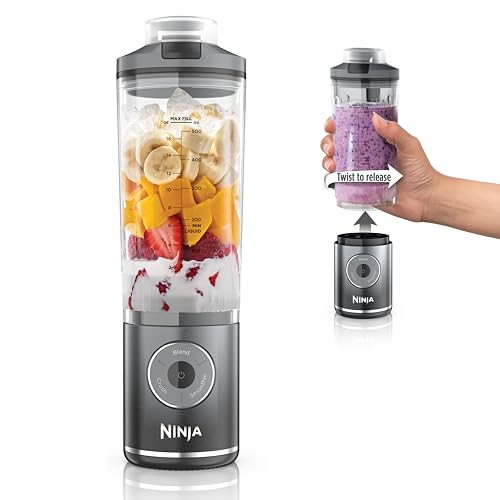
The Blast Max is the pick for portable-blender buyers who found the standard format too small or too gentle. Its 22 oz vessel is the largest in this guide, the Twist & Go design lets the vessel detach from the motor base for carrying and cleaning, and Auto-iQ programs — Crush and Smoothie — run the pulse patterns that thick, frozen single servings need without your thumb managing the cycle. It is the closest a battery blender gets to countertop behavior: bigger load, more frozen content, programmed confidence. The trade is size and weight in the bag, and a step up in tier. If your portable smoothie is a modest protein shake, the standard Blast is the smarter buy. If your portable smoothie is a meal — frozen fruit, oats, nut butter, the works — the Max is the battery blender built for it.
Strengths
- 22 oz vessel: a genuine meal-size smoothie, the largest cordless serving in this guide.
- Auto-iQ Crush and Smoothie programs automate the pulse-then-blend technique frozen loads require.
- Twist & Go removable vessel separates for carrying and washing — a real workflow upgrade over fixed designs.
Trade-offs
- Bigger and heavier in a gym bag; the portability is real but less effortless than the standard Blast.
- Sits at the top of the battery tier — close enough to corded personal blenders that home-only users should compare.
- Even with programs, physics applies: liquid ratios matter, and solid-frozen bricks still need breaking up first.
Key specs (verified)
- Vessel: 22 oz, Twist & Go removable
- Programs: Auto-iQ Crush & Smoothie
- Power: cordless
- Lid: leakproof, dishwasher-safe vessel
What the Max really buys is headroom. Standard portable blenders operate near their limit on a frozen smoothie, so small recipe changes — a bigger handful of frozen mango, a spoon of nut butter — tip them into stalling. The Max’s larger vessel and programmed power delivery keep the same recipes comfortably inside its envelope, and the Auto-iQ cycles matter more than they sound: the Crush program’s aggressive pulsing fractures ice and frozen fruit before the sustained blend, which is exactly the sequence a skilled user performs manually on the standard model. For the portable-blender devotee whose drink is breakfast, not a beverage, this is the machine that stops being a compromise.
The battery blender for people whose smoothie is a meal. Check the current price on Amazon — confirm the BC251 model with the 22 oz Twist & Go vessel on the listing, since the standard Blast line sits right beside it.
Best for: meal-replacement smoothie drinkers, heavy frozen-fruit users, one-blender minimalists / Not suited for: ultralight travelers, protein-shake minimalists, tight budgets

nutribullet Portable Blender NBPB50100K — Best for Smoothie Texture
The nutribullet Portable is the pick for texture-first smoothie drinkers who want to leave the cord behind. nutribullet built its name on extractor blades that break down seeds, skins, and fibrous ingredients more completely than simple cup-blender blades, and that design language carries into this cordless 20 oz model: the vessel is a touch larger than the standard Blast, the charging is USB-C, and the finished smoothie is the smoothest the battery category produces from seedy, fibrous recipes. If your portable drinks are protein powder and milk, this finesse is wasted on you and cheaper picks serve. If your portable drink is a berry-and-greens smoothie and grit is your enemy, this is your battery blender.
Strengths
- Extractor-style blending produces the finest texture in this guide from berries, seeds, and greens.
- 20 oz vessel splits the difference between the Blast and the Max — a full serving without the bulk.
- USB-C charging keeps it on exactly the same cable standard as the rest of your everyday travel kit.
Trade-offs
- Tuned for smoothies, not ice crushing as a party trick — ice in drinks is fine, plain-ice loads are not its brief.
- Single-vessel system: like all cup blenders, it is one serving at a time with a rinse between.
- A newer entrant than the Ninja line, with a shorter long-term track record in the cordless format.
Key specs (verified)
- Vessel: 20 oz
- Power: cordless, USB-C rechargeable
- Format: personal portable blender
- Brand system: nutribullet extractor design
Texture in a portable smoothie is decided by blade design and cycle behavior more than raw power, because the loads are small and the vessel keeps ingredients near the blades. nutribullet’s extractor approach — a blade profile built to rupture cell walls and process seeds rather than merely chop — is why its corded personal blenders earned their following, and the cordless version applies the same thinking within battery limits. Raspberry and blackberry seeds, flax, and spinach stems come out noticeably finer than in crush-focused rivals. The honest boundary is ice-forward drinks, where the Ninja models’ crushing tuning wins; the nutribullet’s home ground is the fruit-and-greens smoothie, and on that ground it is the class of the category.
The texture pick for portable smoothies. Check the current price on Amazon — this model sells in several colors under separate listings; confirm the NBPB50100 model code and 20 oz vessel on the listing.
Best for: berry and green smoothie drinkers, texture-sensitive users, travelers / Not suited for: ice-crushing showcases, batch needs, the strictest budgets

magic bullet Portable Blender MBPB50100 — Best Budget from a Known Brand
The magic bullet Portable is the pick for buyers who want a battery blender from an established personal-blender brand without paying the category leaders’ tier. It applies the magic bullet formula — simple operation, a cup you blend and carry, minimal controls — to a cordless format for shakes, soft smoothies, and on-the-go drinks. This review is honest about the trade: it is a gentler machine than the Blast or the nutribullet Portable, happiest with protein shakes, milk-based drinks, soft fruit, and powders, and it asks for thawed or small frozen pieces when frozen fruit is involved. If frozen smoothies are your daily drink, step up to the Blast. If your portable blending is shakes and soft drinks and the budget matters, this is the sensible brand-name buy.
Strengths
- Established brand with a support network — a meaningful advantage in a category flooded with no-name cups.
- Simple, familiar magic bullet operation: load the cup, blend briefly, swap the lid, and go.
- A friendlier tier than the category leaders, sized for shakes and soft smoothies.
Trade-offs
- Gentler power: frozen fruit needs small, partly thawed pieces and enough liquid — plan recipes accordingly.
- Fewer published details and accessories than the Ninja ecosystem; confirm exactly what the listing includes.
- Not the pick for ice-forward drinks or thick mixtures.
Key specs (verified)
- Format: cordless portable blender
- Brand system: magic bullet personal format
- Role: shakes and soft smoothies
- Model: MBPB50100
The value of this pick is risk management. The battery-blender market’s bottom tier is crowded with unbranded cups whose batteries fade in a season and whose sellers vanish; a magic bullet badge means a real company, a real manual, and a real returns path. Within its envelope — and the envelope is honestly shakes, soft fruit, and powders — it does the portable job: blend at the desk, in the car, at the gym, rinse, repeat. Think of it as the cordless extension of the original magic bullet philosophy, which was never about power and always about removing friction from small blending jobs. Buy it for that job and it satisfies; buy it as a frozen-smoothie machine and the category leaders exist precisely for you.
The low-risk, brand-name way into cordless blending for gentle drinks. Check the current price on Amazon — magic bullet sells corded and cordless models side by side, so confirm the listing says cordless portable before ordering.
Best for: protein-shake drinkers, office and desk blending, brand-conscious budget buyers / Not suited for: daily frozen-fruit smoothies, ice drinks, thick mixtures

KitchenAid Go Cordless Hand Blender KHBRV71 — Best for Cooking Tasks (Cordless Immersion)
The KitchenAid Go is the pick for the shopper whose ‘battery blender’ need is cooking, not smoothies. It is a full-size immersion blender — the stick format you lower into a pot of soup, a pan sauce, or a bowl of whipped cream — running on KitchenAid’s removable Go battery, which is included in this configuration and shared across the Go cordless kitchen system. Freed from the cord, an immersion blender becomes noticeably nicer to use: no cord dragging across burners, no outlet dictating where the pot sits, and easy work at a camp stove or an outdoor kitchen. Blending capacity is pot-scale, not cup-scale — this is the only pick here that can puree a family soup. If your need is a smoothie in a cup, every other pick in this guide serves you better. If your need is cordless blending as a cooking tool, this is the serious option.
Strengths
- True immersion blending at pot scale, cordless — soups, sauces, purees, and whipped tasks anywhere.
- Removable battery included, shared with the KitchenAid Go cordless system: a spare battery means zero downtime.
- KitchenAid build and ergonomics — the most substantial, serviceable machine in this guide.
Trade-offs
- It does not make a smoothie in a cup; it is a cooking tool, and buying it for gym shakes is a category error.
- Immersion blending of frozen or hard ingredients is not its job — it purees cooked and soft foods.
- The system value grows with other Go tools; as a one-off purchase it sits in a premium tier.
Key specs (verified)
- Format: cordless immersion (hand) blender
- Battery: removable, included
- System: KitchenAid Go cordless
- Role: soups, sauces, purees
Cordlessness changes immersion blending more than it changes cup blending. A stick blender’s cord is a genuine hazard and annoyance — it drapes over pot rims, crosses hot burners, and tethers the cook to the outlet’s side of the stove. The Go removes all of that, and its removable-battery design solves the category’s aging problem: when a sealed portable blender’s battery fades, the appliance is done, but a Go battery can be replaced or doubled. Power is honest immersion power — it will silk a pot of butternut soup, emulsify a pan sauce, and whip cream — applied to cooked and soft ingredients, which is the immersion brief. As the only cooking-format pick in a smoothie-dominated guide, it earns its slot by serving the sizable minority of battery-blender shoppers who were never shopping for a smoothie at all.
The cordless blender for cooks, on a battery system built to last. Check the current price on Amazon — this configuration includes the battery; some Go listings sell the tool bare, so verify the battery is in the box on the listing.
Best for: soup and sauce makers, campers with real cooking setups, KitchenAid Go system owners / Not suited for: smoothie-cup routines, frozen drinks, single-purpose gym use

COKUNST Portable Blender — Best Ultra-Budget
The COKUNST is the pick for the ultra-budget corner of the battery category: an 18 oz personal blender with USB-C charging, a six-blade blending head, and a spare lid in the box, sold at a tier where it can serve as a second blender, a travel spare, or a low-risk way to learn whether the portable routine suits your life. This guide is direct about what the tier means: power is modest, long-term battery behavior is unproven compared with the brand leaders, and recipes should stay in the shakes-and-soft-smoothies lane with frozen content kept small and liquid generous. If a portable blender will be a daily driver for years, the Ninja Blast earns its higher tier. If you want to test the lifestyle — or equip a gym bag, a dorm, or a suitcase cheaply — this is the honest way to do it.
Strengths
- The lowest tier in this guide for a USB-C rechargeable portable blender with an 18 oz vessel.
- Extra lid included — a small but real thing that makes the blend-and-carry routine work from day one.
- Six-blade head and standard USB-C charging keep it compatible with the cables you already carry.
Trade-offs
- Modest power: soft ingredients and shakes are its home; frozen fruit must be minimal, small, and well-liquid-ed.
- Unproven long-term battery and brand support versus the category leaders — buy it as a light-duty or spare unit.
- Fit, finish, and seal quality vary more at this tier; check the lid seal before trusting it in a bag.
Key specs (verified)
- Vessel: 18 oz
- Power: USB-C rechargeable
- Blades: 6-blade head
- Included: extra lid
Ultra-budget portables are best understood as consumables with a job: they make the portable routine available at a price where a lost, dropped, or worn-out unit is an annoyance rather than a loss. Judged that way, the COKUNST is sensibly specced — the vessel size matches a real shake, the charging standard is the right one, and the spare lid acknowledges how these machines are actually used. Its smoothies from soft fruit and its protein shakes are perfectly serviceable; its limits appear exactly where this guide says battery physics bites hardest, on frozen and thick loads. The buying advice is symmetrical: if it turns out you love the routine, you will upgrade to the Blast with full knowledge of why; if the routine fades, you have spent the least possible to learn that.
The low-stakes entry ticket to cordless blending. Check the current price on Amazon — ultra-budget listings change configurations quietly, so confirm the 18 oz size, USB-C charging, and extra lid on the listing before ordering.
Best for: spare and travel units, dorms, first-time portable users, gift buyers / Not suited for: daily frozen smoothies, long-term primary use, thick mixtures
Comparison Table
| Pick | Badge | Key spec | Best for |
|---|---|---|---|
| Ninja Blast BC151BK | Best Overall Battery Blender | 18 oz vessel, USB-C cordless | Gym, office, and travel smoothie routines |
| Ninja Blast Max | Best for Bigger, Thicker Blends | 22 oz vessel, Auto-iQ programs, cordless | Meal-size portable smoothies, heavier frozen loads |
| nutribullet Portable | Best for Smoothie Texture | 20 oz vessel, USB-C cordless | Berry-and-greens smoothie drinkers on the move |
| magic bullet Portable | Best Budget from a Known Brand | Cordless portable, magic bullet format | Protein shakes and soft drinks on the go |
| KitchenAid Go KHBRV71 | Best for Cooking Tasks (Cordless Immersion) | Cordless immersion, removable battery included | Cooks who blend soups and sauces anywhere |
| COKUNST Portable | Best Ultra-Budget | 18 oz, USB-C, 6 blades, extra lid | Spares, dorms, travel kits, first experiments |
How to Choose a Battery Operated Blender
Start by confirming the format matches the job. For drinks on the move, you want a portable cup blender: vessel between 18 and 22 oz, a leakproof drinking lid, and USB-C charging. For cooking — soups, sauces, purees — you want the cordless immersion format, and you should stop comparing it to cup blenders entirely; they share a battery and nothing else. Most disappointed battery-blender buyers bought the right category and the wrong format.
Then calibrate power expectations to your recipes. Protein shakes, milk drinks, and soft-fruit smoothies: every pick here works. Frozen-fruit smoothies as a daily habit: the Ninja Blast, Blast Max, and nutribullet Portable are the honest shortlist. Ice-forward frozen drinks: possible in small servings in the strongest cup blenders, but a corded machine is the right tool if that is the main job. Thick smoothie bowls: no battery blender — buy corded and be happy.
- Charging: USB-C is the standard to insist on; it charges from laptops, cars, and power banks with the cable you already own.
- Vessel size: 18 oz is a standard smoothie; 22 oz is a meal. Bigger vessels on weak motors are worse, not better — size and power must match.
- Lid seal: the whole format depends on it. Look for a positive-sealing sip lid, and test with water before the first bag trip.
- Battery strategy: sealed batteries are simpler; a removable system battery (KitchenAid Go) is replaceable and shareable — the longevity play.
- Brand: in a battery category, the maker’s support and returns path are part of the product. Weight them accordingly.
Battery Care: Making a Cordless Blender Last
Lithium batteries age by chemistry and by habit, and the habits are largely in your control. Avoid running the battery to absolute zero and leaving it there; top up after use rather than storing it empty. Keep the blender out of hot cars and freezing garages for long stretches — temperature extremes are battery poison. And blend within the machine’s envelope: repeated stalled, overloaded cycles heat the motor and stress the cells far more than normal smoothies do. A battery blender used inside its limits and charged kindly will hold useful capacity for years; one used as an ice crusher and stored dead will fade within a season or two.
Cleaning interacts with battery life too, in a way owners learn late: never submerge a motor base or battery unit. Cup-blender vessels and lids are washable — several picks here have dishwasher-safe food-contact parts — but the base with the battery and motor gets a wipedown, not a soak. Water in a charging port is the other classic killer: dry the port area before plugging in, every time, especially after a rinse-heavy cleanup at a gym sink.
Charge planning is the other half of ownership. These are small batteries with small chargers — a full charge is a matter of hours, not minutes, and there is no fast-charge rescue on the way out the door. The routine that works is boring: blend, rinse, plug in at the same place every day (desk, kitchen counter, gym bag pocket with a power bank), so the machine is simply always ready. Travelers should note that a power bank that charges a phone will charge these blenders too, which quietly doubles their range on trips.
Where Battery Blenders Genuinely Beat Corded Ones
It is easy to frame cordless blenders as weaker corded blenders, but in four situations they are simply the better tool. Travel and commuting: the smoothie happens where you are, with no kitchen required. Small-space living: no base on the counter, no cord management, storage in a drawer. Outdoor life: boats, campsites, tailgates, and job sites where outlets are scarce and a power bank is not. And the immersion case: a cordless stick blender around hot pots is safer and freer than a corded one, full stop. If your life includes any of these regularly, the battery premium buys something a corded machine cannot offer at any price — location independence.
Budget Tiers in the Battery Category, Honestly Framed
Battery blenders sort into three honest tiers. The ultra-budget tier (the COKUNST’s territory) buys the routine for shakes and soft drinks, with modest power and unproven longevity — right for spares and experiments. The mid tier (magic bullet Portable) buys brand support and polish for the same gentle brief. The leader tier (the Ninjas and the nutribullet) buys real frozen-fruit capability, better seals, and batteries that hold up — the tier to buy if the machine is a daily driver. The KitchenAid Go sits outside the ladder as a system purchase for cooks. The recurring mistake is buying the ultra-budget tier for a leader-tier routine; the second most common is paying leader money for a protein-shake habit that never needed it.
How to Get a Smooth Result From a Battery Blender
Battery blenders reward technique more than any other format, because their power margin is thin. This routine extracts everything the format has to give.
- Cut frozen fruit small: pieces around a half-inch blend dramatically easier than whole frozen strawberries or mango chunks. Freeze your own fruit in a single layer so pieces stay separate.
- Liquid to the line: fill liquid to at least the level of the solid ingredients before blending. A battery blender cannot start a vortex in a dry or under-liquid load.
- Start upside-down or shaken: for cup blenders, a firm shake before starting distributes ingredients at the blades; starting inverted (where the design allows) puts frozen pieces at the blade first while liquid follows.
- Pulse, then blend: two or three short pulses to fracture frozen pieces, then one sustained blend of 30–45 seconds. Restarting a stalled blend after a shake is technique, not failure.
- Rest between back-to-back blends: give the motor a minute between consecutive full blends on frozen loads. Small motors heat quickly, and heat is what ages both motor and battery.
- Charge after, not before: top the battery up right after use so the next blend starts full — and never store the blender fully discharged.
If a blend stalls repeatedly, the diagnosis is almost always one of three things: pieces too big, liquid too low, or a battery near empty (cordless motors lose punch as charge fades, so a recipe that works at full charge may stall at low charge). Fix the variable you find and the same machine will finish the drink. Treat a stall as information rather than an insult to the machine: it is telling you exactly which of its limits you crossed, and every one of those limits moves in your favor with smaller pieces, more liquid, or a fuller battery.
Common Buying Mistakes
- Buying a corded ‘portable’ blender by mistake. Famous personal blenders with travel jars still need an outlet. If the listing does not say cordless and rechargeable, it is not a battery blender — check before you buy, as we did for every pick here.
- Loading it like a countertop blender. Whole frozen fruit, no liquid, filled to the brim — the recipe for a stall. Small pieces, generous liquid, headroom.
- Expecting smoothie-bowl thickness. No battery blender makes spoonable frozen bowls. Buy corded for that job and enjoy the cup blender for drinks.
- Storing it dead. A lithium battery left fully discharged degrades fast. Charge after use, every time, as part of the rinse routine.
- Trusting the lid seal untested. Fill with water, close, shake over the sink before the first gym-bag trip. Seals vary, and protein shake in a bag is a memorable teacher.
- Judging the whole category by a novelty cup. The weakest no-name portables can barely blend a banana, and they are the ones most people meet first. The verified leaders in this guide are different machines with different motors, seals, and batteries — do not let a bad first experience with a novelty cup close the category for you.
Final Recommendation
For most people, the answer is the Ninja Blast: real cordless power, a trustworthy seal, and USB-C charging in the right size. Buy the Ninja Blast Max if your portable smoothies are meals, the nutribullet Portable if texture is your priority, the magic bullet Portable for brand-name shakes on a budget, the KitchenAid Go if your battery blending is cooking, and the COKUNST if you are equipping a spare bag or testing the routine. Check the current price on Amazon for whichever you choose.
If your blending turns out to live at home after all, these guides in the same series cover the corded side of the family: Best Portable Blenders, Best Portable Charger Blenders, Best Basic Blenders For Smoothies, Best Blenders, Best Portable Blenders For Smoothies, and Best Blenders 100 Dollars.
Frequently Asked Questions
Are battery operated blenders powerful enough for frozen fruit?
The leaders are, within single-serving limits: frozen berries and small frozen pieces with adequate liquid blend smoothly in the Ninja Blast, Blast Max, and nutribullet Portable. The budget tier needs frozen fruit small and partly thawed. No battery blender handles a vessel packed with large, solid-frozen fruit — that is a corded machine’s job at any price.
How many blends do you get per charge?
It varies by model, load, and battery age, and listings express it differently, so treat any single number cautiously. In practice, expect a day of normal smoothie use — several blends — from the leaders when blending reasonable loads, fewer when every blend is a maximum frozen load. The ownership habit that matters is charging after use so the question rarely arises.
Can I take a battery blender on a plane?
Portable blenders contain lithium batteries and blades, which makes them poor carry-on candidates — blade rules alone usually settle it. Pack them in checked luggage with the battery guidelines of your airline in mind, and consider that a USB-C model can recharge at your destination from any phone charger. When in doubt, check the airline’s current policy before the trip, not at security.
Why does my portable blender stall on the same recipe that worked yesterday?
Three usual causes: the battery is low (cordless motors lose punch as charge fades), the frozen pieces were bigger this time, or the liquid level dropped below the load. Charge fully, cut smaller, add a splash of liquid, and shake between pulses — the recipe has not changed, but one of those variables has.
Is a cordless immersion blender as strong as a corded one?
For its actual jobs — pureeing soups and sauces, emulsifying, whipping — a quality cordless immersion blender like the KitchenAid Go performs comparably in normal cooking use. Immersion blending works in hot, soft, liquid environments that do not demand crushing power. It is not a tool for frozen or hard ingredients in either format.
How long will a battery blender’s battery last over the years?
With kind habits — charged after use, never stored empty, kept out of temperature extremes, and not chronically stalled on overloads — a quality lithium pack holds useful capacity for years of regular use. Sealed units eventually retire with their batteries; the KitchenAid Go’s removable battery is the exception that can be replaced or supplemented, which is a real longevity argument for that system.


