Disclosure: airfryerkitchensupply.com is reader-supported. When you buy through links on our site, we may earn an affiliate commission at no extra cost to you.
Where to buy
If you are shopping for the best backpacking chopsticks online, buy them where weight, material and case details are stated plainly on the listing. Backpacking chopsticks are a speciality item that general outdoor retailers stock patchily, so Amazon is where we recommend buying: every pick below was verified there, with weights, materials and case details taken from the listings themselves. Order early enough to eat a few home meals with your pair before a trip — grip preference is personal, and a trail dinner is the wrong place to discover yours.
- Snow Peak Titanium Chopsticks — Best Overall: Check on Amazon
- Keith Ti5633 Pure Titanium Solid Square Chopsticks — Best Premium: Check on Amazon
- Snow Peak Wabuki Chopsticks (Collapsible, Large) — Best Packability: Check on Amazon
- Thous Winds Titanium Chopsticks (Foldable) — Best Foldable Value: Check on Amazon
- Youda Pure Titanium Chopsticks with Carrying Case (1 Pair) — Best Budget Titanium: Check on Amazon
- SANTTA Titanium Chopsticks with Travel Case — Best for Travel Beyond the Trail: Check on Amazon
Introduction
Choosing the best backpacking chopsticks is an exercise in honest gram-counting. A pair of chopsticks can replace a fork and spoon for most trail food — noodles, rice, rehydrated meals, even most freeze-dried bags eaten straight from the pouch — at a weight between roughly twenty and forty grams. But the category is full of traps: heavy wooden pairs sold as ‘travel’ chopsticks, collapsible designs with wobbly joints, and titanium-plated steel masquerading as titanium at titanium prices.
Every pick in this guide was verified through Amazon’s catalogue data, and the shortlist converged on the material that genuinely owns this niche: titanium. It does not rust, does not taste of anything, tolerates being boiled clean, and in the Snow Peak pick below weighs a verified 22 grams including the concept of a carrying case. Stainless steel appears once, in a collapsible design whose packability earns its weight. Wood and bamboo were left out deliberately — they absorb trail grime, dry slowly and weigh more than titanium for the same job.
One myth to retire before the picks: carbon fibre chopsticks are essentially not a real product in this market. Our catalogue search for them returned fiberglass and titanium-plated listings only. If a listing promises carbon fibre at a bargain tier, treat it as the marketing fiction it almost certainly is, and buy honest titanium instead.
This guide assumes chopsticks as a primary utensil, not a novelty backup. That assumption changes the buying logic: the pair must be good enough to eat every meal of a trip with, light enough to justify against a spork that weighs nearly nothing, and tough enough to survive being packed, washed in streams and lent to partners. Picks that only made sense as a cute spare did not survive our filters, however charming their product pages.
In this guide
Quick Picks
Six verified pairs, all built around weight, packability and trail-proof hygiene. The badge beside each name matches its full review below, so gram-counters and comfort-seekers can each jump to their pick.
- Snow Peak Titanium Chopsticks — Best Overall. The benchmark trail pair. A verified 22 grams, a proper carrying case, and Snow Peak’s heat-reducing design — the chopsticks most ultralight hikers end up owning after trying cheaper ones. Check on Amazon
- Keith Ti5633 Pure Titanium Solid Square Chopsticks — Best Premium. The connoisseur’s trail pair. Solid — not hollow — pure titanium in a square profile that grips and refuses to roll, presented in a machined aluminium case. Heavier than hollow rivals, better in the hand. Check on Amazon
- Snow Peak Wabuki Chopsticks (Collapsible, Large) — Best Packability. The pair that disappears into any kit. Snow Peak’s Wabuki collapses into its case for a packed size no full-length pair can match, in stainless steel built for decades of trips. Check on Amazon
- Thous Winds Titanium Chopsticks (Foldable) — Best Foldable Value. Titanium that folds. A 9-inch eating length that halves for packing, in genuine titanium with a storage bag — the middle path between the Wabuki’s compactness and a full pair’s feel. Check on Amazon
- Youda Pure Titanium Chopsticks with Carrying Case (1 Pair) — Best Budget Titanium. Real titanium without the boutique badge. The listing states 99.8% pure titanium and includes a black carrying case — the honest entry point for hikers who refuse plated steel. Check on Amazon
- SANTTA Titanium Chopsticks with Travel Case — Best for Travel Beyond the Trail. The everyday-carry pair. Ultralight titanium in a distinct green case, made as much for work lunches, flights and food trucks as for summits — the pair that lives in your day bag. Check on Amazon
Notice the pattern: five of six picks are titanium and the sixth is a collapsible stainless design with a century of outdoor heritage behind its brand. That is not fashion. On a trail, materials that rust, absorb flavours or need babying eliminate themselves, and what survives is this shortlist.
How These Picks Were Chosen
Verification came first: each model was confirmed, with material, weight and case claims taken from the listing text. In a category where ‘titanium’ is sometimes a colour rather than a material, we required the listing to state pure titanium or a specific grade claim, and we note the one stainless pick honestly as stainless.
Second, trail criteria replaced table criteria. We weighted grams, packed length, case inclusion and cleanability in the field — a pair you can rinse, boil or wipe clean at a cold campsite beats a marginally nicer pair that needs a kitchen. Tip grip still mattered, because freeze-dried noodles at the end of a long day are exactly as slippery as ramen at home.
Third, we checked the logic of each format. Full-length pairs are the most reliable and the easiest to eat with; foldable and collapsible pairs trade a little rigidity for a much smaller packed size. Both formats earned places, badged honestly, because backpackers divide genuinely on which trade they prefer.
Fourth, durability over seasons. A backpacking pair is bought once and carried for years, so we favoured established outdoor makers and simple constructions with no springs, threads or coatings to fail. Prices in this speciality niche move and listings rotate, so the guide uses check price on Amazon throughout rather than printing numbers.
One more filter shaped this list: repairability and failure modes. On a long trail, gear fails by breaking, and the best designs fail rarely and gracefully. One-piece titanium pairs have essentially one failure mode — loss — which is a user problem, not a product problem. Jointed pairs add a mechanical failure mode, which is why only well-made joints from established gear makers appear here. Anything with springs, plastic hinges or mystery mechanisms was excluded regardless of its weight claim.
The 6 Best Backpacking Chopsticks

Snow Peak Titanium Chopsticks — Best Overall
Snow Peak is the name backpackers trust for titanium tableware, and this pair justifies it: the listing states 22 grams, includes a carrying case, and the design reduces heat transfer so the pair stays comfortable when you are stirring or eating from a hot pot. It is the full-length, no-compromise format done at the lowest sensible weight.
Strengths
- Verified 22-gram weight puts it among the lightest full-length pairs available
- Included carrying case keeps tips clean in a food bag and protects other gear from the points
- Titanium never rusts, never holds flavours and can be boiled clean in camp
Trade-offs
- Premium-tier pricing, as with all genuine Snow Peak titanium
- Full length packs longer than foldable rivals — it wants a side pocket or cook-kit roll
- Titanium tips are smooth; glass noodles still test your technique
Key specs
- Material: Titanium
- Weight: 22 grams (per listing)
- Case: Carrying case included (per listing)
- Design: Heat reducing (per listing)
The case is not a garnish: loose chopsticks in a hip-belt pocket or food sack pick up grit and puncture bags, and the case ends both problems while adding almost nothing. Eaten with at home first, this pair feels like a normal, well-balanced chopstick that happens to weigh nothing — which is precisely the ultralight ideal. For most backpackers this is the buy-once answer, and the rest of the list is about specific alternatives to it.
There is also a systems argument for this pair: Snow Peak’s titanium ecosystem — pots, mugs, sporks — shares design language and dimensions, so the chopsticks nest and pack predictably with the kit many hikers already own. Even outside that ecosystem, the pair’s proportions are the reference others copy, which means cases, rolls and pot dimensions across the industry tend to fit it. Buying the benchmark is rarely the exciting choice; on a ten-day trail, boring reliability is the excitement.
Best for: most backpackers wanting the lightest reliable full-length pair / Not suited for: shoppers needing the smallest possible packed length above all
Check on Amazon — check the current price on Amazon before you buy, and confirm the pair count and length on the listing, because sellers in this category adjust bundle sizes often.

Keith Ti5633 Pure Titanium Solid Square Chopsticks — Best Premium
Keith built its name on titanium camp gear, and the Ti5633 is its statement chopstick: solid pure titanium with a square cross-section, carried in a grey aluminium case. The solid build is a deliberate trade — a little more weight than hollow pairs in exchange for a rigid, substantial feel that many diners prefer.
Strengths
- Solid titanium build feels rigid and precise, with none of the flex of thin hollow pairs
- Square profile grips food securely and never rolls off a rock or picnic table
- Machined aluminium case is the most protective storage in this guide
Trade-offs
- Solid construction and a metal case make it the heavier premium option here
- Premium tier pricing across both the pair and its case
- The case adds bulk that minimalist cook kits may not welcome
Key specs
- Material: Pure titanium, solid
- Profile: Square
- Case: Grey aluminium case (per listing)
- Model: Ti5633
Square titanium solves the two honest complaints about metal chopsticks — rolling and slipperiness — in one geometry change, and on trail food like oily noodles or sausage pieces the difference is immediate. Choose this pair if you eat with chopsticks constantly at home as well as on trail and want one pair that serves both lives beautifully; choose the lighter Snow Peak if every gram is audited.
The aluminium case deserves its own note: it turns the pair into something closer to a fountain pen than a utensil — an object you carry deliberately and keep for decades. Hikers who also use their trail pair for travel and work lunches will get more total value from this set than from any other pick here, because it is the one that feels at home in every setting. Weight auditors should simply be honest that they are buying that versatility with grams, and many will judge the trade well made.
Best for: frequent chopstick users wanting one premium pair for home and trail / Not suited for: strict ultralight hikers counting single grams
Check on Amazon — check the current price on Amazon before you buy, and confirm the pair count and length on the listing, because sellers in this category adjust bundle sizes often.

Snow Peak Wabuki Chopsticks (Collapsible, Large) — Best Packability
The Wabuki is Snow Peak’s answer to the packed-size problem: a collapsible stainless steel pair that stores inside its own case at a fraction of its eating length. For bikepackers, travellers with tiny cook kits and anyone whose utensil lives in a jacket pocket, that format is not a gimmick — it is the whole point.
Strengths
- Collapsible format packs dramatically smaller than any full-length pair here
- Case is integral to the design, so the packed pair stays clean and contained
- Stainless construction is effectively indestructible in normal trail use
Trade-offs
- Stainless weighs more than the titanium picks — packability, not weight, is its win
- Any jointed design has a faintly less rigid feel than a one-piece pair
- The mechanism wants a rinse if trail grit gets into it
Key specs
- Material: Stainless steel
- Format: Collapsible (per listing)
- Case: Included (per listing)
- Size: L
Judge the Wabuki by where it lets chopsticks go: the tiny repair-kit pouch, the bikepacking frame bag, the carry-on. In those kits a full-length pair simply does not fit, and the comparison is not titanium versus steel but chopsticks versus a spork. Eating feel is good rather than great, and for most trail meals — noodles, rice, pouch dinners — good is entirely sufficient.
The Wabuki also has a travel life beyond backpacking that justifies it for non-hikers: it is the pair that lives in a handbag, a glovebox or a carry-on and produces real chopsticks in places that offer only a plastic fork. Owners tend to keep them for years because the mechanism is simple and the steel is honest. If your adventures are as much urban as alpine, this may quietly be the most-used pick in the entire guide.
Best for: bikepackers, minimalist travellers and tiny cook kits / Not suited for: gram-counters for whom titanium’s weight saving outranks packed size
Check on Amazon — check the current price on Amazon before you buy, and confirm the pair count and length on the listing, because sellers in this category adjust bundle sizes often.

Thous Winds Titanium Chopsticks (Foldable) — Best Foldable Value
Thous Winds is a respected name in titanium camp gear, and this foldable pair splits the difference between our two Snow Peak picks: real titanium like the ultralight choice, a folding format like the packability choice, and a full 9-inch eating length when opened. A storage bag is included for the packed pair.
Strengths
- Genuine titanium keeps weight low while the fold halves packed length
- Full 9-inch eating length feels normal at the meal, not like a compromise tool
- Storage bag included, keeping the folded pair clean in a kit
Trade-offs
- The fold joint is one more thing to rinse and dry than a one-piece pair
- Slightly less rigid at the joint than solid or one-piece titanium
- Less established in Western retail than Snow Peak, though well known in titanium gear circles
Key specs
- Material: Titanium
- Format: Foldable
- Length: 9 inches (per listing)
- Case: Storage bag included (per listing)
For hikers whose cook kit is a small pot with everything nested inside, the fold is decisive: this pair nests where a full-length pair cannot. The eating experience is close enough to a fixed pair that most users stop noticing the joint by the second meal. It is the pick we would hand a titanium-curious hiker who found the Snow Peak’s price or packed length hard to accept.
Thous Winds’ background in titanium stoves and cookware shows in the details hikers notice: the fold is engineered rather than improvised, and the 9-inch opened length respects eating rather than merely existing. It is also the natural recommendation for couples outfitting two kits, where two premium fixed pairs strain the budget but two of these deliver genuine titanium, genuine packability and a shared standard of kit that makes camp cooking smoother.
Best for: hikers wanting titanium with a genuinely small packed size / Not suited for: purists who want a one-piece pair with nothing to rinse out
Check on Amazon — check the current price on Amazon before you buy, and confirm the pair count and length on the listing, because sellers in this category adjust bundle sizes often.
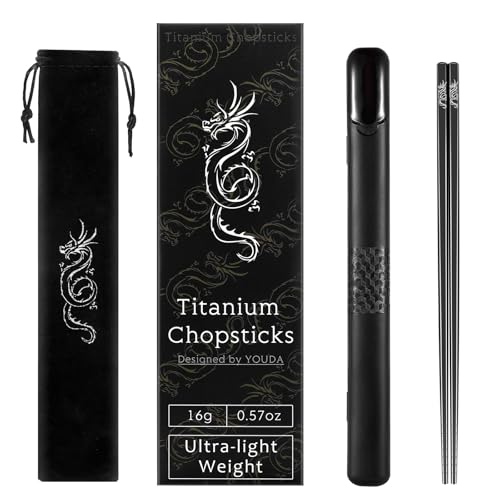
Youda Pure Titanium Chopsticks with Carrying Case (1 Pair) — Best Budget Titanium
The budget end of titanium is where the fakes live, so this Youda pair earns its badge by stating its material plainly: 99.8% pure titanium, one pair, with a black carrying case included. It is the lowest-risk way to find out whether titanium chopsticks suit your hands before paying premium-brand prices.
Strengths
- Material stated precisely on the listing — pure titanium, not titanium-coloured steel
- Carrying case included even at this tier, which many budget pairs omit
- Same rust-proof, flavour-neutral, boil-clean virtues as the premium picks
Trade-offs
- Finishing and tip work are a step below Snow Peak and Keith standards
- Single pair only — couples buy two, with no bundle saving
- Brand support and longevity in the market are less proven than the big names
Key specs
- Material: 99.8% pure titanium (per listing)
- Set size: 1 pair
- Case: Black carrying case included (per listing)
- Use: Camping, home, travel (per listing)
Functionally, pure titanium is pure titanium: it will not rust in a wet food bag, will not flavour tonight’s noodles with last night’s curry, and shrugs off a boil wash. What the premium brands add is refinement — balance, tip finish, case quality — not a different material. For a first titanium pair or a spare for a partner’s kit, that makes this the sensible spend.
A second, underappreciated role for this pair is the loaner: the spare titanium set that equips a partner, a teenager or a friend trying backpacking for the first time, without lending your own benchmark pair. Because the material is genuine, the loaner experience is honest — the borrower learns exactly what titanium feels like — and because the price tier is sane, the loan is made without anxiety. Every experienced hiker’s kit eventually grows such a spare; this is the one to grow.
Best for: first-time titanium buyers and spare-pair shoppers / Not suited for: diners who notice and care about fine tip finishing
Check on Amazon — check the current price on Amazon before you buy, and confirm the pair count and length on the listing, because sellers in this category adjust bundle sizes often.

SANTTA Titanium Chopsticks with Travel Case — Best for Travel Beyond the Trail
Not every backpacking chopstick’s second life is at home; some live permanently in a travel kit. This SANTTA pair — titanium, one pair, with a green travel case — is pitched exactly there: ultralight for camping, but just as useful for the office noodle run and the long-haul flight where the provided cutlery is grim.
Strengths
- Titanium build suits both trail and daily travel use with zero rust or flavour carry-over
- Distinct green case is easy to spot in a dark pack or crowded tote bag
- Light enough to justify permanent residence in a day bag
Trade-offs
- Single pair, like most travel-format picks here
- Case colour is a love-it-or-leave-it detail
- Less specialised for serious ultralight kits than the Snow Peak benchmark
Key specs
- Material: Titanium
- Set size: 1 pair
- Case: Green travel case included (per listing)
- Use: Camping and travel (per listing)
The real virtue of a dedicated travel pair is behavioural: it is always there. Kept in the case in a work bag, it replaces a surprising amount of single-use cutlery across a year of lunches and trips, and titanium’s indifference to being washed in a hotel sink or boiled in a hostel kitchen makes it the right material for that nomadic life. Hikers get a perfectly good trail pair as a bonus.
The everyday-carry logic compounds quietly: a pair used two hundred times a year for lunches and trips delivers more total value than a marginally lighter pair used twelve nights a year on trail, even for a backpacker. Titanium is the only material that supports that double life without complaint — it does not care whether it was washed in a mountain stream or an office kitchen. Buy this pair if your adventures include the 9-to-5 kind, and let it earn its keep daily.
Best for: travellers, commuters and everyday-carry kits as well as campers / Not suited for: buyers wanting a multi-pair household set
Check on Amazon — check the current price on Amazon before you buy, and confirm the pair count and length on the listing, because sellers in this category adjust bundle sizes often.
Comparison Table
The trail trade is three-way: lowest weight, smallest packed size, best eating feel. No pick wins all three — use the table to choose which two matter most to your kit.
| Pick | Badge | Key spec | Best for |
|---|---|---|---|
| Snow Peak Titanium Chopsticks | Best Overall | Titanium, 22 grams, carrying case included | most backpackers wanting the lightest reliable full-length pair |
| Keith Ti5633 Pure Titanium Solid Square Chopsticks | Best Premium | Pure titanium, solid square profile, aluminium case | frequent chopstick users wanting one premium pair for home and trail |
| Snow Peak Wabuki Chopsticks (Collapsible, Large) | Best Packability | Stainless steel, collapsible, case included, size L | bikepackers, minimalist travellers and tiny cook kits |
| Thous Winds Titanium Chopsticks (Foldable) | Best Foldable Value | Titanium, foldable, 9 in eating length, storage bag | hikers wanting titanium with a genuinely small packed size |
| Youda Pure Titanium Chopsticks with Carrying Case (1 Pair) | Best Budget Titanium | 99.8% pure titanium (per listing), 1 pair, black carrying case | first-time titanium buyers and spare-pair shoppers |
| SANTTA Titanium Chopsticks with Travel Case | Best for Travel Beyond the Trail | Titanium, 1 pair, green travel case included | travellers, commuters and everyday-carry kits as well as campers |
Read the table as a triangle. The Snow Peak titanium pair owns the weight corner, the Wabuki owns the packed-size corner, and the Keith owns the eating-feel corner; the remaining three picks are intelligent compromises positioned between those poles. Your kit already knows which corner matters — a frameless pack argues for weight, a bikepacking bag argues for size, a basecamp cook argues for feel — and the honest pick is the one that listens to the kit rather than to the marketing.
How to Choose Backpacking Chopsticks
Start with the material, and be forensic about it. Genuine titanium is the standard for a reason: it is lighter than steel, immune to rust, neutral in taste and strong enough in thin sections. The trap is vocabulary — ‘titanium plated’, ‘titanium colour’ and ‘titanium alloy steel’ all describe steel with a costume on. Look for listings that state pure titanium or a purity figure, as the Youda and Keith picks here do, and be suspicious of titanium claims at disposable-bamboo prices.
Decide your format by your kit, not by novelty. If your utensils ride in a side pocket, a cook-kit roll or the pot itself standing upright, a full-length pair is simpler, lighter for its strength and better to eat with. If everything nests inside a small pot or a frame bag, foldable and collapsible formats earn their joints. Measure your pot’s internal height before ordering; it settles the argument instantly.
Weight claims deserve the same scepticism as material claims. A verified figure from a serious maker — Snow Peak states 22 grams for its pair — means something; an unbranded ‘ultralight’ with no number means nothing. Remember to count the case: a pair at 22 grams in a 30-gram case is a 52-gram system, which is why the lightest setups pair titanium sticks with a simple fabric or slim case.
Finally, think about the food you actually eat on trail. Deep freeze-dried pouches reward a full-length pair that reaches the bottom corners; pot-cooked noodles reward grip at the tips; hikers who also eat at home with the same pair should weight eating feel higher and packed size lower. There is no wrong answer, only an answer matched or mismatched to your menu.
Titanium vs Stainless Steel vs Wood on the Trail
Titanium wins the weight and corrosion argument outright, which is why five of our six picks use it. Its honest weaknesses are price and smoothness: titanium tips are polished metal, and slippery food demands the technique you would use with any metal chopstick. It also conducts less heat than steel — Snow Peak designs around this explicitly — so a titanium pair is kinder when eating straight from a just-boiled pot.
Stainless steel is the durability-and-price answer, and in the collapsible Wabuki it buys a packed format titanium rarely offers. The cost is grams: a steel pair typically weighs noticeably more, and over a long thru-hike that difference is real, though for weekend trips it is honestly trivial. Steel also flavours nothing and cleans easily; its trail sin is only weight.
Wood and bamboo, the default ‘travel chopstick’ materials in gift shops, are the weakest trail choice despite their charm: they absorb water and food oils, dry slowly in a pack, can harbour flavours between meals, and weigh more than titanium while lasting less long. Keep wooden pairs for home and travel-by-car, and let metal do the wet, dirty, gram-counted work.
Building a Complete Chopstick-Based Trail Kitchen
A pair of chopsticks anchors a minimalist cook system surprisingly well. Add a long-handled spoon only if your menu demands one — soups you drink, runny porridge — and you have covered the overwhelming majority of trail food with two tools that nest, weigh little and wash in seconds. Many experienced hikers drop the fork entirely after one trip and never re-add it; the fork is the utensil trail food needs least.
Pair the chopsticks with the right pot logic: a pot wide enough to eat from comfortably beats a deep narrow one for chopstick use, and a pot you can hold by a bail or handle while eating turns the pair into a complete dining system. When cooking for two, a second pair — the budget Youda pick is made for this — doubles as the serving tool and the partner’s set, ending the one-utensil relay that slows every camp dinner.
Finally, think about the pair’s life between trails. Titanium chopsticks that only hike will be forgotten in a gear bin; titanium chopsticks that also live in a work bag, a car kit or a travel pouch get used weekly and are always where you packed them. The SANTTA pick exists in this guide precisely to encourage that double life, which is the real secret of gear that is never left behind.
Chopsticks in a Group Camp Kitchen
Groups change the chopstick maths. A party of four eating from shared pots needs serving pairs as well as eating pairs, and the hiker who brings only a personal set will watch it pressed into communal service, with communal hygiene to match. The lightweight answer is one budget titanium spare per group — the Youda pick exists for this — designated as the serving and loaner pair, so personal pairs stay personal and nobody eats with the communal spork of last resort.
Colour and case discipline matters more in groups: identical titanium pairs migrate between kits with silent ease. Mark yours — a distinctive case, a coloured band, the green-cased SANTTA pick — and the nightly kit audit becomes trivial. Most group gear losses are not losses at all but unmarked migrations discovered at home, by which time the other kit is three states away.
Finally, groups are where converts are made. The partner who mocked chopsticks at the trailhead will, by night three of pouch noodles, be quietly competent and mildly evangelical. Carrying the spare pair that enables that conversion is a small act of camp generosity with an outsized effect on group morale — and on the number of sporks the group needs to carry next season.
Weight weenies should run the final comparison honestly before ordering: a titanium pair at the weights in this guide versus the spork already in your kit. If the spork stays home, the chopsticks are not an addition but a substitution, and the true cost is the difference — often a handful of grams for a dramatically better eating tool. If both travel, the pair must earn its place on versatility: cooking, serving, stirring and eating. For most backpacking menus it does, which is why this category keeps growing while other novelty utensils fade.
There is also a repairability footnote worth packing: a bent titanium pair can usually be coaxed straight enough on a flat rock to finish a trip, and a lost pair can be improvised from sticks for noodle duty in an emergency — the skill transfers even when the tool does not. None of that argues against buying well; it argues that chopstick competence is itself a piece of ultralight gear, weighing nothing, that this guide’s readers take home along with the pair.
How to Eat, Clean and Carry Chopsticks on the Trail
Eating from a pouch is the core trail skill: stand the pouch upright, open it fully, stir thoroughly with the chopsticks — they are better stirrers than any spork — then eat in small lifts, twirling noodles rather than spearing. Chopsticks reach the bottom corners of a deep pouch that defeat short utensils, which alone justifies their place in many kits. With pot meals, the same pair serves as cooking tongs for noodles and as the eating tool, one less thing to wash.
Cleaning in camp is simple because the materials are metal: a rinse and wipe handles most meals, a drop of biodegradable soap and hot water handles oily ones, and a rolling boil sanitises completely when you are already boiling water. Dry the pair before casing it — even rust-proof titanium deserves a dry case, because a sealed wet case grows smells that transfer to the next meal.
Carry the pair cased, tips protected, in the same place every day: food bag, cook kit or hip-belt pocket. The case protects your gear from the points as much as the points from your gear. At home between trips, store the pair with your camp kitchen rather than the kitchen drawer, so it is never the thing forgotten on the counter when the pack is already loaded.
A final trail skill worth practising at home: eating with cold, tired hands. At altitude or after a wet day, fingers lose dexterity, and the pair that felt easy in your kitchen feels demanding at the pass. This is the practical argument for textured or square-profile tips in a trail pair, and for choosing your pair a size more forgiving than your home pair. Rehearse one home dinner with your trail pair before every big trip and the skill — and the confidence — will be there when the weather is not.
Common Buying Mistakes
Backpacking gear mistakes are usually small, light and annoying for an entire trip. These are the chopstick-specific ones worth avoiding before you are five miles from the trailhead.
Buying titanium-plated steel at titanium prices. Plating is a colour, not a material. If the listing does not state pure titanium or a purity percentage, assume steel, weigh your decision accordingly and pay steel prices or walk away
Choosing wooden ‘travel’ chopsticks for wet trips. Wood absorbs water and flavours, dries slowly in a pack and can stay faintly grubby for days. It is a fine home material and a poor multi-day trail material
Ignoring packed length until packing night. A full-length pair that does not fit your pot or kit roll becomes a loose, case-scraping nuisance. Measure your kit first and let the measurement pick your format
Skipping the case to save grams. Uncased tips collect grit, flavour the next meal and poke holes in food bags. A slim case weighs little and prevents all three; the grams are well spent
Never eating with the pair before the trip. Grip preference is personal and titanium feels different from home wood. A week of home dinners tells you whether the pair suits your hand while returns are still easy
Final Recommendation
Most backpackers should simply buy the Snow Peak titanium pair: 22 verified grams, a proper case, and a design refined by the maker that defined titanium camp tableware. Choose the Keith Ti5633 if you want the finest hand feel and a square profile, the Wabuki if packed size rules your kit, the Thous Winds if you want titanium that folds, the Youda if budget rules but material honesty matters, and the SANTTA if your pair will live a double life in a travel bag.
Whichever you carry, eat at home with it first, keep it cased, and let it replace both fork and spoon for a trip. A good pair of trail chopsticks is one of the few gear purchases that gets used three times a day, every day, for years.
Budget honestly across the system: a benchmark pair, a budget spare and a case habit cost less together than most hikers spend on a single cook pot, and the chopsticks will be used more often than the pot on most trips. If funds force one purchase only, the Snow Peak pair is the one that never needs upgrading — the definition of cheap, in the end, is buying the right thing once.
- Snow Peak Titanium Chopsticks: Check on Amazon
- Keith Ti5633 Pure Titanium Solid Square Chopsticks: Check on Amazon
- Snow Peak Wabuki Chopsticks (Collapsible, Large): Check on Amazon
- Thous Winds Titanium Chopsticks (Foldable): Check on Amazon
- Youda Pure Titanium Chopsticks with Carrying Case (1 Pair): Check on Amazon
- SANTTA Titanium Chopsticks with Travel Case: Check on Amazon
Keep exploring the cluster: Best Chopsticks Best At Home Chopsticks Best Bamboo Chopsticks Best Chef Chopsticks Best Authentic Chopsticks Best Ceramic Chopsticks
Frequently Asked Questions
Are chopsticks enough as my only trail utensil?
For most backpacking food, yes. Noodles, rice, grains, rehydrated meals and pouch dinners are all natural chopstick food, and the pair stirs and cooks as well as eats. The honest exceptions are soup you want to drink rather than sip from the pot, and very soft foods like oatmeal at a runny consistency — hikers who live on those should add a spoon or choose a spork instead.
How much should backpacking chopsticks weigh?
A genuine titanium full-length pair lands roughly between twenty and forty grams depending on construction, with the Snow Peak pick in this guide verified at 22 grams. Stainless pairs weigh noticeably more, and solid titanium with a metal case more again. Count the case in your total — it is part of the system you actually carry.
Do folding chopsticks feel flimsy?
Good ones do not. A quality fold or collapsible joint, like those on the Thous Winds and Snow Peak Wabuki picks here, locks up rigid enough for normal eating, with at most a faint difference in feel versus a one-piece pair. What they ask in return is a rinse if grit gets into the joint. Ultra-cheap folding pairs are the ones that wobble — another reason to buy verified brands.
Can I cook with backpacking chopsticks?
Yes, for the jobs trail cooking actually involves: stirring noodles, turning pieces in a small pan, fishing items from hot water. Titanium tolerates the heat of camp cooking well. Do not use any chopstick as a lever to pry a stuck lid or lift a full pot, and keep folding joints out of prolonged boiling water when you can — eat-and-stir duty is their design brief.
Why not just take cheap bamboo chopsticks backpacking?
Plenty of hikers do, for a weekend. Across a longer or wetter trip the weaknesses compound: bamboo absorbs water and food oils, dries slowly inside a pack, picks up flavours between meals and eventually roughens. Titanium costs more once and then simply never has those problems, which is why it dominates this guide.
Are titanium chopsticks allowed in carry-on luggage?
Generally yes — chopsticks are ordinary eating utensils, not restricted items, and titanium pairs in a case travel through security without attention in most jurisdictions. Rules ultimately rest with the airline and local security, so check if you are travelling somewhere with unusual utensil restrictions, but in normal travel a cased pair in your bag is unremarkable.
Can chopsticks replace a fork on the trail?
For the foods backpackers actually carry, mostly yes. Noodles, rice, grains, vegetables, meat pieces and rehydrated meals are all natural chopstick foods, and the pair also stirs, cooks and serves. The fork keeps an edge with very soft or crumbly foods and with some Western camp meals; hikers who eat those regularly should carry both for one trip and let experience, not theory, decide what stays in the kit.
How do I keep trail chopsticks from getting lost?
Case them, and keep the case in one fixed place — food bag or cook kit — every single day. Bright or distinctive cases, like the green travel case in this guide, survive the dark-tent search far better than black ones. Most lost chopsticks are not dropped on the trail; they are left at a lunch rock, which a fixed packing routine prevents almost completely.


