Disclosure: airfryerkitchensupply.com is reader-supported. When you buy through links on our site, we may earn an affiliate commission at no extra cost to you.
Where to buy
Every cleaner in this guide to the best airleaner for smokers — the search term is a typo, the machines are real — was verified against live Amazon listing data before inclusion, and each one pairs particle filtration with a carbon or deodorization stage for smoke. Start with the COWAY Airmega 400 for a large smoking household’s main room, the WINIX A230 for a bedroom, the BLUEAIR Blue 211i Max for quiet large-room cleaning, the Levoit Core 200S-P for a dorm or study, the COWAY Airmega 100 for a compact flat, and the Medify MA-40 for a tower in a dedicated smoke room. Check the current price on Amazon for the cleaner that fits your room, and make sure the listing in your basket is the machine itself, not a replacement filter.
Introduction: The Best Airleaner for Smokers — Yes, Air Cleaner — Compared Properly
If you searched for the best airleaner for smokers, you meant an air cleaner — and you are in good company, because the term itself causes half the confusion in this category. ‘Air cleaner’ and ‘air purifier’ are used almost interchangeably by manufacturers, and neither label guarantees anything: what cleans smoke is not the word on the box but the filter stack inside it. A machine earns a place in this guide only if it traps smoke particles with a genuine HEPA-grade stage and adsorbs smoke odor with activated carbon or a dedicated deodorization filter, because smoke is both problems at once and a cleaner that solves one is a cleaner that fails.
We verified six machines against live listing data and spread them across the rooms smokers actually smoke in: a large household living room, a master bedroom, a media lounge where noise matters, a dorm-sized study, a compact flat and a dedicated den. Each review is written for its room, because an air cleaner is a room appliance — its rated coverage, its noise at the speed you will actually use, and its filter appetite all have to fit the space and the habit, or the specification sheet is fiction.
Set expectations honestly before the picks. A good air cleaner will strip the haze from a room, cut the smell dramatically, and — run during and long after a session, behind a closed door — keep a smoking room from smelling smoked-in. It will not make a live session undetectable to someone walking in, it will not pull odor back out of a sofa that has absorbed years of it, and it makes no health promises: these are comfort appliances for particles and odor, not medical devices, and nothing here should be read as making smoke safe. Within those honest limits, the difference between the right cleaner and the wrong one is the difference between a room that recovers every night and a room that never does.
In this guide
Quick Picks
- Best Overall Air Cleaner: COWAY Airmega 400 Air Purifier AP-2015F — Coway’s big-room cleaner with a washable pre-filter, HEPA filtration listed for smoke and odor, air-quality display, auto and sleep modes and a 5-year warranty — the heavy-duty household choice.
- Best Air Cleaner for Bedrooms: WINIX A230 Air Purifier — A compact Winix tower for bedrooms up to 1,110 ft² in an hour, with an air-quality monitor, True HEPA, a carbon filter and auto mode — the smoker’s bedroom cleaner.
- Best Quiet Large-Room Cleaner: BLUEAIR Blue 211i Max Air Purifier — Blueair’s large-room Max with HEPASilent filtration, WiFi, auto mode, a washable pre-filter and a 23dB quiet floor — big-room cleaning that does not sound like it.
- Best for Small Rooms and Dorms: Levoit Core 200S-P Air Purifier — Levoit’s small smart cleaner with a 3-in-1 HEPA filter, sleep mode, app and voice control and AHAM-verified performance — the compact pick for a dorm, study or spare room.
- Best Compact With a Real Carbon Stage: COWAY Airmega 100 Air Purifier — Coway’s compact unit for rooms up to 810 ft², with HEPA and a carbon filter listed for smoke and odor, an AQI monitor, auto mode and a night light.
- Best Tower Air Cleaner: Medify MA-40 Air Purifier — A tower cleaner listed for smoke and odors with coverage up to 1,793 ft² in an hour and a HEPA-plus-carbon filter family — the corner-friendly workhorse for a den or smoke room.
How These Picks Were Chosen
Verification came first: every candidate was checked through Amazon’s product data on our site’s own connection, and any model whose listing could not be confirmed, whose filtration lacked an identifiable carbon or deodorization stage, or whose smoke claims rested on fragrance or ionization language rather than filtration was excluded. That cut removed most of the novelty ‘smoke eater’ gadgets marketed at smokers, which typically perfume a room or generate more marketing than airflow.
Survivors were scored on room-fit criteria. Coverage honesty: verified room figures matched against the room each machine is recommended for, with headroom preferred because smoke demands repeated air changes. Filter composition: HEPA for particles, carbon quantity for odor, and a pre-filter arrangement that can survive residue — washable where possible. Night and shared-room usability: quiet low settings and auto modes, because a cleaner that gets switched off cleans nothing. Ownership reality: genuine replacement filters that exist and are stocked, warranty length as stated in the listing, and controls — monitors, indicators, timers — that help a household run the machine properly without thinking about it daily.
We also screened for open safety recalls during the verification pass and left out anything with a concern attached. Length of time a platform has been sold counted in a machine’s favor: air cleaners are multi-year appliances fed by consumable filters, and a model whose filters vanish from sale in year two is a bad purchase however brilliantly it cleans in month one.
The 6 Best Air Cleaners for Smokers, Reviewed
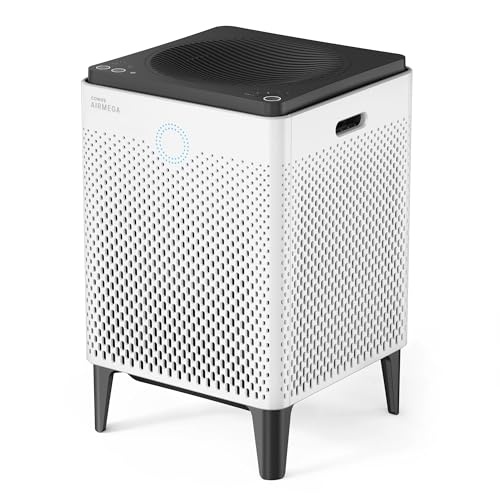
COWAY Airmega 400 Air Purifier AP-2015F — Best Overall Air Cleaner
Reading ‘airleaner’ as what it plainly means — an air cleaner — the Airmega 400 is the machine for a house where smoking is a daily, whole-room reality. Its listing covers rooms up to 3,120 ft², pairs a washable pre-filter with HEPA filtration aimed at smoke and odor, and backs the unit with a 5-year warranty, the longest in this guide. It suits a main living room in a smoking household, where the cleaner must run for years, shrug off residue and clear a large volume of air without being asked twice.
Strengths
- Largest verified coverage in this guide, with filtration whose listing names smoke and odor directly
- Washable pre-filter is the right front end for residue-heavy smoking homes — rinse it instead of replacing it
- 5-year warranty (per the listing) signals an appliance built and supported for the long haul
Trade-offs
- Size and premium tier: this is furniture-scale equipment for a main room, not a bedside accessory
- Replacement filters for a machine this size sit in the premium tier too — running costs match the coverage
- For a single small bedroom it is simply too much cleaner; the smaller picks below will serve better and quieter
| Spec | Detail (from the verified listing) |
|---|---|
| Coverage (listing) | Up to 3,120 ft² |
| Filtration | Washable pre-filter and HEPA filter for smoke, allergies, pet dander, odor |
| Controls | AQI display, Auto & Sleep Mode, timer |
| Warranty (listing) | 5 years |
An air cleaner for a smoking house is infrastructure, and infrastructure should be boring, capacious and warranted. The Airmega 400’s specification reads that way: a front filter you can wash because the manufacturer knows what real homes do to pre-filters, a HEPA stage whose listing is explicit about smoke and odor, a quality display so the household can watch the machine earn its keep, and coverage headroom that lets it clean a big living room at civilised fan speeds instead of living on its loudest setting. In practice that headroom is the luxury smokers actually feel — the room clears, the machine settles, and nobody has a conversation over a jet engine to achieve it.
Give it the corner of the main room with genuine clearance, wash the pre-filter on a monthly rhythm, and let auto mode arbitrate between sessions. At this size, filter changes are infrequent but significant purchases, so diarise them and buy the genuine set. Owners who treat the 400 like the household appliance it is — maintained on schedule, left running, not exiled to a hallway — get the decade-scale service its warranty posture promises.
Best for: main living rooms in households with daily indoor smoking and large air volumes to clean / Not suited for: small bedrooms, dorms or anyone whose smoking room is a single modest space
Check on Amazon — check the current price on Amazon and confirm the filter type in the box before you order.
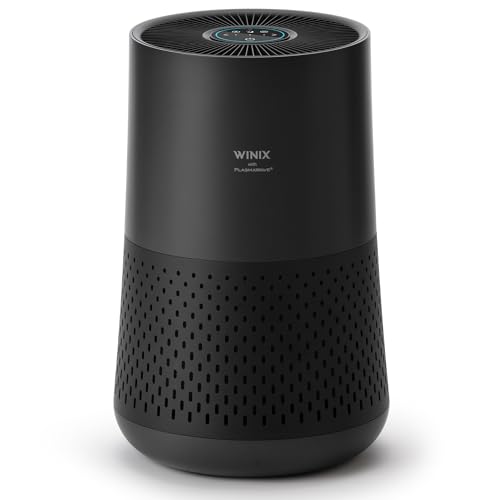
WINIX A230 Air Purifier — Best Air Cleaner for Bedrooms
The A230 is the bedroom answer in a guide full of living-room machines. Its listing sizes it for bedrooms up to 1,110 ft² in an hour — generous headroom for a real bedroom — and its filter stack pairs True HEPA with a carbon filter, which is the combination smoke requires: particles trapped, odor adsorbed. The built-in air-quality monitor and auto mode mean it can sit beside a bed, notice the evening’s smoke, work through it and settle down again while you sleep. It suits smokers whose habit lives where they sleep, in flats and houses alike.
Strengths
- Bedroom-sized tower with genuine carbon + True HEPA, not a particle-only token box
- Air-quality monitor and auto mode handle the session and the after-run without input
- Compact footprint fits the floor space bedrooms actually have spare — beside a dresser, not in the middle of the room
Trade-offs
- Carbon capacity is bedroom-scale; a heavy daily habit will saturate it faster than the big living-room machines’ stages
- Coverage tops out at its listing figure — do not promote it to open-plan duty and expect the same result
- On boost it is audible, as all compact towers are; the quiet work happens on auto after the session
| Spec | Detail (from the verified listing) |
|---|---|
| Coverage (listing) | Bedroom up to 1,110 ft² in 1 hr |
| Filtration | True HEPA + carbon filter |
| Controls | Air quality monitor, Auto Mode |
| Targets (listing) | Smoke, dust, pet allergens |
Bedrooms are where air cleaners earn or lose their reputation with smokers, because the judge sleeps in the evidence. Odor that survives the evening settles into bedding, and a cleaner that is too loud to run overnight forfeits the hours when it could have fixed that. The A230’s design accepts the brief: enough rated capacity to cycle a bedroom’s air repeatedly, a carbon stage for the smell that matters at pillow distance, and automation that keeps it working after you have stopped thinking about it. It is not the strongest machine in this guide and does not pretend to be — it is the one most precisely shaped like the room it is for.
Place it on the smoker’s side of the room with intake clearance, keep the door closed from session to morning, and let the monitor be your referee. Vacuum its pre-filter surface regularly — bedroom units in smoking homes film over quietly — and replace the filter cartridge when the stale note returns to the bedding, which is this room’s most honest saturation test.
Best for: bedroom smokers who need carbon-backed cleaning that can run all night on auto / Not suited for: large living rooms or group sessions, where its capacity ceiling shows quickly
Check on Amazon — check the current price on Amazon and confirm the filter type in the box before you order.

BLUEAIR Blue 211i Max Air Purifier — Best Quiet Large-Room Cleaner
If your smoking room doubles as your media room, your office or the place guests sit, noise is a specification, not a preference. The Blue 211i Max brings the largest-room cleaning in this guide’s quiet class: rated up to 3,235 ft² in its listing, HEPASilent filtration, a washable fabric pre-filter and a low end quoted at 23dB. It suits big lounges and open rooms in smoking households where the cleaner must be powerful during a session and nearly forgettable for the rest of the evening.
Strengths
- Huge verified room coverage with a genuinely quiet low setting — power and calm in one unit
- Washable pre-filter handles the coarse residue load and rinses clean
- WiFi and auto mode let it surge for smoke and retire to near-silence on its own
Trade-offs
- Premium tier in both purchase and filters; over-specified for a solo bedroom
- Standard filter emphasis leans to particles — odor-first buyers should check replacement variants at change time
- Large footprint; measure the corner you intend before it arrives
| Spec | Detail (from the verified listing) |
|---|---|
| Coverage (listing) | Large room up to 3,235 ft² |
| Filtration | HEPASilent filtration, washable pre-filter |
| Noise (listing) | Quiet 23dB |
| Controls | WiFi, Auto Mode; AHAM Verified |
The engineering trick HEPASilent pulls — combining filtration approaches so strong capture does not demand a hurricane — matters more in smoking homes than anywhere else, because smoke cleaning is a marathon measured in evenings. A cleaner that can only perform loudly gets exiled to the moments of active smoking, and the long, quiet after-hours when odor actually leaves a room go unworked. This Blueair’s whole proposition is the opposite: run it hard while the room is in use, then let it whisper through the night shift. For a large room that must stay pleasant for non-smokers by morning, that profile is worth more than any single headline figure on the box.
Wash the fabric pre-filter on schedule and dry it fully — in a smoking home it is doing visible work. Keep the unit inside the room it serves, not in a corridor compromise, and at filter-change time pick the replacement that matches your complaint: households bothered mostly by smell should weight odor variants, households bothered by haze and dust the standard particle strength. The platform supports both; the owner’s job is simply not to reorder on autopilot.
Best for: large lounges and shared rooms where the cleaner must be powerful and quiet in the same evening / Not suited for: small rooms or tight budgets, where its capacity is wasted and its tier is felt
Check on Amazon — check the current price on Amazon and confirm the filter type in the box before you order.

Levoit Core 200S-P Air Purifier — Best for Small Rooms and Dorms
The Core 200S-P is for the smallest version of the problem: one small room, one smoker, limited space and a limited budget. Its listing describes a 3-in-1 filter with HEPA sleep mode aimed at smoke among other pollutants, smart and voice control for starting it from the bed or desk, and AHAM-verified credentials that separate it from the novelty desktop gadgets. It suits students, spare rooms, home-office smokers and anyone whose cleaning brief is honestly a single modest room.
Strengths
- Real 3-in-1 filtration with HEPA at a size and tier small rooms can actually accommodate
- Smart and voice control make the before-and-after routine effortless, which is why it will actually happen
- AHAM-verified listing — credibility the no-name desktop units aimed at smokers rarely offer
Trade-offs
- Small room, small carbon: daily heavy smoking saturates its filter quickly and overwhelms its airflow
- It will not clean a living room, and asking it to clean a flat through an open door is a category error
- Combined cartridge means full replacement cost each time any stage is spent
| Spec | Detail (from the verified listing) |
|---|---|
| Coverage (listing) | Bedroom / dorm room class |
| Filtration | 3-in-1 filter with HEPA sleep mode |
| Controls | Smart WiFi, voice control |
| Verification (listing) | AHAM VERIFIDE; targets include smoke |
Small cleaners are where smokers get scammed most often, because the gap between a real appliance and a scented fan is invisible in photographs. The Core 200S-P earns its place by being verifiably the former: a named platform, a filter with an actual HEPA stage, verification language in its listing, and controls that support the routine smoke cleaning depends on. Its limits are physics, not fraud — a small box moves a small amount of air through a small amount of carbon — and inside a dorm room or study those limits and the brief fit each other. Buy it for the room it describes and it will do the job it promises; buy it as a whole-home solution and the disappointment is in the brief, not the machine.
Keep it close to where you sit, keep the room’s door closed during and after sessions, and keep a spare cartridge if your use is daily — small filters in smoking rooms live fast lives. Use the app scheduling so the after-run survives your forgetfulness, and vacuum the intake area weekly; compact units starve quickly when their small intakes film with residue.
Best for: dorms, studies, spare rooms and small bedrooms with light-to-regular smoking / Not suited for: heavy daily habits or any room bigger than its small-room brief
Check on Amazon — check the current price on Amazon and confirm the filter type in the box before you order.

COWAY Airmega 100 Air Purifier — Best Compact With a Real Carbon Stage
The Airmega 100 fills the gap between the dorm-sized units and the bedroom towers: a compact cleaner for rooms up to 810 ft² whose listing specifies both HEPA and a carbon filter for smoke and odor — the pairing small units so often skip. Its air-quality monitor and auto mode suit a child’s-room-adjacent spare room, a compact flat’s living corner or a home office where smoking happens and the machine must supervise itself. The night light and timer make it an easy bedroom citizen too.
Strengths
- Explicit HEPA + carbon pairing at compact size — the spec small cleaners usually fudge
- AQI monitor, auto mode and filter indicator give it big-machine manners
- 2-year warranty (per the listing) and Coway’s platform support behind a small unit
Trade-offs
- 810 ft² is its ceiling; open-plan spaces will outrun it
- Compact filters saturate under daily smoking sooner than full-size stages — plan replacements accordingly
- Its feature set tempts buyers to stretch it into rooms it was not sized for; resist
| Spec | Detail (from the verified listing) |
|---|---|
| Coverage (listing) | Up to 810 ft² |
| Filtration | HEPA and carbon filter for smoke, allergies, pet dander, odor |
| Controls | AQI monitor, Auto Mode, timer, filter indicator, night light |
| Warranty (listing) | 2 years |
Compact cleaners fail smokers at the spec sheet, usually by omitting carbon while implying odor control. The Airmega 100’s listing does the opposite — it names a carbon filter and names smoke — and that honesty, plus monitoring that lets a small machine punch at its weight, is why it is here. In a room within its rating, its auto mode produces the behavior pattern that matters: a visible reaction when smoke appears, sustained work while the air is loaded, and a settle-down when the room is genuinely clear rather than when a timer guesses it might be. For compact flats, that supervised competence beats a bigger dumb box running blind.
Respect the size ceiling and it will respect you back: one closed room, pre-filter kept clean, cartridge replaced on the indicator-plus-nose verdict. The night light is a small thing that matters in bedrooms — a cleaner people can live with at 3 a.m. is a cleaner that stays plugged in, and staying plugged in is ninety percent of air cleaning.
Best for: compact flats, home offices and mid-size bedrooms needing a monitored, carbon-backed small cleaner / Not suited for: large or open-plan rooms, or heavy daily smoking that needs full-size carbon capacity
Check on Amazon — check the current price on Amazon and confirm the filter type in the box before you order.

Medify MA-40 Air Purifier — Best Tower Air Cleaner
Towers exist because rooms have corners, and the MA-40 is the corner-shaped answer for a den, office or dedicated smoking room. Its listing leads with smoke — household and wildfire — and odors, claims coverage up to 1,793 ft² in an hour, and its filter family combines HEPA with activated carbon in a single replaceable cartridge. It suits the smoker who wants one appliance standing in the corner of the room where smoking happens, running daily, asking little, and steadily keeping yesterday’s session out of today’s air.
Strengths
- Smoke and odor are the headline targets in its listing, not an afterthought
- Tower form fits corners and throws cleaned air at height across the room
- Single-cartridge filter changes keep maintenance to minutes, which keeps it done
Trade-offs
- Combined cartridge means replacing HEPA and carbon together, even when only the carbon is spent
- Needs a stable floor corner with clearance — not a desk or shelf machine
- Persistent, soaked-in fabric odor is beyond any cleaner; it prevents more than it can reverse
| Spec | Detail (from the verified listing) |
|---|---|
| Coverage (listing) | 1,793 ft² coverage in 1 hr |
| Filtration | HEPA filter with activated carbon stage in its 3-in-1 cartridge family |
| Targets (listing) | Smoke, wildfires, odors, pollen, pets |
| Particle size (listing) | Removal to 0.3 microns |
A dedicated smoking room has a particular rhythm: intense load for an hour, slow off-gassing for the rest of the day, repeat tomorrow. The MA-40 matches that rhythm by being unremarkable in exactly the right ways — enough airflow for a mid-to-large room, a carbon-bearing cartridge for the odor half of the problem, and a form that can simply live in the corner and run. Its value compounds over weeks: each day’s session starts from a room that was actually cleaned overnight, instead of from a slightly deeper layer of accumulated smell. That compounding, not any single dramatic clearing, is what separates rooms that smell managed from rooms that smell smoked-in.
Run it daily, not just on smoking days, because the room’s surfaces exhale yesterday’s odor in between. Date the cartridge, vacuum the intake between changes, and reorder the genuine MA-40 filter when the room’s background note returns. Tower owners who treat the machine as a standing appliance — like the fridge, always on, occasionally serviced — are the ones whose dens stop smelling like dens.
Best for: dens, offices and dedicated smoking rooms that need a daily-running corner tower / Not suited for: buyers who want separately replaceable filter stages or a machine for a tiny room
Check on Amazon — check the current price on Amazon and confirm the filter type in the box before you order.
Comparison Table
| Pick | Badge | Key spec | Best for |
|---|---|---|---|
| COWAY Airmega 400 Air Purifier AP-2015F | Best Overall Air Cleaner | Washable pre-filter + HEPA, up to 3,120 ft², 5-year warranty | main living rooms in households with daily indoor smoking and large air volumes to clean |
| WINIX A230 Air Purifier | Best Air Cleaner for Bedrooms | True HEPA + carbon filter, bedroom up to 1,110 ft² in 1 hr | bedroom smokers who need carbon-backed cleaning that can run all night on auto |
| BLUEAIR Blue 211i Max Air Purifier | Best Quiet Large-Room Cleaner | HEPASilent, up to 3,235 ft², quiet 23dB | large lounges and shared rooms where the cleaner must be powerful and quiet in the same evening |
| Levoit Core 200S-P Air Purifier | Best for Small Rooms and Dorms | 3-in-1 HEPA filter, smart control, AHAM VERIFIDE | dorms, studies, spare rooms and small bedrooms with light-to-regular smoking |
| COWAY Airmega 100 Air Purifier | Best Compact With a Real Carbon Stage | HEPA + carbon filter, up to 810 ft², AQI monitor | compact flats, home offices and mid-size bedrooms needing a monitored, carbon-backed small cleaner |
| Medify MA-40 Air Purifier | Best Tower Air Cleaner | HEPA + activated carbon tower, 1,793 ft² in 1 hr | dens, offices and dedicated smoking rooms that need a daily-running corner tower |
How to Choose the Best Air Cleaner for Smokers
Ignore the label war first. ‘Air cleaner’, ‘air purifier’ and ‘air scrubber’ describe the same shelf in the shop; the specification that matters is the filter stack. Demand two stages by name: a HEPA-grade particle stage, and activated carbon or a deodorization filter for odor. If a listing cannot tell you plainly what its filters are, it is telling you what its filters are — and you should believe it and move on.
Size the cleaner to the room’s volume and your habit, in that order. Listings quote the area a unit can cycle in an hour; a smoking room wants that cycle repeated several times during and after a session, so choose a machine rated comfortably above your room rather than exactly at it. Then be honest about frequency: an occasional evening cigarette asks less of carbon than a room smoked in daily, and under-buying carbon is the most common false economy in this category — the machine survives, the smell wins, and the owner concludes wrongly that air cleaners do not work.
Judge noise at the setting you will live with, not the setting in the advertisement’s fine print — then remember that the after-run is where odor is decided, and the after-run happens at night, in shared rooms, during films. A cleaner with a genuinely quiet low end and an auto mode that manages the transition will simply be on more hours per day, and hours of operation beat peak specifications every time. Finally, check the unglamorous trio before purchase: genuine filters in stock, a warranty stated in years, and a pre-filter you can clean without buying anything. Those three predict year-three satisfaction better than any feature list.
Air Cleaner vs Air Purifier vs ‘Smoke Eater’: A Plain-Language Map
Air purifier usually signals a filter-based room appliance — HEPA plus, in the good ones, carbon. Air cleaner is the broader, older term and covers the same filter machines plus, occasionally, electronic and ionizing devices; for smokers, stay with the filter-based meaning and treat ionizing gadgets with suspicion, since they add complexity without a carbon stage to hold odor. ‘Smoke eater’ is a marketing phrase, not a technology: some commercial ceiling units earn it, most small products borrowing it do not. The safe translation of all three terms is a single question — what are the filters, and how much carbon? — and this guide’s six picks are the ones whose listings answer that question in verifiable detail.
One more distinction worth knowing: whole-home systems and HVAC add-ons clean air centrally and dilutely, while every machine here is a room appliance that cleans intensively where the smoke is. For a smoker, the room appliance is the tool; central filtration is, at best, background support for the rest of the house.
How to Set Up and Use an Air Cleaner in a Smoking Room
The routine matters as much as the machine, so run it like this:
Followed consistently, this routine is the difference between the same machine being reviewed as ‘life-changing’ by one household and ‘useless’ by another. The hardware is half the product; the habit is the other half.
- Place the cleaner inside the smoking room, on a stable floor spot with clear space at its intake and outlet — never inside a cupboard, behind a curtain or flat against a wall
- Position it between the usual smoking seat and the door where the layout allows, so smoke crosses the cleaner’s working zone before it reaches the exit
- Start it before the session, run a strong setting during, and keep the room’s door closed throughout — a cleaner serving one closed room wins; a cleaner serving an open house loses
- Leave it running afterwards on auto or its quiet setting for at least an hour, and overnight where the room allows; odor leaves slowly and only while air is moving through carbon
- Clean the pre-filter on a schedule — vacuum or wash as the manufacturer allows — and keep soft furnishings near the smoking spot washable, because no cleaner extracts what fabric has already absorbed
- Log filter install dates, and replace the carbon-bearing stage when the room’s background smell returns despite the cleaner running
What Air Cleaners Cost to Run, Tier by Tier
Budget-tier small-room cleaners are cheap to buy and comparatively hungry: small combined cartridges, changed often under smoking loads. They suit small rooms and light habits honestly, and punish anyone who stretches them beyond that brief. Mid-range machines — the bedroom towers and monitored compacts here — balance carbon capacity, filter life and noise for the typical one-room smoking habit, and are where most smokers should start. Premium large-room cleaners cost more in every direction, purchase and filters alike, and return capacity, quietness and warranty length; for a house where smoking is daily and the main room is big, that trade is usually the cheapest route to a room that actually stays fresh.
Across all tiers, the running-cost rule is identical: carbon is consumed by smoke, so the heavier the habit, the more the filter budget — not the electricity — dominates ownership cost. Buy the machine whose genuine filters you can afford to replace on time, because a mid-range cleaner on fresh carbon outperforms a premium cleaner on exhausted carbon every day of the week.
Why There Are No Ionizers or Ozone Gadgets in This Guide
Every shortlist involves exclusions, and ours deserves explaining, because smokers are marketed to aggressively by exactly the devices we left out. Ionizing and ‘electronic’ air cleaners charge particles so they plate onto surfaces or collection plates. They can reduce airborne particles, but they hold no odor — there is no carbon bed doing adsorption — and the charged particles that settle on walls and furniture are still in the room, on your things, rather than trapped in a filter you can throw away. Some such devices also produce ozone as a by-product, which is the last thing a room already dealing with smoke needs added to its air.
Ozone generators sold as odor destroyers fail the same test harder: they are not filters, they do not remove particles at all, and using enough ozone to attack odor means filling an occupied room with a lung irritant. Filter machines — HEPA for particles, carbon for gases — are less magical and more honest: the pollutant ends up in a cartridge, the cartridge goes in the bin, and the air in between is just air. For a product category bought by people who breathe in one specific room for hours a day, that boring mechanism is the right one, and it is why all six picks here are filter machines whose stages we could verify.
How Long Does a Cleaner Actually Take to Clear a Room?
Owners ask this as if it were a single number, and the honest answer is a rate, not a moment. A cleaner processes a fixed volume of air per hour; a room holds a fixed volume of air. Divide one by the other and you get air changes per hour — the figure that decides everything. One air change removes a large share of airborne particles but far from all of the odor load, because odor keeps arriving from fabrics and surfaces while you clean. Several changes, sustained, are what ‘cleared’ means in practice, which is why this guide prizes coverage headroom and quiet after-runs over any promise of instant freshness.
In practical terms: during a session, expect a correctly sized cleaner to keep the room’s haze visibly thinner than it would otherwise be, not to abolish it. In the hour after, expect the air itself to test and smell substantially cleaner. Across a week of consistent use, expect the room’s background — the smell that greets you at the door before anyone has smoked that day — to fade toward neutral, because each day starts from a cleaner baseline than the last. Judge your cleaner on that weekly trajectory, not on the first twenty minutes, and it will rarely disappoint you.
Common Buying Mistakes
Buying the word instead of the filters. ‘Air cleaner’, ‘purifier’ and ‘smoke eater’ are labels; HEPA plus carbon is a specification. Smokers who shop the label get gadgets; smokers who shop the stack get results.
Undersizing for the room. A cleaner rated exactly at your room’s size must run flat-out to keep pace with smoke and will still lag. Headroom is quietness, speed and filter life in one decision.
Placing it in the hallway. Cleaners clean the air that reaches them. A unit outside the smoking room polishes the corridor while the room itself marinates. Inside the room, door closed — that is the whole trick.
Switching off when the haze clears. The visible cloud is the fast half of the job. Odor adsorbs slowly and off-gasses from fabrics for hours; the after-run is where the cleaner’s reputation is earned.
Forgetting that carbon is a consumable. When the smell returns, the answer is a filter, not a new machine. Owners who diarise replacements keep cleaners for years; owners who do not, replace appliances.
Expecting a cleaner to reverse years of soaked-in odor. These machines prevent accumulation brilliantly and reverse it slowly at best. Deep-clean or replace the worst soft furnishings first, then let the cleaner hold the line.
Final Recommendation
For most smoking households the shortlist resolves simply. The main room belongs to the COWAY Airmega 400, with its washable front end and long warranty; the bedroom belongs to the WINIX A230, sized and automated for overnight work; and the big shared lounge belongs to the BLUEAIR Blue 211i Max, whose quiet low end keeps the after-run running.
Smaller briefs are covered honestly rather than hopefully: the Levoit Core 200S-P for a dorm or study, the COWAY Airmega 100 for a compact flat that still wants a real carbon stage and a monitor, and the Medify MA-40 as the corner tower for a den that is smoked in daily. Pick the cleaner shaped like your room, run it longer than feels necessary, feed it filters on schedule — and the room will stop keeping score.
Keep reading in this series: Best Air Cleaner For Smokers Best Air Purifier For Smokers Best Air Cleaners For Marijuana Smokers Best Air Cleaner For House Pets And Smokers Best Air Purifier For Weed Smokers Best Desktop Air Purifier For Smokers
Frequently Asked Questions
Is an air cleaner the same as an air purifier?
In shops, almost always yes — the terms are used interchangeably for filter-based room appliances, and the label guarantees nothing either way. What matters is the filter stack inside: a HEPA-grade stage for smoke particles and activated carbon for smoke odor. Judge any ‘air cleaner’ or ‘purifier’ by whether its listing states those stages plainly, as all six picks in this guide do.
Can an air cleaner remove cigarette and weed smell completely?
It can reduce it dramatically and keep a room from becoming smoked-in, but ‘completely, instantly’ is not a claim any honest filter machine can make. Odor adsorbs into carbon gradually as air cycles, and odor already soaked into fabrics releases slowly over days. Run the cleaner during and long after sessions, behind a closed door, and the room will stay far fresher than ventilation alone ever manages — with heavy, years-old saturation in soft furnishings being the one opponent no cleaner reliably beats.
Where should I put an air cleaner in a smoking room?
Inside the room, on the floor or a stable surface, with clear space around its intake — not in a hallway, cupboard or behind furniture. Between the smoking spot and the door is ideal where the layout allows. Keep the door closed while it works: a cleaner asked to treat one closed room will win, and the same cleaner asked to treat an open-plan home will lose, regardless of its rating.
How long should the cleaner run after smoking?
At least an hour on auto or a quiet setting, and overnight if the room is a bedroom — longer than intuition suggests. The visible haze clears quickly, but surfaces and fabrics keep releasing odor for hours, and the cleaner can only adsorb what passes through it while it runs. This after-run is the single habit that separates satisfied owners from disappointed ones.
How often will I replace filters if I smoke indoors daily?
Sooner than the box’s generic interval, which assumes a dust-and-pollen household. Carbon saturates with smoke load, so daily indoor smoking shortens the odor stage’s life substantially; pre-filters in smoking homes also need cleaning far more often. Diarise install dates, clean the pre-filter monthly or better, and treat a returning background smell — despite the cleaner running — as the carbon stage asking to be replaced.
Do I need a cleaner in every room?
Only in rooms where smoking actually happens, plus arguably the room where odor complaints originate. One correctly sized cleaner per smoking room, run properly, outperforms several undersized units scattered hopefully around a home. If smoke drifts, fix the drift first — closed doors and placement — before buying a second machine to fight a problem of airflow, not filtration.


