Disclosure: airfryerkitchensupply.com is reader-supported. When you buy through links on our site, we may earn an affiliate commission at no extra cost to you.
Where to Buy
Shopping for the best air purifier for smokers home? Every verified pick in this guide is sold through Amazon, where you can check price on Amazon for the current listing, confirm the exact model and filter type, and arrange delivery. The shortlist:
- LEVOIT Vital 200S-P — Best Overall for the Home. Check the current price on Amazon.
- COWAY Airmega 250S — Best Smart Living Room. Check the current price on Amazon.
- WINIX A230 — Best for the Bedroom. Check the current price on Amazon.
- Honeywell HPA304 AllergenPlus — Best Generalist. Check the current price on Amazon.
- LEVOIT Core 200S-P — Best Compact Second Unit. Check the current price on Amazon.
- Medify MA-40 — Best Smoke-Rated Value. Check the current price on Amazon.
Availability and filter stock move around; if a listing shows a different model suffix than the one named here, match the model name in this guide rather than the photograph.
Choosing the best air purifier for smokers home use is less about one heroic machine and more about a household plan. A smoker’s home has zones: the room where smoking happens, which needs the heavy artillery; the living spaces where everyone else spends time, which need steady background protection; and the bedrooms, where eight hours of breathing make clean air pay back fastest. The buyers who end up satisfied think in zones from the start, even if they buy the machines one at a time.
The good news is that home duty is kinder than dedicated smoking-room duty. In most rooms of the house, the purifier’s job is defense — catching drifting smoke, keeping background odor from building, and protecting bedding, clothes and soft furnishings — rather than fighting a lit cigarette at close range. That means quiet, automatic, low-maintenance machines earn their place here, and the emphasis shifts from maximum carbon to machines a household will genuinely run all day, every day, without thinking about them.
This list is therefore built as a home system in six parts: a main-room anchor, a smart living-room alternative, two bedroom specialists, a compact defender for smaller rooms, and a smoke-rated value pick for the room where the smoking actually happens. Every machine is verified and rated for smoke by its maker. Buy the anchor first, add the bedroom unit second, and most homes will feel the transformation long before the full system is complete.
In this guide
Quick Picks
Best Overall for the Home — LEVOIT Vital 200S-P: HEPA, air quality monitor, quiet 27dB operation, AHAM Verifide. Rated coverage: Up to 1,875 ft². Check the current price on Amazon.
Best Smart Living Room — COWAY Airmega 250S: Washable pre-filter + HEPA for smoke, app control, AQI, 3-year warranty. Rated coverage: Up to 1,860 ft². Check the current price on Amazon.
Best for the Bedroom — WINIX A230: True HEPA + carbon filter, AQI monitor, auto mode, bedroom size. Rated coverage: Up to 1,110 ft² in 1 hr. Check the current price on Amazon.
Best Generalist — Honeywell HPA304 AllergenPlus: AllergenPlus HEPA, large-room rating, quiet operation. Rated coverage: Up to 2,250 ft². Check the current price on Amazon.
Best Compact Second Unit — LEVOIT Core 200S-P: 3-in-1 filter with HEPA sleep mode, smart and voice control, AHAM Verifide. Rated coverage: Bedroom and dorm scale. Check the current price on Amazon.
Best Smoke-Rated Value — Medify MA-40: HEPA filtration to 0.3 microns, rated for smoke and odors. Rated coverage: 1,793 ft² in 1 hr. Check the current price on Amazon.
How These Picks Were Chosen
Every product in this guide was verified on this site’s own storefront connection before it was written about: we searched by brand and model, matched the returned listing title to the product, and only then used its ASIN for links. Models we could not verify with confidence were left out or written about without links — we do not guess at product identifiers.
With the verified shortlist established, picks were scored on the factors that decide real-world smoke performance. First, the filter stack: a HEPA stage for particles, and activated carbon with genuine substance for odor, because smoke is both problems at once. Second, honest capacity: coverage figures quoted by makers and, where available, backed by AHAM verification, always with headroom above the rooms these machines will serve. Third, liveability: noise at working speeds, auto modes and sensors, and the size and shape a machine brings into a real room.
Home-system shortlisting favored behavior over brute force: quiet low-speed operation, sensors and auto modes that need no supervision, washable or cheap-to-maintain pre-filters, and footprints that fit real rooms. One smoke-rated anchor was kept for the smoking room itself, because a home plan still has to win where the smoke is made.
Finally, we applied two honesty filters. Products with safety recalls were excluded outright. And nothing in this guide carries a fixed price or a fixed star rating: prices and ratings change constantly, so linked picks simply say to check the current price on Amazon, and prose describes tiers — budget, mid-range, premium — instead of numbers that would go stale.
The 6 Best Options: Best Air Purifier for a Smoker’s Home Picks Reviewed

LEVOIT Vital 200S-P — Best Overall for the Home
The Vital 200S-P is built around a simple insight: the best purifier is the one that stays on. Its low setting is rated at 27dB, quiet enough for a bedroom, while the air quality monitor lets it step up on its own when the room’s air deteriorates. For a home where smoke drifts from a smoking area into the rooms where people sleep and live, that always-on, self-managing character beats a more powerful machine that gets switched off because it is annoying. It is also rated for pet hair and dander, which makes it a natural double-duty pick for homes fighting smoke and animals at the same time.
As the home’s anchor, the Vital 200S-P wins on temperament: quiet enough to live beside, smart enough to manage itself, and rated generously enough for a main living space. In a smoker’s home, the machine that runs unnoticed for sixteen hours a day protects more air than a stronger machine that gets switched off — and this one never gives anyone a reason to switch it off.
The Vital 200S-P’s ownership pleasures are quiet ones: a low-speed setting you can run beside a bed indefinitely, a monitor that manages the machine so you do not have to, and filter changes that arrive as a single cartridge swap. In a pets-and-smoke home, vacuum its intake area with the room’s normal cleaning, because hair accumulates where the machine breathes. Its carbon will set the replacement rhythm in a smoking household — judge by smell recovery, not by the calendar, and it will not surprise you.
Strengths
- Quiet enough at 27dB on its low setting to live in a bedroom without becoming the loudest thing in it
- Air quality monitor and smart control make always-on running easy to maintain
- Rated for pet hair and dander as well as smoke, which suits mixed-problem homes
Trade-offs
- Like all combination filters, its carbon stage is the first thing heavy smoke will exhaust
- The quiet figure belongs to low speed; clearing a freshly smoked room needs a louder burst
- White finish shows dust and ash-adjacent grime more than darker housings
| Specification | Detail (from maker listing) |
|---|---|
| Coverage (maker rating) | Up to 1,875 ft² |
| Noise (maker rating) | 27dB on its quiet setting |
| Feedback | Air quality monitor |
| Verification | AHAM Verifide |
Best for: Bedrooms and living spaces that need quiet, continuous, self-managing cleaning / Not suited for: A dedicated smoking den, where carbon depth matters more than quiet
Check the current price on Amazon.
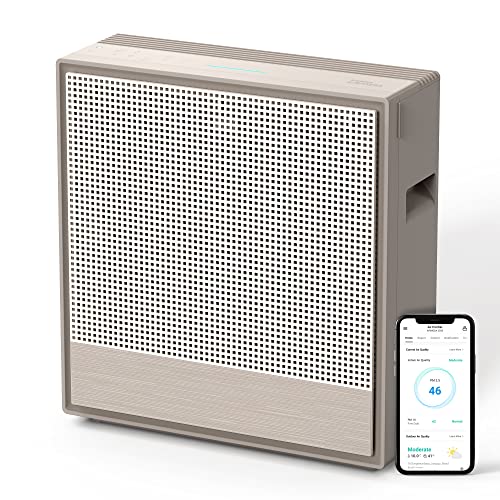
COWAY Airmega 250S — Best Smart Living Room
The Airmega 250S is the modernized middle of COWAY’s range: the washable pre-filter that keeps running costs sane, a HEPA stage rated for smoke, an air quality display, and app control for scheduling and remote speed changes. In a home where someone smokes in the living room and the rest of the family lives around it, the practical pattern is a scheduled one — a strong burst timed to the usual smoking hour, then auto overnight — and this is the kind of machine that makes that pattern effortless. It will not out-carbon the Austin, but for most smoking homes it is the balanced choice.
The Airmega 250S is the planner’s pick: app scheduling lets the home run a rhythm — a cleaning burst timed to the usual smoking hour, gentle auto through the evening, near-silence overnight — while its washable pre-filter keeps the routine cheap. It is the machine for a household that likes its systems set once and forgotten.
The 250S balances modern convenience with sane running costs. Its washable pre-filter absorbs the daily dust-and-hair load for free, the app makes scheduling a one-time setup, and the main filter’s interval in a smoking home should be set by the AQI display’s behavior — recovery times lengthen as the carbon loads, and the machine shows you that honestly. Three years of warranty and COWAY’s established filter supply round out an ownership story with no known traps.
Strengths
- Washable pre-filter plus app control combines low running costs with modern convenience
- Rated coverage suits a large living room without stepping up to the biggest machines
- Three-year warranty and an established filter supply chain reduce ownership risk
Trade-offs
- Mid-depth carbon means it manages household smoke rather than specializing in it
- App control is only useful if your home Wi-Fi reaches the room it lives in
- White finish again; expect visible dust in a smoking household
| Specification | Detail (from maker listing) |
|---|---|
| Coverage (maker rating) | Up to 1,860 ft² |
| Filtration | Washable pre-filter and HEPA filter rated for smoke |
| Controls | App control with AQI display |
| Warranty (maker listing) | 3 years |
Best for: Living rooms in smoking homes that want app scheduling and low upkeep / Not suited for: Dedicated smoking rooms needing maximum odor adsorption
Check the current price on Amazon.
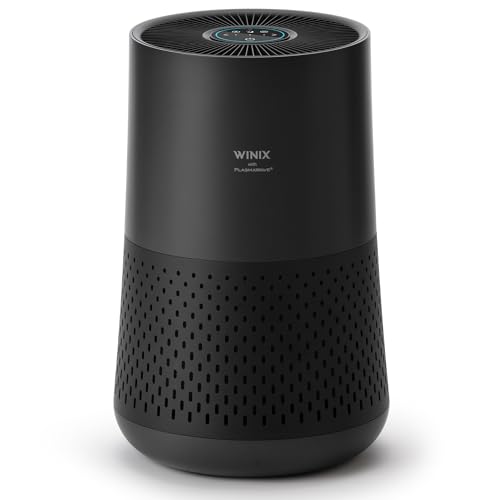
WINIX A230 — Best for the Bedroom
The A230 takes the WINIX formula — true HEPA, a carbon filter, an air quality monitor and an auto mode — and shrinks it to bedroom scale. That is exactly the right shape for a common problem: the smoking happens elsewhere in the home, but the bedroom is where you spend eight hours breathing, and where smoke smell in bedding and curtains is most unwelcome. Run it on auto behind a closed door and it holds the room’s air in a noticeably better state than the rest of the house. It is a defender of one room, and judged on that job it is well equipped.
The A230 is the bedroom specialist this home plan needs: WINIX’s true HEPA and carbon in a right-sized package, with a monitor and auto mode standing guard behind a closed door. Bedrooms are where smoke smell in bedding and curtains is most personal, and this is the machine that holds that line night after night.
The A230 concentrates WINIX’s formula into a bedroom, and its ownership is correspondingly light: a compact combined filter, a monitor that manages the machine, and a footprint that never needs negotiating with furniture. In a smoking home its carbon is a defensive line for one room, so its interval is kinder than a smoking-room machine’s — judge it by whether the bedroom still smells neutral in the morning. Keep the sensor dusted and the door closed, and it will hold its room for years.
Strengths
- True HEPA plus a real carbon filter in a bedroom-friendly size
- Air quality monitor and auto mode bring big-machine behavior to a small room
- WINIX’s smoke-aware filter approach in a compact, quieter package
Trade-offs
- Bedroom scale; it will not rescue a living room where the smoking happens
- Carbon stage is compact, so heavy odor shortens its effective life
- Its rating is a maker figure for one hour; continuous low running is the realistic mode
| Specification | Detail (from maker listing) |
|---|---|
| Coverage (maker rating) | Up to 1,110 ft² in 1 hr |
| Filtration | True HEPA with carbon filter |
| Feedback | Air quality monitor with auto mode |
Best for: Bedrooms in smoking homes, especially the smoker’s own bedroom / Not suited for: Cleaning the room where smoking actually happens
Check the current price on Amazon.

Honeywell HPA304 AllergenPlus — Best Generalist
The HPA304 AllergenPlus is the generalist large-room machine: rated across allergens, dust, pollen, pet dander, odors and smoke, with quiet operation for rooms people sit in all evening. In a home where smoking is one of several air problems — a dog, a dusty street, seasonal pollen — that breadth is the point. It will not out-specialize the carbon-heavy smoke machines on pure odor, but it keeps a big room’s air moving through HEPA media hour after hour, and its filters are the kind you can still buy years later without hunting.
The HPA304 is the generalist for a home whose air problems extend beyond smoke — dust, pollen, a pet, a busy street. Its large-room rating and quiet running suit an all-day living room, and Honeywell’s filter availability makes it a safe decade-long appliance decision.
The HPA304’s running story is breadth: because its filter set serves allergens, dander, dust and smoke together, a multi-problem home gets one maintenance routine instead of three appliances’ worth. Filters are mainstream Honeywell parts with the availability that implies. In a smoking home, inspect quarterly and let the room’s morning-after smell arbitrate replacement. Its quiet running makes it cheap in the currency that matters most — it never annoys anyone into switching it off.
Strengths
- Large-room rating from a brand with a long, well-stocked filter ecosystem
- Quiet operation claim suits living rooms used all evening
- Covers the full household mix — allergens and pet dander alongside smoke
Trade-offs
- White housing shows dust quickly in a smoking home
- Generalist filter set; smoke odor is one job among several rather than the specialty
- No smart control or app scheduling
| Specification | Detail (from maker listing) |
|---|---|
| Coverage (maker rating) | Up to 2,250 ft² |
| Filtration | AllergenPlus HEPA |
| Rated uses (maker listing) | Allergens, dust, pollen, smoke, pet dander, odors |
Best for: Homes where smoke shares the stage with pets, dust and allergies / Not suited for: A single-issue smoking room chasing maximum odor removal
Check the current price on Amazon.

LEVOIT Core 200S-P — Best Compact Second Unit
The Core 200S-P is the compact smart defender: a 3-in-1 filter with a HEPA sleep mode, AHAM verification, and app and voice control in a unit sized for a bedroom or dorm room. In a smoking household its role is specific — hold one small room, usually the bedroom of the non-smoker or the kids’ room, in better shape than the rest of the home while the main battle happens elsewhere. Voice control sounds like a gimmick until you are in bed and want the speed changed without getting up. Small, honest, and easy to live with.
The Core 200S-P is the small-room defender: a child’s bedroom, a study, a guest room — the spaces a home plan reaches last but should not skip. Voice control and a sleep mode make it trivially easy to live with, and its verified rating keeps it honest about its modest territory.
The smallest machine here has the smallest ownership footprint: one compact 3-in-1 cartridge, voice or app control, and a sleep mode that runs nightly without a thought. Its role as a defended-room unit means its filter lives an easier life than a smoking-room machine’s, and its interval will show it. The only discipline required is remembering it exists — a quarterly check that its intake is clear and its cartridge is within life. For a child’s room or a study, that is exactly the right amount of appliance.
Strengths
- The smallest, simplest smart option here, with voice control for hands-free speed changes
- AHAM Verifide backing even at this compact size
- Sleep mode makes overnight running in a bedroom realistic
Trade-offs
- Dorm-and-bedroom scale; it defends a small room and nothing more
- Light carbon capacity means light odor help only
- Smart control is wasted if it ends up in a room with poor Wi-Fi
| Specification | Detail (from maker listing) |
|---|---|
| Filtration | 3-in-1 filter with HEPA sleep mode |
| Controls | Smart and voice control |
| Verification | AHAM Verifide |
| Rated uses (maker listing) | Pollen, pollutants, smoke, dander, dust, pet hair |
Best for: A single bedroom or dorm room that needs defending from household smoke / Not suited for: Any room where smoking actually happens, or spaces beyond small-room scale
Check the current price on Amazon.

Medify MA-40 — Best Smoke-Rated Value
The MA-40 is the mid-size Medify: rated for smoke, wildfire air and odors, with coverage that honestly fits a living room and capture down to 0.3 microns for the fine particle fraction. Its replacement-filter design folds pre-filter, HEPA and activated carbon into one cartridge, which keeps maintenance simple — one part number, one swap. In a smoking home, that simplicity has real value, because the machine that gets its filter changed on time beats the theoretically better machine that does not. A solid, smoke-first choice for a single main room.
Every home plan needs an answer for the smoking room itself, and the MA-40 is it: smoke-rated filtration, living-room coverage, and a one-cartridge filter change that keeps maintenance painless. Put the anchor machines elsewhere; put this one where the smoke is actually made.
The MA-40’s single-cartridge design is its ownership charm: pre-filter, HEPA and carbon arrive and leave as one part, so maintenance is a dated reminder and a five-minute swap. Medify’s smoke-and-wildfire positioning means replacement filters are a core part of its range rather than an afterthought. In a smoking home, set the first reminder at six months, judge by how the room smells the morning after a session, and adjust the interval to your habit’s evidence rather than the brochure’s optimism.
Strengths
- Smoke and odor duty is in its headline rating, not buried in fine print
- Coverage fits a real living room rather than only a bedroom
- The platform’s 3-in-1 replacement filters combine pre-filter, HEPA and carbon in one swap
Trade-offs
- A generation older than the newest smart rivals, with fewer feedback features
- Odor performance depends on keeping the carbon portion fresh in heavy use
- Tower footprint needs the usual clear space around intakes
| Specification | Detail (from maker listing) |
|---|---|
| Coverage (maker rating) | 1,793 ft² coverage in 1 hr |
| Filtration | HEPA, removal to 0.3 microns |
| Rated uses (maker listing) | Smoke, wildfires, odors, pollen, pets |
Best for: A main living room wanting smoke-rated filtration and simple filter swaps / Not suited for: Whole-house coverage or app-driven automation fans
Check the current price on Amazon.
Comparison Table
| Pick | Badge | Key spec | Best for |
|---|---|---|---|
| LEVOIT Vital 200S-P | Best Overall for the Home | HEPA, air quality monitor, quiet 27dB operation, AHAM Verifide | Bedrooms and living spaces that need quiet, continuous, self-managing cleaning |
| COWAY Airmega 250S | Best Smart Living Room | Washable pre-filter + HEPA for smoke, app control, AQI, 3-year warranty | Living rooms in smoking homes that want app scheduling and low upkeep |
| WINIX A230 | Best for the Bedroom | True HEPA + carbon filter, AQI monitor, auto mode, bedroom size | Bedrooms in smoking homes, especially the smoker’s own bedroom |
| Honeywell HPA304 AllergenPlus | Best Generalist | AllergenPlus HEPA, large-room rating, quiet operation | Homes where smoke shares the stage with pets, dust and allergies |
| LEVOIT Core 200S-P | Best Compact Second Unit | 3-in-1 filter with HEPA sleep mode, smart and voice control, AHAM Verifide | A single bedroom or dorm room that needs defending from household smoke |
| Medify MA-40 | Best Smoke-Rated Value | HEPA filtration to 0.3 microns, rated for smoke and odors | A main living room wanting smoke-rated filtration and simple filter swaps |
How to Choose the Best air purifier for smokers home
Plan in zones, buy in order. Zone one is the smoking room: it needs the most smoke-capable machine you place anywhere, because every other room’s problem starts there. Zone two is the main living space, which needs steady, quiet, automatic cleaning. Zone three is the bedrooms, which need right-sized, sleep-quiet defenders. If the budget forces a sequence, buy zone one first — reducing smoke at source improves every other room for free — then the main bedroom, then the living space.
Match each zone’s machine to its job rather than buying three of the same. The smoking room rewards carbon and capacity. The living room rewards quiet and auto behavior. The bedroom rewards a sleep mode you can actually sleep through and a monitor that works without lighting up the room at night. A home is a system of different rooms doing different things; the purifiers should be chosen the same way, which is exactly how the six picks above divide the labor.
Keep whole-home honesty in view. No single purifier cleans a house of separate, closed rooms — air does not travel to be cleaned. What one machine can do is dominate an open-plan area, and what a plan of two or three machines can do is transform a home’s background smell within weeks. Judge success at the home level by the background: guests noticing nothing, bedding smelling neutral, clothes in wardrobes staying fresh. That is the realistic, achievable prize, and it is a large one.
Protecting the Non-Smokers: Bedrooms, Kids’ Rooms and Guests
In most smoking homes, the sharpest motivation is not the smoker’s own comfort — it is everyone else’s air. The household members who benefit most from a deliberate plan are the ones who did not choose the habit: partners, children, elderly parents, and the guests who politely say nothing about the spare room’s smell. A home plan should therefore be judged by how well it defends the rooms those people sleep and live in.
The mechanics are simple and forgiving. A closed bedroom door already does real work; a right-sized purifier running on auto behind that door does the rest, holding the room’s air in a different league from the corridor outside. Bedding and curtains stop accumulating odor, which is the change people notice most — the room starts to smell like a bedroom again. For children’s rooms, the same setup applies with the volume kept low and the machine placed stably and out of climbing range. None of this requires the smoker to change anything except where the ashtray lives; it is a gift the household buys itself, one defended room at a time.
The Guest Test: How Homes Are Actually Judged
A smoker’s home is rarely judged by the smoker, who adapted to its smell years ago and genuinely cannot perceive the background anymore. It is judged in the first three seconds after the front door opens, by a guest whose nose is fresh. That guest test — not any specification — is what most households are really buying their way toward passing, and it is worth designing the home plan around it deliberately.
The test is won in the hallway, which is good news: the hallway is rarely the smoking room, so its air is the easiest in the house to keep clean. A home plan that wins the source room and the living space almost automatically wins the hall, because the hall’s air arrives from those rooms. What the guest notices next is fabric — the offered sofa, the spare bed’s pillow. Those are the slow reservoirs the plan addresses over weeks: continuous purification stops new loading while ordinary washing cycles gradually clear the old. Give the system a month before inviting judgment, keep the front-door area free of coats that live in the smoking room, and the test most homes fear becomes the test they quietly start passing.
Sizing the Machine to Your Room: A Worked Example
Plan the home’s sizes zone by zone with a tape measure, not a guess. The smoking room — say 150 square feet — wants a smoke-rated pick rated several times that, like the larger options in this list. The main living space, perhaps 220 square feet, wants an anchor rated well above it so it can idle quietly; the picks here rated around 1,800 square feet and up are built for exactly that patience. Bedrooms of 120 to 150 square feet are honestly defended by the compact picks rated near or above their size, behind closed doors. Write the three numbers down before shopping; a home plan bought from measurements rarely disappoints, and one bought from vibes rarely satisfies.
One more home-specific consideration deserves a paragraph of its own: resale and rental value. A home that smells neutral is worth more, lets faster, and photographs no differently but feels different the moment a door opens — estate agents have a polite vocabulary for this, and none of it is flattering to smoking homes. A purifier plan that runs for the years you live in a home is therefore not merely a comfort purchase; it is quiet maintenance of the property itself, protecting carpets, curtains, paintwork and soft furnishings from the slow deposition that otherwise has to be paid for, all at once, on the day you sell or move. Few appliances in a house can claim to defend both the air and the asset at once. Run for its full term, this one can.
Filter Costs and Long-Term Ownership
People comparison-shop the machine and forget the subscription, so let us price the relationship honestly — in structure, since figures change and this guide prints no fixed prices. A purifier’s lifetime cost is the purchase, plus a filter cartridge on a repeating cycle, plus modest electricity. In a smoking home the cycle shortens: carbon is consumed by exposure, and daily smoke is heavy exposure. The machines that win the lifetime calculation are rarely the cheapest to buy. They are the ones whose filters last longest under smoke load, whose pre-filters wash instead of being replaced, and whose cartridges stay in production for years.
Three habits keep the subscription sane. First, run on auto where the machine has it, so carbon life is spent on dirty air rather than on polishing an already-clean room at midnight. Second, do the free maintenance religiously — a vacuumed or washed pre-filter protects the expensive stage behind it, and in dusty or pet homes it can be the difference between a filter that lasts its term and one strangled early. Third, buy the replacement when performance first dips, not months later: a saturated filter does not rest and recover, and the weeks spent running a dead cartridge are weeks the room’s furnishings spend re-loading with odor you will pay to remove again.
How to Set Up a Whole-Home Purifier Plan
A weekend is enough to install the plan; the machines do the work from then on.
- Walk the home and name the zones honestly: where smoking happens, where the family lives, where everyone sleeps. Write the order down — smoking room, main bedroom, living space, then secondary rooms.
- Install the smoking-room machine first, in the room, door closing properly, and run it for a full week before judging the rest of the plan; source control changes every other room’s load.
- Place the living-space anchor where the family actually sits, with clear airflow, and set it to auto permanently. Resist moving it around; purifiers protect the room they live in.
- Add bedroom units behind closed doors, on auto or sleep mode, and check after the first night that noise and display lights pass the household’s sleep test.
- Set one maintenance rhythm for the whole home: pre-filters on the first weekend of the month, a quarterly nose-check of each room, and a shared note of filter dates so replacements are ordered before they are urgent.
- Re-audit after a month: stand in each doorway and breathe. The plan is working when the background smell has retreated to the smoking room itself — then decide whether any zone needs reinforcement.
Three Homes, Three Right Answers
The compact flat: one living room where everything happens, one bedroom behind a real door. The plan compresses gracefully — a Vital 200S-P or COWAY 250S anchoring the living room, and the bedroom defended by the same machine’s spillover plus door discipline, or by a Core 200S-P when budget allows. Small homes are the plan’s easiest victories: fewer zones, less air, and a background that can turn around within a fortnight.
The family house with children: the smoking happens in one downstairs room, and the children’s rooms are the plan’s moral center. Anchor the smoking room properly, defend the main bedroom, and put the children’s rooms on the list ahead of any living-space upgrade — a compact unit on auto behind each closed door, or one landing machine serving open doors, depending on the house’s layout and the children’s ages. The guest test matters less here than the nightly one.
The multigenerational home: a grandparent who smokes, adult children, a baby on weekends. Sensitivity runs high and so does the value of a system nobody has to operate: auto modes everywhere, a shared maintenance rhythm owned by one named person, and the baby’s room treated as the home’s clean room — door closed, its own defender, no exceptions during visits. The machines carry the diplomacy so the family does not have to.
The home that is about to be sold: the habit continues, but every viewing is a guest test with money attached. Priorities sharpen wonderfully — the hallway and living room become the plan’s whole world for a season, the smoking migrates to the one room that can be closed and defended hardest, and the purifiers run like they are on commission. Sellers consistently report the same surprise: the system assembled for viewings is the system they wish they had lived with for the previous decade.
A Maintenance Calendar That Actually Survives Real Life
Daily, the machine asks for nothing — that is the point of auto mode — beyond the household’s own habits: ashtrays emptied, doors closed while rooms are being cleaned, sources sealed. If your purifier needs daily attention, it is the wrong machine or it is in the wrong mode, and this guide’s picks were chosen to need neither.
Monthly, one small job protects everything else: clean the pre-filter. Vacuum it or wash it according to its design, wipe the intake grille, and glance at the sensor window if your machine has one. Tie it to a date that already exists in your household’s rhythm — the first weekend, the rent day, the big shop — because maintenance attached to a habit survives, and maintenance attached to a resolution does not. In pet homes and heavy-smoking homes, this is also the moment to vacuum the floor the machine breathes from.
Quarterly, run the performance audit this guide keeps recommending: the morning-after test in the main room, a note of how long the room now takes to clear after a session compared with when the filter was fresh, and a decision — continue, or order the cartridge. Annually, review the whole arrangement: filter dates, the state of door seals in the rooms that matter, whether the machine’s room is still the room the smoking happens in. Habits migrate; the plan should migrate with them, once a year, deliberately, rather than drifting out of true.
One last ownership truth, learned from every category of appliance that filters anything: the machine you maintain is the machine you own, and the machine you neglect is a fan in a box. Nothing in this section requires skill, tools or money beyond the filters themselves — a calendar note, a cloth, a vacuum, and the willingness to believe your own nose when it reports that performance has changed. Households that build those four small habits get the full value of every pick in this guide. Households that do not will conclude, wrongly and expensively, that the category itself is a fraud. The difference was never the machines; it is the rhythm, and the rhythm is free. Set it once, this week, while the purchase is still new and the intention is still warm, and let the calendar carry the discipline from here.
Common Buying Mistakes
Buying one large machine and expecting a whole house. The most expensive disappointment in this category. Closed doors defeat single machines; a plan of right-sized units in the right rooms costs similar money and actually works.
Protecting the living room but not the bedrooms. People spend a third of their lives asleep. A home that smells acceptable in the lounge but stale in the bedding has solved the smaller half of the problem.
Choosing identical machines for different jobs. A smoking room and a child’s bedroom want different things. Zone-appropriate picks outperform a bulk buy of one model almost every time.
Hiding purifiers for the sake of tidiness. Inside cupboards, behind sofas and in corners, machines clean their own exhaust. Clear space around intakes is not a suggestion; it is the mechanism.
Setting up the system and never maintaining it. A home plan multiplies filters as well as benefits. One shared maintenance rhythm — monthly pre-filters, quarterly checks — keeps every zone performing instead of quietly expiring one by one.
Final Recommendation
Build the plan in order: a smoke-rated machine like the Medify MA-40 where the smoking happens, the LEVOIT Vital 200S-P or COWAY Airmega 250S anchoring the living space, the WINIX A230 defending the main bedroom, and compact units like the LEVOIT Core 200S-P for the rooms that remain. The Honeywell HPA304 covers homes whose air problems run wider than smoke. Run everything on auto, keep one maintenance rhythm, and judge the result by the background smell in a month’s time. For the related problem of whole-house scale, see Best Air Purifier For Smokers House; for the base guide, Best Air Purifier For Smokers; and for specific habits, Best Air Purifier For Cigarette Smokers and Best Air Purifier For Pets Smokers.
If you are deciding today, the shortlist to compare first is: LEVOIT Vital 200S-P, COWAY Airmega 250S, WINIX A230. Check the current price on Amazon for each, confirm the filter type matches the model name, and buy the one whose strengths match your room.
Frequently Asked Questions
How many purifiers does a smoker’s home actually need?
Most homes land on two or three: one for the smoking room, one for the main bedroom, and one for the main living space if it is separate from the smoking room. Small open-plan homes can start with one large machine and add a bedroom unit later. Buy in that order and judge by results between purchases.
Which room should get a purifier first?
The room where smoking happens — reducing smoke at source improves the whole home’s background. The main bedroom comes second, because clean sleeping air and neutral-smelling bedding are the improvements households feel most.
Can a purifier keep smoke smell out of bedrooms and wardrobes?
Largely, yes: a right-sized unit running on auto behind a closed door holds a bedroom’s air far cleaner than the rest of the house, and bedding and clothes stop accumulating odor. The door matters — a defended room needs its boundary respected while the machine works.
Are purifiers in children’s rooms a good idea in a smoking home?
They are one of the best uses in this guide. A quiet, stable unit on auto keeps a child’s room defended from drifting smoke and background odor. Place it securely, manage the cord, and keep the speed low at night.
How will I know the home plan is working?
By the background, not by any single dramatic moment: guests stop noticing, bedding smells neutral, wardrobes stay fresh, and the stale note retreats to the smoking room itself. Most households report the shift within two to four weeks of continuous running.
What does a home system cost to run in filters?
It scales with the number of machines and the heaviness of the habit. Washable pre-filters keep the routine cheap, and judging main filters by performance — replacing when clearing slows — avoids both waste and neglect. Budget filters as a household running cost, like the smoking itself.


