Disclosure: airfryerkitchensupply.com is reader-supported. When you buy through links on our site, we may earn an affiliate commission at no extra cost to you.
Where to buy
Every machine below is a current model sold on Amazon by its brand or authorised sellers, verified against Amazon’s own catalogue data before publication. Heavy smoking is a maximum-load use case, so start at the strong end: the LEVOIT Core 600S-P with its smoke-remover filter path, or the COWAY Airmega 400 for the largest coverage here. The full shortlist: the Medify MA-50, the Honeywell HPA5300B, the BLUEAIR Blue 211i Max and the WINIX 5510. Check the current price on Amazon for the machine and a full set of its replacement filters in the same visit — at this load, filters are not an accessory line, they are the operating budget.
Introduction
The best air filter for heavy smokers starts from an admission most guides avoid: heavy smoking is not a standard use case with the volume turned up — it is a different duty cycle entirely, and machines specified for occasional smoke fail it in predictable ways. The best air filter for heavy smokers must survive a load that saturates ordinary carbon in weeks, loads pre-filters with tar at a pace allergy households never see, and runs — genuinely — around the clock, because a home where smoking happens daily, indoors, across many hours produces pollutant faster than any part-time strategy removes it. That duty cycle rewrites the buying rules. Coverage stops being a comfort feature and becomes survival margin: a machine at its limit has nothing left for the bad day. Carbon stops being a line in a feature list and becomes the central consumable, to be sized, priced and scheduled like fuel. And maintenance stops being a suggestion — at this load, the household that will not clean a pre-filter monthly should not buy a purifier at all, because it will own a clogged box and a false conclusion within a season.
This guide therefore ranks machines the way a heavy-smoking household experiences them: by coverage headroom, by the seriousness of their carbon and filter ecosystems, and by whether their design tolerates continuous, high-load service. Every pick is verified against its manufacturer’s published specifications. The guide is equally direct about the strategy around the machine — source habits, a second line of defence at the furnace filter, and the honest ceiling on what filtration can do when the source never really stops. Heavy smokers do not need a lecture, and this is not one; they need equipment that respects the scale of the job, and a plan that does the same.
In this guide
Quick Picks
- LEVOIT Core 600S-P — Best Overall for Heavy Smokers. Coverage up to 2,933 square feet plus a dedicated smoke-remover replacement filter with high-efficiency activated carbon. Check the current price on Amazon
- COWAY Airmega 400 — Best Maximum Coverage. Rated up to 3,120 square feet with a washable pre-filter — built for volume and for owners who maintain. Check the current price on Amazon
- Medify MA-50 — Best Big-Room Tower. HEPA filtration rated at 2,640 square feet of coverage in an hour, specified for smoke and odours. Check the current price on Amazon
- Honeywell HPA5300B — Best XL-Room Workhorse. HEPA filtration rated to clean 2,423 square feet of rooms in an hour, with auto mode and no smart-home overhead. Check the current price on Amazon
- BLUEAIR Blue 211i Max — Best Quiet at Scale. HEPASilent filtration up to 3,235 square feet at a stated 23 dB quiet profile — capacity a household can live beside. Check the current price on Amazon
- WINIX 5510 — Best Carbon Specialist. A high-deodorisation carbon filter behind true HEPA, rated up to 1,881 square feet in an hour — the odour purist’s pick. Check the current price on Amazon
How These Picks Were Chosen
Three filters, all load-bearing. First, coverage headroom: every pick is rated by its maker for large rooms — the smallest figure here is a deliberate exception for the carbon specialist — because a heavy load consumes a machine’s margin, and a purifier running at its ceiling is loud, short-lived in its filters and still behind. Second, a filter ecosystem built for consumption: standard, stocked replacement filters, and where the maker offers one, a smoke-specific or deodorisation-grade carbon option, because at this duty cycle the household will meet the filter catalogue more often than the product page. Third, maintainability under tar load — washable or easily serviced pre-filters and clear filter indication — because the failure mode of this category is not breakdown, it is gradual strangulation by a neglected front end.
Excluded without regret: compact and desktop machines, which cannot exchange a heavily smoked room’s air at any useful rate; HEPA-only designs with token carbon, whose odour work ends within weeks at this load; and ozone generators, which are unacceptable in any home and doubly so in one already carrying a heavy inhaled load. What remains is a shortlist of machines that treat heavy smoking as the industrial-domestic duty it is.
The 6 Best Air Filters for Heavy Smokers

LEVOIT Core 600S-P — Best Overall for Heavy Smokers
The Core 600S-P takes the overall badge for heavy duty on the strength of a combination no rival here matches: large-room coverage rated up to 2,933 square feet, smart control with air quality feedback, and — decisive at this load — a dedicated smoke-remover replacement filter in Levoit’s own range, a 4-in-1 design whose high-efficiency activated carbon is built specifically for smoke. A heavy-smoking household does not merely use filters; it consumes them on a schedule, and a machine whose maker sells a smoke-grade carbon path is a machine whose ownership economics were thought through by someone who understood the duty.
Strengths
- Smoke-remover replacement filter with high-efficiency activated carbon
- Coverage up to 2,933 square feet — genuine headroom for a heavy load
- Smart control and air quality feedback for continuous, managed running
Trade-offs
- The smoke filter is a recurring purchase — at this load, the central one
- Headline coverage is a full-speed figure; plan the room at partial capacity
- Physically large; it commits floor space in the smoking room
| Coverage (manufacturer) | Up to 2,933 sq ft |
| Filtration | 3-in-1 filter for smoke, pet odour, dust; smoke-remover filter option |
| Controls | Smart app and voice control, sleep mode |
Run it in the smoking room on auto, with the smoke-remover filter fitted from the first change — or from day one, if the room’s problem is already established — and it becomes the household’s workhorse: surging through sessions, stripping background odour between them, and reporting its own state honestly. Its headroom is what heavy duty actually buys: not a bigger number, but a machine that at your load is cruising rather than redlining, with filters that live their full span instead of an abbreviated one.
Best for: heavy daily indoor smoking in a main living space / Not suited for: small rooms or households unwilling to run a filter schedule. Check the current price on Amazon
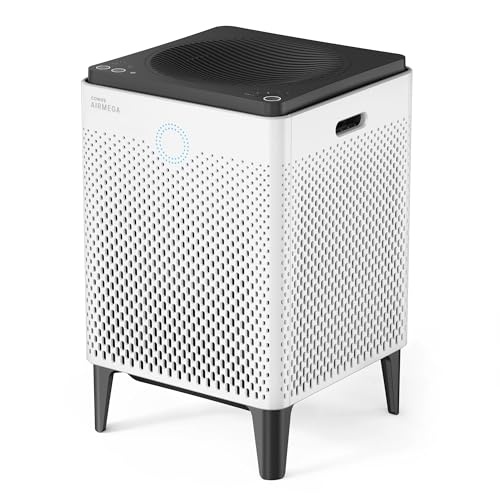
COWAY Airmega 400 — Best Maximum Coverage
The Airmega 400 is the coverage maximalist’s machine: rated by Coway for homes up to 3,120 square feet, with a washable pre-filter in front of its HEPA stage, an air quality indicator, auto and sleep modes, and a manufacturer warranty stated in years that suits a machine bought for continuous service. For heavy smokers, the washable pre-filter is the headline hidden in the specification: tar and dust load a front end brutally at this duty, and a pre-filter that can be rinsed back to full airflow — rather than replaced or left to strangle the machine — is a structural advantage that compounds monthly.
Strengths
- Coverage rated up to 3,120 square feet — among the largest here
- Washable pre-filter — the correct answer to heavy tar loading
- Auto and sleep modes with an air quality indicator for managed continuous running
Trade-offs
- A large machine in every sense — confirm the room can host it
- Carbon duty still falls on the main filter’s schedule; washing the pre-filter does not extend the carbon
- Premium positioning within this list
| Coverage (manufacturer) | Up to 3,120 sq ft |
| Filtration | Washable pre-filter + HEPA filter for smoke, allergies, pet dander, odour |
| Controls | AQI, auto & sleep mode, timer |
Choose the Airmega 400 when the smoking room is big, the smoking is daily, and the household contains at least one person who will perform a two-minute rinse monthly — that person is worth a specification tier, and this machine is how their diligence gets paid. In open, heavily used spaces it is the most complete heavy-duty package in the guide: volume, maintainability and automation in one cabinet.
Best for: large, heavily smoked rooms and maintainers / Not suited for: small spaces or households that will not service a pre-filter. Check the current price on Amazon

Medify MA-50 — Best Big-Room Tower
The MA-50 scales Medify’s straightforward formula to heavy-duty size: HEPA filtration rated at 2,640 square feet of coverage in an hour, specified by the maker for smoke, wildfire, odour, pollen and pet duty, with filtration stated to 0.3 microns and none of the smart-home ceremony. For a heavy smoker’s den, basement lounge or workshop-adjacent room, that directness is a virtue — the machine’s entire budget is in airflow and media, its replacement filters are a standard set, and its operation can be taught to any household member in one sentence.
Strengths
- 2,640 sq ft/hr rated coverage — heavy-duty air changes for big rooms
- Maker specifies it for smoke and odour duty explicitly
- Simple operation; no account or app in the critical path
Trade-offs
- Carbon life at heavy load is the running cost; the 3-in-1 style filter must stay in date
- No sensor-driven finesse — the household sets the strategy
- Substantial tower presence
| Coverage (manufacturer) | 2,640 sq ft in 1 hr |
| Filtration | HEPA filter, removal to 0.3 microns (manufacturer) |
| Stated targets | Smoke, wildfires, odours, pollen, pets |
The MA-50 is the pick for the room that is unambiguously a smoking room — where the household has stopped pretending the load is light and wants a machine that admits the same. Its coverage gives a big room multiple full air changes across an evening, which is the arithmetic by which heavy smoke is actually governed, and its simplicity means it will still be running, correctly, on the days nobody feels like managing anything.
Best for: dedicated smoking rooms, dens and basements / Not suited for: buyers who want sensor automation or the quietest possible profile. Check the current price on Amazon
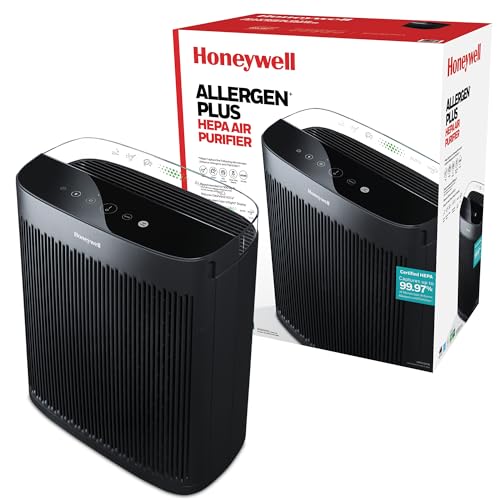
Honeywell HPA5300B — Best XL-Room Workhorse
Honeywell’s HPA5300B is the heavy-duty pick for households that measure reliability in decades and filter availability in “anywhere.” The maker rates it to clean rooms of 2,423 square feet in an hour, with HEPA filtration, auto mode, and a brief spanning allergens, dust, pollen, pet dander, odours and smoke. At heavy load, its argument is the ecosystem: Honeywell filters are commodity items, stocked broadly and priced like it, which matters when the household’s consumption is measured in sets per year rather than per era.
Strengths
- XL-room rating — 2,423 sq ft cleaned in an hour (manufacturer)
- Auto mode without apps or accounts
- Commodity filter availability — the cheapest habit to keep at heavy consumption
Trade-offs
- Carbon duty rides on its pre-filter arrangement; keep it fresh or odour work fades first
- Utilitarian design and interface
- No air quality display feedback of the sensor-led rivals
| Coverage (manufacturer) | Cleans 2,423 sq ft rooms in 1 hr |
| Filtration | HEPA filtration |
| Controls | Auto mode |
| Stated targets | Allergens, dust, pollen, pet dander, odours, smoke |
There is a type of heavy-smoking household — often a multi-generational one, often with the machine in a room used by everyone — for whom the winning feature is that nobody can break the workflow and the filter can be bought in a panic at a local shelf. That household should buy this Honeywell and spend its sophistication budget on the discipline of changing what it can always obtain.
Best for: XL rooms and households valuing filter availability above features / Not suited for: odour purists, who should weight the Winix’s carbon higher. Check the current price on Amazon

BLUEAIR Blue 211i Max — Best Quiet at Scale
Heavy smoking usually happens in company, and company talks. The 211i Max is the machine that lets a heavy load and a conversation coexist: HEPASilent filtration rated up to 3,235 square feet — the largest figure in this guide — at a manufacturer-stated quiet profile of 23 dB, with WiFi auto mode and a pre-filter taking the coarse load. At heavy duty, noise is not a comfort detail; it is the reason machines get switched off mid-evening, and a purifier that is off cleans nothing at all.
Strengths
- Largest stated coverage here, at the lowest stated noise
- WiFi auto mode for a machine across a large room
- Pre-filter handles the coarse fraction before the main stage
Trade-offs
- Odour work depends on configuration and freshness — particle performance leads
- HEPASilent is a proprietary system; buy on the maker’s stated basis
- Premium tier in this list
| Coverage (manufacturer) | Up to 3,235 sq ft |
| Filtration | HEPASilent filtration, pre-filter |
| Noise (manufacturer) | 23 dB quiet profile |
| Controls | WiFi, auto mode |
| Stated targets | Pet hair, allergens, dust, smoke |
Choose the Blueair when the smoking room is the living room in the full social sense — television, guests, children doing homework at the table — and the machine’s licence to operate is its discretion. Its capacity means that even derated for continuous civilised running, it exchanges a large room’s air at a rate a heavy load respects. It is the diplomat of the heavy-duty list, and diplomacy, in a shared home, is a performance feature.
Best for: large shared living spaces where the machine must be tolerated all evening / Not suited for: maximum-carbon odour warfare in a dedicated smoking room. Check the current price on Amazon

WINIX 5510 — Best Carbon Specialist
The 5510 is the smallest-coverage machine on this list and it earns its place anyway, because heavy smoking’s hardest problem is not particles — it is the smell that saturates a home, and the Winix’s high-deodorisation carbon filter is the most serious domestic answer to it. Behind true HEPA, with auto mode and app support, rated up to 1,881 square feet in an hour, it is the pick for the heavy smoker whose room is ordinary-sized but whose odour load is anything but: the machine for when the hallway, the clothes and the guests’ coats have become the complaint.
Strengths
- High-deodorisation carbon filter — the strongest odour tool here
- True HEPA for the heavy particle load in the same stack
- Auto mode and app support suit continuous managed running
Trade-offs
- Coverage is the most modest here — large rooms should take the bigger picks and use this as the standard for carbon expectations
- At heavy load its carbon is a fast-moving consumable; keep a spare
- Two Winix-class machines may serve a large heavy-smoking home better than one of anything
| Coverage (manufacturer) | Up to 1,881 sq ft in 1 hr |
| Filtration | True HEPA + high-deodorisation carbon filter |
| Controls | Auto mode, app support |
| Stated targets | Pet allergies, smoke |
The honest framing: if your room is large, buy coverage first and let the Winix set your expectations for what the carbon should be doing; if your room is standard and the smoking is heavy, this is the machine, full stop. Its deodorisation stage is why former owners of lesser purifiers describe the difference as categorical rather than incremental — at heavy load, carbon mass is not a feature among features. It is the feature.
Best for: standard-sized rooms with a severe odour load / Not suited for: very large rooms as a sole machine. Check the current price on Amazon
Comparison Table
| Pick | Badge | Key spec | Best for |
|---|---|---|---|
| LEVOIT Core 600S-P | Best Overall for Heavy Smokers | Up to 2,933 sq ft, smoke-remover filter option | Daily indoor smoking, main room |
| COWAY Airmega 400 | Best Maximum Coverage | Up to 3,120 sq ft, washable pre-filter | Big rooms, maintainers |
| Medify MA-50 | Best Big-Room Tower | 2,640 sq ft/hr HEPA coverage | Dens, basements, smoking rooms |
| Honeywell HPA5300B | Best XL-Room Workhorse | Cleans 2,423 sq ft/hr, auto mode | Filter availability, simplicity |
| BLUEAIR Blue 211i Max | Best Quiet at Scale | Up to 3,235 sq ft, 23 dB profile | Social living spaces |
| WINIX 5510 | Best Carbon Specialist | True HEPA + high-deodorisation carbon, up to 1,881 sq ft/hr | Severe odour, standard rooms |
The Heavy-Duty Difference: Load, Saturation and Duty Cycle
Three ideas govern everything in this guide, and a heavy-smoking household should hold all three before spending. Load is the rate at which pollutant arrives — and heavy indoor smoking produces particles and gases at a rate that dwarfs cooking, pets or traffic dust, sustained for hours daily. Saturation is the fate of every filter stage under that load: the pre-filter mats with tar, the HEPA fills, and the carbon’s pores occupy until the stage that handled odour simply stops, while the fan keeps turning and the machine keeps looking alive. Duty cycle is the honest name for how the machine is actually used — and at heavy load, the gap between a machine run continuously and one run during smoking only is the gap between governing the problem and chasing it. The purchases that fail in this category are almost never defective machines; they are standard-duty machines installed in a heavy-duty life, saturating on a schedule their owners never priced. Every recommendation here — the headroom, the washable pre-filters, the smoke-grade carbon paths, the spare-filter discipline — is saturation management wearing different clothes.
How to Choose an Air Filter for Heavy Smoking
Choose for the worst week, not the average day. Estimate your room, then buy coverage that leaves the machine cruising at that size — if the room sits at the top of a machine’s rating, the machine will live at full speed, loudly, with its filters ageing in dog years. Weight the carbon path as heavily as the machine: ask whether the maker sells a smoke-specific or deodorisation-grade filter, what a year of your household’s realistic consumption costs in that filter, and whether it is stocked as a standard part. Inspect the pre-filter design as if it were the product, because at this load it functionally is — washable beats disposable beats sealed-away. Then make the household decision that determines whether any of it matters: who owns the monthly pre-filter clean and the filter calendar. A named owner with a reminder outperforms an upgrade tier, every time, and costs nothing.
Consider, finally, whether the honest answer is two machines. A heavy-smoking home with a defined smoking room and a separate sleeping zone often governs both better with a heavy-duty unit at the source and a quieter unit in the bedroom than with any single flagship — air does not turn corners, and the night hours are the longest exposure the household has. The picks above anchor the source; this programme’s indoor-smokers guide covers the bedroom end of that pattern.
How to Run a Purifier Under Heavy Load: The Operating Discipline
The discipline is a calendar and a placement, and both are unforgiving of improvisation. Placement: the machine lives in the smoking room, in the air path between the smoking seat and the door, intake clear, and it does not travel — a heavy-duty machine on tour is a machine defending nowhere at the moment of load. Running: continuous, on auto or a standing medium speed, with the household understanding that “off” is not a setting a heavy-smoking home owns; the background hours between sessions are when the carbon strips the room’s accumulated gases and the furnishings give up their stored share. Pre-filter: vacuumed or rinsed monthly without exception — set the reminder for a fixed date, because “when it looks bad” in a tar load means a month after it started costing airflow. Main filter and carbon: dated at installation, judged by the hallway test — when the smell’s travel distance grows again, the carbon is done, whatever the indicator believes — and replaced from a spare kept in the house, because at this consumption rate a delivery gap is a relapse the whole household can smell.
Support the machine with the two free allies. Ventilation, whenever weather and neighbours allow, removes in minutes what filtration removes in an hour, and the purifier’s finest work is done on the residue ventilation leaves. And the furnace filter — upgraded to a proper pleated rating and changed on a smoker’s schedule, per this programme’s air-conditioner filter guide — keeps the home’s duct system from redistributing what the room machine has already removed. Heavy duty is a system, and the purifier is its hardest-working member, not its only one.
The Honest Ceiling: What Filtration Cannot Do at This Load
At heavy load, the limits deserve the same bluntness as the recommendations. A purifier reduces the household’s exposure and the home’s odour burden — substantially, verifiably — and it does not make heavy indoor smoking harmless to the smoker or to anyone sharing the air, including children and people with respiratory conditions, for whom no domestic appliance constitutes protection in a medical sense. It cannot keep a room pleasant during continuous smoking with the door open to the house; arithmetic defeats it. And it cannot rescue a household from its own maintenance refusal — the finest machine here, neglected for a season, is furniture. None of that argues against buying; it argues for buying with the plan attached, and for keeping the decisions that actually govern exposure — where smoking happens, around whom, with what ventilation — in the household’s hands rather than delegating them to an appliance’s brochure.
Common Buying Mistakes
Buying a standard-duty machine for a heavy-duty life. It will saturate, clog and disappoint on a schedule, and the brand will be blamed for the specification error. Ignoring the carbon economics. At this load the filters are the purchase; price a year of them before the machine. Sizing to the room’s edge. No headroom means full speed, full noise and abbreviated filter life. Skipping the pre-filter discipline. A tar-matted front end quietly halves a great machine. Running the machine only during smoking. The between-hours are when background odour is actually beaten. Expecting the purifier to settle the household’s smoking policy. It is equipment, not arbitration — agree the smoking room like adults, then equip it.
Troubleshooting: Heavy-Duty Failures and Their Actual Causes
Problem: odour control collapsed after a few weeks. Carbon saturation, on schedule for the load. Replace the carbon-bearing filter, shorten the expected interval in your budget, and consider a smoke-grade filter path if your machine offers one. Problem: airflow feels weak and the machine is loud for its output. The pre-filter is matted or the main filter is loaded — service the front end first; it is the cause far more often than the fan. Problem: the room clears during the evening but the house smells every morning. The machine is being switched off overnight while furnishings re-release. Continuous low running is the fix, not a bigger machine. Problem: filters are costing more than expected. Audit the pre-filter discipline (a clean front end extends every stage behind it), confirm you are buying the standard filter rather than a premium variant, and check the two-machine pattern — a second unit at low speed can be cheaper than one unit redlining.
Two Kinds of Heavy: All-Day Cigarettes and the Cigar Room
Heavy is not one pattern, and the two common ones stress a system differently. The all-day cigarette household produces a moderate, near-continuous load: the room rarely gets a full recovery window, furnishings stay in equilibrium with the source, and the winning strategy is constancy — a machine that never really stops, carbon that is replaced on rhythm rather than crisis, and a smoking spot fixed in one chair so the load has an address. The cigar household produces an episodic, extreme load: a single cigar can out-smoke a day of cigarettes in an hour, with an oilier, more adhesive odour that saturates carbon per event and lingers in textiles with unusual loyalty. Its winning strategy is surge capacity — a machine with the headroom to run hard during and for hours after, in a room that can be closed like a bulkhead — plus furnishing choices that forgive: leather and washable textiles over deep upholstery, and an acceptance that the carbon calendar in a cigar room is measured in cigars as much as in weeks. Households that contain both patterns should equip for the cigar logic and run the cigarette logic, because capacity can idle down but cannot be borrowed. Naming your pattern honestly, before the purchase, is worth a tier of equipment.
Furnishing the Smoking Room for the Load It Carries
At heavy load, the room itself becomes part of the equipment, and a few deliberate choices multiply the purifier’s work. Hard or washable surfaces near the smoking seat — a side table that wipes clean, throws that go through the wash weekly, curtains that can be laundered rather than admired — deny odour its favourite reservoirs. A lidded ashtray emptied daily removes the single most concentrated odour source in the room, which continues emitting long after the last cigarette; more background smell is attributable to the ashtray than households ever guess. The purifier’s own position should be treated as furniture planning, not an afterthought: a permanent spot, on the smoke’s path, with its intake facing the room and its outlet unblocked by the sofa it serves. And a door that closes properly — with the under-door gap acknowledged rather than ignored — is worth more than the difference between any two machines in this guide, because containment is the multiplier on every air change the machine performs. None of these choices costs much. Together they are the difference between a room the equipment governs and a room the equipment apologises for.
When the Smoking Changes: Cutting Down, Quitting and Re-Specifying
Households change, and a heavy-duty system should be allowed to change with them without embarrassment or waste. If the smoker cuts down or quits, the purifier’s job does not end — it enters a final, satisfying phase: drawing the accumulated odour out of the room’s furnishings over the following weeks, on a filter that will suddenly last far beyond its predecessors because the load has collapsed. That is the moment for the deep clean the machine has been holding the line against — laundered textiles, wiped walls near the smoking spot, a fresh carbon filter to receive the last of the out-gassing — after which the same machine retires honourably into ordinary duty: allergies, dust, the occasional wood-smoke day, at a fraction of its former running cost. Nothing in this guide’s shortlist is single-purpose enough to be stranded by the household’s improvement, which is a genuine buying consideration in a category where the best outcome is needing the equipment less. Buy for the load you have, in machines that remain useful for the load you hope to have.
The Economics of Heavy Duty, Priced Honestly
A heavy-smoking household should run one calculation before choosing, because it reverses the usual ranking. Take each candidate’s three-year cost as the machine plus its filters at your household’s realistic consumption — not the maker’s general interval — plus a modest allowance for electricity at continuous running. At heavy load, the filter line dominates that total so completely that the machine’s purchase price becomes the smaller variable: a mid-priced machine with inexpensive, long-lived, standard filters routinely undercuts a premium machine with costly proprietary ones, while a cheap machine with a small carbon stage can become the most expensive object in the room by its second year. This is why this guide keeps returning to filter ecosystems, standard parts and washable pre-filters — at heavy duty, those are not convenience features, they are the price. It is also why the spare-filter habit matters financially as well as functionally: a household buying filters in a panic pays panic prices, while a household with a cupboard system buys on its own schedule. Heavy smoking is already an expensive habit; the air equipment should be the part of it that is boringly, predictably priced.
Neighbours, Landlords and the Heavy-Smoking Reality
Heavy indoor smoking in attached housing is the scenario most likely to become a dispute, and the equipment conversation belongs inside a broader honesty. A lease may prohibit smoking outright, in which case no purifier alters the household’s position; where smoking is permitted, the purifier plus containment habits — a closed smoking room, an emptied ashtray, ventilation timed with awareness of neighbouring windows — is a genuine, demonstrable reduction in the nuisance that clauses actually target, and households that can show the system when a complaint arrives fare better than households with only intentions. The same logic applies at move-out, where smoke residue is priced by the square foot: a heavy-duty filtration system running for the whole tenancy slows the accumulation that deposits are retained against, in every room the ducts and doorways connect. None of this makes the equipment a legal instrument. It makes it what it honestly is — the difference between a habit a household manages and a habit a building manages for them, at considerably higher cost and considerably worse humour.
The Two-Week Audit: Verifying a Heavy-Duty Installation
Heavy-duty money deserves verification, and a fortnight is enough to know. In week one, run the system exactly as this guide prescribes — continuous running, door discipline, pre-filter clean at the start — and note three observations each morning: the smoking room’s background smell on entry, the hallway’s smell at the same moment, and how long the room takes to feel recovered after the heaviest session of the previous day. In week two, repeat without changing anything. A correctly specified installation shows a clear direction of travel on all three: the room’s morning baseline lower, the hallway neutral, the recovery time shortened as the furnishings stop accumulating and begin, slowly, to give up their stored share. If the direction is flat, the audit has still done its job, because the pattern of the flatness diagnoses the fault — hallway strong means containment, recovery slow means coverage or carbon, morning baseline static means the furnishing reservoir needs the wash intervention. Heavy duty is engineering at domestic scale, and engineering that is measured can be corrected; it is the unmeasured installation that stays disappointing for years.
A Word on Vaping at Volume and Other Heavy Aerosols
Some households arriving at this guide smoke less than they aerosolise: heavy vaping, particularly with large-cloud devices used indoors all day, produces a continuous aerosol load that behaves differently from smoke — the droplets are larger, settle as a faint film on glass and screens, and carry a lighter odour — but at volume it still rewards the same system: a machine with real airflow in the room of use, a pre-filter kept clean against the sticky residue, and carbon for the background note. The heavy-duty shortlist here is more than sufficient; the relevant adjustment is expectation, because the film on surfaces is a cleaning matter that filtration reduces but does not abolish. The same applies, in the other direction, to households whose heavy load is a wood stove burned all winter: the particle discipline is identical, the carbon matters less, and the machines above serve without modification.
Final Recommendation
For a heavy-smoking main room, buy the LEVOIT Core 600S-P and run its smoke-remover filter path — it is the most complete heavy-duty package here. Take the COWAY Airmega 400 for maximum coverage with a washable front end, the Medify MA-50 for a dedicated smoking room, the Honeywell HPA5300B where filter availability rules, the Blueair 211i Max where the room is social, and the WINIX 5510 where odour is the whole war. Then run whichever you choose like you mean it: continuously, maintained, with a spare filter in the cupboard. Companion guides in this programme: Best Air Cleaner For Smokers, Best Air Filter For Smokers, Best Air Conditioner Air Filter For Smokers and Best Air Filter For Indoor Smokers.
Frequently Asked Questions
Can any single purifier really handle heavy daily indoor smoking?
One correctly sized, heavy-duty machine can govern one room’s air under heavy load — provided it runs continuously and its filters are maintained on a heavy-duty schedule. What no single machine handles is a whole house through doorways, or a maintenance-free fantasy. Govern the smoking room properly and the rest of the home benefits by containment. The corollary is worth stating too: if the one room is large and the smoking is near-continuous, “one machine” may honestly mean one of the maximum-coverage picks in this guide running with headroom — not a standard unit asked to perform a heavy-duty role and forgiven when it cannot.
How fast will filters wear out with heavy smoking?
Faster than any manufacturer’s general guidance, which assumes ordinary household dust in a home where nobody smokes. The pre-filter needs monthly attention, and the carbon stage is finished when odour control fades — in a daily indoor smoking home, treat carbon as a scheduled consumable measured in months, keep a spare, and budget accordingly from the start. The HEPA stage lasts longer than the carbon in most of these stacks, which is why combination filters should be judged by their carbon life: a filter discarded with healthy HEPA remaining, because its carbon is spent, is the normal economics of this duty, not a defect.
Is it worth running the purifier 24 hours a day?
At this load, yes — that is the duty the category assumes, and the arithmetic supports it: the hours between sessions are when background odour is stripped from the air and drawn out of furnishings, so a machine that sleeps when the household does hands the night shift to the smell. Modern machines at low and auto speeds draw modest power; the cost of the off hours is measured in the smell’s return, not saved in the running. If noise at night is the barrier, treat it as the sizing signal it is — capacity bought with headroom runs the night shift quietly.
Should a heavy smoker buy two purifiers instead of one large one?
Often, yes — if the home has a distinct smoking room and a separate sleeping area, which describes most heavy-smoking households honest about their geography. A heavy-duty unit at the source plus a quiet unit behind the bedroom door governs both zones better than one flagship straining through doorways. If all the smoking and living happen in one room, one large machine is the simpler, better answer — and the money a second machine would have cost is better spent on the first machine’s filter supply for the year.
Does the furnace filter matter for a heavy smoker?
Yes, as the second line: the HVAC system recirculates the whole home’s air, and an upgraded pleated filter — changed on a smoker’s schedule — stops the ducts redistributing fine particles to every room and protects the equipment from tarry loading. It does not replace the room purifier or touch odour gases; it completes the system. In a heavy-smoking home the pairing matters more, not less, because the duct system is the one pathway that bypasses the smoking room’s closed door — the filter is what stands in it.
What is the first sign that my setup is undersized?
The machine living at full speed and still losing — the room behind after a session, the hallway smelling by evening, filters ageing in weeks rather than months. That pattern is a sizing verdict, not a maintenance one: add coverage or add a second machine, rather than replacing filters ever faster in a unit that cannot catch up. A useful confirmation test is the closed-door hour: run the machine at full speed in the sealed smoking room for an hour after a session — if the room does not present as substantially recovered, the unit’s ceiling is below the room’s load, and no filter freshness will change that arithmetic.


