Disclosure: airfryerkitchensupply.com is reader-supported. When you buy through links on our site, we may earn an affiliate commission at no extra cost to you.
Where to buy
Every filter below is a current product sold on Amazon by its brand or authorised sellers, verified against Amazon’s own catalogue data before publication. The picks are shown in the common 20×25 size because it is the size we verified — every line here is sold in a range of sizes, and you must match your own system’s slot, as the sizing section explains. Start with the Filtrete MERV 13 MPR 1900 as the default, or the Filterbuy Smoke & Allergy Defense if smoke is the explicit target. The full shortlist: the BNX TruFilter MERV 13 Smoke, the Filtrete 20x25x4 MERV 13, the Filtrete MERV 14 MPR 2800 and the BNX TruFilter 20x25x4 MERV 13 Smoke. Check the current price on Amazon in your exact size before ordering.
Introduction
The best air conditioner air filter for smokers is the most overlooked purchase in a smoker’s home, because it does not sit in the room looking useful — it sits in the air handler, quietly deciding what the whole house breathes. The best air conditioner air filter for smokers matters for a simple mechanical reason: a central heating and cooling system recirculates the home’s air through one filter, again and again, all day. Whatever that filter catches — dust, dander, and the fine particulate fraction of smoke — stops recirculating. Whatever it misses gets distributed, faithfully, to every room the ducts serve, which is how a smoking room on one floor perfumes a bedroom on another. A standard builder-grade filter is a rock catcher: it protects the equipment from large debris and does almost nothing for smoke particles. Upgrading to a properly rated pleated filter — MERV 13 is the working standard for this job — turns the system you already own into a whole-house particle cleaner that runs whenever the heating or cooling runs.
Honesty about limits belongs at the front of this guide, not the back. A furnace filter is a particle device. It will not remove smoke odour gases the way a room purifier’s carbon bed does, and no MERV number changes that physics. What it does — measurably — is cut the fine-particle load that the HVAC system would otherwise spread, slow the smoke-residue film that forms on surfaces throughout the house, and protect the system’s coils and blower from the tarry dust that a smoker’s home produces in unusual quantity. Paired with a room purifier at the source, it completes the system; bought instead of one, it will disappoint anyone whose complaint is smell. This guide covers how to choose the filter itself — ratings, sizes, depth, change intervals in a smoker’s accelerated reality — with every pick verified against its manufacturer’s own published specifications.
In this guide
Quick Picks
- Filtrete 20x25x1 MERV 13 MPR 1900 — Best Overall. The default upgrade: MERV 13 pleated filtration in the standard 1-inch format, from the most widely stocked line in the category. Check the current price on Amazon
- Filterbuy MERV 13 Smoke & Allergy Defense — Best Specifically for Smoke. A MERV 13 electrostatic pleated filter marketed by name for smoke and allergy defence, in a 6-pack format. Check the current price on Amazon
- BNX TruFilter MERV 13 Smoke — Best Multi-Pack for a Change Schedule. MERV 13 with MPR 1900 and FPR 12 equivalences stated, smoke-named, sold in a 6-pack. Check the current price on Amazon
- Filtrete 20x25x4 MERV 13 — Best Deep-Pleat, Long-Life. A 4-inch deep MERV 13 filter the maker rates as a 12-month filter — fewer changes, more media. Check the current price on Amazon
- Filtrete MERV 14 MPR 2800 — Best Maximum Filtration. The step above MERV 13 for ultrafine particle reduction — with an airflow caution for older systems. Check the current price on Amazon
- BNX TruFilter 20x25x4 MERV 13 Smoke — Best Deep Smoke Filter. The smoke-named MERV 13 formula in a 4-inch deep format for systems with a deep filter slot. Check the current price on Amazon
How These Picks Were Chosen
We set the floor at MERV 13. Below that rating, a pleated filter’s capture of the fine particles that dominate smoke is too weak to justify a smoker’s upgrade; at MERV 13, electrostatic pleated media captures a meaningful share of smoke-sized particulate on every pass, and the whole-house arithmetic — the system moving the home’s air volume repeatedly — does the rest. Every pick’s rating, size and actual dimensions come from the manufacturer’s own listing, verified through catalogue data: in this category the difference between nominal size and actual size is where purchases go wrong, so the spec boxes state both where the maker publishes them. We included both 1-inch and 4-inch depths because homes have both slot types and the deep format is a genuinely different ownership proposition — more media area, longer life, gentler pressure drop. We also required the filters to be standard, stocked lines from established makers, because a furnace filter is a repeat purchase for years and an orphaned size or discontinued line is a recurring annoyance.
Excluded: fibreglass panel filters (equipment protection only), washable electrostatic filters whose real-world ratings are difficult to verify, and any filter whose MERV claim could not be confirmed against a manufacturer listing. Also excluded, by honesty rather than quality: carbon-impregnated HVAC pads marketed as odour solutions — the carbon quantity in a 1-inch pad is too small to change a smoker’s odour picture, and this guide will not pretend otherwise.
The 6 Best Air Conditioner Air Filters for Smokers
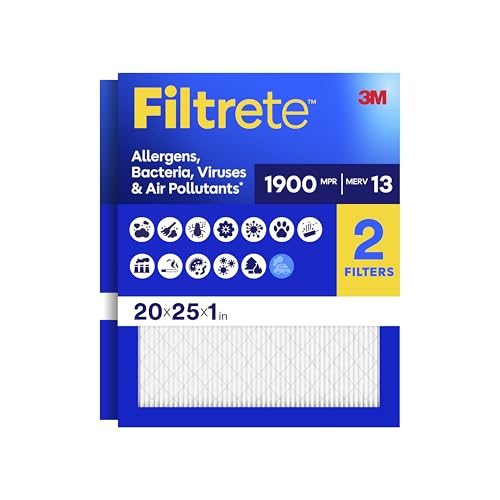
Filtrete 20x25x1 MERV 13 MPR 1900 — Best Overall
Filtrete is the name most households already have in their air handler, and its MERV 13, MPR 1900 filter is the natural upgrade path for a smoker’s home: an electrostatically charged pleated filter rated by its maker for allergens, bacteria, viruses and air pollutants, in the standard 1-inch depth that fits the slot most homes already have. The maker rates it as a 3-month filter under ordinary conditions — a smoker’s home should read that as an outer bound, as the maintenance section explains — and the line’s ubiquity means your size is stocked everywhere, in every season, which for a consumable you will buy for years is a feature, not a footnote.
Strengths
- MERV 13 / MPR 1900 — the working standard for smoke-particle capture in HVAC
- Standard 1-inch format fits the majority of residential slots
- The most widely stocked filter line in the category — replacements are never a hunt
Trade-offs
- Particle filtration only — it will not address smoke odour gases
- 1-inch depth loads faster than deep filters in a smoker’s high-dust home
- The 3-month maker rating assumes ordinary dust; smokers should change sooner
| Rating | MERV 13, MPR 1900 |
| Nominal size | 20x25x1 in |
| Actual size (maker) | 19.62 x 24.62 x 0.78 in |
| Maker’s service interval | 3 months (ordinary conditions) |
| Pack | 2 filters |
Choose this filter if your system takes a 1-inch filter and you want the decision to be simple and repeatable. Its real advantage compounds: because the line is everywhere, the household actually changes it — and in filtration, the changed filter beats the theoretically superior filter that requires a special order and therefore gets stretched. For a smoker’s home running its system daily, that reliability is the performance.
Best for: most homes with a 1-inch filter slot upgrading from a basic filter / Not suited for: households whose primary complaint is odour rather than particles. Check the current price on Amazon

Filterbuy MERV 13 Smoke & Allergy Defense — Best Specifically for Smoke
Filterbuy puts the use case in the product name — Smoke & Allergy Defense — and backs it with the right specification: MERV 13 electrostatic pleated media, made in the USA, in a 6-pack format sized for a household that changes filters on a schedule. For a smoker’s home, the 6-pack is not a bulk gimmick; it is the correct purchasing shape, because the change interval in a smoking household is short enough that having the next filter already in the cupboard is the difference between a system that runs fresh and one that runs overdue. The actual dimensions are published by the maker, which matters when a slot is tight.
Strengths
- Named and specified for smoke defence at MERV 13
- 6-pack format matches a smoker’s realistic change schedule
- Maker publishes actual dimensions — fewer sizing surprises
Trade-offs
- Electrostatic charge-based capture diminishes as the filter loads — change on schedule, not on appearance
- Particle device only; odour needs a room purifier’s carbon
- Direct-brand line — less likely to be on a local shelf in an emergency
| Rating | MERV 13 |
| Nominal size | 20x25x1 in |
| Actual size (maker) | 19.50 x 24.50 x 0.75 in |
| Construction | Electrostatic pleated, made in USA |
| Pack | 6 filters |
This is the pick for the household that has accepted the maintenance reality of smoking and wants to organise around it: a semester of filters in the cupboard, a reminder on the calendar, and a system that never quietly spends two months filtering through a grey mat. The smoke-specific positioning is marketing, but it is marketing that happens to describe the correct specification — which is more than can be said for most of this category’s packaging.
Best for: smokers’ homes committing to a strict change schedule / Not suited for: buyers who prefer to pick up a single filter locally as needed. Check the current price on Amazon

BNX TruFilter MERV 13 Smoke — Best Multi-Pack for a Change Schedule
BNX’s TruFilter competes on clarity: its listing states the MERV 13 rating alongside the cross-system equivalences — MPR 1900 and FPR 12 — that let a buyer compare across the three rating dialects this category confusingly speaks, and names smoke, allergy and pet defence as its targets. The 6-pack format, actual dimensions published, and US manufacture round out a specification sheet written for a buyer who compares. For a smoker’s home, it is functionally a sibling of the Filterbuy pick — which is a compliment to both — with the equivalence labelling as its distinguishing courtesy.
Strengths
- MERV 13 with MPR 1900 and FPR 12 equivalences stated — easy cross-brand comparison
- Smoke named among its stated defence targets
- 6-pack with published actual dimensions, made in USA
Trade-offs
- Same particle-only limit as every HVAC filter — no odour-gas removal
- 1-inch depth means a smoker’s change interval stays short
- Brand shelf presence is thinner than Filtrete’s
| Rating | MERV 13 (MPR 1900 / FPR 12 equivalent) |
| Nominal size | 20x25x1 in |
| Actual size (maker) | 19.69 x 24.69 x 0.75 in |
| Construction | Electrostatic pleated, made in USA |
| Pack | 6 filters |
Choose between this and the Filterbuy the way you would choose between two honest equivalents: by your size’s availability and the delivered cost per filter in your size — and then stop deliberating, because the performance difference between two correctly rated MERV 13 pleated filters is smaller than the difference made by changing either of them on time. That sentence, applied consistently, is worth more than any brand loyalty in this category.
Best for: comparison shoppers who want ratings translated and a schedule-friendly pack / Not suited for: deep-slot systems, which should look at the 4-inch picks below. Check the current price on Amazon

Filtrete 20x25x4 MERV 13 — Best Deep-Pleat, Long-Life
If your air handler takes a 4-inch filter, this is a different class of ownership. The deep pleats pack several times the media area of a 1-inch filter into the slot, which buys two things a smoker’s home values: capacity — the filter holds far more dust and smoke particulate before its pressure drop climbs — and time, with the maker rating this filter at 12 months of service under ordinary conditions. Even discounting that rating for a smoker’s heavier load, the deep format stretches the change interval from a monthly chore to a seasonal one, while maintaining MERV 13, MPR 1900 filtration throughout.
Strengths
- Deep-pleat media area — far greater dust and particle capacity
- Maker-rated 12-month service life under ordinary conditions
- MERV 13 / MPR 1900 filtration with gentler pressure behaviour over its life
Trade-offs
- Requires a genuine 4-inch slot or a compatible media cabinet — it cannot be forced into a 1-inch home
- Higher per-filter cost, offset by the longer interval
- A smoker’s home should still inspect it seasonally rather than trusting the longest rating
| Rating | MERV 13, MPR 1900 |
| Nominal size | 20x25x4 in |
| Actual size (maker) | 19.75 x 24.63 x 4.31 in |
| Maker’s service interval | 12 months (ordinary conditions) |
| Pack | 2 filters |
The deep filter is the connoisseur’s answer in this category, and for smokers it solves the category’s central tension: fine filtration wants frequent changes, households want infrequent ones, and media area is what lets both be true. If your system has the slot, use it. If it does not, a media-cabinet conversion is a conversation worth having with an HVAC technician at the next service — for a smoking household, it is one of the few system upgrades whose benefit is felt in every room.
Best for: homes with a 4-inch filter slot or media cabinet / Not suited for: 1-inch slots, or buyers expecting odour removal from any furnace filter. Check the current price on Amazon

Filtrete MERV 14 MPR 2800 — Best Maximum Filtration
MERV 14 is the step beyond the working standard: Filtrete positions this filter — MPR 2800 in its own dialect — for ultrafine particle reduction, the finest fraction of what smoke and household air carry. For a household that wants the maximum particle capture a residential pleated filter offers in a 1-inch format, this is the pick. It comes with the guide’s clearest caution, stated as a strength’s shadow: finer filtration means more resistance, and some older or marginally sized HVAC systems respond to resistance with reduced airflow, noise and strain. The filter is excellent; the match to the system must be verified, as the buying guide below explains.
Strengths
- MERV 14 / MPR 2800 — the finest particle capture in this guide
- Ultrafine particle reduction is precisely the smoke fraction that travels furthest
- Standard 1-inch format in the widely stocked Filtrete line
Trade-offs
- Higher airflow resistance — not every system should run it; check compatibility
- Loads fastest of all in a smoker’s home; the change interval is the shortest here
- Still a particle device — the odour limit applies in full
| Rating | MERV 14, MPR 2800 |
| Nominal size | 20x25x1 in |
| Actual size (maker) | 19.69 x 24.69 x 0.81 in |
| Maker’s service interval | 3 months (ordinary conditions) |
| Pack | 2 filters |
Buy MERV 14 as a deliberate upgrade, not a reflex: confirm your system’s manual or technician blesses high-MERV filtration, commit to the shorter change rhythm a smoker’s load imposes on fine media, and you will own the strongest particle defence a standard slot can hold. Bought casually and left in for a season, it becomes the opposite — a clog that taxes the blower and filters worse than the MERV 13 it replaced. The filter rewards the attentive and punishes the forgetful more than any other pick here.
Best for: newer, compatible systems and maximum particle capture / Not suited for: older systems with marginal airflow, or set-and-forget households. Check the current price on Amazon

BNX TruFilter 20x25x4 MERV 13 Smoke — Best Deep Smoke Filter
The BNX deep filter combines the two formats this guide values most for smokers: the smoke-named MERV 13 TruFilter formula — with its MPR 1900 and FPR 12 equivalences stated — in a 4-inch deep pleated body. For a home with a deep slot and a smoker, it is the set-and-season choice: large media capacity for a heavy particulate load, ratings translated for easy comparison, and published actual dimensions for a slot type where fit is least forgiving. It is the deep-slot counterpart of the Filterbuy’s smoke brief, with BNX’s labelling clarity on top.
Strengths
- Smoke-named MERV 13 filtration in a high-capacity deep format
- Rating equivalences stated across MERV, MPR and FPR
- Published actual dimensions — critical for deep-slot fit
Trade-offs
- Deep-slot systems only
- Particle-only, like every pick here — pair with a room purifier for odour
- Longer intervals still require seasonal inspection in a smoker’s home
| Rating | MERV 13 (MPR 1900 / FPR 12 equivalent) |
| Nominal size | 20x25x4 in |
| Actual size (maker) | 19.50 x 24.50 x 3.63 in |
| Construction | Electrostatic pleated, made in USA |
| Pack | 2 filters |
Between this and the deep Filtrete, the honest advice mirrors the 1-inch contest: both are correctly specified, and the deciding factors are your slot’s exact dimensions — deep filters vary in true depth more than their labels suggest — and the delivered cost per month of service in your size. Measure the slot, read the actual dimensions in the spec boxes above, and choose the one that fits with the maker’s intended clearance.
Best for: deep-slot systems in smokers’ homes wanting a smoke-named filter / Not suited for: 1-inch systems or odour-first complaints. Check the current price on Amazon
Comparison Table
| Pick | Badge | Key spec | Best for |
|---|---|---|---|
| Filtrete 20x25x1 MERV 13 | Best Overall | MERV 13 / MPR 1900, 1-inch, 3-month maker rating | Most 1-inch systems |
| Filterbuy Smoke & Allergy Defense | Best Specifically for Smoke | MERV 13 electrostatic pleated, 6-pack | Scheduled changers |
| BNX TruFilter MERV 13 Smoke | Best Multi-Pack | MERV 13 = MPR 1900 / FPR 12, 6-pack | Comparison shoppers |
| Filtrete 20x25x4 MERV 13 | Best Deep-Pleat Long-Life | MERV 13, 4-inch, 12-month maker rating | Deep slots, fewer changes |
| Filtrete MERV 14 | Best Maximum Filtration | MERV 14 / MPR 2800 ultrafine reduction | Compatible newer systems |
| BNX TruFilter 20x25x4 Smoke | Best Deep Smoke Filter | MERV 13 smoke-named, 4-inch | Deep slots, smoke-first |
MERV, MPR and FPR: Translating the Three Rating Dialects
This category speaks three languages for the same idea, and a smoker shopping across brands needs the translation. MERV is the industry standard — a scale on which higher numbers capture finer particles — and it is the only dialect every maker shares. MPR is Filtrete’s proprietary scale and FPR is another retail scale; neither converts to MERV with mathematical precision, but the working equivalences used across this guide — MERV 13 sits beside MPR 1900 and FPR 12 in the makers’ own listings — let you compare like with like when a brand leads with its private number. The buyer’s rules are simple. Shop by MERV where you can. Treat MERV 13 as the floor for smoke duty: it is the rating at which pleated media captures a substantial share of smoke-sized particles on each pass while remaining within most residential systems’ airflow tolerance. Regard MERV 14 and above as a deliberate, system-checked upgrade. And be sceptical of any filter that advertises only a proprietary number with no MERV in sight — the omission is the information.
How to Choose an Air Conditioner Filter for a Smoker’s Home
Size before rating, always. A filter that does not fit leaks unfiltered air around its frame — bypass — and a MERV 13 filter with a gap performs like the gap, not the rating. Measure your current filter or the slot itself in all three dimensions, then compare against the maker’s actual dimensions in the spec boxes, because nominal 20×25 filters vary by fractions that matter in a tight slot. Depth second: if your system takes a 4-inch filter, the deep picks in this guide are a straightforward upgrade in capacity and interval; if it takes 1-inch, no adapter enthusiasm should talk you into cramming depth the slot was not built for. Rating third, per the translation above — MERV 13 default, MERV 14 with a compatibility check. Then the system question, which smokers skip at their peril: confirm your air handler’s manual or your technician approves the rating you intend to run, particularly in older systems, because a filter the blower cannot breathe through trades air quality for airflow and can strain the equipment it was meant to protect.
Finally, choose the pack size that matches your honesty about scheduling. A smoker’s home loads filters faster than the makers’ intervals assume — the tarry, fine dust of a smoking household is a heavy diet for pleated media — so the practical rhythm for 1-inch filters is monthly inspection with replacement when the media greys through or airflow at the vents softens, and for deep filters a seasonal inspection on the same evidence. A multi-pack in the cupboard is what turns that rhythm from intention into fact.
How to Install and Maintain an HVAC Filter in a Smoker’s Home
Installation is a five-minute task with three ways to get it wrong. First, the arrow: every pleated filter is marked with an airflow direction, and the arrow points toward the blower — into the system, following the air. A reversed filter still fits and still looks right, and its media is not supported against the airflow in the direction it was designed for. Second, the seat: the filter should sit flat and fully framed in its slot or return grille, with no corner folded and no gap a finger fits through; if the slot is damaged or the frame bows, that is a repair, not a filter problem. Third, the system state: switch the system off while you change the filter, so the blower does not pull a gust of dislodged dust through the open slot. Write the installation date on the frame’s edge with a marker — in a smoker’s home, where intervals are judged by load rather than the calendar on the box, that date is the evidence every later decision uses.
Maintenance between changes is mostly observation. Note the vents’ airflow by feel at the start of a filter’s life and compare monthly; a softening is the filter asking. Look at the filter under a bright light at inspection: a smoker’s filter tells its story in colour, and a uniform deep grey-brown across the pleats, rather than surface dust you can shake off, means the media has done its work. Keep the return grille itself vacuumed — in a smoking home it felts over with tarry dust and becomes a small exhibit of everything the filter downstream is being asked to handle. And when the system is serviced, ask the technician one question — what is the highest MERV this unit should run — and write the answer inside the filter door. It settles every future purchase.
What an HVAC Filter Cannot Do: The Odour Limit, Stated Plainly
Every guide in this programme repeats the division because the category’s marketing blurs it: particles and gases are different problems with different tools. Smoke odour is gas-phase. A pleated HVAC filter — even MERV 14, even changed monthly — passes those gases almost untouched, because its media is a particle sieve, not a carbon bed; the thin carbon layers in some specialty pads adsorb too little to register in a smoker’s home. So the honest system for a smoking household is two-layered: the furnace filter defending the whole house’s particle load and the equipment itself, and a carbon-bearing room purifier at the smoking source defending the smell. Households that expect the furnace filter to do both jobs end up changing it ever more frantically in pursuit of an odour it cannot catch — the most common, and most expensive, misunderstanding in this category.
Common Buying Mistakes
Ordering by nominal size without checking actual dimensions. Nominal twins differ by fractions; measure the slot and read the maker’s actual size. Buying the highest MERV on the shelf. Beyond your system’s airflow tolerance, finer filtration means less air moved and a strained blower. Running a smoker’s filter on a non-smoker’s calendar. Maker intervals assume ordinary dust; smoke loads media faster — inspect monthly and judge by evidence. Installing the filter backwards. The arrow follows the airflow, toward the blower. Expecting odour removal. That is a carbon purifier’s job; the furnace filter handles particles and protects the system. Forgetting the filter exists because it is hidden. Set the reminder when you install it, not when the vents start whispering.
Troubleshooting: Airflow and Filtration Problems
Problem: airflow from the vents dropped after upgrading the filter. The new rating may exceed the system’s comfortable resistance, or the filter may already be loaded. Inspect the filter first; if it is clean and airflow is still weak, step back to MERV 13 or consult a technician before the blower pays for the experiment. Problem: the filter is filthy in a month. In a smoker’s home with pets or nearby construction, that can be an honest load rather than a defect — move to a deep format if your slot allows, or accept the shorter rhythm with multi-packs. Problem: dust settles in rooms despite a fresh MERV 13. Suspect bypass — a gap at the frame — or a return grille pulling unfiltered air through a damaged slot; filtration only counts for air that actually passes through the media. Problem: the house still smells of smoke with a new filter. That is the odour limit, not a failure — the answer is a carbon purifier in the smoking room, covered in this programme’s companion guides.
Protecting the Equipment: What Smoke Does Inside an Air Handler
The case for a serious filter in a smoker’s home is not only about the air in the rooms — it is about the machine in the cupboard. An HVAC system that recirculates smoky air without adequate filtration deposits a tarry film on the evaporator coil, the blower wheel and the duct surfaces it can reach. On the coil, that film insulates the very surface whose job is exchanging heat, so the system works harder for the same cooling; on the blower, it unbalances and coats the blades; in the ducts, it becomes a reservoir that re-odours the air on every cycle long after a room has been cleaned. None of this is dramatic in a month. Across years it is the difference between a system that ages on schedule and one that smells faintly of its history and bills accordingly. The filter is the only checkpoint every cubic foot of that air must pass, which is why technicians in smoking homes treat filter discipline as equipment maintenance, not housekeeping. A MERV 13 pleated filter, changed on a smoker’s rhythm, is cheap insurance measured against a coil cleaning — and unlike the coil cleaning, it also improves the air while it protects.
Renters, Landlords and the Humble Filter
Tenants in smoker households occupy an odd position with HVAC filters: the equipment is the landlord’s, the air is the tenant’s, and the filter is the one component either party can change without a negotiation. A tenant who upgrades the stock filter to a MERV 13 pleated and changes it on schedule is protecting the landlord’s coil and blower at the tenant’s small expense — an arrangement so mutually beneficial that it is worth stating in writing at move-in, because it converts a potential deposit dispute about smoke residue into a documented habit of care. The residue argument runs parallel: smoke film accumulates on walls and blinds in proportion to airborne load over time, and a system filtering the whole home’s air on every cycle slows that accumulation everywhere, not merely near the purifier. It does not make a smoking tenancy residue-free, and the end-of-lease clean still matters, but the filter is the cheapest deposit-protection a smoking tenant can buy — and the only one that also makes the home pleasanter to live in while it works.
Seasonal Rhythm: Heating Season, Cooling Season and the Shoulder Months
An HVAC filter’s workload follows the system’s, and a smoker’s household feels the seasons through it. In deep heating and cooling seasons the system runs for hours daily, moving the home’s entire air volume through the filter many times — which is when the filter earns its whole-house reputation and also when it loads fastest in absolute terms, because every one of those passes deposits its fraction of the smoker’s output. The shoulder months invert the picture: the system idles, the filter rests, and the home’s air quality falls back on windows and the room purifier — a useful reminder that the furnace filter is a partner in the system, not the system itself. The practical calendar writes itself: a fresh filter at the start of the heating season and again at the start of the cooling season, monthly inspections between, and no reliance on the quiet months to forgive a filter that entered them already grey. Households that adopt that rhythm find the filter stops being a surprise — the mid-season discovery of a blackened pleat — and becomes what it should be, the most predictable maintenance item in the house.
Buying Filters Without Waste: Packs, Spares and the Cupboard System
The economics of furnace filters reward the organised. A single filter bought in a hurry costs the most per unit and arrives exactly when the old one is already overdue; a multi-pack — the format of the Filterbuy and BNX picks here — costs less per filter and, more importantly, removes the gap between deciding to change and being able to. For a smoker’s home the cupboard system is the whole strategy: keep at least one spare beyond the installed filter, reorder when the spare goes in, and store the spares flat, dry and in their wrapping, because a pleated filter that has absorbed a damp garage’s humidity or been crushed under paint tins starts its life compromised. Households with two systems — a main unit and a separate attic or basement unit — should label spares by system, since the sizes are rarely identical and the wrong-size spare is discovered, reliably, at the moment of need. None of this is elaborate. It is the same logic as keeping a spare purifier filter, applied to the filter that guards the whole house and the equipment behind it — and in a smoker’s home, where the interval is short and the consequences of stretching it are measured in airflow, it is the difference between a schedule and a hope.
Variable-Speed Systems, Fan-On Mode and Getting More From the Filter You Own
Modern systems offer a lever older ones lacked: many thermostats can run the blower in a circulation or fan-on mode independent of heating and cooling, moving air through the filter for more hours of the day. In a smoker’s home, used judiciously, that is free whole-house filtration — the filter you already bought, working the shoulder hours when the system would otherwise sit idle while smoke drifts. The judgement lies in the energy and wear arithmetic: a blower run continuously consumes electricity and accrues hours, so the sensible pattern is circulation during and after the household’s smoking hours rather than a permanent fan-on commitment, and variable-speed systems — which move air gently and cheaply at low speed — exploit the strategy best. Ask at the next service whether your system’s circulation mode and your chosen MERV rating are compatible companions; a technician who knows the home has a smoker will usually recognise the strategy immediately and tune the advice to the equipment. It is the closest thing in this category to a free upgrade, and it belongs to households that have already done the unglamorous part — the right filter, changed on time.
One Last Distinction: Return-Side Filters and Grille Filters
Some homes filter at the air handler and others at a large return grille in a hallway wall or ceiling, and a few have both slots. The advice in this guide applies identically — the filter’s job is the same wherever it intercepts the return air — with two practical notes. A grille filter is the easiest in the world to inspect, which smokers should exploit by actually looking at it monthly rather than at the calendar’s convenience. And a home with two filter locations should not run fine media in both unless a technician approves, because resistances add: the safest pattern is the rated filter at the system’s designated primary slot and, if a second slot exists, confirmation from the manual about whether it should hold a filter at all. Double-filtering by enthusiasm is the one configuration in this category that can underperform a single, correct installation.
Final Recommendation
For most homes, install the Filtrete MERV 13 in your system’s exact size, confirm the airflow arrow as you seat it, and set a monthly inspection habit — that combination is the whole game for a 1-inch slot. Choose the Filterbuy Smoke & Allergy Defense or the BNX TruFilter if you want the smoke-named specification in a schedule-friendly pack, step up to MERV 14 only with a compatibility check, and if your system takes a 4-inch filter, take the deep Filtrete or BNX and enjoy the longer interval. Pair whichever you choose with a room purifier for odour: see Best Air Cleaner For Smokers, Best Air Filter For Smokers and Best Air Filter For Heavy Smokers in this programme.
Frequently Asked Questions
What MERV rating is best for a smoker’s home?
MERV 13 is the working answer for most homes: fine enough to capture a substantial share of smoke particles on every pass, gentle enough for most residential systems. MERV 14 captures more of the ultrafine fraction but demands a system that tolerates its resistance and a shorter change rhythm. Below MERV 13, the capture of smoke-sized particles falls away quickly — a MERV 8 filter that looks similar on the shelf is, for smoke purposes, a different and much weaker product.
Will a better furnace filter remove smoke smell from the house?
No — and any product implying otherwise should be distrusted. Furnace filters capture particles; smoke smell is gas-phase and needs activated carbon in a room purifier at the source. The furnace filter’s real contributions are whole-house particle reduction, slower residue build-up and protection for the HVAC equipment itself. Households sometimes notice a mild freshening after a filter upgrade, and it is real but indirect: less smoke particulate recirculating means less of the stale dust note that rides on it. The sharp, specific smell of smoke itself will be waiting, untouched, until carbon is involved.
How often should a smoker change the HVAC filter?
More often than the maker’s general interval, which assumes ordinary dust in an ordinary home. Inspect a 1-inch filter monthly and replace it when the media is uniformly loaded or vent airflow softens; deep 4-inch filters earn a seasonal inspection on the same evidence. In a daily-smoking home, expect the honest interval to be noticeably shorter than the box suggests — and treat a filter that still looks clean at the maker’s full interval as a prompt to check for bypass gaps, because in a smoker’s home the load is real and a clean filter usually means the air found another way through.
Can a high-MERV filter damage my HVAC system?
It can strain a system whose blower cannot maintain airflow against the added resistance — symptoms include weak vent airflow, new noises, longer run times for the same temperature and, over time, equipment stress. Check the system’s manual or ask a technician for the maximum recommended rating, especially with older equipment, before moving above MERV 13. The risk is manageable and the check is cheap; the expensive version of this mistake is discovering it through a midsummer breakdown.
How do I know what size filter my system takes?
Read the dimensions printed on the current filter’s frame, and confirm by measuring the slot itself with a tape rather than trusting the label on a filter a previous owner may have forced in. Then compare with the maker’s actual dimensions for the filter you are ordering — nominal sizes are labels, actual sizes are facts, and the spec boxes in this guide list both where the maker publishes them. If the current filter rattles or bows in its slot, measure the slot’s metal, not the filter: the filter may be the wrong size that has been tolerated for years.
Is a 4-inch filter worth it if my system can take one?
For a smoker’s home, usually yes: the deep media holds far more particulate before airflow suffers, stretches the change interval from monthly toward seasonal, and keeps filtration consistent across its life. It is the single most effective format upgrade available in this category. The qualification is fit — a deep filter needs a genuine deep slot or media cabinet, and forcing the format into a system not built for it creates the bypass gaps that quietly undo filtration altogether.


