Disclosure: airfryerkitchensupply.com is reader-supported. When you buy through links on our site, we may earn an affiliate commission at no extra cost to you.
Where to buy
Every pick in this guide to the best affordable kitchen mixers is sold on Amazon, and that is where we recommend buying. “Kitchen mixer” covers everything from a drawer-sized hand mixer to a stand mixer that becomes a permanent counter resident, and Amazon’s listings let you compare bowl sizes, included attachments and footprints side by side before you commit. Use the links in this section for the fastest route to each pick, or the Check on Amazon buttons inside each review. Mixer prices move often with sales and finishes, so check the current price on Amazon rather than trusting any number quoted elsewhere.
- KitchenAid Classic Series 4.5 Quart Tilt-Head Stand Mixer (K45SS) — Best Overall: Check the current price on Amazon
- Hamilton Beach 4 Quart Electric Stand Mixer, 7 Speeds — Best Budget Stand Mixer: Check the current price on Amazon
- Cuisinart Precision Master 5.5-Quart Stand Mixer (SM-50) — Best Capacity: Check the current price on Amazon
- Aucma Stand Mixer, 6.5-Qt, 660W Tilt-Head — Best Big-Bowl Value: Check the current price on Amazon
- Hamilton Beach 6-Speed Electric Hand Mixer with Easy Clean Beaters (62639J) — Best Hand Mixer Option: Check the current price on Amazon
- Hamilton Beach Classic Stand and Hand Mixer, 2-in-1, 4 Quarts — Best for Small Kitchens: Check the current price on Amazon
A framing note before the picks: a kitchen mixer is not one product but a role — the machine that creams, whips, mixes and kneads in your kitchen. This guide fills that role with five stand mixers and one outstanding hand mixer, because for some kitchens the right kitchen mixer genuinely is a hand mixer, and a guide that ignored that would be selling you furniture instead of advice.
Introduction
Choosing the best affordable kitchen mixers means choosing the centre of your kitchen’s baking life. This is the machine that will cream the butter for a decade of birthday cakes, whip the cream for holiday pies, and — if you choose the right type — knead the dough for Sunday bread. The affordable tier of this market splits into two philosophies. The established brands sell mature, metal-where-it-matters designs whose prices have settled after years in production. The challengers sell capacity: bigger bowls and bigger wattage numbers at prices the big names cannot match, with fit, finish and long-term support as the open questions. Both philosophies produced picks in this guide, because different kitchens need different answers.
The first decision is format, and it deserves more thought than brand. A stand mixer works hands-free, kneads properly and handles double batches; it also demands a permanent home and a real budget. A hand mixer costs a fraction as much, lives in a drawer, and covers the majority of home mixing — but it will not knead your bread, and pretending otherwise is how motors die. This guide’s six picks include the strongest affordable version of each format, with badges that tell you plainly which kitchen each one belongs in.
Every pick was verified as a real, currently sold model through the maker’s own listing before writing began — no discontinued classics, no remembered specifications. The reviews that follow give each machine its strengths, its honest trade-offs and a clear verdict. After them, the buying guide works through bowl sizes, mixing actions and head designs in the detail a purchase like this deserves, the how-to section covers setting up and running a kitchen mixer properly, and the FAQ answers the questions that come up in almost every buyer’s first week of ownership.
In this guide
Quick Picks
Six kitchen mixers for six kinds of kitchen, held to one standard: thorough mixing, complete attachment kits, and construction matched to the workload. Here is the short version.
KitchenAid Classic Series 4.5 Quart Tilt-Head Stand Mixer (K45SS) — Best Overall. The kitchen mixer most kitchens should aspire to first: metal construction, ten speeds, a 4.5-quart bowl and the attachment hub that lets the machine grow into pasta, grinding and more. It earns the top badge because metal construction and a proven drivetrain give it a lifespan budget plastic mixers cannot match — value measured in years. Check on Amazon
Hamilton Beach 4 Quart Electric Stand Mixer, 7 Speeds — Best Budget Stand Mixer. True planetary action, a 300-watt motor, and whisk, beater, dough hook and splash guard in the box, at the affordable end of stand mixers. It earns its badge because planetary mixing action covers the whole bowl, a feature cheap stand mixers often fake, and because nothing about its mixing is compromised by its price. Check on Amazon
Cuisinart Precision Master 5.5-Quart Stand Mixer (SM-50) — Best Capacity. A die-cast metal body, twelve speeds and a 5.5-quart bowl — the KitchenAid alternative for buyers who want size without the KitchenAid price. It earns the capacity badge because its bowl handles bigger cookie and cake batches than the Classic, and its 12 speeds give finer control than most rivals at any price here. Check on Amazon
Aucma Stand Mixer, 6.5-Qt, 660W Tilt-Head — Best Big-Bowl Value. The biggest bowl in this guide and a 660-watt motor at a budget price. It earns its badge on simple maths: the largest bowl here at 6.5 quarts makes genuinely large batches possible, for large families and batch bakers whose recipes outgrow standard bowls. Check on Amazon
Hamilton Beach 6-Speed Electric Hand Mixer with Easy Clean Beaters (62639J) — Best Hand Mixer Option. The kitchen mixer for kitchens that cannot host a stand mixer: a 275-watt hand mixer with easy-clean beaters, dough hooks and a whisk in the box. It earns its place because the easy-clean beater shape sheds batter and washes clean without trapped residue, and the full attachment set covers baking, soft doughs and meringue from a drawer. Check on Amazon
Hamilton Beach Classic Stand and Hand Mixer, 2-in-1, 4 Quarts — Best for Small Kitchens. A stand mixer whose head detaches to become a hand mixer, in one footprint. It earns the small-kitchen badge because two tools in one footprint is the only maths that works where storage is scarce, and its stand gives real hands-free creaming and whipping. Check on Amazon
How These Picks Were Chosen
Each model was verified against the manufacturer’s current listing data before writing, and the affordable brief was applied as a hard filter: budget and entry tiers only, with premium flagships excluded even when they are excellent. Within the brief, stand mixers were judged on mixing action first — planetary or not is the single biggest quality divide in the category — then on bowl size against realistic batch sizes, head design against kitchen reality, included attachments, and construction where the workload demands it. The hand mixer pick was judged by the same completeness standard: full attachment set, honest motor, and beaters designed for real kitchens.
Badges follow kitchen types rather than a single ranking, because a kitchen mixer’s job description is written by its kitchen. A batch-baking family kitchen, a first apartment and a bread-every-weekend kitchen need three different machines, and this guide would fail all three if it pretended one ranking served them. Where a tier is thin — affordable stand mixers with metal gearing are rare, and truly cheap large-bowl machines always trade something away — the reviews say exactly what the trade is.
The 6 Best Affordable Kitchen Mixers

KitchenAid Classic Series 4.5 Quart Tilt-Head Stand Mixer (K45SS) — Best Overall
The Classic is the entry point to the KitchenAid stand mixer system: a metal-bodied, tilt-head machine with a 4.5-quart bowl and the attachment hub that opens the door to pasta rollers, grinders and more later. It suits regular bakers who want a machine for a decade, not a season. As this guide’s overall pick, it is the kitchen mixer we would install in a kitchen that bakes weekly and expects to keep baking. It is less suited to very large families or double-batch bread bakers, who should look at 5.5-quart and bowl-lift models.
Strengths
- Metal construction and a proven drivetrain give it a lifespan budget plastic mixers cannot match
- Attachment hub accepts the wide KitchenAid accessory range, so the machine grows with you
- 59-point planetary mixing reaches around the bowl for thorough, even results
Trade-offs
- Highest price among the affordable stand mixers here, though it is the entry KitchenAid
- 4.5-quart bowl is tight for double batches of bread dough
- Tilt-head design needs overhead clearance to open fully under cabinets
| Bowl | 4.5 quart, stainless steel |
| Speeds | 10 |
| Design | Tilt-head, metal construction |
| Mixing action | 59-point planetary touchpoints |
| Attachments | Flat beater, dough hook, wire whip; attachment hub for optional KitchenAid attachments |
There is a reason the Classic is the default recommendation in affordable stand mixers despite costing more than the plastic-bodied competition: stand mixers are stressed machines, and metal gears and a metal body are what survive ten years of bread dough. The tilt-head design is the friendlier format for home kitchens, too — the head lifts back so the bowl and beater come off without a wrestling match, and adding ingredients mid-mix is easy.
The 59 touchpoint figure describes the beater’s planetary path around the bowl, and in practice it means less unmixed flour hiding at the bottom and fewer scraping stops. Capacity is the honest limit: a single loaf, a standard cake, a batch of cookies — all comfortable. Two loaves at once will push dough up the hook. Buy it as a long-term single-batch machine and it is the best value in this guide measured in years, not dollars.
A kitchen mixer is infrastructure, and infrastructure should be boring in the best way: present, capable and unchanged for years. That is the Classic’s real product. The colours and the badge are decoration; the metal frame, the hub and the decade of service are the purchase.
Best for: regular bakers furnishing a kitchen for the long term / Not suited for: strict budgets or households that routinely mix double batches
Check the current price on Amazon

Hamilton Beach 4 Quart Electric Stand Mixer, 7 Speeds — Best Budget Stand Mixer
This is the affordable stand mixer formula done completely: planetary mixing action, a 300-watt motor, seven speeds, and whisk, beater and dough hook plus a splash guard in the box. It suits first-time stand mixer buyers, small families and bakers who mix weekly but not heavily. In a kitchen-mixer guide it is the proof that the stand format itself is now affordable, not just the hand format. It is less suited to frequent lean-bread bakers, whose dough loads will test a mixer at this tier.
Strengths
- Planetary mixing action covers the whole bowl, a feature cheap stand mixers often fake
- Complete kit in the box: whisk, flat beater, dough hook and splash guard
- Carry handle and lighter body make it genuinely easy to store in a cupboard
Trade-offs
- 4-quart bowl suits standard batches; double batches crowd it
- Lighter construction walks slightly on the counter under stiff dough
- Seven speeds are enough, but low-speed finesse trails the KitchenAid models
| Motor | 300 watts |
| Bowl | 4 quart |
| Speeds | 7 |
| Attachments | Whisk, flat beater, dough hook |
| Included extra | Splash guard, mixing guide |
The single most important stand mixer feature is planetary action — the beater spins while also travelling around the bowl — and it is the feature budget models most often quietly omit, leaving a ring of unmixed batter at the bowl’s edge. This Hamilton Beach has true planetary action, and that is why it headlines the affordable end of this guide: the mixing itself is right, even if the body is lighter than the premium machines.
Around that core, the details are practical. The splash guard with its pour spout keeps flour in, the mixing guide printed for the machine maps speeds to tasks so beginners are not guessing, and the handle on top acknowledges the truth that a mixer this light will live in a cupboard and travel to the counter. For cakes, cookies, frostings and soft doughs in standard batch sizes, it does the whole job for a fraction of the premium price.
For a kitchen being equipped on a budget, this is the machine that changes what is cookable: hands-free creaming while you line the tins, dough coming together while you wash up, whipped cream without an aching arm. Those are daily-life upgrades, and they arrive here at the lowest complete price in the stand category.
Best for: first-time stand mixer buyers equipping a kitchen on a budget / Not suited for: frequent bakers of stiff, double-batch bread dough
Check the current price on Amazon

Cuisinart Precision Master 5.5-Quart Stand Mixer (SM-50) — Best Capacity
The SM-50 is the KitchenAid alternative for buyers who want a metal body and a big bowl without paying KitchenAid money: 5.5 quarts, 12 speeds and a die-cast housing. It suits batch bakers, families, and anyone whose recipes regularly outgrow a 4-quart bowl. In this guide it is the capacity answer for real kitchens — the ones cooking for six, not two. It is less suited to bakers who want the vast third-party and attachment ecosystem that surrounds KitchenAid.
Strengths
- Largest bowl among the established brands here at 5.5 quarts, with room for double batches of cookies
- 12 speeds give finer control than most rivals at any price here
- Die-cast metal body feels substantial and stays planted under load
Trade-offs
- No powered attachment hub ecosystem comparable to KitchenAid’s
- Tilt-head still needs clearance under cabinets
- Heavier than the budget plastic models; plan a permanent counter spot
| Bowl | 5.5 quart, stainless steel |
| Speeds | 12 |
| Design | Tilt-head, die-cast metal body |
| Attachments | Chef’s whisk, mixing paddle, dough hook |
| Included extra | Splash guard with pour spout |
Cuisinart’s argument is capacity per dollar, and it is a strong one. The 5.5-quart bowl swallows a double batch of chocolate-chip cookie dough without the mixer straining at the rim, and the 12 speeds include a genuinely slow stir for folding and enough top end for firm meringue peaks. The die-cast body gives it the planted, no-drama feel under load that plastic-bodied budget mixers lack.
What you give up versus KitchenAid is the ecosystem: no equivalent wall of attachments, fewer third-party accessories, and a smaller community of recipes written around it. If your mixing life is bowls and beaters — cakes, cookies, doughs, frostings — that loss barely registers, and the SM-50 is arguably the most mixer you can buy at this tier. If you dream of rolling pasta with a hub attachment later, buy the KitchenAid instead and know why you did.
Family kitchens feel bowl size in a specific way: not in the biggest recipe of the year, but in the weekly ones that sit just past a small bowl’s comfort — the double pancake batter, the full-size layer cake, the holiday potatoes. A 5.5-quart bowl removes a whole category of “will it fit?” from weekly cooking.
Best for: families and batch bakers whose recipes outgrow 4-quart bowls / Not suited for: buyers who want a powered attachment hub and its accessory ecosystem
Check the current price on Amazon

Aucma Stand Mixer, 6.5-Qt, 660W Tilt-Head — Best Big-Bowl Value
The Aucma is the capacity-per-dollar champion: a 6.5-quart bowl and a 660-watt motor at a budget price, in a wide range of colours. It suits large families, batch bakers on a strict budget, and anyone whose first priority is bowl size. It is less suited to buyers who prioritise long-term parts availability and brand support, where the established names are safer.
Strengths
- Biggest bowl in this guide at 6.5 quarts, for genuinely large batches
- 660-watt motor rating leads the affordable class on paper
- Full hook, whip and beater set included at a budget price
Trade-offs
- Long-term durability and parts support are less proven than the big brands
- Fit and finish trail Cuisinart and KitchenAid; expect more plastic in the trim
- Suction-cup stability helps, but stiff doughs still test a light frame
| Motor | 660 watts |
| Bowl | 6.5 quart |
| Design | Tilt-head |
| Attachments | Dough hook, wire whip, beater |
Every affordable stand mixer guide needs one pick that simply maximises size for the money, and this is it. A 6.5-quart bowl changes what you can attempt: holiday-scale mashed potatoes, triple batches of cookie dough for a bake sale, and big enriched doughs all fit without the mixer wearing the ingredients. The 660-watt motor, whatever allowance you make for rating methods, is paired to gearing that handles those loads at sensible speeds.
The honest caveats are about time, not today. Aucma does not have KitchenAid’s decades of parts catalogues and service networks, and the trim and tolerances feel built to a price. For a baker who needs capacity now and accepts that a budget machine may be replaced sooner, that trade is rational. For a baker buying a ten-year machine, it is the reason to save for the metal-bodied picks above it in this guide.
In a whole-kitchen context, this is the mixer for the household that cooks like a small catering operation — school events, team dinners, freezer-filling weekends. If that is your kitchen’s real life, bowl capacity is not a luxury feature; it is the feature, and this is the affordable way to get it.
Best for: large households and batch bakers who need the biggest affordable bowl / Not suited for: buyers who prioritise long-term brand support and premium finish
Check the current price on Amazon

Hamilton Beach 6-Speed Electric Hand Mixer with Easy Clean Beaters (62639J) — Best Hand Mixer Option
Choose this version if you like the Hamilton Beach formula but actually bake bread and whip egg whites, because the box includes dough hooks and a whisk alongside beaters designed to release batter instead of trapping it. It suits regular home bakers who want one hand mixer that covers the full recipe range — and kitchens where a stand mixer simply has no home. It is less suited to minimalists who only ever make boxed cake mix and would never use the extra attachments.
Strengths
- Easy-clean beater shape sheds batter and washes clean without the usual trapped residue in the wires
- Full attachment set in the box: beaters, dough hooks and a whisk cover baking, bread and meringue
- 275-watt motor is the strongest in Hamilton Beach’s affordable hand mixer line
Trade-offs
- Costs a step more than the basic Hamilton Beach hand mixer, which matters if you truly only mix batters
- Black finish shows flour dust more than white or stainless finishes do
- Storage case is handy but makes the stored footprint taller than the mixer alone
| Motor | 275 watts |
| Speeds | 6 |
| Attachments | Easy-clean beaters, dough hooks, whisk |
| Storage | Snap-on storage case |
The easy-clean beaters are not a gimmick. Their smooth, open profile means cake batter rinses off under the tap instead of setting into the tight wire junctions that make traditional beaters a sponge-and-patience job. Anyone who has picked dried frosting out of beater wires will understand why this version exists, and why bakers who mix several times a week tend to prefer it.
The dough hooks deserve a realistic note: on a hand mixer they are for bringing a soft dough together and for short kneads of enriched doughs like brioche or cinnamon-roll dough, not for ten minutes of lean bread dough. Used that way, with the mixer moving around the bowl so the hooks keep finding new dough, they work well and save your arms. The whisk, meanwhile, is a proper balloon shape that whips cream quickly and folds air into egg whites without the splashing you get from using beaters at high speed.
Why does a hand mixer belong in a kitchen mixer guide at all? Because the role matters more than the format. For a small kitchen, a rental, or a cook whose mixing is batters and toppings, this machine fills the kitchen-mixer role completely — at a drawer footprint and a fraction of a stand mixer’s cost. Excluding it on a technicality would be worse advice.
Best for: kitchens without stand-mixer space that still need a full mixing range / Not suited for: bakers who knead lean bread dough weekly
Check the current price on Amazon
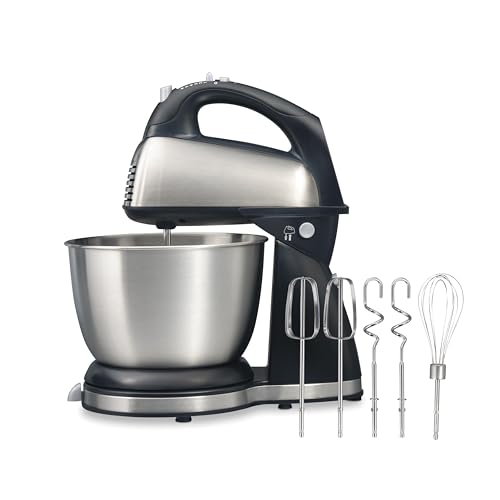
Hamilton Beach Classic Stand and Hand Mixer, 2-in-1, 4 Quarts — Best for Small Kitchens
The 2-in-1 is the space-saver’s answer: a stand mixer whose head lifts off to become a hand mixer for quick jobs, with a 4-quart bowl on the stand for longer ones. It suits small kitchens, first apartments and bakers who cannot justify storing two mixers. It is less suited to heavy dough, where a dedicated stand mixer’s frame and motor have the advantage.
Strengths
- Two tools in one footprint: stand mixing for batches, hand mixing for quick jobs
- QuickBurst boost carries over from Hamilton Beach’s hand mixer line
- Stand locks the mixer head steady for hands-free creaming and whipping
Trade-offs
- Peak-power rating flatters it; sustained heavy dough is beyond its brief
- Stand is lightweight and can shift under load if not on a dry counter
- Jack-of-all-trades design means the stand function trails dedicated models
| Motor | 290 watts peak power |
| Bowl | 4 quart |
| Speeds | 6, plus QuickBurst |
| Design | 2-in-1: stand mixer with detachable hand mixer head |
Compromise products usually fail at both jobs; this one succeeds because the two jobs share so much. The mixer head is a full Hamilton Beach hand mixer — six speeds, QuickBurst, bowl rest — and the stand simply holds it at the right angle over a bowl that rotates for coverage. For creaming butter, whipping cream and mixing cake batter, the stand does the holding while you add ingredients with both hands, which is the actual luxury a stand mixer sells.
Where the compromise shows is at the extremes. Stiff dough will slow it and walk the lightweight stand, and the bowl is not the deep, fixed bowl of a dedicated machine. But for the small kitchen that would otherwise own only a hand mixer and a tired arm, the 2-in-1 adds real hands-free mixing for very little money or space. Judge it as a hand mixer that gained a stand, and it is excellent value.
Small kitchens are where kitchen mixers go to be regretted, and this is the one designed for the reality: one box on one shelf that creams, whips and mixes in both modes. If your kitchen has taught you that every appliance must earn its shelf twice, this is your pick.
Best for: small kitchens and first apartments needing both formats in one footprint / Not suited for: heavy dough bakers who need a dedicated stand mixer’s frame
Check the current price on Amazon
Comparison Table
The table compresses the six picks into the facts that decide most kitchen mixer purchases: the badge, the key specification behind it, and the kitchen each one belongs in. Shortlist from the table, then read the full reviews of your shortlist.
| Pick | Badge | Key spec | Best for |
|---|---|---|---|
| KitchenAid Classic Series 4.5 Quart Tilt-Head Stand Mixer (K45SS) Check on Amazon | Best Overall | 4.5-qt tilt-head, 10 speeds, metal construction | Regular bakers furnishing a kitchen for the long term |
| Hamilton Beach 4 Quart Electric Stand Mixer, 7 Speeds Check on Amazon | Best Budget Stand Mixer | 300W, 7 speeds, planetary action, full attachment set | First-time stand mixer buyers equipping a kitchen on a budget |
| Cuisinart Precision Master 5.5-Quart Stand Mixer (SM-50) Check on Amazon | Best Capacity | 5.5-qt bowl, 12 speeds, die-cast metal body | Families and batch bakers whose recipes outgrow 4-quart bowls |
| Aucma Stand Mixer, 6.5-Qt, 660W Tilt-Head Check on Amazon | Best Big-Bowl Value | 6.5-qt bowl, 660W motor, lowest cost per quart | Large households and batch bakers who need the biggest affordable bowl |
| Hamilton Beach 6-Speed Electric Hand Mixer with Easy Clean Beaters (62639J) Check on Amazon | Best Hand Mixer Option | 275W motor, easy-clean beaters, full attachment set | Kitchens without stand-mixer space that still need a full mixing range |
| Hamilton Beach Classic Stand and Hand Mixer, 2-in-1, 4 Quarts Check on Amazon | Best for Small Kitchens | Mixer head detaches for hand use, 290W peak power | Small kitchens and first apartments needing both formats in one footprint |
How to Choose a Kitchen Mixer: Bowl Size, Head Design and Mixing Action
Start with mixing action, because it is the divide that cannot be fixed later. A stand mixer needs planetary action — the beater orbiting the bowl while it spins — to reach the bowl’s edges; without it, a ring of unmixed batter survives every mix and you become the mixing action, spatula in hand. Every stand pick in this guide has true planetary action, and any model you consider outside this guide should be checked for it by name. Next, bowl size. A 4- to 4.5-quart bowl covers standard recipes: one cake, one batch of cookies, one loaf. A 5.5-quart bowl adds comfortable double batches of cookies and cakes. A 6.5-quart bowl is for households that cook in volume. Bigger is not automatically better — an oversized bowl mixes small quantities badly, because the beater cannot reach a thin layer spread across a wide base — so size the bowl to your typical batch, not your biggest ever.
Head design is the third decision. Tilt-head mixers lift the head back for easy bowl and beater access and easy additions, but they need vertical clearance to open — measure under your cabinets with the head raised, not closed. Bowl-lift mixers crank the bowl up to a fixed head, stay steadier under dough, and fit under low cabinets, at the cost of slightly fussier bowl handling. Most home kitchens are happier with a tilt-head; dedicated bread bakers are the exception. Finally, attachments: the core set is flat beater, whisk and dough hook, and a powered hub for future attachments is a genuine differentiator if you can see yourself rolling pasta or grinding meat in two years’ time. If you cannot, do not pay for the hub — pay for bowl and build instead.
Setting a Sensible Budget for a Kitchen Mixer
A kitchen mixer is one of the few appliances where the cheap, middle and premium tiers are all rational purchases for somebody, which is why “affordable” needs framing rather than a number. The budget tier — the Hamilton Beach stand mixer and the hand mixer pick here — buys correct mixing and complete kits, and trades away longevity and refinement. The entry tier of the established brands — the KitchenAid Classic and Cuisinart SM-50 — buys metal construction and decade-scale service, and is where most serious home kitchens should aim. Above that sit larger, stronger and prettier machines whose extra capability most households will never use.
The discipline is to price the whole purchase, not the box. A mixer that needs a whisk bought separately, a second bowl for back-to-back recipes, or a replacement in four years costs more than its sticker suggests. Conversely, a complete-kit budget mixer that serves a light workload for years is genuinely cheap. Decide your workload first — how often, how much, how much dough — then buy the tier that matches it, and check the current price on Amazon for the exact finish you choose, because kitchen mixer pricing swings hard with sales events and colour.
Kitchen Mixer Attachments, Explained Honestly
Three attachments do nearly all kitchen mixing, and understanding them prevents most buying confusion. The flat beater is the workhorse: it creams butter, mixes batters and mashes potatoes by pushing mixture against the bowl in a broad, even action. The wire whisk is the air specialist: its many thin wires slice through liquid and trap air, which is why it — and only it — should whip cream and egg whites; using a flat beater for whipping works slowly and splashes, and using a whisk for thick batter strains its wires. The dough hook is the kneader: shaped to push dough down and stretch it rather than tear it, it works at low speeds and should be used for dough and nothing else. Every pick in this guide includes all three, because a kitchen mixer missing one of them is missing a third of its job.
Beyond the core three, attachments divide into the useful and the decorative. A splash guard or pouring shield earns its place in any kitchen that adds flour to a running mixer. A flex-edge beater, which scrapes the bowl as it turns, is a genuine upgrade for cake bakers. Hub attachments — pasta rollers, grinders, slicers — are a separate purchase decision about a separate hobby, and they only exist for mixers with a powered hub. Buy the core three in the box, add the shield if it is missing, and let everything else wait until a recipe actually demands it.
How to Set Up and Use a Kitchen Mixer Properly
A kitchen mixer rewards ten minutes of setup and a few habits more than any accessory. Work through these steps when your mixer arrives and at the start of any serious baking session.
- Place it where it will live. Stand mixers get used in proportion to how little they need to be moved. Give yours a permanent spot with clearance for the head or bowl lift, near an outlet, on a dry, level surface — a walking mixer is usually a wet-counter problem.
- Check the beater-to-bowl clearance. The beater should pass close to the bowl’s bottom without striking it. Most stand mixers have an adjustment for this; if your mixes leave a layer unmixed at the bottom, or the beater clinks the bowl, consult the manual and adjust before your first big bake, not during it.
- Learn the speed map before you need it. Slow speeds stir and fold, middle speeds cream and mix, high speeds whip. The mixing guide that comes with your machine maps tasks to speeds — tape it inside a cupboard door for the first month.
- Add flour through the shield, in stages. Use the splash guard or pouring shield for dry additions, add a third at a time at the lowest speed, and let each addition disappear before the next. This one habit eliminates most mixer mess and most overmixed cakes.
- Knead at the maker’s dough speed, usually low. Dough hooks work at low speeds; higher speeds overheat motors and throw dough. Watch the first knead fully so you learn what your machine sounds like when it is working versus straining.
- Scrape once, halfway. Even planetary action leaves a film at the very bottom of the bowl. One deliberate stop-and-scrape per batter keeps texture even without overmixing.
- Wash and dry attachments straight away. Stainless bowls and most attachments in this guide are dishwasher-friendly, but coated beaters and hooks last longer washed by hand. Dry the bowl’s exterior base and the mixer’s hinge area, where batter migrates and hides.
Maintenance after that is minimal: keep the vents clear, store the cord loosely rather than wound tight, and run the machine empty for a few seconds if it will sit unused for months. A kitchen mixer asks very little, which is part of why a good one becomes the most-loved machine in the room.
Common Buying Mistakes
Buying the biggest bowl for the smallest batches
An oversized bowl is a real handicap for small quantities: two egg whites or a half-batch of frosting spread thin across a wide base, below the whisk’s effective reach. Size the bowl to your typical batch. Households that mostly cook for two are better served by a 4-quart machine that handles their daily quantities beautifully than by a cavernous bowl that only shines twice a year.
Measuring the mixer closed, not open
Tilt-head mixers need their height plus the head’s swing to open under cabinets; bowl-lift models need room to raise the bowl and remove it. Measure your intended spot in the working position, and check the door swing of the cupboard above while you are at it. A mixer that cannot open where it lives will be carried to an island forever — or returned.
Paying for an attachment hub you will never use
The hub is a wonderful feature for cooks who will genuinely roll pasta, grind meat or mill grain with their mixer. For cooks who will not, it is money spent on a capped hole. Be honest about which cook you are; the Cuisinart in this guide trades the hub for bowl and build, and for many kitchens that is the smarter trade.
Assuming wattage predicts dough performance
Dough performance comes from gearing, frame stiffness and motor design working together, and makers measure wattage differently enough that cross-brand comparisons mislead. A mixer that walks, flexes and slows on your dough is underbuilt for it regardless of the number on the box. The reviews above flag dough capability pick by pick; trust that over arithmetic.
Forgetting the second-bowl reality of batch baking
If you bake in sequence — cake, then frosting, then a second cake — you will wash the same bowl repeatedly or wish for a second one. Some bakers should price a spare bowl into the purchase from the start, especially for the proprietary-bowl models. It is a small cost that removes the most common rhythm-breaker in batch baking.
Final Recommendation
Furnish a kitchen once, properly, with the KitchenAid Classic — Best Overall Check the current price on Amazon — if the budget allows, because it is the machine least likely to be replaced. If it does not, the Hamilton Beach stand mixer — Best Budget Stand Mixer Check the current price on Amazon — delivers correct planetary mixing and a complete kit at the affordable tier’s floor. Families should look hard at the Cuisinart SM-50’s bowl, volume cooks at the Aucma’s capacity, space-pressed kitchens at the hand mixer and 2-in-1 picks — each is the right kitchen mixer for the kitchen it was badged for.
- KitchenAid Classic Series 4.5 Quart Tilt-Head Stand Mixer (K45SS) — Best Overall: Check the current price on Amazon
- Hamilton Beach 4 Quart Electric Stand Mixer, 7 Speeds — Best Budget Stand Mixer: Check the current price on Amazon
- Cuisinart Precision Master 5.5-Quart Stand Mixer (SM-50) — Best Capacity: Check the current price on Amazon
Related guides in this series: Best Affordable Mixers Best Affordable Hand Mixers Best Affordable Electric Mixers Best Affordable Mixers For Baking Best Affordable Mixers Bed Bath And Beyond
Frequently Asked Questions
What size kitchen mixer do most households need?
A 4- to 4.5-quart stand mixer covers the standard repertoire — cakes, cookies, single loaves, frostings — for most households. Step up to 5.5 quarts if you regularly double cookie and cake batches, and to 6.5 quarts only if you routinely cook in volume, because oversized bowls mix small quantities poorly.
Tilt-head or bowl-lift: which is better?
For most home kitchens, tilt-head: easier bowl handling, easier additions, friendlier day to day. Bowl-lift wins for dedicated bread bakers, because the fixed head stays steadier under dough, and for kitchens with low cabinets, because nothing needs to tilt. Choose by your dough habit and your cabinet height.
Can a kitchen mixer replace a food processor or blender?
Only partly, and only with attachments. A stand mixer’s hub can drive grain mills, pasta rollers and grinders on models that have one, but mixing, processing and blending are different actions: a mixer will not chop like a processor or crush ice like a blender. Buy the mixer for mixing, and treat any overlap as a bonus.
How long does a kitchen mixer last?
Metal-bodied models from the established brands are decade-scale appliances with ordinary care. Budget stand mixers are built for regular, lighter duty and should still give years of service if their dough limits are respected. The biggest longevity factor is matching the machine to the workload — chronic overloading shortens any mixer’s life.
Is a hand mixer enough for a kitchen?
For kitchens whose mixing is batters, frostings, whipped cream and potatoes — which is most kitchens, most weeks — yes, completely, and the hand mixer pick in this guide covers that range with a full attachment set. The stand mixer becomes necessary when dough, double batches or hands-free working enter your routine.
What should I make first to learn my new mixer?
A simple cake or a batch of cookies: the full sequence of creaming, adding eggs, folding flour and scraping once teaches you the speed map, the bowl’s behaviour and the beater clearance in one bake. Whipped cream is the second lesson — it teaches the top speeds and the value of stopping early.

